What's inside
- Key Takeaways
- Quick Picks
- What did we look for in a machine this small?
- How the six compact picks stack up
- What can a compact machine actually sew well?
- How do you get tidy seams from a very small machine?
- Where should a compact machine live when it is not sewing?
- Slip-ups that make small machines seem worse than they are
- Which projects should a new compact owner sew first?
- How does sewing on a mini change your technique?
- What should you check in the first week with a new compact machine?
- When is a compact machine the wrong purchase entirely?
- How long do compact machines last, and what wears first?
- What accessories are worth adding later?
- Can a compact machine teach a household to mend again?
- How do the kit bundles compare with buying notions separately?
- What is the realistic upgrade path from a compact machine?
- Why does the slow speed deserve more respect than it gets?
- Final Recommendation
- Frequently Asked Questions
- Related Guides
As an Amazon Associate I earn from qualifying purchases. This post may contain affiliate links at no extra cost to you.
cottageverdict.com is reader-supported. When you buy through links on our site, we may earn an affiliate commission.
A compact sewing machine is a promise about where sewing fits in your life: on the end of the kitchen table, in a closet between uses, in a dorm room, in a caravan cupboard. The best compact sewing machines keep that promise without shrinking the actual work into toy territory — they sew real seams in real fabric, then disappear into storage the size of a shoebox. The six picks below are all small electric machines aimed at beginners, repairs, and crafts, and they separate on honest details: how many stitches the listing actually names, whether an extension table steadies bigger pieces, how the machine is powered, and how complete the included kit is on the day the box opens.
Where do you buy a machine like this without surprises? Start by deciding which of the six situations in this guide sounds like your household, because the right compact machine for a caravan is a puzzling gift for a dressmaking student, and the fullest craft kit is wasted on a home that only ever shortens curtains. A clear brief makes the listings easy to read and the choice almost obvious. These are lightweight parcels, so ordering is simpler than with full-size equipment — but read the listing as carefully as you would a bigger purchase. The title is your packing list: it tells you whether a foot pedal is included, whether the machine runs on batteries or needs an outlet, and how many kit pieces are marketing garnish versus genuinely useful. Order the exact configuration named in the title, keep the pedal and adapter together in the storage drawer or a labeled pouch from day one, and photograph the box contents before the packaging goes out, because small accessories wander faster than any other kind in a household.
Key Takeaways
- Every pick here is a small electric machine for repairs, crafts, and beginner projects — none of them pretends to be a dressmaker’s main machine.
- Stitch counts in the listings run from twelve to sixteen; for mending and simple makes, the difference matters less than a steady feed and a working reverse.
- Two picks include an extension table, which is the single accessory that most improves results on pieces larger than the machine’s own bed.
- The Rxmeili can run on batteries or plug-in power, making it the true sew-anywhere option in the group.
- Kit size varies from a thread set to a 57-piece bundle; a complete kit on day one beats a bare machine and a shopping list.
Quick Picks
| Model | Fits best in | Reason it earned a spot |
|---|---|---|
| Portable Sewing Machine for Beginners (Compact Electric, 12 Stitches) | A first sewing corner | Twelve stitches, reverse sewing, an LED light, an extension table, and a 32-color thread kit in one box. |
| Portable Mini Sewing Machine (14 Stitches, Extension Table) | Small flats and dorms | Fourteen stitches with dual-speed control and a complete kit for clothing repair and hobby projects. |
| Portable Mini Electric Sewing Machine (12 Stitches, 2 Speed) | The repair drawer upgrade | Twelve stitches, two speeds, a foot pedal, and an accessories kit aimed squarely at quick home repairs. |
| Best Choice Products 55-Piece Beginner Sewing Machine Kit | Gift-ready craft starts | Sixteen stitch patterns with double stitching, a storage drawer, and 55 pieces in a sage and silver finish. |
| Portable Mini Electric Sewing Machine with 57-Piece Kit | Craft tables that clear nightly | The largest kit here plus a two-speed drive, foot pedal, and extension table for DIY projects. |
| Rxmeili Portable 12-Stitch Sewing Machine | Caravans, boats, and spare rooms | Battery or plug-in power, two speeds, a sewing light, and a storage drawer in a pink mini format. |
What did we look for in a machine this small?
Honesty about scale came first. A compact machine earns its keep on hems, seams, patches, tote bags, cushion covers, and the endless small repairs of a household — and it fails its owner when it is marketed as a shrunken dressmaking station. We favored listings that state their stitch counts plainly, include the pedal rather than assuming your hand will do, and describe their kits in countable pieces. Machines that named an extension table scored well because supporting the fabric is where small machines most visibly struggle.
Power arrangements mattered more than we expected. Most of these machines are plug-in electrics, one runs a compact 6V design, and one offers battery operation as a genuine alternative — a distinction that decides whether the machine can sew at a market stall, in a caravan, or during a power cut. Speed control mattered too: beginners on small machines need a slow gear far more than they need a fast one, and the two-speed and dual-speed listings acknowledge that learning happens at half pace.
We also weighed the first-week experience. A compact machine is often a first machine, and the difference between a hobby that sticks and a box that goes back in the closet is usually the first three projects. Thread included, bobbins included, a pedal included, instructions that assume nothing — those inclusions are not garnish. They are the difference between sewing on Saturday and shopping again on Saturday. Every pick below was chosen with that first week in mind, and the verdicts say which kind of beginner each one suits.

Portable Sewing Machine for Beginners (Compact Electric, 12 Stitches) — A first sewing corner
This is the most complete starter proposition in the group, and the listing reads like someone thought about a beginner’s actual first month. Twelve built-in stitches cover the honest essentials — straight for seams, zigzag for edges and knits, and the utility patterns that handle most repairs. Reverse sewing is named, which matters more than any decorative stitch because locking a seam’s ends is what separates sewing from temporary stitching. An LED light puts brightness at the needle where a small machine’s shadow would otherwise hide the seam line, and the extension table gives quilting cotton and curtain panels somewhere to rest instead of dragging off a tiny bed.
The 32-color thread kit deserves a balanced word. Thirty-two colors will not all match your fabric, and serious sewers buy thread by the project — but for crafts, visible topstitching, kids’ projects, and learning what thread weight does to a seam, a rainbow in the box is a genuine head start. Taken together, this pick suits the beginner who wants one purchase to carry them from first hem to first simple garment without an accessories order in between. It is also the compact pick we’d hand to a parent setting up a teenager’s first sewing corner: everything present, nothing intimidating, and a table that makes the work feel real.
- Stitch library: 12 built-in stitches, as given in the listing title
- Named functions: reverse sewing and LED light, per the listing title
- Work surface: extension table included, per the listing title
- In the box highlight: 32-color thread kit for home crafts and repairs
- To order this compact electric model: check price on Amazon, where the thread kit and table are part of this listing’s bundle
Strengths
- Extension table included — rare at this size and genuinely useful
- Reverse sewing named, so seams can be locked properly from day one
- Thread kit removes the first extra purchase beginners forget
Trade-offs
- Twelve stitches is an essentials library, not a creative wardrobe
- Thread kit colors favor crafts over exact garment matching
- Still a mini format; thick denim stacks are beyond its design
Best for: first-time sewers who want a complete, confidence-building start. Not suited for: anyone planning layered heavy fabrics or garment production.

Portable Mini Sewing Machine (14 Stitches, Extension Table) — Small flats and dorms
Fourteen stitches and an extension table is a thoughtful combination for a mini, because it pairs a slightly wider utility range with the surface support that lets you actually use it. The listing emphasizes easy setup for clothing repair, DIY crafts, and hobby projects, and that ordering of jobs is honest: this is a machine for keeping a wardrobe alive and making small things well. Dual-speed control is the feature beginners will feel most — the slow setting turns first seams from a wrestling match into a guided exercise, and confidence built at low speed transfers to everything sewn afterward.
The complete sewing kit rounds out the dorm-room logic. In shared or temporary housing, a machine that arrives with its kit complete avoids the slow bleed of borrowed scissors and missing bobbins that kills small-space hobbies. Keep it in its box or a tote, sew at the table you eat at, and put it away in minutes. Students mending clothes between terms, flat-sharers fixing curtains and cushion covers, and crafters who sell small makes at weekend markets will all recognize their workflow in this pick. What it will not do is grow into a dressmaking practice — and readers who suspect they are headed that way should compare the fuller-size options in our guide to Best Mechanical Sewing Machines for Quilting, where the work surfaces and fabric handling step up a class.
- Stitch library: 14 stitches, as stated in the listing title
- Work surface: extension table included, per the listing title
- Speed handling: dual-speed control named in the listing title
- Kit: described as a complete sewing kit in the listing title
- For this 14-stitch mini: check price on Amazon and look for the extension table in the listing’s contents
Strengths
- Dual speeds make the learning curve noticeably kinder
- Extension table supports projects bigger than the machine
- Complete kit suits temporary and shared living spaces
Trade-offs
- Mini bed still limits how quilts and large panels are handled
- Fourteen stitches covers utility well, decoration lightly
- Not the machine for thick or multi-layer assemblies
Best for: students, flat-sharers, and repair-focused hobby sewers. Not suited for: quilters or garment sewers ready for a full-size bed.

Portable Mini Electric Sewing Machine (12 Stitches, 2 Speed) — The repair drawer upgrade
Some households do not need a hobby; they need the rip in the school uniform fixed tonight. This mini electric is aimed at that household with unusual precision: twelve built-in stitches, two speeds, a foot pedal, and an accessories kit, with the listing naming home quick repairs first among its purposes. The foot pedal matters here more than in any other pick, because repair sewing is stop-start work — a few centimeters, check, a few more — and pedal control keeps both hands free to steer a pocket corner or a strap back into place.
Two speeds sound modest until you sew a curve on a child’s costume at full tilt and understand why the slow gear exists. Beginners and occasional sewers alike do their neatest work at the lower setting, and the higher one is there for long straight hems once the line is established. As a gift, this is the configuration we would choose for a new homeowner or a parent leaving for a first flat: it assumes no existing sewing supplies, no prior skill, and no dedicated space — three assumptions that happen to describe most of the people who receive sewing machines as gifts.
- Stitch library: 12 built-in stitches, as shown in the listing title
- Speed handling: 2-speed operation, per the listing title
- Control: foot pedal included, per the listing title
- Kit: accessories kit included for repairs, crafts, and gifts
- Picking up this mini electric: check price on Amazon — the pedal and accessories kit are named in this listing
Strengths
- Pedal control suits stop-start repair work perfectly
- Two speeds protect beginners from runaway seams
- Positioned honestly for quick repairs rather than oversold
Trade-offs
- No extension table named, so large pieces need table-edge improvisation
- Twelve stitches is a working minimum, not a playground
- Occasional-use design; daily heavy sewing wants a bigger machine
Best for: repair-focused households and gift buyers equipping a first home. Not suited for: crafters planning large or layered projects.

Best Choice Products 55-Piece Beginner Sewing Machine Kit — Gift-ready craft starts
Best Choice Products sells this machine as a kit first and a machine second, and for its intended buyer that ordering is correct. Sixteen built-in stitch patterns is the widest library in this compact group, and the listing adds double stitching — a reinforced pass that gives beginner seams on bags and craft projects a sturdier finish. The 55-piece kit wraps the machine in the supporting cast a new sewer otherwise assembles over months of small orders, and the storage drawer keeps the smallest of those pieces from migrating into the household junk drawer, from which sewing notions rarely return.
The sage and silver finish and the compact 6V design point at its real habitat: a craft shelf, a teen’s desk, a spare-room corner where a machine that looks pleasant gets used more than a machine that looks like equipment. There is no shame in that logic — the best compact machine is the one that is out of its box. Crafters making bunting, simple bags, scrunchies, doll clothes, and personalized gifts will find sixteen patterns plenty to explore, and the double-stitch option gives tote straps and handles a better chance of surviving their loads. What this pick does not promise is garment construction at scale, and its compact format should be read as a craft tool with sewing range, not a dressmaker in disguise.
- Stitch library: 16 built-in stitch patterns, the widest in this group
- Named function: double stitching, per the listing title
- Power design: compact 6V design, as stated in the listing title
- Storage: built-in storage drawer; kit totals 55 pieces
- Ordering the Best Choice Products kit: check price on Amazon for the sage and silver configuration
Strengths
- Sixteen patterns give beginners the most room to experiment here
- Double stitching reinforces craft seams that take strain
- Storage drawer keeps the 55-piece kit together between projects
Trade-offs
- Craft-first design; garment ambitions will outgrow it
- No extension table named in the listing
- Kit breadth favors variety over depth in any one notion
Best for: craft beginners and gift buyers who want the fullest starter bundle. Not suited for: sewers whose projects are mainly clothes for adults.

Portable Mini Electric Sewing Machine with 57-Piece Kit — Craft tables that clear nightly
The headline number here is fifty-seven: the largest sewing kit in this roundup, wrapped around a two-speed mini electric with a foot pedal and an extension table. That combination — big kit, pedal control, extra work surface — makes this the pick for the crafter whose table must return to being a dining table by six o’clock. The extension table assembles the workspace up; the kit means the project never stalls for a missing notion; the pedal keeps hands on the fabric; and at the end of the session everything packs back down to a shelf.
Two-speed operation and an easy-sewing positioning suit the way craft projects actually go: careful starts, a burst down the long edge of a cushion cover, a slow negotiation around a corner. The listing names DIY crafts, home sewing, and repairs as its territory, and within that territory this is arguably the most complete single purchase of the six. Readers whose ambitions lean toward decorated work — names on stockings, motifs on tote bags — will eventually want a machine that sews and embroiders in one frame, and our overview of Best Professional Embroidery Machines shows where that road leads; for everyone else, this mini covers the map most households actually travel.
- Kit size: 57-piece sewing kit, the largest in this group
- Speed handling: 2-speed operation, per the listing title
- Control and surface: foot pedal and extension table both named in the listing title
- Stitch count: not set out in the listing title — confirm the number on the product page before ordering
- For the 57-piece kit model: check price on Amazon, where the extension table is listed among its components
Strengths
- Most complete out-of-box package in the roundup
- Extension table plus pedal gives real project control
- Two speeds suit the rhythm of craft sewing
Trade-offs
- Stitch count unstated in the title, so check before buying
- Kit quantity still cannot substitute for project-specific notions
- Mini format caps fabric weight and project scale
Best for: crafters in shared spaces who need everything in one box. Not suited for: buyers who want a stated stitch library before anything else.
Rxmeili Portable 12-Stitch Sewing Machine — Caravans, boats, and spare rooms
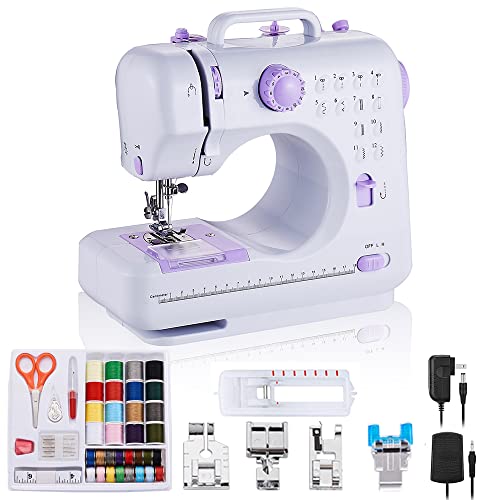
The Rxmeili’s defining line in its listing is the power choice: battery or plug-in. That single flexibility rearranges where sewing can happen — a caravan awning, a boat cabin, a garden shed without a spare socket, a market stall where a hem needs fixing before the gates open. Twelve stitches and two speeds cover the repair-and-craft repertoire, the sewing light keeps the needle area visible in the dim corners where portable sewing tends to happen, and the storage drawer keeps bobbins and feet with the machine instead of in a separate bag that gets left at home.
The 42-piece kit and the pink mini format complete a pick that knows exactly what it is: the machine you take with you. Costume parents at competitions, narrowboat dwellers, festival repair volunteers, and grandparents who sew at whichever grandchild’s house needs curtains shortened will all find the logic familiar. Battery operation does ask for a supply of spares and a realistic sense of how much sewing a set of cells delivers, so heavy users will plug in when they can and save the batteries for the places only batteries can go. Judged as a travel and backup machine rather than a household’s only machine, it is the most distinctive pick in this guide.
- Stitch library: 12 stitches, as stated in the listing title
- Power: battery or plug-in operation, per the listing title
- Speed handling: 2 speeds; foot pedal included
- Extras named in the title: sewing light, storage drawer, 42-piece kit
- Taking home the Rxmeili portable: check price on Amazon for the pink configuration with its kit
Strengths
- Battery option frees it from the wall entirely
- Light and drawer suit sewing in improvised spaces
- Complete 42-piece kit travels as one package
Trade-offs
- Battery sewing needs spare cells for long sessions
- Twelve stitches and a mini bed limit project ambition
- Pink finish will not suit every buyer or gift recipient
Best for: travelers, caravan and boat owners, and anyone needing a backup machine. Not suited for: a household’s one and only machine for garment sewing.
How the six compact picks stack up
| Model | Stitches per its listing | Surface help | Power story |
|---|---|---|---|
| Portable Sewing Machine for Beginners (12 Stitches) | 12 | Extension table included | Plug-in electric |
| Portable Mini (14 Stitches) | 14 | Extension table included | Plug-in electric, dual-speed |
| Portable Mini Electric (2 Speed) | 12 | No table named | Plug-in electric, foot pedal |
| Best Choice Products Kit | 16 patterns | Storage drawer | Compact 6V design |
| Portable Mini Electric with 57-Piece Kit | Not stated in title | Extension table included | Plug-in electric, 2-speed |
| Rxmeili Portable | 12 | Storage drawer | Battery or plug-in |
What can a compact machine actually sew well?
More than skeptics assume, provided the fabric respects the format. Quilting cotton, linen, light denim in single or double layers, fleece, jersey with the right stitch, curtain fabrics, and craft felt all pass happily under these machines. Hems on trousers and skirts, seams on cushion covers and tote bags, patches on knees and elbows, simple curtains, bunting, aprons, and drawstring bags by the dozen — that is the genuine repertoire, and it covers most of what a household asks of sewing in a year. The extension-table picks extend the repertoire by keeping larger pieces level, which is why quilters making small wall hangings and table runners often start compact and only upgrade when quilt size, not stitch quality, outgrows the bed.
The boundaries are equally clear. Multiple layers of heavy denim, canvas straps under load, upholstery assemblies, and leather will defeat motors and feed systems of this size, and forcing them produces the broken needles and chewed seams that give small machines a bad name. Work within the repertoire and a compact machine is not a compromise at all — it is the correctly sized tool. The same realism applies to refreshments during a long craft afternoon, incidentally; readers who sew in the kitchen may enjoy our notes on Best Cold Brew Coffee Machines for the counter’s other small appliance.
How do you get tidy seams from a very small machine?
Support the fabric, slow down, and let the machine feed. Most wavy seams on compact machines come from the sewer pushing or pulling the work, or from a heavy piece dragging off the little bed and steering the line — which is why the extension-table picks punch above their size. Start on the slow speed, keep the fabric flat with both hands resting lightly either side of the foot, and sew a practice line on a folded offcut before touching the real piece. Backstitch or use the reverse function at both ends of structural seams; a compact machine’s stitches are perfectly strong when they are locked, and perfectly temporary when they are not.
Needle and thread discipline matters at this scale too. A fresh needle sized for the fabric, thread that matches the fabric’s weight rather than the thickest spool in the kit, and a bobbin wound evenly will prevent most of the tangles beginners blame on small machines. When a nest forms underneath, rethread completely with the presser foot raised — half of all compact-machine faults are threading faults wearing a disguise — and test on the offcut again before returning to the project.
Where should a compact machine live when it is not sewing?
Storage is part of the product at this size. The picks with drawers keep their small pieces corralled; the kit models want to live in their boxes or a single tote so the pedal, adapter, and feet travel together. Keep the machine away from steamy bathrooms and dusty garages, drop a cover or even a pillowcase over it against household dust, and store it threaded or unthreaded consistently so the next session starts without detective work. In homes with small children, the drawer and box storage also keeps needles and pins accounted for — a safety habit worth building from the first project.
Slip-ups that make small machines seem worse than they are
The commonest is asking a mini to sew a maxi job: six layers of denim flat-felled seam will stop any machine in this guide, and the resulting mess gets blamed on the purchase rather than the brief. Next comes sewing at full speed everywhere, when the slow gear would have produced the neat seam the project deserved. Beginners also forget the reverse lock, then watch a tote handle unravel in its first week of service. Finally, kit machines suffer a quiet entropy — pedal in one drawer, adapter in another, bobbins everywhere — until using the machine means a treasure hunt, and the hobby dies of friction rather than failure. A labeled box prevents that entire obituary.
Which projects should a new compact owner sew first?
Sequence matters more than talent in the first month. Begin with straight seams in forgiving fabric: a drawstring bag teaches cutting, pinning, seam allowances, and turning corners without punishing small errors. Move to a cushion cover, which adds a closure and the satisfaction of an object the household uses daily. A simple tote follows, introducing straps — and therefore the reverse lock at stress points, the habit that separates things that last from things that were merely sewn. Only then attempt a garment repair on something you actually wear, because by now the machine’s threading, speeds, and temperament are familiar rather than theoretical.
Each of the six picks handles that curriculum comfortably, and the kit models shorten it further by removing supply errands between stages. What beginners should avoid in month one is anything whose fabric fights the format — slippery linings, stretch jersey garments, thick layered anything — not because the machine cannot touch them at all, but because early projects should teach the sewer, not argue with them. Keep the first month’s offcuts and failures; they become the test bundle you reach for whenever you change needle, thread, or fabric type later, and that little archive of scraps is worth more than any single accessory in the kits.
There is a social dimension worth planning for as well. Compact machines travel to other people’s houses, to craft evenings, to a parent’s kitchen table for a curtain-shortening session. The owners who get the most from this category are the ones who let the machine be social — packed in its tote, kit complete, ready in five minutes on any table. That portability is not a lesser version of a sewing room; for many households it is the only version that fits real life, and it produces a surprising amount of finished work over a year.
How does sewing on a mini change your technique?
A small bed teaches good hands. On a full-size machine, a wide flat surface forgives fabric that wanders; on a compact machine, the sewer becomes the surface, guiding with fingertips close to the foot and supporting the piece’s weight so it neither drags nor floats. That sounds like a limitation and is actually an education — sewers who learn on minis develop an attentive, light touch that transfers beautifully when they later sit at a larger machine. The extension-table picks soften the lesson by restoring some surface, which is why we recommend them for anyone whose projects include pieces wider than a tea towel.
Speed discipline is the second lesson. Compact motors and small feed systems reward the lower gear: stitches form more evenly, corners turn cleanly, and the operator’s steering errors shrink. Several picks here formalize that lesson with two-speed or dual-speed controls, and owners should treat the fast setting as a tool for long, straight, well-supported runs rather than a default. The third lesson is stopping. Small machines invite short sessions — a hem before work, a patch after dinner — and that rhythm, repeated weekly, maintains a wardrobe better than heroic quarterly sewing marathons. Technique, in this category, is mostly the art of many small, neat interventions.
Finally, minis teach respect for preparation. Because there is less power in reserve, ironing a hem before sewing it, pinning or clipping layers so they cannot creep, and choosing the right needle stop being fussy extras and become the difference between a seam that sings and a seam that puckers. None of this is a workaround for a deficient machine; it is ordinary good sewing practice that compact machines happen to enforce. Experienced sewers returning to a mini after years on a large machine often say the same thing: the little machine made them careful again.
What should you check in the first week with a new compact machine?
Unbox against the listing. Count the kit pieces, find the pedal, confirm the adapter, and check that any named extension table is actually in the box while the packaging still exists to settle questions. Thread the machine slowly from the manual rather than from instinct, wind a bobbin, and sew the test trio: straight stitch on folded cotton, zigzag along a raw edge, and a short seam locked with reverse at both ends. Listen to the machine at both speeds; a healthy mini sounds even and unstrained, and any grinding or laboring on two layers of cotton is a conversation to have with the seller immediately, not after the return window closes.
Then sew one real, low-stakes project — the repair that has been waiting in a pile, the bag, the hem — and notice what the experience asks of you. Did the fabric need more support than the bed gives? Did you reach for a stitch the machine does not have? Did the kit lack the one notion the project wanted? Write those answers on a card kept with the machine; they become your personal accessory list, far more accurate than any generic “also buy” roundup. Most owners discover their compact machine covers ninety percent of their sewing life, and the card defines the remaining ten percent honestly — which is exactly the knowledge that should drive any future upgrade.
Register the purchase details somewhere durable, keep the manual with the machine rather than in a household paper pile, and photograph your working threading path once you have it right. Threading is the skill that evaporates fastest between sessions, and a phone photo of a correctly threaded machine has rescued more Sunday-afternoon projects than any troubleshooting guide ever written.
When is a compact machine the wrong purchase entirely?
When the sewing you dream about is structural. If the plan is jeans from raw denim, a tailored coat, upholstery for a sofa, or quilts wider than the bed of any machine here, a compact will frustrate the plan and absorb the blame. The honest signal is fabric: weigh what you intend to sew most. If the answer is layered, heavy, or large in two dimensions, save toward the full-size category and let the compact idea go — or buy the compact knowingly as a repair-and-craft tool alongside a future main machine, which is a perfectly respectable two-machine strategy many households follow.
It is also the wrong purchase when it is bought as a miniature of someone else’s hobby. A compact machine given to a committed dressmaker “for travel” will mostly gather dust unless they genuinely sew away from home; the Rxmeili’s battery freedom is the exception that proves the rule, because it creates genuinely new sewing occasions rather than duplicating existing ones. Buy compact for a compact-shaped life — small rooms, small projects, repairs, crafts, travel — and the category delights. Buy it as a discount substitute for a full-size ambition and it will disappoint precisely the person it was meant to please.
One more honest case: households where nobody will maintain even minimal order. These machines are simple, but they still need their pedal found, their bobbin area brushed out, and their needles changed when dull. If a machine will live in a chaotic cupboard and emerge twice a year covered in dust, the kindest purchase might be a hand-sewing repair kit instead — or the compact bought together with its storage box and a household agreement about where it lives. Tools reward the smallest amount of care disproportionately; they only ask that the care actually happens.
How long do compact machines last, and what wears first?
A compact machine used within its fabric range can serve for years, because its enemies are not hours but abuse: forced thick layers, dull needles left in service, lint packed around the bobbin, and storage in damp or dusty corners. The parts that show wear first are the humble ones — needles, obviously, but also the bobbin area’s cleanliness, the pedal’s cord where it bends, and on battery models the discipline of removing tired cells before storage. None of the listings here state a motor lifespan, and buyers should treat that silence correctly: longevity in this category is a habit, not a specification.
Care is correspondingly simple. Brush the bobbin area after lint-heavy projects like fleece or flannel. Change the needle at the start of any project you care about; needles are the cheapest component in the entire system and the one most responsible for mysterious stitch faults. Keep the machine covered between sessions, store the adapter and pedal with it so no session begins with a search, and run it for a few minutes every month or two even in quiet periods — machines, like their owners, stiffen when ignored entirely. Owners who follow that light routine routinely report that a modest mini outlasted the ambitious sewing plans of the household that bought it, still hemming and patching long after grander hobbies faded.
When faults do appear, diagnose in the order of likelihood: rethread completely, replace the needle, clean the bobbin area, check that the bobbin is wound evenly and inserted in the correct direction, and only then suspect the machine. That sequence, which experienced sewers perform almost without thinking, resolves the overwhelming majority of compact-machine complaints. It is worth writing on the inside lid of the storage box, where a frustrated beginner will actually find it at the moment of need.
What accessories are worth adding later?
Resist the giant generic accessory set; compact machines reward a short, personal list built from real projects. Nearly every owner benefits from a second pack of needles in assorted sizes, spare bobbins that match the machine exactly — bobbin dimensions vary, and almost-right bobbins cause real faults — and a small brush for the bobbin area if the kit lacks one. Fabric scissors that are actually sharp transform cutting from the worst part of sewing into a neutral one, and a tomato-red pincushion is optional but morale is a genuine factor in whether hobbies survive February.
Beyond that, let projects nominate their own accessories. The curtain-maker discovers a long ruler and hem clips; the bag-maker discovers a heavier needle and a walking pace on the slow speed; the quilter of small pieces discovers that the extension table they skipped would have been worth choosing a different pick for. That last discovery is the one piece of forward advice worth taking at purchase time: if your project list already leans toward pieces larger than the machine, choose a pick whose listing includes the table now, because retrofitting support later is improvised at best. Everything else can arrive as the sewing does — which keeps the compact philosophy intact: small machine, small kit, small footprint, real work.
Can a compact machine teach a household to mend again?
Something quietly significant happens when a repair takes ten minutes instead of a trip to a tailor or a replacement order: clothes start lasting longer, and the household’s relationship with its wardrobe changes. A loose button is trivial by hand, but a split seam, a fallen hem, a torn pocket lining — these are the faults that send wearable garments to landfill, and they are exactly the faults a compact machine fixes at the kitchen table while dinner cooks. The picks here were chosen with that quiet revolution in mind: pedal control for stop-start accuracy, reverse to lock the repair, speeds low enough that a nervous beginner cannot outrun their own steering.
The economics follow the ethics. A machine in this class pays for itself against a handful of professional alterations or a few replaced garments, and then keeps paying in the currency of clothes that fit and last. Parents discover that children’s clothes can be let down, patched decoratively, and handed on; students discover that a repaired jacket survives another winter; everyone discovers that mending is a skill with a very short on-ramp when the machine is small, present, and unintimidating. That, more than any stitch count, is the argument for the category — and the reason the best compact machine is the one that lives within reach rather than in a box of good intentions.
How do the kit bundles compare with buying notions separately?
A bundled kit trades selection for immediacy. The 55-piece and 57-piece bundles in this guide, and the thread set in the first pick, put a working palette of notions in the box on day one: enough to start, enough to learn what you actually use, and enough to discover your preferences before spending on quality versions of the three or four items you reach for constantly. Buying separately inverts the trade — slower to start, easier to stall entirely, but every item chosen. For beginners, immediacy usually wins, because the graveyard of hobbies is filled with equipment waiting for one more accessory order.
The mature pattern is hybrid: start with the bundle, sew for a season, then upgrade the workhorses — scissors, needles, the thread colors your projects actually consume — while the rest of the kit continues in honest service. Read kit counts with a calm eye in the meantime. Fifty-seven pieces includes many small and consumable items; that is not deception, it is how notions come. What matters is whether the categories are covered — cutting, measuring, pins or clips, spare bobbins, needles, thread — and on that test the bundles here were chosen because they cover the map rather than inflating a number.
What is the realistic upgrade path from a compact machine?
Most owners upgrade for one of three reasons, and naming yours in advance makes the compact purchase smarter, not sadder. The first reason is size: projects grow — quilts, curtains for a whole house, garments in multiples — and the bed and surface become the ceiling, which is the extension-table lesson arriving at full scale. The second reason is fabric: the sewer falls for denim, canvas, or upholstery work and needs feed power and needle authority a mini cannot offer. The third is features: buttonholes by the dozen, decorative range, or embroidery ambitions that no compact pretends to satisfy.
Notice what is absent from that list: stitch quality on suitable fabric. A compact machine’s straight seam in quilting cotton is a proper seam, and owners who upgrade for size or fabric reasons often keep the mini as their repair and travel machine rather than selling it — the two-machine household again, each tool sized to its work. So buy the compact for the next two years of your actual sewing life, keep its box and kit together, and let it become the household’s permanent mending station even if a larger machine eventually joins it. Judged that way, none of the six picks here is a compromise purchase; each is the founding member of a sewing setup that grows by addition, not replacement.
Why does the slow speed deserve more respect than it gets?
Because nearly every beginner fault is a speed fault in disguise. Seams wander because the fabric moved faster than the steering; corners overshoot because the machine arrived before the pivot was planned; thread nests bloom at starts because the first stitches formed while the sewer was still arranging the work. The two-speed and dual-speed designs in this guide are therefore not training wheels to be discarded but the core control the category offers, and experienced compact owners keep using the slow gear for anything curved, layered, or precious. Treat speed as a setting you choose per seam — the way you choose a stitch — and the little machine’s work improves out of all proportion to its price. The fast gear earns its place on the long straight runs: curtain hems, tote sides, bunting strings. Everything else belongs to the slow lane, where compact machines quietly produce work that surprises people who judged them by their size.
Final Recommendation
Choose by habitat. For a first sewing corner that should just work, the twelve-stitch model with the extension table and thread kit is the most complete start. Shared and temporary spaces suit the fourteen-stitch mini with dual speeds; repair-focused homes should take the pedal-equipped two-speed electric; crafters will get the most exploration from the sixteen-pattern Best Choice kit or the 57-piece bundle with its extension table; and anyone who sews away from a socket should take the battery-capable Rxmeili and never look back. A compact machine chosen for the life you actually live — measured in table space, storage, and the repairs already waiting in a pile — will sew more in its first month than a bigger machine chosen for a life you only imagine, and that is the whole secret of this category: the smallest machine in the house is often the one that gets used, loved, and reached for, while grander equipment gathers the dust it was bought to avoid.
Frequently Asked Questions
Can a compact sewing machine hem jeans?
A single-layer hem in ordinary denim, yes, with a suitable needle and the slow speed. The folded side seams of jeans, where layers multiply, are where compact machines reach their limit; many owners sew the long stretches by machine and finish the thick crossings carefully by hand. If jeans alteration is your main job, a full-size heavy-duty machine is the honest tool.
Are the included thread kits worth anything?
For learning, crafts, and visible stitching, yes — the 32-color set in the first pick and the large kits in others remove the beginner’s first extra purchase. For garments you will wear for years, buy thread matched to the fabric by fiber and weight. Treat kit thread as the practice and craft supply it is, and it will serve you well.
Do I need the extension table?
Not for repairs and small makes, but it is the accessory that most changes what a compact machine can do neatly. Curtains, cushion covers, and quilt blocks all behave better when the fabric rests level instead of falling off the bed. If your projects lean large-for-their-size, favor the three picks whose listings include one.
Battery or plug-in: which is better for a compact machine?
Plug-in power is steadier for long sessions and costs nothing to run. Battery freedom, offered by the Rxmeili here, wins wherever sockets are scarce — caravans, stalls, sheds, and travel. Many owners use both: plugged in at home, batteries packed for away days. Match the choice to where your sewing actually happens.
How many stitches does a beginner really need?
Straight, zigzag, and a stretch stitch will carry a beginner through most repairs and simple makes; everything beyond that is exploration. The twelve-to-sixteen stitch libraries in this guide are honestly sized for the category. What matters more is a working reverse, a slow speed, and a feed that moves fabric evenly — the features these picks were chosen for.
Can children learn on these machines?
With supervision, the slow speeds and small scale make compact machines approachable first teachers, and the craft-focused kits are plainly designed with young makers in mind. Needles and pins still demand respect and adult oversight, and the machine should be stored with its sharp accessories accounted for, as with any household tool. Start young sewers on paper patterns and straight lines in scrap cotton, keep fingers-behind-the-foot as the household rule, and let early projects be small enough to finish in one sitting — a completed bookmark teaches more than an abandoned quilt, and finishing is the habit every later project depends on.
Where do I start if the machine arrives and I feel overwhelmed?
Thread it once, slowly, following the manual page by page, then sew a straight line on a folded scrap and stop. That is a complete first session, and it ends in success. The second session adds zigzag and the reverse lock; the third makes the drawstring bag. Small machines reward small steps, and the kits in this guide mean every step can happen without a shopping trip in between. Within a fortnight of evenings, the machine that looked complicated in its box will feel like what it is: the simplest powered tool in the house.
Related Guides
Compact and portable overlap but are not identical briefs: readers comparing the wider field of carry-anywhere machines should browse Best Portable Sewing Machines next, where full-size portables join the minis in one lineup. Between that guide and this one, most small-space sewing questions find their answer. If your sewing corner later grows a permanent table and your projects grow with it, the mechanical and quilting roundups linked earlier in this article mark the natural next step — and the compact machine that started it all will still be on the shelf, threaded and ready for the repairs that never stop arriving in any household that wears clothes.


