What's inside
- Key Takeaways
- Quick Picks
- How did we decide which machines count as professional?
- Side-by-side: the six professional picks at a glance
- What about service access and spare parts where you live?
- Which matters more for professional work: speed or control?
- What should a professional setup include beyond the machine itself?
- How do you break in and set up an industrial station?
- Mistakes that cost professional sewers real money
- What does a full production day reveal that a test seam hides?
- How should needle and thread choices change on professional machines?
- When does a studio need a second machine instead of a better one?
- What separates professional maintenance from domestic habits?
- How do you cost a professional machine honestly?
- What training do operators need before production work?
- Which fabrics expose a weak professional machine fastest?
- Can a small studio look professional without industrial equipment?
- How should a buyer read a professional machine listing?
- Final Recommendation
- Frequently Asked Questions
- Related Guides
As an Amazon Associate I earn from qualifying purchases. This post may contain affiliate links at no extra cost to you.
cottageverdict.com is reader-supported. When you buy through links on our site, we may earn an affiliate commission.
Professional sewing stops being a hobby with better lighting and becomes a question of throughput: how many seams can you close in a day, on fabric that fights back, without the machine drifting, skipping, or demanding a service visit every season. The best professional sewing machines in this guide split into two honest families. True industrial lockstitch machines — flat-bed heads bolted to a table with a servo motor underneath — sew one stitch perfectly and fast, all day, for years. Semi-professional tabletop machines trade some of that raw endurance for stitch variety, portability between workstations, and a gentler learning curve for staff who rotate tasks. Both families earn their place here; which one belongs in your room depends on whether your work is one seam repeated ten thousand times or fifty different seams repeated two hundred times each.
A note on buying channels before the picks. Industrial heads in this list ship through Amazon marketplace sellers who specialize in equipment, and the listing title tells you exactly what arrives: a head with table and servo motor, sometimes a lamp, and in two cases an explicit warning that assembly is required. Read that title the way you would read a freight quote. Tabletop semi-pro models ship as ordinary parcels and arrive ready to thread. Either way, order against the exact model name and configuration in the listing, keep the dispatch paperwork with your machine records, and confirm the voltage and plug standard for your country before the box leaves the warehouse, because returning a crated industrial table is nobody’s idea of a light errand.
Key Takeaways
- Two of the six picks are genuine industrial lockstitch stations with servo motors and tables; they sew straight seams at production pace and do almost nothing else, by design.
- The Janome HD9 Black Edition and the SINGER Quantum Stylist 9960 cover the semi-professional middle: fast, sturdy tabletop machines for studios that need more than one kind of stitch.
- Brother’s ST150HDH is the toughest generalist here, with fifty stitches in a frame built for fabric that punishes lighter machines.
- Assembly is part of the deal on the industrial picks — one listing says so outright — so budget an afternoon and a second pair of hands.
- Stitch count matters only on the tabletop side; on the industrial side, the motor type, table, and trimmer are the specs that decide your day.
Quick Picks
| Machine | Workshop role | Why it made the cut |
|---|---|---|
| Juki DDL8700 LockStitch Industrial Sewing Machine | Production straight-seam station | The benchmark single-needle industrial head, sold with table, servo motor, and lamp. |
| Janome HD9 Black Edition Professional Sewing Machine | High-speed semi-pro | A professional tabletop machine with automatic thread cutter and a wide extension table for big work. |
| Brother ST150HDH Strong and Tough Sewing Machine | Heavy-duty all-rounder | Fifty stitches in Brother’s Strong and Tough frame for shops that sew everything from shirts to straps. |
| Juki Heavy Material Industrial Straight Stitch Sewing Machine | Thick-material specialist | An industrial Juki head specified for heavy material, supplied with table and servo motor. |
| VEVOR Industrial Lockstitch Sewing Machine (550W Servo) | Budget industrial set | A complete 550W servo lockstitch station rated at 5000 SPM with an automatic thread trimmer. |
| SINGER Quantum Stylist 9960 Computerized Sewing & Quilting Machine | Feature bench for varied work | Six hundred stitches, thirteen feet, and a hard case for studios whose jobs change hourly. |
How did we decide which machines count as professional?
We started by throwing out anything that would embarrass itself on a clock. A professional machine has to hold stitch quality at speed, feed layered material without coaxing, and survive being the only machine in the room that works eight hours a day. That test pushed us toward industrial heads and the strongest tabletop frames, and away from lightweight domestic models dressed up with the word “pro” in their marketing.
Next we separated the list by working style rather than brand. Production sewers who close the same seam all week need a dedicated lockstitch station. Sample rooms, alterations benches, and small-batch studios need versatility with backbone. Teachers and traveling repair specialists need something that moves. You will find all three logics represented below, and the verdict lines under each pick say plainly who should walk past it.
Finally, we only claimed specifications that the manufacturer’s own listing title states. Where a title is silent — presser foot lift, needle system, warranty terms — the spec boxes below say so instead of borrowing numbers from a cousin model. Professional buyers cross-check those details against the manual before committing floor space, and this guide respects that habit rather than papering over it.
Space shaped the shortlist too. An industrial station claims a permanent footprint roughly the size of a small desk, plus knee room for the lifter and clearance behind for bundles of cut work. If your operation rents by the square meter, that footprint has to earn rent every day, which is why the tabletop picks in this guide are not consolation prizes — for a two-person studio above a shop, a fast semi-pro machine on a sturdy bench can be the rational professional choice, and the industrial head becomes the second purchase once order volume justifies dedicating the floor.

Juki DDL8700 LockStitch Industrial Sewing Machine — Production straight-seam station
The DDL8700 is the machine other industrial lockstitch heads get compared to, usually by people standing in front of one that has been sewing since before their apprenticeship started. It does a single thing — a straight lockstitch — and the entire design serves that stitch: a rigid head, an oil bath that keeps moving parts fed at speed, and a servo motor under the table that answers the pedal instantly yet sits silent between seams. In a production setting that silence matters more than visitors expect, because a clutch motor drones all day whether you sew or not, while a servo only draws power when the needle moves.
What you are buying, per the listing title, is a package: the head, a table, a servo motor, and a lamp, explicitly not assembled. Plan the setup as a small project. The head is heavy, the table wants leveling, and thread stand, belt, and motor alignment all reward patience. Once dialed in, though, the 8700 settles into the rhythm garment work actually has — burst, pivot, burst — and holds stitch length steady from the first shirt of the morning to the last one on Friday.
- Configuration from the listing: lockstitch head with table, servo motor, and lamp included
- Assembly state: not assembled — setup time and a helper are part of the purchase
- Top speed: not given in the listing title — confirm the figure in the seller’s documentation
- Needle system and presser foot lift: not stated in the listing title — verify before ordering needles in bulk
- Where to buy the Juki DDL8700: check price on Amazon, and match the table-and-servo configuration line by line before you commit
Strengths
- Servo drive gives instant response with near-silent idling between seams
- Single-purpose design means fewer systems to drift out of adjustment
- Enormous installed base, so mechanics and parts knowledge are easy to find
Trade-offs
- Sews straight stitch only; zigzag or buttonhole work needs a second machine
- Arrives unassembled and occupies a permanent station footprint
- No decorative range whatsoever — it is a tool, not a hobby bench
Best for: production rooms and serious workrooms closing long straight seams daily. Not suited for: anyone who needs stitch variety from a single machine.
Janome HD9 Black Edition Professional Sewing Machine — High-speed semi-pro
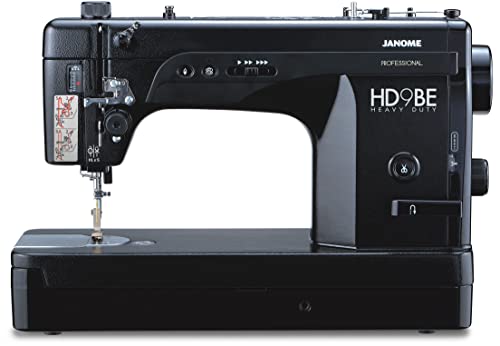
Janome’s HD9 Black Edition occupies the demanding middle ground: a tabletop machine built like it expects to be worked, aimed at professionals whose jobs vary too much for a single-stitch industrial head. Janome labels it a professional machine outright, and the two features the listing names — an automatic thread cutter and a wide extension table — tell you the intended workflow. The cutter trims tails at the end of each seam so piecework moves without scissors in hand; the extension table supports quilts, curtains, and garment sections so fabric weight stops dragging your stitch line sideways.
In practice this is the machine for the one-person studio that does alterations on Monday, a run of tote bags on Wednesday, and a quilt commission on Friday. It sits on a bench rather than owning a station, it can be carried to a classroom or a client’s premises when the job demands, and its straight-stitch focus keeps the feed positive and the seams honest on material that makes decorative machines wander. The black finish is not a performance feature, but in a client-facing studio it does look like it means business.
- Configuration from the listing: professional tabletop machine in the Black Edition finish
- Thread handling: automatic thread cutter named in the listing title
- Work support: wide extension table included, per the listing title
- Stitch library size: not shown in the listing title — check the manual for the exact count
- Ordering note for the Janome HD9 Black Edition: check price on Amazon and confirm the extension table is in the box contents listed
Strengths
- Automatic cutting speeds up repetitive seam work noticeably across a day
- Extension table keeps large pieces supported and stitch lines straight
- Portable enough to move between bench, classroom, and client site
Trade-offs
- Straight-stitch emphasis limits decorative and utility variety
- Still a tabletop machine; all-day industrial volume belongs to a station head
- Extension table needs storage space when the bench is cleared
Best for: solo professionals and small studios mixing garment, bag, and quilt work. Not suited for: factories that need a fixed industrial station per operator.

Brother ST150HDH Strong and Tough Sewing Machine — Heavy-duty all-rounder
Every workroom has one machine that gets handed the jobs nobody planned: the canvas repair, the strap that needs bar-tacking down, the costume with four fabric types in one seam. The ST150HDH is built for that role in Brother’s Strong and Tough line, and its listing leads with the number that defines it — fifty stitches. That library covers the utility end properly: straight, zigzag, blind hem, stretch stitches for knit repairs, and buttonholes, so the machine can finish a whole garment rather than just its long seams.
Fifty stitches will not impress anyone shopping for embroidery fonts, and that is the point. This is a working tool for alteration benches, wardrobe departments, school costume shops, and rental-repair counters where the next job through the door is unknowable. If your sewing business leans on variety at modest volume — a bridal shop’s in-house alterations desk is a perfect example — the ST150HDH earns its bench space daily. If instead your volume concentrates on one seam type, read the industrial picks above and below this one twice, and if you work from a small footprint, our guide to Best Compact Sewing Machines covers machines built for tight rooms.
- Configuration from the listing: Strong and Tough series tabletop machine
- Stitch count: 50 stitches, as stated in the listing title
- Motor rating and top speed: not set out in the listing title — verify in the product documentation
- Included feet and accessories: not itemized in the listing title — check the box contents on the product page
- Buying the Brother ST150HDH: check price on Amazon, where the Strong and Tough configuration is listed under this exact model name
Strengths
- Fifty-stitch library finishes whole garments without swapping machines
- Strong and Tough framing suits fabric that bullies lighter tabletop models
- Approachable for staff who sew competently but are not machine specialists
Trade-offs
- Not an industrial station; continuous production pace is beyond its brief
- Stitch variety comes with dial-and-menu complexity a pure lockstitch avoids
- Heavy layers still need sensible needle and thread choices from the operator
Best for: alterations benches, wardrobe departments, and varied small-batch work. Not suited for: single-seam production lines running all day.

Juki Heavy Material Industrial Straight Stitch Sewing Machine — Thick-material specialist
Some seams are not hard because they are long but because they are thick: webbing stacks, leather assemblies, padded straps, sail corners, upholstery panels with foam behind the face fabric. This Juki industrial head is specified for exactly that territory — the listing calls it a heavy material machine outright — and it arrives as a proper station, with table and servo motor, assembly required. The distinction between this head and the DDL8700 above is intent: the 8700 is the garment-room generalist, while this machine exists for the work that makes garment machines skip, deflect needles, and chew thread.
Shops that add a heavy-material station usually do it after losing money the other way — a broken needle through a nearly finished bag, a strap seam that wandered at the thickest crossing. A dedicated heavy head changes the economics: the thick jobs get their own setup, their own needles and thread weights, and the garment machines stop being abused outside their design. Upholstery studios, bag makers, marine canvas benches, and leather goods workshops are the natural homes. Everyone else should be honest about how often truly heavy assemblies cross the bench, because a specialized station that idles is expensive furniture.
- Configuration from the listing: industrial straight stitch head for heavy material
- Included station parts: table and servo motor, per the listing title
- Assembly state: assembly required, stated plainly in the listing title
- Maximum material thickness and needle system: not stated in the listing title — confirm both with the seller for your exact stack
- For the Juki Heavy Material machine: check price on Amazon and write to the seller about your thickest seam before ordering
Strengths
- Purpose-specified for heavy material rather than adapted to it
- Servo station format gives controlled starts on thick, unforgiving stacks
- Keeps garment machines free from work outside their design envelope
Trade-offs
- Straight stitch only, on a permanent station footprint
- Assembly and setup fall on the buyer
- Overkill — in cost and space — for shops whose heavy work is occasional
Best for: upholstery, bag, leather, and canvas benches with regular thick assemblies. Not suited for: garment-only rooms or anyone short on floor space.
VEVOR Industrial Lockstitch Sewing Machine (550W Servo) — Budget industrial set
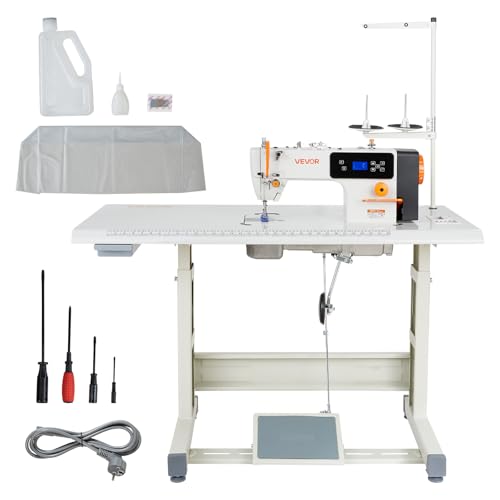
VEVOR’s pitch is completeness at an aggressive price point: a commercial lockstitch set with table stand, a 550W servo motor, a stated 5000 SPM top speed, an automatic thread trimmer, and a metal frame, with denim and cotton named as the working fabrics. On paper that is the full industrial checklist — servo control, production pace, and a trimmer, which is the feature experienced operators miss most when it is absent, because trimming tails by hand at every seam end quietly eats minutes per garment.
The honest framing is value against support. Established industrial brands carry dealer networks and decades of parts catalogues; a value set like this one asks more of the owner — careful assembly, careful adjustment, and self-reliant troubleshooting. For a startup workroom sewing denim goods, aprons, or cotton uniforms, that trade can be entirely rational: the machine opens the door to industrial pace now, and the money saved funds fabric, a second station sooner, or a mechanic’s setup visit. Treat the first week as commissioning, not production, and sew test bundles of your actual material before promising delivery dates against it.
- Configuration from the listing: commercial lockstitch machine set with table stand
- Motor: 550W servo motor, as given in the listing title
- Top speed: 5000 SPM, as stated in the listing title
- Extras named in the title: auto thread trimmer and metal frame; fabrics named are denim and cotton
- Securing the VEVOR lockstitch set: check price on Amazon, noting the table stand is part of this configuration
Strengths
- Automatic thread trimmer included at a value price point
- Servo motor and 5000 SPM rating match genuine production pace
- Complete set — head, motor, and table stand in one order
Trade-offs
- Owner-led assembly and adjustment; dealer support is not the proposition here
- Long-term parts depth is less proven than the legacy industrial brands
- Denim-and-cotton framing suggests staying near its intended fabric range
Best for: startup workrooms and denim or cotton goods makers entering industrial pace. Not suited for: anyone expecting a dealer to install, adjust, and warranty-hold their hand.

SINGER Quantum Stylist 9960 Computerized Sewing & Quilting Machine — Feature bench for varied work
The Quantum Stylist 9960 is the pick that makes old-school industrial operators raise an eyebrow — six hundred stitches, five fonts, thirteen one-step buttonholes — until they watch a sample room work. Sample and development sewing is not production; it is one of everything, constantly: a buttonhole here, a decorative topstitch there, a monogram on a prototype pocket. For that bench, a computerized machine with a deep library, thirteen presser feet in the box, an extension table, and a hard case is not a toy but a time machine, replacing three specialty setups with one footprint.
SINGER also names a metal frame and LED lighting in the title, both of which matter in a working studio: the frame keeps the machine composed at speed, and good light at the needle is a quality-control feature when you are matching thread on dark fabric at the end of a long day. Quilt professionals who piece and finish in the same room will appreciate the extension table for supporting quilts during free-motion work. What the 9960 is not is a production station — if your business closes five hundred identical seams a week, the Juki stations above exist for you, and shops growing into both worlds often pair a feature bench like this with a dedicated machine from our roundup of Best Sewing and Embroidery Machines for decorated work.
- Configuration from the listing: computerized sewing and quilting machine with hard case
- Stitch library: 600 stitches and 5 fonts, as shown in the listing title
- Included extras named in the title: extension table and 13 presser feet
- Buttonholes: 13 one-step buttonholes, as stated in the listing title; frame is metal, lighting is LED
- Getting the SINGER Quantum Stylist 9960: check price on Amazon — the hard case and foot set should appear in the configuration summary
Strengths
- Deepest stitch and font library in this guide by a wide margin
- Thirteen feet and an extension table included from the start
- One-step buttonholes at thirteen styles suit sample and bespoke work
Trade-offs
- Computerized variety is wasted on single-seam production work
- More systems to learn than any other pick here
- Tabletop format still caps true industrial throughput
Best for: sample rooms, bespoke studios, and quilt professionals who finish varied work. Not suited for: production lines that repeat one seam all week.
Side-by-side: the six professional picks at a glance
| Model | Format | Headline spec from its listing | Station or bench? |
|---|---|---|---|
| Juki DDL8700 | Industrial lockstitch | Table, servo motor, and lamp included; ships unassembled | Permanent station |
| Janome HD9 Black Edition | Semi-pro tabletop | Automatic thread cutter; wide extension table | Bench, movable |
| Brother ST150HDH | Heavy-duty tabletop | 50 stitches in the Strong and Tough line | Bench, movable |
| Juki Heavy Material | Industrial straight stitch | Specified for heavy material; table and servo included | Permanent station |
| VEVOR Lockstitch Set | Industrial lockstitch | 550W servo, 5000 SPM, auto thread trimmer | Permanent station |
| SINGER Quantum Stylist 9960 | Computerized tabletop | 600 stitches, 5 fonts, 13 feet, 13 one-step buttonholes | Bench, cased |
What about service access and spare parts where you live?
A professional machine is a relationship with whoever can fix it, and geography quietly shapes which pick is right for you. Legacy industrial heads like the Juki models here are understood by sewing mechanics in nearly every manufacturing town on earth; a competent technician can time, adjust, and source wear parts for them without drama. Newer value stations and computerized tabletop machines lean harder on the seller and the brand’s own parts channel, which works well until a board or a proprietary part is needed quickly during your busiest month. Before buying, find your nearest sewing machine mechanic — they exist in most cities, often behind industrial supply counters — and ask which of these models they see and service. Their answer is local knowledge no review can replicate, and buying the machine your mechanic knows is a legitimate professional strategy.
Which matters more for professional work: speed or control?
New buyers fixate on stitches per minute, and the number is not meaningless — a 5000 SPM station genuinely outruns a domestic machine across a production day. But professional output is seams per hour, and that figure is governed by everything around the needle: how the machine starts, whether it trims its own tails, how the table supports the work, and how calmly the motor behaves at the slow, precise start of a seam. A servo motor that creeps stitch-by-stitch for a strap crossing, then opens up down a long panel, produces more finished work than a faster-on-paper machine that forces the operator to wrestle every start.
Control also shows up in what does not happen. Skipped stitches on a thickness change, thread nests under a seam start, needles deflected at a webbing crossing — each one costs a rip-out and a resew, and resewn work is where professional margins go to die. This is why the heavy-material Juki exists as its own pick rather than as a footnote, and why the trimmer on the VEVOR set is a production feature rather than a luxury. When you cost a machine, cost the rework it prevents.
What should a professional setup include beyond the machine itself?
Budget for the station, not just the head. An industrial setup wants a level table, a task lamp aimed at the needle rather than the room, a thread stand that feeds cones without snagging, and a small stock of the right needle system in several sizes. Add a bobbin winder check, spare bobbins by the dozen, and a maintenance rhythm — oil where the manual says oil, lint removal where the manual says lint — and the machine will repay the attention for years. Tabletop semi-pro setups want a bench that does not flex, because a bouncing table becomes skipped stitches on heavy fabric, plus a surge-protected outlet and a case or cover for dust between sessions.
Lighting deserves its own sentence because two of these listings mention it directly: the DDL8700 package includes a lamp, and the 9960 carries LED lighting at the needle. In both cases the point is inspection — you cannot sell what you cannot see, and seam defects hide in shadow exactly where a tired operator stops looking. Whatever machine you choose, arrange light so the needle area is the brightest spot in the room, and your return rate will quietly improve. Even the break room runs on this logic; a studio that sews all morning tends to gather around something cold by mid-afternoon, which is why our editors also keep notes on Best Coffee Machines for Iced Coffee for the workroom kitchen.
How do you break in and set up an industrial station?
Assemble on a clear floor with the manual open, not from memory of a video. Level the table first, mount the motor and check belt tension, then set the head and route the belt without twists. Oil the machine as directed before the first powered stitch — industrial heads often ship dry or with shipping oil that is meant to be replaced. Wind bobbins, thread the machine, and sew test seams on your actual production fabric, adjusting tension and presser foot pressure in small steps while writing down what you changed. Only when test seams survive a wash, a stretch, and a thickness crossing should real work go under the needle. Keep that test bundle; when quality drifts months later, it is your reference for what correct looked like.
Mistakes that cost professional sewers real money
Buying a domestic machine for production volume is the classic one — it sews beautifully for a month and then wears like a rental car. The mirror mistake is buying an industrial lockstitch for a studio whose work is mostly buttonholes, knits, and decorative finishes, then wondering why every job needs a workaround. A third error is ignoring assembly: two of the industrial listings in this guide state plainly that setup is on you, and a head installed out of level or under-oiled will sew badly enough to convince you the model itself is faulty. Finally, professionals still forget the unglamorous consumables — the correct needle system, thread matched to the fabric weight, bobbins that actually fit — and then blame the machine for faults that arrive in an envelope.
What does a full production day reveal that a test seam hides?
Ten minutes with any machine in this guide will tell you it sews. Eight hours will tell you whether it earns. The first thing a long day exposes is heat and rhythm: industrial heads are designed around continuous duty, with oil circulating to the parts that would run dry and grab in a domestic machine by lunchtime. The second thing is operator fatigue. A servo station that starts gently, trims its own tails, and keeps the work flat on a proper table lets a sewer finish the day with the same stitch quality they started it — and quality at hour seven is the difference between a professional room and a hopeful one.
Tabletop machines reveal a different truth across a long day. Their ceiling is not stitch quality, which can be excellent, but duty cycle and work handling: bundles must be lifted onto a smaller surface, heavy pieces drag against a shorter bed, and the operator becomes the extension table. None of that disqualifies the HD9, the ST150HDH, or the 9960 from professional work — alterations, sampling, and bespoke commissions are stop-start by nature, and the machine rests while the sewer pins, presses, and fits. The professional question is never “is this machine strong?” in the abstract. It is “does this machine’s working rhythm match the rhythm of the jobs I actually sell?” Answer that honestly and the shortlist above sorts itself.
A long day also exposes your consumables system. Professionals keep needles sorted by system and size, thread cones racked by weight and fiber, and bobbins wound ahead in batches, because a production stoppage to wind one bobbin is a small leak that drains money all year. The machines here reward that discipline differently: the industrial heads consume needles and thread at rates that make bulk buying sensible, while the tabletop picks sip from domestic spools and standard bobbins. Whichever format you choose, build the supply shelf at the same time as the station, and the machine will feel faster than its specification sheet promises.
How should needle and thread choices change on professional machines?
Amateur sewing treats the needle as a detail; professional sewing treats it as the cheapest quality-control device in the building. Needle system comes first — industrial heads and domestic tabletop machines use different systems, and a needle that almost fits will sew almost well, which is worse than not sewing at all. Several listings in this guide do not state the needle system in their titles, and that omission is deliberate in our spec boxes: confirm the system with the seller, write it on a card taped to the machine, and never let a mixed needle drawer develop.
Size and point follow the fabric. Fine garment work wants a smaller needle with a point that slips between yarns; denim and canvas want a stouter needle that will not deflect at seam crossings; leather and coated materials want points designed to cut rather than pierce. Thread weight must match the needle’s eye and the fabric’s expectations — heavy thread through a fine needle shreds, fine thread in a webbing seam snaps under load, and both failures masquerade as machine faults. Professionals test the combination on offcuts from the actual job, at production speed, through the thickest crossing the garment contains. That five-minute test, repeated every time materials change, is worth more than any single feature named in a listing title.
There is also a housekeeping dimension. Lint from cotton thread, frayed budget thread, and adhesive residue from fusible interfacings all accumulate where the operator cannot see them, and the first symptom is usually a tension problem that is not a tension problem at all. A soft brush, a weekly cleaning rhythm, and thread bought for consistency rather than novelty keep the expensive machine behaving like an expensive machine. Studios that sew for clients should treat that rhythm as part of the product: customers are buying reliability as much as stitching.
When does a studio need a second machine instead of a better one?
Sooner than most owners expect, and for a reason that has nothing to do with breakdowns. A single machine forces sequential work: the lockstitch seam waits while the buttonholes happen, the sample waits while the repair happens, and every changeover — feet, needles, thread, tension — is unpaid time. Two mid-priced machines set up for different jobs routinely out-produce one premium machine in a varied studio, because the second machine eliminates changeovers rather than sewing faster. That is the logic behind pairing picks from this guide: a Juki station for straight seams beside a 9960 for finishing and variety is a more productive room than either machine doubled in price.
The second-machine moment announces itself in the diary. When you catch yourself batching jobs by machine setting rather than by deadline, when a rush repair queues behind a quilt, when one operator idles while another finishes on the only machine — the room is telling you its bottleneck. Buy the machine that removes the queue, not the machine that duplicates your favorite. Studios that sew decorated goods sometimes find their second machine is not a sewer at all but a dedicated embroidery unit, while garment rooms more often need a second lockstitch so two operators can run parallel seams. Read your own last month of work orders; they describe the correct purchase more accurately than any catalogue.
Floor planning follows from that diary too. A second station needs its own light, its own chair adjusted to its operator, and its own small territory for work in progress, or the room becomes two machines sharing one traffic jam. Measure the walking paths, not just the table tops. Professional output is a system — machines, surfaces, light, supplies, and the order jobs travel through them — and the picks in this guide are components of that system, chosen so they combine sensibly rather than compete for the same job.
What separates professional maintenance from domestic habits?
Domestic sewing maintenance is mostly cleaning; professional maintenance is scheduling. Industrial heads want oil checked the way a driver checks fuel — routinely, before it becomes a problem — because their high-speed bearings depend on that oil bath in a way a home machine’s sealed parts do not. Needles get changed on a clock, not when they break: a needle that has sewn all week is a quality risk even if it looks straight, and a bent needle finishing a client’s garment is the most expensive kind of saving. Belts, motor brushes where fitted, and bobbin case tension all join the calendar.
Tabletop professionals keep a parallel discipline. The HD9’s cutter stays sharp only if lint is kept out of its path; the 9960’s computerized systems want stable power and a dust cover between sessions; every machine in this guide wants its feed dogs and bobbin area cleared of the felted lint that production sewing generates. Keep a log — a notebook page per machine, dated entries, what was changed and why. When a fault appears, the log turns guesswork into diagnosis, and when you sell or upgrade the machine, the log is proof the equipment was kept like a professional asset. That habit, more than any brand badge, is what the word professional means in a sewing room.
How do you cost a professional machine honestly?
The purchase price is the smallest honest number in the decision. A station that costs more but trims its own thread tails saves seconds at every seam end; multiply those seconds by seams per garment, garments per week, and the wage of the person sewing, and the trimmer can repay its premium inside a season. The same arithmetic runs in reverse for assembly: an unassembled industrial package is cheaper to buy because part of the manufacturer’s labor has been transferred to you, and your afternoon with the manual is a real cost — worth paying, but count it. Freight, a mechanic’s commissioning visit if you choose one, the first stock of correct needles and bobbins, and a chair that lets an operator sit properly for eight hours all belong in the same spreadsheet as the machine itself.
Running costs diverge sharply between the two families in this guide. Industrial heads consume oil, needles, and thread in bulk and reward bulk buying; their repairs, when they eventually come, are mechanical and usually within a general sewing mechanic’s skills. Computerized tabletop machines consume less of everything but concentrate their risk in electronics and proprietary parts, which is why studios keep the 9960 class of machine on clean power and under a dust cover. Neither profile is a reason to avoid a family — they are reasons to budget differently. The studios that get hurt are the ones that spend the entire equipment budget on the machine and then run it with the wrong needles, bargain thread, and no maintenance calendar because the shelf money went to the badge on the head.
Resale and longevity belong in the costing too. A widely installed industrial head holds value because every workroom knows what it is and every mechanic can keep it alive; a value-brand station is a better buy-and-use proposition than a buy-and-resell one. Tabletop semi-pro machines hold value when their accessory sets stay complete — another reason the 9960’s hard case and thirteen feet matter beyond convenience. Costed this way, the question stops being “which machine is cheapest?” and becomes “which machine produces a finished, sellable seam at the lowest total cost in my room?” That is the only costing a professional can afford.
What training do operators need before production work?
An industrial station is not dangerous in the way a saw is dangerous, but it is fast in a way that punishes casual habits, and new operators deserve a structured first week. Start with the machine off: threading path, bobbin winding, needle changes, and the knee lifter’s role in keeping both hands on the work. Then sew paper without thread to learn pedal sensitivity — a servo motor will do exactly what a nervous foot asks, including asking for full speed — before graduating to fabric offcuts, straight seams, corners, and thickness crossings. Only when test seams are consistent does a trainee touch client work, and their first production jobs should be the forgiving ones.
Tabletop machines need a different induction. The risk there is not speed but settings: fifty stitches on the ST150HDH or six hundred on the 9960 means an operator can sew an entire garment with the wrong stitch selected, at the wrong length, and notice at the pressing stage. Studios solve this with job cards — the stitch, length, needle, and thread for each recurring product written down — so quality lives in the system rather than in one experienced person’s memory. That documentation habit also protects the business when staff change: the room’s knowledge stays in the room.
Finally, train for faults, not just for sewing. Every operator should recognize the early signs of a dull needle, a lint-packed bobbin area, a tension disc threaded wrong, and thread that is shredding rather than breaking cleanly. Most “machine problems” in professional rooms are consumable problems wearing a disguise, and an operator who can clear them in three minutes keeps production moving while a room that waits for the owner loses the afternoon. The machines in this guide are all capable of professional output; the training around them decides whether that capability shows up on delivery day.
Which fabrics expose a weak professional machine fastest?
Slippery linings creep against their shell fabric and show every uneven feed as a twisted seam. Stretch knits wave under a foot that presses too hard and skip under a needle meant for wovens. Denim stacks at the flat-felled seam crossing, where four layers become eight for exactly three stitches — the three stitches where domestic machines stall, deflect, or snap a needle. Coated and laminated fabrics grab the foot and leave tracks. A professional machine is simply one that has been engineered so these moments are routine rather than dramatic, and the picks divide by which drama they specialize in preventing: the heavy-material Juki owns the thickness crossing, the servo stations own pace on long runs of ordinary fabric, and the tabletop picks own variety across all of the above at moderate volume.
Testing should therefore use your worst fabric, not your best. Bring the eight-layer crossing, the lining-and-shell pair, the knit that waves. Sew at the speed you would actually work, turn the piece over, and look at the underside — bobbin thread tells the truth that the top side hides. Check the seam’s stretch recovery on knits and its pucker on linings after pressing, because some faults only appear once heat and steam have set them. A machine that passes your worst bundle will never surprise you on an easy one, and a machine that only shines on quilting cotton has told you exactly which jobs to keep away from it.
Can a small studio look professional without industrial equipment?
Yes — clients judge the seam, the fit, and the delivery date, not the badge on the machine that made them. A two-person bespoke studio running an HD9 and a 9960 with disciplined setup, job cards, sharp needles, and honest scheduling will out-deliver a chaotic room full of industrial heads. What the tabletop route demands is candor about volume: the moment order books fill with identical garments, the arithmetic of stations takes over, and the studio that refuses to industrialize starts paying for its romance in overtime. Professionalism is a standard of output, and equipment is how you protect that standard as volume grows — which is why this guide treats the industrial and tabletop families as stages of one career rather than rivals.
How should a buyer read a professional machine listing?
Read it like a contract, because in practical terms it is one. The title of each listing in this guide is a compressed packing list and capability statement: when the DDL8700’s title names a table, a servo motor, and a lamp, and then adds that the package is not assembled, it has told you what arrives, what does not need buying separately, and what labor is yours. When the VEVOR title states a wattage, a top speed, and a trimmer, those are checkable claims you can hold against the delivered machine. When a title is silent — as several here are about needle systems, foot lift, or warranty — silence is information too: those are the questions to put to the seller in writing before money moves, not after the crate arrives.
That habit protects you in both directions. It stops you paying station money for a head alone, and it stops you dismissing a complete package as expensive when its table, motor, and lamp would cost real money to source separately. It also disciplines comparison between the tabletop picks: the 9960’s title itemizes feet, case, and table because those inclusions are its value story, while the ST150HDH’s title leads with stitch count because versatility is its story. Every listing in this guide is honest about what it is; the buyer’s job is to be equally honest about what the workroom needs, and then to let those two honesties meet.
Final Recommendation
Match the machine to the seam you sell. If your income is long straight seams at volume, put a Juki station on the floor — the DDL8700 for garment-weight production, the heavy-material head for thick assemblies — and let it do its one job superbly. If you are building a workroom on a budget, the VEVOR set buys genuine industrial pace and a trimmer for startup money, provided you commission it patiently. Studios whose work changes by the hour should anchor the bench with the HD9 for speed with a cutter, the ST150HDH for thankless variety, or the 9960 when buttonholes, lettering, and decorative finishes are billable work. Buy the machine your last twenty jobs actually needed, not the one your most glamorous job needed — the right professional machine is the one that makes an ordinary Tuesday faster, quieter, and harder to get wrong.
Frequently Asked Questions
Is a servo motor really better than a clutch motor for professional sewing?
For most modern workrooms, yes. A servo only turns when you press the pedal, so it idles silently, uses less power, and lets you creep stitch by stitch at seam starts. A clutch motor runs constantly and rewards operators who sew in long bursts. Both industrial Juki packages and the VEVOR set in this guide use servo drive, which reflects where the industry has settled.
Can one professional machine handle both garments and upholstery?
Up to a point. A strong tabletop machine like the ST150HDH or HD9 will sew occasional heavy panels with the right needle and patience. But regular thick assemblies — webbing stacks, foam-backed panels, leather layers — are what the heavy-material industrial head exists for. Shops that force one machine across both worlds usually end up buying the second machine anyway, after paying for repairs.
How much space does an industrial sewing station actually need?
Plan for the table footprint plus working clearance: room to sit with the knee lifter, space behind for finished bundles, and access to the side for bobbin and maintenance work. In practice that is a small desk’s worth of floor plus roughly a step of clearance on three sides. If that space does not exist, a semi-pro tabletop pick is the honest answer.
Do professional machines sew buttonholes and zigzag?
Industrial lockstitch heads generally do not — they are single-stitch specialists, and factories pair them with dedicated buttonhole and zigzag stations. Among the tabletop picks here, the 9960 offers thirteen one-step buttonhole styles and the ST150HDH includes zigzag among its fifty stitches. Decide which finishing operations you sell before choosing the format.
What should I verify before ordering an industrial machine online?
Read the listing title as a packing list: does it include the table, the motor, and a lamp, and does it state that assembly is required? Then confirm needle system, presser foot lift, and voltage with the seller, since several of those figures are not stated in the titles above. Keep the answers in writing with your order records.
How long should a professional machine last?
Industrial heads are built for years of daily service when oiled and adjusted on schedule, and their simplicity is exactly why they age well. Tabletop semi-pro machines last longest when matched to their fabric range and serviced periodically. In both cases, longevity follows maintenance habits more than purchase price.
Should a beginner sewer buy a professional machine first?
Only if the beginner is genuinely headed for professional work and has guidance for the setup. A servo station’s speed can teach bad habits to an unsupervised novice, and an unassembled industrial package is a poor first encounter with sewing. Ambitious learners are usually better served by a strong tabletop pick from this list — the HD9 or ST150HDH — and can graduate to a station when their order book, rather than their enthusiasm, makes the case.
Related Guides
Thick work is a specialty of its own, and readers outfitting a bench for hides and heavy straps will find our guide to Best Sewing Machines for Leather a useful companion to the heavy-material pick above. You may also want to compare the portable and computerized roundups linked throughout this article before settling your workroom’s second machine. And when the workroom grows — a second operator, a dedicated finishing bench, a machine that travels to clients — revisit the tabletop picks here with fresh eyes, because the machine that looked like a compromise at the start often becomes the most versatile employee in the building.


