What's inside
- Key Takeaways
- Quick Picks
- How Did We Sort Six Machines That All Drink the Same Pods?
- Six Keurigs, Side by Side
- Which Keurig Fits the Way Your Household Actually Drinks?
- How Do You Get the Best-Tasting Cup Out of a Pod?
- What Trips Up Keurig Buyers Most Often?
- Does a Pod Machine Belong in a Kitchen That Also Sews, Bakes, and Hosts?
- Reservoir Math: How Tank Size Changes Your Week
- What Do Pods Cost You Beyond the Machine?
- How Does a Keurig Behave When Guests Arrive?
- Keeping Any of These Machines Alive for Years
- Who Should Skip Keurig Entirely?
- Brew Sizes, Mug Sizes, and the Dilution Trap
- Where Should a Keurig Live in the Kitchen?
- A Word on Noise, Heat-Up, and Early Mornings
- Tea, Cocoa, and the Household Members Who Do Not Drink Coffee
- How to Read a Keurig Listing Without Being Misled
- Storing Pods So They Still Taste Like Coffee
- One Last Check Before You Order: the Mug Test
- A Final Practical Note on Water Filters
- Final Recommendation
- Frequently Asked Questions
- Related Guides
As an Amazon Associate I earn from qualifying purchases. This post may contain affiliate links at no extra cost to you.
cottageverdict.com is reader-supported. When you buy through links on our site, we may earn an affiliate commission.
Where to buy: Keurig sells nearly every model in this guide through Amazon, and each pick below links straight to its listing from the shortlist table and from its review heading. Pod brewers get revised quietly — a reservoir grows, a button moves — so glance at the listing photos for the current version of the model you choose, and treat the purchase line inside each spec box as the place to confirm today’s figure for that exact machine.
People shop for the best Keurig coffee machines expecting a simple brand decision, and then discover the hard part is not Keurig versus some rival — it is Keurig versus Keurig. Six machines in this guide all accept the same pods, all heat water the same basic way, and all promise a cup in about a minute. What actually separates them is reservoir size, the number of brew sizes on offer, whether the water hits the grounds through one needle or several streams, and small mercies like a strong-brew button or a tank you can swing to the side of the machine instead of parking it behind. A household of four coffee drinkers and a single person in a studio flat both say they want a Keurig, but they need almost opposite machines.
One honesty note before the shortlist, because brand roundups invite a lazy trick: Keurig sells several of these models in multiple colors, and a black K-Slim and a gray K-Slim are the same machine wearing different plastic. Color variants are not separate picks here. The six machines below are six genuinely different models, chosen because each one wins a distinct situation — the giant shared tank, the narrow counter slot, the one-cup dorm desk, the iced setting, the extra extraction tech, and the plain original formula. If your household leans cold in summer, the wider iced category in Best Coffee Machines for Iced Coffee stretches beyond pods into carafe machines and rapid cold brewers, and it is worth a look before you commit to a pod-only answer.
What this guide will not do is rank these machines by pod variety, because the pod ecosystem is shared across the whole line — every pick here works with K-Cup pods, and the differences that matter live in the hardware. Read the reservoir numbers carefully, because they decide how your mornings actually feel. A 42-ounce tank sounds generous until three people brew travel mugs before work; a 66-ounce tank sounds excessive until you realize it means filling once and forgetting the sink for two days.
Key Takeaways
- All six picks brew from the same K-Cup pod ecosystem, so the real decision is hardware: tank size, brew sizes, footprint, and extraction style.
- The K-Supreme carries the largest reservoir in this group at 66 ounces and adds MultiStream saturation plus back-to-back brewing for households that queue up at the machine.
- The K-Elite is the only pick with both strength and temperature control, and it adds a dedicated iced capability for summer.
- Counter width decides more purchases than features do — the K-Slim is under five inches wide, while the K-Mini skips a storage tank entirely and brews one cup at a time.
- Color versions of the same model are not different machines; this guide treats each distinct model once and ignores cosmetic variants.
- Simple-button models like the K-Classic still earn their place for anyone who finds programmable menus more annoying than helpful.
Quick Picks
| Model | Why it made the shelf | Who should grab it |
|---|---|---|
| Keurig K-Express | Three brew sizes, a 42oz tank, and a Strong Brew button in the line’s straightforward modern shell. | Solo drinkers and couples who want speed without menus |
| Keurig K-Classic | The original formula: 48oz reservoir, plain buttons, and an auto-off feature for forgetful households. | Anyone who wants the familiar Keurig and nothing extra |
| Keurig K-Elite | Strength and temperature control, programmable settings, and an iced coffee capability the others lack. | Drinkers who adjust their cup rather than accept defaults |
| Keurig K-Supreme | A 66oz dual-position reservoir, four brew sizes, MultiStream saturation, and back-to-back brewing. | Busy multi-drinker homes tired of refilling the tank |
| Keurig K-Slim | Under five inches wide with a 46oz tank and Multistream Technology squeezed into the narrow frame. | Small kitchens where counter width is the scarce resource |
| Keurig K-Mini | No storage tank at all — pour in 6 to 12 ounces, brew exactly that, with cord storage underneath. | Dorms, desks, campers, and genuine one-cup routines |
How Did We Sort Six Machines That All Drink the Same Pods?
Because the pods are constant, the sorting criteria had to come from the machines themselves. First came water logistics: how much the reservoir holds, whether it lifts out for filling at the sink, and whether it can reposition to suit a left-handed counter layout. Second came the brew menu — the count and spread of cup sizes, since a machine topping out at 10 ounces frustrates travel-mug owners while one starting at 8 ounces wastes pods on small cups. Third, extraction hardware: standard single-needle brewing versus the MultiStream approach, which showers the grounds more evenly and is Keurig’s own answer to the thin-cup complaint that follows pod coffee around.
Fourth, we weighed the human factors that listings bury: a strong-brew option for people who find standard pods watery, temperature control for those who drink black and notice scalding, programmability for households that want the machine awake before they are, and an auto-off feature for anyone who has ever left for work wondering about the countertop. Finally, footprint honesty — width in inches where the listing states it, and the practical difference between a machine that stores water and one that must be poured for every single cup. Every specification quoted in the spec boxes below comes from the listing title of that model; where a title stays silent, the box says so instead of guessing.

Keurig K-Express Single Serve K-Cup Pod Coffee Maker — The No-Fuss Modern Starter
The K-Express is where the current Keurig line begins, and it shows in the design choices: three brew sizes, a 42oz removable reservoir, and one genuinely useful extra in the Strong Brew button. That button matters more than it sounds. The standing complaint about pod coffee is that it drinks thin compared with drip, and slowing the water’s pass through the pod is the simplest countermeasure a machine at this level can offer. If you take your coffee black and have ever wished a pod cup had more backbone, this is the cheapest seat in the guide with an answer to that wish.
The 42oz tank sits in a sensible middle. It covers a solo drinker’s whole day or a couple’s morning without the countertop bulk of the K-Supreme, and because it lifts out, filling happens at the tap rather than by carrying a jug to a machine parked under cabinets. Travel mug clearance gets an explicit mention in the listing, which owners of tall commuter cups will appreciate — removing the drip tray to fit a mug is normal in this class, but a maker that acknowledges the use case usually designs the space better. What the K-Express does not offer is any programming or temperature adjustment, so households wanting a machine that wakes itself up should keep reading.
- Brew sizes: 3 (listing does not print the ounce spread — confirm on the product page)
- Reservoir: 42oz, removable
- Standout control: Strong Brew button
- Fit note: travel mug friendly per the listing title
- Pod format: works with all K-Cup pods
- To see today’s figure for the K-Express in black, check price on Amazon from this listing.
Strengths
- Strong Brew directly addresses the thin-cup complaint without stepping up the range.
- Removable 42oz tank is big enough for a couple, small enough for a modest counter.
- Travel mug friendliness suits commuters who brew straight into their cup.
Trade-offs
- No programmable start, so the machine waits for you rather than the other way round.
- No temperature control for drinkers who are fussy about scalding.
- Three brew sizes is the line’s minimum spread, shared with the Classic and Slim.
Best for: one or two drinkers who want a current-design Keurig and a stronger cup on demand. Not suited for: larger households, who will refill 42 ounces more often than they expect.

Keurig K-Classic Single Serve K-Cup Pod Coffee Maker — The Original Formula, Unembellished
The K-Classic is the machine most people picture when someone says Keurig, and its listing reads like a refusal to change: three brew sizes, a 48oz removable reservoir, simple button controls, and an auto-off feature. That stubbornness is precisely its appeal for a certain buyer. There is no menu to scroll, no clock to set after a power cut, and nothing for a visiting grandparent to press by accident. You choose a size, press brew, and the machine does the one thing it knows.
Its 48oz tank actually beats the newer K-Express on capacity, which makes the Classic a quiet value for couples who brew back to back in the morning. The auto-off deserves more credit than it gets in comparisons — a pod brewer’s heating element cycling all day in an empty house is wasted electricity and one more thing to worry about, and the Classic simply removes the worry. Where it falls behind the newer designs is extraction and flexibility: no strong setting, no MultiStream shower over the grounds, no iced option. Owners upgrading from a decade-old Keurig will find this machine comfortingly identical; first-time buyers chasing the best-tasting pod cup should weigh the Supreme and Elite below.
- Brew sizes: 3
- Reservoir: 48oz, removable
- Controls: simple buttons, per the listing title
- Energy habit: auto-off feature included
- Temperature control: not mentioned in the listing title — check the manual if it matters to you
- For the current figure on the K-Classic, check price on Amazon before you check out.
Strengths
- Button-simple operation that nobody in the house can misconfigure.
- 48oz reservoir out-sizes the newer entry model by a full large cup.
- Auto-off brings peace of mind to households that rush out in the morning.
Trade-offs
- Standard extraction only, so the cup tastes like classic pod coffee — fine, not remarkable.
- No strong-brew or iced settings anywhere in its repertoire.
- The design is the oldest here, and it looks it beside the Slim and Supreme.
Best for: buyers who want the canonical Keurig experience with the fewest possible decisions. Not suited for: tinkerers, iced coffee drinkers, or anyone chasing the fullest extraction the brand offers.

Keurig K-Elite Single Serve K-Cup Pod Coffee Maker — The One With Actual Controls
Every other machine in this guide makes its decisions for you. The K-Elite hands two of them back: strength control and temperature control, wrapped in a programmable body finished in brushed slate. Temperature control is the feature black-coffee drinkers feel most. Pod machines typically brew at one fixed heat, and coffee poured scalding into a ceramic mug keeps cooking while it sits; being able to nudge that down changes the cup from harsh to drinkable-now, especially with darker roasts that already lean bitter.
The Elite also carries the line’s dedicated iced coffee capability, brewing a concentrated hot shot designed to land over ice without tasting drowned — a different promise from simply pouring a normal cup over cubes and hoping. Its brew range runs 8 to 12oz according to the listing, which quietly excludes the small 6oz cup some drinkers prefer for extra-strong pods, a real if minor gap. Programmability rounds it out for households with a fixed wake time. Taken together, this is the Keurig for people who like the pod system but refuse the pod system’s usual take-it-or-leave-it attitude toward the cup itself.
- Brew sizes: 8 to 12oz range stated in the listing title
- Controls: strength and temperature adjustment, programmable
- Cold option: dedicated iced coffee capability
- Finish: brushed slate
- Reservoir capacity: not printed in the listing title — verify the ounce figure on the product page
- Kept short: check price on Amazon for the K-Elite as configured today.
Strengths
- Temperature control is rare in pod brewers and genuinely changes black coffee.
- Iced capability stretches the machine across seasons without a second appliance.
- Programmable start suits rigid morning schedules.
Trade-offs
- The 8oz floor shuts out the small, intense cup that 6oz settings allow elsewhere.
- More controls mean more settings a household member can leave in a strange state.
- It lacks the MultiStream extraction hardware of the Supreme and Slim.
Best for: pod drinkers who taste differences and want levers to pull. Not suited for: anyone who wants the absolute smallest cup size or the biggest tank in the range.

Keurig K-Supreme Single Serve K-Cup Pod Coffee Maker — The Big-Tank Household Pick
The K-Supreme is built around a simple observation about family kitchens: the coffee machine’s worst moment is an empty tank discovered by the third person in the morning queue. Its 66oz reservoir is the largest in this guide by a wide margin, and the dual-position design lets that tank sit at the back or swing to the side, which rescues counters where a deep machine would crowd the wall or block a cabinet door. Four brew sizes widen the menu beyond the usual three.
Then there is MultiStream Technology, Keurig’s multi-point saturation of the pod, and the listing’s promise of back-to-back brewing — no waiting for the heater to recover between cups. In a house where two adults brew before work and a teenager brews before school, that recovery pause on lesser machines becomes a small daily negotiation about who goes first. The Supreme removes it. What it does not add is temperature control or a clock, so it remains a reactive machine: fast and capacious when you walk up to it, asleep until you do. For most multi-drinker homes, capacity plus pace beats programmability, and that is the bet this model makes.
- Brew sizes: 4
- Reservoir: 66oz, dual-position (rear or side placement)
- Extraction: MultiStream Technology
- Pace: back-to-back brewing with no recovery wait, per the listing
- Pod format: works with K-Cup pods
- When you are ready, check price on Amazon on the K-Supreme listing itself.
Strengths
- 66oz tank ends the refill chore for multi-drinker households.
- Side-swinging reservoir solves awkward counter geometry.
- Back-to-back brewing keeps a morning queue moving.
Trade-offs
- The largest footprint here once the tank swings wide.
- No temperature adjustment despite sitting near the top of the range.
- Households of one will find its scale mostly wasted.
Best for: families and shared houses where the brewer serves a line, not a person. Not suited for: tiny counters or solo drinkers better served by the Slim or Mini.
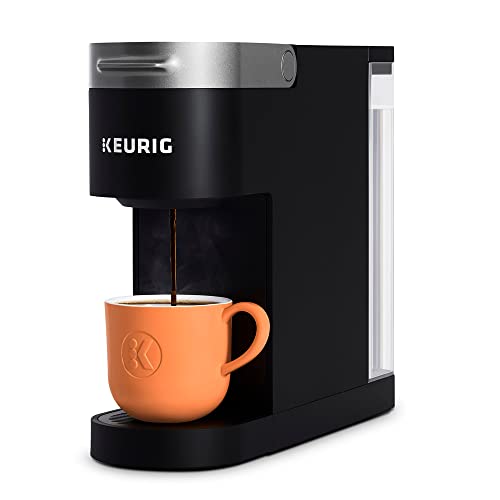
Keurig K-Slim Single Serve K-Cup Pod Coffee Maker — Under Five Inches, Full Reservoir
Most narrow coffee makers achieve their width by shrinking the water tank to a pour-per-cup chore. The K-Slim refuses that trade: it is less than 5 inches wide, per its listing, yet still carries a 46oz removable reservoir — nearly the Classic’s capacity folded into a body that slides into the gap beside a toaster or a knife block. In galley kitchens, rental flats, and office kitchenettes, that width figure is the whole ballgame, and Keurig clearly designed this machine by starting from the tape measure.
The pleasant surprise is that the Slim did not leave extraction behind to get thin. It carries Multistream Technology, the same multi-point saturation as the Supreme, so the cup quality argument survives the diet. Three brew sizes cover the standard range. What thinness costs is presence and some stability — a tall, narrow machine full of water deserves a spot where elbows and pan handles will not catch it, and it offers neither the Elite’s controls nor any programming. Think of it as the pick for counters where the alternative to a Keurig is no coffee machine at all, because nothing wider would fit beside the other appliances that already live there.
- Width: less than 5 inches, stated in the listing title
- Reservoir: 46oz, removable
- Extraction: Multistream Technology
- Brew sizes: 3
- Programmability: not mentioned in the listing title — assume walk-up brewing and confirm on the page if it matters
- For this narrow model, check price on Amazon under the K-Slim name.
Strengths
- Genuinely narrow without surrendering a real reservoir.
- MultiStream extraction matches the flagship’s saturation approach.
- 46oz capacity covers a couple’s day comfortably.
Trade-offs
- Tall, slim proportions want a sheltered corner away from knocks.
- No strong-brew button or temperature control.
- Three brew sizes, like the other compact models here.
Best for: small kitchens, offices, and anyone measuring the counter gap in single inches. Not suited for: households wanting programmable starts or the largest tank.

Keurig K-Mini Single Serve K-Cup Pod Coffee Maker — One Cup, Poured Fresh Each Time
The K-Mini takes the opposite philosophy from the K-Supreme: no stored water at all. You pour in between 6 and 12oz, close the lid, and the machine brews exactly that amount, then sits empty until tomorrow. That design reads as a limitation until you think about who it serves. Water never sits stale in a tank. The machine can live in a drawer-adjacent corner of a dorm room, on a desk, in a camper, or in a guest room that brews twice a month. Cord storage underneath keeps the whole thing tidy enough to pack away between uses.
Because there is no reservoir to keep hot or to descale across a large volume, the Mini is also the most forgiving pick for occasional drinkers — the weekend-only coffee person, the tea drinker’s spouse, the holiday-let kitchen. Its limits are absolute, though: one cup per fill, no queue, no back-to-back anything, and a second cup means another pour and another wait. Households should not buy it as a main machine. But as a personal brewer for one predictable cup, or a travel-and-desk brewer that asks nothing of the space it borrows, nothing else in the Keurig line is this honest about being small.
- Brew range: 6 to 12oz per fill, stated in the listing title
- Reservoir: none — single-cup pour-in design
- Storage: built-in cord storage
- Intended spaces: small spaces, per the listing
- Brew sizes: any single amount within the stated range
- Travelers usually check price on Amazon for the K-Mini before a trip.
Strengths
- No standing water, so no stale-tank taste and minimal descaling fuss.
- Packs away neatly thanks to cord storage and the tankless body.
- Perfectly matched to one-cup-a-day routines.
Trade-offs
- Every cup starts with a fresh pour — there is no shortcut for cup two.
- Useless as a household’s only machine during guest weekends.
- Fewest features of any pick here, by deliberate design.
Best for: dorms, desks, campers, guest rooms, and committed single-cup drinkers. Not suited for: families, offices with a queue, or anyone who brews for two.
Six Keurigs, Side by Side
| Machine | Water story | Cup sizes | Signature extra |
|---|---|---|---|
| K-Express | 42oz removable tank | 3 sizes | Strong Brew button |
| K-Classic | 48oz removable tank | 3 sizes | Auto-off, plain buttons |
| K-Elite | Tank size not stated in title | 8 to 12oz | Strength + temperature control, iced mode |
| K-Supreme | 66oz dual-position tank | 4 sizes | MultiStream, back-to-back brewing |
| K-Slim | 46oz removable tank | 3 sizes | Under 5 inches wide, Multistream |
| K-Mini | No tank — pour per cup | 6 to 12oz per fill | Cord storage, smallest footprint |
Which Keurig Fits the Way Your Household Actually Drinks?
Start with the queue, not the features. Count the cups your kitchen brews between waking and leaving, honestly, including the travel mug that gets filled and carried out. One cup points to the Mini or the Express. Two to three cups spread across a morning suit the Classic, Slim, or Express, where a mid-size tank refills every day or two. Four or more cups in a tight window is Supreme territory, because both its tank and its no-wait brewing are answers to exactly that crush. Feature shoppers often reverse this logic, buying controls they will use twice and capacity they will curse daily — the tank is the spec you interact with most, even though it photographs worst.
Then consider the drinkers themselves. A household where everyone takes the same pod the same way needs nothing beyond size selection. A household split between a black-coffee purist and someone who drowns every cup in milk has a genuine use for the Elite’s temperature control, because the purist’s cup is the one that suffers from fixed heat. And think about the counter as a fixed budget of inches: the Slim exists because some kitchens cannot trade width for anything, and no feature on the Elite compensates for a machine that physically crowds out the kettle. Households planning a permanent coffee station with plumbing sometimes look beyond countertop pods entirely toward Best Integrated Coffee Machines, but for everyone else, one of these six footprints will match the counter they actually have.
How Do You Get the Best-Tasting Cup Out of a Pod?
Pod coffee rewards small disciplines. Run a cleansing rinse of plain hot water after any flavored pod, because the oils and sweeteners from a vanilla or mocha pod linger in the brew path and ghost the next cup. Use the smallest brew size that fills your mug when you want intensity — a pod holds a fixed dose of coffee, so every extra ounce of water is dilution, not generosity. If your machine has a strong setting, treat it as the default for dark roasts and the off switch for delicate ones. Descale on schedule rather than on taste: mineral buildup slows the water, cooler and slower water extracts worse, and by the time the cup tastes obviously wrong the machine has been underperforming for weeks.
Water choice matters more than pod brand debates suggest. Very hard tap water scales the heater and flattens flavor; heavily softened or distilled water can taste oddly hollow because coffee extraction expects some mineral content. Most households land happily on filtered tap water, refreshed in the tank rather than topped up for days. K-Mini owners get this freshness free by design. And store pods away from the steam of the machine itself — the pod shelf above a brewer is a warm, humid cupboard that ages coffee faster than a cool drawer across the kitchen.
What Trips Up Keurig Buyers Most Often?
The classic mistake is buying a second color of a machine you already own and calling it an upgrade — the variants within a model change nothing in the cup. Close behind is tank envy in both directions: the big reservoir bought for a one-person flat that grows stale water, and the cute Mini bought for a family that immediately resents pouring per cup. Travel mug owners trip over clearance, assuming every brewer fits a tall mug with the tray removed; check the listing’s own words on mug fit for the model you choose. Another quiet error is ignoring the brew-size floor — an Elite cannot make the tiny strong cup a 6oz setting allows. Finally, people forget descaling supplies and routine until the machine slows, then blame the pods. A Keurig is a low-maintenance appliance, not a no-maintenance one, and five minutes with a descale cycle a few times a year protects every other quality the machine has.
Does a Pod Machine Belong in a Kitchen That Also Sews, Bakes, and Hosts?
Countertop appliances compete for the same square feet as everything else a home does, and Keurig’s slim and mini models quietly acknowledge that the coffee corner shares space with project work. A household that spreads fabric across the kitchen table on weekends, for instance, might pair a narrow brewer with the space-saving machines in Best Compact Sewing Machines — both categories reward the same discipline of measuring first and buying the footprint, not the fantasy. The pod brewer’s real domestic virtue is that it asks for one mug’s worth of ceremony: no grinder dust, no carafe to wash, no filter basket dripping on the counter while a project waits. For homes where mornings are a relay between school runs, work calls, and hobbies that leave thread on every surface, that tidiness is not a luxury feature. It is the feature.
Reservoir Math: How Tank Size Changes Your Week
Reservoir capacity sounds like a spec-sheet abstraction until you translate ounces into mornings. A 42oz tank, brewing 10oz cups, empties after roughly four cups — a couple’s two-day supply or one person’s long weekend of refills avoided. The Supreme’s 66oz stretches that to six generous cups, which for a family of three drinkers means the tank survives the weekday rush and only asks for attention on Saturday. The Mini’s zero capacity inverts the arithmetic entirely: infinite freshness, zero storage, and a refill folded into every single cup’s ritual. None of these is objectively best. The right answer is the one whose refill rhythm matches the household’s patience, and patience is a resource that runs lowest exactly when the tank runs dry — before the first cup, in a cold kitchen, with a bus to catch.
Placement shapes the refill experience as much as size does. A removable tank carried to the tap beats a fixed machine filled by jug, especially under low cabinets where a jug cannot tilt. The Supreme’s side-position option exists for counters where the machine’s back faces a wall outlet awkwardly or where a rear tank would hide behind the brewer’s own height. When you measure your counter for any of these machines, measure the refill, not just the footprint: stand where you would stand with a full tank in both hands and check the path from sink to machine for obstacles, because you will walk that path hundreds of times a year and a clumsy route breeds the habit of topping up with a drinking glass, dribbling water down the machine’s back, and eventually blaming the brewer for a mess of your own logistics.
What Do Pods Cost You Beyond the Machine?
The brewer is the cheap part of pod ownership; the pods are the subscription you never signed. A household brewing four cups a day consumes well over a hundred pods a month, and the per-cup cost of branded pods runs several times that of drip coffee from a bag of grounds. That arithmetic does not make pods a bad deal — you are buying back the grinding, measuring, filter handling, and carafe washing, plus the ability for each drinker to choose a different roast at 7 a.m. without negotiation. But it does mean the machine decision should be honest about volume. The Supreme’s efficiency in a four-drinker house is partly that it keeps an expensive habit convenient; a household trying to trim grocery spending might deliberately choose the Mini’s friction, because a brewer that makes each cup a small deliberate act quietly discourages the third idle cup of the afternoon.
Waste belongs in the same honest ledger. Pods are small plastic-and-foil packages, and a heavy pod household generates a visible stream of them. Reusable refillable pods exist for the Keurig ecosystem and shift the balance — cheaper per cup, washable, and compatible with any bagged coffee — at the cost of reintroducing the measuring and cleaning the system was bought to escape. Many households land in the middle: commercial pods for weekday speed, a refillable pod for the weekend’s better beans. Every machine in this guide accepts the ecosystem either way, so the choice of brewer does not lock you into one philosophy; it only sets how much friction each philosophy involves at your counter.
How Does a Keurig Behave When Guests Arrive?
Pod brewers are secretly excellent party machines, for a reason drip brewers cannot match: variety without batches. A dinner party’s end usually splits a table into coffee, decaf, tea, and nothing-thanks factions, and a carafe brewer must either brew a full pot of one thing or start a second while the first drinkers wait. A Keurig serves each person their own choice in about a minute, and the back-to-back capability of the Supreme keeps that from becoming a host’s exile in the kitchen. The Mini, by contrast, is a poor host — charming for one guest, tedious for six, with its pour-brew-pour rhythm turning coffee service into a one-person assembly line.
Setting up for guests also exposes reservoir size in a different way: a 66oz tank filled before dinner covers the whole table without a mid-service trip to the tap, while smaller tanks want a pre-emptive top-up as part of your hosting prep, next to laying out cups and pods. Experienced hosts arrange a small pod caddy with a deliberate spread — a medium roast, a dark roast, a decaf, and a tea or cocoa option — because the machine’s promise of individual choice only works if the choices are visibly on offer. None of this requires the top model; it requires thinking of the brewer as a service station rather than a private appliance on the nights when the house fills up.
Keeping Any of These Machines Alive for Years
Keurigs die of neglect in predictable ways, and nearly all of them are preventable. Scale is the first: mineral deposits narrow the water path until pumps strain, cups shrink, and temperatures sag. Descaling solution or a vinegar cycle on a calendar rhythm — not when symptoms appear — keeps the path clear. The second killer is the needle: the sharp hollow needles that pierce each pod clog with grounds and foil fragments, and a straightened paperclip, used gently as the manuals describe, clears them in a minute. The third is the drip tray and pod bin area, where spilled coffee dries into a varnish that smells stale every time the machine heats. A weekly wipe of the parts your hands already touch prevents the funk that owners misattribute to their pods.
Water left sitting is the slow fourth problem, mostly for the big-tank models. A reservoir kept topped up indefinitely grows the faint biofilm that makes first cups taste like the tank rather than the coffee. Empty, rinse, and refill on a rhythm — weekly for most homes — rather than treating the tank as a cistern. The Mini sidesteps this entirely, one of its quietest virtues. Finally, respect the auto-off and power habits: machines left heating all day age their components for nothing, which is why the Classic’s auto-off and the general practice of switching a brewer off after the morning rush genuinely extend service life. None of this maintenance is skilled work; all of it is cheaper than the replacement machine people buy when a neglected brewer gives up mid-winter.
Who Should Skip Keurig Entirely?
Honesty about a brand guide includes naming the readers it cannot serve. If you grind fresh beans and weigh your doses, a pod brewer will feel like a compromise you taste in every cup, and no MultiStream badge closes that gap — your money belongs in drip, pour-over, or espresso equipment. If your household drinks coffee by the pot on weekend mornings, a carafe machine brews that volume cheaper and with less packaging. If counter space is so scarce that even the Slim crowds it, the Mini’s drawer-friendly shape is the only pod answer, and even that may lose to a simple kettle-and-dripper drawer kit. And if your real love is iced coffee in summer volume, a dedicated cold brewer or an iced-focused machine will out-serve any pod brewer’s iced setting across a whole season. Keurig’s promise was never the ultimate cup; it is the dependable, individual, sixty-second cup. Buy it for that promise and it keeps it. Buy it expecting café depth and you will spend a year blaming pods for a mismatch that was in the brief, not the beans.
Brew Sizes, Mug Sizes, and the Dilution Trap
The brew-size buttons on a pod machine are really dilution controls wearing friendly labels. A pod contains a fixed amount of ground coffee; brewing it at 6oz produces a concentrated cup, at 12oz a longer and weaker one, from the identical dose. That is why the size floor and ceiling of each model matter beyond mug fit. The Elite’s 8-to-12oz window means its smallest cup is a mid-strength mug, fine for most drinkers but incapable of the short, intense shot-style cup a 6oz setting gives. The Mini’s 6-to-12oz pour range restores that small end. Travel mugs complicate the math in the other direction: a 14oz commuter mug filled from a 12oz brew is topped with air and disappointment, and two pods brewed back to back into one mug — the workaround many owners adopt — doubles the cost of that commute cup.
A practical habit solves most of this: dedicate each size to a vessel. The small setting belongs to the ceramic mug at breakfast, the mid setting to the work-from-home top-ups, and the large setting to the travel mug that leaves the house. Once sizes map to cups, nobody stands at the machine doing arithmetic, and nobody accidentally brews a large watery cup into a small mug and concludes the pods have gone downhill. Machines with four sizes, like the Supreme, simply give that mapping more granularity — a size for the espresso cup used by the one drinker who likes it strong, and a size for the oversized weekend mug that only comes out on Sundays.
Where Should a Keurig Live in the Kitchen?
Placement decides whether a pod brewer feels effortless or faintly annoying for its entire life. The machine wants three things: a water source within a short carry, headroom to open the pod lever fully, and clearance in front for the mug. Under-cabinet counters are the classic trap — the brewer fits with the lever closed, then the handle arcs into the cabinet bottom every time a pod goes in, and the owner starts pulling the machine forward twice a day, scuffing the counter and loosening the drip tray. Measure with the lever open before you commit a spot. Heat and steam argue against parking any brewer directly beneath wooden cabinet fronts for years, and the daily drip-tray dribble argues against pale grout lines directly in front of it.
Think about the pod supply’s home at the same time. A drawer beneath the machine, a caddy beside it, or a rack on the wall above — each keeps the ritual one-handed. Pods stored across the kitchen turn a sixty-second promise into a treasure hunt, and the machine gets blamed. The Slim and Mini earn extra placement freedom here: the Slim’s width lets it colonize the dead strip between fridge and wall that fits nothing else, while the Mini can live in a cupboard and come out for its one daily performance, which suits kitchens where the counter is a workspace first and an appliance shelf second. Placement is the unglamorous half of ownership, and it is the half you experience every single day.
A Word on Noise, Heat-Up, and Early Mornings
Pod brewers are not silent, and their sound has a particular character: a pump’s buzz and gurgle that carries through a quiet flat at 5:30 a.m. None of the models here advertises quiet operation, so light sleepers in small homes should place the machine as far from bedroom doors as the kitchen allows, and accept that a pod cup cannot be brewed the night before without sitting stale in its mug by morning. What can be prepared in advance is everything around the cup: mug out, pod selected, water checked, so the noisy minute happens once, decisively, rather than as a fumbling sequence of drawer, tap, and cupboard sounds. Programmable models like the Elite shift some of this earlier by having water hot and ready, trimming the fumbling even if the pump still announces itself.
Heat-up behavior differs by design in a way listings understate. Tank machines keep a reservoir and heat on demand or maintain readiness depending on settings, which is why the Classic’s auto-off trades a short warm-up wait for energy savings across the day. The Mini heats only the water you poured, so its energy story is the cleanest and its first-cup wait includes the full heat of a cold start. In practice the differences are measured in seconds and pennies, but across a year of mornings they shape whether the machine feels instant or merely quick — and for the pre-commute cup, that feeling is most of the product.
Tea, Cocoa, and the Household Members Who Do Not Drink Coffee
A pod brewer in a mixed household quietly becomes the hot-drinks station for everyone, not just the coffee drinker who chose it. Tea pods and cocoa pods run through the same machines, and the hot-water function most Keurig models offer serves cup soups, oatmeal, and a tea drinker’s loose-leaf infuser in a pinch. This changes the buying math for couples where one partner drinks coffee and the other drinks everything else: the machine’s cost spreads across two people’s rituals, and the reservoir gets drawn down by both, which argues a size up from what the coffee drinker alone would need. It also argues for a rinse habit, because cocoa residue in the brew path will haunt the next morning’s coffee in a way nobody enjoys.
There is a social dimension too. A guest offered tea from a pod machine accepts happily; a guest offered tea made in a machine that only ever sees coffee may taste the difference. Households that entertain often keep the pod caddy stocked across categories for exactly this reason, and the Elite’s temperature control earns a second mention here — delicate teas scald at coffee temperatures, and a machine that can pour gentler water serves the tea drinker better than one locked at a rolling boil’s edge. None of the six picks is a kettle replacement for a serious tea household, but as a shared drinks station, the line is more versatile than its coffee-first branding suggests.
How to Read a Keurig Listing Without Being Misled
Keurig model names recycle letters and suffixes across years, and listings for older and newer generations of similarly named machines coexist, which is how buyers end up with last decade’s brewer at this decade’s expectations. Anchor on the model name exactly as the listing title prints it, and on the feature words in that title — reservoir ounces, brew-size count, named technologies like MultiStream — rather than on the photo, since product images sometimes span variants. Where a title omits a figure you care about, as several spec boxes in this guide flag, treat the omission as homework rather than assuming the generous interpretation; manufacturers print their best numbers loudly, and silence in a title usually means the number is ordinary.
Also separate the machine from the bundle. Listings frequently pair a brewer with starter pods, filters, or a caddy, and the bundle’s contents change over time even when the machine does not. If you are comparing two listings of the same model, compare what ships in the box, not just the headline. And keep the color discipline from the top of this guide: the same model in a new colorway is a restyle, not a revision. The six machines here were chosen as distinct hardware, and any of them will out-serve a duplicated variant of a lesser model wearing a fashionable finish.
Storing Pods So They Still Taste Like Coffee
Pods are sealed, which tempts owners into treating them as immortal, but the coffee inside still ages, and heat plus humidity hurry it along. The carousel on top of the machine looks tidy in photographs and lives in the warmest, steamiest square foot of the kitchen. A drawer or a closed caddy on a cooler stretch of counter keeps pods in better condition, and a simple first-in, first-out rotation — new boxes emptied behind the remnants of the old — prevents the forgotten back-row pods that brew into cups people describe as tasting like the cupboard. Decaf drinkers should mark their pods’ home clearly; more than one household argument has started with a mislabeled drawer and a wired evening. Small storage discipline, like small descaling discipline, is invisible when it works and obvious in the cup when it does not.
One Last Check Before You Order: the Mug Test
Before any of these machines goes in the cart, gather the three vessels your household actually drinks from — the everyday mug, the big weekend mug, and the travel cup — and check them against the pick’s stated brew range and mug fit. A machine whose largest setting cannot fill the travel mug, or whose tray space cannot swallow the weekend mug, will irritate its owner every day in a way no extraction technology can soothe. It takes two minutes with the listing’s numbers and the cups in your own cupboard, and it prevents the most common and most avoidable disappointment in pod brewing.
A Final Practical Note on Water Filters
Several Keurig models accept a small charcoal water filter inside the reservoir, and owners divide into the diligent, who replace it on schedule, and everyone else. The filter’s honest value is taste in chlorinated districts and a modest slowing of scale; its honest cost is one more consumable to remember. Households already filtering their drinking water at the tap gain little from it, while households filling straight from a hard, chlorinated supply gain the most — one more case, in a guide full of them, of the right answer depending on the house rather than the machine.
Final Recommendation
For most households, the K-Supreme is the easiest Keurig to live with: the 66oz dual-position tank, four sizes, MultiStream extraction, and back-to-back brewing remove the three daily frictions — refilling, waiting, and thin cups — in one machine. Solo drinkers should save the counter and choose between the K-Express for its Strong Brew button and the K-Mini for its pour-per-cup simplicity. The K-Elite earns its place specifically where a black-coffee drinker wants temperature control and a household wants an iced option in summer. The K-Slim is the answer when the tape measure, not the feature list, is making the decision, and the K-Classic remains the right buy for anyone who wants the original pod ritual with plain buttons and an auto-off safety net. Choose by queue size and counter width first, and the rest of the range sorts itself — because the best Keurig is the one whose tank you stop thinking about by the second week.
Frequently Asked Questions
Do all of these machines use the same pods?
Yes — every pick in this guide works with K-Cup pods, and the listings say so explicitly for most models. That shared ecosystem is exactly why the comparison focuses on hardware: tank, sizes, extraction, and footprint are the only real differences between them.
Is MultiStream actually different from standard Keurig brewing?
It is a different water delivery: instead of a single entry point, the Supreme and Slim saturate the grounds through multiple streams, which wets the pod’s contents more evenly. Even wetting generally means fewer dry pockets and a fuller-tasting cup from the same pod, though the pod itself still sets the ceiling.
Which Keurig should a single person in a studio buy?
The K-Mini if you brew once a day and value the space, since it stores no water and packs its cord away. The K-Slim if you brew two or three times a day and would rather not pour for every cup — it keeps a 46oz tank in under five inches of width.
Can a Keurig make proper iced coffee?
The K-Elite carries a dedicated iced capability designed to brew a concentrated shot over ice. Standard models can pour a hot cup over ice too, but dilution hits harder because the brew was not concentrated for the job. If iced coffee is a daily habit rather than an occasional one, a machine designed around it will serve you better.
How often do these machines need descaling?
Follow the manual for your model, but the rhythm most households land on is every few months, sooner with hard water. Warning signs are slower brews, smaller cups than the size you selected, and a flatter taste — all of which trace back to mineral buildup throttling the water path.
Does the K-Mini’s lack of a tank make the coffee taste better?
It removes one stale-water risk, since every cup starts with water you just poured. It does not change extraction itself. Think of the benefit as freshness and simplicity rather than a leap in cup quality over a well-kept reservoir machine.
Related Guides
A pod brewer rarely claims the counter alone, and the same measure-first thinking that picks a Keurig applies to the appliance beside it — our guide to Best Small Countertop Microwave Ovens rounds up compact models for kitchens where every inch is already spoken for.


