What's inside
- Key Takeaways
- Quick Picks
- How Do You Shrink a Coffee Maker Without Shrinking the Coffee?
- Compact Brewers in One View
- How Do You Measure a Counter for a Small Brewer?
- Drip Pot or Single-Serve: Which Small Is Your Small?
- What Do Buyers of Small Machines Regret Most?
- Small Machines in Shared and Temporary Homes
- The Craft Table and the Coffee Corner Share a Wall
- Water, Grounds, and the Small Pot’s Freshness Advantage
- The Second Cup Problem, Solved Three Ways
- Cleaning a Machine the Size of a Kettle
- Small Brewers for Offices, Studios, and Workbenches
- When Small Is the Wrong Answer
- Reading a Small Machine’s Listing Like a Landlord
- The Economics of the Little Pot
- A Morning in a Small Kitchen, Brewed Properly
- Guest Rooms, Lettings, and the Borrowed Kitchen
- Decaf at Small Scale
- The Shelf Life of a Small Machine, and Its Second Life
- Breakfast for One, Brewed Like It Matters
- The Kettle Test: What a Small Brewer Replaces, and What It Does Not
- Travel Mugs and the Small Machine’s Clearance Test
- A Note on Noise in Thin-Walled Homes
- Final Recommendation
- Frequently Asked Questions
- Related Guides
As an Amazon Associate I earn from qualifying purchases. This post may contain affiliate links at no extra cost to you.
cottageverdict.com is reader-supported. When you buy through links on our site, we may earn an affiliate commission.
Where to buy: All six compact brewers below sit on Amazon, linked from the shortlist table and from each detailed review. Small machines are sold in rotating colors and occasional bundle variations, so confirm the finish and contents on the listing you open — the brewer underneath stays the same — and follow the purchase note in each spec box to that model’s current page.
Small is a measurement, not a serving size, and confusing the two is how compact coffee makers disappoint people. The best small coffee machines in this guide were chosen for the kitchens where counter space is genuinely scarce — the galley flat, the studio, the office corner, the holiday-let nook — and they answer that scarcity two different ways. Four are miniature drip machines brewing four or five cups into a glass carafe, enough for a couple’s morning or a small household’s pot. Two are single-serve minis that brew one travel mug at a time. That distinction matters, and it is the difference between this guide and a personal-brewer roundup: here, small describes the footprint a machine claims, and a five-cup drip maker that fits a tiny counter belongs even though it serves more than one person.
Measure before you fall in love. The counter a small machine deserves is measured in three directions — width across the worktop, depth from backsplash to edge, and height under the cabinets with the lid or basket open, because a compact brewer whose lid cannot lift under your cupboards is not compact in your kitchen whatever its listing claims. The picks below were chosen with that tape-measure discipline in mind, and with an eye on the unglamorous virtues small machines often skip: a carafe that pours without dribbling, a warming plate that keeps a second cup kind, a reusable filter that ends the paper-filter supply chain in a one-person flat.
What small machines are not is weak machines. A four-cup drip brewer makes the same coffee as its twelve-cup sibling, at a scale honest to its household — and often fresher coffee, because small households brewing small pots drink them fresh instead of letting a large pot stale on a hot plate. Readers tempted by the high-tech end of small-batch coffee might glance at Best Nitro Coffee Machines for what cold brew becomes with nitrogen; this guide stays with the humble, hot, countertop end of the craft, where a good small brewer quietly outperforms a big one in the kitchens it was sized for.
Key Takeaways
- Small here means footprint, not servings — the guide includes 4 and 5-cup drip brewers alongside single-serve minis, all sized for tight counters.
- The Mr. Coffee Programmable adds a brew-later timer, the feature small machines most often omit, in a 25 ounce carafe format.
- The KRUPS Simply Brew brings stainless design and a drip-free carafe to the 5-cup class, with pause-and-brew and keep-warm.
- Both Elite Gourmet picks run at a stated 600W — one a 4-cup drip with pause and serve, the other a 14 ounce single-serve for grounds and loose-leaf tea.
- The Tastyle Mini adds a carry handle and pod-or-grounds flexibility for travel, camping, RV, and dorm counters.
- Reusable filters on several picks end the paper-filter errand, a small economy that matters in small households.
Quick Picks
| Brewer | Format in brief | Its kitchen is |
|---|---|---|
| Mr. Coffee 5-Cup Mini Brew Switch Coffee Maker (Black) | A 5-cup drip machine with simple switch operation and a compact design brief. | A couple’s small counter that wants a pot, not a pod |
| Elite Gourmet 4-Cup Drip Coffee Maker | A 600W 4-cup drip with pause and serve, a reusable filter, a glass carafe, and a keep-warm plate. | A one or two-person flat brewing fresh small pots |
| KRUPS Simply Brew Compact 5 Cup Coffee Maker | A stainless 5-cup machine with pause and brew, keep-warm, a reusable filter, and a drip-free carafe. | A design-conscious small kitchen that hates counter dribbles |
| Elite Gourmet 14 oz Single-Serve Coffee Maker | A 600W one-touch single-serve for grounds and loose-leaf tea, sized for a travel mug, with auto shut-off. | A desk or studio where one mug is the whole service |
| Mr. Coffee Programmable Coffee Maker (5-Cup) | A programmable 5-cup drip with brew-later timing and an ergonomic carafe marked in ounces, 25 oz capacity. | A small household that wants coffee waiting at wake-up |
| Tastyle Mini Single Serve Coffee Maker with Handle | A handled mini for K Cups and grounds, 6 to 12 ounce brews, built for travel, camping, office, RV, and dorm. | Anywhere temporary — the counter that is not really a kitchen |
How Do You Shrink a Coffee Maker Without Shrinking the Coffee?
The honest small machine removes everything except the brewing. It keeps a proper shower of hot water over a real filter basket, a carafe or mug clearance sized to actual vessels, and controls a groggy person can operate — then it cuts the reservoir to the household’s true volume, narrows the body, and stops. The dishonest small machine cuts the brewing itself: lukewarm water, a token basket, coffee that tastes like the idea of coffee. Our sorting favored the honest kind, weighing stated capacities, warming and pause features, filter type, and the small mercies — ounce markings, lighted switches, water-level windows — that decide whether a compact machine is a pleasure or a compromise at 6 a.m.
Every figure in the spec boxes comes from the model’s listing title: cup counts, wattage where printed, capacities in ounces. Where a title leaves a detail unstated, the box says so in its own words rather than borrowing a number from a sibling model — small machines in the same family differ more than their photographs suggest, and precision here is the whole point of a spec box.

Mr. Coffee 5-Cup Mini Brew Switch Coffee Maker (Black) — The Five-Cup Baseline
Mr. Coffee’s Mini Brew is the small drip machine in its purest form: five cups of capacity, an easy switch for operation, a compact body, and nothing else asking for your attention. That purity is a genuine design position. A switch has no menu to reset after a power flicker, no clock to blink accusingly at midnight, and no settings for a guest to disturb — it brews when it is on, and the coffee it makes is the same on the hundredth morning as the first. For small households that drink a modest pot between them, five cups is the honest size: two mugs each, or one mug and a travel cup for the road, brewed fresh rather than reheated.
The trade for the switch’s simplicity is the absence of the programmable morning — coffee waits for you to wake, not the reverse — and of the pause features that let an impatient drinker steal the first cup mid-brew. Owners who value those should read on to the KRUPS and the programmable Mr. Coffee below. But a great many small kitchens will recognize the Mini Brew as exactly their machine: the one that fits the counter’s last square foot, asks nothing, and makes a proper small pot of coffee for the people who actually live there.
- Capacity: 5 cups
- Operation: easy switch
- Design: compact, black
- Programmability: none — the switch is the whole interface
- Carafe details: not elaborated in the listing title — check the product page for pour and warming specifics
- Switch loyalists can check price on Amazon on the Mini Brew listing.
Strengths
- The simplest possible operation — no menus, no clocks, no resets.
- Five-cup scale matches a couple’s real morning, brewed fresh.
- Compact body claims the smallest counter corner in the drip class.
Trade-offs
- No timer for wake-up coffee.
- No pause-and-serve for the impatient first cup.
- Black basic design aims at function over countertop beauty.
Best for: couples and solo drip drinkers who want a pot with zero ceremony. Not suited for: timer devotees or households brewing for guests often.

Elite Gourmet 4-Cup Drip Coffee Maker — Four Cups, Fully Equipped
The Elite Gourmet 4-Cup is the small drip machine that refused to be feature-poor. Its listing reads like a checklist of everything minis usually skip: pause and serve for the mid-brew cup, a reusable filter that ends paper purchases, a glass carafe, a keep-warm plate for the second mug, a water level indicator so the tank’s state is visible at a glance, a lighted on/off switch, and a removable filter basket that rinses without a wrestling match — all at a stated 600W, in the compact frame the model EHC4128 wears. Four cups is the smallest true pot in this guide, sized for the solo drinker who wants two real mugs or the couple that drinks one each and calls it done.
That completeness makes it the guide’s recommendation for the one-person flat that still believes in drip coffee — a belief the pod era keeps trying to retire. A four-cup pot brewed fresh each morning tastes like coffee in a way reheated leftovers never do, and the reusable filter suits a household that resents buying consumables for a machine bought to save money. The keep-warm plate deserves its usual caution — coffee held hot is coffee cooking — but for the twenty minutes between first and second mug it is a kindness. Among the drip picks, this is the one that treats small as a size rather than a sentence.
- Capacity: 4 cups, glass carafe
- Power: 600W, per the listing title
- Mid-brew access: pause and serve
- Filter: reusable, with removable basket
- Extras: keep-warm plate, water level indicator, lighted switch
- Flat-dwellers can check price on Amazon under the Elite Gourmet EHC4128.
Strengths
- The fullest feature set in the small drip class.
- Reusable filter removes a recurring purchase entirely.
- Pause and serve respects the impatient first cup.
Trade-offs
- Four cups is a hard ceiling — guests mean a second brew.
- Keep-warm plate will cook coffee left on it for hours.
- No programmability for the wake-up pot.
Best for: solo drip loyalists and small flats wanting a complete small pot. Not suited for: larger households or timer-first shoppers.

KRUPS Simply Brew Compact 5 Cup Coffee Maker — Stainless Manners in Five Cups
KRUPS brings a European appliance sensibility to the five-cup class: a stainless steel design, pause and brew, a keep-warm function, a reusable filter, and — the detail experienced drip drinkers will circle — a drip-free carafe. Carafe spouts are the small drip machine’s secret shame; a generation of them has dribbled coffee down the carafe’s side and across counters, and a maker that designs the pour properly understands its users’ mornings better than one that adds a clock. The Simply Brew’s compact brief never reads as cheap, which matters in the small open-plan kitchens where the coffee maker is also a visible object in the living space.
Functionally it stands shoulder to shoulder with the Mr. Coffee drip picks — five cups, pause for the first mug, warmth for the second — while aiming at the buyer who wants the appliance to look considered. The reusable filter aligns it with the Elite Gourmet on consumables, and the keep-warm plate carries the same drink-it-soon advice. What it does not add is programmability, so its mornings begin when yours does. For the small kitchen that hosts its own aesthetic standards, the KRUPS is the drip pick that will not need apologizing for when guests see the counter.
- Capacity: 5 cups
- Body: stainless steel design
- Mid-brew access: pause and brew
- Carafe: drip-free, per the listing title
- Filter: reusable; keep-warm function included
- Design-first buyers can check price on Amazon on the KRUPS Simply Brew listing.
Strengths
- Drip-free carafe ends the morning counter wipe.
- Stainless design suits visible, open-plan counters.
- Pause, keep-warm, and reusable filter cover the essentials completely.
Trade-offs
- No brew-later timer in its repertoire.
- Five cups remains a small household’s ceiling.
- Design polish is its premium; the coffee itself matches its peers.
Best for: small, design-conscious kitchens wanting a proper drip pot. Not suited for: programmable-morning households or large families.

Elite Gourmet 14 oz Single-Serve Coffee Maker — One Mug, One Touch, Tea Included
The second Elite Gourmet in this guide shrinks the idea further: a 14 ounce single-serve brewer, 600W, one-touch, sized for a travel mug and built around a reusable filter that takes ground coffee and — a small, telling generosity — loose-leaf tea. That tea ability makes this the only pick here that serves the two-drink desk, the studio where one person alternates coffee mornings with tea afternoons and owns exactly one hot-drink appliance. Auto shut-off suits the spaces it will live in, where a forgotten machine should not hold a heating element’s vigil, and dishwasher-safe parts acknowledge that a one-person household’s washing-up should be as small as its coffee making.
Fast brew is the listing’s promise, and at 14 ounces the whole performance — fill, brew, go — fits inside a kettle’s boil. The honest limits are capacity and company: this is a machine for a person, singular, and its second cup is a second cycle. Travel-mug clearance is its native country, since the mug is the vessel it was designed around, unlike drip machines whose carafes it replaces. For the desk, the studio flat, the guest room that brews twice a month, or the office corner where a carafe would be an imposition, this is the smallest complete answer in the guide.
- Capacity: 14 ounces, single serve
- Power: 600W, per the listing title
- Filter: reusable, for grounds and loose-leaf tea
- Safety: auto shut-off
- Care: dishwasher-safe parts
- Desk brewers can check price on Amazon under the Elite Gourmet EHC113M.
Strengths
- Coffee and loose-leaf tea from one tiny appliance.
- Travel-mug native — no carafe to wash, ever.
- Auto shut-off and dishwasher-safe parts suit forgetful, busy spaces.
Trade-offs
- Strictly one mug per cycle.
- No pot for guests or second drinkers.
- Grounds-based only — pod devotees should look at the Tastyle.
Best for: solo drinkers at desks and studios who also drink tea. Not suited for: couples, guests, or pod households.

Mr. Coffee Programmable Coffee Maker (5-Cup) — The Small Pot That Wakes Before You
Programmability is the feature the small class usually sacrifices, which makes this Mr. Coffee the guide’s morning person: a 5-cup drip machine with a brew-later function, so the small household gets the same wake-to-coffee choreography the big machines advertise. The carafe is ergonomic with ounce markings printed on it — a quiet aid to consistent measuring, since a household that can see its water level in ounces can repeat yesterday’s good pot instead of approximating it — and the stated capacity is 25 ounces, five honest cups. Compact design keeps the whole proposition on the small counter where it belongs.
The brew-later habit does ask one discipline in return: grounds and water loaded the night before, which means the coffee that greets you was measured by your tired evening self — set the routine up well and it is a gift you give your morning, daily. Against its switch-operated sibling, this model trades a little simplicity for the timer, and the choice between them is really a choice about mornings: reactive or premeditated. For the small household with a fixed wake time — the commuter couple, the school-run parent — the programmable pot is the difference between coffee as a task and coffee as a welcome.
- Capacity: 5 cups, 25 oz stated
- Timing: programmable brew later
- Carafe: ergonomic, with ounce markings
- Design: compact, black
- Filter type: not specified in the listing title — confirm paper or reusable on the product page
- Early risers can check price on Amazon on the programmable Mr. Coffee listing.
Strengths
- Brew-later timing brings the wake-up pot to the small class.
- Ounce-marked carafe makes repeatable measuring easy.
- Five cups suits a couple’s full morning from one timed brew.
Trade-offs
- Night-before loading is a habit the forgetful will skip.
- A clock and menu add the complexity the switch model avoids.
- Still a five-cup ceiling for guests and gatherings.
Best for: schedule-keeping small households who want coffee waiting. Not suited for: spontaneous risers or anyone who hates evening prep.
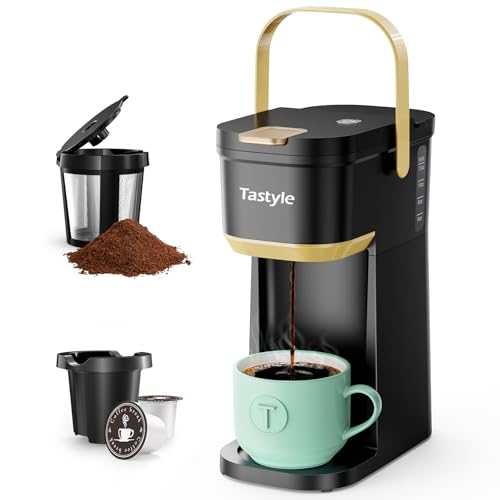
Tastyle Mini Single Serve Coffee Maker with Handle — The One With a Handle, Meant to Move
Every other pick in this guide assumes a counter it will live on. The Tastyle Mini assumes motion: it carries a portable handle, brews for K Cups and grounds across 6 to 12 ounce sizes, runs on standard 120V, and its listing names its habitats — travel, camping, office, RV, dorm. The handle is not a styling flourish; it is the design’s thesis, that a coffee maker can be luggage. Between homes, between the dorm and the summer sublet, between the house and the camper, this machine goes where its owner goes, and its dual-format brewing means it never arrives anywhere to discover the local coffee format is the other one.
BPA-free construction is stated in its listing, a detail traveling drinkers — who brew in the machine daily and carry it in warm vehicles — reasonably care about. The black and gold finish dresses it above the appliance-white of most travel gear. Its limits are the mini’s eternal ones: one cup per cycle, a water supply scaled to that mission, and no pot for company. But judged as the guide’s one true portable, it has no rival here: the drip minis are small residents, while the Tastyle is a small traveler, and households with a foot in two places — the student, the RV couple, the consultant — will feel the difference every time the handle is lifted.
- Brew sizes: 6 to 12 ounces
- Formats: K Cups and ground coffee
- Portability: carry handle; travel, camping, office, RV, dorm use per the listing
- Power: 120V (model K302)
- Materials note: BPA free, per the listing title
- Travelers can check price on Amazon under the Tastyle Mini K302 listing.
Strengths
- A genuine handle and travel brief — it is built to be carried.
- Pods and grounds cover whatever the destination stocks.
- Standard power suits RVs and dorms without adapters or drama.
Trade-offs
- One cup per cycle, like every true mini.
- No carafe or batch mode for shared mornings.
- Its talents are wasted on a counter it never leaves.
Best for: students, travelers, RV and dorm life, and two-home households. Not suited for: settled couples who would rather have a pot.
Compact Brewers in One View
| Brewer | Yield | Signature | Watch out for |
|---|---|---|---|
| Mr. Coffee Mini Brew | 5-cup pot | Switch simplicity | No timer, no pause |
| Elite Gourmet 4-Cup | 4-cup pot | Fullest mini feature set | Smallest pot here |
| KRUPS Simply Brew | 5-cup pot | Drip-free carafe, stainless | No timer |
| Elite Gourmet Single-Serve | 14oz mug | Grounds and loose-leaf tea | One mug per cycle |
| Mr. Coffee Programmable | 5-cup pot, 25oz | Brew-later timer | Needs night-before loading |
| Tastyle Mini | 6–12oz cup | Handle, pods plus grounds | No batch mode |
How Do You Measure a Counter for a Small Brewer?
Bring a tape and measure like a skeptic. Width first, in the exact slot the machine will occupy — between the wall and the kettle, say — remembering that a drip machine’s carafe pulls forward and needs its own inch of grace. Depth second, from the backsplash to the counter’s edge, with the machine’s lid or basket in its open position, because several compact brewers open upward into the space where your cabinets live. Height third, from counter to cabinet underside, again with the lid open; a machine that fits closed and jams open will be pulled forward twice a day for its entire life, scuffing the worktop and its owner’s temper. Finally, stand where you will stand with a full carafe and check the swing to the mug and the sink — small kitchens punish awkward routes, and the route is part of the machine.
Leave a margin for the cord and the steam. A brewer venting against a wooden cabinet’s underside for years leaves a mark, and a cord stretched taut across a wet zone is a small daily hazard. Households outfitting serious small-space systems — the kind that also weigh up the workhorse machines in Best Professional Sewing Machines for a craft corner — already know this discipline: measure the working position, not the stored one, and let the tape, not the photograph, make the decision.
Drip Pot or Single-Serve: Which Small Is Your Small?
The drip picks and the single-serve picks solve different scarcities. A small drip pot serves a household that drinks together — two people, one morning, a shared pot whose second cup is a pour rather than a production. Its coffee is cheaper per cup, its waste is a filter of grounds, and its rhythm is social. A single-serve mini serves a household of staggered schedules and divergent tastes, where each cup is an individual event and a pot would stale between drinkers. Its coffee costs more per cup in effort or pods, and its rhythm is private. Neither is the advanced version of the other; they are answers to the questions who drinks, and when, and with whom.
Households on the border — a couple whose schedules overlap on weekends only — often find the programmable five-cup the treaty: a pot on Saturday, timed and shared; single cups on weekdays, brewed at half capacity or accepted as a small pot for one generous mug and a travel cup. The machine does not care that its five cups serve one person twice. Buy for the household’s calendar, not its headcount, and the small machine will feel sized like a tailor made it.
What Do Buyers of Small Machines Regret Most?
Regret number one is measuring the machine and not the mug: a single-serve brewer whose clearance will not take the household’s beloved tall mug, or a carafe whose spout cannot fill a travel cup without a tilt and a spill. Regret two is the hot plate left on all morning, cooking a small pot into bitterness its owner blames on the beans — small volumes stale faster than large ones, so drink the pot within the hour or brew smaller. Regret three is ignoring the filter question until the first paper filter runs out in a one-person flat at dawn; the reusable-filter picks exist precisely to delete that errand. Regret four is buying the five-cup for a household that drinks eight, out of counter anxiety, and spending a year brewing twice — a slightly deeper machine would have fit, and the tape measure would have said so.
And regret five, the quietest: placing the little machine in the kitchen’s worst corner, far from water and mugs, because it was small enough to exile. Small machines earn daily use when they live where the ritual happens. Give yours the good corner — it takes up so little of it — and it will repay the honor every morning.
Small Machines in Shared and Temporary Homes
Flatshares, dorms, and holiday lets give small brewers their hardest exams: unfamiliar users, contested counters, and cleaning standards set by the most fastidious resident. The switch-operated Mr. Coffee passes the guest test effortlessly — anyone can brew on it without instruction — while the programmable model needs its routine explained or its clock will confuse the house. The Tastyle’s handle makes it the flatshare diplomat, retreating to its owner’s room when counter politics heat up. In a holiday let, a compact drip machine is the difference between guests who feel hosted and guests who drive to a café; hosts choosing one should favor the simple and the sturdy over the programmable and the precious.
These shared settings also argue for the reusable filter and against the pod drawer: a machine that asks nothing of the house but coffee and water will be loved by everyone who uses it, including the ones who never buy the coffee. Smallness, in a shared home, is a social virtue — the machine that claims the least counter claims the least resentment, and brews in peace.
The Craft Table and the Coffee Corner Share a Wall
Small homes rarely dedicate rooms; they dedicate corners, and the coffee corner of a compact flat often shares its wall with the making corner — the table where fabric is cut, letters are written, and projects live between sessions. The disciplines rhyme: tools sized to the space, everything with a home, nothing sprawling. Readers furnishing that other corner by hand power rather than motor might enjoy Best Manual Sewing Machines, where the machines, like these brewers, prove that small and simple are not the opposite of capable. A household that chooses its objects at this scale tends to keep them longer and use them daily, which is the most sustainable sentence in this entire guide.
Water, Grounds, and the Small Pot’s Freshness Advantage
A small pot forgives nothing about stale coffee and rewards everything about fresh. Because a four or five-cup brew is finished within the hour, its drinkers taste coffee at its peak by default — the large-pot household’s second hour, where the warmer plate slowly cooks the remainder, simply never happens. That advantage compounds with small habits: grind or open coffee in quantities the household finishes in a fortnight, keep the reusable filter rinsed so yesterday’s oils do not season today’s pot, and use the water level indicator — the Elite Gourmet wears one openly — to brew the amount the morning actually needs rather than a reflexive full pot on a one-mug day.
Water deserves its sentence too. Small machines heat small volumes quickly, which makes them honest reporters of the tap: a household with heavily mineral water will taste it and scale the little boiler faster per cup than a large machine’s owner notices. Filtered water, or a descale rhythm kept on the calendar, protects both the flavor and the machine. None of this is extra work unique to small brewers; it is the ordinary care of drip coffee, concentrated — like the pot itself — into a smaller, fresher form.
The Second Cup Problem, Solved Three Ways
Every small brewer eventually faces the second cup problem: the pot is empty, the morning is not, and somebody must decide what happens next. The drip picks answer with speed — a four-cup pot brews in minutes, and the household that runs two small pots drinks fresher coffee than the household nursing one large one. The programmable Mr. Coffee answers with timing, its pot ready at the alarm so the second cup is really the first pour of a well-planned morning. The single-serve minis answer with indifference: every cup is a first cup, brewed on demand, and the problem dissolves into a button press.
Hosts of small machines develop a fourth answer: the graceful top-up. A guest’s arrival triggers a fresh small pot rather than a stretched large one, and because the brew is quick and the pot is small, nobody waits long and nothing stales. It is the small machine’s social superpower, invisible in spec sheets — freshness as hospitality, delivered four cups at a time.
Cleaning a Machine the Size of a Kettle
Small machines clean at the scale they brew, which is to say quickly, and their owners have no excuse for the neglect that films larger equipment. The removable filter baskets on these picks rinse under the tap in seconds; the glass carafes fit a bottle brush and a small hand; the single-serve minis wipe down before the mug is finished. The recurring chore is descaling, and small volumes cut both ways — less solution per cycle, but a small boiler shows scale’s effects sooner, in slower brews and cooler cups. A calendar note every couple of months, adjusted for your water’s hardness, keeps the little machines at their stated pace.
Milk and sugar discipline matters around them rather than in them: the small counter crowds the coffee corner against the sugar bowl and the milk’s path to the fridge, and sticky rings under a compact machine are harder to see and easier to ignore. A weekly lift-and-wipe — easy, because the machine weighs so little — keeps the corner honest. Owners of the dishwasher-safe single-serve can delegate even that, which is perhaps the smallest luxury in this entire guide and not the least appreciated.
Small Brewers for Offices, Studios, and Workbenches
Beyond the home kitchen, small coffee machines colonize the world’s desks and benches, and the picks sort themselves by workplace. The Elite Gourmet single-serve is the desk native: one mug, grounds or tea, auto shut-off for the meeting you rush to, and parts that survive the office dishwasher. The Tastyle is the hot-desking nomad, carried between sites by its handle. A small drip pot — the Mini Brew’s switch could not be simpler — serves the workshop or studio where two or three people share a bench and a break, and where a machine with no clock and no menu cannot be misconfigured by whoever arrives first.
Office buyers should weigh the water question hardest: a machine far from a sink will be filled by mug and resented by Friday, whatever its size. Place the little brewer within a short carry of water, keep its coffee supply in the drawer beneath it, and even a four-cup machine becomes the office’s most loved appliance per square inch — a title the big break-room urn, for all its gallons, rarely contests.
When Small Is the Wrong Answer
Close with the households these machines will fail, because a good guide names them. A family of five coffee drinkers will brew a five-cup pot into instant emptiness and a second pot into resentment; buy the twelve-cup and accept the counter cost. A household that entertains at brunch scale will find even the programmable pot a bottleneck, and should think in carafes and thermal servers instead. And the drinker whose ritual is a single enormous travel mug, filled once and carried out, may find the single-serve minis’ 12 to 14 ounce ceilings a daily negotiation — the mug must fit the machine, not the reverse. Small machines are a precise answer to a precise life. Where the life is large, loud, and many-cupped, precision points the other way, and there is no virtue in a tiny machine heroically failing a big household.
Reading a Small Machine’s Listing Like a Landlord
Small machines attract vague adjectives — compact, mini, space-saving — that mean whatever the seller hopes they mean. The listings in this guide were held to a stricter standard, and yours should be too: cup capacity counted, ounces stated where the maker states them, wattage printed where it exists, features named rather than implied. A title that tells you the filter is reusable, the carafe is drip-free, and the switch lights up is a title written by a maker who expects scrutiny. A title that offers only the word compact three times is asking you to buy a photograph. Measure the photograph’s subject yourself — the product page carries dimensions — and remember the three-direction rule from this guide’s measuring section before the box arrives.
Color deserves the landlord’s eye as well. Small machines are frequently sold in several finishes at different prices on the same listing, and the finish changes nothing in the cup. Choose the brewer by its format and features, then take whichever color the household’s kitchen tolerates, and do not let a fashionable finish talk you into a format your mornings will regret.
The Economics of the Little Pot
Small drip machines are among the cheapest coffee appliances sold, and their running costs match their size: grounds measured in spoonfuls, filters reusable on half the picks here, electricity drawn in hundreds of watts for minutes a day. Against the pod economy the arithmetic is not close — a small pot’s cup costs a fraction of a pod’s — and against the café it is not a conversation at all. The single-serve minis split the difference: the grounds-based Elite Gourmet keeps the drip economy at mug scale, while the Tastyle’s pod mode buys convenience at pod prices for the travelers who value it.
The honest ledger adds lifespan. A simple switch machine with no electronics has little to fail, and small drip brewers routinely serve for years beyond their price’s suggestion; a programmable model’s clock and board are its only fragile organs. Buy the little machine whose simplicity matches your appetite for maintenance, and its cost per cup across its life will embarrass almost every other appliance in the kitchen.
A Morning in a Small Kitchen, Brewed Properly
Picture the ritual these machines were sized for, because the picture is the product. The kitchen is a galley; the counter run is short; the little brewer occupies the corner between the wall and the kettle, a corner no other appliance wanted. Water from the tap, two steps. Grounds from the tin in the drawer beneath, one step. The switch or the timer does its work while the day is assembled — lunches, keys, the bag by the door — and the pot that results is exactly the household’s size, so it is poured to the last cup while it is still itself. No carafe of leftovers cools into the afternoon. No pod drawer rattles. The machine rinses in the time the toast takes, and the corner is a corner again, ready to be a chopping board’s overflow or a letter-writing desk by nine.
That picture is why the category endures against every trend in coffee. Big machines promise abundance; these promise fit. In the homes they fit, they are not the small version of the right machine. They are the right machine, and the twelve-cup flagship in a galley kitchen is the one that would be the compromise.
Guest Rooms, Lettings, and the Borrowed Kitchen
A small brewer’s most forgiving stage is the borrowed kitchen — the guest room, the rental flat, the in-law cottage — where its user is a stranger to the house and the machine must explain itself. The picks sort themselves by self-explanation: the Mini Brew’s switch needs no manual and forgives every unfamiliar hand; the programmable model needs its clock understood, which is a host’s note left on the counter; the single-serve minis need only a mug and a minute. Hosts equipping a guest space should choose for the guest’s first groggy morning, not for their own practiced one, and should leave the coffee beside the machine in a quantity that signals welcome rather than rationing.
Lettings add durability to the brief: a machine that survives a season of strangers is simple, sturdy, and cheap enough to replace without grief — a description the little drip machines fit as if designed for it. The Tastyle, meanwhile, serves the other side of the arrangement: the guest who brings their own, trusting no letting’s cupboard. Between the host’s Mini Brew and the traveler’s handled mini, the borrowed kitchen is covered from both directions.
Decaf at Small Scale
Small households include a disproportionate share of decaf drinkers — the evening-cup people, the one-caffeine-a-day people — and small machines serve them with a structural advantage: a four-cup pot of decaf is a reasonable brew, where a twelve-cup pot of decaf is a commitment nobody makes. The small pot lets a household run two coffees in a morning, regular for one drinker and decaf for the other, in sequence, without waste or a second machine. The single-serve minis solve it per cup, as they solve everything. Either way, the decaf drinker in a small household is better served by these little brewers than by any flagship, because the batch size finally matches the demand — a sentence that could stand as this whole guide’s motto.
The Shelf Life of a Small Machine, and Its Second Life
Simple small brewers have a talent for second lives. The drip machine retired from a couple’s kitchen when a bigger household forms migrates to the workshop, the studio, the guest room, the child’s first flat — contexts where its simplicity and size are virtues anew, and where a more electronic machine would have died in the transition. The single-serve minis travel the same circuit in reverse, starting as dorm machines and ending as desk machines in first jobs. Buying a small brewer is therefore rarely buying for one kitchen; it is buying a small, durable capability that a household redeploys for a decade. That redeployability belongs in the value calculation beside the cup cost, and it quietly favors the simple picks — the switch, the sturdy carafe, the handle — over the clever ones, because simplicity is what survives being handed down.
Breakfast for One, Brewed Like It Matters
There is a philosophy hiding in the four-cup pot, and it is worth stating plainly before this guide closes: cooking and brewing for one person deserves the same respect as cooking for six. The solo household that brews a small fresh pot, pours it into a real mug, and sits down to it has not settled for a lesser coffee life — it has refused the two common corruptions of solo drinking, the stale reheated pot and the joyless instant. Every pick in this guide exists to serve that refusal at a different address: the flat, the desk, the dorm, the road. If the coffee world sometimes treats the single drinker as a market segment to be podded, these little machines are the counter-argument, humming on counters the size of cutting boards.
That is also why the guide weighed small mercies — a lighted switch, ounce markings, a carafe that pours clean — as seriously as capacities. At one person’s scale, the ritual is the product even more than the beverage, and a machine that respects the ritual earns its corner for years. Buy the one whose ritual matches your mornings, and the smallest room in the house will hold one of its best routines.
The Kettle Test: What a Small Brewer Replaces, and What It Does Not
Every small kitchen already owns a coffee method of last resort — the kettle and whatever dripper, press, or jar lives in a cupboard — and a small brewer must justify itself against that zero-footprint incumbent. Its justification is the weekday: the morning when nobody will stand over a pour-over, the household that wants the pot to happen while showers and lunches happen. Where the kettle method wins is the unhurried weekend and the power cut, and wise small households keep it as the understudy rather than discarding it in the brewer’s honor. The machines in this guide were chosen to win the weekday honestly — by speed, by timing, by fitting the corner — and a household that knows which mornings it is buying for will choose among them without a wrong answer.
Travel Mugs and the Small Machine’s Clearance Test
One measurement separates satisfied owners from daily irritations, and it is not on any spec sheet in this guide: the height of your household’s favorite travel mug against the brewer’s cup clearance. Drip picks pour into their own carafes and ask you to decant, which adds a rinse but removes the clearance question; single-serve picks brew directly into the mug and live or die by the fit. Before ordering a mini, stand your mug beside a ruler, then read the listing’s clearance figure on the product page with that number in hand. A mug that fits turns the morning into a single motion — mug under, button, lid, door — while a mug that does not fit turns it into a two-vessel transfer performed half asleep, with the predictable spill in week one. The Tastyle and the Elite Gourmet single-serve were both designed around travel mugs, but designed around is a claim your own mug should verify.
A Note on Noise in Thin-Walled Homes
Small drip machines are among the quietest coffee appliances made — a gurgle, a drip, a click — and in a studio flat where the kitchen is also the bedroom, that quiet is a specification whether or not any listing prints it. The single-serve minis add a pump’s brief buzz, still modest beside an espresso machine’s performance. Early risers in shared small homes should place any of these on a folded mat to swallow the counter’s resonance, and the household’s other sleepers will likely never learn what time the coffee happened. It is a fitting last virtue for the category: machines sized for small homes that also sound like they belong in them.
Final Recommendation
For most small households, the drip pot is the answer and the only question is which one: the Elite Gourmet 4-Cup for the fullest feature set at the smallest scale, the KRUPS Simply Brew where the counter is on display and dribbles are unwelcome, the programmable Mr. Coffee where mornings run on a schedule, and the switch-operated Mini Brew where simplicity is the whole religion. Solo drinkers should take a single-serve instead — the Elite Gourmet 14 ounce for grounds and tea at a fixed desk, the Tastyle Mini for a life in motion between dorm, office, and road. Measure your counter in three directions, count your household’s true cups, and buy the machine that matches both numbers — in a small kitchen, the right five cups beat the wrong twelve every single morning.
Frequently Asked Questions
Is a 4 or 5-cup machine enough for two people?
For most couples, yes — a coffee maker’s cup is a small measure, and a 5-cup pot pours roughly two generous mugs. Households of two large-mug drinkers who each want a refill should count in ounces: the programmable Mr. Coffee states 25 ounces plainly, so measure your mugs against that figure.
Do small drip machines make coffee as good as full-size ones?
They make the same kind of coffee at a smaller scale, and often fresher-tasting coffee for small households, because the pot is finished while it is fresh instead of sitting on a warmer. Water temperature and grounds quality matter more than the machine’s size.
What is the advantage of a reusable filter?
No paper filters to buy, store, or run out of at dawn — the Elite Gourmet drip, the KRUPS, and the Elite Gourmet single-serve all include one. The trade is a rinse after each brew, a fair exchange in a small kitchen with a sink two steps away.
Can these machines brew tea?
One can, explicitly: the Elite Gourmet single-serve’s reusable filter accepts loose-leaf tea as well as ground coffee. The drip machines are coffee brewers; running tea through them invites flavor ghosts in both directions, so tea drinkers are better served by that single-serve pick or a kettle.
Which pick works best in an RV or dorm?
The Tastyle Mini — its listing names RV and dorm use, it runs on standard 120V power, takes both pods and grounds, and its handle makes it genuinely portable between spaces. The Elite Gourmet single-serve is the pick for a fixed dorm desk.
Should I leave the warming plate on to keep coffee hot?
Only briefly. A warming plate keeps coffee hot by continuing to cook it, and small pots stale fastest of all. Drink the pot within the hour, or brew a size your household finishes — the 4-cup Elite Gourmet exists for exactly that discipline.
Related Guides
A small coffee machine usually anchors a small kitchen’s whole appliance strategy, and the washing-up end of that strategy lives in our guide to Best Small Dishwashers — compact machines for the same counters, measured with the same tape.


