What's inside
- Key Takeaways
- Quick Picks
- What Evidence Did a Machine Need to Be Called Professional Here?
- Best Professional Coffee Machines, Sorted by Control Philosophy
- PID, Preinfusion, and Pressure: Which Controls Actually Change the Cup?
- The Grinder Question, Answered Four Ways
- What Does Dialling In Actually Look Like on These Machines?
- How Does Milk Steaming Differ Across These Six Machines?
- Should a Serious Buyer Consider Second-Hand Prosumer Machines?
- How Long Do Prosumer Machines Live, and What Decides It?
- Who Should Not Buy a Prosumer Machine at All?
- Which Ownership Mistakes Do Prosumer Buyers Make?
- How Should the Counter Be Arranged Around a Prosumer Machine?
- Final Recommendation
- Frequently Asked Questions
- Related Guides
As an Amazon Associate I earn from qualifying purchases. This post may contain affiliate links at no extra cost to you.
cottageverdict.com is reader-supported. When you buy through links on our site, we may earn an affiliate commission.
“Professional” is the most abused word in espresso, so this guide begins by defining it in hardware. The best professional coffee machines — the prosumer class gathered here — earn the label through temperature control, boiler architecture, and the standard fittings that let an owner measure, adjust, and improve: PID controllers that hold brew temperature to a set point, an E61 group head, a dual boiler that brews and steams at once, a rotary pump delivering a stated 9 bar. Six machines sit on this page, and they divide into two philosophies. The Italian tradition — Rancilio, Gaggia, Diletta — sells control: machines that reward skill and punish its absence. The guided tradition — Breville’s pair and the dual-boiler Meraki — sells measurement and assistance: built-in grinders, touchscreens, and in the Meraki’s case, grinding and brewing by weight. Neither philosophy is a shortcut. They are different answers to the question of where the precision should live — in the operator, or in the machine.
A note on where prosumer machines are bought, because the channel shapes the homework: all six are sold through Amazon, each linked to its own listing, which removes the dealer appointment from a purchase that used to require one. What it does not remove is the buyer’s responsibility for the unglamorous checks — counter depth, circuit capacity, water quality, and the grinder question that two of these machines answer internally and four leave entirely to you. The spec boxes flag those obligations pick by pick.
The evidence rule is at its strictest in this guide, because prosumer buyers are the readers most likely to act on a number. Figures appear only where the listing title states them: the Silvia’s 67-ounce capacity, the Meraki’s 45 grinder settings and 9-bar rotary pump, the Diletta’s PID and preinfusion. Where titles are silent — and they are silent about portafilter diameter on most of this page, a specification this class of buyer cares deeply about — the spec box records the silence in so many words. A guide that invented a portafilter size would deserve the returns it caused.
Key Takeaways
- Two machines state PID temperature control in their titles: the Rancilio Silvia PID and the Diletta Bello+, the latter adding an E61 group, a shot timer, and programmable preinfusion.
- The Meraki is the measurement maximalist — a dual boiler with dual scales, grinding and brewing by weight, a 45-setting built-in burr grinder, and a 9-bar rotary pump, all stated in its title.
- Breville’s Barista Pro and Barista Touch build the grinder in and split on philosophy: the Pro is the manual machine, the Touch the semi-automatic one, per their titles.
- The Gaggia Classic Evo Pro is the compact traditionalist — the smallest claim on the page and the longest lineage behind it.
- Portafilter size is stated in none of the six titles; buyers for whom it is decisive must confirm it on the listing before ordering baskets and tampers, because accessories bought for the wrong diameter are the classic first-week waste of a new prosumer setup.
Quick Picks
| Machine | School of espresso | Defining claim from its title |
|---|---|---|
| Rancilio Silvia PID | Italian single boiler, controlled | PID installed, 67-ounce capacity, in black. |
| Gaggia Classic Evo Pro | Italian traditionalist, compact | The RI9380/51 in industrial grey — small, per its title. |
| Breville Barista Pro BES878 | Manual, grinder built in | A manual coffee maker with built-in grinder for shots, lattes, cappuccinos. |
| Breville Barista Touch BES880 | Semi-automatic, grinder built in | The semi-automatic sibling of the Pro, same drinks brief. |
| Diletta Bello+ | E61 flagship tradition | E61 group, PID, shot timer, programmable preinfusion, handmade in Italy. |
| Meraki Dual Boiler Espresso Machine | Dual boiler, by weight | Dual scales, 45-setting grinder, 9-bar rotary pump, simultaneous steam. |
What Evidence Did a Machine Need to Be Called Professional Here?
The first requirement was a control surface. Professional espresso is the management of variables — temperature, pressure, dose, time — and a machine earns the name by exposing at least some of those variables to the operator rather than hiding them behind a drinks menu. PID controllers, programmable preinfusion, shot timers, and by-weight dosing all qualify, and every pick on this page states at least one in its title. Machines whose titles offered only beverage names and a finish were returned to the domestic shelf where they belong.
The second requirement was architecture honesty. Boiler arrangements decide what a machine can do simultaneously, and titles here were read for exactly that claim: the Meraki states dual boilers and simultaneous brewing and steaming outright; the others make no such claim, and this guide does not make it for them. A single-boiler machine asked to steam between shots imposes a rhythm — pull, wait, steam — that its owner must accept as the price of its class. Readers who run events rather than rituals should carry that arithmetic over to Best Commercial Self-Serve Coffee Machines, where the unattended end of the same trade-off is worked out in full.
The third requirement was a serviceable identity: a model designation, a maker with a lineage, a specification that can be cross-checked. The Gaggia’s RI9380/51 and the Breville BES numbers are examples — small strings that let an owner find parts, manuals, and a community’s accumulated knowledge years after purchase. Prosumer machines are kept, not replaced, and the title that identifies a machine precisely is the first evidence it can be kept.

Rancilio Silvia PID — The single boiler, disciplined by PID
The Silvia is the machine a generation of home baristas learned on, and this version answers its one famous criticism in its title: a Rancilio Silvia espresso machine with PID installed, 67-ounce capacity, in black. The base Silvia’s reputation rests on commercial-grade bones — a machine built like equipment rather than styled like an appliance — paired, in its classic form, with temperature behaviour that demanded a surfer’s patience. A factory-fitted PID changes the machine’s character at its weakest point: brew temperature becomes a set point to be held rather than a wave to be ridden, and the owner’s skill is freed for dose, distribution, and the shot itself.
Sixty-seven ounces is the stated capacity, and it sizes the machine’s social life: a household or small studio pulling drinks in sequence, refilling without drama, never pretending to banquet capacity. The black finish distinguishes this listing from the Silvia’s traditional stainless presentation, a cosmetic point that matters only because prosumer machines live visibly on counters for a decade and should be bought as furniture as well as equipment.
What the PID does not change is the single-boiler rhythm. Brewing and steaming share one boiler’s temperature regime, so milk drinks proceed in order — shots first, steam after, a pause between worlds. Owners who drink straight espresso will never notice; owners whose household runs on lattes will organise their mornings around it. That is not a flaw to be forgiven but a class characteristic to be chosen knowingly, and the Silvia’s defenders have always argued the same bargain: in exchange for the pause, you get the most repairable, best-understood machine in its class.
Buy it as an education as much as an appliance. The Silvia rewards measurement, punishes sloppiness informatively, and holds its value in a community that has documented every one of its behaviours. For the buyer who wants to become good at espresso rather than merely served by it, the PID version removes the one obstacle that was never the student’s fault.
- Format: single-boiler prosumer espresso machine
- Temperature control: PID installed, per the listing title
- Capacity: 67 ounces, as titled
- Finish: black
- Boiler arrangement for simultaneous steaming: not claimed in the title — expect the single-boiler pull-then-steam rhythm
- How to get it: the Rancilio Silvia PID — Amazon’s listing carries this black, PID-fitted version.
Strengths
- PID control fixes the classic Silvia’s temperature surfing at the factory.
- Commercial-style build and a deep owner community make it a decade machine.
- It teaches espresso properly: every variable the owner improves shows in the cup.
Trade-offs
- Single-boiler rhythm serialises milk drinks; latte households queue by design.
- No built-in grinder is claimed — budget a serious grinder beside it.
- It forgives nothing: poor distribution and stale beans are served faithfully.
Best for: espresso students and purists who want control with temperature discipline. Not suited for: households wanting simultaneous milk drinks or push-button ease.

Gaggia Classic Evo Pro — The compact traditionalist
The Gaggia’s title is the most restrained on this page: the RI9380/51 Classic Evo Pro espresso machine, in industrial grey, described as small. Restraint, from Gaggia, is a kind of confidence. The Classic line is one of the longest-running designs in home espresso, and the Evo Pro is its current form — a machine whose argument is not a feature list but a lineage: decades of owners, a mature parts ecosystem, and a design that assumes the operator wants to make espresso rather than supervise it.
Small is a genuine specification in prosumer espresso, where machines grow in every direction and counters do not. A compact traditional machine fits the apartment kitchen, the studio, the office corner that takes coffee seriously — places where the Diletta’s presence or the Meraki’s footprint would evict something else the room needs. Industrial grey suits the same brief: a working finish for a working machine, unbothered by the fingerprints that stainless displays like evidence.
The title’s silences must be read as carefully as its claims. No PID is stated, no grinder is built in, no boiler arrangement is described — and this guide will not furnish the Gaggia with specifications its listing does not print. What can be said within the evidence is that the Classic formula has always been a manual, single-station machine whose temperature manners are the owner’s to learn, and that buyers who want stated temperature control should weight the Silvia PID and the Diletta accordingly. The Gaggia’s case rests on size, lineage, and price-class honesty rather than on a control specification.
That case is stronger than it sounds. Prosumer ownership is a long game of seals, solenoids, and descaling, and a machine from a line this mature is a machine whose every future problem has already been solved publicly by somebody. For the buyer whose space is small and whose intentions are serious, the Classic Evo Pro is the traditional start that thousands of good home baristas share — a common first chapter, and for many a permanent one.
- Format: compact manual espresso machine
- Model: RI9380/51 Classic Evo Pro, per the listing title
- Finish: industrial grey; size described as small in the title
- Temperature control system: the listing title does not specify one — confirm the configuration on the product page
- Grinder: none built in is claimed; plan a separate grinder
- How to get it: the Gaggia Classic Evo Pro — see Amazon for the current RI9380/51 listing.
Strengths
- The compact footprint fits counters that exclude the rest of this page.
- A long-running line means parts, knowledge, and community in depth.
- Manual operation teaches the craft without electronic intermediaries.
Trade-offs
- No temperature-control system is stated in the title; verify before assuming PID-class stability.
- A separate grinder is a mandatory companion purchase.
- Small size caps the party trick: this is a sequential, one-station machine.
Best for: space-limited buyers who want the traditional manual path. Not suited for: buyers who need stated PID control or built-in grinding.
Breville Barista Pro BES878 — The manual machine with the grinder inside
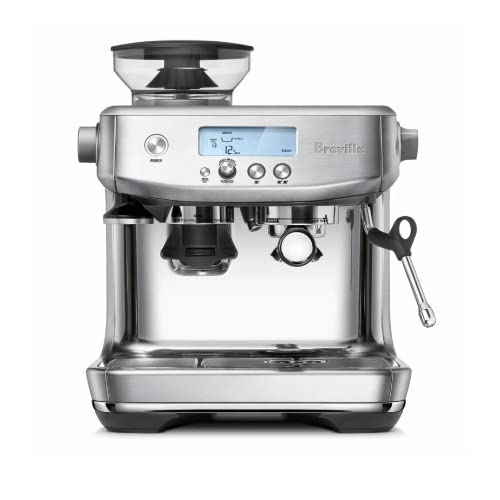
Breville’s Barista Pro states its compromise plainly: the BES878BSS in brushed stainless steel, a manual coffee maker with a built-in grinder, for pulling barista-quality espresso shots, lattes, and cappuccinos at home. The compromise is the category’s most popular one — surrender the separate grinder, gain a single footprint and a workflow in which grinding, tamping, extracting, and steaming happen along one counter run without a second appliance’s real estate or budget. For most kitchens, that trade is not a compromise at all; it is the difference between espresso happening and espresso being planned.
Manual is the operative word, and Breville means it as positioning against its own Touch model below. The Pro keeps the operator in the loop — dose, distribution, timing, milk — while the machine handles heating speed and consistency of the platform underneath. That makes it the guided tradition’s most honest representative: assistance with the physics, apprenticeship in the craft. Owners graduating from pod machines will find the Pro the natural next step; owners arriving from café work will find it a compact station that respects their hands.
The built-in grinder deserves the standard two-sided reading. Integration guarantees the grinder and machine were designed for each other, deletes a purchase, and keeps the counter honest. It also means the grinder’s ceiling is the machine’s ceiling, and the upgrade path for grinding runs through replacing the whole unit. Espresso’s open secret is that the grinder matters as much as the machine; the Pro’s bet is that its integrated grinder is good enough for its owner’s ambitions, and for the great majority of home bars that bet has proven sound.
Brushed stainless and the BES878 designation complete a package aimed at longevity of a different kind from the Italians’: not a machine to be rebuilt forever, but a platform stable enough to anchor a home café for years, with the manufacturer’s ecosystem behind it. Buyers choosing between the Pro and the Touch are really choosing how much of the ritual they want to keep — and the Pro is the keeper’s version.
- Format: manual espresso machine with built-in grinder
- Model: BES878BSS Barista Pro, per the listing title
- Drinks named: espresso shots, lattes, cappuccinos
- Finish: brushed stainless steel
- Temperature control specification: not detailed in the listing title — check the product page for the heating system specification
- How to get it: the Breville Barista Pro BES878 — Amazon lists the brushed stainless version.
Strengths
- One footprint, one purchase: grinder and machine designed as a single station.
- Manual workflow preserves the craft while the platform handles consistency.
- The natural graduation machine for pod owners moving to real espresso.
Trade-offs
- The integrated grinder caps the grinding upgrade path at the machine’s own level.
- Manual means manual: drinks vary with the operator until the operator improves.
- No dual-boiler simultaneity is claimed; milk follows espresso in sequence.
Best for: home baristas who want one station and full manual involvement. Not suited for: buyers determined to run a separate, upgradeable competition grinder.

Breville Barista Touch BES880 — The semi-automatic sibling
The Barista Touch, BES880BSS, mirrors the Pro’s title almost word for word — brushed stainless steel, barista-quality shots, lattes and cappuccinos, built-in grinder — with one word changed: where the Pro is a manual coffee maker, the Touch is a semi-automatic one. That single adjective is the whole product strategy, and buyers should let it organise their decision. Semi-automatic in Breville’s vocabulary means the machine takes over the repetitive judgements — drink selection, milk texturing guidance, the sequence of the build — through a touchscreen interface, while the operator still owns the puck and the pour.
The household case for the Touch is the two-barista problem. In many homes one person loves the ritual and the other loves the drink, and a manual machine quietly restricts good coffee to the hours when the enthusiast is home and willing. The Touch democratises the station: the second person’s cappuccino, made through guided steps, lands close enough to the enthusiast’s that the machine earns its counter space for both of them. Offices and studios with the same two-tier staffing will recognise the argument immediately.
Consistency is the second dividend. A touchscreen workflow remembers what the house drink is — the enthusiast can set it, and the machine will reproduce it for anyone who taps it. That programmability is a modest thing beside the Diletta’s preinfusion curves or the Meraki’s by-weight dosing, but it operates at exactly the level most households need: not laboratory control of extraction, but the same good cup on Tuesday as on Sunday, made by either pair of hands in the house.
The trade is the enthusiast’s ceiling. Guidance systems are opinionated, and the operator who wants to run long preinfusions, odd ratios, and experimental profiles will eventually feel the walls of the guided path. Breville’s own lineup acknowledges the fork: the Pro for the keeper of rituals, the Touch for the household that wants the ritual shared. Neither is the lesser machine; they are answers to different domestic constitutions, and choosing between them honestly is the whole of the decision.
- Format: semi-automatic espresso machine with built-in grinder
- Model: BES880BSS Barista Touch, per the listing title
- Drinks named: espresso shots, lattes, cappuccinos
- Finish: brushed stainless steel
- Control interface: the Touch format centres on guided touchscreen operation — confirm the current interface details on the listing
- How to get it: the Breville Barista Touch BES880 — its Amazon page shows the current package.
Strengths
- Guided semi-automatic workflow lets the whole household make the house drinks.
- Programmable consistency protects the standard when the enthusiast is out.
- Built-in grinding keeps the station to one footprint, like the Pro.
Trade-offs
- Guidance has walls; experimental extraction eventually outgrows it.
- The integrated grinder shares the Pro’s upgrade ceiling.
- Sequential milk work remains; no simultaneity is claimed in the title.
Best for: two-barista households and studios where drinks must survive the enthusiast’s absence. Not suited for: solo purists who want every variable in their own hands.
Diletta Bello+ — E61, PID, and preinfusion, handmade in Italy
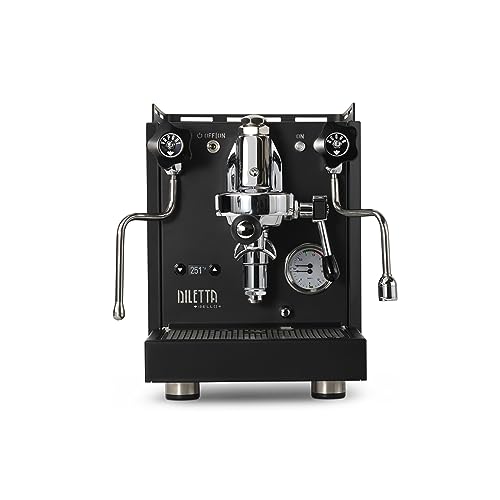
The Diletta Bello+ carries the most evocative title on this page: an espresso machine with an E61 group, PID temperature control, a shot timer, programmable preinfusion, handmade in Italy, in black. Each element is a chapter of espresso tradition. The E61 group head — a design from 1961 that became the prosumer standard — brings thermal mass and a mechanical preinfusion character that modern groups imitate electronically. PID control disciplines that tradition with contemporary precision. A shot timer acknowledges that extraction is a timed event and gives the operator the number at the moment it matters, on the machine rather than on a phone balanced against the drip tray.
Programmable preinfusion is the connoisseur’s clause. Wetting the puck gently before full pressure changes how a shot builds — forgiving small distribution errors, coaxing sweetness from dense coffees — and making it programmable turns a fixed machine behaviour into an ingredient the owner can season to taste. Combined with PID, it gives the Bello+ the deepest stated control surface of any traditional machine here: temperature set, preinfusion shaped, time observed. This is the machine for the operator who keeps a notebook.
Handmade in Italy is a claim about provenance that prosumer buyers weigh seriously, because this class of machine is serviced, modified, and kept for decades, and an Italian-built E61 machine plugs into the deepest ecosystem of parts and knowledge in espresso. The black finish modernises the silhouette without disguising the architecture — the group head sits proud of the body exactly as it has for sixty years, which owners of this school regard as the correct relationship between a machine and its history.
The obligations match the ambitions. No grinder is built in, and a machine of this control deserves a grinder of commensurate seriousness, budgeted as part of the same decision. The title states no boiler arrangement, so simultaneity claims are not made here; buyers for whom brewing and steaming at once is non-negotiable should compare the Meraki’s stated dual boilers before committing. What the Diletta offers instead is depth in the shot itself — and for its intended owner, that has always been the point.
- Format: prosumer espresso machine with E61 group head
- Temperature control: PID, per the listing title
- Extraction tools: shot timer and programmable preinfusion, both stated
- Origin: handmade in Italy, per the title
- Finish: black
- How to get it: the Diletta Bello+ — Amazon’s listing is where to verify the current build.
Strengths
- The deepest stated control surface here: PID, preinfusion, and a shot timer together.
- E61 architecture plugs into espresso’s deepest parts and knowledge ecosystem.
- Italian handmade provenance suits a machine bought to be kept for decades.
Trade-offs
- No built-in grinder; the companion grinder is a serious second budget.
- Boiler arrangement is not stated in the title, so simultaneity must be verified, not assumed.
- Its depth is wasted on owners who want the machine to decide.
Best for: committed home baristas who measure, note, and iterate. Not suited for: buyers seeking automation, integrated grinding, or stated dual-boiler service.

Meraki Dual Boiler Espresso Machine — Espresso by weight, both boilers at once
The Meraki’s title is a specification sheet compressed into a sentence: a semi-automatic dual boiler espresso machine with dual scales, in black, that grinds and brews by weight, with a 45-setting built-in burr grinder, a 9-bar rotary pump, and simultaneous brewing and steaming. Start with the scales, because they signal the machine’s philosophy. Espresso’s modern quality revolution was built on weighing — dose in, yield out — and the Meraki builds that discipline into the machine itself rather than leaving it to a separate scale and the operator’s memory. Grinding by weight removes the timed-dose guesswork; brewing by weight closes the loop at the other end of the shot.
Dual boilers plus simultaneous brewing and steaming answer the single-boiler rhythm that constrains the Silvia and, by silence, the rest of the traditional field. Milk drinks proceed in parallel — the shot extracts while the milk textures — which changes both the speed of a multi-drink morning and the temperature story of every component. For households where four lattes leave the kitchen in ten minutes, simultaneity is not a luxury specification; it is the difference between a routine and a performance.
The 9-bar rotary pump is the connoisseur’s detail. Rotary pumps are the commercial standard, prized for quiet, stable pressure delivery, and the title states the working figure — 9 bar — rather than a maximum the machine never uses in anger. A 45-setting burr grinder, built in, completes the integration story: this is the one machine here that attempts to be the entire espresso station, grinder, scales, boilers, and pump, in a single black footprint.
Integration at this depth carries the familiar caveat in its strongest form: every subsystem’s ceiling is the machine’s, and a failure anywhere is a service event for the whole station. Buyers must also weigh a newer name against the Italian lines’ decades of documented behaviour — the Meraki’s specification is the boldest on this page, and its long-term ownership story is, by definition, the least written. For the measurement-led barista, that exchange — the fullest stated control and simultaneity, against youth as a platform — is the most interesting decision in this guide.
- Format: semi-automatic dual boiler espresso machine
- Dosing: grind and brew by weight, with dual scales, per the listing title
- Grinder: built-in burr grinder with 45 settings
- Pump: rotary, stated at 9 bar
- Simultaneity: brewing and steaming at the same time, per the title
- How to get it: the Meraki Dual Boiler Espresso Machine — check Amazon for current availability.
Strengths
- By-weight grinding and brewing build espresso’s core discipline into the machine.
- Dual boilers and simultaneity end the pull-then-steam queue for milk drinks.
- A rotary pump at a stated 9 bar is commercial practice, honestly specified.
Trade-offs
- Total integration means one service event can idle the entire station.
- The platform’s long-term ownership record is unwritten beside the Italian lines.
- Its measurement richness is wasted on owners who drink by instinct.
Best for: data-led home baristas and milk-drink households wanting café simultaneity. Not suited for: traditionalists who want a machine they can rebuild themselves in twenty years.
Best Professional Coffee Machines, Sorted by Control Philosophy
| Machine | Where precision lives | Stated temperature story | Grinder arrangement |
|---|---|---|---|
| Rancilio Silvia PID | In the operator, PID-assisted | PID installed | Separate — budget for one |
| Gaggia Classic Evo Pro | In the operator | Not specified in title | Separate — budget for one |
| Breville Barista Pro BES878 | Shared: manual on a stable platform | Not detailed in title | Built in |
| Breville Barista Touch BES880 | In the machine’s guidance | Not detailed in title | Built in |
| Diletta Bello+ | In the operator, fully instrumented | PID, programmable preinfusion | Separate — budget seriously |
| Meraki Dual Boiler Espresso Machine | In the machine’s measurement | Dual boiler architecture | Built in, 45 settings, by weight |
PID, Preinfusion, and Pressure: Which Controls Actually Change the Cup?
Temperature first, because it is the least forgiving variable. A degree or two of drift moves a shot from sweet to sour or bitter more reliably than any other single change, which is why PID control — holding the boiler at a set point electronically rather than letting it cycle around one — is the professional feature with the clearest cup value. The Silvia PID and the Diletta state it; the others’ titles do not, and buyers who roast-shop across light and dark coffees, each wanting its own temperature, should treat stated PID as a first-order filter rather than a luxury.
Preinfusion is the second-order refinement with first-order fans. Wetting the puck at low pressure before the full extraction lets water find an even path through the coffee, forgiving the small channeling errors every human distributor commits. The Diletta’s programmable version lets the owner tune that forgiveness; the E61 group carries its own mechanical preinfusion character besides. Owners who pull finicky single-origin coffees will feel preinfusion’s value; owners on forgiving blends may never miss it, and both are right about their own cups.
Pressure is the variable the industry argues about most and measures worst. The Meraki’s stated 9-bar rotary delivery is the professional convention — the pressure at which espresso’s extraction mathematics was standardised — delivered by the pump type cafés use for its stability and quiet. Other machines here do not state a working pressure in their titles, and this guide draws the only honest conclusion: pressure is a question to put to the listing, not a number to assume from the category. The same evidentiary discipline, applied to outdoor cooking, is what separates fuel systems in Best Wood Smokers for BBQ — in both crafts, the honest specification is the one the maker will print.
The Grinder Question, Answered Four Ways
Four of these six machines leave the grinder to you, and that is not an omission — it is the prosumer tradition’s core belief that grinding deserves its own machine, its own budget, and its own upgrade path. A separate grinder can be chosen for the coffees you drink, serviced independently, and replaced without touching the espresso machine. Owners who take espresso seriously enough to read this far should budget the grinder at a level that would embarrass a beginner: in cup terms, it is half the purchase wearing the other half’s clothes.
Dose discipline is where the grinder earns its keep in daily practice. Espresso recipes are ratios — a dose of ground coffee against a yield of liquid — and the grinder is the instrument that sets the dose’s consistency and the extraction’s resistance at once. A grinder that retains yesterday’s grounds, doses unevenly, or drifts in its settings injects noise into every variable the machine’s PID and timers are trying to hold steady. This is why experienced owners, asked to split a fixed budget, so often protect the grinder’s share at the machine’s expense: stability bought at the grinder compounds through every shot, while a specification bought at the machine can be undermined by the puck in front of it.
The Breville pair and the Meraki answer differently, integrating the grinder to collapse the station into one footprint and one decision. The Meraki’s integration is the most ambitious — 45 settings, by-weight dosing — and integration at that level is a legitimate professional answer rather than a convenience compromise, provided the owner accepts that the station stands or falls as a unit. The honest summary is that there are two respectable philosophies and one disreputable one, which is buying a serious machine and feeding it from a grinder chosen as an afterthought. Whichever philosophy you choose, choose it on purpose.
What Does Dialling In Actually Look Like on These Machines?
Dialling in is the ritual that separates this class from every appliance below it, and new owners should know its shape before the machine arrives. A new coffee arrives; the first shots run fast or choke; the grinder moves a step at a time while dose and yield are weighed and the timer watched, until the shot lands in its window and tastes like the coffee’s intention. On the traditional machines — Silvia, Gaggia, Diletta — the operator is the entire feedback loop, notebook in hand. On the Meraki, the machine’s scales hold the dose and yield constant so the operator can vary one thing at a time, which is simply good experimental method built into the hardware. On the Breville pair, guidance compresses the loop for the household’s standard drinks while leaving the manual path open on the Pro for the coffees that deserve it.
The honest timescale is a bag of coffee, not an afternoon. Every coffee behaves differently, lighter roasts less forgivingly than dark, and the owner who expects the second shot to be perfect has bought the wrong hobby. What the machines in this guide share is that they make the process legible: temperatures that hold still, timers that tell the truth, pressures that behave, so that when a shot is wrong the owner can find the reason in one variable rather than in the machine’s mood. Legibility, more than any single specification, is what “professional” means at this level.
There is a social dimension worth naming. Dialling in is where households develop their coffee culture — the Saturday morning experiments, the guest asked to judge two shots blind, the notebook that becomes a family document. Appliances that automate everything produce drinks; prosumer machines produce a practice, and the practice is a large part of what their owners are actually buying, whether or not the listing can say so.
How Does Milk Steaming Differ Across These Six Machines?
Milk is where boiler architecture stops being a specification and becomes a sensation. On a dual boiler like the Meraki’s, steam is a standing resource: full pressure, available the instant the pitcher is ready, while the shot extracts in parallel — the café experience, intact, at home. On single-boiler machines the steam arrives as a second act, after the boiler climbs from brew temperature to steam temperature, and the experienced owner builds the pause into the ritual — shots pulled, cups warmed, conversation continued — until the pause disappears into the rhythm. Neither experience is false; they are different tempos of the same music, and households should choose the tempo their mornings actually keep.
Steam power also decides the milk itself. Microfoam for latte art wants a wand that can roll a small pitcher of milk into a vortex quickly, before the milk overheats; underpowered steam stretches the process until the milk cooks rather than textures. Titles on this page are largely silent about wand design and steam specifications — the Breville pair name their milk drinks, the Meraki states its simultaneity, and the Italians leave their wands to their reputations — so buyers for whom latte art is the point should interrogate the listings’ detail sections and owner footage with the same scepticism this guide applies to numbers. A machine can be professional in extraction and merely adequate in steam, and the milk-drinking household will judge it by the weaker half.
Technique, finally, is the variable no boiler supplies. Every machine here can texture milk beautifully in practised hands and scald it in careless ones, and the guided end of the page exists precisely to narrow that gap. The Touch’s assistance is, in milk terms, a promise that the household’s second barista will produce drinkable foam on the first morning — a promise the traditional machines make only to the patient.
Should a Serious Buyer Consider Second-Hand Prosumer Machines?
The prosumer market’s second-hand circulation is unusually healthy, for a structural reason: these machines are rebuildable, so a used example is a project with a known ceiling rather than a gamble with an unknown one. A Silvia or a Classic with a documented descale history, fresh gaskets, and a seller who can discuss its habits is often a better purchase than a newer domestic appliance, and the community knowledge around both lines makes every fault diagnosable before it is expensive. The Diletta’s E61 architecture belongs to the same economy — a design with sixty years of parts behind it does not become obsolete because its first owner upgraded.
The discipline is inspection. Run the machine: watch the shot’s timing, listen to the pump, steam a pitcher, check for the weeping valve and the scaled shower screen that tell the maintenance story the seller may not. Ask about water — a machine raised on hard tap water carries its childhood inside its boiler. Prices should reflect the answers, and a seller who welcomes the questions is, as in every equipment market, selling a different product from one who hurries them.
The integrated machines circulate too, on different terms: their value rides on the manufacturer’s support horizon rather than on rebuildability, and buyers should weigh remaining support as explicitly as they weigh the Italian machines’ gaskets. Either way, the second-hand route rewards exactly the temperament this whole class rewards — patience, measurement, and a preference for evidence over shine.
How Long Do Prosumer Machines Live, and What Decides It?
Measured in decades, if the owner cooperates. The Italian machines in particular are built on the assumption of service: boilers that can be descaled or replaced, group gaskets treated as consumables, solenoids and pumps that a competent technician — or a confident owner — can swap with hand tools. Longevity in this class is a design philosophy, and it is the deepest difference between a prosumer machine and a sealed domestic appliance whose failure is total by construction. Buyers should nonetheless be honest that the philosophy demands participation: gaskets harden, steam valves weep, and the owner who ignores small maintenance for five years will meet it all at once, expensively.
Water remains the chief negotiator of lifespan. Scale is the slow enemy of every boiler and valve in this guide, and the owner’s water decision — filtration, softening, or bottled water of sane mineral content — will matter more to the machine’s tenth year than the badge on its front. Descaling on schedule, backflushing with detergent at the rhythm the group demands, and wiping steam wands as if the milk were paint: these are the whole of the secret, and they are all habits rather than expenses.
The integrated machines live by a different contract. Their longevity is the manufacturer’s — parts programs, service networks, platform support — and buyers trade the Italian machines’ indefinite rebuildability for a decade-scale supported life with far less personal involvement. Neither contract is superior in the abstract. The owner who enjoys a spanner should buy the machine that rewards one; the owner who does not should buy the machine that never asks, and should not let either camp’s evangelists decide for them.
Who Should Not Buy a Prosumer Machine at All?
The honest guide names its own exits. The household that wants café drinks without any ritual should buy a bean-to-cup automatic and be happy; the venue that needs drinks served by whoever is standing there should buy commercial or self-serve equipment; the drinker who loves espresso twice a month will be better served by a good café than by any machine on this page, at any price. Prosumer machines are for people who want the making to be part of the drinking, and no specification can substitute for that wanting.
There is also a staging argument for the undecided. A year with a manual machine at the Gaggia’s level teaches more about taste and budget than any amount of research, and the prosumer market’s healthy second-hand circulation means the lesson is rarely a sunk cost. Owners who discover the practice is not for them sell into a queue of owners who discovered it is. The only genuinely poor outcome is the flagship bought on a whim and abandoned in a fortnight — a fate this guide has tried, section by section, to make structurally unlikely.
Which Ownership Mistakes Do Prosumer Buyers Make?
The first is buying the machine their ambitions describe rather than the one their mornings do. A dual-boiler, by-weight station serving one espresso a day is not wrong, exactly, but its owner has purchased a laboratory for a ritual, and the ritual might have preferred the Silvia’s simplicity. The second mistake is the inverse and more common: buying a single-boiler traditional machine for a household of four latte drinkers, then blaming the machine for a queue that was specified in its architecture from the beginning.
Water neglect is the silent killer of this entire class. Prosumer boilers concentrate minerals with every steam cycle, and owners who feed unfiltered hard water are scheduling a descale crisis or a boiler failure on a timeline the machine did not choose. Filter or soften from day one; the cost is trivial beside any repair in this category. The third mistake is neglecting the accessories budget — scales where the machine lacks them, a tamper that fits, distribution tools, and the college-budget reality that a young barista’s setup, like the setups in Best Coffee Machines for College, succeeds by spending on the few things that matter rather than the many that photograph well.
Finally, buyers underrate the learning curve’s length. These machines repay months of practice, and the first fortnight’s shots will be worse than the pod machine’s. Owners who expect otherwise sell good machines cheaply in month two — which is, of course, exactly where the patient second-hand buyer is waiting.
How Should the Counter Be Arranged Around a Prosumer Machine?
A prosumer station is a small workshop, and its layout decides whether the ritual feels like craft or clutter. The machine wants level, stable counter with headroom for cup warming and steam-wand swing; the grinder, where separate, belongs on the dominant hand’s side with the tamper and distribution tools in the same reach; the knock box and a rinse cloth complete a triangle the operator should be able to work without steps. Scales, where the machine does not build them in, live under the drip tray’s position permanently — a scale that must be fetched is a scale that will be skipped, and the shot’s data with it.
Water and waste are the layout’s plumbing. A machine filled from a jug wants the sink within a short walk and a filling routine that does not involve pouring over the machine’s own electronics; drip trays empty daily in milk households, and a tray that is awkward to remove will be emptied weekly instead, with predictable consequences. Beans live away from the machine’s heat in a sealed container, cups live warm where the machine allows it, and milk lives in the fridge’s most disciplined corner. None of this is in any listing title, and all of it decides whether the professional machine produces professional mornings.
Lighting deserves its unlikely sentence: puck preparation is visual work, and a station under a cabinet’s shadow hides the distribution flaws the operator is trying to learn to see. The owners who arrange light, space, and tools around the machine are not being precious; they are removing the noise from a measurement practice, which is the most professional act available at any budget.
Final Recommendation
Decide where precision should live, and the page sorts itself. In your own hands, fully instrumented: the Diletta Bello+, with the Silvia PID as the disciplined, single-boiler alternative and the Gaggia as the compact traditional start. In the machine’s measurement: the Meraki, whose by-weight dual-boiler specification is the boldest statement here. In a shared household workflow: the Barista Touch for guidance, the Barista Pro for the manual ritual with the grinder already inside. Whichever you choose, fund the grinder or respect the integrated one, filter the water from the first day, and give the machine a season before judging it — professional espresso is a practice disguised as a purchase, and the owners who thrive are the ones who bought the practice on purpose.
Frequently Asked Questions
What makes a machine “prosumer” rather than domestic or commercial?
Architecture and control. Prosumer machines borrow commercial components — serious boilers, standard groups, PID control, rotary pumps — at domestic scale and price, and they expose espresso’s variables to the operator instead of automating them away. They assume skill, or the intention to acquire it.
How long does a prosumer machine take to learn?
Competence in weeks, confidence in months, mastery on a longer clock that most owners come to enjoy rather than endure. The machines differ in how they pace the learning: the Touch compresses it, the Pro scaffolds it, the Italians simply present the craft whole and let the owner grow into it, shot by documented shot.
Is PID control worth prioritising?
For most buyers, yes — temperature stability has the clearest, most repeatable effect on the cup of any feature in this guide. It matters most to owners who switch between roasts and coffees; a single-blend household on a forgiving coffee will feel it least, though they will still taste it.
Dual boiler or single boiler for a milk-drink household?
Dual, if the household drinks milk drinks in batches — simultaneity changes the morning’s whole rhythm, and the Meraki states it outright. Single boilers serve sequential households perfectly well and cost less in money and complexity; the error is only in mismatching the architecture to the household’s actual pattern.
Should I buy a machine with a built-in grinder?
If counter space, budget simplicity, or a second operator matters most, yes — the Breville pair and the Meraki make integration respectable. If you expect to upgrade grinding independently over the years, the Italian three’s separate-grinder tradition is the better long-term chassis.
Why do the titles not state portafilter size?
Listing titles are marketing space, and portafilter diameter — a specification prosumer buyers genuinely need for baskets and tampers — is often left to the product page’s detail sections. This guide flags the silence rather than filling it; check the listing for the machine you choose before ordering accessories.
Related Guides
Buyers drawn to the built-in, plumbed-in end of home espresso should also read Best Integrated Coffee Machines, where the counter disappears entirely and the machine joins the kitchen’s architecture — the logical extreme of the integration philosophy the Meraki and Breville machines argue for here, and a useful contrast for any buyer deciding how much of the espresso station should be appliance, how much furniture, and how much a permanent part of the house itself.


