What's inside
- Key Takeaways
- Four Listings, Three Families, One Honest Shortlist
- How Did We Fold a Crowded Search Page Into Three Families?
- The Four, Compared on What Their Titles Can Prove
- How Do You Cook Well in an Oven Measured in Tenths?
- What Should You Measure Before Ordering a Compact Range?
- Which Small Mistakes Do Compact-Range Buyers Repeat?
- Final Recommendation
- Frequently Asked Questions
- A Second Pass: Which Small Kitchen Gets Which Range?
- How Does a Compact Range Change the Rest of a Small Kitchen?
- What About Propane, Cabins, and Life Beyond the Gas Main?
- How Do You Keep a Small Range Cooking Like New?
- What Should Landlords and ADU Builders Take From This Short List?
- How Does Baking — Real Baking — Fare at This Size?
- What Happens on Delivery and Installation Day?
- Why Do Small Kitchens Cook Bigger Than Their Reputation?
- Which Questions Should You Put to the Seller Before a Compact Order?
- How Long Should a Compact Range Last, and What Decides It?
- What Is the Daily Rhythm of Cooking on Two Honest Burners?
- How Should a Small Kitchen Handle Ventilation and Air?
- What Does the Holiday Test Look Like at 24 Inches?
- One More Distinction: Compact by Choice Versus Compact by Constraint
- Related Guides
As an Amazon Associate I earn from qualifying purchases. This post may contain affiliate links at no extra cost to you.
**cottageverdict.com is reader-supported. When you buy through links on our site, we may earn an affiliate commission.**
Small ranges ship differently from big ones — most of these arrive by ordinary parcel or light freight rather than on a pallet — but the buying discipline is the same: confirm the exact model and finish on the Amazon listing before paying, and treat each “check price on Amazon” note as a prompt to verify what is actually in the cart, since this category’s listings multiply finishes of the same machine.
Here is the truth about the best 24-inch gas ranges, stated before any product appears: this market contains essentially three model families. Search results will show you dozens of listings, but they resolve into a small handful of actual machines wearing different finishes, sold under a couple of badges, plus one 20-inch model that belongs in the conversation for kitchens smaller still. This roundup therefore contains four linked picks, not six or ten, and that shorter list is a feature rather than a failure — it is what the market honestly contains once duplicate listings are folded back into the models they belong to. Any roundup showing you twelve distinct 24-inch gas ranges is showing you the same three machines four times each.
Who cooks at 24 inches? Apartment dwellers in pre-war buildings where the range alcove was framed a century ago. Accessory dwelling units, in-law suites, and studio conversions where the kitchen is a wall, not a room. Cabins and small rentals where a real gas flame matters more than a fifth burner nobody has space for. The good news hidden in the category’s smallness is that the surviving models are mature designs, refined over years of production, with parts and knowledge widely available. The bad news is that choice is an illusion here, so the decision becomes about which family fits your space and habits — and that is a decision this article can genuinely help with.
Key Takeaways
- Only three model families genuinely compete at 24 inches; most listings are finish variants of them.
- Stated oven capacities run from 1.9 to 3.0 cubic feet — measure your largest pan before falling for any of them.
- One pick in this roundup is a 20-inch model, labeled honestly, for kitchens where even 24 inches will not fit.
- Sealed burners and electronic ignition on one family contrast with continuous cast iron grates and ADA compliance on another.
- Color variants of the same model are not separate picks, here or anywhere honest.
Four Listings, Three Families, One Honest Shortlist
| Range | Family character | Oven figure from the title |
|---|---|---|
| Avanti GR24 Stainless — The established compact | Sealed burners, electronic ignition, glass door with oven light | 2.6 cu. ft. |
| Frigidaire 24-Inch Gas Range — The accessibility pick | Continuous cast iron grates and ADA compliance in white | 1.9 cu. ft. |
| Magnificent Chef 24 — The capacity challenger | The largest stated oven here, with delivery and warranty in the title | 3.0 cu. ft. |
| Avanti 20-Inch Gas Range — The true 20-inch option | Four inches narrower again, for the smallest galleys | Not stated in the listing title — verify with the manufacturer documentation |
How Did We Fold a Crowded Search Page Into Three Families?
By model, not by listing. When the same machine appears in stainless, white, and black, that is one pick with three finishes, and this roundup links one representative listing per family while discussing finishes in prose. The Avanti family contributes two genuinely different machines — a 24-inch and a 20-inch — which are separate picks because they are separate sizes serving separate kitchens, not because their badges match. The Frigidaire is its own long-running compact design. The Magnificent Chef is the newer challenger, competing on stated oven capacity and purchase terms.
Every specification below comes from the listing titles, with silences noted rather than filled. That discipline matters doubly in a small category, where a single invented figure can dominate a comparison simply because there are so few real ones. Readers furnishing a whole small dwelling in one pass — range, cold storage, laundry — will find the same fold-the-variants method at work in our pizza and outdoor guides; the natural next read for this kitchen size, once the range is settled, is the entertaining companion covered by Best Pizza Ovens, several of which suit a counter that a 24-inch range leaves mercifully free.
One more honesty note: two of these families have appeared in earlier roundups on this site under related searches, because a small market recycles its genuine members. The write-ups here are written for the 24-inch question specifically — alcove fit, small-pan cooking, single-oven life — rather than recycled from any earlier angle.

Avanti GR24 Stainless — The established compact
Avanti is the name most associated with compact cooking in North America, and the GR24 in stainless is the family’s full-size compact: a 24-inch gas range with four sealed burners, automatic electronic ignition, a 2.6 cubic foot oven, a storage drawer, and a glass door with an oven light. Each element of that sentence earns its place. Sealed burners keep the inevitable small-kitchen spills on the surface, where a cloth reaches them, instead of inside the burner box. Electronic ignition ends the standing-pilot era’s constant small flame and its heat. The glass door and oven light together solve the compact cook’s oldest problem — checking on food without opening the door and dumping a small oven’s entire store of heat into the room.
The 2.6 cubic foot oven is the middle figure in this roundup, and it defines the GR24’s cooking life honestly: a chicken and a tray of vegetables in sequence, a half sheet pan if the pan is chosen for the cavity, a modest turkey with planning. The storage drawer underneath matters more at this size than on any wide range, because a 24-inch kitchen has nowhere else for the roasting pan to live. Other finishes of this same model circulate in the marketplace; they are this machine in different clothes, so choose by the finish that suits the room and know that the cooking hardware does not change with the color.
- Burners: 4 sealed burners with automatic electronic ignition, per the title
- Oven capacity: 2.6 cu. ft. as printed in the listing title
- Door and light: glass door with oven light, stated in the title
- Storage: drawer included, per the title
- Finish of this listing: stainless steel; other finishes are the same Avanti GR24 Stainless family machine
- Before ordering the Avanti GR24 Stainless, confirm whether your installation needs a propane conversion arrangement, since the title does not state one
Strengths
- Sealed burners and electronic ignition are the modern compact essentials, both present.
- The glass door and oven light protect a small oven’s heat during checks.
- A mature, widely distributed model with knowledge and parts behind it.
Trade-offs
- Mid-pack oven capacity asks for pan discipline on big cooking days.
- No convection or grate material is claimed in the title.
- Finish variants can make comparison shopping feel more crowded than it is.
Best for: apartment and ADU kitchens wanting the proven compact formula in stainless. Not suited for: cooks who regularly roast for a crowd from a single small oven.

Frigidaire 24-Inch Gas Range — The accessibility pick
Frigidaire’s compact entry states two things no other title in this roundup states: continuous cast iron grates and ADA compliance. The grates change daily cooking more than any other single feature at this size, because continuous cast iron lets a cook slide a pan from a hot burner to a cool corner instead of lifting it — a small mercy with a full saucepan, and a larger one for cooks with limited grip strength. ADA compliance signals a control and reach design reviewed against accessibility standards, which in practice means front-facing, reachable controls and an oven approach that does not demand deep bending or stretching.
The trade is printed just as plainly: 1.9 cubic feet, the smallest oven in this group, in a white finish. That cavity is a two-person household’s oven — a casserole, a small roast, a tray of biscuits — and it will not pretend otherwise. For the buyer it suits, though, the exchange is correct: an oven used comfortably every day beats a larger one used awkwardly, and the Frigidaire badge brings the deepest mainstream service network in this roundup, a consideration that grows teeth in smaller towns where the nearest compact-specialist technician may be a county away.
- Oven capacity: 1.9 cu. ft., the smallest stated here — plan pans accordingly
- Grates: continuous cast iron, stated in the title
- Accessibility: ADA compliant, stated in the title
- Finish of this listing: white
- Burner details: the title does not enumerate burner speeds, so the Frigidaire 24-Inch Gas Range asks speed-focused cooks to consult its specification page
- Storage drawer and ignition type are likewise unmentioned in the title of the Frigidaire 24-Inch Gas Range — worth one check before ordering
Strengths
- Continuous cast iron grates are the best daily-cooking surface in this group.
- ADA compliance makes it the considered choice for accessible kitchens.
- A mainstream badge with mainstream parts and service reach.
Trade-offs
- The 1.9 cubic foot oven is a genuine limit for batch bakers.
- White finish only in this listing, which constrains design matching.
- Several everyday details require a specification check beyond the title.
Best for: accessible kitchens and two-person households prioritizing grate quality and service reach. Not suited for: holiday hosts or anyone whose roasting pan is already wide.
Magnificent Chef 24 — The capacity challenger
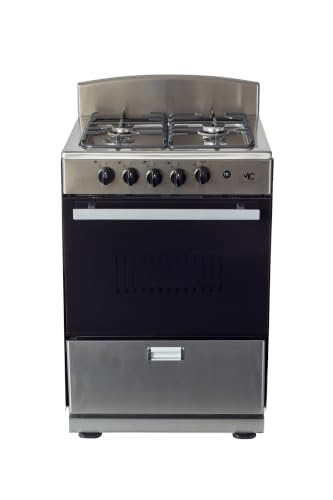
The challenger brand’s pitch fits in one number: 3.0 cubic feet, the largest oven stated at this width in this roundup, inside a freestanding stainless 24-inch range described as a space-saver design. The title adds one ultra-fast and three fast burners, cast iron grates, delivery included, and a two-year warranty — the same logistics-forward formula this maker applies at 30 inches, transplanted to the compact class. For a small kitchen that cooks big — the studio dweller who meal-preps for the week, the cabin that feeds eight twice a year — that extra oven volume is the entire argument, and it is a legitimate one.
The cast iron grates deserve a comparison note: the Frigidaire’s are continuous, while this title says cast iron without the word continuous, so a buyer who cares about slide-across cooking should confirm the grate layout on the listing rather than assuming equivalence. The burner split — one ultra-fast, three fast — reads as a speed-led map with no explicitly gentle burner, which sauce-heavy cooks should weigh; a small dedicated simmer position is the feature compact ranges most often quietly omit. As with its larger sibling, the delivery and warranty terms belong in the checkout verification, where they can be read in full rather than trusted from a headline.
- Oven capacity: 3.0 cu. ft., the largest figure stated in this roundup
- Burners: 1 ultra-fast and 3 fast, per the title
- Grates: cast iron, stated in the title — continuity of layout is a listing check
- Format: freestanding, stainless steel, space-saver design
- Terms in the title: delivery included and a 2-year warranty are claimed for the Magnificent Chef 24 — read both in full at checkout before relying on them
Strengths
- The biggest stated oven at this width, in a genuinely compact footprint.
- Cast iron grates and a speed-led burner map suit ambitious small-kitchen cooking.
- Delivery and warranty terms are stated where buyers can see them.
Trade-offs
- No gentle simmer burner is described in the title.
- A newer challenger badge means a thinner long-term track record than the incumbents.
- Grate continuity is unconfirmed from the title alone.
Best for: small kitchens with big cooking ambitions, and distance buyers who value stated delivery terms. Not suited for: sauce specialists who need a proven low simmer above all.

Avanti 20-Inch Gas Range — The true 20-inch option
This pick is 20 inches wide. Not 24, not “compact 24-class” — twenty inches, stated twice in its own title, and included here because the honest map of small-kitchen shopping has a second, smaller territory that 24-inch roundups usually pretend does not exist. If your alcove measures 24 inches, buy one of the three picks above. If it measures 20 — a boat galley, a tiny house, a pre-war studio whose range nook predates modern sizing, a garage conversion where four inches is the whole negotiation — this Avanti is one of the very few real gas ranges that fits, with four sealed burners, a broiler with pan, and a storage drawer in stainless steel.
Life at 20 inches is a discipline of pan diameters. Four burners exist, but two genuinely usable pans at once is the realistic pattern, and the oven below is a small household’s oven in the strictest sense. The title does not state its capacity, and this article will not guess it; measure your essential bakeware against the manufacturer’s stated interior dimensions before ordering. What the 20-inch Avanti offers in exchange for its limits is legitimacy: a real range from the compact specialist, with sealed burners and a broiler, instead of the hot-plate improvisation that kitchens this size usually endure. For the right alcove, that is not a compromise pick — it is the only pick, and a good one.
- Width: 20 inches — confirmed in the title, and the entire reason for this pick’s inclusion
- Burners: 4 sealed burners, per the title
- Broiler: included, with pan, per the title
- Storage: drawer included, per the title
- Oven capacity: not printed in the title — the Avanti 20-Inch Gas Range requires its interior dimensions to be checked against your pans in the manufacturer documentation
- Finish of this listing: stainless steel; as with its larger sibling, other finishes of the Avanti 20-Inch Gas Range are the same machine
Strengths
- Fits alcoves no 24-inch range can enter, without giving up real gas cooking.
- Sealed burners and an included broiler pan keep the specification honest.
- From the compact specialist brand, with the support that implies.
Trade-offs
- Two-pan cooking is the realistic ceiling on top.
- Oven capacity must be verified and will be small by any standard.
- Four inches narrower is a permanent constraint, not a starting position.
Best for: 20-inch alcoves in tiny homes, boats, and the smallest studios. Not suited for: any kitchen that can fit 24 inches — the extra width is worth too much to surrender.
The Four, Compared on What Their Titles Can Prove
| Range | Top story | Deciding virtue | Deciding limit |
|---|---|---|---|
| Avanti GR24 Stainless | 4 sealed burners, electronic ignition | Glass door and oven light in a proven compact | 2.6 cu. ft. oven asks pan discipline |
| Frigidaire 24-Inch Gas Range | Continuous cast iron grates | ADA compliance and service network | 1.9 cu. ft. oven |
| Magnificent Chef 24 | 1 ultra-fast + 3 fast burners, cast iron grates | 3.0 cu. ft. stated oven, stated delivery terms | No gentle burner described |
| Avanti 20-Inch Gas Range | 4 sealed burners, broiler with pan | Fits a true 20-inch alcove | Capacity unstated; two-pan reality |
The comparison teaches the category’s real lesson: at this size, you are not choosing features, you are choosing which limit to live with. The Avanti 24 balances its limits most evenly. The Frigidaire trades oven volume for the best grates and the accessibility story. The Magnificent Chef trades track record for the largest stated cavity. The little Avanti trades everything for four inches. Households equipping a small office kitchen alongside living space will recognize the same choose-your-limit logic in our guide to Best Corporate Coffee Machines, where capacity and footprint negotiate the same truce.
How Do You Cook Well in an Oven Measured in Tenths?
By shrinking the repertoire’s geometry, not its ambition. Half sheet pans give way to quarter sheets, which two of can still share a rack in the larger cavities here if the manufacturer’s dimensions allow it — verify, do not assume. Dutch ovens drop from the wide oval to the round five-quart form that fits every cavity in this roundup. Roasting becomes a sequence rather than a simultaneity: the bird rests, tented, while the vegetables take their turn, and the meal loses nothing except the fantasy that everything must finish in the same minute. Bakers learn their cavity’s hot corner in the first month — every small oven has one — and rotate trays by habit thereafter. None of this is deprivation; it is the ordinary craft of small kitchens everywhere on earth, most of which cook superbly at widths American marketing calls impossible.
Burner cooking adapts in parallel. One large pan, one small pan is the sustainable pattern across all four tops, and the cook who plans the meal in that shape — a braise occupying the large burner while grains simmer small — never feels the width. The Frigidaire’s continuous grates make that pattern graceful, since pans slide rather than lift; the Avanti’s sealed burners make it forgiving, since small spills stay visible and wipeable. Menu planning, in short, is the fifth burner a compact range does not have, and it is free.
What Should You Measure Before Ordering a Compact Range?
The alcove, three times: width at counter height and at floor level, because old walls lean; depth, including the gas connection’s protrusion behind the unit; and the height of any cabinet or shelf above, since compact ranges in old alcoves often sit under storage that modern clearances would question. Then measure the two pans you use most and the roasting dish you use at holidays, and set those numbers against the oven interior dimensions from the manufacturer’s documentation — not the cubic-foot headline, which counts corners no pan can occupy. Finally, measure the route: a 24-inch range passes doors a 30-inch cannot, which is one of this category’s quiet pleasures, but a 20-inch stairwell turn has ended more than one delivery.
Fuel and ignition checks ride along. Confirm whether your supply is natural gas or propane and whether the chosen model needs a conversion arrangement, because the titles in this group are largely silent on the point. Confirm the electrical need for electronic ignition models — a standard outlet within reach, which old alcoves occasionally lack. And if the kitchen is an ADU or rental, confirm who is permitted to connect gas in your jurisdiction; compact does not mean casual, and the licensed-connection rule applies at 24 inches exactly as it does at 60, a point our guide to Best 60-Inch Pro Ranges makes at the other end of the size scale.
Which Small Mistakes Do Compact-Range Buyers Repeat?
Buying by the cubic-foot headline without checking interior width, so the beloved roasting pan fits on paper and not in the oven. Counting color variants as comparison shopping and emerging more confused than informed. Assuming four burners means four pans, when the honest number is two working pans and a small third. Forgetting that a 20-inch model exists until after forcing a renovation around a 24-inch alcove that was never going to fit. And skipping the storage question: in a kitchen this size, a range without a drawer — or a household that never opens the drawer it has — exiles the sheet pans to the oven itself, where they must be evicted at every preheat.
Final Recommendation
Choose the Avanti GR24 if you want the balanced compact: sealed burners, electronic ignition, a mid-sized stated oven, and the door-and-light combination that respects a small cavity’s heat. Choose the Frigidaire when continuous grates, accessibility, and service reach lead your list, and accept its small oven as the fair price. Choose the Magnificent Chef when oven volume inside a small footprint is the whole argument, and verify its grate layout and terms at checkout. And choose the 20-inch Avanti without a moment’s embarrassment when the alcove says twenty — it is a real range for a real kitchen size, not a consolation prize. In a category with only three families, the best purchase is simply the family whose limits match the limits you already live with happily.
Frequently Asked Questions
Why does this roundup have four picks instead of six or more?
Because the market honestly contains three model families at 24 inches, plus one genuine 20-inch model. The dozens of other listings are finish and color variants of these same machines. Padding the list with duplicates would look thorough and be false.
Is the 20-inch Avanti a lesser version of the 24-inch?
It is a different size of range for a different alcove, with its own specification — four sealed burners, a broiler with pan, and a storage drawer. If your space fits 24 inches, the larger models serve you better; if it fits only 20, this is a complete range, not a compromise gadget.
What size turkey fits in these ovens?
Work from interior dimensions, not headlines. The 1.9 cubic foot Frigidaire suits a small bird or a breast; the 3.0 cubic foot Magnificent Chef, as the largest stated cavity, gives the most room — but verify the manufacturer’s interior width and height against your roasting pan before planning a holiday around any of them.
Are the different colors of the Avanti different models?
No. Finish variants of the GR24 are the same machine in different clothes, which is why only one listing per family is linked here. Choose the finish for the room; the burners, oven, and hardware do not change with the color.
Do compact gas ranges need a hood?
They need ventilation like any gas cooking — ideally a hood vented outdoors, sized to a small kitchen rather than to a restaurant line. At minimum, follow the range manual’s clearance and ventilation guidance, and keep a working carbon monoxide alarm in any home with fuel-burning appliances.
A Second Pass: Which Small Kitchen Gets Which Range?
Consider the pre-war apartment first, the one with the alcove, the tin ceiling, and a tenant who genuinely cooks. That kitchen’s range works daily and rests never, and it rewards the Avanti GR24’s balance — sealed burners for the spills of a one-sink cleanup life, a door window for the small oven’s heat, a drawer for the pans that have no cabinet. Now the accessible remodel: a parent moving into a ground-floor suite, a cook whose grip is not what it was. The Frigidaire’s continuous grates and ADA-reviewed design stop being features and become the architecture of independence, letting pans slide and controls sit where hands expect them.
The studio meal-prepper is the Magnificent Chef’s natural owner — one person, one small kitchen, seven days of lunches cooked in a Sunday session that needs every tenth of that 3.0 cubic foot claim and treats the range as production equipment. And the 20-inch Avanti belongs to the kitchens that would otherwise have no range at all: the tiny house on its foundation blocks, the boat refitted for weekends, the basement suite where four inches decided whether cooking meant a flame or a hot plate. Four households, four different correct answers, one honest market of three families plus a smaller sibling — this is what shopping looks like when the duplicates are folded away.
How Does a Compact Range Change the Rest of a Small Kitchen?
It returns counter space to its owner, and counter space in a small kitchen is the currency everything else is priced in. Six inches saved against a 30-inch range is a knife block, a coffee station, or simply an empty stretch where a cutting board can live permanently — the single greatest luxury a small kitchen can own. The range also sets the room’s workflow geometry: with two working burners as the honest pattern, the sink and the counter form a tight triangle with the stove, and a cook who arranges the prep zone within one step of the burners will move less in an evening than a cook in a sprawling kitchen with an island. Smallness, organized, is efficiency wearing a disguise.
Storage planning follows the range’s lead. The drawer under the oven — present in both Avanti titles and worth verifying on the others — should hold the pans in their order of use, not become the drawer of last resort for lids without pots. Vertical space above a compact range is precious and mostly forbidden by clearance rules, so the small kitchen’s storage grows sideways: a rail for utensils, a magnetic strip for knives, shelves where a larger kitchen would put cabinets. None of this is specific to a badge, but all of it is unlocked by choosing the range’s width deliberately instead of inheriting whatever the alcove’s previous tenant tolerated.
What About Propane, Cabins, and Life Beyond the Gas Main?
A large share of compact ranges live where natural gas does not: cabins, rural rentals, farm outbuildings converted to dwellings. For those kitchens, the fuel question outranks every feature in this article, and the titles here are mostly silent on it — which means the conversion conversation happens with the manufacturer’s documentation and a licensed installer before the range ships, not after it lands on a porch forty miles from the nearest gas fitter. Ask whether the model converts, what the conversion requires, and who locally performs it; the answers differ by family and are not guessable from a photograph.
Ignition is the second off-main question. Electronic ignition, like the Avanti GR24’s, needs household electricity at the moment of lighting — trivial on the grid, a consideration where power is solar, generator, or intermittent. A range that lights with a match during an outage is a resilience feature some rural households rank above every other specification, and it is a fair question to put to each family’s documentation. The compact category’s maturity helps here: these are long-running designs, and their behavior on propane and on imperfect infrastructure is documented in a way a brand-new model’s never is.
How Do You Keep a Small Range Cooking Like New?
Compact ranges age at the same points as large ones — igniters, seals, burner ports — but their small ovens punish neglect faster, because a thin layer of baked-on soil is a larger fraction of a small cavity and a warped seal leaks a larger share of its heat. The weekly habits are identical in spirit to any gas range: burners wiped once cool, caps kept clear, flames eyeballed for the steady blue that signals health. Sealed-burner models forgive the small kitchen’s spills; continuous grates ask to be lifted and washed rather than drowned in place. The oven light on the Avanti earns a maintenance footnote — a bulb is a trivial replacement that owners postpone for years, surrendering the door-window advantage they paid for; replace it the week it dies.
Storage drawers deserve one caution: they sit under a hot oven, which makes them right for pans and wrong for anything wooden, plastic, or aerosol that wandered in during a move. And in rental service, the compact range’s best friend is a tenant briefing — two minutes on ignition behavior and grate care at move-in prevents the service calls that landlords otherwise file under mysterious breakage. Small ranges are not fragile; they are simply honest about the care all ranges want.
What Should Landlords and ADU Builders Take From This Short List?
Accessory dwelling units are where compact ranges do their growth work, and the purchasing logic there is a landlord’s logic: durability, serviceability, and tenant-proof simplicity outrank every cooking nuance. The established families win that argument most years — parts on shelves, manuals online, and a generation of technicians who have serviced the design before. The challenger’s counter-argument is written in its title: stated delivery and a stated warranty term simplify a purchase made for a property across town. Either way, the professional move is identical: have the gas connection made by a licensed fitter, file the paperwork with the unit’s records, and leave the tenant a one-page note on ignition and cleaning. A compact range in a rental is an appliance that should be invisible for a decade, and invisibility is an outcome purchased with installation quality, not with features.
Builders speccing several units at once should also note the variant trap from the other side: ordering six ranges across three finish listings of one family is ordering one model six times, which is fine — spares and knowledge standardize beautifully — provided the order is placed knowingly. Standardizing a small portfolio on one family is a legitimate strategy; believing you diversified when you did not is merely a bookkeeping error with a delivery date.
How Does Baking — Real Baking — Fare at This Size?
Better than the cubic-foot numbers suggest, provided the baker adapts the vessel rather than the ambition. A compact oven bakes a loaf in a Dutch oven beautifully, because the vessel creates its own microclimate and the cavity only has to be hot and reasonably even. Sheet-pan work shrinks to quarter sheets, which brown more evenly in a small cavity than a half sheet ever did in a large one, since the tray sits fully inside the oven’s consistent zone instead of spanning its gradients. Layer cakes bake one tier at a time — a constraint that professional bakers in small European ovens have turned into a quality argument, since each tier gets the rack position and the attention it deserves.
What compact ovens will not do is forgive crowding. Two trays in a 1.9 cubic foot cavity block the airflow that evenness depends on, and the honest technique is sequence: biscuits while the casserole rests, vegetables while the roast stands. None of the titles in this roundup claims convection, so plan on still-air behavior — a known hot corner, a mid-bake rotation — and verify any fan claim in documentation before relying on it. Bakers who accept those terms produce excellent work at 24 inches, as several generations of apartment bakers can testify; bakers who need three racks at once need a different width, and no title in this category will change that.
What Happens on Delivery and Installation Day?
Mostly, relief — this is the one range category where delivery is genuinely easy. A 24-inch unit passes standard doors, turns in ordinary hallways, and can often be handled by the installer without a crew, which collapses the freight drama that dominates the larger categories in this batch. The checks remain the checks, in miniature: inspect the glass door and grates before signing, confirm the model and finish against the order, and have the licensed connection made with a leak test rather than a handshake. Level the unit with particular care, because a small range on an old floor shows its tilt in every saucepan, and small ovens preheat fast enough that the burn-off cycle is a short, windows-open formality rather than an afternoon.
Then cook the calibration meal — something known, something forgiving — and learn the cavity’s signature while the stakes are low. Note where the oven’s hot corner lives, which burner simmers most gently, and how the grates feel under your heaviest pan. A compact range learned this way in its first week becomes an instrument; the same range left unlearned stays an appliance that its owner blames for the oven’s entirely predictable geography.
Why Do Small Kitchens Cook Bigger Than Their Reputation?
Because constraint is a teacher. The compact kitchen’s cook owns fewer pans, knows each one, and plans meals in sequences that use the whole small range deliberately — skills that transfer upward if the household ever moves to a wider kitchen, and that wide-kitchen cooks often never learn. Restaurants know this: the great small kitchens of the world run on two burners and an oven the size of these, producing food that shames suburban acreage. The point of this roundup is not to apologize for 24 inches but to equip it properly, and the three families here — plus the 20-inch sibling for the smallest alcoves — are the equipment that a century of small kitchens has effectively voted for by keeping them in production.
There is also a sustainability footnote that deserves daylight: a small oven heats a small volume, and a household that cooks daily in 2 cubic feet uses less energy across a year than one heating 5 cubic feet for the same two-person meals. Nobody should buy a range on that basis alone, but the compact household can note, with some satisfaction, that its constraint and its efficiency are the same fact viewed from two sides.
Which Questions Should You Put to the Seller Before a Compact Order?
Ask for the interior oven dimensions in inches, not the cubic-foot headline, and set them against your largest pan. Ask whether the finish in the cart is the finish you chose, in a category where one model wears three listings. Ask what the delivery includes at this size — parcel, threshold, or placement — and whether haul-away of the old unit is offered, since removing a dead range from a fourth-floor walk-up is its own small project. Ask about the conversion path for your fuel, in writing. And ask who services the brand within your postcode, because the answer distinguishes a purchase from a postponement. Five questions, ten minutes, and the compact range that arrives will be the one the kitchen was measured for.
Can a 24-inch range replace a 30-inch without cabinet work?
Not invisibly. Six inches of gap must be filled — with a filler strip, a narrow pull-out, or a redesigned run — and the countertop must be addressed, or the installation reads as temporary forever. Households downsizing deliberately, for accessibility or an ADU conversion, plan that filler as part of the project; households hoping the gap will go unnoticed are disappointed by it daily.
Is a storage drawer under a small oven actually useful?
Yes, for exactly the pans the small kitchen cannot store elsewhere — provided it holds pans and only pans. In a compact kitchen the drawer is prime real estate, and both Avanti titles in this roundup include one; treat it as the roasting pan’s home and it repays its inclusion every week.
How Long Should a Compact Range Last, and What Decides It?
These are simple machines by modern standards — burners, an oven, an ignition system — and simple machines reward their owners with long service when the small disciplines hold: seals wiped, ports clear, the drawer kept for pans, the oven light bulb actually replaced. The established families add a second longevity factor that no specification can print: production maturity. A design that has been built for years has had its weak points found and engineered out, and its parts pipeline stocked by demand. The challenger’s counter is its stated warranty term, which is a promise the incumbents’ titles do not make in so many words. A buyer weighing a decade of service should weigh both — the maturity you can inspect and the promise you can hold — and choose the one whose evidence they trust more.
When a compact range does reach its end, it usually announces the fact honestly: an oven that will not hold temperature, an igniter on its third replacement, a door seal gone hard and cracked. At that point the category’s smallness becomes a mercy — the replacement decision is the same short list, the alcove has not changed, and the household can re-run this article’s questions in an afternoon, pans already measured, lessons already learned.
What Is the Daily Rhythm of Cooking on Two Honest Burners?
It begins with mise en place, because a compact top has no spare corner where ingredients can wait their turn in the pan’s neighborhood. The small-kitchen cook chops everything first, lines the bowls along the counter the range’s narrowness freed up, and then cooks in a flow that larger kitchens interrupt with wandering. Sauces reduce while proteins rest; grains hold in their pot, off the flame, in the residual heat that a heavy pan keeps generously. The meal arrives in waves that turn out to be a pleasanter way to eat than the all-at-once landing of a wide-range production — a course, a pause, a conversation, the next course — and many compact households, given the hypothetical upgrade, admit they would keep the rhythm even with six burners standing by.
Breakfast is the compact range’s showcase meal: eggs in the small skillet, toast from the oven’s residual warmth or a countertop companion, coffee from the counter space the narrow range returned. Dinner parties are its examination, and the technique that passes is sequencing with confidence — a braise that improves by resting, a salad that wants no heat at all, a dessert baked in the morning. None of this requires apology or even much talent; it requires deciding the order before the first burner lights, which is to say it requires cooking the way cooks cooked for most of history, in kitchens that would make a 24-inch alcove look generous.
A final word for the buyer standing in the alcove with a tape measure, half persuaded that a small range means a small cooking life. The tape is telling the truth about the kitchen; it says nothing about the meals. Measure the alcove honestly, choose the family whose limits rhyme with your habits, have the connection made properly, and then cook the food you actually love at the width you actually have — which is, in the end, the only specification that has ever mattered in any kitchen of any size.
How Should a Small Kitchen Handle Ventilation and Air?
Proportionally, a compact range asks less of a hood than a wide one — fewer burners, smaller total output — but small kitchens concentrate what cooking produces into a smaller volume of air, so the case for a real, outdoor-vented hood remains strong. Where a ducted hood is impossible — a rental, a landmarked building — the hierarchy of fallbacks is honest: a ductless hood with maintained filters captures grease but not moisture or combustion gases, a window fan exhausts genuinely if the layout cooperates, and the cook’s habits (lids on pots, the back burners preferred, the door open a crack) do the rest. What no compact household should do is treat the range’s smallness as ventilation’s exemption; gas combustion is gas combustion at any width, and the carbon monoxide alarm belongs in the small home exactly as in the large one.
What Does the Holiday Test Look Like at 24 Inches?
It looks like a plan made on Tuesday. The bird — sized to the cavity by measurement, not optimism — roasts in the morning and rests, tented and patient, while the oven turns to the sides in sequence. The top runs its two-pan pattern: gravy in the small pan, a vegetable in the large one, nothing waiting for a burner that does not exist. Dessert was baked yesterday, because compact households learn that the oven’s calendar is as real as its dimensions. Guests who eat the result rarely guess the range’s width, because a well-sequenced meal arrives as abundance; the only witness to the choreography is the cook, who has usually made peace with it years ago and privately considers the performance a point of pride. That pride is the compact category’s open secret, and it is available with any of the three families — the fourth, smaller Avanti simply asks for a smaller bird and the same clear-eyed planning.
Keep the purchase paperwork in the drawer that is not under the oven — the order confirmation naming the exact model and finish, the installer’s invoice, a photograph of the rating plate. In a category built on near-identical listings, that small file is what turns a future warranty call or parts order from a guessing game into a single phone call, and it costs ten minutes on the day the range arrives.
One More Distinction: Compact by Choice Versus Compact by Constraint
Some of these kitchens chose their width — the ADU designed on purpose, the tiny house drawn around its owner’s values — and some inherited it from a century-old wall. The distinction matters to satisfaction more than to shopping, because both kitchens buy from the same three families, but the choosers tend to outfit the rest of the room to match: pans sized to the cavities, storage planned around the drawer, a menu repertoire built in sequences. The inheritors who thrive do exactly the same things a year later, after the first holiday teaches the lessons this article has tried to teach in advance. Either way, the range is the room’s fixed point, and everything else in a small kitchen is negotiable — which is a liberating thought to end on, since it means the four decisions above are the only ones that have to be right.
And if the household grows — a partner, a child, a parent moving in — the compact range absorbs the change the way it absorbs everything: by sequence and by planning, with the occasional assist from a countertop companion appliance on the counter its narrowness preserved. Kitchens outgrow ranges more slowly than folklore claims, and many a household that swore it needed thirty inches at the first child is still cooking, contentedly and well, at twenty-four when that child leaves for college.
So the shortlist stays short on purpose. Three families, one smaller sibling, no padding — and a decision that comes down to grates, capacity, accessibility, and four honest inches. Make it with a tape measure in one hand and your largest pan in the other, and the range that arrives will fit the alcove, the household, and the life cooked in both.
One last encouragement belongs to the cook who has been making do with a hot plate or a borrowed burner while saving for a real range: the step from improvisation to any of these four is the largest single upgrade a small kitchen can receive, larger than any later step between families. Flame, oven, broiler, and a door that closes on heat — once those are in the room, the kitchen is complete, and everything after is refinement.
Small kitchens also forgive slowly and remember kindly: a range chosen carefully at this size tends to be kept, maintained, and handed along — to the next tenant, the next owner, the grown child furnishing a first apartment — long after wider appliances have been replaced twice. Buy the family that fits, and you may be buying for two households: yours now, and someone else’s later.
That hand-me-down quality is worth one practical step at purchase: register the appliance or save the dated receipt somewhere durable, because the second household in a compact range’s life almost never receives its paperwork, and the model number on the rating plate becomes the whole of its inheritance. Photograph that plate on installation day — it takes a minute, and it serves every owner the range will ever have.
Related Guides
Fitting out the same small footprint off the grid, or nearly? Our guide to Best 24-Inch Gas Ranges for Off-Grid Kitchens takes this exact size class into cabins and low-infrastructure homes, where ignition and fuel questions matter even more.


