What's inside
- Key Takeaways
- Sixty Inches, Two Different Species
- How Did We Sort Flagships From Line Equipment?
- Reading the Six as Two Shopping Lists, Not One
- What Does a Commercial Installation Actually Demand?
- How Do You Ventilate Ten Burners Without Regretting It?
- Which Errors Do 60-Inch Buyers Make Most Often?
- Final Recommendation
- Frequently Asked Questions
- A Second Pass: Living and Working With Each of the Six
- What Does the Whole Project Cost Beyond the Range Itself?
- How Does a Dual-Fuel Flagship Behave Across a Year of Home Cooking?
- What Happens on Delivery Day With a Machine This Size?
- How Should a Small Operator Choose Between the Four Commercial Units?
- What Does Griddle Ownership Really Involve, Morning and Night?
- Why Do Flagship Buyers and Line Buyers Talk Past Each Other?
- What Should a Buyer Verify in Writing Before Any 60-Inch Order?
- How Do Insurance and Resale Enter the 60-Inch Conversation?
- What Does It Cost to Run a Range This Size?
- How Do You Train a Household or a Crew on a New Line?
- Related Guides
As an Amazon Associate I earn from qualifying purchases. This post may contain affiliate links at no extra cost to you.
**cottageverdict.com is reader-supported. When you buy through links on our site, we may earn an affiliate commission.**
Where these machines are bought matters less than how they arrive: every pick below is a freight purchase through its Amazon listing, with delivery scope, liftgate needs, and placement terms to confirm in writing before payment. Use the “check price on Amazon” prompts as a cue to verify the exact fuel configuration on the listing page, because at this size a wrong-variant order is not an inconvenience — it is a freight claim.
The premise of this roundup must be stated before any product name: the best 60-inch pro ranges are, with two exceptions, commercial restaurant equipment. Four of the six picks below are built for commercial kitchens — commercial gas supply, commercial ventilation, commercial clearances, and in many jurisdictions a hard legal line against installing them in a residence at all. The remaining two are residential dual-fuel flagships that borrow the width and the drama while keeping home certification. Everything else in this article — the installation requirements, the ventilation arithmetic, the clearance rules, the insurance questions — flows from that split, and it is treated here as the main subject rather than a footnote, because a 60-inch range installed wrong is not a disappointment. It is a hazard with a warranty void stapled to it.
Who legitimately shops at this width? Three buyers. The estate or farmhouse kitchen designed from the studs around a residential flagship, with the electrical and ventilation planned alongside. The small restaurant, bakery, or catering operation buying a line range for a premises that already meets commercial code. And the serious cooking household — a bed-and-breakfast, a community kitchen, a multi-generational home — that has done the code homework and knows which side of the commercial line its building sits on. If none of those describes the project, the honest advice is to stop here and buy a superb 36- or 48-inch residential range instead.
Key Takeaways
- Sixty inches splits into two species: two residential dual-fuel flagships and four commercial restaurant ranges, with different rules for each.
- Commercial models assume commercial gas supply, ventilation, and clearances; many home kitchens cannot legally host them.
- Griddle configuration is the great divider among the commercial picks — 24 inches on one, 36 inches on another, none on the ten-burner units.
- One pick is listed in a natural-gas configuration only here; its propane sibling is the same model and is not a separate pick.
- Installation planning — gas line, hood, floor, doorway route — costs real money and must be budgeted before the range is ordered.
Sixty Inches, Two Different Species
| Range | Species | What the title promises |
|---|---|---|
| Capriasca 60 Dual Fuel — The residential flagship | Home dual-fuel | Ten burners and true-convection double ovens at 8.54 cu. ft. combined; check price on Amazon. |
| Lofra DolceVita 60 — The Italian design flagship | Home dual-fuel | Eight sealed brass burners, nine cooking modes, brass trim in lavender; check price on Amazon. |
| MoTak MR10-C-S 60 — True commercial line unit | Commercial | Ten burners at a stated per-burner output, dual full-size ovens, backriser shelf; check price on Amazon. |
| KoolMore KM-CRGB60-NG — Griddle-and-broiler workhorse | Commercial | Six burners plus a 24-inch griddle and broiler in natural gas; check price on Amazon. |
| Southbend S-Series 60 — The restaurant-industry standard | Commercial | Ten open burners and two standard ovens from a career commercial maker; check price on Amazon. |
| Kratos 60 with 36 Griddle — Griddle-first commercial layout | Commercial | A 36-inch griddle flanked by four burners over two standard ovens; check price on Amazon. |
How Did We Sort Flagships From Line Equipment?
The sort began with the title’s own vocabulary. Listings that say “dual fuel” and “freestanding” in a residential voice went to the flagship pile; listings that say “commercial,” “restaurant,” or quote per-burner output and oven temperature ranges went to the line pile. That vocabulary is not marketing decoration — it tracks certification, and certification tracks where the machine may legally live. The two piles were then reviewed separately, because comparing a Lofra against a Southbend on the same criteria would be like comparing a grand piano against a forklift on tone.
Within the commercial pile, configuration decided the order of discussion: pure burner arrays for sauté-heavy lines, griddle-led layouts for breakfast and short-order work, and a mixed griddle-broiler unit between them. Within the flagship pile, the split is temperament — one model maximizes burner count and stated oven volume, the other wraps eight burners in Italian design and brass. Readers at the opposite end of the size spectrum, fitting out a small apartment or an accessory dwelling, will find the same species-sorting logic applied in miniature in our guide to Best 24-Inch Gas Ranges.
Fuel variants were handled strictly. The KoolMore appears once, in its natural-gas configuration; a propane version of the same model exists in the marketplace and is the same machine, so it is mentioned in prose within that pick’s section and never counted as a second pick. Everywhere in this article, a specification is claimed only when a listing title states it, and commercial temperature or output figures are quoted exactly as their titles give them — no borrowed numbers from sibling models, no rounding in the reader’s favor.

Capriasca 60 Dual Fuel — The residential flagship
The Capriasca is what a household actually means when it dreams about this width: a 60-inch dual-fuel range in stainless steel, with ten burners on a gas top and true-convection double ovens below, the combined oven capacity stated at 8.54 cubic feet. Dual fuel is the connoisseur’s arrangement — gas above for visible, instant flame control, electric below for the dry, even, precisely held heat that pastry and roasting reward — and at 60 inches it stops being a luxury configuration and becomes the sensible default, because no residential gas oven section will match an electric element’s steadiness across two full cavities.
Ten burners is a number to interrogate rather than applaud. On a working top, ten burners means a line of smaller burners rather than ten stockpot stations, and its real value is parallelism: sauces, sides, and sautés proceeding simultaneously during the twenty minutes when a large dinner converges. The double ovens carry the heavier practical load — two temperatures at once, a roast in one cavity and a gratin in the other, or a single oven running while the second stays cold on a weeknight. Even as a residential model, this machine demands a serious electrical supply for its oven section and a hood sized for a ten-burner top; “residential” describes its certification, not its appetite.
- Fuel arrangement: dual fuel — gas cooktop, electric ovens, per the title
- Burners: 10, stated in the title
- Ovens: double ovens with true convection, combined capacity stated at 8.54 cu. ft.
- Finish: stainless steel
- Electrical demand: the oven section’s exact circuit requirement sits in the manual — have an electrician confirm capacity before the Capriasca 60 Dual Fuel is ordered, not after
- When the Capriasca 60 Dual Fuel is your pick, budget the hood and the circuit work into the same project plan
Strengths
- The full flagship formula — dual fuel, ten burners, twin convection ovens — in one residential unit.
- True convection in the ovens is the baker-grade configuration, not a fan-only nod.
- Stated combined capacity is the largest in this roundup.
Trade-offs
- Ten burners crowd; large pans will still negotiate for the best positions.
- Dual fuel means two utility connections to plan, run, and pay for.
- A residential flagship at this width is a design commitment the whole kitchen must support.
Best for: estate kitchens and serious home cooks building the room around the range from the start. Not suited for: a drop-in replacement project with existing wiring and a standard hood.

Lofra DolceVita 60 — The Italian design flagship
Lofra builds ranges in Italy that treat the appliance as furniture, and the DolceVita in lavender with brass knobs and a brass handrail is the boldest object in this roundup by a wide margin. Beneath the styling, the title states a serious specification: a freestanding dual-fuel range with a double oven, eight sealed brass burners on top, convection, and nine cooking modes. Sealed burners matter practically — spills stay on the surface instead of migrating into the burner box — and brass burner construction is a durability and heat-conduction choice as much as an aesthetic one, the kind of detail that separates a design object that cooks from a cooking appliance that merely poses.
Nine cooking modes in the oven section signal an electronic control philosophy closer to a European wall oven than to a restaurant range: programmed combinations of elements and fan for specific tasks. Cooks who bake European pastry, proof dough, or slow-roast by program will use them; cooks who want a knob and a number should be honest with themselves before choosing this over the Capriasca. The lavender finish, like the red door in smaller categories, is a household decision with a decade-long tail — cabinet color, flooring tone, and eventually a buyer’s taste all orbit it. Chosen deliberately, it is magnificent. Chosen impulsively, it is a very large, very purple commitment.
- Fuel arrangement: dual fuel with a double oven, freestanding, per the title
- Burners: 8 sealed brass burners, stated in the title
- Oven system: convection with 9 cooking modes, per the title
- Trim: knobs and handrail in brass; finish in lavender, per the title
- Oven capacity: the title does not print a figure, so the Lofra DolceVita 60 asks capacity-driven buyers to consult its documentation
- Service planning matters with an Italian import — confirm parts and service channels for the Lofra DolceVita 60 in your region before ordering
Strengths
- Sealed brass burners pair genuine function with the design story.
- Nine oven modes serve program-driven bakers unusually well at this width.
- Nothing else in the category looks like it, in a market of stainless uniformity.
Trade-offs
- The lavender finish will divide households, guests, and future buyers.
- Eight burners, not ten — parallelism yields slightly to design.
- Imported-brand service networks require advance homework.
Best for: design-led flagship kitchens where the range is the room’s artwork and baking is program-driven. Not suited for: neutral palettes, quick resale horizons, or knob-and-number traditionalists.
MoTak MR10-C-S 60 — True commercial line unit
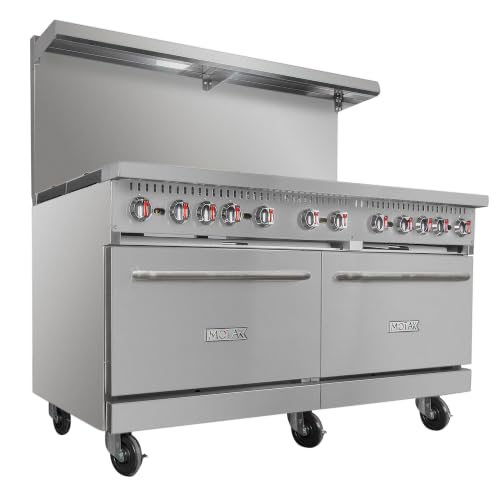
From here on, the roundup crosses into restaurant equipment, and the MoTak announces the crossing in its title’s own numbers: a 60-inch commercial gas range with ten burners rated at 30,000 BTU per burner, dual full-size ovens, cast iron grates, an oven range of 200 to 550 degrees Fahrenheit, and a 24.75-inch backriser shelf. That backriser is a line cook’s detail — a raised rear shelf that keeps pans, plates, and seasoning within reach above the back burners — and its presence tells you this machine was specified by people who outfit working kitchens, not styled by people who photograph them.
Ten burners at a stated commercial output is a sauté station, designed for a cook standing in one place working pans in sequence, and the dual full-size ovens beneath are the standard ovens of the trade: capacious, direct, and innocent of convection fans and cooking programs. Everything about the unit assumes its environment — a gas line sized for the total draw, a Type I hood with fire suppression where code requires it, non-combustible surroundings, and an operator who cooks in volume daily. Placed in that environment, it is a rational, serviceable tool with parts channels behind it. Placed in a suburban kitchen, it is a code violation with excellent grates.
- Class: commercial gas range, stated in the title
- Burners: 10, at 30,000 BTU per burner per the title
- Ovens: dual full-size ovens, oven range 200–550°F per the title
- Grates: cast iron, stated in the title
- Backriser shelf: 24.75-inch, per the title
- The MoTak MR10-C-S 60 belongs where commercial code is already satisfied — confirm your premises qualify before the MoTak MR10-C-S 60 is even quoted for delivery
Strengths
- Stated per-burner output gives operators real planning numbers.
- The backriser shelf is genuine line ergonomics, not decoration.
- Dual full-size ovens match high-volume batch work.
Trade-offs
- Commercial installation requirements exclude most homes outright.
- No convection or programmed modes — standard ovens only.
- Total gas draw demands a supply sized by a professional.
Best for: restaurants and caterers building a sauté-led line on code-compliant premises. Not suited for: any residence that has not been specifically engineered and approved for commercial equipment.

KoolMore KM-CRGB60-NG — Griddle-and-broiler workhorse
The KoolMore rearranges the 60-inch top around a different style of cooking: six burners, a 24-inch griddle, and a broiler, in a commercial natural-gas range. That layout is the classic American short-order station. The griddle handles eggs, pancakes, burgers, and onions in continuous service while the burners take soups and sauces, and the broiler finishes gratins and melts cheese at a speed no oven broiler in a residential range attempts. For a diner, a food truck commissary, or a busy café, this division of labor is worth more than four additional burners standing idle.
The configuration note from the brief bears repeating in plain terms: this pick is the natural-gas version, the KM-CRGB60-NG. A propane version of the same model circulates in the marketplace; it is the same machine configured for the other fuel, not a different or better range, and it is therefore not a separate pick here. Buyers on propane should shop that variant knowing it is this range’s sibling, and buyers on natural gas should verify the NG designation survives all the way to the checkout confirmation, because at commercial sizes a fuel mistake is measured in freight charges and lost trading days.
- Class: commercial range, natural gas configuration, per the title
- Top layout: 6 burners plus a 24-inch griddle, per the title
- Broiler: included, stated in the title
- Fuel: this listing is the natural-gas model — the propane version is the same KoolMore KM-CRGB60-NG family machine in another configuration
- Oven details: the title does not detail the oven section, so operators should pull the full specification for the KoolMore KM-CRGB60-NG before planning a menu around it
Strengths
- The griddle-plus-broiler layout matches short-order service perfectly.
- Six burners remain plenty when the griddle carries the volume work.
- A recognized commercial configuration with a clear model designation.
Trade-offs
- Griddle seasoning and cleaning become a daily closing ritual.
- Fuel configuration discipline is essential at ordering.
- Oven specifications require a documentation step beyond the title.
Best for: diners, cafés, and commissaries whose menu lives on a griddle. Not suited for: sauté-led fine-dining lines or any residential setting.
Southbend S-Series 60 — The restaurant-industry standard
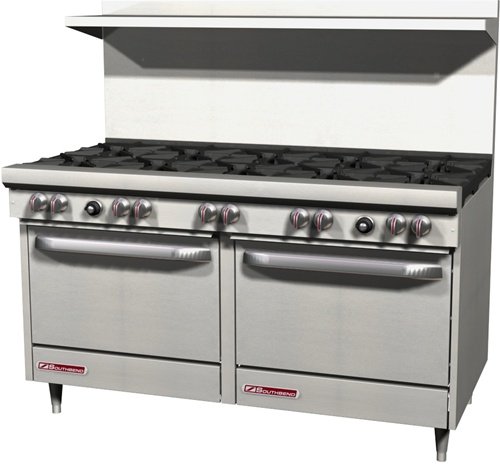
Southbend is one of the names that commercial kitchens are simply built from, and its S-Series 60-inch restaurant range states its case with trade brevity: ten open burners, two standard ovens, sixty inches of gas restaurant range. Open burners — as opposed to sealed — are the traditional commercial choice, lifting out for cleaning and tolerating the violent pace of a service line, and their presence here marks the difference in philosophy between this machine and the sealed-burner flagships above. This is equipment specified by people who will employ cooks to stand at it, and serviced by technicians who stock its parts as a matter of routine.
That service ecosystem is the deepest argument for the Southbend. A restaurant range is not a purchase; it is a decade of gaskets, igniters, thermostats, and grate replacements, and the value of a career commercial maker is that every one of those parts has a number, a warehouse, and a technician within driving distance of most American cities. The title’s restraint — no oven capacity, no output figures — reflects a trade channel where the buyer reads a spec sheet, not a headline. Operators should do exactly that, and households should take the hint: nothing about this listing is addressed to them.
- Class: gas restaurant range, stated in the title
- Burners: 10 open burners, per the title
- Ovens: 2 standard ovens, per the title
- Burner output and oven capacity: not printed in the title — trade buyers will pull the spec sheet for the Southbend S-Series 60 as a matter of course
- Parts and service depth is the Southbend S-Series 60 story; verify your local service coverage as part of the purchase
Strengths
- A career commercial maker’s parts and service ecosystem stands behind it.
- Open burners suit high-pace line cleaning and service.
- The configuration is the industry reference layout for a reason.
Trade-offs
- Open burners let spills into the burner box — line cleaning is a discipline.
- Standard ovens only; no convection claim in the title.
- Entirely a commercial proposition, with commercial premises required.
Best for: established restaurants prioritizing serviceability over novelty. Not suited for: homes, startups without a service relationship, or buyers wanting programmed ovens.

Kratos 60 with 36 Griddle — Griddle-first commercial layout
Kratos pushes the griddle logic further than the KoolMore dares: a 60-inch commercial gas range where a 36-inch griddle takes the majority of the top, flanked by four burners, over two standard ovens, in natural gas. Read that layout as a menu written in steel. Thirty-six inches of griddle is a breakfast service, a smash-burger lunch, and a cheesesteak dinner on one continuous heated plate, with the four burners demoted to support work — soup, sauce, a sauté to order. If your concept’s tickets are eighty percent flat-top work, this is the correct shape of range and the ten-burner arrays are the distraction.
The trade embedded in the layout is equally clear. Four burners is a hard ceiling on pan work, and a kitchen that discovers mid-service that it needed six will not forgive the griddle its acreage. Griddle ownership also brings the heaviest daily maintenance in this roundup: seasoning management, grease handling, and a cool-down cleaning ritual that closes the kitchen every night. Kratos, as a commercial foodservice brand, sells into operations that already employ that ritual. For them, this configuration concentrates money exactly where the tickets are, which is the most professional sentence that can be written about any range in this article.
- Class: commercial gas range, natural gas, per the title
- Top layout: 36-inch griddle with 4 burners, per the title
- Ovens: 2 standard ovens, stated in the title
- Model reference in the title: 29Y-171-NAT
- Griddle plate specifications are a documentation item — anyone planning a high-volume flat-top menu on the Kratos 60 with 36 Griddle should confirm plate thickness and heat zoning from the spec sheet
Strengths
- The largest griddle allocation in this roundup, matched to flat-top-led menus.
- Two standard ovens still provide batch capacity beneath the top.
- Money is spent where a griddle concept actually earns.
Trade-offs
- Four burners cap pan work permanently.
- Griddle upkeep is the heaviest daily ritual here.
- A narrow-concept machine; pivoting the menu means replacing the range.
Best for: breakfast and burger concepts built around the flat-top. Not suited for: sauté-led menus or operations unsure of their concept’s direction.
Reading the Six as Two Shopping Lists, Not One
| Model | Top configuration | Oven arrangement | Installation reality |
|---|---|---|---|
| Capriasca 60 Dual Fuel | 10 gas burners | Double ovens, true convection, 8.54 cu. ft. stated | Residential certification; serious circuit and hood |
| Lofra DolceVita 60 | 8 sealed brass burners | Double oven, convection, 9 modes | Residential certification; import service homework |
| MoTak MR10-C-S 60 | 10 burners at stated output, backriser | Dual full-size standard ovens | Commercial premises, gas, and ventilation required |
| KoolMore KM-CRGB60-NG | 6 burners + 24-inch griddle, broiler | Details beyond the title — verify | Commercial premises; NG configuration discipline |
| Southbend S-Series 60 | 10 open burners | 2 standard ovens | Commercial premises; trade service network |
| Kratos 60 with 36 Griddle | 36-inch griddle + 4 burners | 2 standard ovens | Commercial premises; griddle ritual staffing |
The table’s last column is the one that decides purchases. A flagship buyer is planning a kitchen project; a commercial buyer is satisfying a code environment that either already exists or must be built by licensed trades before the range ships. Kitchens that also run serious cold storage will recognize the same premises logic in our guide to Best Commercial Deep Freezers, where the commercial-versus-household line is drawn with the same firmness.
What Does a Commercial Installation Actually Demand?
Start with the gas supply. Ten commercial burners lit together, plus two oven burners, draw gas at a rate a residential service was never sized for; the supply line, meter capacity, and regulator all become engineering questions answered by the gas utility and a licensed fitter, not by optimism. Continue with ventilation: commercial cooking requires a hood system engineered for grease-laden vapor, typically with fire suppression interlocked to the gas supply, inspected and permitted. Clearances follow — specified distances to combustible surfaces, often effectively requiring non-combustible wall and floor finishes around the range. Then the floor itself, which must carry a machine that can weigh as much as a small car once ovens and griddle plate are counted, and the doorway route, which at 60 inches wide excludes some premises before the conversation starts.
Residential flagships soften every item on that list without deleting any of them. The Capriasca and Lofra are certified for home installation, but their oven sections need substantial electrical circuits, their tops need hoods with real capture, and their weight and width still govern the delivery route. The difference is that a competent residential remodeler can satisfy a flagship’s requirements inside a normal — if ambitious — kitchen project, while a commercial unit’s requirements reclassify the project itself. Anyone uncertain which side of that line their building occupies should ask the local building department before ordering, because that answer is free and the alternative is not. Households that discover their kitchen belongs firmly on the residential side often land happily one category down, in the world covered by our guide to Best 30-Inch Pro Gas Kitchen Ranges, where pro-style design delivers most of the theater with none of the permitting.
How Do You Ventilate Ten Burners Without Regretting It?
By treating the hood as half the appliance. Capture depends on the hood’s size relative to the cooking surface, its overhang, and its mounting height more than on any single airflow figure, and a 60-inch top wants a hood at least as wide, mounted at the manufacturer’s specified height, ducted in smooth metal at the diameter the manual demands. Make-up air is the forgotten half: a powerful hood in a tight modern house will pull against doors, whistle through gaps, and in the worst case interfere with other fuel-burning appliances’ venting, which is a safety issue and not merely a comfort one. Commercial premises solve this with engineered make-up air as part of the permitted system. Ambitious home projects should solve it the same way, on paper, with the mechanical contractor in the room — before the range arrives, not after the first smoky service.
Which Errors Do 60-Inch Buyers Make Most Often?
Ordering the commercial unit for a home is the catastrophic one, and it happens because photography cannot show certification. Second is under-sizing the hood and discovering that ten burners defeat it nightly. Third is the doorway: a range that fits the kitchen but not the corridor is a sculpture in a hallway. Fourth is fuel-variant confusion on the KoolMore, where the natural-gas and propane siblings invite a careless click. Fifth is forgetting the floor — a loaded griddle range on an aging joist span is a structural conversation, not an appliance one. And the quietest error is buying the griddle-led layout for a sauté-led menu, or the reverse; at this width, the top configuration is the menu, and changing your mind means changing the range.
Final Recommendation
Households should choose between exactly two names. The Capriasca is the maximalist flagship — ten burners, the largest stated oven volume, true convection in both cavities — for the kitchen being built around it. The Lofra is the design flagship, trading two burners for sealed brass hardware, programmed oven modes, and a presence nothing else in the category attempts. Operators should choose by menu: the MoTak or the Southbend for sauté-led lines, the Southbend first where service depth matters most; the KoolMore for the balanced short-order station; the Kratos when the flat-top is the business. What no buyer at this width should do is blur the species line — a 60-inch range rewards the buyer who respects what it is, installs it where it belongs, and lets its sheer capability become the most ordinary thing in the building.
Frequently Asked Questions
Can a commercial 60-inch range go in a house?
Generally, no — and sometimes, with extensive permitted work, which is a question for your local building department and insurer, not for a product listing. Commercial units assume commercial gas, ventilation, and clearances. Households should buy the residential dual-fuel flagships, which are certified for home installation.
What is dual fuel, and why does it dominate the flagship end?
Gas burners on top, electric heating in the ovens. Gas gives visible, instant cooktop control; electric elements hold oven temperatures more evenly and precisely, which baking and roasting reward. At 60 inches with two cavities to keep even, the electric oven advantage becomes decisive.
Is the propane KoolMore a different range from the natural-gas pick?
No. It is the same model configured for the other fuel. Only the natural-gas configuration is a linked pick here; propane buyers should shop the sibling variant as the same machine and verify the configuration at checkout.
How much hood does a ten-burner top need?
More than a standard residential hood provides, engineered rather than guessed: a hood at least as wide as the range, correct mounting height, proper duct diameter, and make-up air considered as part of the system. Commercial premises handle this through a permitted Type I installation; flagship homes should involve a mechanical contractor early.
Griddle or more burners — how should an operator decide?
By the ticket mix. If most plates pass across a flat surface — breakfasts, burgers, sandwiches — griddle width is revenue and burner count beyond four or six is decoration. If most plates come out of pans, the reverse is true. The KoolMore splits the difference; the Kratos and the ten-burner units commit.
A Second Pass: Living and Working With Each of the Six
Live with the Capriasca for a year and the feature that fades fastest is the burner count; nobody uses ten burners weekly. What endures is the double-oven rhythm — a slow braise holding in the left cavity while the right runs hot for gratins — and the quiet confidence of electric oven temperature held steady through a three-hour roast. The Lofra’s enduring feature is different: it changes how the room feels. Owners of design flagships consistently report that the range becomes the kitchen’s gathering point, and the brass and lavender either mature into beloved patina or get repainted around; the cooking hardware underneath, sealed burners and programmed convection, simply does its work while the room argues about color.
Work a service on the MoTak and the backriser shelf stops being a specification and becomes a workstation — salt, pans, and plating all staged above the rear burners, exactly where a line cook’s hands expect them. Work a winter on the Southbend and its virtue is boredom: parts arrive, technicians know it, and the range’s failures, when they come, are the known failures of a known machine. The KoolMore’s daily truth is the griddle’s closing ritual, fifteen minutes of scraping and seasoning that its owners either build into the shift or resent forever. The Kratos concentrates that same ritual and multiplies the griddle’s pleasures by the same factor. None of these ownership stories is interchangeable, which is why the species-and-menu sort in this article matters more than any ranking could.
What Does the Whole Project Cost Beyond the Range Itself?
Budget in layers. The appliance layer is the listing. The delivery layer — freight, liftgate, room placement for a machine of this weight — is a real second figure. The utility layer is where projects surprise: a gas service upgrade or a new high-capacity circuit can each rival a mid-range appliance in cost, and both require licensed trades and inspections. The ventilation layer, hood plus ducting plus make-up air, is frequently the largest single line after the range itself. The finish layer — non-combustible surrounds where required, floor reinforcement where needed — arrives last and is quoted least accurately at the start.
None of this argues against buying at 60 inches. It argues for sequencing: obtain the building department’s answer and the trades’ quotes while the range is still a shortlist, because a flagship installed into a prepared kitchen is a triumph, while the identical range installed into surprises is a grievance. Commercial operators already think this way instinctively, since their premises either pass inspection or do not open. Households graduating to this width should borrow the instinct along with the aesthetic.
How Does a Dual-Fuel Flagship Behave Across a Year of Home Cooking?
The gas top teaches its owner the same lessons any good gas top teaches, at larger scale: which burners simmer honestly, how the big positions handle a canning kettle, where a small saucepan sits stably. The electric ovens teach a different lesson — trust. Electric elements cycle tightly, so a flagship’s oven typically holds a set temperature with less swing than a residential gas oven, and once an owner verifies that with a thermometer in the first week, recipe timing becomes transferable in a way gas-oven owners quietly envy. Convection, present in both flagship picks here, adds the multi-rack evenness that holiday baking demands, at the usual price of learning modest temperature adjustments for fan mode.
Maintenance scales gently. Two oven cavities mean two sets of seals to wipe and racks to clean, but also the option to keep one cavity pristine for pastry while the other absorbs roasting duty. The cooktop’s ten or eight burners mean more caps and grates to lift at cleaning time — an argument for the Lofra’s sealed burners, which keep the worst of a boil-over on the surface where a cloth can reach it. Owners who adopt a weekly wipe-down rhythm report that even a 60-inch top stays presentable; owners who clean monthly report the opposite, at exactly the same width.
What Happens on Delivery Day With a Machine This Size?
Rehearse it. A 60-inch range travels on a pallet, and the route from the truck to the kitchen — gate widths, door swings, a single step that looked trivial on paper — decides whether installation day is an hour or a saga. Measure the narrowest point of the route with the range’s depth in mind, because the machine turns corners on its shortest dimension, and tell the freight company about stairs, gravel, or a long driveway before the truck is dispatched, not while it idles. Inside, the floor protection goes down first, the old appliance leaves before the new one crosses the threshold, and the installers level the unit before any connection is made, because a griddle that tilts turns every egg into a geography lesson and a cooktop that tilts sends every saucepan wandering.
Inspect before signing, with the packaging open and a flashlight in hand: griddle plates for transit damage, oven doors for alignment, every burner cap present and seated. Then the first firing is a supervised event — burners lit in sequence, ovens run empty through their initial heat cycle to clear manufacturing oils, flames observed for the steady blue that signals correct supply and adjustment. A buyer who treats delivery day as a checklist rather than a celebration ends it with a working line and a signed form that protects the warranty; a buyer who waves the truck away in excitement sometimes ends it with a photograph of a dent and no one to send it to.
How Should a Small Operator Choose Between the Four Commercial Units?
Start from the menu’s busiest hour, not its average one. Count the pans in the air at peak: if the answer approaches ten, the MoTak and the Southbend are the honest candidates, and the choice between them turns on service — the Southbend’s trade depth against the MoTak’s stated output figures and backriser ergonomics. Count the flat-top tickets at peak: if they dominate, the Kratos is the range the menu is asking for, and the KoolMore becomes the candidate when the menu is genuinely split between griddle work and pan work, with the broiler tipping close calls. Then verify the unglamorous layer — gas capacity at the meter, hood and suppression status, floor and doorway — because a commercial range that cannot be permitted is not a bargain at any specification.
Finally, price the decade, not the day. Gaskets, igniters, thermostats, and grates are consumables on a working line, and the operator’s real question is whose parts counter answers the phone locally. That is the Southbend’s home ground, the specification no title can print, and the reason experienced operators so often buy the familiar badge: a range that earns money only when it is lit should be the one that can always be relit by Friday.
What Does Griddle Ownership Really Involve, Morning and Night?
A commercial griddle is a cast surface with a memory, and its owners are in a relationship with it. The morning begins with a heat-up and a light oiling; service leaves its geography of sugars and proteins across the plate; the night ends with the ritual — scrape while warm, work the stubborn patches with a brick or screen as the maker directs, wipe, and leave the thinnest film of oil as protection against the humid dark. Seasoning is not a one-time event but a rolling state, renewed by every service and damaged by every harsh shortcut, and a well-kept plate becomes effectively non-stick in the way only polymerized oil on hot steel can be. The KoolMore’s 24 inches and the Kratos’s 36 differ in scale, not in kind: the Kratos simply asks for a longer ritual and repays it with a bigger canvas.
Grease management is the unphotogenic half of griddle ownership. The grease drawer or trough fills on a schedule set by the menu’s fat content, and ignoring it is how kitchens acquire smells, pests, and fire risk in ascending order of seriousness. Build the emptying into the closing checklist with a name beside it, the way professional kitchens do, and the griddle stays an asset. Leave it to memory and goodwill, and the most expensive surface in the kitchen becomes the one everyone avoids cleaning — a fate visible in more secondhand commercial ranges than any other single trait.
Why Do Flagship Buyers and Line Buyers Talk Past Each Other?
Because they are buying different things with the same vocabulary. The flagship buyer is buying a room’s centerpiece and a decade of holidays; the line buyer is buying throughput and uptime. Each finds the other’s criteria faintly absurd — the operator cannot imagine paying for brass trim, the homeowner cannot imagine wanting a backriser shelf — and both are right inside their own premises. This roundup has kept the two conversations in separate rooms deliberately, because the costliest mistake at this width is importing the wrong criteria: judging a Southbend by its looks, or a Lofra by its parts counter. Decide which buyer you are before you fall for any photograph, and the six names above sort themselves with surprising speed.
What Should a Buyer Verify in Writing Before Any 60-Inch Order?
Five confirmations, each cheap now and expensive later. The exact model number and fuel configuration on the order confirmation, matching the listing’s designation character for character. The delivery scope, in the freight vocabulary: curbside or threshold or room of choice, liftgate included or not, packaging removed or left. The installation responsibility — who connects gas, who connects electric, who levels and anchors — named as businesses, not assumed as vibes. The premises readiness, confirmed by the relevant authority or trade: gas capacity, circuit capacity, hood and suppression status, clearances. And the service path: who answers a warranty call in your area, and what documentation they will want. A seller and installer who produce those five answers crisply have earned the order; hesitation on any of them is information, and at this width information is the cheapest component of the entire project.
Do the two flagship ranges need commercial ventilation too?
They need serious residential ventilation, which is a different legal category from a commercial Type I system but not a casual purchase. A ten-burner top under a decorative hood will grease a kitchen steadily; size the hood to the top, duct it properly, and plan make-up air with the same care an operator would, even though no inspector will demand the commercial paperwork.
Which of the six is easiest to get serviced in a small town?
Among the commercial units, the Southbend’s trade network is the deepest bet, and among the flagships the honest answer is to ask locally before ordering either — an Italian import’s nearest technician may be a day away, which is a fact to know in November rather than during a holiday breakdown.
How Do Insurance and Resale Enter the 60-Inch Conversation?
Quietly, and then all at once. A home insurer who discovers an unpermitted commercial range after an incident has grounds to dispute a claim, which is the financial form of the safety argument running through this article; a permitted flagship, installed by licensed trades with paperwork filed, raises no such question. Tell your insurer about a flagship installation as you would about a wood stove — proactively, with the invoice attached — and the conversation is a formality. Resale cuts the other way for flagships: a well-installed 60-inch dual-fuel range in a kitchen designed around it is a listing photograph that sells houses, while the same range crammed into an unprepared kitchen reads as a liability the next buyer’s inspector will price. Commercial units in commercial premises are simpler — they are equipment, depreciated and replaced on a schedule, and their resale is a used-equipment market question rather than a real-estate one.
The thread connecting insurance, resale, and everything else in this roundup is documentation. Permits, invoices, order confirmations with exact model designations, service records — the paper trail is what converts a very large stove into an asset with a story. Buyers at this width who keep the folder rarely regret the purchase; buyers who treat a machine of this consequence like a toaster sometimes regret it in several currencies at once.
One more household deserves a direct word: the multi-generational home or small inn that cooks at near-commercial volume inside a residential building. Your instinct toward the commercial units is understandable, and the answer is still the flagships — because your building’s certification, insurance, and ventilation are residential, and your volume, however heroic, does not change its legal category. What volume does change is wear: choose the flagship whose service channel you have verified, keep the spare igniter and gasket the technician recommends, and your kitchen will feed a crowd for years inside the rules that protect it.
What Does It Cost to Run a Range This Size?
Less than folklore says, more than a standard range, and mostly in standby patterns rather than peak drama. A commercial line at full roar consumes serious fuel, but lines run at full roar for the service hours they earn money in, and their ovens’ pilot and standby designs — detailed in each maker’s documentation — decide the idle bill. Flagship households discover a gentler arithmetic: two electric ovens sound extravagant until the household learns to heat the one cavity a weeknight needs, and the gas top’s cost per meal remains modest because burners, unlike ovens, heat pans rather than rooms. The honest way to forecast running cost is by your own pattern — services per week, ovens lit per day — applied to the consumption figures in the spec sheet, which is one more reason this article keeps sending readers to documentation: the numbers that matter for your building live there, not in any headline.
How Do You Train a Household or a Crew on a New Line?
With a first week treated as orientation rather than production. Light every burner, learn its voice; run both ovens empty and then with a thermometer; cook the three dishes the kitchen makes most before attempting the one it makes for occasions. On a commercial line, add the closing ritual to the training from day one — griddle care, grease handling, burner checks — because habits installed in week one are the ones still running in year three, while habits postponed become the previous crew’s folklore that nobody actually follows. In a flagship home, the equivalent training is gentler but real: the convection adjustments, the door seals’ wipe-down, the hood switched on by reflex. A range of this size repays a deliberate first week with a decade of unremarkable reliability, and unremarkable, at sixty inches, is the sound of everything working.
And a last practical mercy: order the small spares with the range, not after the first failure. A spare igniter, a door gasket, and the griddle tools your configuration needs weigh nothing in the freight shipment and everything on the Friday night something fails. Operators learn this from their first breakdown; flagship households can learn it here instead, for the price of one paragraph’s attention.
Measure twice in the most literal sense this category allows: once with a tape, for the cutout, the route, and the clearances; and once with a phone call, for the permits, the utility capacity, and the insurance. The tape takes an afternoon. The calls take a morning. Together they are the entire difference between a 60-inch range that anchors a kitchen for twenty years and one that anchors a dispute — and every pick above, flagship or line unit, deserves the first of those fates.
If, after all of this, the width still calls — good. Sixty inches is a glorious amount of range, and in the right premises, with the right preparation, it stops being an extravagance and becomes simply the correct tool, the way a grand piano is correct in a concert hall. Buy the species that matches your building, configure the top that matches your menu, prepare the room before the truck rolls, and the machine will repay the rigor every single day it is lit.
Keep the commissioning paperwork with the range’s folder — the installer’s sign-off, the permit copies, the first service record — because the next owner, the next insurer, and the next technician will all ask for exactly those pages, and producing them in a minute is the final proof that the range was bought the way this article has argued it should be: deliberately, legally, and with its whole life in view.
Related Guides
Sixty inches too much, but the dual-fuel idea right? Our guide to Best 48-Inch Dual-Fuel Ranges covers the same gas-top, electric-oven formula one size down, where residential installation gets noticeably simpler.


