What's inside
- Where to buy
- Quick Picks
- How these picks were chosen
- Each rug in detail
- Head-to-head: bath rugs on one side, floor rugs on the other
- Which reversible cotton rug belongs in which room?
- Cotton as a rug fibre: the honest ledger
- Flipping, rotating and washing: a care rhythm that works
- Sizing small cotton rugs to real rooms
- Pattern behaviour: plaid, fringe, mosaic and stripes
- Cotton rugs where children and animals actually live
- What the second face actually buys over a rug’s lifetime
- When a spare rug is the smartest purchase in the house
- Common mistakes
- Final recommendation
- FAQ
As an Amazon Associate I earn from qualifying purchases. This post may contain affiliate links at no extra cost to you.
As an Amazon Associate, cottageverdict.com earns from qualifying purchases.
Two-sided rugs sound like a gimmick until you have lived with one through a muddy season, and that is why reversible cotton rugs keep earning their floor space: flip the rug over and the pattern refreshes, the wear distributes across both faces, and a cotton weave can go through the wash in a way that thicker, backed rugs simply cannot. Cotton brings its own character to the arrangement (soft under bare feet, thirsty when wet, honest about shrinking if you abuse it in a hot dryer) and this guide treats those traits as the main event rather than as footnotes.
One clarification has to come before any recommendation, because the six listings below do not all belong to the same room. Two of them are bath rugs, built for the wet rectangle in front of a tub or shower. Three are small area rugs for entryways, kitchens and living room edges. One is a flat-woven dhurrie of the sort that has covered Indian floors for generations. Lumping them together as interchangeable would be sloppy, so each review names its rug’s true territory, and the comparison further down keeps the bath pair visibly separate from the floor rugs. What unites them is genuine: every one is cotton, every one is reversible, and every one can be washed or shaken and refreshed without professional help.
Handwoven cotton also carries a caveat that machine-made rugs do not. Several picks here are woven by hand, and the Ramanta Home entry is a chindi rag rug built from recycled cotton, which means the exact distribution of colour varies from one rug to the next. Your teal will not be the photograph’s teal, row for row. For many buyers that variation is the charm of the category (no two pieces alike, nothing wasted), but it deserves stating at the top rather than discovering at the door.
Where to buy
Each of the six is listed on Amazon, with a direct link inside its review below. The Madison Park Splendor is the bathroom heavyweight, a tufted 21×34 bath rug in charcoal whose listing quotes a very plush 3000 GSM and OEKO-TEX certification. GLAMBURG’s plaid entry is a handwoven 3×5 area rug in black and white checks for porches, kitchens and living rooms. WOVEN ST. sells its reversible bath rugs as a two-pack in ivory, pairing a 17×24 with a 21×34. COTTON CRAFT also works in pairs, offering two fringed entryway mats in a tan natural tone. Ramanta Home’s chindi rag rug brings recycled colour at 2×3 in teal, and the Budhrajrugs dhurrie closes the set as the largest piece here, a handmade flat weave at 120×180 centimetres in multicolour stripes.
Quick Picks
| Pick | Best for | Điểm nổi bật theo title |
|---|---|---|
| Madison Park Splendor Reversible Cotton Bath Rug 21×34 Charcoal | Bathrooms wanting maximum plushness underfoot | Tufted 100% cotton, 3000 GSM, OEKO-TEX, medium pile |
| GLAMBURG Cotton Reversible Area Rug 3×5 Black White Plaid | Farmhouse entries and kitchen work zones | Handwoven washable plaid, 3×5, black and white |
| WOVEN ST Reversible Cotton Bath Rugs 2 Pack Ivory | Homes furnishing two bathroom spots at once | Two sizes in one pack: 17×24 and 21×34, 100% cotton |
| COTTON CRAFT Woven Area Rug 2 Pack Entryway Tan Natural | Paired doorways and layered entry styling | Two fringed mats, reversible boho farmhouse weave |
| Ramanta Home Cotton Chindi Rag Rug 2×3 Teal Reversible | Small colourful accents with a recycled story | Hand woven chindi from recycled cotton, 2×3 |
| Budhrajrugs Cotton Dhurrie Rug Reversible 120×180 Multicolour | The largest floor coverage in this guide | Handmade flat woven dhurrie, washable, 120×180 cm |
How these picks were chosen
The first test was the fibre claim itself: a listing had to commit to cotton, and ideally to 100% cotton, in its own title. Four of the six do exactly that, and the others describe cotton weaves (chindi, dhurrie) whose whole identity is the fibre. Reversibility had to be equally explicit rather than implied by a photograph of the back, because a rug is only genuinely two-sided if both faces are finished to be seen, with the pattern carried through the weave instead of printed on one surface.
Room honesty formed the second test. Bath rugs were admitted as bath rugs, with their absorbency and quick-dry claims read in that context, and floor rugs were judged on coverage, weave and washability. The guide keeps a deliberate spread of sizes (from the 2×3 chindi up to the dhurrie’s roughly 4×6 footprint, with bath formats in between) because reversible cotton lives mostly at this modest scale; anyone promising a reversible cotton rug for a vast living room is usually selling something else.
Washing instructions shaped the third pass, insofar as the titles reveal them. The GLAMBURG and the dhurrie both declare washable in their listings, the COTTON CRAFT pair declares it too, and cotton as a fibre tolerates a gentle machine cycle far better than wool or jute. Where a title gives a weight figure, it is reported as given (the Madison Park’s striking 3000 GSM) and where a title offers certification, that is reported as well, attributed to the listing rather than independently verified here.
Price of effort counted too, in a deliberately unglamorous way. A rug’s true cost includes the pad it needs, the washing it demands and the drying space it occupies afterward, so candidates were weighed as systems rather than as squares of cotton. A small rug that washes in any machine and dries over a bath edge asks almost nothing of its owner; a large flat weave that needs a grip layer and a big drum asks more, and had to justify those demands with coverage the small pieces cannot offer. That accounting is visible in the reviews, where pads, drums and drying rails are discussed alongside pattern and colour, because a rug that fits a household’s laundry reality will be loved longer than a prettier one that fights it.
The final test was variety of weave. Tufted plush, handwoven plaid, flat dhurrie weave and rag-woven chindi behave so differently in a home that a guide containing only one of them would misrepresent the category, so the six deliberately span the family, and each review explains its weave’s particular manners: how it dries, how it grips, how it ages.
Each rug in detail
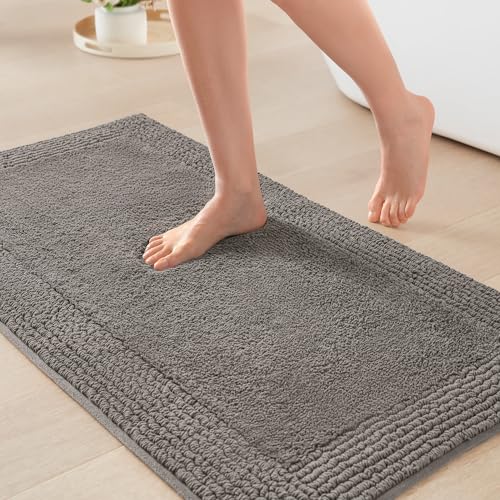
Madison Park Splendor Reversible Cotton Bath Rug 21×34 Charcoal
Begin with the number the listing leads with: 3000 GSM. GSM measures grams per square metre, and in bath textiles that figure is the difference between a mat that feels like a folded towel and one that feels like a cushion. At the weight Madison Park claims for the Splendor, this 21×34 charcoal rug is firmly in cushion territory (tufted, medium pile, described as hotel quality and luxuriously plush) and it belongs in a bathroom, whatever the word rug in its name might suggest to a casual browser. Its job is to receive wet feet stepping out of a shower and to do so with more generosity than anything else in this guide.
- Fibre as listed: 100% cotton
- Weight as listed: 3000 GSM
- Size as listed: 21 x 34 inches
- Build as listed: tufted, medium pile
- Certification as listed: OEKO-TEX
- Behaviour as listed: absorbent, quick dry
Strengths
- The claimed weight gives it a planted, substantial feel that lighter bath mats never achieve.
- Charcoal is the most forgiving bathroom colour for hair, dust and water spots between washes.
- Reversibility doubles the interval between wash days in a busy family bathroom.
Trade-offs
- A heavy cotton rug holds a great deal of water, so it needs air and space to dry fully between showers.
- At 21×34 it serves one bather’s landing zone, not a long double-vanity run.
- Tufted plush and quick-dry claims pull in opposite directions; in a steamy, unventilated bathroom it will dry slower than a flat weave.
The OEKO-TEX mention in the listing signals that the textile has been tested for harmful substances under that scheme, which matters more for a product that touches bare wet skin daily than for almost anything else in a home. Treat the claim as the maker’s, stated on the listing, and it still usefully separates this rug from anonymous bath mats that certify nothing at all.
Placement logic is simple: charcoal works hardest in a bathroom with white or pale fixtures, where it grounds the room, and in a household where the bath rug is washed weekly and hung properly to dry. If your bathroom has no window and a feeble fan, rotate the rug’s faces and hang it over the tub edge after the morning rush; cotton rewards that small discipline with years of service and punishes its absence with a musty sulk.
Best for: a main bathroom wanting a plush, weighty, certified cotton landing pad in a practical dark colour. Not suited for: a steamy ensuite with no ventilation, where a heavy tufted cotton rug would rarely dry through. Check price on Amazon before assuming the charcoal suits your tile; the listing photos show its pile depth honestly.

GLAMBURG Cotton Reversible Area Rug 3×5 Black White Plaid
The GLAMBURG is the farmhouse archetype of this guide: a handwoven cotton area rug at 3×5, checked in black and white plaid, washable, and aimed by its listing at the front porch, living room, kitchen and bedroom. Plaid is a shrewd pattern choice for a working rug, because the grid breaks up the visual evidence of crumbs, pet hair and tracked dust far better than a solid colour, while the monochrome palette slips into almost any scheme that already contains white paint or black hardware, which is to say most kitchens built in the last twenty years.
- Size as listed: 3′ x 5′
- Weave as listed: handwoven
- Pattern as listed: checkered plaid, black and white
- Washing as listed: washable
- Rooms named in the listing: front porch, living room, kitchen, bedroom
Strengths
- The 3×5 footprint is the classic galley-kitchen and entryway size, big enough to work on, small enough to wash easily.
- Handwoven cotton lies flat and stays flexible, draping over a step edge or shaking out over a railing without a fight.
- Two usable faces in a plaid weave mean the pattern reads correctly from either side.
Trade-offs
- Handwoven pieces vary slightly in dimension and edge straightness; perfectionists should expect character, not machining.
- No backing is claimed, so on slick tile or polished wood it will travel unless a pad or mat tape intervenes.
- White checks in a kitchen will eventually show turmeric and tomato, however honest the wash cycle.
In a kitchen, park it in front of the sink and hob run, where standing time accumulates and splashes land. Cotton absorbs those splashes instead of letting them pool on tile, and when the rug has absorbed one spill too many it goes in the wash rather than into a specialist cleaner’s queue. On a covered porch it softens the threshold and catches the first scrape of shoes, though an uncovered porch in a wet climate will keep it damp more often than cotton enjoys.
The plaid also earns its keep in rental homes and first apartments, where the floors are somebody else’s and the budget for covering them is real. A washable, reversible 3×5 that can migrate from entry to kitchen to bedroom as life rearranges itself is the opposite of a precious purchase, and that flexibility is precisely its value.
Best for: a farmhouse-leaning kitchen or entryway that wants a washable handwoven plaid with two working faces. Not suited for: a glossy tiled hall with no rug pad in the budget, because unbacked cotton will skate. Check price on Amazon — the black and white check is the colourway reviewed here.

WOVEN ST Reversible Cotton Bath Rugs 2 Pack Ivory
WOVEN ST. answers a problem the Madison Park cannot: most homes have two wet spots to cover, not one. The pack pairs a 17×24 with a 21×34, both 100% cotton and reversible, in ivory, and the listing spreads its ambitions across spa, vanity shower, bathrooms, kitchen and bedroom. In practice the sensible deployment is bathroom-first: the larger rug at the tub or shower door, the smaller at the vanity or in the guest cloakroom, with the pair rotating through the wash together so neither fades or wears ahead of the other.
- Fibre as listed: 100% cotton
- Pack contents as listed: pack of 2
- Sizes as listed: 17 x 24 inches and 21 x 34 inches
- Colour as listed: ivory
- Behaviour as listed: water absorbent
Strengths
- Two coordinated sizes solve the bath-plus-vanity layout in a single purchase.
- Ivory brightens small windowless bathrooms where charcoal would brood.
- Reversible faces stretch the time between washes, useful when the pair serves a family bathroom.
Trade-offs
- Ivory shows every mascara fleck, hair dye drip and muddy footprint without mercy.
- The smaller 17×24 is a vanity mat, not a step-out rug; a tall adult stepping from a tub wants the larger one there.
- The listing states no GSM, so plushness cannot be compared with the Madison Park on paper.
The listing’s kitchen suggestion deserves a measured response. A cotton bath rug can serve in front of a sink, and plenty of households retire bathroom cotton to the kitchen for its second life, but the absorbency-first design of a bath rug (thick, thirsty, slower to dry) is not the same as a kitchen rug’s brief. Buy this pack for bathrooms, and let any kitchen service be a bonus rather than the plan.
Ivory also asks for a laundry habit: wash the pair together, in a gentle cycle, and dry them fully before they go back down, because two rugs bought as a set only stay a set if they age as one. Households with hard water will notice ivory greying over the years; that is cotton’s honesty, not a defect, and a periodic brightening wash is the accepted maintenance.
Best for: a household furnishing a bathroom and a vanity or guest bath together in a clean ivory palette. Not suited for: anyone whose bathroom floor regularly meets hair dye or muddy paws, because ivory keeps receipts. Check price on Amazon and check both sizes against your floor plan before ordering.

COTTON CRAFT Woven Area Rug 2 Pack Entryway Tan Natural
COTTON CRAFT sells the doorway as a pair. Two woven cotton mats with fringe, in a tan natural shade, reversible, washable, and described in boho farmhouse rustic language for bedroom, living room, kitchen, bathroom and dorm. The two-pack logic suits the way houses actually have doors: front and back, or door and patio, or a matched pair flanking a bed. Fringe changes the personality considerably (softer, more decorative, more willing to be seen) and also adds the one maintenance note flat rugs avoid, since fringe tangles in aggressive vacuum heads and prefers a shake outside.
- Pack contents as listed: 2 pack entryway mats
- Finish as listed: with fringe
- Colour as listed: tan natural
- Washing as listed: washable
- Style as listed: reversible boho farmhouse rustic
- Rooms named in the listing: bedroom, living room, kitchen, bathroom, dorm
Strengths
- Matching pairs make a two-door house look deliberately finished rather than improvised.
- Tan natural is the most dirt-tolerant colour in this entire guide.
- Fringe and a woven texture bring softness to hard, echoing entry halls.
Trade-offs
- Fringe at a doorway catches heels and door sweeps; a door with low clearance will brush it constantly.
- The listing gives no dimensions in its title, so measure carefully on the product page before picturing them in place.
- Two mats of one colour is a commitment if your front and back doors live very different lives.
The dorm mention in the listing is quietly astute. A washable woven cotton mat beside a dorm bed or under a desk chair warms institutional flooring, survives a laundromat, and comes home at term’s end rolled in a duffel. Likewise the pair can split duties (one at the door, one in front of a kitchen sink) which is probably how most sets will actually live, whatever the styling photographs suggest.
Because the colour is a natural tan, these mats layer well over darker floors and under patterned runners, acting as the calm base in a layered entryway. Layering is also a practical trick: the cotton mat takes the weather and the washing, while the prettier runner on top takes the compliments.
Best for: a two-door household or a layered entryway scheme wanting washable fringed cotton in a forgiving natural tone. Not suited for: a door with a tight sweep clearance, because the fringe will be combed by it daily. Check price on Amazon and confirm the dimensions on the listing fit your doorway before the pair ships.

Ramanta Home Cotton Chindi Rag Rug 2×3 Teal Reversible
Chindi weaving takes strips of leftover cotton cloth and weaves them into something new, and the Ramanta Home rug wears that origin proudly: hand woven, recycled, reversible, 2×3, in teal, aimed at living room, kitchen and entryway. Understand what that means visually before ordering. A chindi rug is a mosaic of its source cloths, so the teal is a family of teals (deeper here, greener there, interrupted by whatever tones the recycled strips carried) and no two rugs leaving the weaver are identical. The listing’s photograph is a portrait of one example, not a promise of yours.
- Size as listed: 2′ x 3′ (24 x 36 inches)
- Weave as listed: hand woven chindi rag rug
- Material as listed: recycled cotton
- Colour as listed: teal
- Rooms named in the listing: living room, kitchen, entryway
Strengths
- Recycled cotton gives discarded cloth a second working life, the strongest sustainability story in this guide.
- The variegated teal hides wear, stains and fading better than any flat colour could.
- At 2×3 it fits the precise spots (under a desk, inside a door, beside a cooker) that larger rugs overshoot.
Trade-offs
- Colour distribution varies piece to piece, so an exact match to a painted wall cannot be guaranteed.
- Rag-woven surfaces have a rustic, slightly uneven texture that reads handmade rather than sleek.
- The small footprint is an accent, not floor coverage; it will not warm a whole room.
That variation, handled honestly, is also the rug’s decorative superpower. A chindi beside a plain sofa or under a simple wooden desk introduces colour the way a patchwork quilt does, in conversation with the room rather than in command of it. Kitchens suit it particularly well: the busy weave swallows the evidence of cooking life, and the cotton construction tolerates the sink-side splash zone that would ruin a backed rug.
Care follows the material. Shake it outside weekly, wash it gently when the colours dull, and let it dry flat so the woven strips keep their shape. Expect it to soften with every wash; chindi rugs age toward comfort the way denim does, and a slight fade after a year of service is the patina of the category, not a failure of it.
Best for: a small, colour-hungry spot (desk, doorway, cooker side) whose owner values recycled, one-of-a-kind character. Not suited for: a buyer matching an exact teal to existing décor, because recycled strips refuse to be colour-matched. Check price on Amazon with the variation in mind and the surprise becomes part of the pleasure.

Budhrajrugs Cotton Dhurrie Rug Reversible 120×180 Multicolour
The dhurrie is the elder statesman of flat-woven rugs, a tight, tapestry-like weave with no pile at all, and Budhrajrugs offers a handmade cotton example at 120×180 centimetres (roughly 4×6 feet) in multicolour, reversible and washable. Flatness is the whole proposition: furniture stands level on it, doors glide over it, chairs slide without resistance, and the rug itself can be lifted, washed and re-laid by one person without drama. In a guide of mostly small pieces, this is the one that can genuinely furnish a room (a small living room, a bedroom’s open floor, a studio’s everything zone).
- Size as listed: 120 x 180 cm
- Weave as listed: handmade flat woven dhurrie
- Pattern as listed: multicolour
- Washing as listed: washable
- Fibre as listed: cotton
Strengths
- The largest coverage here, in a weave that stays perfectly flat under furniture.
- Multicolour striping coordinates with almost any existing textiles, since most rooms contain at least two of its tones.
- A pile-free surface releases dust and pet hair to the vacuum instead of trapping them.
Trade-offs
- No pile means no cushion; on hard floors, standing comfort comes from your shoes, not the rug.
- Flat weaves slide on smooth floors and need a pad or grip layer in traffic lanes.
- Handmade pieces can arrive with slight size variance and edges that relax over the first weeks.
Dhurries have a particular gift for rooms that change their minds. Because the weave is thin and flexible, the rug rolls small for storage, folds over a step, and can move from bedroom to studio to a child’s room across the years without ever being the wrong weight for the job. The multicolour face also handles the reality of family life gracefully: no single stain owns a colour field this varied, and flipping the rug presents the same pattern family with the wear redistributed.
Under a dining set for four, the flat weave earns its keep daily, since chairs move silently and the whole rug can be carried to the wash after a catastrophic curry night. Under a sofa it will want a pad to stop the slow creep that flat cotton on hard flooring always attempts. Neither demand is exotic; they are the standard terms of dhurrie ownership, unchanged for generations.
Best for: a small living room, studio or dining four wanting the most washable flat-woven coverage cotton can offer. Not suited for: anyone seeking plush comfort on a hard floor, because a dhurrie’s virtues are flatness and lightness, not cushion. Check price on Amazon — and plan a grip pad in the same basket if your floors are smooth.
Head-to-head: bath rugs on one side, floor rugs on the other
| Rug | True territory | Dimensions | Weave character |
|---|---|---|---|
| Madison Park Splendor | Bathroom | 21×34 in | Tufted plush, 3000 GSM per listing |
| WOVEN ST. 2 Pack | Bathroom and vanity | 17×24 and 21×34 in | Absorbent cotton, ivory |
| GLAMBURG Plaid | Entry, kitchen, porch | 3×5 ft | Handwoven check, washable |
| COTTON CRAFT 2 Pack | Doorways, layered entries | See listing | Woven with fringe, tan natural |
| Ramanta Home Chindi | Small accent spots | 2×3 ft | Recycled rag weave, teal |
| Budhrajrugs Dhurrie | Small rooms, dining | 120×180 cm | Flat weave, multicolour |
Which reversible cotton rug belongs in which room?
Is it for wet feet or for dry floors?
Answer this first and the shortlist halves itself. Wet feet need absorbency above all (a tufted or woven bath rug that drinks the water off your soles and then dries before the next shower), which is the Madison Park and WOVEN ST. brief exactly. Dry floors need coverage, flatness and washability, the territory of the GLAMBURG, the COTTON CRAFT pair, the chindi and the dhurrie. Crossing the streams (a plush bath rug as a hallway runner, a flat dhurrie as a bath mat) produces a rug that is merely adequate at a job it was never woven for.
How much variation can you happily live with?
Handwoven and recycled pieces carry individuality in their DNA. The chindi varies most, its recycled strips guaranteeing a one-off colour mix; handwoven plaid and dhurrie pieces vary gently in dimension and edge; the tufted bath rugs vary least. Decide which temperament is yours before ordering, because the same irregularity that one buyer frames as soul, another experiences as a defect, and cotton rugs are bought to be lived on, not adjudicated.
What will your washing machine actually accept?
Washable is a claim with a size limit, and the limit is your drum. The small pieces here (chindi, bath rugs, entryway mats) wash in any domestic machine without argument. The 3×5 GLAMBURG is a comfortable load. The dhurrie at 120×180 is the borderline case: cotton at that size, soaked, is heavy, and a small apartment machine may refuse the relationship. Measure the drum, not just the rug, and remember that a rug you cannot wash loses the central advantage of the entire category.
Does the floor underneath need grip help?
Unbacked cotton on tile, laminate or polished boards will migrate, and the lighter and flatter the rug, the further it travels. Budget for a thin grip pad under the dhurrie and the GLAMBURG in traffic lanes, and under any rug placed where children arrive at speed. Bath rugs on textured tile usually stay put by weight and moisture alone, one of the few free lunches in this category.
Cotton as a rug fibre: the honest ledger
Cotton’s virtues begin with water. The fibre can absorb a remarkable share of its own weight before it feels wet, which is why it owns the bath mat category and why kitchen cotton earns its sink-side post. It is soft without being slippery, kind to bare skin, and free of the static crackle that synthetic fibres generate in dry winter air. It also takes dye deeply and washes clean without specialised chemistry, so colours stay true through a regime that would fade or stiffen other fibres.
The debits are equally real. Cotton dries slowly compared with synthetics, and a thick cotton rug in a damp room can stay damp long enough to smell of it; ventilation is not optional equipment for cotton ownership. Cotton shrinks when abused with hot water and hotter drying, so the washable promise in these listings assumes a gentle cycle and a patient air-dry. And cotton, for all its softness, is not the hardest-wearing fibre at the door of a house with grit-bearing boots; it prefers to be the second line of defence behind a coarse scraper mat outside.
Cotton also ages in a way many buyers find kind. Rather than pilling into hard bobbles or shedding its surface, a woven cotton rug softens, its colours mellowing a half-step toward the pastel, its hand growing more familiar the way a favourite towel’s does. In a home that values patina over showroom freshness, that trajectory is a pleasure; in a home that wants the purchase-day look preserved indefinitely, it is a reason to choose the darkest, busiest patterns here, charcoal and chindi and multicolour stripe, which disguise mellowing longest. Either way, the fibre is honest about what time does to it, and there are no sudden failures in its character, no backing that cracks, no coating that peels, only a gradual softening that most owners come to read as comfort.
None of that diminishes the fibre; it defines its postings. Cotton where water, skin and washability rule (bathroom, kitchen sink run, bedside, a child’s floor). Other fibres where grit, weather and decades of boots rule. The reversible construction then doubles cotton’s value in its chosen posts, because flipping shares the wear and the fading between two faces instead of concentrating both on one.
Flipping, rotating and washing: a care rhythm that works
Treat the second face as a schedule, not a rescue. Flip a reversible rug monthly in a bathroom, quarterly in a living space, and rotate it end-to-end at the same moment if the room allows, so sunlight and traffic distribute across four orientations across a year instead of engraving one. Shake small pieces outside weekly; grit trapped in a weave is sandpaper working from within, and thirty seconds at the door removes most of it before the vacuum ever runs.
Wash on a gentle cycle with a mild detergent, skip the fabric softener (it coats cotton fibres and quietly strangles the absorbency you bought them for), and dry flat or on a line rather than tumbling hot. Bath rugs in daily use want washing weekly; floor rugs monthly or by visible need. Cotton that is allowed to dry completely between uses and washed before it smells, rather than after, will outlast cotton treated casually by a factor that surprises most first-time owners.
The same wash-and-dry discipline follows cotton textiles outdoors, where sun and salt air punish anything left damp in a heap; readers kitting out a beach or surf setup will find the wearable end of that world compared in Best Towels for Surfers, where the picks are hooded ponchos for changing out of a wetsuit rather than flat towels. Back indoors, cotton’s softness also explains its second career as a yoga prop, folded for support under knees and hips; the studio blankets assessed in Best Blankets Iyengar Yoga examine that folded-support role in detail. And households weighing bigger home investments against small textile ones may enjoy the evidence-tiered breakdown in Best Eco Friendly Hot Tubs, which separates built-in insulation from mere cover claims when judging running costs.
Sizing small cotton rugs to real rooms
Small rugs fail by ambition more often than by quality. A 3×5 like the GLAMBURG is a work surface (the strip where a cook stands, the rectangle a door’s swing clears, the ground a desk chair rolls on) and judged on that basis it is generous. The same rug laid in the middle of a large living room becomes a raft, visually adrift, and no weave quality can rescue a placement error. The discipline is to define the job in one sentence before measuring: this rug receives feet leaving a bath; this rug catches the first three steps inside a door; this rug warms the floor a child plays on. The sentence chooses the size, and the size then chooses among the six here.
Bathrooms reward precision most. The step-out zone in front of a standard tub is roughly the 21×34 footprint both bath picks offer, and the vanity zone in front of a single basin is the 17×24 that WOVEN ST. includes as its second piece. Oversizing a bath rug into the toilet’s splash territory or under a door’s swing creates damp corners and brushing edges; undersizing it leaves the second foot on cold tile, which the bather will resent daily. Measure from the tub’s edge outward and from the vanity’s plinth to where heels actually land, and let those chalk marks arbitrate.
Entryways have their own arithmetic. A door mat should cover the full stride of an entering adult (two full steps, not one) or the grit simply relocates to the far edge of a too-short rug. That is why the COTTON CRAFT pair, deployed end to end in a long hall or split between two doors, solves a problem a single mat cannot, and why the 2×3 chindi belongs inside a door only where the traffic beyond it is one person wide (a side door, a studio entrance) rather than a family’s main artery.
Kitchens divide into galley and island layouts. A galley wants the long work strip in front of sink and hob, served here by the GLAMBURG’s 3×5 or the dhurrie run widthwise. An island kitchen wants a rug where people stand to prep, usually a shorter patch, which is chindi territory if the cook wants colour or bath-rug territory in a rug’s second life. The dhurrie alone among the six can step up to a small dining area, because its 120×180 span satisfies the chair rule for a table of four, a threshold none of the smaller pieces can honestly cross.
Pattern behaviour: plaid, fringe, mosaic and stripes
Woven patterns behave differently from printed ones, and reversible cotton is woven to its core. In the GLAMBURG’s plaid, the check exists in the threads themselves, so it cannot wear off, crack or fade in patches the way a surface print can; it can only fade overall, gracefully, the way a good shirt does. The black and white grid also performs a camouflage trick in kitchens, because the eye reads the pattern’s own contrast and overlooks the lesser contrast of crumbs and splashes until cleaning day.
Fringe, on the COTTON CRAFT pair, is pattern’s punctuation. It extends the rug’s visual footprint beyond its woven body, softening the transition to hard flooring, and it announces the handmade register of the piece before a hand ever touches it. Its cost is mechanical: fringe wants shaking rather than suction, and it should be combed straight with fingers after washing, a ten-second ritual that keeps the pair looking tended. Households that find that ritual charming will love fringe; households that find it fussy should buy the unfringed weaves and never look back.
The chindi’s mosaic is pattern as collage. Because the strips vary, the rug scatters light and colour unevenly, which is precisely why it forgives stains so completely (a new mark joins a crowd) and why it pairs best with plain surroundings that let its patchwork speak. The dhurrie’s multicolour stripes are the most architectural pattern here: stripes lengthen a room when run along its axis, widen it when run across, and give furniture a ruled ground to align with. A striped flat weave under a dining set reads almost like floorboards drawn in colour, orderly and calm, where the chindi beside a sofa reads as festival. Choosing between them is choosing the room’s temperament, not its quality tier.
The two bath rugs sit at the quiet end of the pattern spectrum, charcoal solid and ivory solid, and that restraint is deliberate design rather than absence of it. Bathrooms are small rooms full of hard reflections and patterned tile; a solid, weighty cotton field calms the visual noise and lets fixtures and towels carry whatever pattern the household wants to rotate. When the towels change, the rug stays, which is the correct hierarchy for the most washed textiles in the house.
Cotton rugs where children and animals actually live
A house with a toddler or a dog processes floor textiles at industrial speed, and cotton’s washability stops being a feature and becomes the whole argument. The working system in such houses is rotation: one rug down, one in the wash, one dry and waiting, which the two-pack picks here (WOVEN ST. for bathrooms, COTTON CRAFT for doors) support almost by accident of their packaging. Single larger pieces like the dhurrie join the system on a slower cycle, washed on the weekend they are least needed, while the chindi’s camouflage weave buys time between washes in the spots where snacks and paws concentrate.
Pet hair deserves a specific word, because cotton handles it better than its reputation suggests. Hair sits on a flat or low cotton weave rather than embedding in it, so a shake outside removes the bulk and a wash removes the rest; it is deep synthetic pile, not cotton, that truly hoards hair. Claws are a gentler issue on woven cotton than on looped constructions, since a flat weave offers nothing to snag, though the fringe on the COTTON CRAFT pair will attract feline attention and should be placed where the household cat does not hold court.
For children’s floors, the calculus adds softness and washability together. A cotton rug over hard flooring gives a play surface that can be lifted and washed after the inevitable juice events, and the reversible faces mean a rug flipped at naptime presents a clean side while the stained side waits for laundry day. The dhurrie’s size makes it the play-mat candidate here, with the chindi as the reading-corner accent beside it. What cotton will not do is cushion a fall like a foam mat, and parents should hold that boundary clearly: these are washable comfort and colour, not safety equipment.
What the second face actually buys over a rug’s lifetime
Reversibility is usually sold as a styling trick (two looks for one purchase) and that is the least of it. The real dividend is mechanical. Wear on a rug concentrates where feet pivot: at the door-side edge, in front of the sink, beside the bed. A rug that can be flipped spreads that pivot wear across two surfaces, and a rug that can also be rotated spreads it across four zones, which is how a modest cotton piece outlasts a heavier one-directional rug in the same house. Sunlight tells the same story. Ultraviolet fades the face it can see; flipping turns the faded side to the floor and presents the sheltered one, so the rug ages in two slower acts instead of one fast one.
There is also a hygiene dividend that busy households feel immediately. A reversible bath rug flipped on Wednesday morning presents a dry, aired face while yesterday’s face dries against the floor’s warmth; the household effectively owns a rug and a half without storing anything extra. In kitchens, flipping after a spill buys the hours needed to wash properly at the weekend rather than badly at midnight. These are small mercies, but floor textiles are judged in small mercies accumulated over years.
The honest limit of the second face is that it shares the same body. A stain that soaks through a thin cotton weave marks both sides, and a rug worn threadbare at its centre is worn on both faces at once, because flipping mirrors the weak zone rather than escaping it. Reversibility extends a rug’s life; it does not double it, and sellers who imply otherwise are selling arithmetic that weaving cannot perform. Judged at its true value (perhaps a third to a half more service, plus the styling and hygiene flexibility), it remains one of the best bargains in the whole rug market, and it is available only in constructions like these, where both faces were finished to be lived on.
That finishing is worth inspecting on arrival. A genuinely reversible rug shows the same pattern logic on both sides, edges bound or woven to the same standard, and no rubberised backing hiding underneath, because a backing is a confession that the second face was never meant to be seen. Every pick in this guide was chosen because its listing describes a two-faced construction; if the rug that arrives contradicts its listing on that point, it is the wrong rug, whatever its colour.
When a spare rug is the smartest purchase in the house
Washable textiles create a logistics problem that backed rugs never pose: the floor is bare while the rug is in the machine and on the line, and in a bathroom that gap is felt at the very next shower. Households that commit to cotton usually solve it with a spare, which is why the two-pack format keeps appearing in this guide. A spare in the same weave and colour restores the floor instantly, lets the washed rug dry completely instead of being rushed back damp, and quietly doubles the system’s lifespan, because each rug works half the days. The arithmetic favours pairs wherever the rug’s job cannot pause: bathrooms, the kitchen sink run, and the door of a house with a dog whose paws observe no laundry schedule.
Colour discipline matters when buying spares across time. Cotton shades shift slightly between dye lots, and a rug bought a year later may sit a half-tone away from its elder, close enough for separate rooms, noticeable side by side. Buying the pair together, as WOVEN ST. and COTTON CRAFT package them, removes the gamble entirely. For single pieces like the dhurrie or the chindi, the wiser spare strategy is a coordinating rather than matching second rug, since handmade variation makes an exact twin unlikely in any case, and a deliberate contrast looks chosen where a near-match looks like a mistake.
Common mistakes
Deploying a bath rug as a hallway runner. Bath cotton is woven to drink water and dry in place, not to endure grit-bearing cross-traffic; in a hall it will look tired within a season and slide while doing so.
Washing cotton hot to get it extra clean. Heat is how cotton rugs shrink and fringe tangles. Gentle cycles and full air-drying keep the dimensions you paid for.
Adding fabric softener out of habit. Softener films the fibres and measurably dulls absorbency, the one property bath and kitchen cotton exists to provide.
Expecting a chindi to match the photograph. Recycled strips make every rug a variation. Buyers who need an exact colour should choose a dyed, uniform weave instead.
Skipping the grip pad on smooth floors. A flat cotton rug on laminate is a slow magic trick that ends with the rug against the skirting board and, occasionally, a person on the floor.
Final recommendation
Match the rug to the room’s water before anything else. Bathrooms split between the Madison Park Splendor (one plush, heavyweight landing pad in charcoal) and the WOVEN ST. pair (two ivory spots covered at once). Working floors belong to the GLAMBURG plaid in kitchens and entries, the fringed COTTON CRAFT pair where two doorways want a matched, natural-toned welcome, and the Budhrajrugs dhurrie wherever real coverage in a flat washable weave is the brief. The Ramanta Home chindi stands apart as the character piece: small, recycled, unrepeatable, and all the better for it. Every one of the six can be flipped, washed and forgiven, which is the entire philosophy of the category in a single sentence of behaviour.
FAQ
Are reversible rugs really usable on both sides? In this guide, yes by design: the listings describe woven or tufted cotton whose pattern and finish carry through, so the second face is a working surface rather than a backing. That is the difference between a reversible rug and a rug you merely can flip.
Will cotton rugs shrink in the wash? They can if washed hot or tumble-dried hard. A gentle cycle and air-drying flat keeps the stated sizes honest; expect at most a slight settling of the weave in the first wash.
Which pick suits a rental bathroom? The WOVEN ST. two-pack, because it covers bath and vanity in one purchase, washes easily, and asks for no installation, no pad and no landlord’s permission.
Do flat dhurrie rugs work under dining chairs? They are arguably the best shape for it: no pile to catch chair legs, a level surface for furniture, and full washability when dinner goes wrong. Add a grip layer so the rug stays where the table is.
Why does my cotton bath rug stay damp? Almost always airflow. Hang it over the tub edge or a rail after the morning showers, flip it at the next use, and ventilate the room; thick cotton in still, steamy air cannot dry by wishing.
Can these cotton rugs go outdoors? Only in the sheltered sense. The GLAMBURG listing names the front porch, and a covered porch that stays dry is fair territory; an open deck or patio will keep cotton damp, mildewed and fading, because cotton has none of the weatherproofing of outdoor synthetics.
How do I stop a flat cotton rug curling at the corners? Wash and dry it flat, store it rolled rather than folded, and let a grip pad hold the corners while the weave relaxes. A night under a stack of heavy books on the offending corner persuades most cotton weaves without any ironing, which cotton fringe in particular would rather avoid.
Is a heavier bath rug always better? Up to the point your bathroom can dry it. Weight buys plushness and absorbency, but a very heavy rug in a small, still bathroom trades those for a permanently damp core, which is why the lighter WOVEN ST. pair suits steamy ensuites while the heavyweight Madison Park belongs where air moves.
One last sizing habit: chalk or tape the outline on the bare floor and live around it for a day, because a taped rectangle exposes door swings, drawer pulls and traffic lines that no amount of mental measuring ever quite reveals.
Flip it, wash it gently, let it dry properly, and a cotton rug will repay you on both of its faces.


