What's inside
- Where to buy these picks
- Quick Picks
- How these picks were chosen
- The six picks in detail
- What each clock states, lined up
- How do you choose between two alarms that both ring?
- The two-alarm household, choreographed
- Why phones lost the bedside
- Snooze, studied seriously
- Placement: the nightstand is a system
- Guests, spare rooms and the loaner clock
- What dual alarms do for shift workers
- Common mistakes
- Final recommendation
- Frequently asked questions
As an Amazon Associate I earn from qualifying purchases. This post may contain affiliate links at no extra cost to you.
As an Amazon Associate, cottageverdict.com earns from qualifying purchases.
Two alarms sound like a small feature until a household actually runs on two schedules: one partner up for a shift, the other for the school run, or a single sleeper who wants a gentle first call and a sterner second one as insurance. People searching for the best dual alarm clocks are usually solving one of those two problems, and the six clocks below solve them with different display sizes, dimming ranges, sound choices and backup arrangements. Every fact used here comes from the listing titles, which for clocks are unusually informative — dimmer levels, volume counts, display inches and snooze minutes are all stated in words for most of these models, and where a title stays silent, the review says so.
Where to buy these picks
Netzu leads with breadth: bold digits, five dimmer settings, four volume levels, a snooze, and a pitch aimed at deep sleepers, children, teenagers and seniors in one plug-in bedside clock.
Odokee counters with the widest dimming promise here, a display adjustable from zero to one hundred percent, plus weekday and weekend modes, five alarm sounds and a blue display.
The unbranded large-display entry competes on sheer size, a 7.5-inch screen with big LED numbers, five dimmer levels, volume control and a USB charger built in.
Mesqool changes the geometry entirely, projecting the time with a projector that rotates 180 degrees, with five dimmer levels, daylight-saving handling and battery backup for memory only.
Sharp brings the established-name option: red LED digits, an ascending wake sound, weekday and weekend scheduling, a nine-minute snooze and two AA batteries as backup.
JALL closes with the senior-focused design, a 5.5-inch display showing day and date, a colour-coded screen, six dimmer levels, dual USB charging and a room temperature readout.
Quick Picks
| Pick | Best for | Highlight from the listing title |
|---|---|---|
| Netzu Digital Dual Alarm | Households mixing light and deep sleepers | Four volume levels and five dimmers around bold digits |
| Odokee Digital Dual Alarm | Couples on weekday-weekend split schedules | 0-100% dimming, weekday/weekend mode, five sounds |
| Generic 7.5in Dual Alarm Large Display | Anyone who reads the time without glasses | 7.5-inch display with big LED numbers |
| Mesqool Projection Dual Alarm | People who check the time on the ceiling | 180-degree rotatable projector, DST handling |
| Sharp Dual Alarm Red LED | Traditionalists who like a named brand and red digits | Ascending wake sound, 9-minute snooze, AA backup |
| JALL Digital Alarm Seniors | Seniors who want day and date at a glance | 5.5-inch colour-coded screen, dual USB, temperature |
How these picks were chosen
Dual alarms were the entry ticket — all six titles state them outright, so no clock here is a single-alarm model in disguise. Beyond that, the titles were mined for the four things that decide whether a bedside clock is loved or unplugged: how completely the display can be dimmed at night, how the volume behaves for different sleepers, what happens when the power blips, and whether the clock understands that weekdays and weekends are different countries.
Dimming turned out to be the sharpest divider. One title promises a continuous zero-to-one-hundred-percent range, others count out four, five or six steps, and one — the Sharp — says nothing about dimming at all, which is reported plainly below rather than assumed. Backup arrangements divide the list too: one clock is explicit that its battery guards memory only, another names two AA cells, and a third mentions settings backup without naming a battery at all. Those distinctions are the difference between a clock that wakes you after a stormy night and one that merely remembers what time it was.
Display size was the third axis, from the 5.5-inch senior screen to the 7.5-inch large-format entry, with the projector sidestepping inches entirely by putting the time on the ceiling. No single size wins; the right one depends on eyesight, room size and whether the clock serves one bedside or a whole room. The reviews keep returning to that fit question instead of crowning a universal champion.
The six picks in detail

Netzu Digital Dual Alarm
Netzu’s clock is built around range: four volume levels for the alarm, five dimmer settings for the display, bold digits for readability, and a snooze for the negotiators. The title addresses it to deep sleepers, kids, teens and seniors simultaneously, which sounds like marketing breadth but actually describes the dual-alarm household well — two alarms at two volumes for two different sleepers is exactly the mixed audience this clock is courting.
- Alarms: dual
- Display: bold digits
- Dimming: 5 settings
- Volume: 4 levels, plus snooze
- Power: plug-in; battery backup not stated in the listing title
Strengths
- Four volume steps let two alarms sit at genuinely different loudness
- Five dimmer levels cover most bedroom light preferences
- Bold digits favour quick, glasses-free time checks at night
Trade-offs
- No battery backup is mentioned, so outage behaviour is unconfirmed
- No weekday/weekend mode is named, unlike two rivals here
- Display size in inches never appears in the title
The volume ladder is this clock’s real argument. In a dual-alarm household the common failure is one volume serving two nervous systems: the deep sleeper’s setting terrorises the light sleeper, or the gentle setting lets the deep sleeper sail through. Four steps will not fine-tune like a hi-fi, but they give the two alarms distinct personalities — a moderate first call for the person who wakes easily, a full-throated second for the one who does not. Set that way, the dual alarms stop being a duplicate and become a division of labour.
Five dimmer settings sit in the sensible middle of this list: fewer than the step-count leaders, more granular than a simple high-low switch. What matters at 3 a.m. is the bottom of the range, and a buyer sensitive to light should confirm from the full listing how dark the lowest step actually goes, since the title counts steps without describing the floor. The absence of any battery mention is the other homework item — plug-in clocks without backup go dark and silent in an outage, and shift workers cannot afford that surprise.
Ease of setting is claimed in the title, and for this category that claim carries unusual weight. Dual alarms double the programming: two times, two volumes, possibly two on-off states, all set through buttons shared with dimming and snooze. A clock that makes that logic obvious gets reprogrammed willingly when schedules change; a cryptic one gets left on last month’s settings. The Netzu’s pitch to every age from kids to seniors only holds if the setting routine is genuinely legible to all of them, so grandparents and grandchildren are the right test panel.
Picture the Netzu in a spare room that hosts grandchildren one weekend and a shift-working relative the next. Its breadth — volumes, dimmers, bold digits — is exactly what a rotating cast of sleepers needs, because the clock adapts without being replaced. Specialist rivals below beat it on individual axes, a bigger screen here, a projector there, but as a general-purpose dual-alarm bedside clock for a household whose sleepers keep changing, the all-round specification is the point.
Travel exposes a bedside clock’s character, and the Netzu’s plug-in simplicity cuts both ways: it will work in any bedroom with a socket, yet a hotel stay reminds you how completely it depends on the wall. Households that travel with their own clock — more common among shift workers than anyone admits — should weigh the socket question. At home, though, the dependence is invisible, and the four-volume, five-dimmer flexibility resumes its quiet usefulness the moment the suitcase is unpacked.
Best for: mixed households where two sleepers need two alarms at two different volumes
Not suited for: homes where the power cuts out often — this title never confirms a battery backup
Check price on Amazon — weigh the volume ladder first; it is what this clock is really selling.

Odokee Digital Dual Alarm
Odokee’s headline is a dimmer that runs from zero to one hundred percent — a continuous range rather than counted steps, and zero is the important end of it. A display that can go fully dark while the clock keeps working answers the light-sensitive sleeper’s oldest complaint. Around that headline sit a weekday and weekend mode, five selectable alarm sounds with adjustable volume, and a blue display, all aimed at heavy sleepers who still want their bedroom dark.
- Alarms: dual, with weekday/weekend mode
- Dimming: 0-100% adjustable display
- Sounds: 5 alarm sounds, adjustable volume
- Display colour: blue
- Battery backup: not stated in the listing title
Strengths
- A dimmer reaching zero suits genuinely light-sensitive sleepers
- Weekday/weekend mode automates the two-schedule week
- Five sounds let two alarms be told apart by ear
Trade-offs
- Backup power goes unmentioned in the title
- Blue light is the display colour some sleepers find harshest
- No display size is published in the title
Weekday and weekend mode deserves more respect than it usually gets. The classic dual-alarm failure is the Saturday disaster: Friday’s work alarm, still armed, detonating at dawn on the one morning the household could sleep. A mode that separates the working week from the weekend removes that failure structurally rather than relying on Friday-night memory. Paired with two alarms, it gives a household four logical slots — early and late, weekday and weekend — which covers most real rosters without daily reprogramming.
Five sounds with adjustable volume serve recognition as much as waking. Two alarms that sound identical blur together in a half-asleep mind; two distinct sounds teach the household a language — that tone means the early shift, this one means the school run — and a partner can hear whose alarm is ringing and act accordingly. The blue display is the one point of taste to interrogate: many sleepers find blue digits vivid at night, which the zero-to-full dimmer can tame, but a buyer who knows blue light bothers them should think before choosing this over a red or warm display.
The continuous dimmer also changes the clock’s daytime manners. A display that can sit at a modest middle brightness reads clearly in a bright bedroom without glaring, then sinks toward darkness at night in fine increments rather than the visible jumps of stepped dimmers. Small thing, daily pleasure. What the title never addresses is the power-cut scenario, so outage-prone households should verify backup arrangements on the full listing before relying on this clock for anything unforgiving, like a flight or an exam morning.
Consider the Odokee for the household whose week has a hard edge — workdays that start brutally early against weekends guarded like treasure. Its mode structure was drawn for exactly that edge. The clock asks only two questions back: can you live with blue digits, and is your mains supply trustworthy. Answer those and its combination of total dimming control and schedule awareness is the most modern-feeling specification in this six.
One Odokee habit worth adopting is a monthly dimmer audit. Preferences drift with the seasons — summer’s bright evenings forgive a brighter display, winter’s long dark punishes it — and a continuous dimmer only earns its keep if someone occasionally re-tunes it. The same audit catches schedule drift: modes set for a school term quietly wrong-foot the household in the holidays. Two minutes, four times a year, keeps this clock’s two headline features honest.
Best for: light-sensitive sleepers on a strict weekday-weekend split who want distinct sounds per alarm
Not suited for: households needing confirmed battery backup, since the title is silent about outages
Check price on Amazon — the zero end of that dimmer is the feature; test your feelings about blue.
Generic 7.5in Dual Alarm Large Display
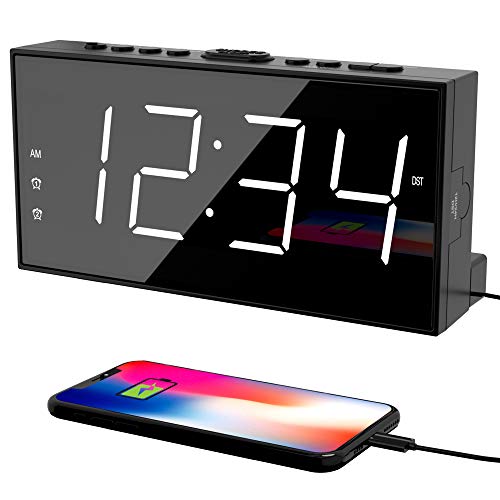
The third clock has no brand name to lean on, so its title sells geometry instead: a 7.5-inch display with big LED numbers. That is the largest stated screen in this group by a wide margin, and it reframes who the clock is for — not the sleeper who checks the time by squinting from the pillow’s edge, but anyone who wants the time legible from across the room, without glasses, in the middle of the night.
- Alarms: dual
- Display: 7.5-inch, big LED numbers
- Dimming: 5 levels
- Volume: volume control named; level count not stated
- Extras: USB charger; plug-in power
Strengths
- The 7.5-inch display is readable from across a bedroom
- Five dimmer levels keep the big screen tameable at night
- Built-in USB charging clears one plug from the bedside tangle
Trade-offs
- Unbranded, so support and longevity rest on the listing alone
- Volume levels are not counted in the title
- No battery backup or schedule mode is mentioned
A screen this size changes the clock’s job description. It stops being a personal bedside instrument and becomes the room’s clock — visible from a dressing table, a doorway, a child’s bed across the room. For sleepers whose eyesight makes ordinary digits a nightly frustration, that is not a luxury; it is the difference between knowing the time and guessing it. The five-level dimmer then does essential work, because a 7.5-inch display at full brightness is a small television, and the household needs its lowest settings to be genuinely low.
The USB charger is a modest feature with outsized daily effect: a phone charging from the clock frees the wall socket and shortens the cable run across the nightstand. Volume control is named without a level count, so the deep-sleeper question — how loud, exactly, at maximum — must be answered from the full listing. The same goes for backup power, which goes unmentioned; a clock this size is plainly a mains resident, and an outage will likely blank it, alarms and all.
There is a dormitory and guest-room logic to this pick as well. Big digits serve whoever is in the room without adjustment or instruction, and dual alarms let two occupants in a shared room run separate mornings from one device. The absence of a brand cuts both ways — no reputation to trust, but also no premium attached to one — and the buyer’s protection is to read the listing’s own detail carefully, since the title has already told you everything this product wants to be judged on: size, dimming, volume and a charger.
Aesthetic honesty helps here too. A 7.5-inch LED display is a presence; it will be the brightest object in a dark room even dimmed, and it suits bedrooms that are comfortable with a bold, functional look. Minimalists furnishing a calm, screen-free sleep space should look at the smaller or fully dimmable rivals. Households that treat the bedroom as a practical room — getting ready, checking time from the wardrobe, waking children across the space — will find the big screen earning its inches nightly.
The big unbranded display has one more audience nobody markets to: the household member who gets up in the night for someone else. Parents crossing to a child’s room, carers checking on a parent, anyone navigating by that huge readout at 3 a.m. benefits from time that can be read at walking pace, mid-corridor, without stopping to squint. Legibility is usually framed as a comfort for the sleeper; in a caring household it is a tool for the waker, and it works every single night.
Best for: sleepers who read the time from across the room or without glasses, and shared rooms running two mornings
Not suited for: light sleepers wanting a display that can vanish entirely, because five steps on a huge screen still glow
Check price on Amazon — stand across your bedroom and imagine reading it; that is the whole test.

Mesqool Projection Dual Alarm
Mesqool’s clock takes the display off the nightstand entirely. Its projector rotates through 180 degrees to throw the time onto a ceiling or wall, while the base unit carries dual alarms, five dimmer levels, twelve and twenty-four hour formats, daylight-saving handling and a snooze. The title is unusually candid about power: AC powered, with battery backup for memory only — a limitation stated in plain words, and worth more than silence.
- Alarms: dual
- Projector: 180-degree rotatable
- Dimming: 5 levels
- Formats: 12/24H and DST handling
- Power: AC; battery backup for memory only, per the title
Strengths
- Ceiling projection lets you read the time without sitting up or reaching
- Rotating projector aims the display at the surface your room offers
- DST handling removes two annoying reprogramming days a year
Trade-offs
- Backup preserves memory only — an outage can still silence the alarm itself
- Projection brightness in daylight is a question the title cannot answer
- Ceiling texture and colour affect readability in ways no listing controls
Projection suits a particular kind of night-waking: the sleeper who wants to know whether it is 3 a.m. or nearly morning without fully surfacing. A glance at the ceiling answers it with the body still flat and the eyes half open, and many people fall back asleep faster than after the sit-up, squint and phone-check routine. The 180-degree rotation matters because bedrooms differ — the clear surface might be the ceiling, the wall above the wardrobe, or a stretch beside the door — and the projector can be aimed at whichever blank canvas the room provides.
The memory-only backup is the honest catch, and the title deserves credit for printing it. In a power cut this clock remembers its settings but cannot be trusted to sound the alarm, so a household in an outage-prone area should treat the Mesqool as a fair-weather primary and keep a battery-capable backup for critical mornings — the Sharp below, with its AA cells, is the natural understudy. Daylight-saving handling is the countervailing convenience: twice a year this clock adjusts while its rivals wait to be noticed, wrong by an hour, at the worst possible moment.
Heavy sleepers are named in the title, which raises the volume question the listing does not answer with numbers. Projection clocks sometimes pair their clever displays with ordinary buzzers, so a genuinely deep sleeper should verify the alarm’s character on the full listing rather than assume the display’s ingenuity extends to the sound. The five-level dimmer applies to the base display; how the projected image dims is another detail worth confirming, since a bright ceiling readout can be its own disturbance on a dark-adapted night.
Rooms decide this pick. A smooth pale ceiling and a bed positioned to see it make the Mesqool delightful; a beamed, dark or cluttered ceiling makes it pointless. Renters who cannot repaint, and sleepers who share with a partner disturbed by light, should think carefully. But for the right room — and the right kind of half-awake time-checker — no other clock on this page offers the same small luxury of information without movement.
Mesqool ownership teaches a small lesson in reading specifications generously but literally. The title’s candour about memory-only backup is the kind of honesty buyers should reward, because the alternative — discovering the limitation during a storm — is how trust in a whole category erodes. If more listings stated their limits as plainly as this one states its projector angles and its backup boundary, clock shopping would be a shorter, happier task for everyone.
Best for: ceiling-checkers in outage-rare homes who want the time projected and DST handled automatically
Not suited for: anyone relying on it through power cuts, because the stated backup protects memory only, not the alarm
Check price on Amazon — look at your ceiling tonight and decide if it deserves a clock on it.
Sharp Dual Alarm Red LED
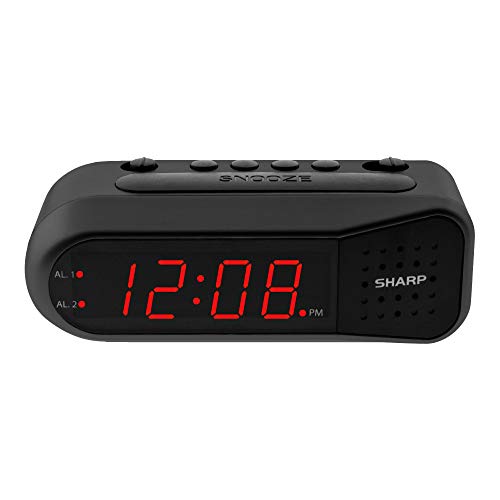
Sharp’s entry is the traditionalist of the six: red LED digits in a black case, an ascending wake sound that climbs rather than detonates, weekday and weekend scheduling, a nine-minute snooze stated to the minute, easy-set controls, and backup from two AA batteries. The title even lists its habitats — bedroom, dorm, office — which fits a clock designed as a dependable appliance rather than a feature showcase.
- Alarms: dual, with weekday/weekend scheduling
- Display: red LED
- Wake sound: ascending
- Snooze: 9 minutes, as stated
- Backup: 2 AA batteries
Strengths
- AA backup is real backup — batteries can actually run a simple clock’s alarm
- Ascending sound wakes gradually instead of ambushing the sleeper
- A nine-minute snooze is stated precisely, not left vague
Trade-offs
- No dimmer is mentioned anywhere in the title
- Red LED displays are a fixed, old-school aesthetic
- No USB charging or extra readouts are offered
Ascending volume is a humane piece of engineering. A sleeper caught early in the climb often surfaces gently, sometimes before the sound peaks; a sleeper deep down gets the full crescendo. For couples, that gradient is diplomatic — the partner who does not need to wake may sleep through the quiet opening that a fixed-volume alarm would never allow. Paired with weekday and weekend scheduling, the Sharp covers the two courtesies a bedside clock owes a household: do not wake the wrong person, and do not ring on Saturday.
The two AA batteries deserve emphasis because they distinguish this clock in the group. Battery backup that can genuinely power a simple LED clock’s alarm is a different promise from memory-only backup, and for outage-prone homes, dorm rooms with temperamental wiring, or anyone with an unmissable morning, it is the specification that matters most on this page. AA cells are also universally replaceable — no proprietary pack, no charging ritual — which suits a clock meant to be forgotten about until it is needed.
What the Sharp withholds is dimming. No level count, no range, nothing — so a light-sensitive buyer must assume the red display sits at a fixed brightness and judge accordingly. Red light is traditionally considered gentler at night than blue or white, which softens the concern, but a sleeper who needs darkness should not gamble. The easy-set controls claim is the other title promise to test: Sharp’s long history in this category suggests straightforward logic, yet the honest position is that the title asserts ease without demonstrating it.
Think of this clock as infrastructure. It will not project, charge a phone or report the temperature; it will sit in a dorm, a spare room or a bedside for years doing two alarms, two schedules and one ascending sound, through power cuts, without complaint. Households assembling a reliable home — the kind with spare batteries in a drawer — tend to underrate such appliances when shopping and overrate them at 6 a.m. in a blackout. The Sharp is built for the second moment.
Dorm life is the Sharp’s natural stress test: thin walls, shared rooms, unpredictable power and roommates on alien schedules. An ascending alarm is diplomacy in that setting, weekday-weekend scheduling prevents the Saturday incident that starts feuds, and AA backup ignores whatever the building’s wiring does at night. It is easy to see why the title lists the dorm alongside the bedroom; this specification reads like it was written by someone who has lived in both.
Best for: outage-prone homes, dorms and anyone who wants AA-backed alarms and a gentler ascending wake
Not suited for: light-sensitive sleepers who need a dimmer, because none is stated for this clock
Check price on Amazon — if blackouts are your fear, the AA cells are the argument.

JALL Digital Alarm Seniors
JALL’s clock is designed around a reader: a senior who wants the day and date alongside the time, on a 5.5-inch colour-coded screen with six dimmer levels. Dual alarms, volume control and a snooze cover the waking duties, while dual USB charging, settings backup and a temperature readout round out a specification that treats the bedside clock as a small information station for someone who should never have to squint, guess or reprogram.
- Alarms: dual, with volume control and snooze
- Display: 5.5-inch, day and date, colour-coded screen
- Dimming: 6 levels
- Extras: dual USB charging, settings backup, temperature
- Backup type: settings backup stated; battery type not stated
Strengths
- Day and date display answers the question seniors actually ask on waking
- Six dimmer levels give fine control over a large screen
- Colour-coding helps separate time, day and other readouts at a glance
Trade-offs
- Settings backup is named without saying whether alarms sound in an outage
- Temperature is a nice extra that some buyers will never look at
- 5.5 inches is large for a small nightstand
Day and date sound like a small addition until you consider the waking moments they serve. For an older sleeper — or anyone after illness, travel or a disorienting nap — the first questions are often not the hour but the day itself, and whether today holds an appointment, medication timing or a visit. A clock that answers on its face, in colour-coded sections, removes a small daily uncertainty that phones solve only after being found, unlocked and focused on. That is thoughtful design aimed at a real reader, not feature stuffing.
Six dimmer levels on a 5.5-inch screen is the right pairing of size and control: enough steps to find a personal floor for night brightness, on a display large enough to remain legible at that floor. Dual USB charging speaks to the same reader — a phone and perhaps a tablet or a hearing-aid charger, both topped up at the bedside without a socket hunt. The temperature readout is the lightest feature here, pleasant for deciding whether the room or the bedding is at fault on a restless night, and harmless if ignored.
The one ambiguity is the settings backup. The phrase promises that programmed alarms and preferences survive an interruption, but it does not promise the alarm will sound during one — the same distinction the Mesqool states explicitly. A buyer equipping a parent’s bedside, where a missed alarm might mean missed medication timing, should clarify that point on the full listing and, if the answer is memory-only, pair the clock with a simple battery-backed understudy for critical mornings.
There is also a gift-buying dimension to this pick. Adult children equipping a parent’s home need products that explain themselves, and the JALL’s colour-coded face, day-date clarity and forgiving dimmer ladder are self-explanatory in a way app-paired gadgets never are. Set it up once, on a visit, and it asks nothing further — no account, no updates, no phone. For the senior audience named in its title, that independence is the feature underneath all the others.
For the JALL, the temperature readout earns a defence, because carers actually use it. A senior who insists the room is cold may be showing you a number worth acting on, and a bedroom that drifts hot overnight explains restless sleep better than any lecture about bedding. Small data, kindly presented on a colour-coded face, helps families care at a distance of one glance — which is, in the end, the entire design philosophy of this clock stated in one sentence.
Best for: seniors and their families who want day, date and time legible at a glance with gentle dimming
Not suited for: a household that needs the alarm itself guaranteed through an outage, because the backup wording covers settings only
Check price on Amazon — read its face the way its intended reader will: half asleep, no glasses.
What each clock states, lined up
| Model | Dimming as stated | Schedule awareness | Backup as stated |
|---|---|---|---|
| Netzu Digital Dual Alarm | 5 settings | No mode named | Not stated |
| Odokee Digital Dual Alarm | 0-100% range | Weekday/weekend mode | Not stated |
| Generic 7.5in Dual Alarm Large Display | 5 levels | No mode named | Not stated |
| Mesqool Projection Dual Alarm | 5 levels | DST handling | Memory only |
| Sharp Dual Alarm Red LED | Not stated | Weekday/weekend scheduling | 2 AA batteries |
| JALL Digital Alarm Seniors | 6 levels | No mode named | Settings backup |
Lined up this way, the six divide by philosophy: display control, schedule intelligence, or power resilience — each clock leads on one and concedes another. Readers setting up a bedside from scratch often pair the clock decision with the clock-radio question, since a CD-playing alarm changes the same nightstand. Best Alarm Clocks With CD Players
How do you choose between two alarms that both ring?
Who is each alarm actually for?
Name the two alarms before shopping. If they belong to two people, volume separation and distinct sounds matter most, because each sleeper must recognise and respond to their own call while ideally sleeping through the other’s. If both alarms belong to one person — a first nudge and a final deadline — then snooze length and an ascending second alarm matter more, and schedule modes matter less. The six titles sort themselves quickly once that ownership is clear.
Households often discover their true pattern after a week of use, so favour clocks whose logic can be rethought without pain: modes that can be switched, volumes that can be rebalanced. A clock that demands a manual and a free afternoon every time the roster changes will quietly stop being reprogrammed, and an un-reprogrammed dual alarm is worse than a simple one, because it rings with total confidence at the wrong time.
How dark is dark enough in your bedroom?
Dimming specifications sound abstract until translated: counted steps, a continuous range, or silence. The continuous zero-to-one-hundred range here is the only one that promises a fully dark face, and light-sensitive sleepers should weight that heavily. Stepped dimmers are fine for most people, but their lowest step is a guess from the title alone — five steps might end at a glow or at a ember, and only the full listing or the first night will tell.
The Sharp’s silence on dimming deserves the same translation: assume fixed brightness, softened by the red colour’s reputation for night gentleness. Couples with different light tolerances should also consider placement as a dimmer of last resort — a clock angled away from the sensitive partner, or a projector model whose base can face the wall while the ceiling carries the time.
What happens at your house when the power fails?
Power resilience is the least glamorous axis and the one that matters on the worst morning of the year. The honest hierarchy from these titles: AA batteries that can run the alarm, then settings or memory backup that at least restores the clock’s brain, then silence on the subject, which should be read as no protection at all. Households with reliable mains can safely shop the whole list; households at the end of a stormy rural line cannot.
There is no shame in a two-clock strategy for critical sleepers — a feature-rich primary for ordinary mornings and a cheap battery stalwart armed only for exam days, flights and first days at new jobs. Pilots, nurses and fishermen have run that system for decades. What the titles here give you is the information to assign each clock its role without discovering the assignment during a blackout.
Early risers who take their mornings seriously often extend the ritual beyond the alarm itself, into coffee that is ready with the same reliability. Best Nitro Cold Brew Coffee Makers
The two-alarm household, choreographed
A dual alarm earns its keep through choreography, not hardware. The smoothest households run a pattern: first alarm low and kind for the person who showers first, second alarm fuller for the person whose leaving time is later, with the snooze on each owned by its own sleeper and never borrowed. Trouble starts when alarms are shared informally — one partner snoozing the other’s call out of half-asleep kindness — so the rule worth stating aloud is that nobody touches an alarm that is not theirs.
Weekends need their own choreography, which is why the schedule-aware models here matter. A household that must remember to disarm Friday’s alarm will eventually forget on the one Friday before a wedding, a holiday or a lie-in that mattered. Automation is not laziness in this category; it is the removal of a recurring human error from the sleepiest hour of the week.
Why phones lost the bedside
Every clock on this page exists because phones turned out to be mediocre alarm clocks: they invite midnight scrolling, die uncharged, update at night and put the whole internet one snooze-tap away from a waking mind. A dedicated clock does one job in the dark with physical buttons, keeps the phone charging in another room or face-down, and gives a bedroom back its analogue calm. The dual-alarm versions simply extend that calm to households with two mornings to protect.
There is a sleep-hygiene dividend too. Checking the time on a clock — even a projected one — delivers the hour and nothing else: no notifications, no headlines, no messages demanding a reply at 3 a.m. Households that moved the phone out of the bedroom routinely report the clock as the smallest purchase with the largest effect on their nights, which is why this modest category keeps growing new models.
Snooze, studied seriously
The snooze button is the most philosophically loaded control in the home. Used as designed — one press, a few extra minutes of shallow doze — it softens waking for people whose bodies resist abrupt starts. Used as a lifestyle, five snoozes deep, it fragments the last hour of sleep into the worst rest of the night. The nine-minute snooze stated on the Sharp is the industry’s traditional interval; the other titles here confirm a snooze exists without always counting its minutes.
Households get the most from dual alarms by making the second alarm the snooze’s replacement: instead of one alarm pressed four times, two alarms set deliberately, the second non-negotiable. That reframing turns a guilty habit into a planned two-stage wake, and it is arguably the strongest reason this entire category exists. Set the first alarm for the person you hope to be and the second for the person you are, and let both do their jobs.
Placement: the nightstand is a system
Where a clock sits decides how well its specification performs. A dimmer’s lowest step still glares if the display aims straight at the pillow; angle it a few degrees away. A volume ladder sounds louder with the speaker unobstructed, so a clock buried behind books underperforms its own title. Projection models need their throw distance respected, and big displays need enough distance that their size reads as clarity rather than glare.
Cables belong to the same system. A clock whose cord stretches taut across the nightstand will migrate, tilt and eventually fall; route the cable with slack, keep the charging leads — on the models that offer them — from dragging the clock forward, and the whole arrangement stays put through a year of half-asleep snooze reaches. The best clock in this list, badly placed, performs like the worst one.
Guests, spare rooms and the loaner clock
Every household eventually hosts a sleeper whose morning matters — a friend with a dawn flight, a grandparent with a hospital appointment, a teenager before an exam. A dual alarm clock in the spare room, pre-settable in minutes and explainable in one sentence, is a small masterpiece of hospitality. The features that matter for guests are legibility and obvious controls, which is why the big-display and easy-set claims in this list deserve more weight than their modest billing suggests.
Hosts should do the setting, not delegate it: program the guest’s alarm yourself, rehearse it once in the evening, and leave the second alarm off rather than armed at some forgotten hour. That last point matters — a spare-room clock’s stale second alarm is the most common way these devices ambush an innocent visitor at 5 a.m. The dual format’s strength becomes its only real hazard when a clock changes sleepers often.
What dual alarms do for shift workers
Rotating shifts break ordinary alarms because the sleeper’s day keeps moving. Dual alarms give a shift worker a structure that survives rotation: one alarm for the current shift’s wake time, a second parked at the next rotation’s, so the changeover is a toggle rather than a reprogramming session at the end of a night shift, which is precisely when complex button sequences go wrong.
The schedule modes and volume ladders in this list map onto shift life too. A day-sleeping night worker needs a display that can go truly dark at noon behind curtains, and an alarm that can out-shout a household’s daytime noise without terrorising it at night. Reading these six titles through a shift worker’s eyes reorders them completely — which is the real lesson of the category: the ranking lives in the roster, not in the clock.
Common mistakes
Setting both alarms to the same volume
Two alarms at identical loudness are just one alarm with a sequel. The format’s power is contrast: a first call pitched to the lighter sleeper or the gentler intention, a second pitched to cut through. Use the volume ladders and sound choices these titles advertise, and rehearse both alarms once in daylight so nobody meets their 6 a.m. voice for the first time while asleep.
Forgetting the Saturday trap
The most-resented sound in domestic life is a weekday alarm on a weekend morning. Two of these clocks automate the distinction; the other four rely on the household’s Friday-night memory. If you choose a model without a schedule mode, build the disarming into an existing ritual — the Friday door-locking round, the weekend bag unpack — because willpower at midnight is a poor system.
Assuming backup means the alarm will ring
Backup is the most misread word in this category. One title here limits its battery to memory, another says settings backup, and only the AA-powered model plainly implies the alarm itself survives. Read the wording with a lawyer’s care, test the clock once by pulling the plug on a safe morning, and never let an untested clock guard an unmissable one.
Buying the biggest display for the darkest sleeper
Screen inches and sleep quality pull in opposite directions. The 7.5-inch model is a gift for poor eyesight and a burden for a sleeper who needs darkness, even across five dimmer steps. Match the display to the eyes and the light tolerance of the person who will actually sleep beside it — not to the person doing the shopping, who is usually awake, dressed and optimistic.
Leaving a new clock’s settings at factory defaults
Dual alarms ship in whatever state the factory left them, and the first week with a new clock is when wrong modes, wrong formats and armed test alarms do their damage. Spend ten unhurried minutes on day one: set both alarms, walk the dimmer to its floor, try the snooze, confirm the weekday logic. That small commissioning ceremony prevents nearly every story people tell about clocks that ‘went off for no reason’.
Placing the clock within arm’s reach of a committed snoozer
Distance is a feature no title can sell you. A deep sleeper who can silence an alarm without opening both eyes will do so, on any of these six, however loud. Moving the clock across the room — ideally the big-display or projector model, whose time stays visible from the bed — converts waking into standing, and standing is the battle mostly won. Households fighting a losing snooze war should change geography before changing clocks.
Households that run on early alarms and tracked-in pet hair have a second morning problem waiting in the hallway, and the cordless vacuum category aimed at cat litter exists for exactly that pairing. Best Cordless Vacuums for Cat Litter
Final recommendation
Decide by failure mode. If the disaster you fear is a Saturday alarm, choose a schedule-aware clock — the Odokee or the Sharp. If it is a power cut on the morning that matters, the Sharp’s AA backup stands alone here, with the Mesqool and JALL honestly limited to remembering rather than ringing. If it is light — a display that will not darken — the Odokee’s range to zero is the answer, and if it is eyesight, the big 7.5-inch display or the JALL’s day-date face are the two honest solutions.
The Netzu remains the balanced generalist, the clock to buy when the household’s sleepers and schedules keep changing and no single failure mode dominates. And the Mesqool is the delight pick, for the right ceiling and a reliable grid. None of the six rings falsely in its title; each simply protects against a different bad morning, and your household already knows which bad morning it fears.
One closing test before you order: describe your household’s worst recent morning in one sentence — the missed shift, the Saturday detonation, the blackout, the squinting confusion. The right clock in this six is the one whose stated features make that sentence impossible to say again, and that test will sort the list faster and more honestly than any star chart. Trust it over feature envy, because a clock bought to prevent your actual bad morning will be thanked weekly, while a clock bought for a stranger’s priorities becomes furniture with digits.
Frequently asked questions
Why would one person need two alarms?
As a staged wake: a gentler first alarm that starts the surfacing, and a firmer second one set as the true deadline. Heavy sleepers use the pair as insurance, anxious sleepers use it to relax — knowing the second alarm exists makes the first snooze guilt-free. Shift workers also park a backup alarm for the days when exhaustion wins the first round.
What is the difference between memory backup and real battery backup?
Memory or settings backup means the clock remembers its programming through an outage and resumes correctly when power returns — but it may stay dark and silent during the cut itself. Battery backup that powers the clock, like the AA arrangement on one model here, can keep the display and the alarm working while the mains are down. The titles state which kind each clock offers, and the distinction matters most on stormy grids.
Are red digits really easier on sleep than blue or white?
Red light is widely regarded as the least disruptive colour for night vision, which is why the Sharp’s red LED has its defenders. Blue displays, like the Odokee’s, look crisp and modern but some sleepers find them vivid; that clock’s dimmer reaching zero is its countermeasure. Personal sensitivity varies enough that the dimming range is the safer specification to shop by than colour alone.
How loud is loud enough for a heavy sleeper?
Titles rarely publish decibels, so judge by structure: multiple volume levels, an ascending design that ends high, or sounds chosen for penetration. Two models here court heavy sleepers explicitly. The practical test is a daylight rehearsal at the intended setting, from under a pillow if that is where the sleeper’s head will be — and for the truly deep sleeper, a second clock across the room beats any single louder one.
Do projection clocks work in a bright bedroom?
Projection reads best on a pale surface in a darkened room; in daylight or on dark, textured ceilings it fades or blurs. The Mesqool’s rotating projector helps you hunt for the best surface, but no projector wins against a sunlit white ceiling at noon. Treat projection as a night feature — which is, of course, exactly when the time matters.
Should both partners’ alarms live on one clock?
Often yes, when the nightstand space or the socket count says so, and the clocks here with distinct sounds or volume ladders make shared use workable. The arrangement succeeds when each partner owns their alarm completely — its time, its sound, its snooze — and fails when settings become communal property that either person adjusts half-asleep. Couples who argue about alarms should split devices instead; two cheap clocks beat one resented one.
May both your alarms be set for the life you actually live — early when it counts, silent on the mornings that are yours.


