What's inside
- Where to buy these picks
- Quick Picks
- How these picks were chosen
- The six picks in detail
- Charging, bands and backup across the six
- What should a CD alarm clock do besides play discs?
- The disc shelf beside the bed
- Clock radios as the phone-free bedroom’s anchor
- What a clock radio does to a guest room
- Audiobooks on disc: the bedtime library
- Second-hand discs and the economics of the format
- Setting up day one, properly
- Why this format keeps being manufactured
- Common mistakes
- Final recommendation
- Frequently asked questions
As an Amazon Associate I earn from qualifying purchases. This post may contain affiliate links at no extra cost to you.
As an Amazon Associate, cottageverdict.com earns from qualifying purchases.
Waking to a compact disc sounds like nostalgia until you live with it: the same album opening your morning, at the same track, with no phone screen, no streaming login and no algorithm choosing for you. People hunting for the best alarm clocks with cd player usually own discs they still love and want a bedside machine that plays them, keeps FM or AM radio company through the day, and runs two alarms for two schedules. The six models below all combine a CD player with a clock radio and dual alarms, but they diverge on charging, remotes, display colours and extra inputs — and, as ever in this guide, only what the titles state is treated as fact.
Where to buy these picks
Proscan’s PCR4896 opens the set plainly: a CD clock radio with a USB charger and a model number, nothing more claimed and nothing less delivered on paper.
GPX follows with the tidy summary version — CD player, FM radio, dual alarm and battery backup, the four essentials named in one breath.
Gelielim is the maximalist: FM radio, wireless charging, Bluetooth boombox ambitions, a remote control, a dimmable display with timer, and dual alarms pitched at heavy and light sleepers alike.
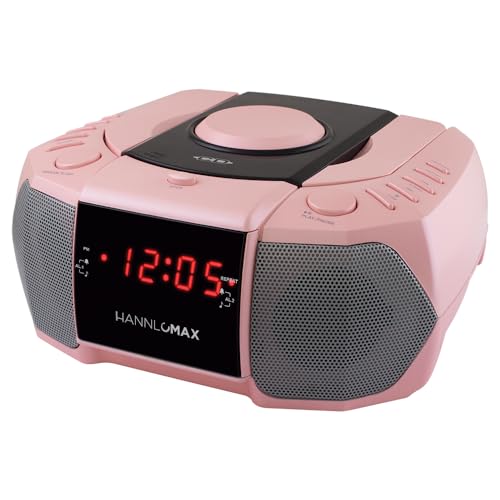
The pink HANNLOMAX HX-334CD brings AM as well as FM radio, an LED display, dual alarms, an aux-in socket and AC power.
Its black sibling, the HX-300CD, swaps in a 1.2-inch green LED display and USB charging ports rated at 2.1A and 1A, alongside FM radio and an aux-in.
Jensen closes with the heritage proposition: a stereo compact disc player with AM/FM digital tuning and dual alarms from a long-established audio name.
Quick Picks
| Pick | Best for | Highlight from the listing title |
|---|---|---|
| Proscan CD Clock Radio PCR4896 | A straightforward CD clock radio with phone charging | Model PCR4896, USB charger included in the pitch |
| GPX CD Clock Radio Dual Alarm | The essentials with outage protection | CD, FM, dual alarm and battery backup all named |
| Gelielim CD Player Alarm Clock | Feature collectors and remote-control fans | Wireless charging, Bluetooth, remote, dimmable display |
| HANNLOMAX HX-334CD CD Alarm | AM listeners who want a pink finish | AM/FM radio, aux-in, LED display, dual alarm |
| HANNLOMAX HX-300CD CD Alarm | Charging two devices at the bedside | USB ports stated at 2.1A and 1A, green LED display |
| Jensen Stereo CD Dual Alarm | Stereo sound from a known audio brand | Stereo CD player, AM/FM digital radio, dual alarm |
How these picks were chosen
The entry requirements were strict: a real CD player, a clock, and dual alarms, all stated in the title. All six pass, which already separates this list from the clock radios that dropped the disc drive years ago. Beyond that, titles were compared on the bedside questions that decide daily satisfaction — what else can charge here, what happens in a power cut, how the display behaves at night, and whether the machine accepts music from anything besides discs and radio.
Charging turned out to be a genuine divider: two models name USB chargers without speeds, one names two ports with their amp ratings spelled out, one leaps to wireless charging, and two say nothing about charging at all. Backup divides them too — only the GPX title says the words battery backup, while the HANNLOMAX HX-334CD states AC power, which is a different and more limited promise. Those silences are reported as silences below.
Sound claims were kept on a short leash. One title says stereo, one calls itself a boom box, and the rest make no audio claims at all, so the reviews discuss format and features rather than inventing sound quality. A CD clock radio lives or dies on whether its owner keeps feeding it discs, and that habit — the shelf of albums beside the bed — matters more to long-term satisfaction than any specification in these titles.
The six picks in detail

Proscan CD Clock Radio PCR4896
Proscan’s PCR4896 is the minimalist of the group: a CD clock radio, a USB charger, a model number. The title makes no claims about display size, radio bands beyond the clock-radio label, or backup power, and that plainness can be read two ways — as a product with nothing to hide, or as a listing that leaves the buyer homework. What is certain is the core promise: discs at the bedside, two alarms implied by the category it competes in, and a charger for the phone that also lives there.
- Type: CD clock radio
- Model: PCR4896
- Charging: USB charger
- Radio bands: not specified in the listing title
- Battery backup: not stated in the listing title
Strengths
- A model number makes manuals and support searches precise
- USB charging covers the phone’s nightly top-up
- Uncluttered pitch suits buyers who want CD and clock without extras
Trade-offs
- Title omits radio bands, display details and backup entirely
- Dual alarm is not spelled out in the title’s own words
- No remote, aux-in or Bluetooth is claimed
There is a real audience for this restraint. A CD clock radio is often bought for a guest room, a parent’s bedside or a kitchen counter, places where the machine should explain itself to whoever stands in front of it. Every added feature — Bluetooth pairing, wireless charging pads, remote controls — is another thing a guest cannot work at midnight. The Proscan’s bet is that a disc, a clock and a charger need no manual, and for a large share of households that bet is correct.
The homework list, though, is longer than for any rival here. A buyer should confirm from the full listing whether the radio covers FM only or AM too, whether the dual alarms are indeed present as the category suggests, and what happens in an outage. None of that is hidden malice; it is simply a short title. But this guide’s rule is that unstated is unverified, so the Proscan is recommended below with its questions attached rather than with assumptions pasted over them.
Consider who still buys CD clock radios and the Proscan makes more sense. The disc shelf is the point: audiobooks on CD, language courses, the album collection that never migrated to streaming. For those listeners a simple, durable-feeling player with a clock face is not a compromise purchase — it is the exact product the streaming era stopped making. The USB charger quietly acknowledges the household’s other device without letting it take over the nightstand’s purpose.
Placement flatters this model. On a kitchen counter it becomes the morning-news-and-music station; in a guest room it offers visitors radio and a charger without instructions; at a bedside it keeps its face simple in the dark. Multi-room households sometimes buy the same simple model twice rather than learn two feature sets, and a clock radio with a clear model number and few surprises is the natural candidate for that kind of doubling.
The one caution worth repeating is alarm verification. This whole category is bought for waking, and the Proscan’s title leans on the clock-radio label rather than enumerating its alarms. Spend the two minutes on the listing to confirm the dual-alarm arrangement and the wake-to-CD option if that is your plan, because waking to a chosen disc is the romantic centre of this category and it should be confirmed, not presumed.
Best for: guest rooms, parents’ bedsides and simple households wanting CD, clock and a charger without a feature maze
Not suited for: a primary bedroom that needs dual alarms and radio bands confirmed in writing, because this title leaves them to the listing
Check price on Amazon — bring three questions to the listing; the machine itself asks nothing of you.

GPX CD Clock Radio Dual Alarm
GPX writes the tidiest title in the group: CD player, FM radio, dual alarm, battery backup — the four things a CD clock radio must do, each named once, with nothing decorative added. That economy makes the GPX the easiest model here to understand in ten seconds, and its battery backup claim makes it the only one whose title directly addresses the power-cut question that haunts every alarm purchase.
- Player: CD
- Radio: FM
- Alarms: dual
- Backup: battery backup stated
- Charging ports: not stated in the listing title
Strengths
- Battery backup is claimed outright, a rarity in this group
- Every core function is named in the title — no homework on basics
- FM plus CD covers the two classic bedside sources
Trade-offs
- No AM band is mentioned for talk and sports listeners
- No USB charging or aux-in is claimed
- Display size and dimming go undescribed
Battery backup in a clock radio deserves unpacking, because it usually means the clock and alarm survive an outage on battery while the CD and radio rest. For an alarm buyer that is precisely the right priority: the disc can wait for the power company, the wake-up cannot. The GPX title’s decision to spend words on backup rather than on display inches suggests a maker who understands why these machines are bought, and households on unreliable grids should notice.
FM-only, as far as the title states, is the honest limitation. FM covers music radio handsomely, but AM carries talk, news and a great deal of sport in many regions, and two rivals below state AM explicitly. A listener whose mornings run on an AM station should treat that absence as decisive rather than minor. Similarly, the lack of any stated charging or aux-in keeps this machine in its lane: it plays discs and FM, keeps time, backs itself up, and leaves phones and other inputs to other devices.
There is a discipline to a product like this that feature-rich rivals sometimes lose. Every control on a CD clock radio serves the disc, the radio or the alarms; a buyer who wants exactly that, in a bedroom or a holiday cabin, will find the GPX’s focus restful. The dual alarms cover the two-schedule household, the CD covers the disc shelf, and the specification ends where the need ends. Not every purchase should be a platform, and this one declines to be.
Cabins, caravans and spare rooms with temperamental power are this model’s natural habitat, because battery backup travels well and FM needs no internet, no account and no signal beyond the airwaves. A household equipping a place that sits empty between visits — where a clock must survive outages unvisited and still greet the next arrival with the right time — has found its candidate. Set it, back it up, and let it wait patiently in the dark.
The unanswered questions are about comfort rather than function: display brightness at night, whether a dimmer exists, and how the alarm sounds. None appear in the title. A light-sensitive buyer should check the listing for dimming before ordering, because a clock radio that performs flawlessly at 7 a.m. can still lose the household at 2 a.m. if its face glows unchecked. Function is fully promised here; night manners must be verified.
Best for: outage-aware households wanting the CD clock radio essentials with backup stated in writing
Not suited for: AM radio listeners, since only FM is named in this title
Check price on Amazon — the backup claim is the headline; check the display’s night manners second.

Gelielim CD Player Alarm Clock
Gelielim’s clock is the maximalist answer to the same brief: a CD player and FM radio joined by wireless charging, Bluetooth described in boom box terms, a remote control, a dimmable display with a timer, and dual alarms explicitly pitched at heavy and light sleepers. Where the GPX spends its title on four essentials, this one spends its title on abundance, aiming at the buyer who wants the nightstand to do everything at once.
- Player: CD, plus Bluetooth
- Radio: FM
- Charging: wireless charging
- Controls: remote control included in the pitch
- Display: dimmable, with timer; dual alarms for heavy/light sleepers
Strengths
- Wireless charging removes the bedside cable for compatible phones
- A remote suits listeners who play discs from across the room
- Dimmable display addresses the night-glow problem directly
Trade-offs
- No battery backup is mentioned despite the long feature list
- Boom box is a maker’s flourish, not a measurable sound claim
- Feature abundance means more to learn and more to misplace, remote included
Wireless charging changes the nightstand’s geography. The phone lands on the clock rather than beside it, the cable disappears, and the morning grab is a single motion. For households already living with wireless charging elsewhere, this Gelielim completes the set; for others it introduces the standard, with the usual caveat that the phone must support it and be placed accurately — a half-asleep placement miss means a half-charged morning, so the first week with this clock is a habit-forming exercise.
The remote control reframes who the CD player is for. A bedside disc player is normally operated at arm’s length, but a remote turns it into a room player: discs changed from a chair, volume trimmed from the bed’s far side, the timer set without leaning across. Paired with the Bluetooth claim, the machine is really auditioning as the bedroom’s small stereo that also wakes you, rather than an alarm that happens to play discs. Buyers should decide which of those two identities they are shopping for, because it determines whether the extra features are value or clutter.
Heavy and light sleepers sharing one clock is the dual-alarm problem stated honestly, and this title names both audiences. The useful reading is that the two alarms are expected to differ — in volume or tone — so each sleeper gets a call calibrated to them. The dimmable display supports the same diplomacy at the visual level. What the title never promises is backup power, so this feature palace shares the Proscan’s outage question, and a household on a fragile grid should weigh that silence against the longer feature list.
The timer deserves its sentence, because sleep timers are how clock radios earn their evenings as well as their mornings: radio or a disc playing the room down, then silence. In a machine with Bluetooth, the timer also disciplines the phone’s music, which makes this a plausible single device for the whole bedtime routine. Households trying to move phones out of the bedroom should note the irony and the opportunity — the phone can stay, docked and charging, while its owner’s attention goes to a disc, a book and a timer.
Feature-rich clocks live or die on control layout, and no title can prove that. The remote mitigates the risk — the most-used functions usually migrate to it — but a buyer should still scan the listing for how alarms are set, because a dual alarm buried in menus will not be reprogrammed when schedules change. The Gelielim’s specification is the broadest here; its homework is about usability, the one quality a title cannot state.
Best for: nightstands that want everything: discs, Bluetooth, wireless charging and a remote, in one machine
Not suited for: outage-prone homes, because for all its features the title never mentions backup power
Check price on Amazon — decide if you are buying an alarm or a bedroom stereo; it wants to be both.
HANNLOMAX HX-334CD CD Alarm
The HX-334CD is the pink one, and its colour is doing honest work: this is a clock radio meant to be looked at, for a bedroom, a dressing table or a teenager’s room where appliances are allowed personalities. Under the colour sits a complete classic specification — CD player, AM and FM radio, digital clock, dual alarms, LED display, aux-in for other devices, and AC power stated plainly.
- Player: CD
- Radio: AM/FM
- Colour: pink
- Input: aux-in
- Power: AC power source, as stated; no backup claimed
Strengths
- AM as well as FM covers talk, news and sports bands
- Aux-in lets a phone or player use the speaker without Bluetooth pairing
- Colour and compact clock-radio format suit personal rooms
Trade-offs
- AC power with no backup mentioned leaves outages unanswered
- No USB charging is claimed for the bedside phone
- Display size and dimming are not described
AM radio is this model’s quiet headline. Music has largely migrated to FM and streaming, but AM remains where live sport, talk and local news live in many places, and a bedside radio that cannot reach it cuts its owner off from a whole tier of morning listening. The HX-334CD states both bands, which makes it a genuine radio as well as a disc player — a distinction the FM-only models here cannot claim, and one that matters more with every year a clock radio stays in service.
Aux-in is the unglamorous input that never asks for a password. Any device with a headphone socket — an older phone, a tablet, a child’s music player — can play through this machine with a cable, no pairing ritual, no compatibility list. In a teenager’s room or a guest room that universality beats Bluetooth’s elegance. The trade is the cable itself and the absence of stated USB charging, so the phone that plays through the aux-in must charge elsewhere in the room.
The AC power statement should be read as the outage answer: this clock depends on the wall. In a teenager’s room or a dressing-table role, where the alarm is a convenience rather than a lifeline, that dependence is acceptable and even simplifies the product. In a primary bedroom guarding a shift worker’s morning, it is a genuine limitation, and the household should either accept a phone as the backup alarm or choose the GPX above, whose title promises battery support.
Colour in appliances is usually dismissed as decoration, but a clock radio is furniture that shows the time. A pink machine in a room designed around it looks intentional; the same machine in a walnut-and-linen master bedroom looks like a mistake someone keeps meaning to replace. Buy the colour for the room it will live in for years, not the room in a photograph. HANNLOMAX sells this model on personality, and personality is a legitimate specification when the object sits at eye level beside the bed.
Dual alarms in a teenager’s room deserve a mention, because the second alarm there is rarely for a second person — it is the negotiation between the wake-up the teenager sets and the one a parent insists on as insurance. A clock that runs both, on AC power in a home where someone is always awake to notice an outage, fits that domestic diplomacy well. The LED display’s brightness at night remains the open question to check on the listing.
Best for: AM listeners and personal rooms that want a colourful, classic CD clock radio with aux-in
Not suited for: primary bedrooms needing outage protection, since AC power is stated and backup is not
Check price on Amazon — the AM band and the colour are the reasons; the outage question is the caveat.

HANNLOMAX HX-300CD CD Alarm
The HX-300CD is the HX-334CD’s black-clad sibling with a different set of priorities: FM radio rather than AM/FM, a 1.2-inch green LED display whose size is actually stated, an aux-in, and the most precisely described charging in this group — USB ports rated at 2.1A and 1A. That amp detail is the kind of specification that lets a buyer plan a nightstand exactly: the fast port for the phone, the gentle one for whatever else sleeps there.
- Player: CD
- Radio: FM
- Display: 1.2-inch green LED, as stated
- Charging: USB ports at 2.1A and 1A
- Input: aux-in; dual alarms stated
Strengths
- Two USB ports with stated ratings end the bedside socket contest
- A stated display size removes the guesswork rivals leave
- Green LED is a distinctive, traditional clock colour
Trade-offs
- FM only, where its pink sibling offers AM too
- No battery backup is mentioned in the title
- Green digits are a taste not every bedroom shares
Amp ratings sound like trivia until two devices compete for one clock. A 2.1A port charges a phone or small tablet at a respectable pace; a 1A port suits a second phone, an e-reader or a partner’s device that has all night. Stating both numbers lets a household assign the ports before the machine arrives, and it marks this listing as written by someone who expects to be compared on facts. In a category full of vague USB claims, that precision is the HX-300CD’s character reference.
The 1.2-inch display is modest and deliberately so. A clock radio’s face must be readable from the pillow and ignorable by the sleeper, and 1.2 inches of green LED sits at the traditional compromise — the size generations of clock radios converged on. Green is the interesting choice: softer in folk reputation than blue-white, more characterful than red, and polarising in a decorated room. As with its pink sibling, the colour should be chosen for the room’s long-term scheme, not for novelty.
Losing AM is the sibling trade to register. This model spends its specification budget on charging and display clarity, and pays with the AM band its pink counterpart keeps. A household whose listening is music, FM news and discs will never miss it; a sports-talk household will miss it weekly. The aux-in partially compensates — a phone can stream the AM station’s app through the speaker — but that workaround chains the radio to the phone, which is what a clock radio exists to avoid.
Two HANNLOMAX models in one list is a useful accident, because it shows how a maker segments a category: colour and bands for one buyer, charging and display for another, the same CD-clock-radio skeleton beneath. A buyer torn between them should simply rank their own habits — AM listening against two-device charging — and the choice resolves itself. Brand-level questions, like how the alarms are set, are likely answered similarly by both, so the sibling comparison is really a values test disguised as a product comparison.
The outage silence is shared with its sibling: no backup is claimed, so the wall owns this clock’s mornings. In homes with reliable power and a phone charging — conveniently, from this very machine — as the understudy alarm, that is a workable arrangement. Just make it a decision rather than a discovery, and set the phone’s backup alarm on the mornings that cannot be missed.
Best for: two-device households that want stated charging speeds and a compact green display
Not suited for: AM listeners, who should take the pink sibling’s band list instead
Check price on Amazon — assign the two USB ports in your head; if both are taken, this is your clock.

Jensen Stereo CD Dual Alarm
Jensen’s entry trades on two words the others do not use: stereo and its own name. This is a stereo compact disc player with AM/FM digital tuning and a dual alarm clock radio, from a brand with a long history in American audio. The title offers no model number, no charging claims and no backup statement — its argument is that a proper stereo CD player, built by an audio company, is the point of the purchase.
- Player: stereo compact disc player
- Radio: AM/FM, digital tuning
- Alarms: dual
- Model number: not stated in the listing title
- Charging and backup: not stated in the listing title
Strengths
- Stereo playback is claimed outright, which most rivals omit
- AM/FM with digital tuning covers both bands precisely
- An established audio brand stands behind the format
Trade-offs
- No model number complicates manual and support searches
- Charging, backup and display details all go unstated
- Stereo from a compact bedside unit has physical limits no brand repeals
Stereo matters at the bedside in a specific way: not for power, but for the shape of music at low volume. A favourite album played quietly at night gains separation and place from two channels, and since the CD clock radio’s disc playing is a listening act as much as a waking one, the Jensen’s stereo claim speaks to the evening half of the machine’s life. Digital tuning supports the radio half with precise station holding, a small mercy compared with analogue dials that drift off the talk station overnight.
Both bands are present, matching the pink HANNLOMAX on radio coverage and beating the FM-only models for listeners who divide their mornings between music and talk. What the title withholds is everything domestic: no USB, no backup, no display description. The Jensen buyer is therefore choosing on audio identity and brand trust, and should run the standard listing checks — backup, dimming, alarm-to-CD — before ordering, with the same diligence as for the Proscan, the other short title in this group.
Brand history cuts both ways and deserves an honest paragraph. A long-established audio name suggests parts, manuals and a design lineage; it does not guarantee this particular model’s virtues, and the absence of a model number in the title is a small frustration for anyone trying to research precisely. Search by the full title wording when looking for documentation, and treat the brand as a prior, not a proof. The stereo claim, at least, is stated in words and can be held to account.
This is the pick for the listener whose disc shelf is the household’s music library — the person for whom the alarm is almost an excuse to keep a CD player in production. Waking to a disc you chose, played in stereo by a machine built for the format, is the category’s founding pleasure, and the Jensen states that pleasure more directly than any rival here. Households buying primarily an alarm, with discs as an afterthought, will find better-specified alarms above; households buying a disc player that also wakes them have found their finalist.
A last practical note on stereo placement: two channels need a little air around them, so this machine earns a nightstand position with clearance on both sides rather than a corner burial among books. Give it that modest stage and the evening listening justifies the footprint. Wedged and muffled, its one stated advantage evaporates, and the buyer may as well have chosen on charging ports instead.
Best for: disc listeners who want stereo playback, both radio bands and an established audio name
Not suited for: a nightstand that needs charging or backup confirmed in writing, because this title confirms neither
Check price on Amazon — buy it for the listening, then verify the waking arrangements on the listing.
Charging, bands and backup across the six
| Model | Radio as stated | Charging as stated | Backup as stated |
|---|---|---|---|
| Proscan CD Clock Radio PCR4896 | Not specified | USB charger | Not stated |
| GPX CD Clock Radio Dual Alarm | FM | Not stated | Battery backup |
| Gelielim CD Player Alarm Clock | FM | Wireless charging | Not stated |
| HANNLOMAX HX-334CD CD Alarm | AM/FM | Not stated | AC power only, as stated |
| HANNLOMAX HX-300CD CD Alarm | FM | USB 2.1A and 1A | Not stated |
| Jensen Stereo CD Dual Alarm | AM/FM digital | Not stated | Not stated |
The pattern is almost comic: each machine spends its title on a different virtue, so the comparison table, not any single row, is the honest picture of the category. Readers whose bedside already has its clock may be shopping the same shelf for the morning’s other machine, the one that crushes ice for breakfast smoothies. Best Blenders for Crushing Ice
What should a CD alarm clock do besides play discs?
How will yours survive a power cut?
Only one title here promises battery backup, one states AC power outright, and four say nothing — which in this guide’s discipline means unconfirmed, not absent. The practical question is what the backup needs to protect. If the clock guards a shift, a flight or medication timing, backup that keeps the alarm alive is a requirement, and the shortlist narrows brutally. If it guards a gentle preference for waking to music, an outage is an anecdote, and the feature-rich models rejoin the contest.
There is also the phone-as-understudy arrangement: the clock performs daily, the phone’s alarm sits armed only for critical mornings. That system lets a household buy the Gelielim’s abundance or the Jensen’s stereo without gambling a career on the grid. What is not acceptable is the unexamined middle — a critical morning riding on a clock whose backup nobody ever checked.
Which inputs does your household actually use?
Discs are the given. Beyond them, the inputs divide by habit: radio bands for the broadcast loyal, aux-in for the cable-and-any-device household, Bluetooth for the phone-streaming bedroom, and charging — USB or wireless — for the phone that sleeps beside its owner regardless. Rank your household’s real evenings, not its imagined ones. A machine whose Bluetooth never pairs is just a heavier clock radio, and a wireless charging pad under a phone that lacks the feature is a coaster.
The two HANNLOMAX siblings stage this ranking perfectly: one keeps AM and skips charging, the other charges two devices at stated speeds and skips AM. Neither is the better clock; each is the better answer to a different household’s evening. Write your ranking down before comparing prices or colours, because colours are seductive and habits are forever.
Will you wake to the disc, the radio or the buzzer?
The wake source shapes the morning’s first minute. Waking to a disc is waking to a chosen, familiar opening — the same track, at a volume you set, with no presenter and no news. Waking to radio is waking to the world, variable and alive. A buzzer is waking to an order. Most of these machines offer more than one source, but the titles do not always enumerate the wake options, so confirm wake-to-CD specifically if that ritual is your reason for buying.
Households with two sleepers should also decide whether both alarms share a source. A disc for the music lover and the radio for the news hound is a small domestic treaty that dual alarms make possible, and it is worth setting up deliberately on day one rather than discovering by accident in month three.
Bedside decisions travel in packs: the household furnishing a guest room’s clock often ends up rethinking the kitchen’s work surfaces in the same project. Best Two Burner Gas Cooktops
The disc shelf beside the bed
A CD clock radio quietly reorganises a room around physical music. A small shelf or basket of discs appears beside the bed — the waking album, the evening album, the audiobook in progress — and choosing among them becomes a tactile ritual that streaming queues never reproduce. Listeners rediscover albums as wholes, because a disc player makes skipping possible but not frictionless, and many owners report that constraint as the pleasure: the record plays as its maker sequenced it.
Curating that shelf is the household’s real customisation. Keep it small and current — a dozen discs in rotation — and the machine stays a joy; let it become an archive and choosing turns into homework. The alarm disc especially deserves thought: it will be heard more than any other music in the house, half-asleep, so pick the album whose opening track you can love on the five-hundredth hearing.
Clock radios as the phone-free bedroom’s anchor
Every phone-free bedroom needs a device that tells the time, wakes the sleeper and provides evening audio, or the phone creeps back to the nightstand by Friday. The CD clock radio is the strongest candidate for that anchor job because it covers all three duties with physical media and broadcast radio — no account, no feed, no notifications. The models with charging complicate the purity slightly, but even they let the phone sit dark and face-down while the clock does the talking.
The health argument is by now familiar: a bedroom where the last and first information of the day comes from a disc and a clock face sleeps differently from one lit by a feed. These six machines are, in that sense, less nostalgic than they look. They are the current technology for a deliberate bedroom, wearing the shape of an older one.
What a clock radio does to a guest room
A guest room with a CD clock radio in it sends a particular message: you may wake when you like, to music we left for you, without asking anyone for a charger or a Wi-Fi password. A small stack of discs beside it — something gentle, something local on the radio dial noted on a card — turns a spare bed into a considered room. Of this list, the simple models suit guests best, because a visitor should never need a tutorial to set an alarm.
Hosts should still do the setting when a guest’s morning matters, and should disarm the second alarm rather than leave it armed at a forgotten hour. That ten-second courtesy is the difference between hospitality and a 5 a.m. surprise. The guest room is where this category’s virtues — self-contained, account-free, obvious — shine brightest, and where its few homework items matter least.
Audiobooks on disc: the bedtime library
A large share of these machines will spend their evenings playing spoken word. Library audiobooks on CD remain common, language courses live on disc, and a clock radio with a timer is a complete bedtime listening station: the chapter plays, the timer ends it, the sleeper never touches a screen. The remote-controlled model here flatters this use most, since pausing from under the covers beats sitting up to find a button in the dark.
Households rediscovering disc audiobooks should keep the current title beside the machine and the rest shelved elsewhere, because a bedside is a small stage. One story at a time, finished properly, is the rhythm the format teaches — another of its unfashionable virtues. Children especially take to a disc ritual: the same player, the same shelf, the story advancing a chapter a night, with the clock’s face the only light in the room.
Second-hand discs and the economics of the format
The CD clock radio is the rare appliance whose fuel gets cheaper every year. Charity shops and library sales overflow with discs — albums, audiobooks, complete radio dramas — at prices that make a month’s listening cost less than a single streaming subscription. A household equipping one of these six inherits that economy instantly: the machine is the only real purchase, and its library can grow for pocket change.
That economy changes listening behaviour in a healthy direction. Cheap discs invite gambles — the unfamiliar composer, the classic album never owned, the audiobook bought on a whim — and gambles are how taste grows. The bedside shelf becomes a small, physical frontier of things not yet heard, which no recommendation feed has ever quite replicated. For the price of the machine alone, that is a remarkable amount of culture to install beside a bed.
Setting up day one, properly
A CD clock radio rewards a deliberate first evening. Set the clock, programme both alarms, and then run a rehearsal: put a disc in, set a test alarm five minutes ahead, and listen to the machine wake an empty room. That rehearsal teaches the volume the room actually needs — always less than instinct suggests — and proves the wake source behaves as the listing promised. Skipping it is how households meet their new clock’s voice for the first time at the worst possible moment.
Finish the setup by deciding the machine’s evening job too: the radio station it rests on, the disc that lives in it, the timer’s usual length. A clock radio configured once, completely, disappears into the household’s routine, which is the highest compliment this category can earn.
Why this format keeps being manufactured
Manufacturers do not keep a product line alive for sentiment. CD clock radios persist because the demand is structural: older listeners with large disc collections, households building phone-free bedrooms, guest rooms and cabins that need self-contained machines, and gift buyers who need an appliance a recipient can use without an account or an app. Every one of those buyers appears somewhere in the six titles above, addressed in their own vocabulary of bands, ports and backups.
Understanding that demand helps a buyer choose confidently rather than apologetically. You are not buying yesterday’s technology; you are buying the current answer to a set of needs that streaming hardware serves badly. The disc by the bed, the radio on the hour, the alarm that answers to buttons — that is a coherent philosophy of the bedroom, and these machines are its standard-bearers.
Common mistakes
Assuming every clock radio wakes to CD
It is the category’s signature ritual and it is not universal enough to assume. Titles here promise CD players and alarms side by side without always promising the combination as a wake source. If waking to a disc is your reason for buying, verify that exact function on the listing before ordering, and test it on the first evening, not on the morning it matters.
Letting the remote become a single point of failure
The remote-controlled model here gains real convenience — and a new way to lose control of the machine, down the side of the bed, forever. Decide on day one where the remote lives, and confirm the clock’s own buttons can run the alarms without it. A dual alarm that can only be set by a missing remote is a paperweight with a disc inside.
Ignoring the display until the first night
Display colour and brightness are the features buyers notice least in a showroom and most at 2 a.m. Green, LED-unspecified and dimmable faces all appear in this list, and only one title promises dimming. Light sleepers should treat an unmentioned dimmer as an absent dimmer, and place the clock angled away from the pillow as insurance until its night manners are known.
Buying for the colour before the bands
A pink clock that cannot reach your AM station, or a black one that can, is a daily irritation wearing a pretty case. Colours in this list are attached to real specification differences — bands, charging, displays — so rank the habits first and let the colour be the reward for the right shortlist, never the shortlist itself.
Expecting boom box sound from a bedside box
One title here uses boom box language, and it should be read as enthusiasm, not physics. Compact clock radios play at bedroom scale: clear at conversation volume, present across a small room, and not a party system. Buyers wanting to fill a kitchen-diner with music should treat the clock radio as the bedroom device it is and let another machine carry the party.
Stacking things on top of the clock
Bedside machines attract clutter — books, glasses, the phone they were meant to replace — and top-loading or top-surfaced models suffer for it, while vents and speakers muffle under the pile. Give the clock its own clear footprint on the nightstand and defend it. A machine that can breathe and be seen will be used; a machine buried under the week’s reading becomes part of the furniture and stops waking anyone well.
A freshly furnished bedroom eventually raises air questions too, especially in larger homes where a commercial-grade purifier enters the conversation for the main living space. Best Commercial Air Purifiers
Final recommendation
The shortlist resolves by priority. For backup in writing, the GPX stands alone. For charging, the HX-300CD states its amps like an engineer, while the Gelielim goes further with wireless charging, Bluetooth and a remote for the household that wants one machine to do everything. For radio completeness, the pink HX-334CD and the Jensen share the AM/FM crown, with the Jensen adding stereo for the disc listener and the HANNLOMAX adding aux-in and colour.
The Proscan is the honest simple option for rooms that need no teaching. A first-time buyer forced to one name should take the GPX for its complete, backup-backed essentials — unless AM radio matters, in which case the Jensen or the pink HANNLOMAX takes the same money’s worth of morning. Every model here keeps the disc alive at the bedside; they simply disagree, usefully, about what else a nightstand is for.
And a word for the undecided household hovering between a clock radio and a smart speaker: ask which device you would trust in a power cut, operate in the dark without speaking, and hand to a grandparent without a tutorial. The six machines above were built for exactly those tests, and their titles — bands, ports, backups and all — are the honest evidence of it. Choose by the morning you need to protect and the evenings you want to hear, and the right one will be obvious to the whole household within a week of mornings.
Frequently asked questions
Can I definitely wake to a CD on these clocks?
The titles promise CD players and dual alarms together, but wake-to-CD as the alarm source is not enumerated for every model. Treat it as a function to confirm on the specific listing — it is a headline ritual of this category and most such machines offer it, yet this guide does not upgrade category habits into product facts. A two-minute check protects the exact morning you are buying the clock for.
What does battery backup actually keep running?
On the one model here that claims it, expect the clock and alarm functions to survive an outage while power-hungry extras like the CD player rest. That is the standard arrangement and the right priority. Models whose titles state AC power or say nothing should be assumed to stop with the mains until the listing proves otherwise.
Is FM-only a problem?
Only if your listening lives on AM — talk, news and much live sport in many areas. Music listeners will rarely notice the missing band. Two models here state AM/FM explicitly, so the choice is available in both directions, and the aux-in or Bluetooth on other models offers a phone-based workaround for the occasional AM programme.
Why buy a CD clock radio in the streaming era?
For ownership and calm. Discs play without accounts, adverts or connectivity, albums play whole, and the machine keeps the phone out of the bedroom’s first and last minutes. Add radio for the living world and dual alarms for a two-schedule household, and the format’s survival stops looking like nostalgia and starts looking like a design decision.
Which display colour is kindest at night?
Green and red both carry reputations for gentleness; the only title here that promises dimming sidesteps the question entirely. Judge by the combination — colour plus dimming plus angle — rather than colour alone, and remember that a clock can be turned a few degrees away from the pillow, the cheapest brightness control ever made.
Do these clocks need an internet connection for anything?
No — and that is rather the point. Discs, broadcast radio, alarms and clocks all work with no network at all, which makes these machines dependable in outages, cabins and guest rooms where connectivity is a favour rather than a utility. The Bluetooth model pairs locally with a phone, which is a cable-free convenience, not an internet dependency.
Are CDs still easy to find for these machines?
Easier than at any time since their peak, because the second-hand market is flooded with them: charity shops, library sales and market stalls sell albums and audiobooks for very little, and most households already own a shelf that never migrated to streaming. Your existing collection is the catalogue; the machine simply gives it back its room.
May you wake to the opening track you chose on purpose, in a room where the first voice of the day is one you invited in.


