What's inside
- Where to buy a metal-shaft hand blender
- Quick Picks
- How these picks were chosen
- Domestic finesse versus commercial reach
- How do you choose a hand blender with a metal working end?
- Technique: the difference between blending and splashing
- Cleaning and storing a metal shaft properly
- Six blenders, six kinds of cook
- Hot soup, cold smoothies and the shaft’s double life
- Why shaft material matters if the blades do the cutting
- When a hand blender should yield to another tool
- Common mistakes
- The first month with a metal-shaft blender
- Reading a hand blender listing like an inspector
- Final recommendation
- FAQ
As an Amazon Associate I earn from qualifying purchases. This post may contain affiliate links at no extra cost to you.
As an Amazon Associate, cottageverdict.com earns from qualifying purchases.
Start this guide with the honest version of its own title, because the best all-metal hand blenders are not, in fact, made entirely of metal, and pretending otherwise would waste your money and this article’s credibility. No mainstream immersion blender has a solid metal body; the motor housing is polymer on every machine here, as it is across the market. What the phrase really describes, and what these six listings deliver in varying degrees, is metal where the work happens: stainless steel shafts that enter hot soup without complaint, stainless blades, and in the commercial models, long removable shafts built for restaurant pots. Read every claim below in that corrected frame, metal shaft and metal blade, never a solid metal body, and the comparison becomes genuinely useful.
That correction is not a disappointment; it is the actual engineering. A hand blender’s shaft lives in boiling soup, tomato sauce and pancake batter, gets knocked against pot rims, and is washed daily, so stainless construction there decides the tool’s working life. The handle and motor housing, by contrast, should be light, grippy and electrically safe, which is why polymers rule that end of every design. Shoppers who understand which half of the tool the metal belongs to can read these six titles accurately, from the All-Clad’s stainless branding to the VONCI’s 16-inch SUS 304 commercial shaft.
Two listings in this set, the Braun MultiQuick 5 and the Vitamix Immersion Blender, are comparatively quiet about metal construction in their titles, and their spec boxes below say so plainly where the metal question is concerned, even though both titles name stainless blades among their details. Four others state stainless construction more directly. This guide keeps those levels of evidence separate throughout, because in a category sold on a material promise, the difference between stated and assumed is the whole story.
Where to buy a metal-shaft hand blender
All six immersion blenders below are listed on Amazon, and every review carries a purchase link of its own.
All-Clad’s stainless steel immersion blender opens the set with a two-piece, detachable design, turbo function, variable speed control and 600 watts, with a nine-and-a-quarter-inch blending shaft.
Cuisinart’s CSB-179 Smart Stick pairs a 300-watt quiet motor and variable speed with an eight-inch stainless shaft and a full accessory kit of chopper, whisk and measuring cup.
Braun’s MultiQuick 5 brings 350 watts, dual speed, a beaker and whisk, an ergonomic slip-proof handle, and a title that lists blending, chopping, whisking, mashing, crushing and puréeing among its jobs.
Vitamix’s immersion blender is the power entry, a 625-watt motor with five speeds, four-prong stainless steel blades, an ergonomic handle, a bell guard and a five-foot power cord.
Waring’s Commercial Quik Stix Plus, model WSB40X, is built for professional kitchens and restaurants, with variable speed and a ten-inch removable shaft.
VONCI’s commercial immersion blender closes the set with the longest reach, a sixteen-inch SUS 304 shaft, 500 watts, variable speed and a hands-free lock, aimed at soups, sauces and purées in restaurant kitchens.
Quick Picks
| Pick | Best for | Điểm nổi bật theo title |
|---|---|---|
| All-Clad Stainless Immersion Blender | Premium home blending with detachable shaft | Stainless steel, 600 watts, turbo, variable speed, 9-1/4-inch |
| Cuisinart CSB-179 Smart Stick | A complete kit for varied small jobs | 300W quiet motor, 8-inch shaft, chopper, whisk, measuring cup |
| Braun MultiQuick 5 Hand Blender | Ergonomics and multi-tasking | 350W, dual speed, beaker and whisk, slip-proof handle |
| Vitamix Immersion Blender | Maximum power in hand-blender form | 625-watt, 5 speeds, 4-prong blades, bell guard, 5 ft cord |
| Waring Quik Stix Plus | Professional pots at commercial scale | Variable speed, 10-inch removable shaft, WSB40X |
| VONCI 500W Commercial Immersion | The deepest pots and longest reach | 16-inch SUS 304 shaft, 500W, hands-free lock |
How these picks were chosen
The first filter applied the corrected premise of this category: a hand blender qualified by the metal in its working end, a stainless shaft, stainless blades, or both stated in the title, rather than by any impossible claim of an all-metal body. Replacement shafts sold as accessories were excluded, since a spare part is not a blender, and the set was built to span the real market’s two halves, domestic machines from All-Clad, Cuisinart, Braun and Vitamix, and commercial machines from Waring and VONCI whose shafts run to ten and sixteen inches.
Shaft length was recorded exactly as titled, because it decides which pots a blender can serve: nine and a quarter inches on the All-Clad, eight inches on the Cuisinart’s shaft as stated, ten inches removable on the Waring, sixteen inches on the VONCI. The Braun and Vitamix titles do not print a shaft length, and their reviews leave that line unstated rather than estimating from photographs. A cook with a deep stockpot should shortlist from the stated lengths alone.
Power was the third lens, again as printed: 600 watts for the All-Clad, 300 for the Cuisinart with a quiet-motor claim, 350 for the Braun, 625 for the Vitamix, 500 for the VONCI, and no wattage in the Waring title, which is noted in its review. Immersion blending is a torque-and-technique task as much as a wattage one, so these figures are reported as orientation rather than as a league table.
Fourth came the accessory ecosystems, because a hand blender’s usefulness multiplies through its attachments: chopper, whisk and measuring cup on the Cuisinart; beaker and whisk on the Braun; detachable or removable shafts on the All-Clad and Waring that make washing and storage easier. Titles that name such kits were weighted for households that blend, whisk and chop in the same week.
Finally, grip and control details were noted wherever a title offers them, slip-proof ergonomic handles, variable versus dual speed, a bell guard on the Vitamix, a hands-free lock on the VONCI. A hand blender is held in one wet hand above hot liquid; its ergonomics are safety equipment, and this guide treats them with that seriousness.

All-Clad Stainless Immersion Blender
All-Clad builds its name on metal cookware, so its immersion blender leading with stainless steel construction is on-brand and, more importantly, stated outright in the title. The machine is a two-piece detachable design with a turbo function, variable speed control and 600 watts driving a nine-and-a-quarter-inch shaft. Detachability is the ownership feature here: the working end separates for washing and compact storage, which matters for a tool used in soups and sauces that punish lazy cleaning. Variable speed plus a turbo burst gives both ends of the blending repertoire, a gentle fold for a pan sauce and a committed blast for a root-vegetable soup.
- Construction as titled: stainless steel immersion blender
- Power: 600 watts
- Design: 2-piece, detachable
- Speeds: variable, plus turbo function
- Shaft length: 9-1/4 inch
- Accessories beyond the shaft: absent from the title
Strengths
- Stainless construction is the headline claim, matching this category’s corrected premise directly.
- Six hundred watts is strong for a domestic hand blender, second only to the Vitamix here.
- A detachable two-piece build makes the messy end easy to wash and store.
Trade-offs
- No whisk or chopper is named in the title, so multi-taskers must look to the Cuisinart or Braun kits.
- Nine and a quarter inches serves home pots well but not the deepest commercial vessels.
- The body above the shaft follows the category’s polymer reality, despite the stainless headline.
In a home kitchen, this is the blender for the cook who makes soup weekly and sauces nightly, and who values a tool that feels like the rest of a serious pan rack. The variable dial invites the technique that separates good immersion blending from frothy chaos: start low, submerge fully, then climb. Turbo exists for the stubborn lumps that survive politeness. Owners upgrading from a plastic-shafted budget blender will feel the difference first in hot liquids, where the stainless shaft’s indifference to temperature removes the background worry that shapes how confidently a person blends.
The detachable design also quietly solves storage in shallow drawers, where a one-piece blender of this length often refuses to fit. Two shorter pieces find homes that one long one cannot, a mundane virtue that decides whether a tool lives within reach or in exile.
Best for: home cooks wanting stated stainless construction, strong power and a detachable shaft for soups and pan sauces. Not suited for: buyers needing a whisk-and-chopper kit in the same purchase, which this title does not include. Check price on Amazon
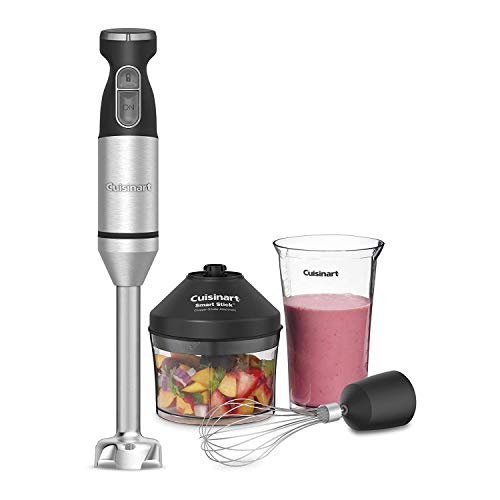
Cuisinart CSB-179 Smart Stick
The CSB-179 Smart Stick is the kit-builder of the set: a 300-watt quiet motor with variable speed control, an eight-inch stainless shaft, and a chopper, a whisk and a measuring cup in the box, with stainless steel named in the title. The quiet-motor claim, made by the maker, addresses the hand blender’s most antisocial trait, its whine, which matters in open-plan homes and early kitchens. Eight inches of shaft suits the standard domestic pot and saucepan range, and the measuring cup doubles as a blending vessel sized to the tool, which reduces both splatter and washing.
- Model: CSB-179 Smart Stick
- Power: 300 watts, described as a quiet motor
- Shaft: 8 inches, stainless per the title
- Included: chopper, whisk, measuring cup
- Speeds: variable
- Turbo function: absent from the title
Strengths
- The fullest accessory kit here turns one motor into a small food-prep station.
- A quiet motor, as the maker frames it, softens the tool’s impact on a sleeping household.
- Variable speed at this level suits dressings, batters and soups alike.
Trade-offs
- Three hundred watts is the lowest figure in the set, so dense frozen work is beyond its brief.
- An eight-inch shaft will not reach the bottom of deep stockpots.
- More accessories mean more pieces to store, wash and eventually misplace.
Consider the week this machine is designed for: soup on Monday blended in the pot, vinaigrette whisked on Wednesday in the measuring cup, herbs and nuts chopped on Friday in the chopper for a sauce. That is a realistic domestic repertoire, and the Smart Stick covers it with one motor and a drawer of attachments. Households graduating from a single-purpose blender often find the chopper becomes the surprise favourite, because small chopping jobs are the ones a full food processor is too much trouble to assemble for.
The variable speed deserves a practical note. On a hand blender, low speed is not a lesser version of the tool; it is the setting that keeps soup inside the pot and cream from turning to butter beneath a whisk. A dial that can be feathered while the other hand holds the pot is the difference between blending as control and blending as weather.
Best for: households wanting one variable-speed system that blends, chops and whisks, with stainless construction stated. Not suited for: deep-pot cooks or frozen-ingredient work, where shaft length and wattage here run out. View the Cuisinart Smart Stick on Amazon
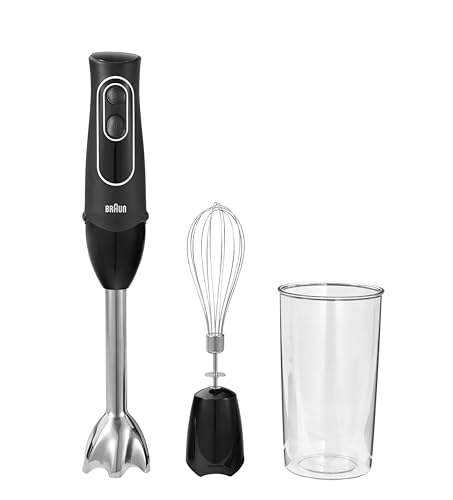
Braun MultiQuick 5 Hand Blender
Braun’s MultiQuick 5 arrives with a beaker and a whisk, 350 watts, dual speed, and a title that lists an ambitious verb set: blend, chop, whisk, mash, crush and purée. Its handle is described as slip-proof and ergonomic, and the brand claims the number one position in hand blenders, a claim reported here as the maker’s. On the metal question this guide follows the batch’s honesty rule precisely: the Braun title names stainless steel blades, but it does not present the machine as an all-metal or stainless-shaft design, so the spec box records the broader metal construction as unstated in the title, and the review makes no claim beyond the blades the title actually names.
- Power: 350 watts
- Speeds: dual
- Included: beaker and whisk
- Handle: slip-proof, ergonomic, per the title
- Blades: stainless steel, per the title
- All-metal / stainless shaft construction: not stated in the listing title
Strengths
- A slip-proof ergonomic handle addresses the wet-hand reality of immersion blending directly.
- The widest verb list here signals a machine aimed at varied daily prep, not a single trick.
- Beaker and whisk included make it a working kit from the first day.
Trade-offs
- Dual speed is simpler than the variable dials offered by All-Clad, Cuisinart and Vitamix.
- Readers shopping specifically for a stated stainless shaft will not find that claim in this title.
- Three hundred and fifty watts sits in the set’s lower half for demanding mixtures.
Ergonomics is where the MultiQuick 5 makes its real argument, and it is a stronger argument than it first appears. A hand blender is used one-handed, often at arm’s length, often above steam, and the quality of that experience is decided by grip security and button placement more than by wattage. A handle designed against slipping, in a wet and greasy environment, is a safety feature with daily relevance, and Braun’s long specialisation in this exact product category shows in the title’s priorities.
The verb list also deserves a fair reading. Mash and crush point at baby food, guacamole, and crushed-ice-adjacent small jobs, the humble tasks that fill actual weeks. A household whose blending life is mostly those tasks, plus smoothies in the beaker and cream under the whisk, will find this machine’s 350 watts and two speeds entirely adequate, and its handle the best reason of the six to choose it.
Best for: comfort-first cooks wanting an ergonomic, slip-proof multi-tasker with beaker and whisk included. Not suited for: metal purists, since no stainless shaft is stated in this title. See the Braun MultiQuick 5 on Amazon

Vitamix Immersion Blender
Vitamix brings its countertop reputation into the hand with the strongest motor in this set: 625 watts, five speeds, four-prong stainless steel blades, an ergonomic handle, a bell guard, and a five-foot power cord, in a finish the title describes as stainless steel and black. The bell guard is the connoisseur’s detail, the shaped housing around the blades that manages flow and helps protect pan surfaces from direct blade contact. Five speeds give finer gradation than any rival here. On metal framing, the same honesty rule applies as with the Braun: the title names stainless blades and a stainless-and-black finish, while a full stainless shaft construction goes unstated in the title, and the spec box records it that way.
- Power: 625 watts
- Speeds: 5
- Blades: 4-prong, stainless steel
- Guard: bell guard included
- Cord: 5 feet
- All-metal / full stainless shaft construction: not stated in the listing title
Strengths
- The highest wattage and the most speeds here make it the power-and-control leader of the domestic four.
- A bell guard shows design attention to both flow and pan protection.
- A five-foot cord gives real freedom around a stove and island.
Trade-offs
- No whisk or chopper is named in the title, unlike the Cuisinart and Braun kits.
- Power this strong demands technique; careless use will redecorate a kitchen with soup.
- Shoppers wanting an explicitly stated stainless shaft claim should note its absence here.
Power in an immersion blender behaves differently from power in a countertop jar. There is no sealed vessel; the cook is the vessel’s manager, angling the head, raising and lowering it, deciding when a soup has surrendered. Six hundred and twenty-five watts in skilled hands produces silk quickly, and in unskilled hands produces a geyser, which is why the five speeds matter as much as the headline number: they let the user approach full power through gradations the mixture can accept. Start every pot on the lowest speed, a rule this machine rewards more than any other in the set.
The cord length is a small specification with outsized daily effect. Hand blenders tether their users to a socket’s radius, and five feet converts most stoves and islands from a negotiation into a workspace. Cooks who blend at a hob with the socket behind the pans will understand immediately why this line earned its place in the title.
For readers whose blending needs sit inside a wider cooking system, our companion guide to Best Instant Pot Multi Cookers covers the pressure-and-slow-cook machines whose soups these blenders so often finish.
Best for: experienced cooks wanting maximum hand-blender power, five speeds and a bell guard from a blending specialist. Not suited for: anyone counting on attachments in the box or a stated stainless shaft, neither of which this title provides. Explore the Vitamix immersion blender on Amazon

Waring Quik Stix Plus
Waring’s Quik Stix Plus, model WSB40X, crosses the line into professional territory: a commercial immersion blender with variable speed and a ten-inch removable shaft, made for professional kitchens and restaurants. Removability at commercial scale is about hygiene and logistics as much as washing, letting a kitchen separate the shaft for thorough cleaning and store the motor unit apart. Ten inches of reach serves the stockpots and sauce pans of a working kitchen, deeper than any domestic model here except the VONCI. The title does not print a wattage, and this review does not invent one; commercial buyers judge such tools by duty and reach as much as by numbers.
- Model: WSB40X, Quik Stix Plus
- Class: commercial, for professional kitchens and restaurants
- Shaft: 10 inches, removable
- Speeds: variable
- Power in watts: the title publishes no wattage
- Home accessories such as whisk or beaker: absent from the listing
Strengths
- A ten-inch removable shaft serves deep vessels and simplifies commercial-grade cleaning.
- Variable speed suits the range of a professional kitchen’s daily sauces and soups.
- The Waring name carries commercial-kitchen heritage that home brands do not claim.
Trade-offs
- No wattage is published in the title, frustrating specification-led comparison.
- Domestic niceties like beakers and whisks are absent from this listing’s world.
- Its scale and purpose overshoot a small home kitchen’s actual needs.
Who buys a commercial stick blender for a home? The preserver with a cauldron of tomatoes each September, the soup-maker for a community kitchen or a large extended family, the home brewer or sauce enthusiast whose pots outgrew domestic shafts. For those readers the Quik Stix Plus is not an extravagance but the first tool in this set actually sized for their vessels, and its variable speed keeps it usable for ordinary sauces between the great batches. Everyone else should admire it as the professional’s answer and buy closer to their own pot collection.
Commercial design also implies a different relationship with duty cycles. A restaurant tool expects to run through service, pot after pot, and to be cleaned to a standard a home tool rarely meets. That robustness is the quiet content of the Waring title, legible to anyone who has worked a line and reassuring even in a domestic context, where a tool built for service tends to shrug off the occasional double batch, the borrowed afternoon in a neighbour’s kitchen, and the years of weekday soups that retire lesser machines.
Best for: large-batch cooks and semi-professional kitchens needing a ten-inch removable shaft and variable speed. Not suited for: small households wanting accessories and a stated wattage, which this commercial listing does not offer. Check the Waring Quik Stix Plus on Amazon

VONCI 500W Commercial Immersion
VONCI closes the set with the longest reach and the most explicit shaft specification: a 500-watt commercial immersion blender with a sixteen-inch SUS 304 shaft, described as heavy duty, with variable speed and a hands-free lock, for soups, sauces and purées in restaurant kitchen use. SUS 304 names the stainless grade of the shaft, the most specific material claim in any title here, and sixteen inches reaches the bottom of vessels that would defeat every domestic model in the row. The hands-free lock addresses commercial reality, long blends in big pots, where holding a trigger for minutes is a genuine ergonomic cost.
- Power: 500 watts
- Shaft: 16 inches, SUS 304 stainless per the title
- Speeds: variable
- Lock: hands-free lock included
- Class: commercial, heavy duty, restaurant kitchens
- Domestic accessories: absent from the title
Strengths
- Sixteen inches of SUS 304 shaft is the deepest, most specifically specified working end here.
- A hands-free lock suits long commercial blends in large vessels.
- Five hundred watts with variable speed gives the reach a motor worthy of it.
Trade-offs
- Sixteen inches is unwieldy in shallow home saucepans and small blending beakers.
- The commercial brief omits the whisks and cups domestic buyers may expect.
- Its size demands storage thought that drawer-friendly domestic models avoid.
Grade specificity deserves a moment of appreciation. Most titles in this category say stainless and stop; this one names the alloy family of its shaft, which is the language of a maker selling to buyers who specify equipment. For a restaurant, a caterer or a serious preserver, that specificity plus the lock plus the reach compose a coherent professional proposition, and the VONCI should be judged as that, not as an oversized home gadget.
At home, its constituency is narrow and real: the largest stockpots, the harvest-scale batches, the outdoor and community kitchens where a sixteen-inch shaft stops being a curiosity and becomes the only tool that reaches. Everyone else will find the same length a daily encumbrance, because a shaft must be submerged sensibly to blend well, and most home pots cannot give sixteen inches a proper working depth.
Best for: commercial kitchens and harvest-scale home preservers needing a sixteen-inch SUS 304 shaft with a hands-free lock. Not suited for: everyday domestic blending in standard saucepans, where its reach becomes clumsiness. See the VONCI commercial blender on Amazon
Domestic finesse versus commercial reach
| Blender | Power as titled | Shaft evidence | Class |
|---|---|---|---|
| All-Clad Stainless Immersion Blender | 600 watts | 9-1/4 inch, stainless construction stated | Domestic, detachable |
| Cuisinart CSB-179 Smart Stick | 300 watts, quiet motor | 8 inch, stainless stated | Domestic, full kit |
| Braun MultiQuick 5 Hand Blender | 350 watts | Stainless blades stated; shaft construction unstated | Domestic, ergonomic kit |
| Vitamix Immersion Blender | 625 watts | Stainless blades stated; shaft construction not stated | Domestic, power-led |
| Waring Quik Stix Plus | Not stated | 10 inch, removable | Commercial |
| VONCI 500W Commercial Immersion | 500 watts | 16 inch, SUS 304 stated | Commercial |
How do you choose a hand blender with a metal working end?
Measure your deepest pot first
The shaft must reach the bottom of the vessel with the motor comfortably above the rim, so measure the pot you blend in most and shortlist by stated length: eight to nine and a quarter inches for ordinary domestic pots, ten for deep stockpots, sixteen for commercial vessels. A blender that cannot reach cannot blend, whatever its wattage, and a blender far longer than the pot is an awkward guest at every meal.
Read the metal claim at the resolution it is written
Distinguish a stated stainless shaft from stated stainless blades and from a stainless finish, because these six titles contain all three levels of claim. Buy the level your use demands: hot, frequent, corrosive work argues for the stated shaft; lighter duty can accept blades alone with eyes open. What no buyer should do is upgrade a title’s claim in their imagination.
Let the week’s recipes cast the deciding vote
Write down the last ten things you actually blended, chopped or whisked, and score each finalist against that list rather than against an imagined repertoire. A household whose list reads soup, soup, smoothie, sauce will choose differently from one whose list reads baby food, whipped cream, chopped nuts and dressing, and both will choose better than a household shopping from a fantasy of dinner parties. The exercise takes three minutes, uses evidence no listing can contradict, and routinely overturns the ranking that specifications suggested, because it measures the tool against a life instead of against its rivals.
Decide whether you are buying a tool or a kit
A bare blender with a superb shaft, like the All-Clad or Vitamix, serves cooks who already own processors and whisks. A kit, like the Cuisinart’s or Braun’s, serves cooks building a prep station from one motor. Neither is better; they are answers to different kitchen inventories, and double-buying attachments you already own is the quiet waste in this category.
Consider the cord, the socket and the stove’s geography
Hand blenders work where the food is, and the food is usually on a stove whose nearest socket may sit behind a kettle or across a walkway. Cord length, stated at five feet on the Vitamix and unstated elsewhere here, decides whether blending happens at the pot or involves carrying hot liquid to the tool, a journey that should never be part of a recipe. Before ordering, stand at your own stove with a tape in mind: where is the socket, what stands between it and the largest pot, and can a cord cross that space without draping over a burner? Kitchens answer these questions differently, and the answers can reorder a shortlist more honestly than another hundred watts. Where a title stays silent on cord length, as most here do, treat that measurement as a detail to verify on a finalist’s full listing rather than a fact to assume, because the gap between reaching the pot and carrying the pot is the gap between a tool that gets used and a tool that gets negotiated with every single time it is needed, in every kitchen, on every ordinary evening of its long working life in that particular kitchen at home, without exception or excuse.
Take grip as seriously as power
You will hold this tool one-handed over hot liquid for the whole of its working life. Slip-proof shaping, sane button placement and a weight your wrist tolerates at arm’s length are performance specifications in every sense that matters at a stove. Where a title speaks of ergonomics, as the Braun and Vitamix do, treat the sentence as load-bearing.
Ask how the tool will be washed on a tired evening
Every hand blender is washed by a tired person at the end of a meal, and designs differ in how kindly they treat that person. A detachable shaft that rinses alone, a removable commercial shaft that can be scrubbed properly, a smooth beaker that does not trap food in mouldings: these are the features that decide whether the tool is cleaned properly nightly or merely promised a proper clean tomorrow. Judge your finalist by imagining its worst evening, a tomato soup, a late hour, a full sink, and prefer the design whose working end can be made clean in that scene without heroics. Hygiene in this category is a design property before it is a virtue of the owner.
Be honest about commercial ambitions
Commercial machines repay their scale only when the batches are real. A household that makes one cauldron of sauce a year can borrow reach for that weekend; a household that makes one a month should buy it. Let the calendar, not the fantasy of the harvest, decide between the Waring, the VONCI and the domestic four.
Technique: the difference between blending and splashing
Immersion blending rewards a short liturgy. Submerge the head fully before starting, begin on the lowest speed, and only then climb, because a blade started in air or at the surface manufactures a fountain. Work the head in slow vertical strokes, tilting slightly to draw mixture from the pot’s edges, and let the vortex do the travelling rather than stirring with the shaft like a spoon. For soups, blend in the pot they cooked in, off the fiercest heat, and give the mixture a rest halfway so trapped air can rise instead of frothing into the texture.
Sound is a diagnostic worth learning in the same lessons. A healthy immersion blender under load settles into a steady, purposeful note; a rising whine with falling progress usually means the mixture is too thick, too frozen or too shallow for the head to work in, and the correct response is liquid, patience or a narrower vessel rather than more speed. Cooks who learn their machine’s voice catch problems a full minute before cooks who blend by timer, and that minute is usually the difference between a silky soup and a scorched, frothy one.
Thickness is managed by liquid, not by force. A mixture that will not circulate needs a ladle of stock, not a higher speed, and adding it early saves both the motor’s temper and the cook’s shirt. Cream and egg-based sauces ask the opposite discipline, low speeds and patience, because the same tool that silkens a soup can split a hollandaise-adjacent emulsion in seconds. Variable and multi-speed machines earn their keep precisely here, in the recipes where restraint is the skill.
Cleaning and storing a metal shaft properly
The fastest wash is the immediate one: a jug of warm water with a drop of detergent, blended for a few seconds, rinsed and dried, returns most shafts to cleanliness before food can set. Detachable and removable designs, the All-Clad, Waring and their kin, then allow a fuller wash of the working end away from the motor. Tomato and turmeric will tint plastic parts over time but leave stainless shafts largely unbothered, one of the working end’s quiet advantages in this category.
Drying is the overlooked half of that wash. A shaft towelled dry and stored where air can reach it will hold its finish for years, while the same shaft sealed damp into a drawer or a closed container invites spotting and stale smells that no amount of stainless branding can legislate away. Build the towel into the routine, hanging it where the blender lives, and the habit costs nothing after the first week.
Storage should protect both the blades and the household. A shaft stored loose in a utensil drawer will find fingers and dull its edges against other tools; a guard, a drawer divider or hanging storage keeps the peace. Commercial lengths need a declared home, a tall cupboard or a hook, decided before purchase rather than after the first week of the VONCI leaning in a corner like a guest who has not been offered a chair.
Readers equipping the rest of a hard-working kitchen may enjoy our companion notes on Best Summer Slippers for the hours when the cooking is done and the floor is finally yours.
Six blenders, six kinds of cook
The All-Clad belongs to the soup-and-sauce cook whose week is built around pots: a bisque on Sunday, a pan sauce most nights, a curry that wants silk rather than chunks. Its owner already owns whisks and processors and needs exactly one thing, a serious shaft with real power and a dial, delivered without a bundle of duplicates.
The Cuisinart belongs to the small-kitchen generalist, the cook whose prep is varied and whose storage is not. One motor, three attachments and a measuring cup compose an entire station in a single drawer, and its owner will use the chopper for nuts and herbs more often than any specification predicted.
The Braun belongs to the comfort-led cook, perhaps managing a weaker grip or simply blending often enough that handle design has become a lived issue. Its owner chose the tool their hand voted for, and the beaker-and-whisk kit covers a week of smoothies, creams and baby food without drama.
The Vitamix belongs to the power enthusiast who blends like they drive, attentively and at the top of the range. Five speeds and the set’s strongest motor reward that temperament, and the bell guard and long cord show the same seriousness about the details surrounding the power.
The Waring belongs to the batch cook with a calendar: preserving weekends, community meals, a freezer filled by the pot rather than by the portion. Its owner measures success in litres and regards the domestic models the way a carpenter regards a toy hammer, fondly and without confusion.
The VONCI belongs to the professional or the nearest domestic equivalent, the cook whose vessels are measured in gallons and whose blends run long enough that a hands-free lock reads as mercy. Its owner specified the shaft’s alloy the way they specify everything in that kitchen, exactly.
These portraits share a moral with the rest of this guide: the tool’s material story, its length and its kit all matter only inside a particular kitchen’s week. The most metal shaft in the world will not save a blender bought for the wrong pots, and the humblest kit will delight the cook whose drawer it exactly fills.
Hot soup, cold smoothies and the shaft’s double life
A stainless shaft earns its keep at temperature extremes that define this tool’s double life. In the morning it may be puréeing frozen fruit in a beaker, a job that punishes weak couplings with shock and noise; by evening it is standing in a pot of near-simmering soup, a job that punishes materials that dislike heat. The domestic four in this set all claim that double life implicitly by their designs, while the commercial pair live it at larger scale and longer duration. Shoppers should picture both ends of their own blender’s day before choosing, because a tool bought for smoothies alone can be lighter and cheaper in conscience, while a tool bought for soup must be judged by the standards of the pot.
Acidity writes the third verse of that story. Tomato, wine-based sauces and citrus mixtures are unkind to lesser materials over years of contact, and stainless construction is the category’s traditional answer, which is why the stated-shaft models in this set carry an advantage that wattage tables cannot show. A cook whose repertoire runs red and acidic should weight the metal evidence in these titles more heavily than a cook whose blender meets only dairy and fruit.
Why shaft material matters if the blades do the cutting
The question is fair and deserves its own answer outside the quick summaries. The blades do the cutting, but the shaft does the living: it is the part submerged in boiling soup, dragged through acidic tomato, knocked against pot rims, and washed under a tap every day of the tool’s life. A shaft must not flex under load, because flex changes the blade’s angle and the cook’s control; it must not stain or pit, because its surface meets food directly; and it must tolerate thermal swings that would stress lesser constructions, from a frozen smoothie at breakfast to a simmering sauce at night. Stainless steel is the category’s answer to that entire job description at once, which is why the titles in this set that state it are making the most consequential claim a hand blender title can make, and why the two that leave the shaft unstated are recorded here with that gap visible rather than smoothed over.
When a hand blender should yield to another tool
Honesty about limits completes any buying guide. A hand blender, however metallic its shaft, is the wrong tool for crushing large quantities of ice, for nut butters that demand sustained torque in a sealed jar, and for doughs of any kind. The countertop machines in this batch’s companion coverage exist for those jobs, and a household that forces a stick blender into them will shorten its life while producing worse results. The immersion tool’s genius is the pot, the beaker and the sauce, the places a jar cannot go, and its owners are happiest when they let it reign over exactly that territory.
There is also a volume ceiling written into the format itself. Beyond a certain pot size, even the commercial shafts here are working against the mixture’s inertia, and a kitchen that routinely blends at that scale should be reading about floor-standing or high-capacity countertop equipment instead. Recognising the ceiling is not a criticism of these six; it is the same fit-first logic this guide has applied to lengths, kits and claims from its first page.
Common mistakes
Believing any hand blender is solid metal throughout. None is, in this set or in the wider market; the motor housing is polymer by design and by electrical necessity. Shop for metal in the shaft and blades, where it performs, and let the all-metal phrase in any title be translated by the evidence of that title’s own words.
Starting the motor before the head is submerged. The classic first-use fountain, soup on the hob, the wall and the cook, is a technique error rather than a product flaw. Submerge, start low, then climb, and the same machine that decorated a kitchen on day one becomes civilised by day two.
Buying commercial length for domestic pots. A sixteen-inch shaft in a two-litre saucepan is not thoroughness; it is an accident arranging itself. Match the reach to the deepest vessel you use monthly, not the deepest you own.
Judging the tool by its first smoothie alone. A beaker smoothie is the gentlest examination a hand blender will ever sit, and passing it proves almost nothing about soup night. Test any new machine across its intended repertoire within the first fortnight, hot, cold, thick and thin, while its habits can still inform how the household organises around it.
Ignoring the attachments you already own. A kit duplicates what a well-equipped kitchen already has, while a bare premium blender may leave a sparse kitchen without a whisk. Inventory before ordering, and let the gap, not the bundle, decide.
Storing the shaft wet in a closed drawer. Stainless resists rust admirably and rewards drying anyway; a shaft put away damp in a dark drawer will eventually mark, smell or dull at its edges. Thirty seconds with a towel after washing is the cheapest maintenance in this entire category, and the commercial lengths, with more surface to dry, deserve it most.
Blending at full power in shallow liquid. Shallow mixtures vortex air and splash at speed, whatever the machine. Add depth, tilt the pot, or transfer to a narrower vessel, and use the lower speeds that variable models provide for exactly this situation.
The first month with a metal-shaft blender
Week one belongs to soups and sauces at modest scale, whatever the machine, because those jobs teach submerging, speed discipline and the sound a happy motor makes. Resist inaugurating a new blender with its hardest imaginable task; a tool introduced gently becomes a tool understood, and understanding is what separates the owners who blend daily from those who blend until the first fountain and then quietly stop. Note which speed handled which mixture, in a phone note or on the recipe itself, because that small archive becomes the household’s operating manual within a month.
Weeks two and three are for range: the whisk’s behaviour with cream if your kit includes one, the chopper’s manners with nuts and herbs, the beaker’s splash profile with smoothies. Each attachment has its own learning curve and its own failure mode, usually overfilling, and discovering those curves on ordinary evenings is far cheaper than discovering them while guests wait. By the end of this period the tool should have a fixed home, a washing routine that takes under a minute, and a reputation in the household as the thing that finishes soups.
Week four is when the metal working end quietly proves itself. The shaft will have met heat, acid, ice-cold fruit and daily washing, and it should look and behave exactly as it did on day one, which is the entire promise of the category stated in one sentence. If it does, the purchase has kept its word at the level the titles actually wrote it, and the misleading nickname that brought you here can be retired with thanks for the introduction.
Reading a hand blender listing like an inspector
Because this category’s nickname promises more metal than any product delivers, a short inspection method is worth teaching outright. Read a title in four passes. First, find the shaft: its length and its material, stated or absent. Second, find the blades: their material and arrangement, prongs or points where named. Third, find the motor: wattage where printed, speed system, and any duty language such as commercial or heavy duty. Fourth, find the company the tool keeps: whisk, chopper, beaker, cup, or the eloquent absence of all of them. A title that survives those four passes with the facts you need, as the All-Clad, Cuisinart and VONCI largely do here, has earned its place on a shortlist; a title that leaves the first pass blank, however famous its brand, is asking to be believed rather than read.
Apply the same method in reverse when a listing seems too good. A hand blender advertised with the vocabulary of this category’s title but silent on shaft material, shaft length and wattage simultaneously is not a bargain hiding its light; it is a product declining to be inspected. The six gathered here were chosen partly because their titles, at their various levels of completeness, withstand reading, and the two that leave the shaft question open do so inside otherwise detailed listings whose other claims can be weighed in the balance.
Final recommendation
For most home cooks, the All-Clad is the set’s most complete answer to its own title: stainless construction stated plainly, strong power, variable speed with turbo, and a detachable shaft of sensible domestic length. The Cuisinart Smart Stick is the kit buy, the Braun the comfort buy, and the Vitamix the power buy, each with its metal evidence stated at its own level and none of them pretending to a metal body. The Waring and VONCI serve the genuinely large-batch world, ten and sixteen inches respectively, and should be bought by the cooks whose pots demand them. Choose by pot depth and by the exact wording of the metal claim, and this category’s misleading nickname stops mattering.
FAQ
Is any hand blender really all metal? No. Every model here, like the wider market, pairs a polymer motor housing with metal in the working end. The meaningful differences are whether the shaft is stated as stainless, as on the All-Clad, Cuisinart and VONCI, whether only the blades are named as stainless, and how long that shaft runs.
How long a shaft do I need for a stockpot? Match the shaft to the pot’s depth with the motor kept clear of the rim: the stated eight to nine-and-a-quarter-inch domestic shafts cover ordinary pots, the Waring’s ten inches covers deep stockpots, and the VONCI’s sixteen inches is commercial-vessel territory that most homes never require.
Are the commercial models worth it for home use? Only where the batches justify them: preserving, community cooking, very large families. Their reach, duty and cleaning logic are real advantages at scale and pure encumbrance in a small kitchen’s daily routine of sauces and single soups.
Can a hand blender replace a countertop blender entirely? For soups, sauces, smoothies in a beaker and small chopping or whisking jobs with the right kit, largely yes, and many small kitchens run exactly that way. For large frozen batches, nut butters and high-volume drinks, a countertop jar remains the better tool, which is why this batch covers both formats in separate guides.
What does a bell guard do on the Vitamix? As its name suggests, the guard shapes the housing around the blades, managing the flow of the mixture and helping keep the blade assembly from direct contact with pan surfaces. It is one of the design details that separates a considered blending head from a merely powerful one.
The right hand blender disappears into the pot and reappears as soup, which is the highest compliment a tool with a misleading nickname can earn. Buy the shaft your pots require, read its material claim at face value and no further, and the metal you were promised will be exactly where it matters, in the food, at the heat, doing the work.
Cooks planning a full summer kitchen refresh may also like our guide to Best Indoor Grills With Removable Plates, which covers grill plates that lift out for washing as easily as these shafts detach after a long evening of soups and sauces.


