What's inside
- Key Takeaways
- Quick Picks
- How Did We Choose Machines to Govern a Whole Room?
- How Do the Six Compare Across a Whole Room?
- What Does Speech Privacy Actually Require From a Machine?
- How Do You Size an Ambient Machine to a Room?
- Where Should a Room Machine Stand, and Where Should It Never Stand?
- How Loud Should a Room’s Background Be?
- Ambient Sound for Home Workers: Calls, Focus and Household Peace
- What About Waiting Rooms, Rentals and Other People’s Spaces?
- How Does Ambient Noise Interact With Television, Music and Conversation?
- Can Ambient Sound Help Dogs, Guests and Other Temporary Residents?
- How Do You Introduce Ambient Sound to a Household That Did Not Ask for It?
- Ambient Sound in Bedrooms Versus Living Spaces: What Really Differs?
- What Should Renters Know Before Relying on a Room Machine?
- How Do You Maintain a Room Machine Across Years of Daily Duty?
- Can Ambient Sound Change How a Room Feels Without Anyone Noticing?
- A Short History of Humming Rooms, and Why Yours Wants One
- How Should a Room Machine Behave During a Power Cut or a Quiet Sunday?
- What Is the Right Background for Reading, Conversation and Rest?
- How Do You Test a Room Machine Fairly in Its First Week?
- Why Do Some Rooms Need Two Quieter Machines Instead of One Loud One?
- What Mistakes Do Room-Machine Buyers Keep Making?
- Final Recommendation
- Frequently Asked Questions
- Related Guides
As an Amazon Associate I earn from qualifying purchases. This post may contain affiliate links at no extra cost to you.
cottageverdict.com is reader-supported. When you buy through links on our site, we may earn an affiliate commission.
Where to buy: the six machines below are all sold through Amazon, and the pick names in the Quick Picks table, the detailed sections and the comparison table link to their listings so you can check price on Amazon whenever you are ready — sensible with the best ambient noise machines for a room, because the right choice depends less on brand than on the size, surfaces and social life of the particular room you are trying to change.
An ambient noise machine is not a sleep machine that wandered out of the bedroom. Its job is to govern a whole room’s background: to take a living room where every footstep and fridge hum stands out, a home office where a caller’s voice carries through the door to the whole flat, or a waiting area where strangers’ conversations feel uncomfortably public, and give that space a steady acoustic floor. Under that floor, small noises stop being events, speech blurs at a distance, and the room feels calmer and more private than its walls deserve.
The physics are unforgiving about scale. A machine that charms a bedside will vanish in a high-ceilinged living room, and a machine voiced for a hall will bully a small study. Output, speaker spread and placement therefore dominate this guide, ahead of library size. The second theme is speech privacy specifically: intelligible speech is the most distracting and least private sound in any home or office, and steady noise placed near a door or between talkers reduces that intelligibility far more effectively than the same noise placed randomly.
Nothing here promises silence, and a room machine should never be asked to provide it. What the six below provide is control — of background level, of how far a voice carries, of whether a room feels exposed or upholstered. Choose for your room’s dimensions and its actual problem, place the machine where the problem enters, and the change feels larger than the little box that caused it.
Key Takeaways
- Ambient machines are room tools: judge output and speaker spread against your room’s size before counting sounds or features.
- The Brown Noise machine’s 36 volume levels and five timers suit rooms whose background needs change across the day.
- Magicteam’s non-looping sounds and USB power make it the flexible pick for studies, desks and smaller rooms.
- Housbay’s 5W stereo output is the heavy lifter for large living rooms and open-plan spaces.
- Hotmoon’s dual speakers and green noise are aimed squarely at speech privacy for home offices and consulting rooms.
- The fan-driven Dohm fills a room with a mechanical wash that no one has ever caught repeating itself.
- Dreamegg’s battery portable creates a temporary ambient zone anywhere — a rented desk, a holiday let, a spare room turned office.
Quick Picks
| Pick | Badge | Why it earns its place |
|---|---|---|
| Brown Noise Sound Machine 30 Sounds Night Light | Best Day-Long Room Controller | Thirty sounds with 36 volume steps, five timers and a memory — the fine-grained controller for rooms that change mood across the day. |
| Magicteam Sound White Noise Machine 20 Sounds | Best for Studies and Small Rooms | Twenty non-looping sounds on AC or USB power, with memory — honest background for studies and small rooms without loop fatigue. |
| Housbay White Noise Machine 31 Sounds | Best for Large and Open-Plan Rooms | A loud 5W stereo machine in wood grain that can raise the background of a whole open-plan living space without shouting. |
| Hotmoon Sound Machine Cocoon 2 40 Sounds | Best for Speech Privacy | Forty sounds through dual speakers, including green noise for speech privacy, with four timers for working hours. |
| Yogasleep Dohm Classic White Noise Machine | Best Mechanical Room Wash | A real fan in a tuned housing — the mechanical original that fills a room evenly and never repeats a pattern. |
| Dreamegg Portable Noise Machine | Best Temporary Ambient Zone | A battery portable with 21 sounds that turns any corner, desk or rented room into a governed acoustic zone for a day. |
How Did We Choose Machines to Govern a Whole Room?
We measured candidates against rooms, not pillows. A room machine must move enough air — acoustically speaking — to raise a background evenly across sofas, desks and doorways, and its sound must stay pleasant at the higher levels that larger spaces demand. Small speakers that turn harsh when pushed were marked down hard, however charming their bedside manners, because an ambient machine lives most of its life at working volume, not at a whisper.
Speech privacy was the second filter. The test in our heads was a phone call behind a closed door: does the machine, placed near that door, blur the words into murmur for listeners outside? Steady, full-spectrum sounds placed at the boundary do this well; thin, hissy sounds placed across the room do it badly. Machines with lower-frequency options — brown and pink noise, a real fan’s wash — earned their places on that evidence.
Finally, we valued day-long citizenship: timers that can run a working day and stop at close of business, memory that survives the cleaner’s unplugging, finishes that belong in living rooms, and controls a colleague or a grandparent can operate without a tutorial. A room machine is shared infrastructure, and infrastructure must be boring, legible and hard to break.
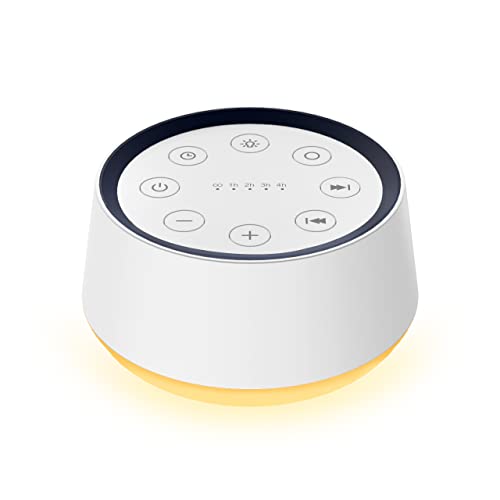
Brown Noise Sound Machine 30 Sounds Night Light — Best Day-Long Room Controller
A living room is not one room across a day. It is a playroom at nine, a reading room at two, a cinema at eight, and the background that suits each hour differs. This machine’s 36 volume levels, five timers and memory function make it the group’s natural day-manager: a low brown wash under morning play, a notch higher under a working lunch call, a timer set to hand the room back to true quiet when the film ends. Granularity is the feature; the room’s moods are the reason.
Brown noise itself is the right default texture for shared spaces. Its low-frequency weight sits under conversation rather than competing with it, masking the sounds that travel — footsteps through a ceiling, a television through a wall, the plumbing’s opinions — while leaving the voices in the room clear and natural. Guests rarely identify the sound consciously; they simply report that the flat feels calm, which is the highest compliment ambient design can earn.
The twelve-colour night light, such a temptation in a nursery, plays a smaller role here — a low warm glow for evening use, or off entirely. Judge this machine as a controller: thirty sounds to choose the room’s texture from, thirty-six steps to set its level, five timers to schedule its shifts, and a memory to hold the whole arrangement when the socket is borrowed for the vacuum.
A final virtue of the timer set deserves emphasis: it lets the room keep office hours even when you forget. A background that starts before the first call and stands down after the last one becomes part of the house’s reliability, like hot water. Visitors will never praise it directly — they will simply find the flat easy to be in, which is the ambient machine’s whole ambition stated in one sentence.
- Listed sounds: 30 soothing sounds including brown noise
- Volume: 36 levels with memory function
- Timers: 5 timer options
- Light: 12-colour night light
- Settings in listing: home, office and travel; adults, baby and kids
Strengths
- Finest volume granularity here for changing room moods.
- Brown noise masks travelling low sounds without dulling conversation.
- Timers and memory automate a full day’s background.
Trade-offs
- Light colours are surplus in a grown-up living room.
- Output suits ordinary rooms better than very large halls.
- Rich controls ask for one thoughtful setup session.
Best for: living rooms and family spaces whose background needs shift between play, work and evening quiet.
Not suited for: vast open-plan areas needing the Housbay’s heavier output.
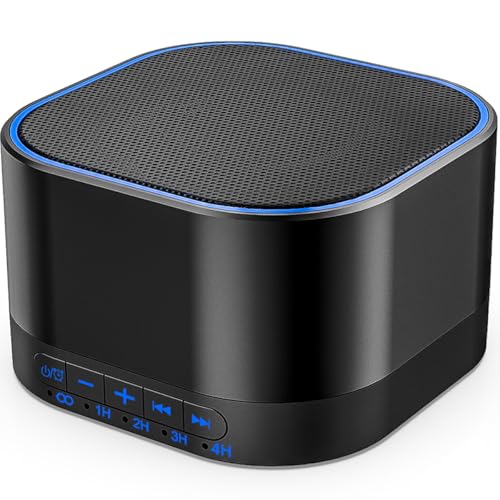
Magicteam Sound White Noise Machine 20 Sounds — Best for Studies and Small Rooms
A study, a box-room office, a reading corner: smaller rooms forgive smaller machines, and the Magicteam’s virtues map precisely onto them. Twenty non-looping sounds mean a full working day — or a full week of them — passes without the background ever repeating a pattern your ear can catch, which matters more in a room where you are awake and listening than it ever does in sleep. Working attention is ruthless about loops; this machine simply never offers one.
USB power is the second study virtue. The machine runs from the same hub or charger that feeds the desk’s other citizens, travels to a hot-desk or a library carrel without a wall-wart hunt, and keeps its remembered setting through every move thanks to its memory function. Thirty-two volume levels let a small room be tuned exactly: enough to blur the household beyond the door, never enough to become the loudest thing in your own head.
Its limits are the limits of its class. Ask it to govern a double-height living room and it will sound like a kettle in a cathedral; ask it to mask a building site and it will decline. Within the four walls of a small room, though, it is close to the ideal ambient instrument — present, even, forgettable — and forgettability, in background sound, is the entire art.
There is an economy argument for this modest box that rarely gets made. A small room with a governed background feels finished enough to postpone bigger interventions — heavier doors, acoustic panels, a move to a quieter street. None of those are cheap, and some are impossible in a rental. The Magicteam will not perform their miracles, but across a year of working days it buys a surprising amount of their peace at a desk-lamp price.
- Listed sounds: 20 non-looping natural soothing sounds
- Volume: 32 levels
- Memory: memory function included
- Power: AC or USB
- Extras: sleep sound timer; also pitched for home and travel use
Strengths
- Non-looping sound survives long waking hours of listening.
- USB power suits desks, hubs and hot-desking.
- Fine volume steps tune small rooms precisely.
Trade-offs
- Cannot fill large or high-ceilinged rooms.
- No speaker muscle for severe external noise.
- No light features for evening living-room duty.
Best for: studies, box-room offices and reading corners needing an honest, even background all day.
Not suited for: open-plan living spaces and party-proofing ambitions.

Housbay White Noise Machine 31 Sounds — Best for Large and Open-Plan Rooms
Open-plan living defeats most ambient machines because there is simply so much air to govern: a kitchen-diner-lounge is three rooms wearing one ceiling, and a bedside speaker placed in it produces a small island of hush around an armchair and nothing anywhere else. The Housbay’s 5W stereo output is the answer this guide offers — enough clean level, spread widely enough, to raise the background of a genuinely large space without the sound turning thin or strained at working volume.
Stereo spread is doing quiet work here. Two channels of sound decorrelate the wash, so the room fills evenly rather than beaming from a point, and the background feels like a property of the space — like good heating — instead of a device performing in the corner. The wood-grain finish completes the disguise, reading as a small piece of furniture among the room’s other objects rather than as equipment on display.
Thirty-one sounds give the household its choice of texture, and the auto-off timer suits rooms that should return to silence on schedule — a rental’s quiet hours, a shared house’s midnight agreement. The Housbay will not travel, will not run on batteries and will not apologise for either. It is a fixture, bought the way you buy a rug: measured against the room, placed once, and expected to change how the whole space feels for years.
Furniture thinking also protects the purchase long-term. A rug is not replaced because a newer pattern exists, and a fixture machine should be bought with the same calm: output for the room, a finish for the furniture, controls the household can run. The Housbay’s wood grain is a small thing that signals the right relationship — this object plans to stay, unremarked, for years.
- Listed sounds: 31 soothing sounds
- Speaker: 5W loud stereo sound
- Timer: auto-off timer
- Volume: adjustable
- Finish: wood grain, designed to sit as furniture
Strengths
- Output and spread genuinely fill large, open rooms.
- Stereo wash feels like the room itself, not a device.
- Furniture finish suits adult living spaces.
Trade-offs
- Fixed, plug-in fixture — no travel or battery role.
- Power is wasted on small studies and box rooms.
- No fine 32-step volume; adjustment is broader-brushed.
Best for: open-plan kitchen-diners, large lounges and shared houses needing a real background across a big space.
Not suited for: small rooms, desks and anyone wanting portability.

Hotmoon Sound Machine Cocoon 2 40 Sounds — Best for Speech Privacy
Speech is the sound that most needs governing in modern homes, because speech is information: a partner’s negotiation call, a teenager’s conversation, a therapist’s session in a rented room. The Cocoon 2 is the pick built around that problem. Its listing names office privacy outright, its dual speakers spread the mask evenly across a room and its doorway, and its library includes green noise — a mid-frequency texture, like wind in leaves, that sits exactly where voices live and blurs them with unusual efficiency.
Placement turns the Cocoon from a comfort into a privacy tool. Put it near the door of the room where calls happen — inside for the caller’s concentration, or just outside for the listeners’ protection — and intelligibility collapses within a few steps, while the sound itself stays at a level nobody has to raise their voice over. Forty sounds let the household tune the mask to its own walls: brown for bass-heavy buildings, green for voices, pink for a general wash.
Four timers map onto a working day’s shape — a morning block, a school-run pause, an evening of family noise — and the eight night-light settings, kept low or off, serve the room’s after-hours life. The Cocoon asks its owner to configure it once, thoughtfully, and then to let it guard the door like staff. For the home-working, counselling, tutoring and calling that now fill ordinary houses, it is the most purposeful machine in this group.
One caution belongs to the privacy use specifically: a mask by the door protects speech from casual overhearing, which is the everyday need of homes, tutors and clinics. It is not a security device, and rooms where genuinely confidential matters are discussed deserve architectural answers as well. Used for what it is — everyday privacy, honestly provided — the Cocoon is exemplary. Asked to be a vault, no speaker can comply.
- Listed sounds: 40, including white, green, pink and brown noise
- Speakers: dual-speaker, plug-in
- Timers: 4 timer options
- Light: 8 night-light settings
- Named uses in listing: sleeping adults, office privacy, baby, dogs
Strengths
- Green noise and dual speakers target speech privacy directly.
- Library breadth tunes the mask to different walls and voices.
- Timers follow a working day’s schedule.
Trade-offs
- Plug-in only; privacy stays where the socket is.
- Forty sounds invite over-browsing before settling.
- Light settings are unnecessary for a pure office role.
Best for: home offices, consulting and tutoring rooms, and any household where calls must not carry.
Not suited for: buyers wanting a simple two-button background box.

Yogasleep Dohm Classic White Noise Machine — Best Mechanical Room Wash
A room governed by the Dohm sounds different from a room governed by speakers, and regular visitors feel it before they can name it. The sound is a real fan’s moving air, shaped by a housing you twist to tune — vents opening and closing to lean the wash brighter or deeper — so the background has the slight, living unevenness of weather rather than the sterile evenness of a file. In a living room that hosts conversation, that naturalness matters: the mask never sounds like a machine performing, so nobody asks for it to be turned off.
Two fan speeds set the broad level for the room’s size, and the twist-tuning does the rest by ear. There is no library to browse, no display to glow through a film, no settings for a guest to destroy — a babysitter, a cleaner or a grandparent can operate the Dohm perfectly within ten seconds of meeting it, which cannot be said of any app-adjacent rival. Shared infrastructure should be this legible, and almost none of it is.
The Dohm’s costs are known and stable: it uses fan power rather than speaker sips, it gathers dust like any fan and repays an occasional clean, and its single sound — however beautifully tuned — is a single sound. Households that want their background to feel like air rather than audio will accept those terms gladly. This is the machine for people who distrust playlists on principle.
Guests operate the Dohm best when nobody explains it. A twist, a click of speed, and the room’s weather changes; there is no wrong setting to leave behind and no menu to get lost in. Hosts with a stream of visitors, lodgers or grandchildren will feel that simplicity as a weekly mercy, and it is a large part of why this decades-old design still anchors a guide full of digital rivals.
- Sound source: real fan inside an acoustic housing
- Speeds: 2, tone tuned by rotating the housing
- Recording: none — mechanically generated
- Named uses in listing: office privacy and meditation, adults and baby
- Colour: white
Strengths
- Mechanical wash never loops and feels like weather.
- Anyone can operate it — no menus, apps or settings.
- Tunes by ear to the room in seconds.
Trade-offs
- One sound only, however well tuned.
- Fan power draw and dust exceed speaker machines.
- Coarse control beside 36-step digital rivals.
Best for: living rooms and shared spaces wanting a natural, guest-proof background with zero technology on show.
Not suited for: households wanting libraries, timers and schedules.

Dreamegg Portable Noise Machine — Best Temporary Ambient Zone
Not every room is yours to govern permanently. The rented desk by the week, the holiday cottage with paper walls, the spare room borrowed as an office during a renovation, the hospital side-room where a family waits — these spaces need an ambient zone that can be declared for a day and packed away at night. The Dreamegg, battery-powered and pocket-sized with 21 sounds, is the machine that declares it: set it near the door or the desk, and a borrowed space acquires a background, a boundary and a measure of privacy it did not have at breakfast.
Battery operation is the whole argument. There is no cable to trail across a landlord’s carpet, no socket to beg from a coworking hub, and no setup longer than a minute between arriving and working. The sound will not fill a hall — physics again — but ambient need is usually local: the few metres around a desk, a chair, a bed. Within that radius the Dreamegg’s wash blurs corridor voices and lends the temporary room a feeling of intention.
Households that already own a room machine will still find this one employed constantly, because temporary rooms multiply in modern life. It is also the kindest guest-room gift a host can leave on the dresser: your visitor chooses their own background, in a strange house, without asking anyone for anything. Small, remembered, and endlessly redeployed — the Dreamegg is the ambient idea in its most portable form.
Keep a note of the Dreamegg’s charge state the way you note a passport’s expiry: casually, and before it matters. A portable ambient machine earns its keep in unplanned rooms — the sudden work trip, the relative’s spare bed, the rented desk that turned out to face a building site — and every one of those rescues begins with a battery that somebody remembered to feed last week.
- Listed sounds: 21 soothing sounds
- Power: rechargeable battery pack, so no socket is needed
- Named uses in listing: office and sleeping, home and travel
- Audience in listing: baby and adult
- Colour: classic white
Strengths
- Creates a governed zone in borrowed or temporary rooms.
- Battery freedom — no socket, no cable, one-minute setup.
- Doubles as a thoughtful guest-room amenity.
Trade-offs
- Local radius only; cannot govern a large room.
- Charging routine required between deployments.
- Fewer sounds and less spread than the plug-in fixtures.
Best for: renters, hot-deskers, travellers and hosts who need ambient control that moves with the day.
Not suited for: permanent large-room installations.
How Do the Six Compare Across a Whole Room?
| Pick | Badge | Key specification | Watch out for |
|---|---|---|---|
| Brown Noise 30 Sounds | Best Day-Long Room Controller | 36 volume levels, 5 timers, memory | Light colours surplus for living rooms. |
| Magicteam 20 Sounds | Best for Studies and Small Rooms | 20 non-looping sounds, USB power | Small-room scale only. |
| Housbay 31 Sounds | Best for Large and Open-Plan Rooms | 5W stereo, wood-grain finish | A fixture; no portability. |
| Hotmoon Cocoon 2 | Best for Speech Privacy | 40 sounds, dual speakers, green noise | Setup richness needs one firm configuration. |
| Yogasleep Dohm Classic | Best Mechanical Room Wash | Real fan, twist-tuned tone | Single sound; fan upkeep. |
| Dreamegg Portable | Best Temporary Ambient Zone | 21 sounds, battery powered | Local radius; needs charging. |
What Does Speech Privacy Actually Require From a Machine?
Privacy is about intelligibility, not loudness. A conversation behind a door is private when a listener outside can tell that someone is speaking but cannot make out the words — and that threshold arrives surprisingly early when a steady sound is placed near the door itself. The mask works hardest exactly at the boundary where the speech leaks out, which is why one modest machine by the door outperforms a powerful one booming from the far corner of the next room.
Sound texture matters because speech occupies the middle frequencies. Pure hiss masks consonants poorly for its volume; fuller textures — pink, green, brown, a fan’s broad wash — cover the speech band more efficiently, so privacy arrives at a lower, more comfortable level. This is the technical reason this guide keeps returning to noise colours in a way a sleep guide never needs to: for ambient duty, colour is not taste, it is coverage.
How Do You Size an Ambient Machine to a Room?
Start with the room’s volume and its surfaces. A carpeted, curtained, sofa-filled room absorbs sound and forgives a modest machine; a bare, high-ceilinged, glass-and-plaster space reflects everything and demands both more output and better spread. Then consider the room’s leaks: the door to the hall, the wall shared with the television, the ceiling under a teenager’s bedroom. The machine must hold its background against whatever pours in through those leaks at the day’s loudest hour.
When in doubt, buy spread before power. Two speakers, or a fan’s natural diffusion, raise a room’s background evenly, while a single loud point source creates a noisy corner and a still-exposed far end. And test honestly at the room’s worst moment — school-run chaos, the evening call, the neighbour’s music hour — because an ambient machine that only works when the house is already quiet is a machine that works when it is not needed.
Where Should a Room Machine Stand, and Where Should It Never Stand?
Near the problem’s entry point is the governing rule: by the door for corridor noise and speech privacy, toward the shared wall for a neighbour’s television, toward the window for the street. The machine raises the background where unwanted sound arrives, so the intrusion is absorbed into the room’s floor the moment it crosses the boundary, instead of travelling across the space to find you.
Never inside the conversation it serves. A machine in the middle of a seating group forces every voice up a notch to cross it — the famous Lombard effect, where everyone in a noisy room gradually shouts — and an ambient machine that makes its room louder has failed at its only job. Keep it at the room’s edge, at roughly ear height or a little below, off soft furnishings that muffle it, and let it be weather at the borders rather than a participant at the table.
How Loud Should a Room’s Background Be?
Lower than intuition suggests. The right ambient level is the one where the room’s small noises — cutlury, footsteps, the fridge — stop being individually noticeable, while conversation at normal volume remains effortless and unforced. If guests raise their voices, the background is too high; if you can hear a pen drop across the room, it is too low. Most households land on a level they can only detect by its absence, which is exactly the point.
Let the level follow the day rather than fixing it heroically. Timers and fine volume steps — the Brown Noise machine’s specialities — exist because a room at 9 a.m. and a room at 9 p.m. are different acoustic countries. Set two or three remembered landmarks, morning, work and evening, and the room’s background becomes as scheduled and unremarkable as its lighting.
Ambient Sound for Home Workers: Calls, Focus and Household Peace
The home worker’s acoustic problem runs in both directions at once: the household’s noise breaks their focus, and their calls leak into the household. One well-placed machine near the office door works on both problems simultaneously, blurring inbound distractions before they reach the desk and outbound speech before it reaches the kitchen. It is the cheapest piece of office infrastructure a flat can buy, and unlike a headset it also improves the room for everyone else.
Choose the working texture with care. Anything you find sleepy will tax an afternoon; many workers settle on pink or green noise at a modest level because it reads as weather rather than as bedtime. And agree the arrangement with the household — a machine imposed on a family’s living room at full voice will be unplugged by Friday, while one negotiated as shared comfort becomes permanent.
What About Waiting Rooms, Rentals and Other People’s Spaces?
Rooms that host strangers — a rental’s lounge, a small clinic’s waiting area, a tutor’s front room — benefit from ambient sound in a way their owners often discover by accident. A steady background shortens perceived waits, softens the awkwardness of overhearing and being overheard, and gives a space a finished, intentional feeling that furniture alone rarely achieves. Several machines here are explicitly pitched at office settings for exactly this reason.
The owner’s duties are restraint and maintenance. Keep the level low, the texture neutral, the machine clean and its cables invisible, and never let it compete with a television or a receptionist’s voice. Ambient sound in a public-facing room is hospitality, and like all hospitality it succeeds when nobody notices the effort — only the calm.
How Does Ambient Noise Interact With Television, Music and Conversation?
Poorly, if asked to share the same moment at the same volume — and it should not be asked. An ambient machine’s working hours are the gaps in a room’s life: the morning before the radio, the working day, the quiet evening read. When the television or music starts, the machine’s job is done, and the polite arrangement is a timer or a household habit that retires it rather than letting two sound sources wrestle.
There is one honourable exception: very low background under a film or a dinner can soften a room’s hard edges and mask the street outside without touching the dialogue or the talk, provided the level stays well beneath the main event. Think of it as the difference between a restaurant’s murmur and its music. The murmur is architecture; the music is entertainment. Keep your machine firmly in the architecture department.
Can Ambient Sound Help Dogs, Guests and Other Temporary Residents?
The Hotmoon listing mentions dogs outright, and the logic is sound: a steady background blurs the sudden noises — doorbells, fireworks two streets away, the postman’s performance — that startle animals in an otherwise silent house. Owners should keep volumes modest, watch the animal’s own verdict over a few days, and remember that a machine is a comfort, not a substitute for company, exercise or a vet’s advice about genuine anxiety.
Human guests benefit in the same currency. A spare room with a small machine by the door gives a visitor control over an unfamiliar house’s night noises — its boiler, its stairs, its early risers — without a host’s apology tour. Hosts who travel themselves, and know what a strange ceiling sounds like at 3 a.m., tend to become evangelists for the guest-room machine, and their guests rarely argue.
How Do You Introduce Ambient Sound to a Household That Did Not Ask for It?
Quietly, at low volume, during the room’s noisiest hour — and then by switching it off and letting the contrast argue for you. Most resistance to a room machine is resistance to an announcement; a background discovered rather than presented rarely offends anyone. Set the level below your own preference for the first week, because other ears need time to stop monitoring the new sound, and a machine accepted at low volume can be raised a notch later without a fresh negotiation.
Involve the household in the one choice they can hear: the texture. Play each candidate colour for an evening and let the room vote, because a sound chosen together survives, while a sound imposed becomes the first suspect in every future bad mood. The machine’s settings are diplomacy as much as acoustics, and households that treat them that way keep their machines for years.
Ambient Sound in Bedrooms Versus Living Spaces: What Really Differs?
Level and loyalty. A bedroom machine serves one or two sleepers, runs at the lowest effective volume, and is judged by a single criterion — the night. A living-space machine serves a changing cast at higher levels, must survive being noticed, discussed and occasionally vetoed, and is judged across play, work, calls and rest. That is why this guide prizes spread, timers and furniture finishes where a sleep guide prizes darkness and simplicity.
The practical consequence is that hand-me-downs disappoint in both directions. A retired nursery machine sounds lost in a lounge; a retired lounge machine bullies a bedroom with its minimum volume and glowing confidence. Buy each room its own instrument where you can, and let the portable pick cover the gaps and the guests, rather than forcing one box to be two kinds of citizen.
What Should Renters Know Before Relying on a Room Machine?
That it is the most landlord-proof acoustic improvement in existence. It drills nothing, sticks nothing and leaves with you, yet it changes how a thin-walled flat feels more than many permanent fixes a tenancy forbids. Renters should favour machines that need no installation, keep volumes neighbourly — your background is also, faintly, theirs — and place the unit against shared boundaries where it does the most diplomatic work per decibel.
It also travels upward in life. The machine that blurred a studio’s door at twenty-five will govern a study at thirty-five and a guest room at fifty, which makes it one of the few household purchases a renter can make with a whole life’s use in view. Buy the honest, well-made version once, and let it follow you from flat to house like a particularly quiet piece of furniture.
How Do You Maintain a Room Machine Across Years of Daily Duty?
Daily duty is mostly dust duty. A machine that runs ten hours a day inhales its room, and a monthly wipe of the casing and grille — with a soft brush for speaker cloth — keeps the sound open and the electronics cool. Fan-based designs repay a slightly deeper periodic clean, since their tone depends on air moving through a shaped housing that fluff slowly narrows.
Beyond cleaning, protect the arrangement rather than the object: keep the cable routed where chairs and vacuum cleaners cannot worry it, keep drinks at a civilised distance, and re-check the remembered settings after any power cut until you trust them. A room machine’s real product is a standing arrangement — this sound, this level, these hours — and maintenance means keeping that arrangement true, not merely keeping a box alive.
Can Ambient Sound Change How a Room Feels Without Anyone Noticing?
It is the normal outcome, and designers of hotels and good restaurants have exploited it for decades. Guests in a governed room report that it feels calm, private, finished — adjectives they attach to the décor, the lighting, the company — because the brain credits the senses it can name and files the acoustic floor under general wellbeing. Your machine’s finest reviews will be compliments aimed at everything except the machine.
That invisibility is worth protecting. The moment a background becomes noticeable — too loud, too hissy, looping, glowing — it stops being architecture and becomes an appliance asking for opinions. Keep it low, keep it even, keep it boring, and your room will quietly acquire the reputation of a place where people relax, work and talk easily, for reasons nobody can quite put into words.
A Short History of Humming Rooms, and Why Yours Wants One
Rooms were never silent before electricity made them so. Fires crackled, clocks ticked, water moved in pipes and cisterns, and the pre-modern house carried a constant low soundtrack that nobody chose and everybody slept, worked and conversed inside. The modern sealed, carpeted, double-glazed room removed that floor and replaced it with a silence so complete that a single dripping tap can dominate a night — an acoustic environment no previous century would have recognised.
An ambient machine is, in that light, a restoration rather than an invention: it puts back the floor that building methods took away, except this time the household chooses the texture and the level. That framing helps buyers set it correctly — not as a gadget straining to be noticed, but as the room’s weather, restored to something human beings have always lived inside.
How Should a Room Machine Behave During a Power Cut or a Quiet Sunday?
Mostly, by being missed in proportion to its usefulness. Plug-in fixtures stop with the power, and the sudden exposure of the room’s raw noises — the street unmasked, the pipes unblurred — teaches a household exactly how much work the little box had been doing. Battery portables earn a small ovation here: the Dreamegg can hold a room’s background through an outage, which is why keeping one charged in a drawer is a habit this guide has recommended in two articles now, for two different kinds of room.
On a quiet Sunday the opposite discipline applies: stand the machine down. Ambient sound earns its place against noise and self-conscious silence, not against a genuinely peaceful house with the windows open. Timers and household habits that rest the machine on calm days keep it welcome on the days it is needed — infrastructure, like seasoning, fails by being applied to everything.
What Is the Right Background for Reading, Conversation and Rest?
Reading wants the least: a whisper of background that erases the house’s small ticks without entering the reader’s awareness at all, because print competes with sound for the same attention. Conversation wants a little more — enough to give a room privacy and ease, never enough to tax a voice — and rest wants the level set by whoever is resting, which in a shared room means the machine’s finest steps and a household agreement about siesta hours.
The practical method is landmarks, again: three remembered levels, named for their hours, that anyone in the house can set without debate. Machines with memory and fine steps hold those landmarks faithfully; simpler machines can be marked, literally, with a pencil line at the dial’s sweet spots. However it is recorded, a shared language for the room’s sound — ‘reading level’, ‘call level’ — turns an appliance into a household institution.
How Do You Test a Room Machine Fairly in Its First Week?
Test it against the week’s worst hour, not its best evening. Run the machine through the school-run morning, the neighbour’s music practice, the evening of competing calls, and note — from the room’s far chair, not from beside the speaker — whether small noises stopped arriving as events. Then test its absence: switch it off mid-routine and feel the room’s floor drop away. That contrast, experienced twice, tells a household more than any specification about whether the background was working.
Also test the humans. Ask the people who share the room, a few days in, whether they have noticed anything — and treat ‘not really’ as the highest available praise. A background that guests and family cannot identify but would miss is precisely the product being bought. If instead everyone has an opinion about the sound itself, adjust the texture or the level before adjusting your expectations.
Why Do Some Rooms Need Two Quieter Machines Instead of One Loud One?
Geometry. A long room, an L-shaped open plan or a space divided by a stairwell has acoustic corners a single source cannot reach evenly: raise one machine enough to govern the far end and the near end becomes a wind tunnel. Two modest machines, one at each boundary, hold a gentle, even floor across the whole plan at lower individual levels — the same reason good lighting uses several lamps rather than one floodlight.
The pair need not match. A fixture at the noisy boundary and a portable at the quiet one is a perfectly rational arrangement, and timers can run them as one system in practice. Buy the second machine only after the first has proven the concept for a month, though — many rooms that look like two-machine problems turn out, once the single unit is placed at the right boundary, to have been one-machine rooms all along.
What Mistakes Do Room-Machine Buyers Keep Making?
Sizing by the bedroom they know is the first. A machine bought because it performed beautifully on a nightstand gets placed in a double-height lounge and pronounced useless, when the truth is narrower: it was the right machine at the wrong scale. Measure the room’s ambition honestly — corner, zone or whole open-plan space — and buy the output and spread that match it.
Placing the machine in the middle of the room comes second, usually on a coffee table, where it taxes every conversation and still fails to guard the door. Ambient machines belong at boundaries: doors, shared walls, windows. The centre of the room is for people, and people should always win against their own appliances.
Third is chasing silence. Buyers raise the level week by week, trying to erase the street entirely, until the cure is louder than the disease and the household rebels. Ambient sound is a floor, not a wall; its victory condition is a room where small noises stop mattering, not a room where nothing can be heard.
Finally, forgetting the other occupants. A room machine governs shared air, and settings imposed without negotiation — a partner’s reading hour drowned, a flatmate’s calls masked against their will — breed unplugging. Agree the landmarks together, use the timers, and the machine becomes the house’s shared thermostat for sound rather than one person’s weapon.
Final Recommendation
Match the machine to the room’s true job. Speech privacy points to the Hotmoon by the door; a big open-plan space to the Housbay’s spread; a changing family room to the Brown Noise machine’s scheduled finesse; a small study to the Magicteam; a technology-weary household to the Dohm’s honest fan; and every temporary, borrowed or guest space to the Dreamegg in the drawer, ready to declare a zone wherever the week puts you.
Place it at the boundary, set it lower than your first instinct, and judge it after a week of ordinary days rather than a single evening’s demonstration. Ambient sound is architecture you can hear, and like all good architecture it succeeds by disappearing — leaving a room that simply feels calmer, more private and more finished than it did before.
For a typical flat we would station the Hotmoon Cocoon 2 by the office door for privacy, let the Housbay 31-sound machine hold the big living room, and keep the Dreamegg portable charged for every room that is only ours for a while.
Govern the background and the room governs itself — that is the whole secret, humming quietly in the corner.
Frequently Asked Questions
Will an ambient machine make my room completely silent?
No, and that is not its purpose. It raises the room’s background with a steady sound so that small, intermittent noises stop standing out and speech blurs at a distance. Sudden loud sounds will still be heard; what disappears is the constant distraction of a room where every little noise is an event.
Where is the single best place to put a room machine?
Near the point where unwanted sound enters or speech escapes — usually the door. A machine by the door masks corridor noise arriving and blurs conversation leaving, doing privacy work in both directions. Keep it at the room’s edge rather than among the seats, so conversation never has to cross it.
Which noise colour is best for speech privacy?
Fuller, mid-weighted textures — green and pink noise, and the broad wash of a real fan — blur speech most efficiently, because speech lives in the middle frequencies. Brown noise excels against low sounds like footsteps and traffic rumble. Many households run brown for general calm and switch to green or pink for calls.
Can one machine cover an open-plan kitchen and living room?
A powerful, wide-spreading machine like the Housbay can raise the background of a typical open-plan space, especially placed toward its noisiest boundary. Very large or split-level spaces may honestly need the background set zone by zone — a fixture for the main space and a portable for the far corner — rather than one machine straining at full volume.
Is it expensive to run a room machine all day?
No. The digital machines draw roughly what a phone charger draws, and even the fan-based Dohm costs a fraction of heating or lighting the same room. Timers trim it further by standing the machine down overnight or whenever the room is empty.
Will my television or music sound worse with a machine running?
At proper ambient levels, no — the background sits far beneath dialogue and music and simply softens the room’s edges. Most households still retire the machine when the television becomes the main event, by timer or habit, because two competing sound sources help neither. Ambient sound is for the room’s in-between hours.
Related Guides
A calmer house deserves a calmer kitchen too, and these guides continue the theme of rooms and tools that behave themselves: Best Automatic Pasta Makers Best Brother Sewing Machines for Beginners Best Automatic Coffee Machines That Grind Coffee


