What's inside
- Where to buy the six sinks
- Quick Picks
- How these picks were chosen
- The six sinks in detail
- The material ledger, in one place
- How do you choose between farmhouse, undermount and drop-in?
- Living with a heavy sink: installation and daily care
- Common mistakes in this category
- Final recommendation
- Why cast iron keeps its place in the kitchen
- The countertop conversation: what surrounds the bowl
- Drains, disposals and the hardware nobody photographs
- Period houses, new builds and the retrofit question
- How a sink earns its keep across an ordinary day
- Reading sink titles: a transferable skill
- Budgeting beyond the bowl
- A word on white: shades, light and the room’s palette
- Delivery day: receiving a very heavy fixture
- The secondhand and salvage angle
- Frequently asked questions
As an Amazon Associate I earn from qualifying purchases. This post may contain affiliate links at no extra cost to you.
As an Amazon Associate, cottageverdict.com earns from qualifying purchases.
A kitchen sink is the one fixture a household touches a hundred times a day, in every season and at every hour, which is why the best enameld cast iron kitchen sinks keep drawing renovators back to a heavy, old, deeply proven material in an age of featherweight, disposable alternatives. This guide handles its own title with unusual care, though, because the six listings below do not all say the same thing about what they are made of — and a sink is a thirty-year purchase, plumbed in and surrounded by stone and cabinetry, where the material claim deserves to be read word for word before any money moves.
Here is the honest map of the whole list before any review begins, so no reader is surprised later. Two listings print the full phrase Enameled Cast Iron in their titles: the Kohler Riverby and the Kohler Whitehaven. Three listings print Cast Iron but stay silent about enamel: the American Standard Quince, the American Standard Delancey, and the smaller Kohler Iron/Tones. One listing, the 33-inch Kohler Iron/Tones, prints neither material word at all. Each review below describes its sink using only the material words its own title actually supplies, and flags every silence plainly where it occurs, in the spec box, the prose and the verdict alike.
That discipline is not pedantry, and it is not caution for its own sake either. Enamel over cast iron is a specific construction — a glass-like coating fused over an iron body at high temperature — and it behaves, ages and chips in ways that belong to that construction alone. A title that confirms cast iron but not the finish has told you the body and left the surface open. Buyers deserve to know, before any money moves, which of the six listings close that question completely and which leave it to the manufacturer’s documentation.
Where to buy the six sinks
All six are sold on Amazon; a single line for each here, with materials stated exactly as their titles state them and no material word added, softened or borrowed from a sibling model anywhere in the summary.
- The Kohler Riverby is the giant: 35-3/4 inches, undermount, farmhouse style, with workstation accessories included and Enameled Cast Iron printed outright.
- Kohler’s Whitehaven shrinks the same farmhouse undermount idea to 23-1/2 inches, again with Enameled Cast Iron in the title.
- American Standard’s Quince offers a 33 x 22 single bowl in cast iron per its title, drilled with 3 holes.
- The Delancey from the same maker divides the work into two bowls across 30×19 inches of cast iron, finished in Brilliant White.
- Kohler’s 33-inch Iron/Tones mounts from the top or below, in a single bowl, with its title silent on material.
- The 27-inch Iron/Tones is the compact entry, cast iron per its title, offered as top-mount or drop-in.
Quick Picks
| Pick | Best for | Material words in its title |
|---|---|---|
| Kohler Riverby 35-3/4 Enameled Cast Iron K-24564 | A workstation farmhouse sink at full width | Enameled Cast Iron, printed in full |
| Kohler Whitehaven 23-1/2 Enameled Cast Iron K-5665 | Farmhouse character in a smaller cabinet run | Enameled Cast Iron, printed in full |
| American Standard Quince 33×22 Single Cast Iron | A wide single bowl with faucet holes drilled | Cast Iron; enamel finish not stated |
| American Standard Delancey 30×19 Double Cast Iron | Two-bowl working in a moderate footprint | Cast Iron; enamel finish not stated |
| Kohler Iron/Tones 33in K-5707 | Choosing the mounting style after purchase | Material not stated in the title |
| Kohler Iron/Tones 27in Cast Iron K-5708 | Compact kitchens wanting cast iron per the title | Cast Iron; enamel finish not stated |
How these picks were chosen
The first gate was category truth: each pick had to be a genuine kitchen sink — single or double bowl, farmhouse, undermount, top-mount or drop-in — which excluded utility and bathroom basins wearing similar material words. The second gate was the material conversation itself. Listings printing Enameled Cast Iron in full were ranked as the topic’s centre; listings printing cast iron alone were admitted with their silence labelled; one listing with no material words at all was admitted for its format and brand line, with the gap stated wherever it appears.
Deliberate exclusions shaped the list as much as inclusions. Enameled steel sinks — a different, lighter construction — were refused outright, however handsome, because steel under enamel is not cast iron under enamel. Fireclay farmhouse sinks, the usual alternative in this aesthetic, were likewise set aside: a fine material, but not this topic. What remains is a list that argues about size, bowl count and mounting style while keeping the material question in plain sight.
Dimensions and model numbers were taken only from the titles, and they are quoted exactly: 35-3/4, 23-1/2, 33 x 22, 30×19, 33 and 27 inches, with Kohler’s K-numbers preserved for cross-checking against cabinet specifications. Bowl counts and mounting styles are likewise title facts. Anything a title omits — bowl depth, drain position, minimum cabinet size — is omitted here too, and the reviews say so when the omission matters.
The six sinks in detail
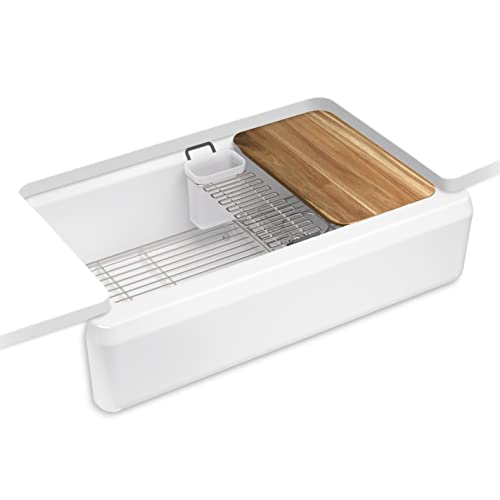
Kohler Riverby 35-3/4 Enameled Cast Iron K-24564
The Riverby is the flagship of this list by every printed measure: the widest sink here at 35-3/4 inches, an undermount single-bowl farmhouse design, workstation accessories included in the box, and the full material phrase Enameled Cast Iron stated in its title. Its model number, K-24564-0, and its colour, White, complete a title that leaves a renovator with few basic questions unasked.
Listing details
- Width printed: 35-3/4 inches
- Mounting and style: undermount, farmhouse
- Bowl count: single-bowl
- Material per the title: Enameled Cast Iron
- Included per the title: workstation sink accessories
- Model: K-24564-0; colour: White
Strengths
- The material claim is complete — both the iron body and the enamel are printed
- Workstation accessories arrive included, extending the bowl into a prep surface
- At 35-3/4 inches it offers the broadest single bowl in this group
Trade-offs
- Undermount farmhouse installation is the most demanding fitting style here
- A single bowl gives no second compartment for soak-versus-rinse working
- Bowl depth and minimum cabinet size are not given in the listing title
Workstation design is the idea that reorganised high-end sinks, and the Riverby’s title puts it in writing: accessories included. A workstation sink carries ledges inside the bowl on which boards, racks and colanders rest, converting the sink from a hole that holds water into a counter that happens to have a drain. Prep happens over the bowl, scraps sweep straight down, and the surrounding counter stays clear. In a 35-3/4-inch single bowl, that working width is generous enough for a board and a resting rack to coexist, which is precisely the choreography the accessories exist to enable.
The farmhouse element is the apron front — the exposed face of the sink standing proud of the cabinetry. Undermount farmhouse sinks demand cabinetry built or adapted for that apron, with support for a very heavy fixture; cast iron’s weight is the unspoken engineering fact behind every title in this list, and it is greatest at this width. A Riverby installation is a planned project with proper bracing, not a weekend swap, and the title’s farmhouse word is the fair warning of that.
On material, this listing is one of only two here that close the question completely. Enameled Cast Iron in the title means the buyer is promised the iron body and the fused enamel surface in the manufacturer’s own words. Everything the enamel-over-iron construction is known for — the depth of the white, the solidity, the particular care the surface asks for — can fairly be discussed for this sink, because its title has actually claimed the construction.
Best for: a full renovation building a workstation farmhouse centrepiece at maximum width, with the material claim in print
Not suited for: a drop-in replacement project, since this undermount farmhouse design needs cabinetry planned around it
Check price on Amazon — the Riverby, for the complete printed package: width, workstation and the full material phrase.
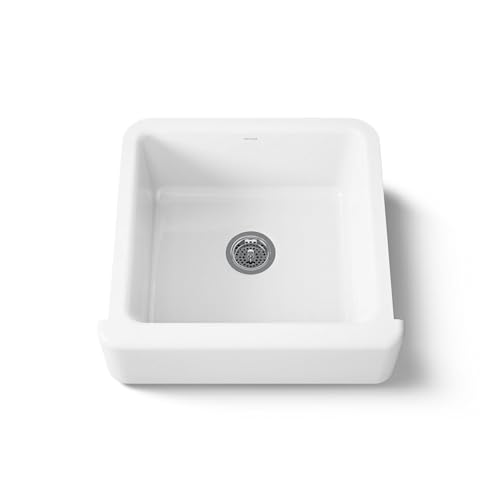
Kohler Whitehaven 23-1/2 Enameled Cast Iron K-5665
The Whitehaven takes the same formula — undermount, single-bowl, farmhouse, Enameled Cast Iron printed in full — and compresses it to 23-1/2 inches. That width changes the audience entirely: galley kitchens, cottage renovations, butler’s pantries and anywhere the farmhouse look is wanted without surrendering a metre of cabinet run. Its title adds a Durable and Easy-to-Clean Design claim and the model number K-5665-0.
Listing details
- Width printed: 23-1/2 inches
- Mounting and style: undermount, farmhouse
- Bowl count: single-bowl
- Material per the title: Enameled Cast Iron
- Design claim in the title: durable and easy-to-clean
- Model: K-5665-0; colour: White
Strengths
- The full Enameled Cast Iron phrase appears here too, at a far smaller width
- Farmhouse apron character survives the compression to 23-1/2 inches
- The listing itself raises durability and cleaning, the two daily questions for this material
Trade-offs
- A 23-1/2-inch bowl will not swallow the largest roasting pans flat
- No accessories are mentioned, unlike the Riverby above
- Undermount farmhouse fitting still requires cabinetry built for an apron front
Small farmhouse sinks answer a real design problem. The apron-front look is usually sold at widths that assume a large kitchen; cottages and older homes with narrow cabinet runs were left to admire it from afar. A 23-1/2-inch version preserves the proportions — the deep single bowl, the exposed front — at a scale a compact kitchen can actually host. The trade is capacity: sheet pans and stockpots will sit at angles rather than flat, and the household that regularly washes oven racks should measure before falling for the format.
The title’s own words — durable and easy-to-clean — are the manufacturer’s framing of the enamel surface, and they are reported here as the listing’s claim. Enamel’s smoothness is the basis of the cleaning claim: a fused glass-like surface gives grime little to grip. Durability, in this construction, means resistance to staining, fading and everyday wear rather than invulnerability; enamel over iron can chip if a heavy pan strikes it hard, which is true of the material generally and worth knowing before purchase rather than after.
Because this title prints Enameled Cast Iron in full, the Whitehaven stands with the Riverby as the list’s two unambiguous answers to the topic. A buyer whose first requirement is that the material be exactly what the article’s headline describes, in the manufacturer’s own words, has precisely two listings to choose between — and they differ chiefly in width, accessories and price of installation, which makes the decision refreshingly simple.
Best for: compact kitchens wanting the farmhouse apron and the full material claim at 23-1/2 inches
Not suited for: households washing wide roasting pans and oven racks flat in the bowl
Check price on Amazon — the Whitehaven, for farmhouse character and a complete material claim in a small footprint.

American Standard Quince 33×22 Single Cast Iron
The Quince is the sparest title in the six: a name, dimensions of 33 x 22, a single bowl, the words Cast Iron Kitchen Sink, and 3 Holes. That is the whole statement. It promises a wide single bowl in cast iron per its title, drilled for a faucet arrangement — and it does not mention enamel at all, so this review does not either: the finish of this sink is not stated in the listing title.
Listing details
- Dimensions printed: 33 x 22
- Bowl count: single bowl
- Material per the title: Cast Iron
- Enamel finish: absent from the title
- Faucet preparation: 3 holes
- Mounting style: the title does not say
Strengths
- Thirty-three inches of single bowl is serious washing width at a mainstream brand
- Pre-drilled holes simplify faucet matching for standard configurations
- The title makes no claims it does not support — what it prints, it prints plainly
Trade-offs
- The enamel question is left entirely open by the title
- Mounting style goes unprinted, so installation planning needs documentation
- No colour is named in the title
A 33 x 22 single bowl is the classic American kitchen footprint, and the Quince occupies it without ornament. Single bowls at this width take the roasting pan, the stockpot and the day’s accumulated everything in one undivided volume. The 3 holes are a practical datum: they suit a faucet with accompanying fittings in standard layouts, sparing the buyer the blank-deck question of where handles and sprayers will live. For a renovation reusing an existing faucet set, that hole count can be the deciding compatibility check.
The material silence deserves its full paragraph because it defines how this sink should be bought. The title claims cast iron — the body, the weight, the substance. It does not claim an enamel finish. American Standard’s line knowledge might suggest what the surface is, but this guide grades titles, not line knowledge, and the honest summary is that its title does not state the finish. A buyer for whom the enamel surface is the entire point should verify the finish through the manufacturer’s documentation before ordering; someone whose priority is a cast iron body at this footprint has their fact already.
There is a certain integrity in a five-fact title. Nothing here is inflated, no lifestyle adjectives compete for attention, and every printed word is checkable. In a category where titles often read like brochures, the Quince reads like a label — and labels, for a fixture that will be plumbed in for decades, have their own kind of trustworthiness.
Best for: a wide single-bowl replacement where cast iron per the title and a 3-hole deck fit the existing faucet plan
Not suited for: a purchase that requires the enamel finish confirmed in the listing itself
Check price on Amazon — the Quince, for 33 x 22 inches of unadorned, title-confirmed cast iron.

American Standard Delancey 30×19 Double Cast Iron
The Delancey divides what the Quince unites: a double bowl across 30×19 inches, cast iron per its title, in a colour the listing names Brilliant White, with a full model reference of 77DB30190.308. As with its sibling, the title claims cast iron and says nothing about enamel, so the finish is treated here as not stated in the listing title.
Listing details
- Dimensions printed: 30×19
- Bowl count: double bowl
- Material per the title: Cast Iron
- Enamel finish: the title does not mention it
- Colour named: Brilliant White
- Model reference: 77DB30190.308
Strengths
- Two bowls support the soak-on-one-side, rinse-on-the-other workflow
- At 30×19 it fits cabinet runs that cannot host the 33-inch class
- Brilliant White is named outright, settling the colour question the Quince leaves open
Trade-offs
- Double bowls divide width, so the largest pans may fit in neither side
- The finish remains unconfirmed by the title, as with the Quince
- Hole count and mounting style are not given in the listing title
The double-bowl argument is about parallel work. One side holds soaking water and the day’s pans; the other stays clear for rinsing, draining vegetables, or running the tap without disturbing the soak. Households that hand-wash delicate items alongside heavy cookware, or that lack a dishwasher and live at the sink, feel the division as a daily kindness. The cost is written in the same dimensions: 30×19 split in two yields bowls that each measure in the mid-teens of inches, and a wide roasting pan will bridge or angle rather than rest flat.
Brilliant White is worth a sentence because colour language in sink titles is rarely this specific. It signals the bright, cool white that suits contemporary kitchens and distinguishes the finish visually from creamier antique whites. What it does not do — and this review keeps the boundary bright — is state the finish’s material. The colour is printed; the enamel is not. Both facts belong to the buyer, stated at exactly the strength the title supports.
Between the two American Standard entries, the choice is architectural rather than qualitative: one wide uninterrupted bowl with drilled holes, or two divided bowls in a smaller footprint with the colour named. Both titles claim cast iron, both leave the finish unstated, and a household shortlisting either should put the same single question to the manufacturer’s documentation — what, precisely, is the surface? — and then decide on layout.
Best for: households that work two bowls in parallel within a 30×19 footprint
Not suited for: washing oversize pans flat, since each divided bowl is narrower than the Quince’s single span
Check price on Amazon — the Delancey, for divided working and a named Brilliant White in cast iron per its title.

Kohler Iron/Tones 33in K-5707
The 33-inch Iron/Tones is the list’s question mark, and its review must begin there: this title prints no material at all. What it does print is a 33-inch sink that mounts from the top or below, a single bowl, the model K-5707-0 and the colour White. The Iron/Tones name hints at a product family, but a hint is not a claim, and this guide records the material of this sink as not stated in the listing title.
Listing details
- Width printed: 33 inches
- Mounting options: top-mount or undermount
- Bowl count: single bowl
- Material: the title names no material
- Model: K-5707-0; colour: White
- Enamel finish: not stated in the listing title
Strengths
- Dual mounting options let the installation method be decided with the countertop, not before it
- Thirty-three inches of single bowl matches the classic full-size footprint
- The model number is printed for exact specification cross-checking
Trade-offs
- Neither cast iron nor enamel is claimed anywhere in the title
- A buyer cannot confirm this sink belongs to the topic from the title alone
- Depths, drain details and cabinet minimums are likewise unprinted
Flexible mounting is a genuinely valuable trait, and it is the honest centre of this listing. A sink that can sit top-mount on one counter material or undermount beneath another frees the renovator to sequence decisions — sink first, counter later — and it rescues projects when a planned undermount proves impractical for the chosen worktop. At 33 inches in a single bowl, the format is the category’s standard footprint, so the flexibility attaches to a size that fits the greatest number of kitchens.
Why include a sink whose title omits the topic’s material entirely? Because the Iron/Tones line is a known Kohler family, because shoppers will encounter this exact listing while searching this exact topic, and because a guide that silently passed it off as enameled cast iron would be committing the precise sin this article exists to avoid. Included and labelled, it serves the reader: here is a well-formed 33-inch dual-mount option from a major maker, and here, in plain words, is what its title does not tell you.
The practical instruction follows naturally. If this format is the one your kitchen needs, the material question must be answered from Kohler’s documentation for model K-5707-0 before purchase — the model number, helpfully, is printed right in the title for that purpose. Until that check is made, file this sink under format-known, material-unverified, and let the five other listings carry the material argument.
Best for: renovators who need one 33-inch single bowl that can mount either way, and who will verify material from the model number
Not suited for: any purchase that needs the material confirmed by the listing title itself
Check price on Amazon — the Iron/Tones 33-inch, for mounting flexibility with the material question openly flagged.

Kohler Iron/Tones 27in Cast Iron K-5708
The smaller Iron/Tones restores one material word: its title prints Cast Iron for a 27-inch sink offered as top-mount or drop-in, single bowl, model K-5708-0, in White. Enamel remains unmentioned, so — like the Quince and Delancey — its finish is recorded here as unstated by its title, while its cast iron body is a title fact.
Listing details
- Width printed: 27 inches
- Mounting options: top-mount / drop-in, with undermount also mentioned in the title’s phrasing
- Bowl count: single bowl
- Material per the title: Cast Iron
- Enamel finish: unstated in the title
- Model: K-5708-0; colour: White
Strengths
- At 27 inches it is the only genuinely compact option in this heavyweight list
- Cast iron is claimed in the title, unlike its 33-inch sibling
- Top-mount or drop-in fitting suits replacement projects and simpler cabinetry
Trade-offs
- The enamel finish is not stated, keeping it short of the topic’s full phrase
- A 27-inch bowl limits the largest cookware, as every compact sink does
- The title’s mounting phrasing is dense and worth reading twice before ordering
Compact cast iron sinks serve kitchens that refuse to give up substance when space runs short: the small period kitchen, the scullery, the serious utility space, the narrow galley in a city flat. Twenty-seven inches will not bathe a roasting pan, but it will take a stockpot, a day’s dishes for a small household, and decades of daily use in a material whose weight reads as permanence. Top-mount and drop-in options suit the replacement scenario — an old sink out, this one in — without the cabinet surgery an undermount farmhouse demands.
The contrast with its 33-inch sibling is instructive about titles generally. Two sinks, one product family, adjacent model numbers — and materially different titles, one claiming cast iron, the other claiming nothing. A shopper who assumed family resemblance settled the material question would be wrong in one direction or the other. This is why the guide insists on reading each title as its own evidence: the 27-inch claims cast iron, the 33-inch does not, and the reviews report exactly that asymmetry.
As with the other cast-iron-only titles, the enamel question routes to documentation. But note the ordering of virtues: someone seeking compact dimensions, drop-in simplicity and a title-confirmed cast iron body has, in this listing, the only pick that assembles all three. The finish check is one errand; the format fit is the substance of the purchase.
Best for: small kitchens and replacement projects wanting a compact, drop-in sink with cast iron in the title
Not suited for: a confirmed enamel finish from the listing, which only the Riverby and Whitehaven titles provide
Check price on Amazon — the Iron/Tones 27-inch, for compact cast iron with the simplest fitting in the list.
The material ledger, in one place
| Sink | Cast Iron in title | Enameled in title | Format |
|---|---|---|---|
| Riverby K-24564 | Yes | Yes | 35-3/4 in undermount farmhouse, single |
| Whitehaven K-5665 | Yes | Yes | 23-1/2 in undermount farmhouse, single |
| Quince | Yes | Not stated | 33 x 22 single, 3 holes |
| Delancey | Yes | Not stated | 30×19 double |
| Iron/Tones K-5707 | Not stated | Not stated | 33 in top-/undermount, single |
| Iron/Tones K-5708 | Yes | Not stated | 27 in top-mount/drop-in, single |
Keep this ledger open while you shop. It is the whole honesty position of the article in six rows: two complete claims, three partial claims, one open question — and not a single cell filled in by assumption.
How do you choose between farmhouse, undermount and drop-in?
What is your cabinetry prepared to hold?
Mounting style is a cabinetry decision before it is a style decision. Farmhouse aprons need a cabinet front cut or built for the apron and support engineered for serious weight. Plain undermounts need a solid countertop material and a supported cabinet. Drop-ins forgive the most: they sit in a cutout and rest on their rim, which is why replacement projects gravitate to the Iron/Tones 27-inch and its top-mount kin.
One bowl or two, honestly assessed?
Count what actually happens at your sink. Bakers, roasters and sheet-pan households live in wide single bowls. Households that soak and rinse in parallel, or wash delicate things apart from heavy pans, use a division daily. The Quince and Delancey embody the fork precisely: similar brand, similar footprint class, opposite answers.
Is the material claim complete, and does it need to be?
If the enamel-over-iron construction is the reason you came — its look, its feel, its ageing — then only two titles here complete the claim, and your shortlist is the Riverby and the Whitehaven, decided by width and accessories. If a cast iron body with a finish you will verify in documentation satisfies you, the field widens to five. If format flexibility leads, the 33-inch Iron/Tones waits, with its material homework clearly assigned.
Where will the faucet live?
The Quince’s 3 holes are the only faucet preparation printed in any title here. Every other pick leaves the deck question open, implying wall-mounted, counter-mounted or separately drilled arrangements to confirm. Settle the faucet plan alongside the sink, because the two purchases interlock and the titles will not settle it for you.
Living with a heavy sink: installation and daily care
Weight governs installation from the first minute. Cast iron sinks are two-person lifts with braced support beneath, and the farmhouse pair add apron alignment to the job. This is professional or very confident DIY territory: the sink must sit level, sealed and supported so that its weight rests on the structure designed for it, not on sealant and optimism. Budget the installation as part of the purchase, because a fixture of this class installed casually will announce the fact at the seams within a year.
Daily care for an enamel surface — where enamel is the confirmed finish, as on the Riverby and Whitehaven — is mostly gentleness with good tools. Rinse after acidic foods, wash with a soft cloth or sponge and ordinary detergent, and avoid scouring powders that dull the gloss over time. A sink grid or mat softens the impact of heavy pans, the one genuine vulnerability of the construction: enamel is hard and smooth, but a cast iron skillet dropped corner-first can chip what a decade of washing would not.
For the listings whose finish is not stated, the same gentle regime is the prudent default until documentation confirms the surface — soft cloths and mild cleaners are safe advice for any sink finish, and they cost nothing while the paperwork is checked. Across all six, the habits that age a sink gracefully are identical: do not let standing water and steel cans rust-mark the bowl, lift rather than drag heavy cookware across the surface, and treat the fixture as furniture that happens to hold water.
Renovators planning the room around the sink often work outward to the counters and then the rest of the house; the drainboard-equipped alternatives in Best Kitchen Sinks with Drainboards make a useful contrast read for anyone still weighing formats.
Common mistakes in this category
Assuming every cast iron sink title implies the enamel finish. Three titles in this very list claim the iron and stop there. The finish is a separate fact, and on a decades-long fixture it deserves its own confirmation rather than a family-resemblance guess.
Confusing enameled steel with enameled cast iron. The words differ by one noun and describe different constructions with different weight, feel and price. Listings for the steel version were excluded from this guide deliberately; shoppers comparing across the wider market should keep the same hard line.
Ordering a farmhouse apron sink for cabinetry that cannot take it. The apron needs a prepared cabinet and serious support. Measuring the cabinet run and confirming the installation plan matters more than the width printed in the title — though that, too, must be checked to the fraction.
Choosing bowl count by fashion. Farmhouse singles photograph beautifully; double bowls work quietly. The right answer is the one that matches the household’s actual washing traffic, not the showroom’s.
Skipping the model number. Kohler prints K-numbers in every title here for a reason: they are the key to specification sheets, cabinet minimums and finish documentation. The 33-inch Iron/Tones especially should never be ordered from the listing headline alone — checking model K-5707-0 unlocks every specification the headline leaves out.
Treating white as one colour. Brilliant White is a specific, bright white; other listings simply say White. Beside existing appliances and cabinets, shades of white can clash quietly for years. Samples and surroundings deserve a thought before the heaviest object in the kitchen is plumbed in.
Final recommendation
Let the material ledger make the first cut. If you want the construction this topic names, confirmed in the manufacturer’s own title, the choice is between two Kohlers. The Riverby is the full-scale answer — widest bowl, workstation accessories, farmhouse presence — for a renovation built around the sink. The Whitehaven is the same complete claim at cottage scale, and for small kitchens it is not a compromise but the correct size of the same idea.
If cast iron confirmed and finish-to-verify is acceptable, layout decides. The Quince gives the wide single bowl and the drilled deck; the Delancey gives two bowls and a named Brilliant White in a tighter footprint; the 27-inch Iron/Tones gives compact drop-in practicality. Each is a coherent purchase once its one open question is answered in documentation.
The 33-inch Iron/Tones stands as the format-first option: buy it for dual mounting and standard dimensions, with the model number K-5707-0 as your homework before money moves. Households furnishing beyond the kitchen in the same project may find Best Unfinished Nightstands a congenial next read, and the garage-minded have Best Garage Vacuums waiting for the other end of the house.
Why cast iron keeps its place in the kitchen
Materials cycle through kitchen fashion, yet cast iron sinks persist for reasons a hand understands the first time it rests on the rim: the fixture feels immovable, sounds solid when a pan lands, and holds the visual depth that its white surface is known for where enamel is the finish. In farmhouse design especially, the sink is not an appliance inserted into the room but a piece of the room’s architecture, and lighter constructions struggle to carry that role convincingly.
There is also a longevity argument that suits the material’s weight. A sink is plumbed, sealed and surrounded by cabinetry and stone; replacing one is a project, not a purchase. Materials with multi-decade service expectations justify their installation cost in a way disposable fixtures cannot. That is the deeper reason this guide reads the titles so strictly: a fixture bought for thirty years deserves claims verified to the word, because the buyer will live with the truth of them for a very long time.
The countertop conversation: what surrounds the bowl
A sink does not sit alone; it negotiates with the countertop for the whole of its life. Undermount designs — the Riverby, the Whitehaven, and the 33-inch Iron/Tones in its undermount mode — expose the counter’s edge around the bowl, which suits solid stone and quartz whose edges can be finished and sealed, and which makes wiping crumbs directly into the bowl the daily pleasure undermount owners describe. The same exposure demands a watertight seal maintained over years, because the seam between sink and stone is where water will test the installation forever.
Top-mount and drop-in designs reverse the relationship. The rim covers the cut edge, forgiving countertop materials that cannot take an exposed polished edge and simplifying both installation and eventual replacement. The 27-inch Iron/Tones carries this flag in the list, and its compact width pairs naturally with the butcher-block and laminate counters of smaller kitchens, where an undermount’s demands would be disproportionate to the room.
Farmhouse aprons introduce a third relationship: the sink becomes part of the cabinetry’s face. The apron’s white front stands in the run of cupboard doors, and its proportions — height, projection, the reveal around it — are millimetre decisions made with the cabinet maker, not afterthoughts. Renovators drawn to the Riverby or Whitehaven should expect the sink conversation to happen early in the design process, with the cabinet order following the sink’s specification sheet rather than preceding it.
Drains, disposals and the hardware nobody photographs
No title in this list prints drain specifications, and that silence is normal for the category — yet the hardware beneath the bowl decides daily satisfaction as surely as the bowl itself. Drain position affects whether a disposal fits the cabinet, whether a drawer beneath the sink is possible, and how the bowl empties when a large pan covers the outlet. These are specification-sheet questions, reachable through the model numbers the Kohler titles print and through the manufacturers of the American Standard pair, and they should be answered before the plumber’s visit rather than during it.
Sound is the other unphotographed quality. A heavy cast iron body has an inherent advantage here that follows from the material itself: mass absorbs the drumming of running water and the clatter of pans in a way thin steel cannot. Where a title confirms cast iron — five of the six do — that solidity of feel and sound is a fair expectation from the material class. It is one of the quiet reasons households that have owned a cast iron sink describe stainless replacements as tinny, however unfair that may be to good steel.
Grids, racks and basin accessories complete the working sink, and only the Riverby’s title speaks to them, with its included workstation accessories. For the other five, accessories are a separate purchase matched to bowl dimensions — another reason the printed dimensions in each title matter beyond the cabinet cutout. Measure the bowl’s floor, not just its rim, before ordering any grid, because bowls taper and rim dimensions flatter the space a grid must actually fit.
Period houses, new builds and the retrofit question
In a period house, a cast iron sink is often a restoration as much as a renovation: kitchens of a certain age were built around exactly such fixtures, and the farmhouse pair here speak that language fluently. The retrofit challenges are structural — floor and cabinet support for the weight, plumbing positions that predate modern layouts — and they reward the drop-in and smaller formats when the house resists bigger plans. The 23-1/2-inch Whitehaven and the 27-inch Iron/Tones exist in this list largely for such houses.
New builds invert the problem: everything can be planned, so the question becomes purely one of desire and budget. The Riverby’s workstation format is a new-build native, designed into an island or a long counter run from the first sketch. The discipline for new builds is sequencing — sink chosen before cabinets, cabinets built to the sink’s published specification, countertop templated with the sink on site. Every professional kitchen fitter has a story about a counter cut for a sink that had not yet been chosen; the model numbers printed throughout these titles are the antidote.
Rental and resale considerations trail behind both. A substantial sink signals permanence to buyers and photographs as a kitchen’s centre rather than its afterthought. Landlords rarely install at this weight class, but owner-occupiers renovating for a decade of their own use — the natural audience for every pick here — are buying exactly that permanence, and the material honesty this guide insists on is simply what a decade-scale purchase deserves.
How a sink earns its keep across an ordinary day
Morning begins with filling, rinsing and the kettle’s overflow — small uses that reward a bowl which feels solid under a resting hand and a tap that clears the tallest jug. The single-bowl formats dominate this list for a reason: breakfast washing is a stream of unlike objects, glasses beside a saucepan beside a chopping board, and an undivided bowl receives them all without negotiation. Midday adds the soaking pan, the rinsed salad, the colander of pasta — the workstation Riverby was accessorised for, and the moment a divided Delancey household uses its second bowl as the clean zone while the first holds the morning’s residue.
Evening is the trial: the roasting pan, the stockpot, the accumulated evidence of a cooked meal. Width tells here — the Quince’s 33 inches and the Riverby’s span swallow what the compact pair must angle and rotate. None of this makes the small sinks lesser; it makes them honest to the households they serve, whose cooking is scaled to their kitchens. A sink earns its keep not by surviving the largest imaginable day but by fitting the ordinary day so well that nobody thinks about it — the highest praise available to a fixture, and the standard against which every pick here should be imagined in place.
Reading sink titles: a transferable skill
The six titles in this article form a small masterclass in specification reading. The complete titles — Riverby and Whitehaven — hand the buyer dimensions, mounting, bowl count, material, model and colour in one breath. The terse titles — the Quince above all — hand over fewer facts but stand behind every one. The incomplete title, the 33-inch Iron/Tones, omits the very fact the shopper came for, and only a reader comparing across listings would notice, because its format facts are so reassuringly complete.
The transferable habit is to list what a fixture purchase requires — material, dimensions, mounting, bowl configuration, faucet preparation, colour, model — and then audit each candidate title against the list, marking blanks rather than assuming them. Blanks are not disqualifications; several picks here carry blanks worth an errand. But a blank mistaken for a fact becomes a delivery-day discovery, and with fixtures of this weight, delivery-day discoveries are measured in return freight and replanned cabinetry. Read the titles the way this guide read them, and the category holds no traps.
Budgeting beyond the bowl
The sink’s price is the beginning of its budget, not the whole of it, and the titles quietly predict the rest. A farmhouse undermount implies cabinet adaptation and professional fitting. A workstation model implies the accessories are included — the Riverby says so — while the other five imply accessory purchases to reach the same working arrangement. A drop-in at 27 inches implies the least supporting spend of all, which is part of its honest appeal for smaller projects.
Faucets, disposals, grids and plumbing adjustments distribute across all six as unlisted necessities, and the only defence against surprise is the specification sheet for the chosen model, checked before the order rather than after the delivery. None of this argues against the category; heavy, permanent fixtures have always carried installation weight in their budgets. It argues for entering the purchase with the whole number in view, so the sink that arrives is the sink the project can finish — because a beautiful bowl sitting in its crate while the budget recovers helps nobody, least of all the household washing up in the bath.
A word on white: shades, light and the room’s palette
Five titles here say White and one says Brilliant White, and the difference is a design decision hiding in a single adjective. Brilliant whites read cool and crisp beside stainless appliances and pale stone; softer whites sit more gently with warm timber, brass fittings and the farmhouse palette. North-facing kitchens cool every white further; south-facing rooms warm them. The sink is likely to be the largest single expanse of white in the room, larger than any appliance front, so its shade anchors the palette whether the renovator planned it that way or not.
The practical defence is comparison in place: swatches and appliance doors held beside the chosen sink’s listing imagery are a start, but the real test is the room’s own light at the hours the kitchen is used. Households renovating in stages should fix the sink’s white early and let later choices — cabinet paint, tile, worktop veining — harmonise to it, because repainting a cabinet is a weekend and replacing a plumbed cast iron sink is a project. In that sense the colour line in these titles, easy to skim past, carries more daily consequence than several of the dimensions.
Delivery day: receiving a very heavy fixture
A cast iron sink arrives as freight, not as a parcel, and the receiving ritual matters. Inspect the bowl and apron before signing anything, in daylight, looking across the surface at an angle where chips and cracks announce themselves. Photograph the fixture in its packaging if anything looks amiss. Store it flat and supported, never on its apron edge, in the room where it will be installed or somewhere the path between is free of thresholds and tight corners — because moving it twice doubles the handling risk that one careful move avoids.
Schedule the installation only when cabinetry, countertop and plumbing are genuinely ready for it. A heavy sink that must be lifted in and out for measuring is a sink being gambled with; the specification sheets exist so the fixture can be lifted exactly once into its prepared place. That single-lift discipline, mundane as it sounds, is how these fixtures begin their decades without the chips that careless beginnings carve into them.
The secondhand and salvage angle
Cast iron sinks are among the few kitchen fixtures with a genuine second life: architectural salvage yards trade in them, and a sound vintage bowl can outlast the house it was rescued from. That afterlife says something reassuring about every new pick in this list — the material class endures. It also sharpens the buying discipline for new sinks, because the qualities that make an old sink valuable are exactly the qualities the titles here are audited for: a confirmed construction, a sound surface, dimensions that suit standard cabinetry. Buy the new sink that a salvage hunter, forty years from now, would be pleased to find, and the purchase has been made at the right standard.
Frequently asked questions
Which of these sinks are actually confirmed as enameled cast iron?
Two, by their titles: the Kohler Riverby K-24564 and the Kohler Whitehaven K-5665 both print the full phrase Enameled Cast Iron. Three others print Cast Iron without stating a finish, and the 33-inch Iron/Tones prints no material at all. The material ledger above lays the six out row by row.
Does a cast iron sink without a stated finish still have enamel on it?
The title does not say, and this guide does not guess. The finish may well be documented by the manufacturer — the model numbers printed in each title are the route to that documentation. Until it is confirmed there, the accurate statement is the one used throughout: enamel finish not stated in the listing title.
Are farmhouse sinks harder to install than drop-ins?
Yes, as a rule. Apron-front undermounts like the Riverby and Whitehaven need cabinetry prepared for the apron and support built for the weight. A drop-in like the 27-inch Iron/Tones rests in a cutout on its rim and is the most forgiving format here for replacement projects.
Single bowl or double bowl — which suits a family kitchen?
Wide single bowls swallow roasting pans, stockpots and sheet trays whole, and suit households whose washing is bulky. Double bowls suit parallel working — soaking while rinsing — at the cost of narrower compartments. The Quince and Delancey in this list are the two answers at similar scale; match them to your traffic, not to photographs.
How heavy are these sinks, really?
No title here prints a weight, so this guide quotes none. Cast iron construction is substantially heavier than steel or fireclay alternatives as a material class, and every installation should be planned with braced support and a two-person lift. Exact figures belong to each model’s specification sheet, reachable through the printed model numbers.
Buy the sink whose title tells the truth you need — the full material phrase where that phrase matters, the honest silence where it does not, the model number followed into the documentation wherever the title runs out — and the heaviest, most-touched fixture in your kitchen will justify its weight every single day, through every meal, every washing-up, and every year of the long life it was bought for.


