What's inside
- Where to buy these spiralizing machines
- Quick picks, split by machine type
- How these picks were chosen
- The three true processors first
- Now the dedicated electric spiralizers — specialists, not processors
- Two families, one counter: the full ledger
- How to choose between a processor and a dedicated spiralizer?
- Storage, the silent decider between the families
- A week of dinners, mapped to the six machines
- Getting good noodles: technique notes for both families
- Feed openings and hoppers: the numbers that govern hard vegetables
- Why electric changes the spiralizing habit
- Common mistakes in this category
- Final recommendation
- Frequently asked questions
As an Amazon Associate I earn from qualifying purchases. This post may contain affiliate links at no extra cost to you.
As an Amazon Associate, cottageverdict.com earns from qualifying purchases.
This roundup needs its premise stated before anything else, because the honest answer to “best food processors with spiralizer” is that the category is smaller than shoppers expect. Only three machines in this list are genuine food processors with spiralizing built in or attached: two Hamilton Beach processors and the NutriBullet Veggie Bullet. The remaining three picks are dedicated electric spiralizers — countertop machines that do one job, turning vegetables into noodles, and do not process food in the broader sense at all. They are included, clearly labelled, because a shopper whose real goal is a bowl of zucchini noodles may be better served by a specialist than by a processor, and pretending the specialists are processors would help nobody. Read the first three reviews if you need slicing, shredding, kneading, and pureeing alongside your spirals; read the last three if noodles are the whole point.
Shoppers should also know what this category is not. None of these six machines is a blender, none juices, and none of the titles promises frozen-dessert or nut-butter heroics. The processors chop, slice, shred, and in one case knead; the specialists spiralize. A kitchen that needs high-speed blending belongs in a different roundup, and a kitchen that needs dough should note that exactly one title here — the 70815’s — names kneading at all. Reading the category by its stated verbs keeps expectations where the machines can meet them.
That split shapes everything below. The processors compete on capacity — ten cups, twelve cups — feed chute size, and the range of blades beyond the spiralizer. The specialists compete on cutting cones, noodle shapes, and hopper size. What unites all six is electricity: every machine here spiralizes under power, sparing your wrist the hand-crank that puts so many manual spiralizers into the cupboard of abandoned gadgets by February. Vegetable noodles have moved from diet fad to ordinary weeknight cooking — a way to put a pan of something fresh beside richer dishes — and the machine that makes them in ninety seconds gets used, while the machine that takes ten minutes to assemble does not.
Where to buy these spiralizing machines
All six are sold on Amazon, each with its own link inside its review.
- Hamilton Beach’s 70735 leads the true processors: a ten-cup machine whose title names a veggie spiralizer attachment among its slicing, shredding, mincing, and puree work.
- Hamilton Beach’s Professional 70815 follows at twelve cups, with a three-inch feed chute the title says fits whole vegetables.
- The NutriBullet Veggie Bullet is the hybrid: an electric spiralizer and food processor in one silver unit.
- Hamilton Beach’s 3-in-1 electric spiralizer opens the specialist half — a dedicated noodle machine with three cutting cones, and not a food processor.
- Oster’s FPSTES1000 is the plainest specialist here, an electric spiralizer whose title promises nothing beyond the job itself.
- MasterChef’s electric spiralizer closes the list with an XL hopper and recipe-driven, low-carb positioning in its title.
Quick picks, split by machine type
| Pick | Type | Title highlight |
|---|---|---|
| Hamilton Beach 10 Cup with Spiralizer 70735 | Food processor with spiralizer attachment | 10 cup, slicing, shredding, mincing, puree, spiralizer attachment |
| Hamilton Beach Professional Stack & Snap Spiralizer 70815 | Food processor with spiralizer | 12 cups, extra-large 3 inch feed chute, kneading named |
| NutriBullet Veggie Bullet Spiralizer & Processor | Electric spiralizer and food processor | Both functions named in the title, silver |
| Hamilton Beach 3-in-1 Electric Spiralizer | Dedicated electric spiralizer — not a processor | 3 cutting cones: spaghetti, linguine, ribbons; 6 cups |
| Oster Electric Spiralizer | Dedicated electric spiralizer — not a processor | Electric spiralizer, black, model FPSTES1000 |
| MasterChef Electric Spiralizer | Dedicated electric spiralizer — not a processor | 3-in-1 noodle maker, XL hopper, recipes included per title |
How these picks were chosen
Two tempting listings were excluded on class grounds during the pool research and are worth naming so the boundary is visible: a handheld spiralizer tool, which fails the electric and processor tests alike, and a spiralizer attachment built for a stand mixer, which is an accessory rather than a machine. Excluding them kept the list honest at exactly six self-powered appliances, three per family.
The selection began with a hard filter: the listing title had to name a spiralizer. That filter is why this article has its unusual shape. Among true food processors, only a handful of titles claim spiralizing at all — the two Hamilton Beach machines and the Veggie Bullet — while the wider processor market stays silent on the feature, however capable those machines are at slicing and shredding. Rather than dilute the premise by admitting silent processors, the list completes itself with dedicated electric spiralizers, labelled as such at every mention. The addendum discipline behind this batch is recorded in the sources file: the three specialists are spiralizer-only machines and are never described as food processors anywhere in this article.
Within each half, variety guided the order. The processors span ten and twelve cups and two design philosophies — attachment-based and stack-and-snap — plus the Veggie Bullet’s hybrid identity. The specialists span cone-based noodle variety, minimalist single-purpose design, and hopper-led batch prep. Every pick is electric, every pick’s spiralizing is stated in its title, and every claim in the reviews traces to those titles. Cooks equipping a whole prep station may also want Best Hand Blenders for Baby Food for the pureeing end of the counter, where stick blenders handle the soft-food jobs a spiralizer never touches.
The three true processors first
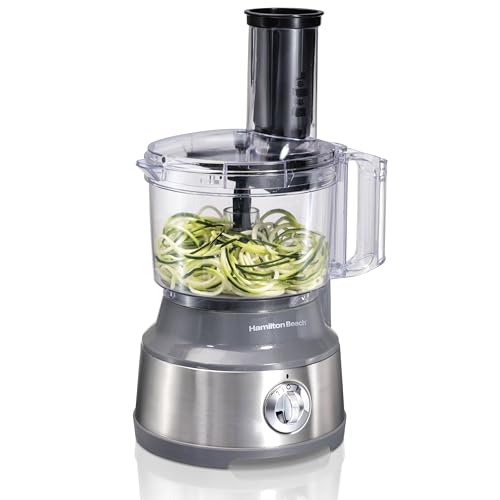
Hamilton Beach 10 Cup with Spiralizer 70735
The 70735 is the straightforward answer to the article’s title: a ten-cup food processor and vegetable chopper whose title lists slicing, shredding, mincing, and puree, and then adds a veggie spiralizer attachment to the repertoire. That word attachment is informative rather than disappointing — the spiralizer is a component of a system whose main bowl and blades handle the everyday processor work, so the machine earns its counter space on soup bases, slaws, and salsas even in weeks when no noodle is planned. Ten cups is the family-practical capacity, grey and stainless steel is the finish, and 70735 is the model number to match accessories against. For a household buying one machine to cover both the processor jobs and the spiralizing curiosity, this is the list’s most balanced single purchase.
Spec mini box — Type: food processor with spiralizer attachment, stated. Capacity: 10 cup, stated. Functions named: slicing, shredding, mincing, puree. Finish: grey and stainless steel. Feed chute size: unpublished in the title. Motor wattage: no figure printed.
Strengths
- The broadest stated function list among the true processors, with spiralizing included rather than implied.
- Ten cups hits the family batch size without the storage bulk of the largest bowls.
- An attachment model means the spiralizer stores inside the processor’s ecosystem, not as a separate appliance.
Trade-offs
- Attachment spiralizing means assembly steps before noodles, unlike a dedicated machine’s single purpose.
- No feed chute dimension is published in the title, so whole-vegetable handling is unverified there.
- Puree and mincing share the bowl with spiralizing, so a multi-dish prep session means washing between jobs.
Think about the week this machine serves. Monday it shreds cabbage and carrots for slaw. Wednesday it minces onions and herbs for a sauce base. Friday it purees a soup smooth. And on Sunday, the spiralizer attachment comes out and turns a pile of zucchini and sweet potatoes into the noodle base for a lighter dinner before the week resets. That rotation is the attachment model’s whole argument: spiralizing is a weekly pleasure rather than a daily staple for most households, so housing it inside a machine that works every day beats dedicating counter space to it. The chopper naming in the title also matters for expectations — this is a processor that chops as a first-class job, not a blender pretending upward. Readers whose spiralizing ambitions are daily and large should keep reading into the specialists; those whose ambitions are weekly should stop here with confidence.
Storage logic completes the 70735’s case. A food processor already claims a cupboard zone for its bowl, discs, and blades; an attachment that lives in the same zone adds spiralizing for the price of one more component’s shelf space. Compare that with the dedicated machines below, each demanding its own footprint for a single talent, and the attachment’s economy becomes vivid for small kitchens. The grey and stainless finish also helps the processor sit out on the counter without shouting, and a machine that lives out gets used — the oldest truth in kitchen equipment. For households still deciding whether vegetable noodles are a phase or a fixture, this pick is the hedge that cannot lose: if the noodle habit fades, a full processor remains.
Best for: a family wanting one ten-cup processor whose attachment covers weekly vegetable noodles. Not suited for: a daily noodle routine, where a dedicated spiralizer’s zero-assembly workflow wins. Check price on Amazon with the full 70735 system in view.
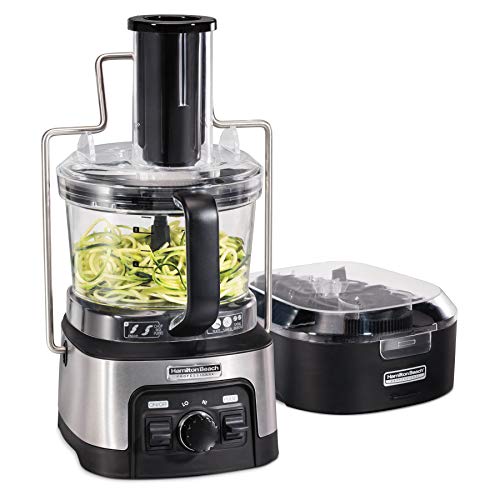
Hamilton Beach Professional Stack & Snap Spiralizer 70815
The 70815 is the bigger, more ambitious Hamilton Beach: a Professional Stack & Snap food processor and veggie spiralizer at twelve cups, whose title names slicing, shredding, and kneading — kneading being the function that separates serious processors from choppers — and headlines an extra-large three-inch feed chute that fits whole vegetables. That chute dimension is the most practically important number in this entire article, because spiralizing and slicing both begin at the chute: a three-inch opening swallows whole zucchini, cucumbers, and potatoes without the pre-cutting that turns a quick job into a knife session. Stack & Snap names the assembly style, a bowl that stacks and snaps into place rather than twisting into alignment, which owners of arthritic hands or hurried habits appreciate more with every use.
Spec mini box — Type: food processor and veggie spiralizer, stated. Capacity: 12 cups, stated. Feed chute: extra-large 3 inch, fits whole vegetables, stated. Functions named: slicing, shredding, kneading. Finish: stainless steel. Model: 70815.
Strengths
- The three-inch chute removes pre-cutting from most spiralizing and slicing jobs.
- Kneading in the function list extends the machine into dough, beyond vegetable prep entirely.
- Twelve cups is the largest processor capacity in this list, for batch cooks and big households.
Trade-offs
- The largest footprint here, in a category where counter space is the recurring complaint.
- Professional naming sets expectations the buyer should calibrate to home and light-duty use.
- Its breadth may be wasted in a kitchen that only ever wanted noodles.
Batch cooking is where this machine separates itself. A gardener facing a glut of zucchini in August, a meal-prepper spiralizing a week of lunars on Sunday, a parent shredding cheese and vegetables for a crowd — all three feel the twelve cups and the wide chute as time returned. The kneading function deserves its sentence too: a processor that kneads lets one machine cover pizza dough on Friday and spiralized courgette on Saturday, which in a small kitchen can retire a separate mixer from daily duty. The Stack & Snap assembly reduces the fiddle factor that makes people avoid processors generally; when the bowl fights its owner, the food processor loses to the knife, but when it stacks and snaps, it wins. If your household’s vegetable volume is genuinely large, this is the processor the list has been pointing toward.
There is a confidence to specifying a feed chute dimension in a title, and it invites a corresponding confidence in the buyer: measure your typical produce against three inches and you will know before ordering whether whole vegetables truly pass. Most zucchini, cucumbers, and medium potatoes do, which converts spiralizing from a two-tool job into a one-tool job and slicing from a trimming exercise into a straight feed. The twelve-cup bowl then catches the volume that such easy feeding produces. Households that preserve, freeze, or cater from their own kitchen will recognise this as the working end of the processor market, where specifications stop being adjectives and start being measurements.
Best for: a batch-cooking household needing twelve cups, whole-vegetable feeding, and dough kneading in one processor. Not suited for: a compact galley kitchen where a twelve-cup bowl has nowhere to live. Check price on Amazon and measure the 70815’s chute against your produce.

NutriBullet Veggie Bullet Spiralizer & Processor
The Veggie Bullet’s title is the shortest of the processor half and the most symmetrical: an electric spiralizer and food processor, in silver. NutriBullet built its name on compact personal blending, and the Veggie Bullet applies that compact philosophy to the spiralizer-processor hybrid — a machine conceived from the start around vegetable preparation rather than adapted from a general processor line. That conception matters for expectations: where the Hamilton Beach machines are processors that spiralize, the Veggie Bullet presents the two functions as equals, spiralizer first in its own name. The title publishes no capacity, no chute dimension, and no function list beyond the two headline jobs, so this review keeps its claims at exactly that level and flags the figures a buyer must confirm in the full listing.
Spec mini box — Type: electric spiralizer and food processor, both stated. Finish: silver. Capacity: the title withholds the figure. Feed chute size: likewise withheld. Additional functions beyond the two named: the title adds none.
Strengths
- A purpose-built hybrid identity, spiralizing treated as a headline function rather than an accessory.
- NutriBullet’s compact-appliance design language suits smaller counters than full processors demand.
- One machine covers both buying intentions in this article’s premise without a half measure.
Trade-offs
- The title’s brevity leaves capacity and chute size to verify before a large household commits.
- No kneading or puree claim appears, so dough and soup ambitions belong with the Hamilton Beach picks.
- Buyers wanting published figures in the title itself will find the other two processors more forthcoming.
The Veggie Bullet’s natural owner is the vegetable-forward cook whose prep is dominated by exactly the two named jobs: spiralizing for noodle bases and processing for slaws, riced vegetables, and chopped salads. For that cook, a machine designed around vegetables — rather than a generalist that also kneads dough — can feel more direct in daily use, with the workflow arranged around produce instead of around a bowl. The silver finish keeps it visually quiet among stainless appliances. The homework is real, though: capacity decides whether it serves a couple or a family, and only the full listing answers that. Treat this pick as the specialist-leaning hybrid, verify its size against your household, and it may be the most likeable machine here for a produce-heavy kitchen.
Brand context adds one more consideration. NutriBullet’s machines are designed for people who like their appliances singular and counter-friendly, and the Veggie Bullet’s owner is likely running a produce-heavy, smoothie-adjacent kitchen where vegetables are the main event rather than a side. In that kitchen the hybrid’s priorities align: spiralize tonight’s base, process tomorrow’s slaw, and let a separate heavyweight machine — if one exists at all — live elsewhere. The title’s silence on numbers cuts both ways, of course; it keeps the promise simple, but it transfers the sizing work to the buyer. Five minutes in the full listing settles capacity, and a household doing that homework can buy the most conceptually elegant machine in this list with open eyes.
Best for: a vegetable-centred cook wanting spiralizing and processing as equal headline jobs in one silver unit. Not suited for: a dough-making household, since no kneading function is stated in the title. Check price on Amazon and confirm the Veggie Bullet’s capacity.
Now the dedicated electric spiralizers — specialists, not processors
The three machines below do not chop, knead, puree, or process in any broader sense. Each is an electric spiralizer: feed a vegetable in, receive noodles or ribbons out. They earn their places because they perform that single job with less assembly and often more noodle variety than a processor’s attachment, and because many shoppers arriving at this article want exactly that job and nothing else.
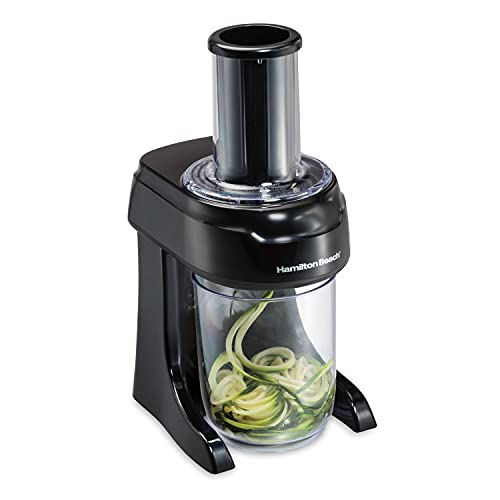
Hamilton Beach 3-in-1 Electric Spiralizer
Hamilton Beach appears again, this time as a specialist: a 3-in-1 electric vegetable spiralizer for veggie noodles, described as a zoodle maker and slicer with three cutting cones for spaghetti, linguine, and ribbons, at six cups, in black, model 70930. The three named noodle shapes are the substance of the offer — spaghetti for twirling bowls, linguine for flatter sauces, ribbons for salads and garnishes — and cone-based cutting makes swapping shapes a physical, obvious act rather than a menu setting. Six cups describes the collection capacity for the noodles produced. As a dedicated machine it asks for counter or cupboard space that does nothing else, and in exchange it removes every assembly barrier between a zucchini and a plate of zoodles.
Spec mini box — Type: dedicated electric spiralizer — not a food processor. Cutting cones: 3, for spaghetti, linguine, and ribbons, stated. Collection capacity: 6 cups, stated. Colour: black. Model: 70930. Processing functions: none — this machine spiralizes and slices only, per its title.
Strengths
- Three named noodle shapes cover the forms home cooks actually serve.
- A single-purpose workflow means the machine is ready the moment a vegetable is.
- Hamilton Beach’s presence in both halves of this list lets buyers stay with one brand’s ecosystem.
Trade-offs
- It will never chop an onion or shred cheese; the specialisation is total.
- Dedicated space must be justified by noodle frequency alone.
- Six cups of collection suits household batches, not catering-scale prep.
The psychology of the dedicated spiralizer is worth respecting. Gadgets get used in proportion to their readiness, and a machine whose entire being is noodles — no bowl to fit, no blade system to configure — collapses the decision to cook vegetables into a thirty-second act. Households following low-carb or vegetable-heavy patterns, where zoodles appear four nights a week, feel that readiness as the difference between a habit kept and a habit abandoned. The three cones keep the habit from going stale, rotating shapes so the same zucchini reads as a different dinner across the week. If your household’s spiralizing is occasional, the 70735’s attachment is the wiser buy; if it is a standing weeknight pattern, this specialist repays its shelf space quickly.
Ribbons deserve a special mention among the three cones, because they unlock the dishes that sell spiralizing to sceptics: wide vegetable ribbons layered into salads, curled over grain bowls, or wilted briefly into broths where a noodle shape would tangle. Making only spaghetti-style zoodles uses a third of this machine; rotating all three cones yields a small repertoire from one drawer of equipment. The six-cup collection chamber also suits the rhythm of family service, holding a full batch of strands while the pan heats, so the cooking and the spiralizing overlap instead of queueing. That overlap is the specialist’s hidden speed advantage, invisible in specifications and obvious at the stove.
Best for: a household spiralizing several nights a week that wants three noodle shapes with no processor assembly. Not suited for: a kitchen needing chopping or shredding, since this machine does neither. Check price on Amazon and explore the three-cone system.

Oster Electric Spiralizer
Oster’s FPSTES1000 carries the most economical title in the list: electric spiralizer, black. No cone count, no capacity, no noodle shapes are published in the title, and this review invents none of them. What can be said honestly is structural. Oster is a long-established kitchen appliance name, the machine is electric rather than hand-cranked, and its single-purpose identity places it in the specialist half of this article — it is a spiralizer, not a food processor, and it should be bought for noodles alone. For a shopper who distrusts feature inflation and wants the plainest possible powered route from vegetable to spiral, that minimalism is the pitch; the full listing carries the burden of every figure.
Spec mini box — Type: a dedicated electric spiralizer, spiralizing only. Model: FPSTES1000, stated. Colour: black. Cutting cone or blade count: unprinted. Capacity: a full-listing figure. Noodle shapes named: the title names none.
Strengths
- The simplest proposition here: powered spiralizing from an established appliance brand.
- A black, single-purpose unit asks little visual or mental space in the kitchen.
- No feature promises in the title means no feature disappointments against it.
Trade-offs
- Every practical figure — cones, capacity, shapes — must be confirmed in the full listing.
- Buyers wanting named noodle variety up front will prefer the Hamilton Beach 3-in-1 or MasterChef titles.
- Like all specialists here, it offers nothing beyond spiralizing.
There is a type of buyer the Oster serves well: the one who has been burned by over-featured gadgets and now shops for the minimum viable machine from a name they recognise. Electric drive is the one feature that matters most in spiralizing, because hand-cranking a hard sweet potato is where manual machines go to die in drawers; the Oster guarantees that core upgrade and leaves the rest unspoken. The discipline required is a five-minute read of the full listing to learn its cone arrangement and capacity before ordering, since the title delegates everything. If those figures suit your household’s noodle volume, the FPSTES1000 is the list’s quiet, brand-anchored specialist — the appliance equivalent of a plain answer to a plain question.
Oster’s broader history in blenders and kitchen electrics gives the FPSTES1000 one advantage no title can print: parts and service familiarity. A minimalist machine from a long-running brand is the easiest kind of appliance to keep in service, and for an owner whose nightmare is an orphaned gadget with an unavailable blade, that background has real value. The black finish suits the same temperament — it disappears among other appliances, asks for no colour coordination, and hides the faint staining that beetroot and turmeric-adjacent vegetables leave on lighter plastics. Plain, powered, and from a name the repair shop recognises: the Oster’s argument is temperament, and temperament is a legitimate basis for choosing between near-equal machines.
Best for: a brand-trusting minimalist wanting powered spiralizing without a feature circus. Not suited for: a purchase decision requiring noodle shapes and capacity confirmed by the title itself. Check price on Amazon to read the FPSTES1000 details in full.

MasterChef Electric Spiralizer
MasterChef’s specialist is the most exuberant title in the list: a 3-in-1 vegetable noodle and homemade pasta maker, positioned for low carb, keto, vegan, and gluten free cooking, described as a zoodle and zucchini veggie slicer with an XL hopper, free recipes, and quick healthy meal prep gifting. Strip the enthusiasm back and the concrete assets are three: a 3-in-1 cutting proposition, an XL hopper that suggests larger vegetables or larger batches with fewer reloads, and included recipes to start a new owner’s repertoire. The dietary framing is the brand’s own positioning — the machine spiralizes vegetables, and what that means for a menu is the cook’s business — but it correctly identifies the audience: households restructuring dinners around vegetable noodles as a staple rather than a novelty.
Spec mini box — Type: dedicated electric spiralizer; no processing functions claimed. Configuration: 3-in-1, stated. Hopper: XL, stated. Extras named: free recipes. Dietary positioning in title: low carb, keto, vegan, gluten free — the listing’s own framing. Capacity figure: absent from the title.
Strengths
- An XL hopper points at batch prep and bigger vegetables with fewer interruptions.
- Included recipes shorten the gap between unboxing and a repertoire of noodle dinners.
- The gift framing suits households buying for a cook beginning a vegetable-noodle routine.
Trade-offs
- The title’s dietary language is marketing positioning, not a machine capability to verify.
- No numeric capacity is published, so batch size needs the full listing’s confirmation.
- It remains a specialist: no processing, chopping, or kneading of any kind.
The XL hopper is the detail to dwell on, because hopper size is the specialist spiralizer’s equivalent of a processor’s feed chute — it decides how much vegetable the machine accepts before the cook must stop, reload, and restart the rhythm. For a household spiralizing for four, or prepping a week of lunches, that continuity is the difference between a five-minute job and a fifteen-minute chore, and chores are where healthy routines go to die. The included recipes play a supporting role in the same drama: the first fortnight of ownership decides whether a spiralizer becomes furniture or fixture, and a small repertoire of proven dinners carries a new owner through it. Buy the MasterChef if your noodle volume is the largest in your kitchen’s week and you want the machine that talks most directly to that life.
The gifting angle in the title is worth taking seriously rather than smiling at. Spiralizers are classic well-meant gifts that fail when the recipient cannot picture dinner; the included recipes attack exactly that failure, handing the new owner a first week of meals instead of a bare machine and a search engine. If you are buying for a household beginning a vegetable-noodle chapter — a new year resolution with genuine intent, a cook expanding a repertoire — the MasterChef’s recipe scaffolding raises the odds the machine is still in weekly use by spring. Buy it for yourself and the same logic applies, minus the wrapping paper.
Best for: a high-volume noodle household wanting an XL hopper and starter recipes in a dedicated machine. Not suited for: a general prep station, since this spiralizer performs no processing tasks at all. Check price on Amazon and check the MasterChef’s XL hopper.
Two families, one counter: the full ledger
| Machine | Family | Capacity or hopper per title | Beyond spiralizing |
|---|---|---|---|
| Hamilton Beach 10 Cup with Spiralizer 70735 | Food processor | 10 cup bowl | Slicing, shredding, mincing, puree |
| Hamilton Beach Professional Stack & Snap Spiralizer 70815 | Food processor | 12 cups, 3 inch chute | Slicing, shredding, kneading |
| NutriBullet Veggie Bullet Spiralizer & Processor | Hybrid processor | Not stated in title | Food processing named in title |
| Hamilton Beach 3-in-1 Electric Spiralizer | Dedicated spiralizer | 6 cups collection | Slicing via cones; no processing |
| Oster Electric Spiralizer | Dedicated spiralizer | Not stated in title | None — spiralizer only |
| MasterChef Electric Spiralizer | Dedicated spiralizer | XL hopper | None — spiralizer only |
How to choose between a processor and a dedicated spiralizer?
How many non-noodle jobs does your week contain?
Count honestly. If onions, slaws, cheese, dough, and soups pass through your kitchen weekly, a true processor — the 70735, the 70815, or the Veggie Bullet — earns its space on those jobs and treats spiralizing as a bonus. If your vegetable prep is overwhelmingly noodles, the specialists remove every step between intention and dinner. Write the count down if you must; households are routinely surprised by how lopsided their own tally is, in one direction or the other. The worst purchase in this category is the mirror of that logic: a dedicated spiralizer in a kitchen that needed a processor, or a twelve-cup processor in a kitchen that only ever makes zoodles. The cooktop those noodles land on matters as well, and large-batch cooks planning a kitchen around volume should read Best Radiant Cooktops 36inch, which covers five-burner 36-inch radiant hobs for wide pans of spiralized vegetables.
How noisy is too noisy for your kitchen?
No title here publishes a noise figure, yet electric spiralizing and processing are not silent crafts, and open-plan homes feel appliance noise more than closed kitchens do. Short duty cycles save the category — a spiralizer runs for a minute, a processor for seconds at a time — so even a loud machine is a brief neighbour rather than a droning one. Households prepping early while others sleep should simply note the question and check the full listing of their finalist, since it is the one comfort figure no title in this list volunteers.
Who else will use the machine?
A machine operated by one confident cook can be as idiosyncratic as that cook likes; a machine shared with teenagers, grandparents, or a partner who cooks differently needs legible assembly and forgiving feeding. The Stack & Snap language in the 70815’s title speaks to that shared use, as does the sheer simplicity of the Oster’s single job. Households should also think about hand strength and grip: feeding a spiralizer is a sustained push-and-hold task, and electric drive reduces but does not erase it, so anyone with limited grip will be happiest with the widest, easiest intake — again pointing at the stated chute and hopper figures.
Which vegetables will you spiralize most?
Zucchini and cucumber forgive almost any machine. Sweet potato, celeriac, and beetroot test feed openings and motor resolve, which is where the 70815’s three-inch chute and the MasterChef’s XL hopper state their cases. Match the machine’s stated intake to your hardest regular vegetable, not your easiest, because the hard one is the night the machine either earns its keep or gets abandoned mid-recipe.
What will you do with the core and the end nub?
Every spiralizer leaves a core and a final nub of vegetable that the mechanism cannot safely take, and a household’s feelings about that remnant predict satisfaction. Thrifty cooks chop the cores into soups and stir-fries and never think about them again; cooks who expected the whole vegetable to become noodles feel quietly cheated by physics. Keeping a small stock container in the freezer for these remnants turns the by-product into a habit with its own reward, a free soup base accumulating week by week. The processors soften the issue elegantly — the remnant can be processed in the same bowl — while specialist owners should plan the soup pot as the nub’s destination from the first week.
How much assembly will you tolerate at 6 p.m.?
Attachment systems ask for a minute of fitting; dedicated machines ask for none. That minute sounds trivial in a showroom and enormous on a tired Tuesday. If your household’s weeknight cooking survives on momentum, weight the specialists more heavily than their narrower talent suggests — readiness is a feature, even though no title can print it.
Storage, the silent decider between the families
Counter and cupboard geometry quietly veto more purchases than any feature list. The 70815’s twelve-cup bowl system is a cupboard commitment measured in a full shelf zone; the 70735’s ten-cup system is somewhat kinder; the Veggie Bullet’s footprint depends on figures its title withholds. The specialists invert the problem: each is smaller than a processor, yet each is a separate object competing for the same shelf, so a household owning a processor already may find the attachment route adds spiralizing for the storage cost of one component, while the specialist route adds a whole appliance. Measure the shelf before the heart decides. Kitchens with a genuine appliance garage or deep pantry drawers can house either family without pain; kitchens where every object negotiates for its place should let the tape measure arbitrate, because a machine stored behind three others is a machine retired in practice.
A week of dinners, mapped to the six machines
Abstract comparisons sharpen when a menu walks through them. Monday’s plan is a quick zucchini noodle bowl for two after work: the Hamilton Beach 3-in-1 or the Oster wins the evening, because either is cutting within a minute of the decision, while the processors are still being assembled. Wednesday is soup and slaw night for six: the 70735 purees the soup and shreds the slaw in one residency on the counter, and its spiralizer never leaves the drawer. Friday is pizza night with a salad of ribbons: the 70815 kneads the dough earlier in the day, and the same machine’s spiralizer turns out cucumber ribbons while the oven heats — the two-job evening only a processor can serve. Sunday is meal prep, a mountain of sweet potatoes and courgettes becoming the week’s lunch bases: the MasterChef’s XL hopper or the 70815’s twelve cups earn their size, and the Veggie Bullet suits the smaller household prepping for two. No single machine wins the whole week, which is precisely why this article refuses to blur its two families into one ranking.
Getting good noodles: technique notes for both families
Sauce pairing is the habit nobody teaches. A spiralized noodle carries sauce differently from wheat pasta — its surface is smooth and its water content high — so thick, clinging sauces outperform thin ones, and a quick toss in the pan with the sauce warms the strands while marrying the two. Raw applications skip the problem entirely: ribbons and spirals dressed at the table keep their crunch and their colour. The households that keep spiralizing for years are the ones that stopped asking vegetable noodles to impersonate spaghetti exactly and started treating them as their own ingredient with its own rules — which is also why the ribbon cone, the salad form, quietly becomes many owners’ favourite.
Machine choice sets the ceiling, but a few habits decide the plate. Choose firm, straight vegetables where you can — a curved zucchini yields broken spirals in any machine, while a straight one gives the long, twirlable strands that make the dish feel like pasta’s cousin rather than a salad. Keep pressure steady and let the motor set the pace; forcing the feed produces uneven thickness and strains the drive. Pat very wet vegetables dry after spiralizing, or rest them briefly with a pinch of salt and a drain, so the finished dish does not swim. And cook the noodles briefly — a minute or two in the pan — because vegetable strands surrender their bite quickly and reward a light hand. These habits apply identically to the processors’ attachments and the dedicated machines, which is why the honest contest between the families is about workflow, not noodle quality.
Feed openings and hoppers: the numbers that govern hard vegetables
Only two titles in this list quantify how a vegetable enters the machine, and both deserve their prominence. The 70815 prints a three-inch feed chute and promises whole vegetables fit; the MasterChef prints an XL hopper without a dimension. Everything else — the 70735’s attachment, the Veggie Bullet, the 3-in-1’s cones, the Oster — leaves intake size to the full listing, which means a household spiralizing whole sweet potatoes weekly should treat those two stated figures as the shortlist’s spine. Intake size governs prep in a way motor power never gets to: a vegetable that must be halved lengthwise before feeding produces half-length strands, changing the dish’s texture and the cook’s willingness to bother. Gardeners with oversized zucchini know the extreme case, where the vegetable exceeds every chute and the knife comes out regardless; for ordinary market produce, three inches covers the great majority whole.
The cone-versus-disc distinction sits underneath the same practical layer. The Hamilton Beach 3-in-1 names three cones for spaghetti, linguine, and ribbons, a geometry where the vegetable meets a rotating cone and emerges in the cone’s chosen form. Processor attachments and the Veggie Bullet work within a bowl system instead, where the spiralizing component is one station among several. Neither geometry is inherently superior; cones tend to make shape-swapping tangible, while bowl systems keep every by-product contained for the next processing step. A cook making ribbons for a salad and then shredding cabbage in the same session feels the bowl system’s continuity; a cook making only noodles feels the cone machine’s directness.
Why electric changes the spiralizing habit
The manual spiralizer is a graveyard category: crank handles and spiked holders that work beautifully for one carrot and become a negotiation by the third. Electric drive removes the negotiation. A motor holds the cutting pace steady, so strands come out even, the cook’s hands stay on feeding rather than cranking, and hard vegetables stop being an upper-body workout. That steadiness is the real product all six machines here sell, whether the motor lives in a twelve-cup processor or a single-purpose noodle maker. It is also why the category’s centre of gravity has shifted electric-ward: the difference between a gadget used weekly and one used twice is rarely the blade and almost always the effort curve. Every title in this list promises the powered version of the job, which is the minimum viable promise for a habit that must survive tired evenings.
Cleaning follows the same logic. Vegetable prep creates wet, fibrous debris that clings to cones, discs, and chutes, and the machine that rinses clean in a minute gets rinsed; the one needing a brush, a soak, and a diagram gets postponed until the residue becomes archaeology. None of the titles here publishes a dishwasher claim for its parts, so a buyer for whom machine-washing is non-negotiable should check the full listings — and everyone else should value simple geometry, the kind that sheds strands under a running tap without excavating corners.
Common mistakes in this category
- Buying a dedicated spiralizer and expecting a food processor. The Oster, the Hamilton Beach 3-in-1, and the MasterChef spiralize only; no title here claims otherwise, and the disappointment is a reading failure, not a product failure.
- Ignoring the feed opening. A narrow chute turns every sweet potato into a knife job first; the stated three-inch chute and XL hopper exist precisely to prevent that.
- Spiralizing soft or crooked vegetables and blaming the machine. Firm, straight produce is half the recipe in every model on this page.
- Overcooking the result. Vegetable noodles need a fraction of pasta’s cooking time, and a soggy plate has ended more spiralizing habits than any gadget flaw.
- Letting the gadget live in its box. Any of these six only earns its space out on the counter or at the front of a cupboard, within reach of a tired Tuesday.
- Judging the first attempt as the verdict. Strand quality improves noticeably by the third vegetable, once hands learn the feeding pressure; households that quit after one crooked cucumber never meet the machine’s real performance.
- Buying capacity for a crowd that never comes. Twelve cups and an XL hopper serve gluts and families; a couple spiralizing two courgettes pays for volume in cupboard space every day and uses it never.
Final recommendation
One household type deserves a direct word: the gardener. A garden produces vegetables in gluts that no recipe schedule respects, and spiralizing is among the fastest ways to convert a zucchini surplus into freezable, cookable form. For that household the 70815’s twelve cups and whole-vegetable chute are not luxuries but harvest equipment, and the MasterChef’s XL hopper serves the same glut from the specialist side. City shoppers buying two zucchini at a time can safely ignore capacity almost entirely and choose on assembly tolerance alone — a reminder that in this category, the right machine is the one matched to the household’s actual vegetable traffic, not the one with the longest title.
Decide which family you belong to, then take the strongest member. Processor households should default to the Hamilton Beach 70735 for its complete stated function list, stepping up to the 70815 when batch volume, whole vegetables, or dough enter the picture, and considering the Veggie Bullet when a vegetable-first hybrid suits the counter better. Noodle households should take the Hamilton Beach 3-in-1 for its three named shapes, the MasterChef for batch volume through its XL hopper, and the Oster for the plainest powered route from a trusted name. What no household should do is blur the families: the specialists are excellent spiralizers and no kind of processor, and this article has kept that line bright so your money lands on the machine your cooking actually describes. The room those vegetables are prepped in deserves the same clarity about its air and heat, which is why Best Furnace Filters 16x20x1 is a worthwhile companion read for the smaller furnace slot size.
Frequently asked questions
Are the last three picks food processors?
No. The Hamilton Beach 3-in-1, the Oster FPSTES1000, and the MasterChef are dedicated electric spiralizers. They make vegetable noodles and ribbons and perform no chopping, kneading, or pureeing. The first three picks are the processors and hybrid in this list. This distinction is printed at the top of the article, repeated in the quick picks table, and restated in each specialist’s own review, because it is the single most consequential fact a buyer in this category can carry into a purchase.
Why are there only three true processors with spiralizers?
Because few processor titles claim the feature. This list required spiralizing to be stated in the listing title, and most mainstream processors stay silent on it, so the honest list is three processors plus three clearly labelled specialists rather than six blurred claims. The pool research behind this batch found the same scarcity independently: only three true processors in the catalogue cache carried spiralizer in the title, with the remaining spiralizer listings being handheld tools or stand-mixer attachments rather than processors at all.
Does an attachment spiralize as well as a dedicated machine?
The noodles themselves are comparable when the vegetable suits the machine; the difference is workflow. Attachments add assembly steps but live inside a multi-purpose machine, while dedicated spiralizers trade all versatility for instant readiness. A useful self-test is your last month of cooking: count the evenings a processor’s other jobs would have been used, and if the count is zero, the dedicated machine is not the compromise it appears to be — it is the honest fit.
Which pick handles whole vegetables best on paper?
The Hamilton Beach 70815, whose title states an extra-large three-inch feed chute that fits whole vegetables. The MasterChef’s XL hopper makes a similar volume claim for the specialist family without a printed dimension. For the remaining four picks, intake size is a full-listing question, and it deserves asking before purchase whenever whole produce is the plan rather than an occasional hope.
Can these machines handle sweet potato and other hard vegetables?
The titles give partial answers: the 70815’s three-inch chute accepts whole vegetables by dimension, and the MasterChef’s XL hopper implies generous intake, but no title publishes a hardness rating or motor figure for any pick. Hard roots are the stress test of the category, so a household built around sweet potato noodles should read the full listing of its finalist for motor and intake specifics rather than assuming the electric drive settles it. Peeling hard roots first and choosing straighter specimens also measurably improves strand quality on every machine named here.
Do the specialists slice anything besides noodles?
The Hamilton Beach 3-in-1 names itself a zoodle maker and slicer with ribbon among its three cones, so slicing in the ribbon sense is stated. The Oster and MasterChef titles speak of noodles and slicing vegetables into spirals; none of the three specialists claims the flat slicing or shredding discs of a processor, and none should be bought expecting them. A cook whose slicing needs are really about cheese, potatoes for gratins, or cabbage for slaw belongs in the processor half of this list, where those discs and blades are the stated stock in trade.
What vegetables spiralize most reliably?
Zucchini, cucumber, carrots, and sweet potatoes are the staples named by the category’s cooking culture; firmness and straightness of the individual specimen matter more than the species printed on the seed packet or the market sign. Very soft or very curved produce gives broken strands in any machine here. Apples and firm pears spiralize surprisingly well for salads and desserts, while onions — though sliceable on the processors — are nobody’s noodle and belong to the chopping functions instead.
Choose the family your cooking honestly belongs to, feed it firm straight vegetables, keep the machine where your hands can reach it without moving anything else first, and dinner turns into noodles in the time pasta water takes to boil.


