What's inside
- Where to buy these six 18x30x1 filters
- Quick Picks
- How these picks were chosen
- The six filters, reviewed one by one
- All six at a glance: actual size, rating and pack count
- How to choose an 18x30x1 filter that actually fits?
- Reading a rating like an engineer, not like an advertisement
- The change itself: ten quiet minutes, done properly
- What a loaded filter does to the rest of the system
- Spares, disposal and the small print of ownership
- Common mistakes when buying furnace filters
- Final recommendation
- Frequently asked questions
As an Amazon Associate I earn from qualifying purchases. This post may contain affiliate links at no extra cost to you.
As an Amazon Associate, cottageverdict.com earns from qualifying purchases.
Ordering the best furnace filters 18x30x1 sounds like a two-minute job until the first box arrives a quarter inch too wide for the rack, and the reason is printed right on every listing in this guide: 18x30x1 is a nominal size, a rounded label, while the filter that must slide into the slot is built to an actual size that is always slightly smaller. Each title below states its own actual dimensions, and they differ from brand to brand by enough to matter. Layered on top of the sizing puzzle sit two different rating systems, MERV and MPR, which this guide keeps strictly separate, because they are measured differently and no honest conversion between them exists.
Six listings earned a place here, all of them genuinely titled 18x30x1, all pleated HVAC filters for furnaces and air conditioning, and together they cover the decisions a homeowner actually faces: a four-pack or a six-pack, a basic MERV 8 or a higher-rated Filtrete, an actual width of 17.5 inches or 17.81. Ratings in these titles are technical specifications of the products — numbers describing how the filters are rated under their respective test systems — and the reviews treat them exactly that way, as specification data for comparing products, never as a promise about any person’s health, breathing or household outcomes.
Where to buy these six 18x30x1 filters
Each pick is sold on Amazon in the pack count its title states, and each name below leads to its own listing so the actual size can be verified against the slot at home before a multipack is ordered.
- Filterbuy opens the list with a MERV 8 four-pack, electrostatic and pleated, made in USA, with an actual size of 17.75 x 29.75 x 0.75 inches.
- Filter King counters with six MERV 8 filters in the box and the slimmest actual footprint here, 17.5 x 29.5 x .75 inches.
- Filtrete’s first entry pairs a MERV 8 rating with its own MPR 700 figure in a two-pack of three-month filters.
- Simply keeps the formula plain: MERV 8, four filters, an actual size matching the Filterbuy’s printed dimensions.
- Filtrete steps up to MERV 11 and MPR 1000 in a four-pack for households replacing on a three-month rhythm.
- Filtrete’s top entry here carries MERV 12 and MPR 1500 across six filters, the largest pack and the highest ratings in the group.
Quick Picks
| Pick | Best for | Highlight from the title |
|---|---|---|
| Filterbuy 18x30x1 MERV 8 4-Pack | Standard replacement duty | Electrostatic pleated, made in USA, actual 17.75 x 29.75 x 0.75 |
| Filter King 18x30x1 MERV 8 6-Pack | Tight racks, bulk buying | Six filters, actual 17.5 x 29.5 x .75 |
| Filtrete 18x30x1 MERV 8 MPR 700 2-Pack | Trying the Filtrete line | Dual rating printed, 3-month filters, 2-pack |
| Simply 18x30x1 MERV 8 4-Pack | Like-for-like swaps | MERV 8, 4 pack, actual 17.75 x 29.75 x 0.75 |
| Filtrete 18x30x1 MERV 11 MPR 1000 4-Pack | Higher-rated replacement | MERV 11, MPR 1000, 3-month, 4 filters |
| Filtrete 18x30x1 MERV 12 MPR 1500 6-Pack | Stocking up at top rating | MERV 12, MPR 1500, 3-month, 6 filters |
How these picks were chosen
The first filter applied to candidates was literal: the title had to state 18x30x1 as the nominal size. Listings for neighbouring nominal sizes, however close, were excluded, because a guide organised around one rack size fails its readers the moment it quietly admits another. Every surviving title was then read for its actual size, and any listing that withheld actual dimensions would have been marked down for it; in the event, all six print theirs, though in three different formats, which the spec boxes below reproduce faithfully for each pick rather than normalising into a false uniformity.
Rating systems were recorded exactly as printed, without translation. Three brands here — Filterbuy, Filter King and Simply — publish a MERV number only. Filtrete publishes a MERV number and an MPR number side by side on each of its three listings. MERV, short for Minimum Efficiency Reporting Value, comes from an industry test standard; MPR, short for Microparticle Performance Rating, is a rating system used by 3M for its Filtrete range. They are not two names for one scale, and this guide never converts a figure from one system into the other or declares a MERV number and an MPR number equivalent. Where a Filtrete title prints both, both are reported; where a title prints only MERV, only MERV appears.
Pack count formed the third selection axis, because replacement filters are a repeat purchase and the arithmetic of a household’s year depends on it. The six picks span two, four and six filters per box, and three of the titles state a three-month service framing, which lets a reader map pack counts onto a calendar: a two-pack covers roughly two change cycles on that framing, a six-pack roughly six. Titles that state an electrostatic construction or a country of manufacture were noted for those facts, and no construction detail has been borrowed from one listing to decorate another.
Finally, particle wording in the titles — dust, pollen, pet dander and similar terms — was treated as listing language describing the filter’s rated capture categories under its test system. Such wording is quoted or paraphrased as product specification in the reviews, attributed to the listing, and it is never extended into a claim that any person will breathe easier, react less or stay healthier. Readers with medical questions about indoor air need a clinician and an HVAC professional, not a filter guide, and the honest role of the numbers here is narrower: they describe and differentiate products.
The six filters, reviewed one by one

1. Filterbuy 18x30x1 MERV 8 4-Pack
Filterbuy’s four-pack is the reference point of this group, the listing against which the others define themselves. Its title states MERV 8, describes the construction as electrostatic pleated, notes that the filters are made in USA, and gives an actual size of 17.75 x 29.75 x 0.75 inches against the 18x30x1 nominal label. The listing’s own wording frames the product around dust and allergy defence; read as specification language, that places this filter in the general household tier of the MERV scale, the tier manufacturers position for ordinary residential dust and pollen capture under the rating system’s test conditions.
- Nominal size: 18x30x1
- Actual size: 17.75 x 29.75 x 0.75 inches
- Rating: MERV 8
- Construction: electrostatic pleated, per the title
- Pack count: 4 filters
- Origin: made in USA, per the title
Strengths
- Actual dimensions sit at the generous end of this group, suiting racks built close to nominal.
- Electrostatic pleated construction is stated outright rather than implied.
- Four filters map neatly onto a year of quarterly changes in one box.
Trade-offs
- No service interval is printed in the title, unlike the three-month framing on the Filtrete listings.
- MERV 8 is the entry rating of this line-up, so shoppers seeking a higher specification number will look further down.
- Generous actual width can bind in a rack that was fitted around a slimmer filter.
Sizing deserves the deepest look with this pick. An actual width of 17.75 inches leaves a quarter inch of total clearance against an 18-inch nominal slot, which is the conventional allowance, yet racks vary: some were installed with folded metal edges that eat into the opening, others have swollen slightly with age and paint. Sliding the old filter out and measuring the rack’s inside faces with a tape takes two minutes and settles whether 17.75 will glide or jam. The 29.75 length behaves the same way along the long axis, and the 0.75 depth keeps the frame inside a one-inch track without the bowing that deeper filters can show.
Electrostatic media, as the title describes it, carries a charge intended to attract particles to the fibres as air passes, working alongside the pleats that multiply surface area within a thin frame. Pleating is the quiet workhorse of every filter in this guide: more folded area means the same volume of air crosses more material at lower resistance than a flat panel would impose. A four-pack suits the common quarterly rhythm without committing storage space to a tall stack, and households that mark change dates on the frame edge with a pen will find four boxes a year from now easy to audit. The title prints no MPR figure, so none is reported here; the MERV 8 stands on its own scale.
There is a quiet satisfaction in a filter that asks nothing unusual of its owner, and that is the character of this box. No dual rating to interpret, no depth surprise at the rack, no pack size that demands a storage plan — just a stated construction, a stated origin and dimensions that behave as the nominal label leads a reasonable person to expect. Households replacing a filter fitted by a builder years ago will often find this footprint waiting in the slot, because 17.75 across is close to the industry’s centre of gravity for this nominal size. Starting a maintenance routine on the most conventional option also creates a baseline: every later experiment with tier or brand is measured against a known, uneventful performer.
Check price on Amazon — begin here when the rack measures close to nominal and a domestic-made filter appeals.
Best for: a standard 18×30 rack measuring near nominal, on a quarterly change rhythm.
Not suited for: racks whose inside width measures under 17.75 inches, where this actual size will bind.

2. Filter King 18x30x1 MERV 8 6-Pack
Six filters and the slimmest actual dimensions in the group define the Filter King offer. The title states MERV 8, counts six filters in the pack, frames the product around dust and allergy control in the listing’s own words, and prints an actual size of 17.5 x 29.5 x .75 inches — a full quarter inch narrower and shorter than the Filterbuy’s actual footprint. That difference, trivial on paper, is the entire ballgame in a tight rack, and it makes this pick the natural first test for homes where previous filters needed persuading, trimming of knuckles, or a shove that bent the frame.
- Actual size: 17.5 x 29.5 x .75 inches
- Rating: MERV 8
- Pack count: 6 filters
- Construction detail beyond rating: none stated in the listing title
- Service interval: not given in the title
- Nominal size: 18x30x1
Strengths
- Six filters per box is joint-largest here, stretching the interval between orders.
- Slimmest actual footprint suits racks that reject near-nominal filters.
- MERV 8 specification matches the other entry-tier picks for like-for-like comparison.
Trade-offs
- Extra clearance in a true-to-nominal rack can leave edge gaps that let air bypass the media.
- Construction details such as pleating or electrostatic media go unmentioned in the title.
- Six filters demand shelf space and a home organised enough to use them all before any move.
Bypass is the honest counterweight to easy fitting. Air follows the path of least resistance, and a filter floating loose in its rack invites a share of the airflow to slip around the frame edges untreated. A quarter inch of slack across a 30-inch side is a meaningful channel. The remedy is measurement, not guesswork: if the rack’s inside width measures close to 17.5, this filter seats correctly and the slim figure is a virtue; if the rack measures 17.9, the Filterbuy or Simply footprint will seal better. Foam tape weatherstripping along the rack edge is a recognised field fix for minor gaps, though it should never be used to wedge an oversized filter into place.
Bulk buying carries its own quiet logic for a consumable this predictable. A furnace does not care which month it is; the filter loads steadily whenever the blower runs, and a six-pack on the shelf converts a recurring chore into a grab-and-swap measured in minutes. Landlords maintaining a property from a distance, and owners of a second home visited monthly, both benefit from deep stock stored beside the air handler. The title offers no three-month framing, so the calendar maths belongs to the household: count the changes per year the system genuinely gets, and six filters divide by that number without remainder or optimism.
Homes being measured this carefully often have other precision-fit purchases on the same list; a kitchen project running in parallel might send the same household to Best Personal Air Fryers, where counter depth and basket capacity reward exactly the same measure-first discipline.
Second homes and rental properties give this pack a particular shine. A filter change is the kind of task that slips when a property sits empty or a tenant cannot be relied on to report a due date, and arriving with six filters in the car boot converts a year and a half of good intentions into a shelf by the air handler. The slim footprint also suits the older housing stock such properties often are, where racks were folded from sheet metal on site and never matched the nominal label with any precision. One caution travels with bulk stock in an empty house: store the box somewhere dry and visible, because a forgotten six-pack in a damp basement helps nobody and quietly absorbs the moisture it was bought to stay ahead of.
Check price on Amazon — start with this one when the current filter has always needed a shove.
Best for: tight racks measuring near 17.5 inches wide, and households stocking up with six filters at once.
Not suited for: racks measuring close to a full 18 inches inside, where the slim actual size leaves bypass gaps.
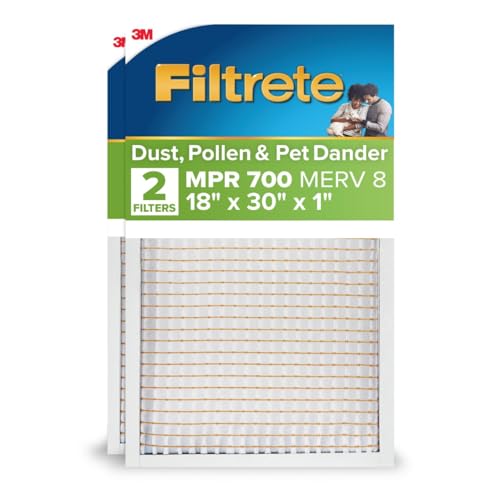
3. Filtrete 18x30x1 MERV 8 MPR 700 2-Pack
Filtrete enters with the smallest box and the busiest title. Two filters, a MERV 8 rating, an MPR 700 rating printed alongside it, a three-month service framing, and an actual size of 17.81 x 29.81 x 0.81 inches — the widest and deepest actual footprint in this guide. The title names dust, pollen and pet dander among its capture categories, in the listing’s own specification language, and adds phrases about cleaner air and reliable airflow that belong to the manufacturer’s framing. Because both rating systems appear on this one product, this review is the right place to repeat the rule: MERV 8 and MPR 700 are figures from two separate systems, printed together by the maker, and neither is a translation of the other.
- Ratings: MERV 8 and MPR 700 (separate systems, both as printed)
- Pack count: 2 filters
- Service framing: 3-month, per the title
- System fit: HVAC, AC and furnace, per the title
- Nominal size: 18x30x1
- Actual size: 17.81 x 29.81 x 0.81 inches
Strengths
- Two-pack keeps the first trial of the Filtrete line small and inexpensive in commitment.
- Three-month framing in the title gives a clear change rhythm to plan around.
- Deepest actual frame here, at 0.81 inches, for racks that accept a fuller one-inch profile.
Trade-offs
- Widest actual size, 17.81 inches, risks binding in racks fitted around slimmer filters.
- Only two filters means reordering sooner than any other pick here.
- Dual ratings can confuse at first glance; the two figures are not interchangeable.
Trying a new brand in a two-pack is sound household economics. Filter fit is empirical — a rack either accepts a frame gracefully or it does not — and discovering a mismatch with two filters on hand is a smaller lesson than discovering it with six. The 0.81-inch depth also deserves a test fit, since some one-inch tracks have a lip or a retaining clip that a deeper frame can foul. Once fit is proven across one change cycle, stepping up to the four-pack or six-pack further down this page becomes a decision with evidence behind it rather than a hope.
Understanding why Filtrete prints two ratings helps a shopper read every listing in this category more calmly. MPR is the maker’s own rating, built around microparticle capture performance as that company defines and tests it; MERV comes from an independent industry standard with its own particle size bands and test method. A brand selling through many retailers prints the standard figure so its products can sit in cross-brand comparisons, and prints its house figure for continuity within its own range. Both practices are legitimate. What is not legitimate — and what this guide refuses to do — is to line the two scales up and declare that a given MERV value equals a given MPR value, because the test methods behind them differ.
Depth, the least discussed of the three dimensions, gets its moment with this frame. At 0.81 inches the filter uses nearly the whole of a one-inch track, which usually means a firmer seat and less rattle when the blower starts, provided the retaining clip was designed with that fullness in mind. Some racks carry a shallow lip that a deep frame can catch on during insertion, twisting the cardboard edge if it is forced. The two-pack format makes the experiment gentle: seat the first filter slowly, feel for the catch, and learn the rack’s manners before the larger Filtrete boxes are considered. A frame that enters square and stays square also comes out cleaner at change time, without the torn corner that leaves media fibres behind in the slot.
Check price on Amazon — a sensible first order for a rack that has never held a Filtrete frame.
Best for: a first trial of the Filtrete range in a rack with room for a 17.81-inch width and 0.81-inch depth.
Not suited for: narrow racks under 17.81 inches inside width, or stock plans needing a year of filters in one box.

4. Simply 18x30x1 MERV 8 4-Pack
Plain naming suits this listing. Simply offers four MERV 8 filters for home AC, furnace and HVAC use, with an actual size of 17.75 x 29.75 x 0.75 inches that matches the Filterbuy’s printed footprint dimension for dimension. The title’s particle wording covers dust, pet and allergy categories in the manufacturer’s specification language. Where the Filterbuy adds electrostatic construction and a made in USA note, the Simply title keeps its powder dry, which makes this pick the straightforward like-for-like candidate for a household whose current filter already measures 17.75 across and whose priority is an uneventful swap.
- Pack count: 4 pack
- Use: home AC furnace and HVAC, per the title
- Service interval: none stated in the listing title
- Nominal size: 18x30x1
- Actual size: 17.75 x 29.75 x 0.75 inches
- Rating: MERV 8 (printed as “Merv 8” in the title)
Strengths
- Actual footprint identical to the Filterbuy’s, easing swaps in racks already fitted to that size.
- Four-pack matches a quarterly household rhythm without surplus stock.
- Title language is restrained, concentrating on size, rating and application.
Trade-offs
- No construction claims in the title, so media type cannot be compared from the listing headline alone.
- No service interval is printed, leaving the change schedule to household judgement.
- Rating sits at the group’s entry tier, MERV 8, like three of its five rivals.
Identical footprints from different brands are more useful than they first appear. A rack that has accepted 17.75 x 29.75 frames for years represents known territory: the retaining clip clears, the frame seals, the blower door closes without argument. Staying on that footprint while changing brand removes fit from the list of variables, letting the household judge the new filter purely on how it loads, how the system sounds, and how the frame holds up at removal. Filters that come out bowed or torn after a season tell their own story about media support, and a clean comparison requires the size to be held constant.
The absence of a printed change interval invites a more attentive habit instead of a calendar guess. A filter’s real service life depends on runtime hours, and runtime depends on climate, insulation and how hard the household heats or cools. Checking the filter monthly — holding it beside a fresh one, or up to a light — teaches a home’s actual loading rate within two or three inspections. Dusty renovations, shedding pets and wildfire smoke weeks all shorten the honest interval, whatever any box prints, and a four-pack gives enough stock to respond to those discoveries without an emergency order.
Precision about fit travels well beyond the furnace closet; the same household comparing countertop equipment for a small kitchen might next read Best Portable Espresso Machines, where tank size and counter footprint decide usability just as firmly as rack dimensions do here.
Brand modesty can be a feature in a component nobody sees. This filter lives in a dark rack, is handled twice a year at most, and succeeds by being forgotten — and a listing that spends its words on size, rating and application rather than on elaborate construction stories matches that reality. The shared footprint with the Filterbuy also gives households a genuine A-B comparison across a year: run one brand for two changes, the other for the next two, and let the frames at removal, the blower’s sound and the dust on nearby surfaces form the verdict. Few household products allow so clean an experiment, and fewer still reward it, because the winner becomes the standing order for years.
Check price on Amazon — a close match when the outgoing filter already measures 17.75 inches across.
Best for: racks already fitted to a 17.75 x 29.75 footprint, wanting four MERV 8 filters with no surprises.
Not suited for: installations where construction details or a printed service interval must be stated in the title itself.

5. Filtrete 18x30x1 MERV 11 MPR 1000 4-Pack
Specification steps up a tier here. This Filtrete four-pack prints MERV 11 and MPR 1000, keeps the three-month framing of its smaller sibling, names allergens and pet dander in its specification wording, and measures 17.68 x 29.68 x 0.81 inches in actual size — slightly narrower than the MERV 8 Filtrete, slightly deeper than the MERV-only picks. Within the Filtrete range, the higher numbers describe a filter rated for finer particle capture under each system’s own test method. Within this guide, they are reported as printed, on their separate scales, with no conversion offered between MERV 11 and MPR 1000 or across to any other brand’s single figure.
- Service framing: 3-month, per the title
- System fit: AC and furnace, per the title
- Nominal size: 18x30x1
- Actual size: 17.68 x 29.68 x 0.81 inches
- Ratings: MERV 11 and MPR 1000 (separate systems, both as printed)
- Pack count: 4 filters
Strengths
- Higher specification on both printed scales than the Filtrete two-pack above.
- Four filters at a three-month framing map onto roughly a year of changes.
- Actual width of 17.68 inches threads between the slim Filter King and the wider Filtrete two-pack.
Trade-offs
- Finer-rated media generally asks the blower to work against more resistance, a system consideration the title cannot settle.
- Depth of 0.81 inches still needs a track and clip that accept a fuller frame.
- Four filters at a higher tier represent a larger single outlay than the entry-tier boxes.
Airflow is the discussion every higher-rated filter deserves. A filter rated for finer capture presents more resistance to moving air, and an HVAC system is a balanced machine: blower, ductwork and filter were sized in relation to one another. Modern blowers usually tolerate a step up within the residential range, yet an older air handler already straining against long duct runs may respond with longer cycles or audible effort. The title’s own phrase about reliable airflow is the manufacturer’s framing, not a measurement this guide can verify, so the prudent path is empirical again — fit one, run the system through a heating and a cooling call, and listen. Whistling at registers or a blower that sounds laboured are data, and they argue for stepping back a tier.
Pack maths at this level is refreshingly tidy. Four filters, each framed by the maker at three months, describe a year of coverage in a single box, which suits households that like their maintenance annualised: one order, four dated swaps, a note on the calendar. The 17.68-inch width is worth a second glance in any rack that rejected the 17.81 two-pack, since the difference — roughly an eighth of an inch — is exactly the scale at which filter fit is decided. Depth remains 0.81, shared with its Filtrete siblings, so a track that accepted the two-pack’s frame will accept this one on the depth axis at least.
Seasonality sharpens the case for this tier. Pollen-heavy spring weeks and smoky late-summer spells are when a filter’s rated capture categories are worked hardest, and running the fan to circulate air during those weeks asks real work of the media. Planning the calendar so a fresh filter from this four-pack lands at the start of the hardest season, rather than midway through it, is the kind of small optimisation that costs nothing. The three-month framing then carries the household through the season on one frame, with the remaining three covering the gentler months. None of this turns a specification into a health promise — it simply aligns a consumable’s freshest weeks with the weeks the air outside is at its worst.
Check price on Amazon — choose it after confirming the blower handles the current filter without strain.
Best for: a three-month change rhythm wanting Filtrete’s higher printed ratings in a four-filter box.
Not suited for: older air handlers already labouring against restrictive ductwork, where added media resistance compounds the strain.

6. Filtrete 18x30x1 MERV 12 MPR 1500 6-Pack
The largest box carries the highest printed numbers. Six Filtrete filters, MERV 12 and MPR 1500 on their separate scales, a three-month framing, and an actual size of 17.81 x 29.81 x 0.78 inches — the width of the two-pack sibling with a fractionally shallower frame. The title’s specification wording extends its capture categories to allergens, bacteria and viruses, which this review reports strictly as the manufacturer’s rated category language under its test systems. Six filters at three months each describe eighteen months of shelf coverage, making this the stock-up option for a household already certain that the Filtrete fit and tier suit its system.
- System fit: AC and furnace, per the title
- Nominal size: 18x30x1
- Actual size: 17.81 x 29.81 x 0.78 inches
- Ratings: MERV 12 and MPR 1500 (separate systems, both as printed)
- Pack count: 6 filters
- Service framing: 3-month, per the title
Strengths
- Highest printed ratings in the group on both the MERV and MPR scales.
- Six filters at a three-month framing cover roughly eighteen months per box.
- Frame depth of 0.78 inches sits a touch shallower than the other Filtrete picks.
Trade-offs
- Committing to six filters before proving fit repeats the bulk-buy gamble at the top tier.
- Width of 17.81 inches is joint-widest here and will bind in slimmer racks.
- Finest-rated media in the group makes the blower-resistance question most pointed.
Sequencing is the smart way to arrive at this box. Running the two-pack first — confirming the 17.81 width glides into the rack, listening to the blower across a season, and settling into the three-month rhythm — de-risks every variable this six-pack contains. Arriving here first, on day one, inverts that logic and stakes the largest order on the least information. The reward for patience is real, though: eighteen months without thinking about filter stock, at the highest specification this guide covers, with each swap taking minutes because the spare is already beside the air handler.
Storage, unglamorous as it sounds, decides whether a six-pack stays six good filters. Pleated media should be kept dry, flat and away from garage chemicals, because a frame warped by a leaning paint tin or dampened by a leaking pipe is wasted money. The shallow 0.78 depth helps the stack sit neatly, and keeping the filters in their box until the day of the swap protects the pleats from dust settling into the very folds meant to catch it later. Marking each frame with its install date in marker, a habit mentioned earlier for the Filterbuy, pays off most at this pack size, where the difference between the third and fourth change can blur across a busy year.
Eighteen months of stock also changes the household’s relationship with the task itself. Filter changing stops being a purchase decision — with its delivery waits, its size double-checking and its occasional wrong box — and becomes pure routine, closer to replacing a light bulb than to shopping. That reliability is worth most in homes where the air handler lives somewhere awkward, an attic hatch or a crawl-space door, because every avoided emergency trip is a small mercy. Keep one habit as the stack shrinks: when the second-to-last filter goes in, that is the reorder signal, noted on the same calendar that holds the change dates, so the shelf never quite reaches empty.
Check price on Amazon — order it once fit and tier are proven, not as the experiment itself.
Best for: households already running Filtrete frames at 17.81 inches wide, stocking eighteen months of top-tier filters.
Not suited for: first-time Filtrete buyers, or racks narrower than 17.81 inches inside.
All six at a glance: actual size, rating and pack count
| Filter | Actual size from its title | Rating as printed | Filters in box |
|---|---|---|---|
| Filterbuy 18x30x1 MERV 8 4-Pack | 17.75 x 29.75 x 0.75 in | MERV 8 | 4 |
| Filter King 18x30x1 MERV 8 6-Pack | 17.5 x 29.5 x .75 in | MERV 8 | 6 |
| Filtrete 18x30x1 MERV 8 MPR 700 2-Pack | 17.81 x 29.81 x 0.81 in | MERV 8 · MPR 700 | 2 |
| Simply 18x30x1 MERV 8 4-Pack | 17.75 x 29.75 x 0.75 in | MERV 8 | 4 |
| Filtrete 18x30x1 MERV 11 MPR 1000 4-Pack | 17.68 x 29.68 x 0.81 in | MERV 11 · MPR 1000 | 4 |
| Filtrete 18x30x1 MERV 12 MPR 1500 6-Pack | 17.81 x 29.81 x 0.78 in | MERV 12 · MPR 1500 | 6 |
Two patterns stand out from the rows. Actual width spans a third of an inch across brands sharing one nominal label, which is why measuring the rack outranks every other step in this guide. And the dual Filtrete figures sit in their own column logic entirely: an MPR number describes position inside one maker’s range, while the MERV number beside it speaks the cross-brand language, and the table deliberately keeps both visible rather than merging them into a single invented score.
How to choose an 18x30x1 filter that actually fits?
Measure the rack, then measure the old filter
Pull the current filter and measure it in three places: width, length and frame depth, taken with a tape rather than read off a faded label. Then measure the rack itself — the inside faces of the slot — because the rack is the fixed truth and the old filter might have been the wrong size for years, bent into compliance by whoever installed it. Compare both sets of numbers against the actual sizes printed in this guide: 17.5, 17.68, 17.75 and 17.81 inches of width all answer to the same 18x30x1 name. A filter should slide in with finger pressure, seat flat, and leave no visible light gap around the frame when a torch is shone from the other side.
Keep MERV and MPR in their separate lanes
When a listing prints one rating, compare that rating only against listings using the same system. MERV numbers compare cleanly across Filterbuy, Filter King, Simply and the MERV side of Filtrete’s titles, because one standard governs them all. MPR numbers compare cleanly only inside the Filtrete range, where 700, 1000 and 1500 mark steps within that maker’s own line. Crossing the streams — treating an MPR figure as if it were a MERV figure, or hunting for a conversion chart — produces confident nonsense. If a single comparable number is needed for a cross-brand shortlist, the MERV figure is the shared language, and the MPR figure is extra information about position within one brand’s family.
Decide how much stock the house should hold
Pack counts translate into calendar coverage once a change rhythm is chosen. On a three-month rhythm, the framings printed on the Filtrete titles, a two-pack lasts about six months, a four-pack about a year, and a six-pack about eighteen months. Households that change monthly during heavy heating or cooling seasons should divide accordingly. Storage space, the chance of moving house, and the risk of an unproven fit all argue for starting smaller; a settled home with a proven rack can buy deep with a clear conscience. Either way, write the install date on each frame, because memory is the least reliable component in any maintenance schedule.
Check the retaining hardware before blaming a filter
Clips, doors and grilles decide fit as surely as frame dimensions do. A bent retaining clip can hold one corner of a frame a quarter inch proud, opening a bypass channel that no correct size can seal, and a grille that no longer latches flat does the same along a whole edge. While a new box is on order, straighten what can be straightened, replace a perished foam seal on the rack door, and vacuum the slot itself, because grit along the seating face holds frames off their seat in exactly the way a wrong size would. Several mysterious fit problems, investigated honestly, turn out to be hardware problems wearing a filter’s clothes.
Match the tier to the blower, not to ambition
Higher printed ratings describe finer rated capture, and finer media generally resists airflow more strongly. A system with a strong modern blower and short, generous ductwork will usually run a MERV 11 or MERV 12 filter without complaint, while an ageing air handler at the end of long, narrow ducts may already be near its limit on MERV 8. The equipment manual, or the plate inside the blower compartment, sometimes states a maximum filter rating, and that statement outranks any shopping preference. When in doubt, step up one tier at a time and observe a full heating or cooling cycle before stepping again.
Reading a rating like an engineer, not like an advertisement
A MERV figure summarises performance across particle size bands under a standardised test, reported as the minimum efficiency the filter demonstrated — the M in the acronym is doing real work, because it signals a floor rather than a best case. That is genuinely useful for comparing products, and it is also all the number does. It does not describe the air in any particular home, which depends on runtime, duct leakage, how often doors open, and whether the system circulates air between heating calls. Running the blower’s fan-only mode for periods each day passes more household air through whatever filter is fitted, a systems decision that changes real exposure to the media far more than a one-step rating difference.
MPR rewards a similarly cool reading. Inside the Filtrete family, the step from 700 to 1000 to 1500 tracks the maker’s own microparticle testing, giving loyal buyers a ladder. Outside that family the figure carries no standardised meaning, so a shelf edge that places an MPR number beside a competitor’s MERV number as if they were rivals is marketing geometry, not engineering. This guide has kept the two apart in every table and spec box for exactly that reason, and readers should hold any other source to the same discipline. Specification honesty is also why particle categories in the titles — dust, pollen, pet dander and the rest — are reported here as rated categories in the manufacturer’s language, not as outcomes promised to any household.
The change itself: ten quiet minutes, done properly
Switch the system off at the thermostat or the service switch before opening the rack, because a blower starting mid-swap can pull the new filter out of alignment and shower the workspace with the old filter’s collected dust. Note the airflow arrow printed on the old frame before removing it; the arrow points toward the blower, and installing the replacement backwards reduces its designed performance and can stress the media. Bag the spent filter immediately rather than carrying it through the house face-out. Slide the new frame in until it seats, confirm no corner is folded, close the door or grille fully, and restore power. A system run with the rack door ajar bypasses the filter entirely, quietly undoing the whole exercise.
While the rack is open, look at what the old filter is reporting. Even grey loading suggests steady, ordinary duty. A filter darkened on one side only points to a bypass gap or a door that never sealed. Debris like insulation fibres or construction dust tells a story about duct condition or recent renovation work, and a filter that has collapsed inward signals resistance the blower could not handle — a finding that argues for a lower tier or a professional look at the ductwork. Households mid-renovation often find that the kitchen side of the project generates its own equipment questions, and readers equipping a serious prep space may also browse Best Food Processors with Glass Bowls, where bowl materials and capacities reward the same title-first reading practised throughout this guide.
What a loaded filter does to the rest of the system
A filter does not fail suddenly; it loads gradually, and the system absorbs the change so slowly that the household adapts without noticing. Resistance rises as the pleats collect material, airflow falls, and the blower runs longer to deliver the same heating or cooling. Longer runtime shows up first as a subtle change in the house’s sounds — cycles that stretch, registers that sigh for more minutes each hour — and only later as rooms that drift from their set temperatures. Coils and heat exchangers also live downstream of that resistance, and equipment forced to work against a choked intake ages in ways no filter saving justifies. This is the mechanical reason change intervals matter, stated without any appeal to health: the filter is a wearing part in an air-moving machine, and the machine’s other components pay for its neglect.
Static pressure is the term technicians use for that resistance, and a home has a simple proxy for it — the filter itself at removal. A frame that bows toward the blower has been pulled by pressure it could not pass; media sucked out of shape is a report card on both the interval and possibly the tier. Households that step up to MERV 11 or MERV 12 media should read that report card after the first change with particular care, because a bowed frame at the higher tier is the system voting against the experiment. Stepping back down is not defeat; it is matching a consumable to a machine, which is the entire skill this guide has been practising from the first measurement.
Spares, disposal and the small print of ownership
Spent filters leave the house most gracefully when they are bagged at the rack, as described earlier, and placed straight into household waste; the collected material on the media is exactly what should not be shaken loose indoors. Cardboard frames and media are not candidates for the recycling tote in most districts, and local rules govern where they apply, so the bin is the default rather than the composter or the recycling cart. Spares, meanwhile, deserve a labelled home: a shelf or a spot beside the air handler, off the floor, with the size written on the box end facing outward. That last detail sounds fussy until a household member who did not place the order needs to confirm, mid-swap, that the spare on the shelf is the 18x30x1 box and not a leftover from a previous house with a different rack.
Finally, keep the paperwork habit that ties this whole guide together. A note inside the blower door — filter size, brand in use, dates of the last three changes — turns every future swap into a thirty-second confirmation instead of a fresh investigation. When a technician services the system, that note also speaks for the household’s diligence and gives the professional the loading history at a glance. Filters are among the cheapest components in a home and among the most consequential for the machine they protect; treating their record-keeping with this much respect is proportionate, not excessive.
Common mistakes when buying furnace filters
Ordering by the nominal size alone. Eighteen by thirty is a label, not a measurement; the actual sizes in this guide alone span 17.5 to 17.81 inches of width, and the rack at home accepts exactly one neighbourhood of that range gracefully.
Converting MERV to MPR with a chart found online. The two systems test differently, no official equivalence exists, and any tidy conversion table is an invention that will mislead a purchase.
Buying the biggest pack of an unproven brand. Six filters that bind in the rack are not a bargain at any rating; prove the fit with a small box first, then stock up.
Installing the filter with the airflow arrow reversed. Media and its support are built to face the airflow in one direction, and a backwards filter underperforms while risking damage under blower pressure.
Stretching changes to save money. A loaded filter resists airflow more each week it serves, so the system runs longer to move the same air, quietly spending the saving and more on runtime.
Assuming a higher rating is automatically better for every system. An older blower straining against fine media can deliver less air, run hotter cycles and still leave the house less comfortable than it was on the entry tier.
Final recommendation
Start where the rack dictates. A slot measuring near nominal with a healthy blower is served honestly by the Filterbuy four-pack, whose electrostatic pleated construction and 17.75-inch width make it the reference swap of this group, with the Simply four-pack as its footprint twin for households preferring that listing’s plainer presentation. A tight rack belongs to the Filter King, the only pick whose 17.5-inch actual width respects a slim slot, and its six-pack rewards the discovery generously. Filtrete’s ladder is climbed in order: the MERV 8, MPR 700 two-pack proves fit and depth, the MERV 11, MPR 1000 four-pack settles in for a year of three-month changes, and the MERV 12, MPR 1500 six-pack is the eighteen-month stock-up for a system already proven happy at that tier and width.
Frequently asked questions
Why is an 18x30x1 filter not actually 18 by 30 inches?
Nominal sizing is a rounded shelf label shared across brands, while each manufacturer builds to a slightly smaller actual size so the frame clears the rack. Every title in this guide prints its own actual dimensions — from 17.5 x 29.5 up to 17.81 x 29.81 inches — which is why the rack’s inside measurements, not the box label, should drive the choice between brands that all carry the same nominal name.
Can MERV and MPR ratings be converted into each other?
No. MERV comes from an industry test standard and MPR is one manufacturer’s own rating system for its Filtrete range, built on a different test method. Filtrete prints both figures on its titles so shoppers can compare within the brand using MPR and across brands using MERV. Any source offering a direct equivalence between a MERV value and an MPR value is inventing it, and purchases based on such a conversion rest on nothing solid.
How often should an 18x30x1 filter be changed?
Three of the titles here frame their filters at three months, which suits an average home in average use. Runtime is the real variable: systems heating or cooling hard for long hours load a filter faster than systems in a mild climate, and dusty periods shorten the honest interval further. Inspecting the filter monthly and comparing it with a fresh one teaches a household its own rate, and the date written on each frame at installation keeps the schedule honest.
Does a higher MERV number strain the furnace?
Finer-rated media generally resists airflow more, and the blower must work against that resistance. Most modern systems tolerate the residential range comfortably, but older air handlers, long duct runs or an already-restrictive layout can struggle, showing up as longer cycles, noise at registers or reduced air delivery. Checking the equipment manual for a stated maximum rating, and stepping up one tier at a time while listening to the system, keeps the experiment safe.
Which pack size makes sense for a first purchase?
The smallest box that proves the fit. A two-pack, like the Filtrete entry here, or a four-pack from Filterbuy or Simply, confirms width, depth and seating in the actual rack before real money is committed to stock. Once a brand’s frame is known to glide in and seal, the six-packs from Filter King and Filtrete convert that knowledge into six or eighteen months of not thinking about filters at all.
Measure the rack, respect the two rating systems as the separate languages they are, and the right 18x30x1 filter becomes the easiest repeat purchase in the house.


