What's inside
- Key Takeaways
- Quick Picks
- How Did We Choose These Affordable Down Blankets?
- What Is the Real Difference Between Down, Down Fibre and Down Alternative?
- How Should You Layer a Down Blanket Across the Seasons?
- How Does a Down Blanket Compare with Wool and Cotton Layers?
- What Should the Word Affordable Never Mean in a Down Blanket?
- Who Should Skip Down and Down Alternative Filled Blankets Entirely?
- Why Do Dimensions Matter More Than Size Names with Down Blankets?
- Comparison Table
- How Do You Wash a Down Blanket Without Ruining the Fill?
- What Are the Most Common Mistakes When Buying an Affordable Down Blanket?
- How Can You Judge a New Down Blanket During Its First Week at Home?
- Final Recommendation
- Frequently Asked Questions
- Related Guides
As an Amazon Associate I earn from qualifying purchases. This post may contain affiliate links at no extra cost to you.
cottageverdict.com is reader-supported. When you buy through links on our site, we may earn an affiliate commission.
Where to buy: the linked blankets below lead to their Amazon listings, where you can check price on Amazon and verify the fill description, the dimensions and the care instructions before ordering. In this category the fill line deserves your closest reading, because the distance between down, down fibre and down alternative is the distance between three different products wearing similar names.
The best affordable down blankets occupy a sweet spot that took the bedding industry decades to find: a thin, even layer of real down or feather-down fill inside a simple shell, giving a bed genuine down character, the lightness, the softness, the way it settles around the sleeper, without the cost or the bulk of a full winter comforter. This guide rounds up five linked blankets and one prose-only route, and it keeps one distinction bright from the first page to the last. Some of these picks contain real down. Some contain down alternative, which is a synthetic fill designed to imitate down. Both can be the right purchase. They are not the same thing, and every pick below is labelled as what it is.
Why does a blanket, rather than a comforter, suit so many beds? Because most sleepers in most houses are not cold enough for a comforter’s loft. A down blanket delivers a measured layer that works over a sheet in spring and autumn, under a duvet in winter, and alone in air-conditioned summer rooms. It folds small, washes more manageably than a bulky comforter in many home machines, and costs less across the board, which is precisely the territory the word affordable in this search is pointing at. The blanket is the down purchase for people who like down’s feel and dislike its usual price of admission and storage appetite.
Affordable, in this guide, is a positioning rather than a promise of the cheapest object on the internet. It means the value end of honest construction: real down or well-made alternative fill, a shell that keeps the fill where it belongs, stitching that survives the wash, in the sizes beds actually come in. The picks are described in tier language, budget and mid-tier, instead of prices, because prices move and value judgements should not expire with a sale weekend. What does not move is the construction, and construction is what the sections below examine.
A word on terminology before the picks, because the whole category hides inside it. Down means the soft clusters from beneath the feathers of ducks or geese, prized for lightness and insulation. Feather and down-fibre blends mix those clusters with small feathers or processed down fibre, trading a little loft for durability and a lower tier. Down alternative means polyester engineered to mimic down’s softness; it contains no animal fill at all, which matters to allergy-conscious and vegan households, and it behaves differently in the wash and over years. When a listing says down-like, it is describing a feeling, not a fill, and this guide translates accordingly wherever the phrase appears.
Warmth expectations should be set before money moves. A down blanket is a light-to-medium layer. It will not replace a winter comforter in a cold house, and it is not meant to. Its genius is range: the same blanket that takes the edge off a September night becomes the middle layer of a serious winter stack in January, then returns to solo duty in May. Buyers who understand they are purchasing versatility rather than maximum warmth are the buyers this category delights, season after season.
Key Takeaways
- Real down, feather-down fibre blends and down alternative are three different fills, and every pick here is labelled as its true type.
- A down blanket is a versatile light-to-medium layer, not a substitute for a heavy winter comforter.
- The puredown queen is the straightforward real-down default for most beds in this roundup.
- Two linked picks are honestly down alternative, chosen for easy care and allergy-conscious households.
- Affordable here means honest construction at the value end, judged by fill, shell and stitching rather than by a sale price.
- Thin down layers wash, fold and store far more easily than the bulky comforters they complement.
Quick Picks
| Pick | Badge | Why it earned its place |
|---|---|---|
| puredown Down Blanket Queen | Best Real-Down Default | A genuine down blanket in queen size with satin trim, the classic form of this product done simply. |
| puredown Feather Down Fiber Throw Blanket | Best Throw Size | A packable feather and down-fibre throw that moves between couch, travel and the foot of the bed. |
| Pacific Coast Goose Feather Down Fiber Blanket King | Best King Size | A full king blanket in goose feather and down fibre from a long-established down specialist. |
| downluxe Down Alternative Blanket Queen | Best Down Alternative | Synthetic fill, honestly labelled, with wide satin binding and an even queen-size layer. |
| Madison Park Down Alternative Blanket King Brown | Down Alternative with Wicking | A king-size synthetic blanket with a moisture-wicking treatment and a warm brown colourway. |
| A Store-Brand Real Down Blanket, Discussed Generically | Watch-for-It Route | Retailers’ own-label down blankets can undercut brands when their fill and shell check out. |
How Did We Choose These Affordable Down Blankets?
Fill honesty came first, and it was applied in both directions. A pick could not blur its fill type to borrow down’s prestige, and our own descriptions could not blur it either. That is why the two synthetic blankets sit in this guide openly labelled down alternative in their headings, their spec lists and the comparison table. Readers deserve a roundup where the word down in a product’s name never has to be cross-examined, because the guide has already done the cross-examining in public.
Construction came second. A thin down layer lives or dies by its shell and stitching: the shell must be woven tightly enough that clusters and fibres stay inside rather than migrating onto your pyjamas, and the quilting pattern must hold the fill evenly so the blanket does not develop warm and cold parishes. Satin trim, which several picks carry, is not decoration alone here; it finishes edges that would otherwise be the first place fill escapes and seams tire.
Size coverage shaped the final list. A throw, two queens and two kings appear among the linked five, because affordable should not mean available only in the size nobody needs. Brand pedigree played a supporting role: down is a specialist material, and makers who work with it constantly, puredown and Pacific Coast among them, tend to handle its quirks, fill distribution, shell weave, care guidance, with more competence than generalists who add one down product to a vast catalogue.
Finally, each pick had to justify itself as a blanket rather than a shrunken comforter. Loft was deliberately kept low across the selection. The moment a product wants to be a winter duvet, it leaves this guide’s territory and its price tier behind. What remains is a set of layers that fold into a linen cupboard without a fight and come out ready for three seasons of the year, which is the entire promise of the category.
What Is the Real Difference Between Down, Down Fibre and Down Alternative?
Pure down is the premium material of the three: clusters with no hard quill, extraordinarily light for the warmth they trap, and compressible enough to fold into a fraction of their working size. A blanket filled with down feels almost weightless while it insulates, and it recovers its loft after every wash and shake. Its vulnerabilities are price, a need for gentler laundering, and the fact that wet down loses its insulating structure until it dries, which is why down bedding belongs in dry bedrooms rather than damp cottages.
Feather and down-fibre blends sit in the pragmatic middle. Small feathers add body and resilience, down fibre, which is down processed into a more uniform filling, adds softness and consistency, and the blend costs less than pure clusters while behaving more forgivingly in everyday use. The trade is a slightly firmer, heavier hand and the occasional feather that works its way toward the shell, which a tight weave mostly prevents. For blankets, as opposed to showcase comforters, blends are arguably the sweet spot of the whole down family, and two picks below use them deliberately.
Down alternative is polyester persuaded to act like down: clusters of fine synthetic fibres that loft, compress and wash with an ease real down cannot match. It is the correct choice for households avoiding animal products, for many allergy-conscious buyers who find synthetics easier to keep scrupulously clean, and for anyone whose laundry habits are vigorous. What it cannot do is match down’s warmth-to-weight or its decades-long loft recovery; synthetic fills gradually tire. None of that makes it a lesser product. It makes it a different one, and this guide’s two alternative picks were chosen as the best of their own kind, not as imitations graded against real down.
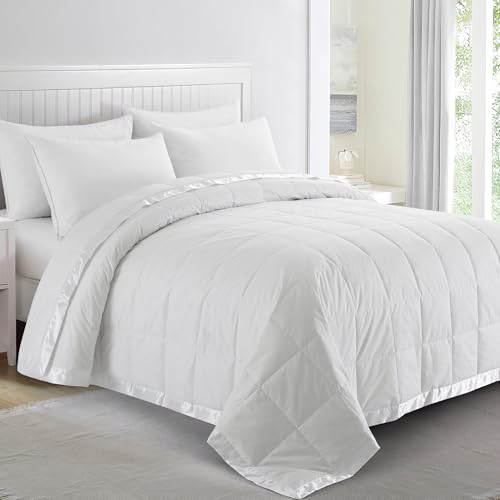
puredown Down Blanket Queen — Best Real-Down Default
If a friend asked for one recommendation from this entire page, this is the blanket that would be named. The puredown queen is the category in its classic form: genuine down fill in a soft, lightweight blanket body, finished with satin trim, sized at 90 by 90 inches for a proper queen drape. There is no novelty in it and no apology either. It is the blanket for the buyer who wants real down’s particular feel, that dry, light, settling warmth, at the value end of what real down costs.
On the bed it behaves exactly as the form promises. Alone over a sheet it handles the long shoulder seasons; under a duvet it becomes the layer that removes the duvet’s cold spots; folded at the foot it waits as the extra wrap for reading in bed. The satin trim gives it a finished edge that elevates it above purely utilitarian down layers, so it can be the visible top layer on a simply made bed without looking like camping equipment that wandered indoors. White keeps the look classic and shows laundering needs honestly.
Care follows real down’s rules, which are simpler than their reputation. Wash gently in a machine with enough room for the blanket to move, dry thoroughly and patiently, because down stored or slept under while still damp loses loft and gains odour, and fluff it back to life with a good shake. Households that can offer that modest ceremony get a blanket that stays pleasant for years. Households that cannot should look honestly at the down-alternative picks below, which is why they are in this guide beside it rather than in a separate, lesser one.
- Fill: real down
- Size: queen, 90 x 90 in
- Trim: satin trim
- Colour: white
- Positioning: value end of genuine down
Strengths
- Genuine down lightness and settling warmth in the most useful bed size.
- Satin trim lets it serve as a visible top layer, not just a hidden stratum.
- Versatile across three seasons as solo cover or winter mid-layer.
Trade-offs
- Real down asks for patient, thorough drying after every wash.
- White shows marks and will ask for laundering more often than colours.
- Not the right pick for households avoiding animal-derived fill entirely.
Best for: most queen beds wanting authentic down character at the affordable end of the market.
Not suited for: vegan households, vigorous laundry routines or anyone needing heavy winter warmth alone.

puredown Feather Down Fiber Throw Blanket — Best Throw Size
Not every down purchase is for a bed, and this throw exists for the rest of life: the couch at film time, the passenger seat on a long drive, the reading chair that catches a draught, the foot of the bed where an extra layer waits for cold feet. At 50 by 70 inches it is a true throw, filled with a feather and down-fibre blend that puredown describes as packable, and in navy it forgives the crumbs and paw prints that a white bed blanket would advertise.
The blend fill suits the throw’s rougher life. Pure down clusters are delicate aristocrats; a feather-down fibre mix tolerates being rolled, stuffed into a tote, sat upon by mistake and washed after a picnic without losing its composure. Warmth is modest, as a throw’s should be, aimed at laps and shoulders rather than whole bodies through a winter night. Think of it as the down family’s everyday ambassador, the piece that introduces households to the material’s feel at the smallest commitment in this guide.
It also makes a quietly excellent gift, because throws do not require knowing anyone’s bed size. For a household that travels, it earns a permanent place in the car, where its packability turns cold rest stops and chilly rentals into non-events. The honest limit is coverage: two adults under one 50-by-70 throw is a negotiation, not a solution, and anyone wanting a shared couch blanket should size up to a bed blanket from this list and drape it with intent.
- Fill: feather and down fibre blend
- Size: throw, 50 x 70 in
- Character: lightweight and packable
- Colour: navy
- Positioning: budget-friendly entry to down
Strengths
- Packable blend travels between couch, car and bed foot without fuss.
- Feather-down fibre tolerates rougher everyday handling than pure clusters.
- Navy colour hides the evidence of snacks, pets and road trips gracefully.
Trade-offs
- Throw dimensions cannot cover two adults or serve as a bed blanket.
- Blend fill feels firmer and heavier than the pure down pick above.
- Warmth is lap-and-shoulders level, not a cold night’s whole answer.
Best for: couches, cars, reading chairs and anyone sampling down’s feel at throw scale.
Not suited for: buyers needing full bed coverage or pure down’s weightless hand.

Pacific Coast Goose Feather Down Fiber Blanket King — Best King Size
King beds are where affordable down usually gives up, because the yardage of fill and shell pushes prices toward comforter territory. This Pacific Coast blanket holds the line: a full king at 108 by 90 inches, filled with goose feather and down fibre, trimmed in satin, from a maker whose entire business is down and feather bedding. That specialisation shows in the details a generalist might skip, an even fill distribution across a very wide blanket and a shell chosen to keep feathers on the inside of the product.
The goose feather and down-fibre fill gives the blanket a slightly more substantial hand than the puredown queen, a quality many king-bed owners actively prefer, because a wide bed makes a whisper-light blanket feel insubstantial and prone to wandering. This one settles and stays. Its warmth sits in the same light-to-medium band as the rest of the guide, scaled up in area rather than in loft, so it serves the king bed through the same three-season rhythm: solo in the shoulder months, layered when winter insists.
Pacific Coast describes the blanket as breathable and soft, and breathability is the right thing to praise in a feather blend, since feathers can sleep warmer than pure down clusters do. In a king size, laundering needs a thought: confirm your machine’s capacity or use a commercial drum, because a king blanket crammed into a small washer emerges neither clean nor evenly dried. Given room to wash and dry properly, it is the large-bed anchor of this roundup, the pick that proves affordable and king are not contradictions in the down aisle.
- Fill: goose feather and down fibre blend
- Size: king, 108 x 90 in
- Trim: satin trim
- Colour: white
- Positioning: value end of king-size down
Strengths
- Full king coverage from a specialist down maker at the affordable tier.
- Blend fill settles with enough body to stay put on a wide bed.
- Breathable character suits a feather blanket’s warmer tendencies well.
Trade-offs
- King dimensions demand a large-capacity or commercial machine for washing.
- Feather blends can sleep warmer than pure down for sensitive sleepers.
- White, again, is honest about dirt and will need regular laundering.
Best for: king-bed households wanting real down-family fill without comforter pricing or bulk.
Not suited for: small washing machines, strict down-purists or anyone avoiding animal fill.

downluxe Down Alternative Blanket Queen — Best Down Alternative
This pick contains no down whatsoever, and it is in a down blanket guide on purpose, clearly labelled, because a large share of shoppers using the search term down blanket are actually shopping for the experience, a light, soft, even layer, and are indifferent or actively opposed to animal fill. The downluxe queen delivers that experience synthetically: a down-alternative fill the maker rates at 135 GSM, a generous three-inch satin binding, and dimensions of 90 by 90 inches in a calm silver. Its OEKO-TEX certification adds a recognised materials standard to the file.
What synthetic fill buys is freedom from down’s few ceremonies. Wash it without anxiety, dry it without a vigil, store it without worrying that residual damp is quietly ruining clusters you cannot see. For allergy-conscious households the calculus is personal and this guide makes no medical claims, but many buyers simply find a synthetic blanket easier to keep scrupulously clean, and cleanliness they can maintain beats theoretical purity they cannot. The blanket’s warmth is even and modest, squarely in the light-layer band the rest of this guide occupies.
Set against the puredown queen, the honest differences are hand-feel and longevity. The downluxe feels smooth and uniform where real down feels alive and settling, and over years of washing the synthetic fill will gradually lose loft that real down recovers with a shake. For the price tier and the effort saved, many households will call that a fair trade and make it happily. It earns its place here as the best version of its own kind of product, judged on those terms and no others.
- Fill: down alternative (synthetic, no down)
- Size: queen, 90 x 90 in
- Binding: 3-inch satin binding
- Fill weight: 135 GSM per maker
- Certification: OEKO-TEX per maker
Strengths
- Completely animal-free fill with the easiest wash-and-dry routine in this guide.
- Wide satin binding gives it the most finished look of the queen-size picks.
- Even, uniform warmth with no fill migration or feather surprises, ever.
Trade-offs
- It is not down, and buyers seeking the genuine material should choose accordingly.
- Synthetic loft tires gradually over years where real down keeps recovering.
- Sleeps slightly warmer and less breathably than the real-down queen above.
Best for: animal-free households and anyone wanting down-style layering with zero laundry ceremony.
Not suited for: down purists or buyers prioritising maximum warmth per ounce.

Madison Park Down Alternative Blanket King Brown — Down Alternative with Wicking
The second synthetic pick takes the format to a king bed and adds the feature that distinguishes Madison Park’s Windom line: a 3M Scotchgard moisture-wicking treatment, intended to help the blanket handle perspiration rather than trapping it against the sleeper. It is also, unusually for this guide, brown, a warm, forgiving colour that suits rustic and earth-toned bedrooms and hides the minor marks of daily life far better than the whites elsewhere on this page. Like its queen sibling in the satin-binding guide’s family, it carries OEKO-TEX certification per the maker.
Why include two down-alternative blankets in a down guide? Because the king shopper avoiding animal fill deserves a real option at their size, and because the wicking treatment makes this a genuinely different product from the downluxe rather than a colour variant of it. Warm sleepers in king beds are doubly underserved by the market, too warm for most filled blankets and too wide for most throws, and this pick speaks to them directly. Its warmth remains a filled blanket’s warmth, so the wicking is an aid, not air conditioning, and it should be bought with that proportion in mind.
Against the Pacific Coast king, the comparison is the guide’s central distinction at maximum size: real goose feather and down fibre with a specialist maker’s shell, versus synthetic fill with easier care and moisture management. Neither answer is wrong; they serve different households. A family that washes bedding weekly and includes a warm sleeper will likely be happier here. A family that wants natural fill and washes monthly will be happier with the Pacific Coast. The guide’s job is to make that fork in the road visible, and at king size this pick holds up the synthetic side honourably.
- Fill: down alternative (synthetic, no down)
- Size: king
- Feature: 3M Scotchgard moisture-wicking treatment per maker
- Colour: brown
- Certification: OEKO-TEX per maker
Strengths
- A real king-size option for households avoiding animal fill entirely.
- Wicking treatment helps warm sleepers manage moisture through the night.
- Brown colourway forgives daily wear and warms up earth-toned rooms.
Trade-offs
- Synthetic fill, however well made, lacks real down’s loft recovery over time.
- Filled construction still sleeps warm despite the wicking assistance.
- Its earthy colour will not suit buyers dressing a crisp white bed.
Best for: king-bed households wanting animal-free fill, easy care and help with night warmth.
Not suited for: anyone who came to this guide specifically for genuine down or feathers.
A Store-Brand Real Down Blanket, Discussed Generically — Watch-for-It Route
The final entry has no link because its identity changes with the retail calendar: the own-label down blanket sold by a warehouse club, a department store or a big bedding retailer under its house brand. These products periodically undercut the named makers in this guide while offering genuinely similar construction, because the same factories often produce both. Discussed generically, the route is simple: when a retailer you trust fields a house-brand down blanket, it deserves the same inspection you would give any pick here, and it can win.
Inspection is the operative word. Read the fill line for the down and feather proportions and be wary of any label that hides behind the phrase down blend without numbers. Feel the shell for the tight, smooth weave that keeps fill contained, check the quilting for even distribution, and read the care label to confirm the blanket can be washed the way your household washes. House brands vary from excellent to evasive, sometimes within the same store in different seasons, so the specific blanket in your hands is the only specification that counts.
Position this route at the budget tier with an asterisk: the savings are real when the construction checks out, and illusory when a thin shell starts leaking fill by the third wash. Shoppers who enjoy the evaluation itself, who read labels in the aisle while other people read prices, will do well here. Shoppers who want a known maker’s consistency and a listing they can reorder next year should stay with the linked picks above, which is precisely why both routes appear in the same guide.
- Fill: real down or down blend, verify proportions on each label
- Size: varies by retailer and season
- Availability: warehouse clubs and department-store house brands
- Positioning: budget tier, quality varies by batch
- Link: none, discussed generically by design
Strengths
- Can undercut named brands while sharing their factory construction.
- Lets label-reading shoppers convert knowledge directly into savings.
- Seasonal appearances mean patient buyers can time the purchase well.
Trade-offs
- Quality swings between seasons make last year’s bargain no guarantee.
- Fill descriptions on house labels can be vaguer than specialist brands.
- Reordering the identical blanket later is often impossible.
Best for: label-literate bargain hunters comfortable judging construction in the aisle.
Not suited for: buyers who value a consistent, reorderable product from a known maker.
How Should You Layer a Down Blanket Across the Seasons?
Think of the down blanket as the adjustable stratum in a three-part system. In summer it works alone above the top sheet in air-conditioned rooms, or migrates to the foot of the bed as an optional layer for the sleeper whose feet run cold. In the shoulder seasons it becomes the main event, the single blanket over the sheet, which is the duty it was designed for and where its lightness feels like luxury rather than insufficiency. In winter it slides under a duvet or a wool blanket, where its even fill eliminates the cold channels that lofty layers leave at hips and shoulders.
That middle-layer role deserves emphasis because it rescues many disappointing winter beds. A household that finds its comforter alternately too hot and too cold is often missing the thin, even layer that smooths the whole system out. Adding a down blanket under the comforter costs a fraction of replacing the comforter and frequently ends the argument entirely. It is also why buying a down blanket in spring is not a seasonal mistake: its most valuable months may be the winter ones, spent working invisibly inside a warmer stack.
How Does a Down Blanket Compare with Wool and Cotton Layers?
Every blanket fibre has a personality, and choosing down means choosing its particular one. Down’s signature is warmth without weight and a distinctive settling softness, the sense that the layer pours itself around the sleeper rather than lying on top. Wool, by contrast, warms with substance and breathes superbly, regulating temperature through a long night better than down does, but it asks more money for comparable coverage and more care in the wash. Cotton breathes best of all and sleeps coolest, while insulating least, which makes it the summer specialist rather than a year-round rival.
The practical consequence is that households rarely need to crown one fibre forever. A down blanket for the shoulder seasons, a cotton layer for high summer and a wool blanket for deep winter is a classic three-layer wardrobe, and many of the readers of this guide are really shopping for the missing member of that set. Down’s candidacy rests on versatility: of the three, it layers most invisibly inside other combinations, folds smallest in the cupboard and feels the most luxurious relative to its weight. Its candidacy fails where damp lives, since down in a humid, unheated house never quite dries into its best self, and wool handles that world with more grace.
Synthetic down alternative, to complete the picture, competes on logistics rather than sensation. It wins the laundry, wins the storage, wins the guest-room turnover, and loses, slowly, on loft and lifespan. Households that prize a blanket they can wash after every guest without a second thought are not imagining its advantages. The fibres are tools; the honest guide simply refuses to pretend they are interchangeable.
What Should the Word Affordable Never Mean in a Down Blanket?
It should never mean a shell so loosely woven that the fill migrates out within a season, leaving the owner wearing the blanket’s insides on their pyjamas. It should never mean fill described in fog, percentages hidden, the word down doing decorative work for a product that is mostly feather quills or mostly polyester. It should never mean stitching that quilts the blanket into channels the fill immediately abandons, producing a layer that is warm in stripes. And it should never mean a size that shrinks its promise, a queen that measures like a generous full, because a blanket that does not cover the bed is expensive at any price.
What affordable legitimately means is restraint in the right places. A simpler shell fabric, honestly woven. A blend fill where pure clusters would double the cost for a difference many sleepers cannot feel in a thin blanket. Fewer colourways. Trim that is neat rather than luxurious. Every pick in this guide saves money by one of those honest routes, and the store-brand prose entry exists to remind readers that the same routes are available on other shelves when the label reading is done carefully. The moment a low price is achieved by hiding the fill or shrinking the blanket, it stops being value and becomes a toll on the uninformed.
There is a time dimension to value as well. A blanket washed kindly and used three seasons a year amortises itself into pennies per night very quickly, while a bargain that leaks, clumps or shrinks is expensive by Christmas. Readers who think in cost-per-year rather than cost-per-click will find this entire category friendlier, because down, real or alternative, rewards the longer view more than most bedding does.
Who Should Skip Down and Down Alternative Filled Blankets Entirely?
Some households are simply pointed elsewhere, and a guide that admits it earns its credibility. Homes with persistent damp, unheated bedrooms in humid climates or bedding stored in less-than-dry cupboards will fight real down’s nature all year; wool or a washable synthetic layer serves them better. Sleepers who want a single blanket to handle deep winter alone should buy a proper comforter or a heavy wool blanket rather than asking a light down layer to be something it is not, because disappointment in that mismatch gets misreported as the product’s failure.
Anyone whose laundry reality is a small machine, a hot wash and a hotter dryer, every time, without exception, should also think twice about real down, not because it is fragile but because its care needs are specific and non-negotiable. That household is exactly who the synthetic picks in this guide were chosen for, and choosing them is not a compromise narrative; it is the correct matching of product to life. Likewise, buyers furnishing a rental or a dorm, where the blanket’s treatment cannot be supervised, may find that a sturdy cotton or fleece layer absorbs the chaos with less at stake.
Finally, shoppers who dislike any loft at all, who want the flat, cool hand of a woven blanket and nothing puffed anywhere near the bed, should follow that preference without being talked out of it by down’s reputation. Bedding is intimate equipment. The best blanket in this guide is the one whose feel you enjoy on the first night and whose care you sustain in the fiftieth week, and for some sleepers that blanket was never going to contain a single cluster of down.
Why Do Dimensions Matter More Than Size Names with Down Blankets?
Blanket sizing is the Wild West of bedding: the words twin, queen and king describe intentions more reliably than measurements, and two blankets wearing the same size name can differ by several inches in each direction. Those inches decide whether the blanket drapes over the mattress edge, whether two sleepers each get a fair share, and whether the layer tucks or merely visits. The linked picks in this guide state real dimensions, 90 by 90 for the queens, 108 by 90 for the Pacific Coast king, and those numbers, compared against your mattress with a tape measure, are worth more than any size label.
Drape is not vanity. A blanket that ends exactly at the mattress edge slides off during the night and leaves the sleeper at the border uncovered, while a blanket with a few inches of overhang anchors itself by its own geometry. On shared beds, width is peace treaty: measure the mattress, add the drape both sleepers expect, and let the total choose the size, even when the total argues for going one size up. Nobody has ever regretted a down blanket that was slightly generous; the reverse regret fills review sections.
Height of mattress matters too, and modern mattresses run deep. A blanket sized for a slim traditional mattress can look lost on a tall pillow-top, ending mid-air where the eye expects it to land. When in doubt, drape a sheet or an old blanket of known dimensions over the bed and judge the landing point in the mirror of your own standards. It takes three minutes and prevents the most common sizing disappointment in the category, which is not smallness exactly, but the subtle wrongness of a layer that never quite reaches where it should.
Comparison Table
| Pick | Fill type | Size | Standout feature | Best role |
|---|---|---|---|---|
| puredown Down Blanket Queen | Real down | Queen | Satin trim, classic form | Real-down default |
| puredown Feather Down Fiber Throw Blanket | Feather/down fibre | Throw | Packable, navy | Couch, car, travel |
| Pacific Coast Goose Feather Down Fiber Blanket King | Goose feather/down fibre | King | Specialist maker | Large beds, real fill |
| downluxe Down Alternative Blanket Queen | Down alternative | Queen | 3-inch satin binding | Animal-free, easy care |
| Madison Park Down Alternative Blanket King Brown | Down alternative | King | Moisture-wicking treatment | Warm sleepers, king beds |
| A Store-Brand Real Down Blanket, Discussed Generically | Real down, varies | Varies | House-brand pricing | Label-reader’s bargain |
How Do You Wash a Down Blanket Without Ruining the Fill?
Real down’s laundering rules reduce to three words: room, gentle, dry. Room means a machine the blanket can actually move in; a queen or king down blanket stuffed into a small drum gets abraded rather than washed, and a launderette’s large machine is the correct tool for big sizes. Gentle means a mild cycle and modest detergent, because harsh treatment strips the natural resilience from clusters and breaks feathers into the fragments that later poke through shells. Dry means completely, patiently dry, with the blanket fluffed and redistributed during the process, since down put away even slightly damp will clump, lose loft and develop an odour that is difficult to forgive.
The synthetic picks forgive all of this, which is their quiet superpower. Down alternative can be washed warm, dried without ceremony and returned to the bed the same day, and for households with children, pets or illness in the rotation, that turnaround is worth more than loft theory. Whichever fill you own, wash the blanket before first use, keep it inside a routine rather than waiting for visible dirt, and store it loose and dry rather than compressed in a vacuum bag, because both down and its imitators recover better from storage that lets them breathe.
Between washes, a down blanket appreciates air. A morning draped over a chair or a line in dry shade freshens it more honestly than any spray, and a weekly shake redistributes fill that sleeping bodies push toward the edges. These small habits are the difference between a blanket that feels tired in its second year and one that feels seasoned in its fifth, and they cost nothing but attention.
What Are the Most Common Mistakes When Buying an Affordable Down Blanket?
The first mistake is reading the word down and stopping there. Down, down fibre, feather blend and down alternative describe different fills with different prices, and the affordable end of the market is exactly where vague language does its best work. The second mistake is buying a blanket while secretly wanting a comforter, then judging the blanket’s honest light warmth as a failure. Match the product to the layer you actually need. The third is ignoring the shell: fill gets the headlines, but a loose weave leaks feathers, feels scratchy and shortens the blanket’s life no matter how good the clusters inside are.
Fourth comes careless laundering, the single largest cause of early down deaths, usually a too-small machine or a blanket stored before it was truly dry. Fifth is sizing by hope: a queen blanket on a king bed leaves two sleepers negotiating over a shrinking island, and the savings evaporate into nightly resentment. Measure the bed, allow for drape, and buy the size the mattress asks for. Sixth, and subtlest, is assuming affordable means disposable. The blankets in this guide are value-tier, not throwaway; treated properly they serve for years, and treating them as temporary is what makes them so.
How Can You Judge a New Down Blanket During Its First Week at Home?
Give any down blanket a fair first week before forming the verdict, because the product that arrives compressed in a parcel is not the product you bought. Wash it if the maker directs, dry it thoroughly, and let it rest a full day to recover its loft; judging the loft in the first hour is like judging a soufflé in the oven door’s draught. Then sleep under it in its intended role, as the shoulder-season solo layer or the winter mid-layer, for several nights rather than one, since a single warm or cold night says more about the weather than about the blanket.
The checks that matter are tactile and specific. Run your palm across the shell in the morning: escaping feathers or fibres this early predict a leaky future. Press along the quilting lines and feel whether the fill sits evenly or has already begun emigrating to the edges. Notice whether the blanket stays where the bed needs it, or migrates off one side by morning, a habit that light blankets on smooth sheets can develop and that a change of top sheet sometimes cures. And notice your own temperature across the whole night, not just at lights-out, because a layer that starts perfect and overheats by three in the morning is telling you it belongs one level deeper in the winter stack.
If the blanket passes those checks, commit to the small rituals that keep it passing: the weekly shake, the airing when the weather allows, the prompt wash when life happens on it. A down blanket’s first week predicts its fifth year surprisingly well, because the construction qualities that matter, shell integrity, fill distribution, honest sizing, announce themselves early to anyone paying attention. That attentiveness, more than any brand name, is what the affordable end of this market rewards.
Final Recommendation
For most beds, start with the puredown queen: genuine down, honest construction, the size the majority of households need, at the value end of its material. King-bed owners who want real fill should step to the Pacific Coast, and anyone furnishing a couch, a car or a reading chair should add the puredown throw without overthinking it. Households that avoid animal fill, or whose laundry life is too vigorous for down’s ceremonies, are not settling when they choose the downluxe queen or the wicking Madison Park king; they are choosing the best versions of a different, legitimate product, and this guide has labelled the difference at every step so the choice is truly theirs. Buy the fill your household will care for happily, and the blanket will repay you in the currency down has traded in for centuries: a light layer that makes the whole bed feel considered.
Frequently Asked Questions
What colour should I choose for a down blanket?
White dominates this category for practical reasons: it shows when laundering is due, it suits the classic bedding look the satin trims belong to, and it hides nothing, which keeps the blanket honest. Its cost is visibility of every mark. The navy throw and the brown king in this guide show the alternative logic, deeper colours that forgive daily life and anchor warmer room schemes. Choose by your laundry temperament as much as by your palette, because a blanket whose colour stresses you will be washed either too often or not enough, and both extremes shorten its life.
Is a down blanket warm enough for winter?
On its own, in a cold house, generally no, and it is not designed to be. A down blanket is a light-to-medium layer. Its winter role is inside a system, under a duvet or comforter, where its even fill removes cold spots and lets the heavier layer work efficiently. In heated homes with mild winters it may serve solo all year, but buyers in cold climates should purchase it as a versatile layer, not as their only defence.
What is the difference between this and a down comforter?
Loft, weight and intent. A comforter is a thick, high-loft product meant to be the bed’s primary insulation, usually needing a duvet cover and serious storage space. A down blanket is thin and even, meant to layer flexibly, fold small and wash manageably. Many households own both and use the blanket three seasons of the year, which makes the blanket, not the comforter, the hardest-working down product they own.
Can people with dust sensitivities use real down?
This guide makes no medical claims, and anyone with a diagnosed sensitivity should follow their clinician’s advice. What can be said practically is that reactions attributed to down are often reactions to dust and residues that thorough, regular washing controls, and that high-quality, well-encased down starts cleaner than its reputation suggests. Buyers who prefer not to navigate the question at all have two honestly labelled synthetic picks in this guide, which is one reason they are here.
How long should an affordable down blanket last?
Years, if the laundering is kind. Real down’s loft recovers wash after wash when the blanket is dried completely and stored loose, and a good shell outlasts several cheaper ones. Synthetic fills tire more quickly, gradually losing loft, though their easy care means they are often washed more faithfully. In both cases the blanket retired early almost always died of storage damp or a too-small washing machine rather than of age.
Why do some of these blankets have satin trim?
Because the edge is where a thin blanket is most vulnerable and most visible. Satin trim seals the perimeter where fill would otherwise work its way out, protects the stitching that takes the most handling, and gives a light blanket a finished look when it serves as the bed’s top layer. It is the same marriage of function and finish that made satin binding beloved on the classic blankets covered elsewhere in this batch.
Should I put a down blanket inside a duvet cover?
You can, and in winter many people do, treating the blanket as a slim insert that the cover protects from washing wear. The pairing works best when the cover is a breathable natural fibre and the blanket’s dimensions genuinely match the cover’s, because a blanket swimming inside an oversized cover bunches at the corners. In the shoulder seasons most owners prefer the blanket bare, where its trim and light hand are part of the pleasure, and reserve the cover arrangement for the months when the blanket works as hidden infrastructure inside the winter stack.
Does fill power matter in a blanket the way it does in a comforter?
Less, because a blanket is not chasing maximum loft. Fill quality still shows in evenness, softness and how the layer recovers after washing, but the dramatic fill-power numbers of expedition comforters are beside the point in a product designed to lie thin and layer well. Judge a down blanket by its shell, its stitching, its size honesty and its fill type, and you will judge it by everything that actually affects your sleep.
Can a down blanket go in a standard home washing machine?
Throw and queen sizes usually can, provided the drum lets the blanket move freely rather than packing it into a solid wad; if you have to force the door closed, the machine is too small and a launderette’s large drum is the right call. King sizes almost always belong in a commercial machine. The blanket should come out only when it is completely dry, which takes longer than impatience suggests, and that single discipline protects more down blankets than any other habit in this guide.
Related Guides
From here the blanket shelf branches by fibre and by room. The natural next read is Best Alpaca Blankets for a warmer natural-fibre direction, while summer sleepers should browse Best Baby Blankets for Summer. Families furnishing a toddler’s first real bed will find Best Blankets for 2-Year-Olds waiting, and anyone who loved the satin trims in this guide can hear the wider story in Best Acoustic Blankets.



[…] the batting is chosen, the layers around it deserve the same care, and our guide to the Best Affordable Down Blankets covers the ready-made alternative for nights when the quilt goes to the wash. Makers furnishing the […]