Our Top Picks


What's inside
As an Amazon Associate I earn from qualifying purchases. This post may contain affiliate links at no extra cost to you.
Finding clean drinking water is one of the few non-negotiable jobs at camp. You can postpone a fancy meal, wear the same shirt for another day, or sleep under a tarp that flaps all night, but you cannot postpone hydration for long. That is why choosing the best water purifier for camping is less about collecting gear and more about building a simple, repeatable routine: collect water from a source you trust as much as the landscape allows, filter it in a way that suits your group size and pace, store it in clean containers, and repeat without fuss for the whole trip. When that routine works, nobody thinks about it. When it fails, it dominates the day.
This guide walks through eight current options that cover the three main approaches campers actually use: personal straw filters you drink through directly, gravity systems that filter while you do other camp chores, and hand pumps that give you control over flow and filling. The eight products are the LifeStraw Personal Water Filter in a single pack, the Waterdrop Gravity Water Filter Straw with its 1.5 gallon water bag, a 6L Gravity Water Filter Set with a hanging TPU reservoir and activated carbon filter, the Sawyer Products SP128 Mini Water Filtration System, the Katadyn Hiker Pro Transparent Hand Pump Water Filter, the Trailgo Pro Portable Water Filter, a 3-Stage Portable Hand Pump Camping Water Filter with a 0.01-micron membrane, and the LifeStraw Personal Water Filter in a 5 pack. Between them, they suit solo hikers, pairs, families, and base camps, and they illustrate the real trade-offs far better than any single do-everything device could.
A quick note on language matters before the details. Campers use the words filter and purifier almost interchangeably, and product names do the same. In strict terms, a filter physically strains out particles and many microorganisms through tiny pores, while purification can also involve chemical treatment, ultraviolet light, or other methods aimed at a broader range of contaminants, including viruses. Most of the portable devices in this guide are filters, even when a title uses the word purifier. That distinction is not pedantry. It shapes where a device is appropriate, what it can reasonably be expected to do, and when you should add a second treatment step or choose a different water source altogether. Throughout this guide, claims about a specific product stay close to what its own title states, and broader points are framed as general knowledge about how these categories of gear work.
How camping water filters work
Almost every lightweight camping filter relies on the same basic idea: push or pull water through a membrane or media bed whose openings are small enough to block things you do not want to drink, while letting water itself pass. The size of those openings is measured in microns. A micron is one millionth of a metre, and the smaller the number, the finer the filtration. Two of the products below state their pore size directly in their titles: the Waterdrop gravity straw at 0.1 micron and the 3-stage hand pump at 0.01-micron. Those figures help explain why flow and effort differ between models. Finer membranes tend to need more pressure, more time, or more careful backflushing to keep water moving, while coarser stages are often included first to catch sediment so the fine membrane does not clog straight away.
Straw filters are the simplest expression of the idea. You place the intake end in a stream, lake, or filled container and draw water through the filter with your mouth, much like drinking through a thick straw. There are no moving parts, nothing to assemble beyond the straw itself, and almost nothing to lose in the dark. The limitation is equally simple: a straw is a personal, drink-as-you-go tool. Filling cooking pots, bottles for the whole group, or a reservoir for later usually means awkward workarounds, repeated squeezing if the design allows it, or a lot of patience. Straws shine on the move, at a trailside source, or as a backup in a daypack. They are less satisfying as the only water plan for a busy base camp kitchen.
Gravity systems remove effort from the equation by letting height do the work. You fill a reservoir, hang it from a branch, tripod, or hook, and let water flow down through a filter into a clean container below. The Waterdrop option pairs its straw-style filter with a 1.5 gallon water bag for exactly this purpose, and the 6L set builds the whole idea around a foldable hanging TPU reservoir with a hose and clamp to control flow. Gravity filtration is slow in the way good camp systems often are: steady, hands-free, and easy to run in the background while you pitch a tent, sort food, or repair a boot. It needs a suitable hanging point and a little patience, and flow naturally slows as the upper reservoir empties and pressure drops, but for groups it is hard to beat for convenience per ounce of effort.
Hand pumps take the opposite approach. Instead of waiting for gravity or sipping through a straw, you work a handle to push water through the filter on demand. The Katadyn Hiker Pro, the Trailgo Pro, and the 3-stage hand pump in this guide all follow that pattern. A pump lets you filter directly from a shallow source into the exact bottle or pot you want to fill, and the stated flow figures in two titles — 1L per minute for the Katadyn and 1.5L/min for the Trailgo Pro — show why pumps appeal to people who dislike waiting. The cost is mechanical: pumps have seals, handles, hoses, and replaceable elements that need care, rinsing, and protection from freezing and grit. None of that is difficult, but it does reward campers who like maintaining their kit rather than forgetting it in a stuff sack.
Many modern systems are described as multi-stage or 3-stage, and both the Waterdrop and the two pump and gravity designs here use that language. In general terms, staging means water passes through more than one barrier in sequence. An early stage might screen out leaves, sand, and larger sediment. A later membrane stage does the fine work. Some systems add activated carbon, as the 6L gravity set states in its title, and carbon is commonly used in water treatment because it can adsorb certain chemicals and improve taste and odour compared with untreated source water. Staging is not magic and more stages do not automatically mean better water in every situation, but a sensible sequence does protect the finest element from clogging quickly, which is the most common frustration campers meet in silty or leaf-strewn sources.
What filters can and cannot do
It helps to be clear-eyed about limits. The single LifeStraw title states that it removes bacteria and parasites, which reflects the core job of this class of membrane filter: reducing common waterborne microorganisms that are large enough to be blocked by the membrane. Bacteria and parasites such as those carried in untreated surface water are the everyday concern for most campers in many regions, and a well-maintained filter used correctly addresses that concern far better than drinking untreated water and hoping for the best. Choosing the clearest, calmest source you can find, away from obvious contamination, still matters. A filter is a barrier, not a licence to collect from the worst puddle beside a car park.
Viruses are the important exception to keep in mind for this category in general. Viruses are far smaller than bacteria, and many ordinary camping filters are not designed, on their own, to remove them. In places where viral contamination of water is a realistic concern, campers commonly add a separate purification step, follow local guidance, or select a device specifically rated for that job rather than assuming any filter will do. Dissolved chemicals, heavy metals, salt, and agricultural runoff are a different problem again. Activated carbon can help with taste and some chemical compounds, but no lightweight straw or pump in this guide should be treated as a universal answer to industrial or heavily polluted water. If a source smells strongly of fuel, sits below obvious chemical discharge, or looks contaminated in a way that worries you, the correct decision is to walk to a better source or carry water in.
Freezing deserves its own warning because it catches people out every winter. Water left inside a hollow membrane can expand as it freezes and damage the fine pores in ways you cannot see from outside. A filter that has frozen may still let water through while no longer filtering as intended. The standard defensive habits are simple: drain and shake out a filter after use in cold weather, sleep with a small personal filter in your bag on frosty nights, keep pumps and gravity elements in a protected place, and never force water through a unit you suspect is ice-damaged. The same care applies in reverse in hot, silty conditions. Grit is the enemy of every membrane and seal, so pre-filtering cloudy water through a bandana or letting a filled container settle before filtering can extend the useful life of any of these eight products.
The 8 camping water filters in this guide
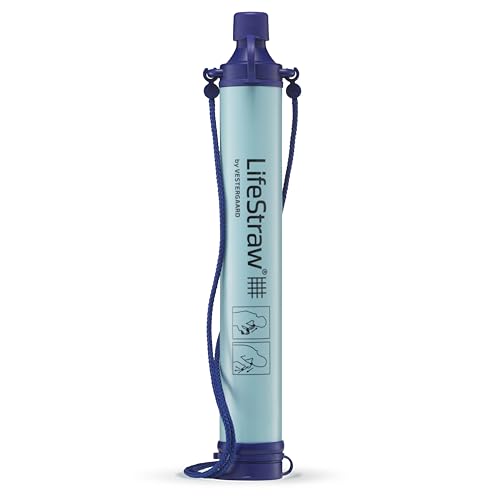
LifeStraw Personal Water Filter, Blue, 1PK
The LifeStraw Personal Water Filter for Hiking, Travel and Emergency, in Blue and sold as a 1PK, is the archetypal personal straw. Its full title also frames it as a water filter for hiking, camping, travel, and emergency preparedness that removes bacteria and parasites. That positioning tells you almost everything about its best use. It is a direct-drinking tool for one person, designed to travel light, live in a side pocket or emergency kit, and turn a stop at a stream into a drink without any setup, pumping, or waiting for a reservoir to drain.
For campers, the appeal is immediacy and simplicity. There is no group logistics problem to solve, no hose to keep out of the dirt, and no clean-versus-dirty container discipline beyond keeping the mouthpiece protected. A solo camper moving between sources during the day, a hiker who wants a backup to a primary system, or a family that gives each older child a personal straw for supervised use at a clear source will all understand the format instantly. The trade-off is throughput and versatility. A personal straw is not the tool most people would choose to fill a large pot for pasta night, and drinking directly from a low source means kneeling at the bank, which is fine on a warm afternoon and less charming in cold rain. Treat it as a brilliant specialist rather than a complete camp kitchen system, and it earns its tiny place in a pack without argument.
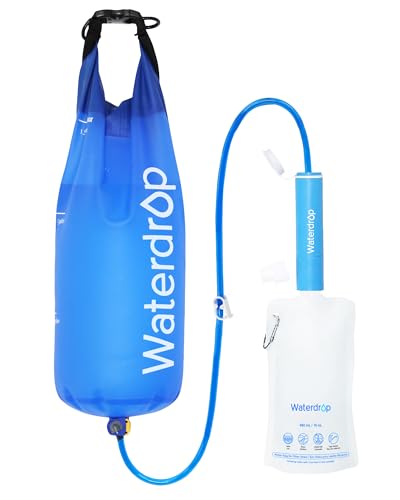
Waterdrop Gravity Water Filter Straw with 1.5 Gallon Water Bag
The Waterdrop Gravity Water Filter Straw is described as a camping water filter with 0.1 micron filtration, a survival water purifier for hiking, backpacking and emergency preparedness, and a multi-stage filter supplied with a 1.5 gallon water bag. That combination moves the straw idea into group territory. Instead of only sipping directly, you can fill the bag, hang it, and let gravity pull water through the multi-stage filter while you get on with camp. The stated bag capacity is the headline for families and small groups, because it turns filtration from a repeated chore into a background process that can be topped up once and drawn on for drinks and cooking.
In practice, a system like this suits campers who stay in one place for at least a night and can find a tree, line, or vehicle point to hang a full bag safely. A full reservoir is heavy, as any large volume of water is, so the hanging point needs to be genuinely sturdy and the bag positioned over a stable clean container, not balanced and hoped for. The 0.1 micron figure places it firmly in fine membrane territory, which is why source selection and settling cloudy water matter: the finer the final barrier, the more it appreciates not being fed liquid mud. For a base camp of two to four people who value hands-free filtering over pump speed, this is one of the most balanced designs in the list, bridging personal straw simplicity and true group capacity without a handle to work.
Gravity Water Filter Set 6L Hanging Filtration Bag
The Gravity Water Filter Set is built around a 6L hanging filtration bag for camping and hiking, supplied as a 1-piece set with a 6L TPU reservoir, a foldable hanging design, an activated carbon filter, and a hose and clamp, intended for camping, backpacking and emergency kits. Of the eight products here, this is the one most explicitly shaped as a camp water station. Six litres is a substantial working volume for a group, the foldable design acknowledges that the reservoir must pack away when empty, and the hose and clamp give you a way to start and stop flow rather than lifting and tilting a heavy bag every time someone wants a cup filled.
The activated carbon element is the other distinguishing point in its title. As noted earlier, carbon stages are commonly included to help with taste and odour, which matters more than newcomers expect. Water that is safe but tastes strongly of a peaty lake or a still pond tends to be drunk reluctantly, and reluctant drinking leads to dehydration just as surely as a broken filter does. A gravity station that produces water people are happy to drink, placed in shade near the kitchen area with a clear rule that only clean containers go under the hose, can quietly improve a whole trip. The responsibilities are organisation and hygiene: keep the dirty reservoir and hose intake away from the clean outlet, hang the set high enough for useful flow, and pack the reservoir dry and clean so it does not develop stale tastes in storage.
Sawyer Products SP128 Mini Water Filtration System
The Sawyer Products SP128 Mini Water Filtration System, Single, in Blue, carries the shortest title of the eight, and this guide respects that brevity by not inventing figures the title does not give. What the name itself establishes is a mini water filtration system from Sawyer Products, sold singly, and mini is the operative word for campers. Small squeeze-and-straw style systems in this class are popular precisely because they disappear into a pack until needed, can be used to drink directly or to push water into a bottle depending on setup, and serve equally well as a primary filter for a minimalist hiker or as a backup that weighs so little there is little excuse to leave it behind.
Choosing a mini system is a decision about habits. Campers who are disciplined about backflushing or cleaning a small filter according to its instructions, who protect it from freezing, and who mostly filter for themselves will find the format liberating. Campers who routinely need water for a large group, hate any fiddliness, or let gear sit wet and forgotten for months may be happier with a gravity bag doing the work in camp. The SP128 Mini also makes sense as part of a layered approach: one mini filter per person for the trail, plus a larger gravity or pump system at camp, means a single clogged or lost unit never becomes a trip-ending problem. Redundancy in water treatment is not paranoia; it is the cheapest insurance in the whole pack list.
Katadyn Hiker Pro Transparent Hand Pump Water Filter
The Katadyn Hiker Pro Transparent Hand Pump Water Filter states three facts that define it: a flow of 1L per minute, a weight of 11.2 oz, and a lightweight, portable filtration design for camping, backpacking, hiking and survival. A litre a minute is a practical, honest pace for a hand pump. It means filling a bottle is a short, active job rather than a project, while still reminding you that pumping for a large group is real work that adds up over an evening. The transparent element in its name is also more useful than it sounds, because being able to see the state of a pump and its filter area encourages the quick visual checks that keep small problems from becoming failures at a remote source.
Pumps like the Hiker Pro are at their best where gravity systems struggle: shallow streams where you cannot submerge a reservoir easily, sources at ground level, or camps where no good hanging point exists. You place the intake in the source, keep it off the silty bottom if you can, and pump straight into the vessel you actually want to use. That directness is satisfying and precise. It also demands clean technique. The intake hose is dirty by definition once it has been in a lake, so it should live in its own bag, never draped across clean bottle rims, and the outlet should never be allowed to trail in the source. Campers who enjoy that kind of deliberate, well-drilled process tend to love a good hand pump for years. Campers who know they get sloppy when tired should build their system around gravity instead and be honest about it.
Trailgo Pro Portable Water Filter for Camping
The Trailgo Pro Portable Water Filter for Camping is titled as a water purifier for survival use, a hand-pump emergency filtration option for hiking, backpacking and off-grid base camps, with 3-stage ultrafiltration, a flow of 1.5L/min, and a figure of 3000L. On paper, that is the fastest stated flow in this guide, and the off-grid base camp framing is significant. This is a pump aimed not only at a quick bottle fill on the trail but at camps that stay put and process water repeatedly for cooking, drinking, and washing up water that still needs to start from a natural source.
The 3-stage ultrafiltration description fits the general staging principle discussed earlier: sequential barriers sharing the work so the finest stage is protected and flow stays usable for longer between cleaning cycles. For an off-grid camp, the practical questions are about routine rather than headline flow. Who pumps, when, and into which marked containers? Where does the pump live so its hoses stay clean? How are replaceable or serviceable parts tracked so nothing is discovered missing on the third evening? A fast pump rewards a camp that answers those questions once and then follows the routine without debate. Paired with a gravity bag for background top-ups, a pump at this pace gives a larger group two independent ways to produce water, which is exactly the resilience an off-grid stay calls for.
Camping Water Filter, 3-Stage Portable Hand Pump
This Camping Water Filter is described as a 3-stage portable hand pump survival water filtration unit, with a 3-stage hand pump, a 0.01-micron membrane, replaceable elements and rugged construction, supplied as 1 set. The 0.01-micron membrane is the finest pore size stated anywhere in this guide, and that single figure shapes expectations. Very fine membranes are chosen by campers who prioritise the fineness of the final barrier and accept that technique, source quality, and maintenance matter even more. Feeding a membrane this fine with cloudy, gritty water without settling or pre-filtering is asking for slow flow and frequent cleaning, whatever the handle promises.
Replaceable elements and rugged construction, both stated in the title, speak to a different kind of value: serviceability. A pump that can have its elements replaced can be kept in service rather than discarded when performance drops, and rugged construction matters for gear that will be pumped on rocks, packed in vehicles, and used by more than one person at a busy camp. If you choose this unit, build your habits around its strengths. Carry the spares discipline seriously, keep a simple note of when elements were changed, rinse and dry parts properly after a trip, and treat the pump as a small machine that repays care. For a camper who wants a hand pump defined by a very fine membrane and the ability to refresh its working parts, this is the clearest proposition among the eight.
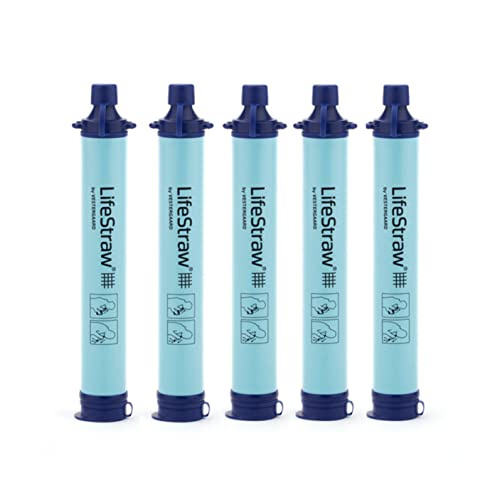
LifeStraw Personal Water Filter, 5 Pack, Blue
The LifeStraw Personal Water Filter for Hiking, Camping, Travel, and Emergency Preparedness in a 5 Pack, Blue, takes the same personal straw concept as the single pack and multiplies it for groups, families, and preparedness-minded households. Buying filtration one straw at a time makes sense for a solo hiker. Buying five at once makes sense when the plan is one per person, spares for a vehicle kit and a cabin, or a shared camp where nobody should have to wait for, borrow, or backwash someone else’s mouthpiece. Personal gear is personal, and a multipack respects that hygiene reality while keeping the packing list simple: identical units, identical instructions, no arguments about whose filter is whose if they are labelled on arrival.
For family camping, the 5 pack also changes the risk picture. A dropped or cracked straw is an inconvenience rather than a crisis when a spare is already in the kit. A friend who joins a trip without any water plan can be handed a sealed personal filter and a two-minute briefing instead of sharing the group pump for every sip. The limits remain those of the straw format itself. Five straws do not add up to a convenient way to fill a big cooking pot, and children still need supervision at any water source. The strongest family setup in this guide would pair a multipack of personal straws for drinking on the move with one gravity system at camp for volume. Each tool then does the job it is genuinely good at, and nobody is forcing a straw to be a kitchen tap.
How to choose the right option for your camp
Start with group size, because it eliminates half the list honestly. A solo camper or a pair who mostly drink on the move can be well served by a personal straw or a mini system, with the LifeStraw single, the LifeStraw 5 pack shared between trips, or the Sawyer SP128 Mini all fitting that low-bulk philosophy. A pair who cook proper meals at camp, or any group of three or more, will feel the limits of personal tools by the second evening and should look first at the Waterdrop gravity bag, the 6L gravity set, or one of the three pumps. Groups that both hike during the day and cook at night often need one option from each world, and there is no failure in admitting that a complete water plan can be two products used together rather than one product used resentfully.
Next, consider your typical water sources. Deep, clear lakes and flowing streams are kind to every filter here. Shallow, silty, or debris-filled sources favour pumps, because an intake can be positioned carefully in the clearest pocket of water, and they favour campers willing to settle and pre-filter before a fine membrane sees the water. High, reliable hanging points favour gravity. Exposed or vehicle-based camps without trees can still use gravity from a roof rack, a tripod, or any sturdy raised point, but if you know your favourite sites offer none of those, a pump removes the uncertainty. Desert and arid camping, where water may be carried more than collected, changes the question again: filtration still matters for refills at taps of unknown quality, springs, and stock tanks where permitted, but container capacity and carrying may matter more than filter flow.
Trip length and resupply complete the picture. On a short trip, almost any maintained filter in this guide will perform its job if the source is reasonable. On longer trips, serviceability and spares move up the list: replaceable elements on the 3-stage pump, the simple identical spares logic of the LifeStraw 5 pack, and the general discipline of carrying whatever cleaning tool or spare part your chosen system expects. Weight matters too, but weigh the whole water system, not just the filter. Containers, reservoirs, hoses, and the water itself usually outweigh the filter by a wide margin, so saving a small amount on the filter while carrying a badly designed reservoir is poor arithmetic. The Katadyn title stating 11.2 oz is a useful reminder that a full pump system can still be genuinely lightweight when the design is purposeful.
Water planning also sits inside the wider camp kitchen and sleep system, not apart from it. A camp that cooks real food needs filtered water ready before cooking starts, which is why many organised groups filter a reservoir on arrival, before tents are fully settled; if you are planning the cooking side of that same routine, our guide to best camping grills assebly covers the grill setup that a well-supplied kitchen can support. Sleep choices affect water too, because a camper who sleeps cold and wakes exhausted makes sloppy mistakes at a stream bank, so it is worth pairing a sound water routine with the warmth advice in best down camping blankets for colder sites. Comfort details are not separate from safety here. A rested camper who has eaten and drunk properly follows clean-container discipline without being reminded, and that discipline is half of any filtration system.
Using your filter well at camp
Good technique begins at the source. Walk a few steps further for clearer water rather than collecting at the churned edge where boots and dogs have stirred the bottom. Fill from below the surface but above the sediment, avoid sources with an oily sheen or strong chemical smell entirely, and keep soap, sunscreen-heavy hands, and food waste well away from any water you or anyone else may later drink. If the water is cloudy, let a filled container stand until the worst of the grit settles, pour carefully, or strain through a clean cloth before filtering. These habits cost minutes and save membranes, pumps, and tempers.
At camp, run a strict clean and dirty separation. Dirty containers, intakes, and unfiltered reservoirs stay on one side of your water station. Clean bottles, the outlet hose, and filtered storage stay on the other. Never let an outlet touch a source, a dirty rim, or the ground. Fill clean containers fully, cap them promptly, and store filtered water in shade, because warm, sunlit storage encourages stale tastes and, over time, growth in a container that was not clean to begin with. Label anything that is not obvious. At a busy group camp, an unlabelled container of unfiltered water beside an identical container of filtered water is an accident waiting for a tired person at dusk.
Sleep and recovery close the loop between hydration and judgement. Campers who plan their bedding as carefully as their water tend to make better decisions on both, which is why the compact comfort options in best inflatable camping pillows are worth considering for weight-conscious trips where rest still matters. For shoulder-season camps, the insulation guidance in best lightweight camping quilts can help you balance pack weight against the warm, uninterrupted sleep that keeps a group careful and good-humoured. None of this replaces filtration, of course. It simply recognises that safe water habits are performed by people, and people perform them better when they are fed, warm, and rested.
Cleaning, storage, and common problems
Every filter in this guide will eventually slow down if it is used, and a gradual slowing is usually a maintenance signal rather than a mystery. Sediment, biofilm from repeated wet use, and mineral content in some sources all contribute. Follow the cleaning method intended for your specific product, whether that involves backflushing a membrane, rinsing a pump element, or flushing a gravity line, and do it sooner rather than later. A filter cleaned while flow is merely reduced usually recovers well. A filter forced for days against a heavy clog is being punished for a two-minute job postponed. Keep cleaning tools with the filter itself, in the same bag, so the job never depends on finding a small part at the bottom of a pack in the rain.
Three field problems account for most frustration. The first is air locks or poor priming in gravity and pump lines, usually solved by patient repositioning, ensuring the reservoir sits high enough, and following the product’s priming steps instead of pumping harder. The second is cross-contamination, where filtered water is stored in a container that previously held untreated water without being washed, quietly undoing the filter’s work; dedicate and mark containers so this cannot happen by guesswork. The third is freezing damage, covered earlier, which has no reliable field repair and is prevented only by warmth and drainage. Notice that none of these problems is solved by buying a more expensive filter. All three are solved by routine, which is encouraging, because routine is free and travels at no weight.
Disclosure
As an Amazon Associate we earn from qualifying purchases. Product links in this guide may therefore support the running of this site at no additional cost to you, and prices and availability can change after publication, so the listing itself is the place to confirm current details before you buy.
Frequently asked questions
Is a straw filter enough for a whole camping trip?
For a solo camper drinking directly at frequent, reliable sources, a personal straw such as either LifeStraw option can cover drinking needs for a trip. It becomes limiting when you need stored water for cooking, for the night, or for a group. Most campers who cook should pair a straw with a gravity system or a pump, or choose one of those volume systems as the main plan and keep the straw as a personal backup.
Which is better for a family, gravity or a hand pump?
Gravity is usually better for a settled family camp because it works unattended and children can be given a clear, simple rule about which container is safe to drink from. A pump is better when sources are shallow, hanging points are scarce, or you need water quickly on demand. Families who camp in varied places often end up happiest with gravity at camp and a pump or personal straws for excursions away from it.
What does a finer micron figure actually change?
A smaller micron figure means a finer final barrier, as with the 0.1 micron Waterdrop and the 0.01-micron membrane in the 3-stage hand pump. Finer barriers place greater importance on source selection, settling cloudy water, and regular cleaning, because they have smaller openings to protect. The figure is one useful part of a decision, alongside format, capacity, flow, and how willingly you will maintain the system.
Can these filters make any water safe?
No portable filter should be treated as a promise for any water whatsoever. These products address the common concerns of camping at reasonable natural sources, and the single LifeStraw title states removal of bacteria and parasites, but chemically polluted water, salt water, and sources affected by viruses call for different treatment, additional steps, or a different source entirely. Judgement about where you collect remains part of the system.
How long will a camping filter last?
Service life depends on the product, the volume filtered, and above all the quality of water it has been fed and the care it has received. One title in this guide states a 3000L figure for the Trailgo Pro, but no honest single number can be transferred to other products or to silty real-world use. Clean, settled source water, prompt maintenance, dry storage, and protection from freezing will extend the useful life of any unit here more reliably than any other habit.
Check prices on Amazon
Live listings for the shortlist in this guide are pulled from Amazon below, so prices and availability are always current at the moment you look.

Final verdict
The best water purifier for camping is the one whose format matches your group, your sources, and your habits closely enough that using it correctly feels effortless by the second day. Choose a LifeStraw single for personal simplicity, the LifeStraw 5 pack for family and preparedness coverage, or the Sawyer SP128 Mini for a compact system that disappears into a pack. Choose the Waterdrop gravity straw with its 1.5 gallon bag or the 6L gravity set with activated carbon when camp volume and hands-free filtering matter most. Choose the Katadyn Hiker Pro for a proven pump pace of 1L per minute at 11.2 oz, the Trailgo Pro for its stated 1.5L/min flow and 3-stage ultrafiltration aimed at base camps, or the 3-stage hand pump for its 0.01-micron membrane and replaceable elements. Then protect whichever you choose with clean technique, regular maintenance, and honest source selection. Do that, and water stops being a worry and becomes what it should be at camp: a quiet routine running in the background of a good trip.