What's inside
- Key Takeaways
- Quick Picks
- How Did We Choose These Chair Leg Floor Protectors for Angled Legs?
- Comparison Table
- Straight Legs and Angled Legs: What Actually Differs?
- How Do You Measure a Chair Leg for Protectors?
- How Do You Fit Caps So They Stay On?
- What Mistakes Do People Make with Chair Leg Protectors?
- How Do Protectors Behave on Different Hard Floors?
- Why Do Downstairs Neighbours Care About Your Chair Legs?
- What About Square Legs, Sled Bases and Other Awkward Shapes?
- When Should the Whole System Be Renewed? A Seasonal Ritual Worth Keeping
- How Do You Read a Protector Listing Without Guessing?
- Do Protectors Change How a Chair Feels to Sit In?
- What Do Protectors Mean for Renters and Furnished Homes?
- Final Recommendation
- Frequently Asked Questions
- Related Guides
As an Amazon Associate I earn from qualifying purchases. This post may contain affiliate links at no extra cost to you.
cottageverdict.com is reader-supported. When you buy through links on our site, we may earn an affiliate commission.
Where to buy: each linked set below leads to its Amazon listing, where you can check price on Amazon and confirm the fit range against your own chair legs’ measurements before ordering. One pick is discussed in prose only, because adhesive felt pads are a commodity best bought by size and thickness wherever you already shop for household supplies.
The best chair leg floor protectors for angled leg chairs exist because of a small geometric betrayal. A chair leg that meets the floor at an angle — the splayed mid-century leg, the raked dining-chair leg, the tapered leg that leans as it lands — does not present its full end to the floor. It presents an edge. All the chair’s weight, plus the sitter’s, plus the sideways force of every sit-down and stand-up, concentrates on that one narrow line of contact, which is why angled legs gouge hardwood, dent vinyl and sing against tile in a way straight legs never do. A protector designed for a straight leg, forced onto an angled one, sits crooked, wears through on its loaded edge within weeks, and peels away leaving the problem exactly where it started.
The protectors in this guide answer the geometry in three different ways. Silicone caps with felt bottoms stretch over the leg end and put a padded, replaceable face between leg and floor, sized by the leg’s diameter at the point where the cap grips. Angled-specific caps are moulded with the tilt already in mind, so their felt face lands flat instead of edged. And swivel glides take the most mechanical route: a screw-fixed base with a pivoting felt foot that aligns itself to the floor whatever the leg’s angle, turning a fixed mismatch into a self-correcting joint. Choosing between them is mostly a matter of your legs’ angle, their thickness, and how the chairs are used — dragged daily at a family table, or placed once and admired in a reading corner.
One discipline governs everything below: measure before you buy. Protector listings state fit ranges in fractions of an inch because the products live or die by them — a silicone cap a size too large walks off the leg within a week, and a size too small splits at the seam or never seats at all. The measuring section of this guide is short and non-negotiable, and it will save more money than any other paragraph here.
Key Takeaways
- Angled legs touch the floor on an edge, not a face — protectors must be chosen for that geometry, not adapted from straight-leg designs.
- Measure each leg’s width where the cap will grip; fit ranges in this category are exact, not approximate.
- Silicone felt caps are the easy, reversible answer for most angled dining and accent chairs.
- Screw-on swivel glides self-align to the floor and suit the steepest angles and heaviest chairs.
- Chairs differ leg by leg: front and back legs on the same chair can need different sizes.
- Felt faces are consumables — plan to inspect and replace them as they thin, especially on dragged chairs.
Quick Picks
| Pick | Badge | Why it earns its place |
|---|---|---|
| Chair Leg Floor Protectors Silicone Felt Caps 24 Pcs | Best All-Round Caps | Round silicone felt caps made for angled legs, in a 24-piece count that covers six chairs. |
| Angled Chair Leg Floor Protectors Felt Silicone Caps | Best for Slender Legs | A small-size angled design for slim legs, in clear silicone that disappears on wood. |
| GorillaFelt Swivel Glide Felt Sliders 16 Pack | Best Self-Levelling Glide | Screw-on swivel glides whose felt feet pivot flat to the floor at any leg angle. |
| PISAO Chair Leg Floor Protectors Caps 24 Pcs | Best Wide Fit Range | Wrapped-felt silicone caps spanning a broad medium size range for mixed chair sets. |
| OCONDA Chair Leg Floor Protectors 24 PCS | Best Extra-Small in Black | Extra-small black silicone cups for the thinnest legs, where clear caps would still show. |
| Adhesive Felt Pads, Discussed Generically | Prose-Only Budget Staple | The budget-tier classic for light chairs and gentle angles, bought by sheet and cut to size. |
How Did We Choose These Chair Leg Floor Protectors for Angled Legs?
We filtered first for honesty about angle. Many “chair leg protectors” are straight-leg products whose listings never mention tilt, and on an angled leg they fail in the predictable way — felt face landing on its edge, cap creeping, adhesive shearing. The picks below either state the angled application outright, as the first two do, or solve the angle mechanically, as the swivel glide does, or offer a fit-and-felt design forgiving enough to seat correctly on a moderate rake. Generic pads appear only as the prose-only pick, labelled with the limits of their competence.
Fit range came next, because an angled-leg household rarely owns one chair design. Dining sets mix leg thicknesses; accent chairs differ from both. We favoured a spread of stated ranges — from the extra-small OCONDA through the broad medium PISAO — so that most real leg measurements land inside at least one pick’s honest territory, and we have repeated those ranges in each review rather than rounding them into vagueness. Where a listing gives a range, the middle of it is the comfort zone; legs at the extremes deserve a test purchase of one set before a household-wide commitment.
Finally, we weighed the felt itself. The felt face is the sacrificial surface in every design here: it must be dense enough not to pack flat in a month, bonded or wrapped securely enough not to peel at its edge under sideways drag, and quiet on hard floors. Listings that described their felt’s attachment — wrapped, in the PISAO’s case — earned more confidence than those that treated the pad as an afterthought, because sideways drag is the angled leg’s signature force and the felt’s edge is where it attacks.

Chair Leg Floor Protectors Silicone Felt Caps 24 Pcs — Best All-Round Caps
This is the set to start with if your angled legs are of ordinary dining-chair substance. The listing describes round silicone caps with felt bottoms, made for angled chair legs, fitting legs from 0.83 to 1.1 inches across, in a 24-piece count — enough for six four-legged chairs, or a dining set with a couple of spares for the inevitable day one cap is found behind the sideboard. The silicone body grips the leg by elasticity, the felt face meets the floor, and the combination addresses both halves of the angled problem: the cap stays on a leg that wants to shed it, and the felt lands as a pad rather than the leg’s own hard edge.
The noise claim in the listing deserves translation into domestic terms. Angled legs on hardwood announce every adjustment of a seated guest — a scrape with a frequency that carries through floorboards — and a felt face converts that announcement into near-silence. Hosts notice this before guests do: a dinner party on protected legs sounds like a calmer room, because the percussion section has been dismissed. On tile the effect is similar; on vinyl, the felt’s real gift is preventing the slow denting that an edged leg presses into a soft floor over a season of identical placement.
One scenario deserves a direct word: the chair that lives half on a rug and half off it, at a table straddling a rug’s edge. Its front legs stand on pile and its back legs on board, and the angled back legs — the ones this guide exists for — do all the audible work every time the chair is used. Protectors on the hard-floor legs alone are a legitimate configuration here, since felt on carpet is pointless, but fit them as a deliberate pair and check that the small height the felt adds does not rock the chair against its rug-side legs; a millimetre of felt is a small thing until it is the only uneven thing under a full dining set.
Fitting is the whole skill with this design. Measure the leg where the cap will sit — on a tapered leg that point is a few inches above the floor, and its measurement, not the foot’s, decides the size. The cap should stretch on with firm resistance and sit with its felt face flat; if the face lands tilted, the leg’s angle exceeds what the cap’s moulding forgives, and the swivel glide further down this guide is your honest answer. Within their angle, though, these caps are the category at its most convenient: no tools, no adhesive, removable for cleaning, and cheap enough per chair that keeping spares is simply good housekeeping.
- Form: round silicone caps with felt bottoms
- Stated fit: legs 0.83–1.1 inches across
- Count: 24 pieces
- Application: angled legs on hardwood and hard floors
Strengths
- Purpose-described for angled legs, not adapted to them.
- Generous count covers a full dining set plus spares.
- Tool-free, reversible and easy to replace individually.
Trade-offs
- Steep angles can still tilt the felt face off flat.
- Legs outside the stated range need a different size class.
- Felt faces thin with dragging and must be checked seasonally.
Best for: typical angled dining and kitchen chairs on hard floors. Not suited for: extremely raked legs, very slender or very heavy legs outside the fit range.
Check price on Amazon.

Angled Chair Leg Floor Protectors Felt Silicone Caps — Best for Slender Legs
Slender legs are where protector ranges go to be forgotten, so a set sized honestly for them earns its place. This 16-pack of clear silicone caps with felt bottoms is listed in a small size fitting legs from 0.59 to 0.7 inches, described specifically as furniture pads for slanted legs. That combination — small, angled, clear — addresses a recognisable chair tribe: Scandinavian-style dining chairs, slim mid-century pieces and modern metal-framed chairs whose legs are elegant precisely because they are thin, and whose thinness concentrates their floor pressure cruelly.
The clear silicone matters on this tribe. A black or brown cap on a pale, slender beech leg reads as a sock on a dancer; the clear body lets the leg’s own colour and grain show through, so the protection disappears at conversational distance. What remains visible is only the felt face at the very bottom, which at this scale reads as the leg’s own shadow. For design-led chairs — the ones bought partly as objects — that discretion is not vanity but the difference between protecting the floor and apologising for it.
Small sizes demand the most careful measuring in this guide, because the tolerances are the whole product. A cap for a 0.65-inch leg has almost no elastic forgiveness to lend a 0.75-inch leg, and forcing the fit splits seams or leaves the cap riding half-seated, where the first drag removes it. Measure with calipers if you own them, or wrap the leg with paper, mark the overlap and measure the circumference flat, then convert honestly. Sixteen pieces cover four chairs; slender-legged sets often run to six chairs, so count your chairs before the basket, not after the first four are dressed.
- Form: clear silicone caps with felt bottoms, angled design
- Stated fit: legs 0.59–0.7 inches across (size S)
- Count: 16 pieces
- Application: slanted legs on hardwood floors
Strengths
- True small sizing for slender legs most ranges skip.
- Clear body disappears on pale wood and metal legs.
- Angled-leg design brief stated plainly in the listing.
Trade-offs
- Sixteen pieces cover only four chairs.
- Tight tolerance punishes approximate measuring.
- Not for legs above 0.7 inches, however close they look.
Best for: slim Scandinavian and mid-century legs on hard floors. Not suited for: standard or heavy dining legs, or buyers unwilling to measure precisely.
Check price on Amazon.

GorillaFelt Swivel Glide Felt Sliders 16 Pack — Best Self-Levelling Glide
The GorillaFelt glide abandons the cap philosophy entirely and solves the angle with a joint. Each unit is a screw-on chair leveler with a one-inch round felt glide on a swivel, listed for angled furniture legs or straight ones — the pivot lets the felt foot sit flat on the floor regardless of the leg’s rake, while the screw fixing makes the attachment permanent in a way no elastic cap can promise. For the steepest legs in the house, and for heavy chairs whose drag forces peel caps off like bottle tops, this is the engineering answer, and its presence in the guide is a standing reminder that some angles should be mechanised rather than accommodated.
Screw-on means commitment, and the commitment should be made knowingly. You will drill a small pilot hole into the end of each leg — into end grain, on an angle, which asks for a steady hand and a moment’s marking before the drill — and the glide then becomes part of the chair. In exchange you get a protector that cannot walk off, cannot be lost to a vacuum cleaner’s enthusiasm, and levels the chair as a side benefit: the leveler function takes small amounts of wobble out of chairs on imperfect floors, which on old floorboards is a second repair disguised as the first.
There is a dignity argument for the glide that suits this guide’s cottage-minded readers: it is the only pick that treats the protector as furniture hardware rather than a disposable accessory. A well-made chair deserves a foot that was fitted to it with a tool, adjusted to its floor, and expected to serve for years — the same philosophy as a properly hung door or a re-soled shoe. Households tired of the cap economy, of spares drawers and seasonal peelings, will recognise the appeal immediately: buy the joint, drill once, and let the felt alone be the consumable, replaced on a glide designed to receive its successor gracefully.
The felt face on a swivel glide also wears differently from a cap’s, and better. Because the foot stays flat, its felt wears evenly across its face instead of grinding through on one loaded edge, so the replacement interval stretches. When the felt does thin, the glide’s design treats it as the consumable it is. Choose this pick for the chairs that matter most and move hardest — the head-of-table chairs, the heavy carver, the reading chair dragged daily toward the light — and accept the drill as the price of never thinking about those legs again.
- Form: screw-on swivel glide with 1-inch round felt foot
- Fit: angled or straight legs, per listing
- Count: 16 pieces
- Bonus function: levels chairs on uneven floors
Strengths
- Swivel foot lands flat at any leg angle, by design.
- Screw fixing cannot walk off, peel or be lost.
- Even felt wear extends the replacement interval.
Trade-offs
- Requires drilling into every leg; not reversible invisibly.
- End-grain drilling on an angle needs care and marking.
- Overkill for light chairs on gentle angles.
Best for: steep angles, heavy chairs and permanent solutions on prized furniture. Not suited for: renters’ furniture, antiques you will not drill, or the very slender legs that caps serve better.
Check price on Amazon.
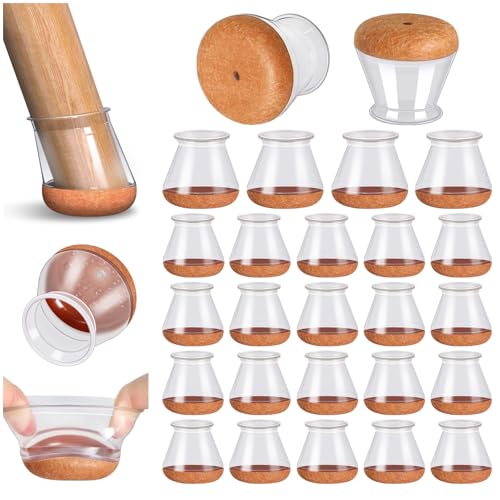
PISAO Chair Leg Floor Protectors Caps 24 Pcs — Best Wide Fit Range
The PISAO caps stake their claim on two specifications: a medium fit range spanning 0.76 to 1.18 inches — the broadest window in this guide — and a wrapped felt bottom, where the felt is carried up and around the cap’s base rather than simply stuck to its face. The range matters for the real-world dining room, where a “set” of chairs often conceals two leg thicknesses between the carvers and the side chairs, and where tapered legs present different measurements depending on how high the cap rides. A range this wide lets one purchase dress the whole table, which is how these products are actually bought.
Wrapped felt is the detail to understand, because it answers the angled leg’s characteristic attack. On a raked leg, the drag force arrives sideways, and a merely glued felt disc is peeled at its leading edge a fraction at a time until it folds, bunches and fails. Felt that wraps the base has no free leading edge to lift; the silicone body itself shields the felt’s perimeter. On angled legs specifically, that construction is worth more than a thicker pad glued worse, and it is the reason this set is recommended here for the chairs that get dragged — the everyday kitchen chairs that are pulled out and pushed in three times a day by people who have never once thought about floor protection.
The 24-piece count repeats the first pick’s sensible arithmetic: six chairs, or four chairs and a generous spares drawer. That spares drawer deserves one refinement: keep the spare caps with a note of which chairs they fit, because a household with two sizes in service — a medium set at the table, smalls in the study — will otherwise conduct a small archaeological dig at every replacement, trying caps against legs by lamplight. A labelled envelope per size turns the seasonal ritual from a sorting exercise back into the twenty-minute job it should be, and it makes the system legible to anyone else in the house who might perform it. Silicone caps in a busy household are consumables with a long fuse — one will eventually split, vanish into a toy box or be removed by a curious toddler — and the household that owns spares replaces in seconds rather than re-ordering in weeks. If your legs sit near the middle of this set’s range and your chairs live active lives, the PISAO is the low-drama default: measure once, dress everything, keep the change.
- Form: silicone caps with wrapped felt bottoms
- Stated fit: legs 0.76–1.18 inches across (medium)
- Count: 24 pieces
- Application: hardwood floors, anti-scratch and noise reduction
Strengths
- Broadest fit range here; one set can dress mixed chairs.
- Wrapped felt resists the sideways peeling of angled drag.
- Count supports a full set plus working spares.
Trade-offs
- At the range’s extremes, fit is workable rather than perfect.
- Silicone caps still yield to the steepest angles eventually.
- Medium size excludes the slender-leg tribe entirely.
Best for: mixed dining sets and busy kitchen chairs with medium legs. Not suited for: very slim legs, or extreme angles that demand the swivel glide.
Check price on Amazon.

OCONDA Chair Leg Floor Protectors 24 PCS — Best Extra-Small in Black
The OCONDA set occupies the corner of the size chart the first pick cannot reach: extra-small silicone cups with wrapped felt, fitting legs from half an inch to three-quarters of an inch, in black, in a count of twenty-four. This is the territory of folding-chair-adjacent dining sets, slim metal legs, plant-stand-turned-side-chair improvisations and the delicate antique chair whose legs were turned on a lathe in a slimmer century. For those legs, the standard ranges are not approximately right; they are simply absent, and a cap that grips at half an inch is the difference between protection and another year of bare edges on the floorboards.
Black is the deliberate choice here, answering the clear caps’ discretion with a different kind: on dark-stained legs, black metal frames and the shadowed undersides of most dining chairs, a black cup reads as part of the leg’s own foot, a designed plinth rather than an accessory. Twenty-four pieces at this size also invites whole-house thinking — the side tables, the stool, the spare chairs in the spare room all wear legs in this class, and a single purchase can walk the house with a tape measure’s worth of attention and dress every one of them.
The cautions are the size chart’s usual ones, sharpened by smallness. At these diameters, an eighth of an inch is a large percentage, so measure each leg rather than assuming the set matches; manufacturers of slender-legged chairs vary leg thickness between production runs with a freedom that would scandalise the car industry. And keep the angle honest: extra-small legs are often extra-angled too, in the splayed Scandinavian manner, so test one chair through a week of meals before dressing its five siblings. If the cups hold and the felt lands flat, you have found the smallest honest answer in this guide.
- Form: black silicone cups with wrapped felt
- Stated fit: legs 1/2–3/4 inch across (extra small)
- Count: 24 pieces
- Application: hardwood floors, anti-scratch, noise reduction
Strengths
- Extra-small sizing serves legs other ranges abandon.
- Black finish reads as part of dark legs and frames.
- Count encourages protecting side chairs and stools too.
Trade-offs
- Small tolerances demand leg-by-leg measuring.
- Black shows on pale legs where clear would vanish.
- Steep splay still tests any cap; trial one chair first.
Best for: extra-slender legs on dark furniture throughout the house. Not suited for: standard dining legs, or pale slender legs better served by the clear small set.
Check price on Amazon.
Adhesive Felt Pads, Discussed Generically — Prose-Only Budget Staple
Before caps and glides, there were felt pads: sheets and discs of adhesive-backed felt, cut or bought to size and stuck to the leg’s end. They remain the budget tier of this entire category and the right answer in a narrow set of conditions — light chairs, gentle angles, smooth leg ends with enough flat area for the adhesive to hold, and households that treat pads as the consumables they are, replaced at the first sign of peel. We discuss them in prose because at this tier the buying decision is about thickness and adhesive quality in the hand, not about brands.
The angled leg is precisely where their limits show, and honesty requires naming them. A pad stuck to an angled leg end meets the floor on its edge, the adhesive is loaded in shear every time the chair drags, and the pad’s working life is measured in weeks on a busy chair. Doubling the pad, or choosing the thickest felt, postpones rather than solves. Keep adhesive pads for the guest-room chair, the light side table and the temporary fix while the correct caps are in the post — roles they perform honourably — and let the chairs that work for a living wear the engineered answers above.
- Form: adhesive-backed felt discs or cut-to-size sheets
- Tier: budget; available wherever household supplies are sold
- Best conditions: light chairs, gentle angles, flat leg ends
- Expectation: consumable; inspect and replace as they peel
Strengths
- Cheapest and most available protection in the category.
- Cut-to-size sheets fit square and unusual leg ends.
- Instant, tool-free and completely reversible.
Trade-offs
- Shear forces on angled legs peel them quickly.
- Thin felt packs down and stops cushioning.
- Adhesive residue can mark delicate leg finishes.
Best for: light, rarely dragged chairs and temporary protection. Not suited for: busy dining chairs or steeply angled legs as a permanent answer.
Comparison Table
| Pick | Form | Stated fit | Defining feature |
|---|---|---|---|
| Chair Leg Floor Protectors Silicone Felt Caps 24 Pcs | Silicone felt caps | 0.83–1.1 in | Angled-leg all-rounder, 24 pcs |
| Angled Chair Leg Floor Protectors Felt Silicone Caps | Clear silicone caps | 0.59–0.7 in (S) | Slender legs, invisible finish |
| GorillaFelt Swivel Glide Felt Sliders 16 Pack | Screw-on swivel glide | Angled or straight | Self-levelling pivoting foot |
| PISAO Chair Leg Floor Protectors Caps 24 Pcs | Silicone caps, wrapped felt | 0.76–1.18 in (M) | Broadest range, peel-resistant felt |
| OCONDA Chair Leg Floor Protectors 24 PCS | Black silicone cups | 1/2–3/4 in (XS) | Extra-small, dark finish |
| Adhesive Felt Pads (prose-only) | Stick-on felt | Cut to size | Budget staple for light duty |
Straight Legs and Angled Legs: What Actually Differs?
Set two chairs side by side and the difference explains the whole category. The straight leg lands on its full end — a circle or square of wood whose whole area shares the load — and a simple pad or cap under it is compressed evenly, wears evenly and stays put because the forces on it are mostly vertical. The angled leg lands on a chord of that circle: a crescent of contact with a hard leading edge, loaded not only downward but sideways every time the chair is dragged, sat in or vacated. Its protector is compressed unevenly, worn at one edge, and peeled by forces the straight leg never generates. Every design decision in this guide — moulded angles, wrapped felt, swivelling feet — is an answer to that crescent.
The angle’s degree writes the prescription. A gentle rake of a few degrees behaves almost like a straight leg, and ordinary caps forgive it completely. The classic dining-chair splay, where the leg visibly leans, is the caps’ working territory and the wrapped felt’s home ground. The dramatic mid-century rake, where the leg meets the floor like a landing aircraft strut, is where caps reach their honest limit and the swivel glide stops being the expensive option and becomes the only one still working in month six. Knowing which of the three your chairs are — by eye, honestly — is worth more than any brand preference this page could give you.
How Do You Measure a Chair Leg for Protectors?
Measure the leg at the height where the protector will grip, which for caps is the lowest inch or two — and on tapered legs, that is the narrowest part, so a measurement taken higher up will order a cap that slides off the foot it was meant to dress. Use calipers for round legs if you have them; otherwise wrap a strip of paper tightly around the leg, mark where it overlaps, lay it flat and measure the circumference, then divide by 3.14 for the diameter. For square legs, measure the width of one face and check whether the cap range is quoted for round or square — a square leg’s diagonal is wider than its face, and a cap sized to the face alone may split at the corners.
Measure all four legs, not one. Chairs are less uniform than they look: back legs are often raked more steeply and turned thinner than front legs, replacement legs from old repairs sneak into antique sets, and a protector order based on the front-left leg alone has embarrassed more households than any other sentence in this category’s reviews. Write the eight numbers — four legs, angle noted beside each — on one card, and order against the card. It takes four minutes, and it converts the fit ranges in this guide from marketing into arithmetic.
How Do You Fit Caps So They Stay On?
Clean legs first: dust, old adhesive and floor wax are the enemies of grip, and a cap stretched over a dirty leg is a cap already halfway off. Warm the silicone in your hands for a moment — it flexes more willingly — then stretch the cap over the leg end and work it up evenly, a little on each side, rather than forcing one side fully home and levering the other. The felt face should end flat to the floor when the chair stands; check by standing the chair and sighting along the floor, and if the face lands tilted, rotate the cap a quarter-turn and check again, since some caps seat better in one orientation on a raked leg.
Then run the household test: a day of real meals. Drag, sit, stand, swivel — the chair’s ordinary violence — and inspect in the evening. A cap that has crept will show a millimetre of leg below its rim; reseat it once, and if it creeps again, the honest verdict is size or angle, and the answer is the next size down or the swivel glide, not a dab of glue that converts a reversible protector into a permanent mess. Fitted well, caps disappear from your attention for months at a time, which — as with every product in the floor-protection family — is the entire point of them.
What Mistakes Do People Make with Chair Leg Protectors?
Ordering by chair rather than by leg is the founding error: one set, one size, bought for a dining set whose legs span three sizes and two angles. The second mistake is optimism about felt — treating the pad as permanent while it thins to a whisper, until the leg’s edge is effectively bare again and the floor learns about it first. Felt is a consumable with a long fuse, and the inspection takes seconds per chair when the vacuum is already out.
Third comes the glue temptation: when a cap walks off, the household superglue comes out, and a reversible, floor-friendly system becomes a residue problem on the chair instead. A walking cap is information about fit, not an invitation to adhesives. And the quietest mistake is protecting only the chairs that scrape audibly. The silent legs — on vinyl, on carpet-underlaid laminate — are denting without announcing themselves, and the full set of legs deserves the full set of protectors, which is why the counts in this guide are sized for six chairs rather than the two loudest.
How Do Protectors Behave on Different Hard Floors?
Hardwood is the floor this category was invented for, and its demands are the baseline: prevent the scratch, silence the drag, spread the edge’s pressure. But the other hard floors each add a condition. Vinyl and luxury vinyl plank are softer than they look, and their characteristic damage is not the scratch but the dent — a slow, permanent impression pressed by an angled leg’s edge in the exact spot a chair always returns to. Felt answers it by widening the contact patch, which is why vinyl owners should treat protectors as structural rather than acoustic, and why the felt’s condition matters doubly: a thinned pad on vinyl is a dent half-pressed already.
Tile inverts the problem. The floor itself is nearly invulnerable, but the grout lines are not, and an angled leg dragged across a grout joint chips at its edges while making the loudest sound in this entire guide — a ceramic clatter that carries through a house at night. Felt swallows both the noise and the chipping force. Laminate sits between the cases: its wear layer resists scratches well but its joints dislike point loads and moisture, so protectors there should be kept dry and inspected after any spill reaches the chair’s feet. One protector family serves all four floors, but the inspection rhythm and the failure you are preventing change with the surface — know which floor you are actually protecting, and the felt will be checked for the right reasons.
Why Do Downstairs Neighbours Care About Your Chair Legs?
In flats and terraced houses, chair noise is a shared resource problem. The scrape of an unprotected angled leg is a structure-borne sound: it enters the floorboards at the contact point and is delivered, with remarkable fidelity, to the ceiling of the room below. It is also, unlike music or voices, a sound with no social licence — nobody has ever been forgiven a chair scrape on grounds of taste. Felt protectors are therefore partly a neighbourly technology, and in rented flats they are arguably a tenancy technology too, since the same contact that makes the noise makes the scratch that the deposit is later argued over.
The timing sharpens the point. Chair legs are dragged most at meals and in the late-evening migration from table to sofa — precisely the hours when the flat below is settling children or sleeping. A household that fits good protectors is, without ever discussing it, a quieter neighbour every single night, and the felt’s slow thinning is why the courtesy fades so gradually that nobody notices its departure until a guest’s chair announces itself through the floor again. If you live above anyone, put your protectors on the seasonal inspection rhythm for their sake as much as your floor’s.
What About Square Legs, Sled Bases and Other Awkward Shapes?
Round legs dominate the listings because they are measurable, but real houses are full of exceptions. Square legs need caps whose ranges are quoted for square profiles, or the honest admission that a round cap stretched over a square leg is being asked to seal at four corners it was not moulded for — some manage it within their elastic tolerance, and the test is a week of meals, not a hopeful first fitting. Where a square cap cannot be found in size, the swivel glide’s screw-on foot is shape-blind, since it attaches to the leg’s end rather than wrapping its sides, which is another quiet argument for the glide in awkward households.
Sled bases and cantilevered frames — the continuous tube or flat bar that replaces individual legs — leave the cap category behind entirely. Their contact is a line rather than a point, and their protection is a strip: adhesive felt or glide tape run along the bearing edge, inspected where the frame’s curve meets the floor. Cross-braced and H-stretcher chairs add a fourth case, where the stretcher bar, not the leg, is what a seated person’s heels drag against the floor. The principle survives every shape: find the actual contact geometry, put a replaceable soft face on it, and inspect the face as the consumable it is. The products change; the geometry lesson does not.
When Should the Whole System Be Renewed? A Seasonal Ritual Worth Keeping
Protectors fail gradually and then suddenly, and the gradual phase is easy to miss because the household adapts to each decibel and each millimetre as it arrives. A fixed ritual defeats the adaptation: twice a year — spring cleaning and the start of the heating season are natural anchors — tip every protected chair, read its feet, and replace whatever felt has thinned, packed or peeled, in one session, from the spares drawer, before the chairs go back. The session takes twenty minutes for a dining set and converts a dozen future micro-failures into one act of housekeeping.
The same ritual is the moment to re-audit fit. Children grow heavier, chairs migrate between rooms and floors, a leg repaired in the interim may have changed its measurement, and the cap that was correct for the dining room’s oak may be wrong for the same chair’s new life on the kitchen’s vinyl. Treat the audit as the product’s second installation and it will catch the mismatches that the first one could not have predicted. Households that keep this rhythm stop having floor incidents altogether — not because their protectors are immortal, but because no protector in the house is ever allowed to reach the end of its life unnoticed.
How Do You Read a Protector Listing Without Guessing?
The specifications that decide success in this category are few, and they hide in plain sight. The fit range is the headline: note whether it is quoted as diameter for round legs or width for square, and whether the range’s unit is inches or millimetres — the two systems sit close enough at these sizes to cause real ordering errors, and a listing that mixes them in one breath deserves a second, slower read. Count is the second fact: divide by four before you celebrate, because a “24-pack” is six chairs, not the abundance the number suggests, and a household of eight chairs needs two packs and the humility to admit it at the basket.
Construction language is the third tell. “Felt pad” alone tells you nothing about attachment; “wrapped felt,” “felt bottom” with the silicone carrying over the edge, or a named glide mechanism tells you the maker has thought about the peeling force that kills these products. Photographs complete the audit: look for the felt’s thickness at the cap’s mouth, the seam’s position, and whether the listing shows the protector on an angled leg or only on the straight-legged studio chair every listing seems to own. The picks in this guide were favoured because their listings state their ranges and constructions plainly enough to survive this reading — in a category of two-pound decisions, that plainness is the quality signal.
Do Protectors Change How a Chair Feels to Sit In?
Slightly, and mostly for the better. A felt face adds a millimetre or two of height and, more noticeably, a quality of movement: the chair that once juddered across the floor now slides with a damped, deliberate glide, which changes the small ergonomics of sitting down and standing up — the chair yields a fraction as you settle, rather than gripping and tipping. Older sitters and anyone with unreliable knees often prefer the protected chair for exactly this reason, provided the glide is felt and not plastic; a hard glide on a smooth floor can make a light chair genuinely skittish, travelling when it is leaned on, which is a fall risk wearing a protector’s clothing.
Stability deserves one honest paragraph. Protectors do not make a sound chair unsound, but they sit at the exact interface where a chair’s steadiness is decided, so a protector that is half-off, folded under, or missing from one leg creates the wobble it was bought to prevent. The rule that emerges is all-or-nothing: a chair wears four good protectors or, temporarily, none — never three and a rumour. Households with small children should add one more consideration: caps are exactly the size a toddler’s hand finds interesting, so check that fitted caps resist a determined pull, and keep spares out of reach in the drawer rather than loose in a bowl on the sideboard.
What Do Protectors Mean for Renters and Furnished Homes?
In a rented home, chair legs are a financial instrument. Hard floors in rental properties are inspected at departure with a thoroughness that would shame a crime scene, and leg marks — being localised, patterned and unmistakably furniture-shaped — are among the easiest damages to attribute and deduct. A set of protectors fitted on moving day, photographed in place, is among the cheapest deposit protection a tenant can buy, and unlike most insurance it pays a daily dividend in silence. The discipline that completes the strategy is continuity: protectors fitted in week one and lost by month three protect nothing, so the spares drawer and the seasonal check are part of the tenancy, not an enthusiast’s extra.
Furnished rentals invert the ownership but not the logic. The chairs are the landlord’s and the floor is the landlord’s, yet the tenant lives with both and answers for their meeting. Silicone caps are the perfect instrument here precisely because they are reversible — they protect the floor from the chair and the chair from accusation, then come off at departure leaving neither altered. The one pick in this guide a tenant should not fit to a landlord’s furniture is the screw-on glide: its pilot hole is a permanent alteration, however small, and permanence in someone else’s property is a conversation to have in writing before it is a hole drilled in confidence.
Final Recommendation
Begin with the tape measure, because in this category the best product is simply the one whose range contains your legs. Most angled dining chairs will land in the first pick’s territory or the PISAO’s broader window — choose the PISAO where legs vary across the set or chairs drag hard, the first set where they do not. Slender legs have their own two answers: clear for pale wood, the OCONDA’s black for dark frames. And where the rake is steep, the chair is heavy, or caps have already failed you once, skip the elastic era entirely and fit the GorillaFelt swivel glides, whose pivoting feet simply decline to care about your legs’ angle. Whichever you choose, dress every leg, check the felt each season, and keep spares in the drawer — because the reward for this small, exact housekeeping is a floor that ages gracefully and a room where chairs move in silence, as if the house itself had been taught manners.
Frequently Asked Questions
How do I know if my chair legs count as angled?
Stand back and look at the chair in profile from a few steps away: if the legs visibly lean — splaying outward toward the floor or raking backward as they descend — they are angled, whatever the catalogue called them. The practical test is the contact patch: set the chair on a hard floor and slip a single sheet of paper under a leg; an angled leg grips the paper at one edge only, while a straight leg traps it evenly across its whole end.
Can I use these protectors on carpet?
Felt-faced protectors are designed for hard floors, where sliding and scratching happen and where a leg’s edge can do its damage quietly over months. On carpet they are unnecessary for floor protection and can make chairs oddly grippy or prone to tipping when dragged by an unsuspecting guest. If a chair must slide on carpet, smooth plastic glides without felt are the appropriate tool for that job instead.
Why do my silicone caps keep falling off?
Almost always fit: the cap is a size too large for the leg’s narrowest point, or the leg’s angle levers it off under drag a fraction at a time. Measure at the foot of the leg, choose the size whose range centres on that measurement, and if correct sizing still walks off a steep leg, move to the screw-on swivel glide, which cannot walk anywhere at all.
Do felt protectors work on tile and vinyl as well as wood?
Yes — felt is gentle on all three surfaces, and on vinyl it prevents the slow denting that an angled leg’s edge presses into a soft surface over a season of identical placement. On wet-area tile, check caps after mopping; a waterlogged felt face should be dried or swapped, since grit trapped in damp felt is the one way a protector can scratch the very floor it guards.
How often should felt faces be replaced?
Inspect them when you vacuum under the table — monthly in busy homes, and at every change of season in quieter ones. Replace a cap or glide’s felt when it has thinned visibly, packed flat or begun to peel at an exposed edge. On dragged dining chairs that is typically a matter of seasons rather than years; on a still reading chair in a quiet corner, the same felt may serve for years.
Will screw-on glides damage antique chairs?
They require a small pilot hole in the leg’s end, which is a real alteration to the furniture, however neatly it is made. For antiques with collectible value, prefer the reversible silicone caps and accept their limits, or consult a furniture restorer about glide options. For sturdy everyday furniture, the hole is invisible in use and the glide’s permanence is a fair and honest trade.
Related Guides
The chairs these protectors serve are gathered in Best Chairs and Ottomans, the youngest members of the household are considered in Best Blankets for Foster Kittens, classroom seating gets its own treatment in Best Bouncy Chairs for Fourth Graders, and the bathroom’s hard floors are covered by Best Bath Mats for Cleanliness.



[…] stationary chairs of the house need the floor care in Best Chair Leg Floor Protectors for Angled Legs, the household’s giving is organised with Best Blankets for Donations and Shelters, the […]