What's inside
- Key Takeaways
- Quick Picks
- How We Chose These Picks
- Why would anyone choose 700 watts on purpose?
- Comparison Table
- What should you check before a 700-watt oven arrives?
- Which features actually matter in the best 700 watt microwave ovens?
- How do you cook well in a low-wattage microwave?
- What Are the Most Common Mistakes?
- Final Recommendation
- Frequently Asked Questions
- Related Guides
As an Amazon Associate I earn from qualifying purchases. This post may contain affiliate links at no extra cost to you.
cottageverdict.com is reader-supported. When you buy through links on our site, we may earn an affiliate commission.
A 700-watt microwave is a compromise you choose on purpose. The best 700 watt microwave ovens all share the same small 0.7 cubic foot cavity and the same modest power, so this guide is not pretending otherwise: food cooks more slowly here than in a full-size oven, sometimes by a third or more. What you get in return is a machine that fits a dorm shelf, sips power an RV inverter or an old house circuit can supply, and costs little enough to furnish a rental without anxiety.
Because the headline numbers are identical across all six picks, the differences that matter live elsewhere — in how the door opens, whether the beeper can be silenced, how thoughtfully the presets are arranged, and whether defrosting is handled by weight or by guesswork. Read the reviews below with your own routine in mind: the person reheating coffee at midnight needs a different winner from the renter cooking a nightly bowl of pasta.
Where to buy: each pick links to its Amazon listing, where you can check price on Amazon and confirm the current finish and dimensions before ordering. Measure your shelf or counter corner first, including the space the door needs to swing and the clearance the vents need behind and beside the cabinet.
One clarification before the reviews: 700 watts describes cooking power delivered to the food, not the electricity drawn from the wall, which is higher. Even so, the whole class remains gentle by kitchen standards, and that gentleness — together with the compact footprint — is the entire reason these ovens exist alongside far stronger machines.
If you already know a full-size microwave is what your household needs, this page will talk you out of itself within a paragraph, and that is by design. But if your constraint is space, wiring, noise or a second location, the six ovens below are the honest shortlist, ranked by how gracefully each one lives inside the limits they all share.
Key Takeaways
- Every pick here is 0.7 cu ft and 700 watts — choose on controls, noise and door design, not on power.
- Add roughly a third to the cooking times written for 1,000-watt ovens, and stir or turn food halfway through.
- A mute or sound-off setting is the single feature flat-dwellers will appreciate most after dark.
- Multi-stage cooking and defrost-by-weight, found on the Farberware, lift a small oven from reheater to cooker.
- These ovens suit singles, couples, dorms, RVs and offices — not family batch cooking.
- Leave vent clearance on the sides and top; a small oven in a sealed cubby overheats like any other.
Quick Picks
| Pick | Badge | Why it earns its place |
|---|---|---|
| BLACK+DECKER 0.7 Cu Ft 700W Countertop Microwave | Most familiar controls | Digital keypad, push-button door and a stainless front make it the easiest small microwave here to hand to a guest without explanation. |
| COMFEE’ 0.7 Cu Ft 700W Countertop Microwave | Quietest small footprint | ECO mode, a sound on/off switch and one-touch buttons make it the considerate choice for thin walls and late-night snacks. |
| Farberware 0.7 Cu Ft 700 Watt Countertop Microwave | Best preset range | Six preset options and multi-stage cooking give this compact oven the deepest programme bench in the 700-watt group. |
| Amazon Basics 0.7 Cu Ft 700W Countertop Microwave | Simplest spare-room pick | LED light, child lock and deliberately plain controls make it the low-fuss spare for a guest room, workshop or break area. |
| Chefman 0.7 Cu Ft 700 Watt Countertop Microwave | Express-cook convenience | One-touch express cook, six presets and a mute button combine speed of use with manners in a small black cabinet. |
| Commercial Chef 0.7 Cu Ft Countertop Microwave CHM770S | Sturdiest budget classic | A long-running 700-watt design with touch controls, a recessed door handle and stainless looks that shrug off heavy daily use. |
How We Chose These Picks
We fixed the class first: countertop models at exactly 700 watts and around 0.7 cubic feet, verified against each manufacturer’s listing, so the comparison stays honest. Anything stronger belongs in a different guide, and anything weaker struggles to reheat evenly at all.
Within that class we compared the things that actually separate these ovens in daily use — control layout, preset depth, defrost method, door mechanism, noise options and standby behaviour. We also weighed how each model handles the classic 700-watt problems: cold centres in thick food, popcorn timing, and the patience needed for frozen meals. Brand support and the maturity of each design counted too, because a dorm microwave is often bought once and expected to survive several tenants.
We also discounted the paper specifications that mislead in this class. Capacity figures are measured with water and flatter every oven equally, so we leaned on turntable diameter and usable height instead — the dimensions that decide whether your plate and your tallest mug actually fit. Where a listing promised a feature, we checked it against the manufacturer’s own description rather than a retailer’s paraphrase.
Long-term running costs were part of the comparison, too. None of these ovens will trouble an electricity bill in active use, but standby draw and the availability of an ECO mode separate the thoughtful designs from the indifferent ones over a year of plugged-in waiting. Small numbers, honestly reported, beat large claims in a category this modest.
Why would anyone choose 700 watts on purpose?
The honest answer is that plenty of homes cannot use more. Older wiring, a shared dorm circuit, an RV running from a hookup or an inverter, a bedsit where the kettle and the microwave cannot run together — in all of these, a gentle 700-watt draw is not a limitation but the condition that makes a microwave possible at all. A full-power oven that trips the breaker cooks nothing.
Smallness brings its own advantages. A 0.7 cubic foot oven heats a single mug or bowl with less wasted space, fits under cabinets that would never accept a family model, and is light enough to move when you redecorate or move house. For one person reheating one portion, the big oven’s extra capacity is unused volume you paid for and clean around.
The cost of admission is time and technique. Microwaves cook from the outside of the food inward regardless of wattage, and at 700 watts the centre of a thick portion lags further behind the edges. Resting food for a minute after the cycle — letting heat equalise — matters more here than in any other class, and arranging food in a ring or stirring halfway stops being advice and becomes the method itself.
There is a historical footnote worth knowing: 700 watts was once close to a standard size for home microwaves, and an entire generation of cookbook timings was written around it. The class feels slow today only because family ovens climbed to 1,000 watts and beyond. Nothing about the physics changed — your grandmother’s microwave recipes, if you have them, will work in these ovens almost exactly as written.
The other quiet truth is that most microwave use was never cooking at all. Industry surveys have said for years that reheating and defrosting dominate the appliance’s working life, and both jobs scale down gracefully. A mug reheats in a small cavity as well as in a large one; it is only the ambitious jobs — the whole chicken, the family lasagne — that expose the class, and those jobs were always better done elsewhere.
A caravan awning at dawn is as good a test as any laboratory. The kettle is forbidden fruit while the microwave runs, the hookup post is shared with the pitch next door, and breakfast still has to happen. A 700-watt oven threads that needle — porridge in minutes, no tripped breaker, no grumbling from the neighbours’ pitch — and scenes like that, repeated across dorms and bedsits and site cabins, are the real specification this class was built to meet.
There is also dignity in a small appliance that knows its station. These ovens do not pretend to roast, grill or air fry; they warm, thaw and soften, and they do those three things in rooms where nothing larger would fit at all. Judged against absence — no microwave, cold food, a kettle pressed into service as a cooker — the modest 700-watt box is not a compromise at all. It is the difference between a room and a home.
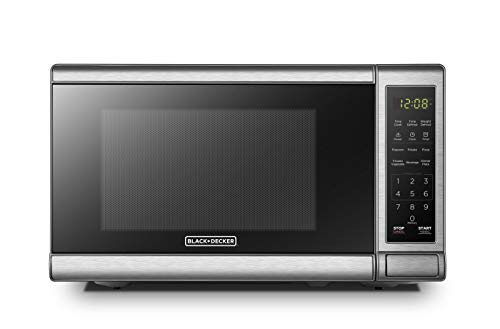
BLACK+DECKER 0.7 Cu Ft 700W Countertop Microwave — Most familiar controls
There is a particular kind of kitchen where this microwave belongs: the one where three different people reheat three different lunches and nobody wants a lesson first. The BLACK+DECKER wears a stainless front that looks at home beside full-size appliances, yet the cavity behind the door is firmly dorm-scale. A dinner plate fits, a tall travel mug fits, and a family-size casserole dish mostly does not, which is exactly the honest boundary of the 0.7 cubic foot class.
The keypad layout is the reason it leads this list. Ten power levels sit behind plain digital controls, the express-style entry is predictable, and the push-button door opens with an elbow when your hands are holding a hot bowl. At 700 watts you should expect reheating to take noticeably longer than the directions printed for a 1,000-watt oven suggest; adding roughly a third more time and stirring halfway turns that weakness into a routine rather than a disappointment.
Where it quietly earns points is evenness for its class. Low power in a small cavity can mean scorching edges around a cold centre, but patient power-level cooking — soup at a reduced setting, butter softened in short bursts — behaves well here. It is a reheating and simple-cooking machine, and judged on that job rather than on ambitions it never claimed, it does the work cleanly.
Consider the weekday rhythm this oven falls into. Morning porridge, a midday soup, an evening portion of yesterday’s curry — none of these asks for power so much as predictability, and the keypad delivers the same result on the tenth day as the first. The interior light is bright enough to judge whether cheese has melted without opening the door and dumping the heat, a small mercy that low-wattage cooking makes more valuable, because every door opening costs proportionally more recovery time here.
Cleaning deserves a word, because small cavities concentrate splashes. The turntable lifts out for the sink, the walls wipe down with a damp cloth while still warm, and a bowl of water with a slice of lemon, run for a few minutes, loosens the dried tomato film that every shared kitchen accumulates. Do that weekly and this class of oven stays pleasant; skip it for a term and even the best small microwave starts to smell like its greatest hits.
Ownership, a few months in, tends to sort itself into a simple verdict: the oven disappears into the routine. The stainless front asks for a wipe where fingerprints gather around the door button, the cavity light keeps working, and the keypad shows no interest in peeling or fading. That boring reliability is why this model so often becomes the recommendation passed between flatmates — not because any single feature dazzles, but because nothing about it nags. In a category defined by a shared limitation, the appliance that adds no fresh irritations of its own has done something genuinely difficult.
Who ends up happiest with this BLACK+DECKER? The household that treats the microwave as shared infrastructure. Because the controls need no translation, it survives contact with babysitters, grandparents and new flatmates without a briefing, and the stainless finish forgives the visual chaos of a busy counter. It is not the quietest here, nor the cleverest, but it is the one nobody ever complains about — and in shared housing, the absence of complaints is the truest measure of a small appliance.
- Capacity: 0.7 cu ft
- Power: 700 watts
- Controls: digital keypad with LED display
- Door: push-button release
- Safety: child safety lock
- Turntable: removable glass
Strengths
- Stainless front blends with larger appliances
- Push-button door is easy with full hands
- Straightforward keypad suits shared kitchens
Trade-offs
- 700 watts means longer cook times throughout
- Cavity will not take a large casserole dish
- No sensor cooking to judge doneness for you
Best for: Dorm rooms, offices and first flats that reheat single portions daily.
Not suited for: Families cooking full meals or defrosting large joints of meat.

COMFEE’ 0.7 Cu Ft 700W Countertop Microwave — Quietest small footprint
A microwave beep carries through a studio flat at midnight like a fire alarm in miniature, so the COMFEE’ earns its place by letting you switch the sound off entirely. That single setting, plus an ECO mode that trims standby draw, tells you who this oven was designed for: someone whose kitchen is also their bedroom, office and hallway, cooking within earshot of a sleeping partner or a baby in the next room.
The cooking itself is unpretentious 700-watt work. One-touch buttons cover the reheating staples, the cavity handles a mug, a bowl of oats or a single portion of leftovers, and the black finish disappears against a dark countertop instead of shouting appliance. Defrosting is where patience matters most; small portions thaw evenly enough if you separate pieces as they loosen, while a thick frozen chicken breast will always be a slow, uneven project in any oven of this wattage.
Treat it as a specialist in considerate reheating and it shines. The controls are legible without being cluttered, the child lock matters in a bedsit where toddlers visit, and the muted running character suits open-plan living. Buyers wanting to cook raw meals from scratch every night will outgrow it, but that was never the assignment it signed up for.
The ECO mode sounds like a footnote until you add up a year of standby. An oven that sits plugged in beside the kettle spends almost its whole life waiting, and trimming that idle draw is the rare feature that pays you back continuously rather than on the days you remember to use it. In a bedsit on a meter, or an off-grid cabin running a modest battery bank, that restraint is not a garnish — it is part of why a 700-watt oven was chosen at all.
There is also a social dimension to a quiet appliance that spec sheets never capture. The flatmate who works nights, the parent of a newborn, the partner on an early shift — all of them hear a standard microwave’s beeping as a small act of selfishness. Silencing it, and softening the door’s closing routine, turns reheating back into a private act. Few features at this size change how an appliance fits a household as completely as that one switch.
One caution belongs in any honest account of a muted microwave: silence cuts both ways. A forgotten mug of milk can sit cooling behind the door because nothing announced its readiness, and households with children should keep the lock engaged so the quiet panel does not invite experimentation. Neither point dents the case for the COMFEE’ in adult, space-pressed homes; they simply mark the boundary where its signature virtue needs a little supervision from the people enjoying it.
Picture the bedsit at eleven at night: laptop closed, lamp low, a bowl of noodles turning slowly behind the COMFEE’ door while the person in the next room sleeps through what would normally be a fanfare of beeps. That scene is the whole review in miniature. Everything else about this oven is competent small-microwave work, but the competence is in service of a particular life — compact, considerate and lived at close quarters with other people’s sleep.
- Capacity: 0.7 cu ft
- Power: 700 watts
- Controls: one-touch buttons, digital panel
- Extras: ECO mode, sound on/off
- Safety: child safety lock
- Finish: black
Strengths
- Sound can be muted for night-time use
- ECO mode cuts standby power draw
- Compact black body suits small flats
Trade-offs
- Black finish shows fingerprints and dust
- Small cavity limits plate size
- Slow defrosting on thick frozen items
Best for: Studio flats, night owls and anyone cooking near sleeping people.
Not suited for: Keen cooks who batch-prepare family meals.
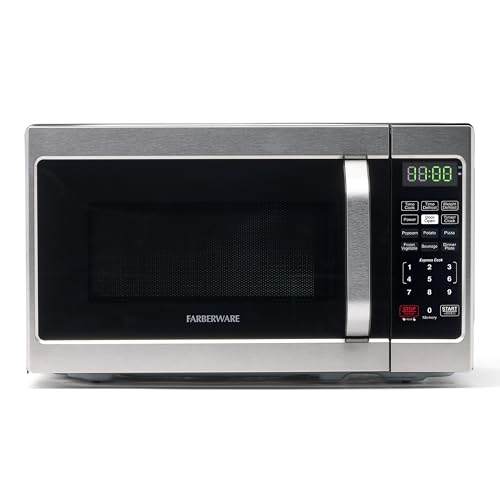
Farberware 0.7 Cu Ft 700 Watt Countertop Microwave — Best preset range
Farberware has sold small kitchen appliances for generations, and the experience shows in how much programming is squeezed into this little box. Six presets handle the repeat offenders of a small kitchen, while multi-stage cooking — a defrost stage flowing straight into a cooking stage — is genuinely rare at this size and wattage. For a renter who cooks the same handful of meals on rotation, that automation removes the standing-and-waiting that makes low-wattage cooking tedious.
Defrosting by weight is the other grown-up feature. Tell the oven what the mince weighs and it apportions time and power more sensibly than guessing minutes ever does, though at 700 watts you should still pause, turn and separate as the manual suggests. The stainless styling is conventional in the best sense: it will not date quickly and it wipes clean without drama.
The trade for all this programming is a panel you need to learn once. The first week involves a little manual-checking, after which the presets become muscle memory. Households who want nothing more than a start button may prefer a simpler rival, but anyone who actually cooks — rather than merely reheats — in a tiny kitchen gets the most capable tool here.
Multi-stage cooking rewards a few minutes of planning in a way single-stage ovens cannot. A portion of frozen soup can defrost gently, rest in its own residual warmth, then cook through, all from one set of instructions given while you change out of work clothes. The result is not magic — the wattage still governs the total time — but the texture improves, because food is no longer blasted from frozen at full power around the edges while the centre stays icy.
The preset library also teaches realistic expectations if you read it closely. Portions are sized for one person, sometimes two, and the programmes assume you will stir when prompted. Follow those prompts and the Farberware produces the most even results in this group; ignore them and it behaves like every other 700-watt oven, which is to say honestly but unevenly. The machine meets you halfway, and the halfway it offers is further than most.
It is worth saying plainly who should walk past this one. If your microwave use begins and ends with reheating a drink, the Farberware’s programme bench is capacity you will never touch, and a simpler panel will serve you faster. Its case rests entirely on cooking — real cooking, in small portions, several nights a week — and for the renter whose hob is unreliable or whose kitchen is a single counter, that case is strong enough to top a different buyer’s list entirely.
A word about the learning curve, since it is the only real toll this oven charges. Spend the first Sunday with the manual open and a mug of water, running each preset once, and the panel’s logic settles into place: weight first, stage second, power third. After that apprenticeship the Farberware stops feeling complicated and starts feeling thorough, rather like a well-organised small kitchen itself — everything in reach, nothing decorative, all of it earning its space.
- Capacity: 0.7 cu ft
- Power: 700 watts
- Programmes: 6 preset options
- Cooking: multi-stage, 10 power levels
- Defrost: by weight or by time
- Display: LED with child safety lock
Strengths
- Multi-stage cooking uncommon at this size
- Defrost by weight beats guessing times
- Six presets cover everyday small meals
Trade-offs
- Panel takes a week to learn properly
- Still bound by 700-watt cooking speed
- Presets assume standard portion sizes
Best for: Renters who genuinely cook small meals rather than only reheating.
Not suited for: Anyone who wants a single-button appliance.

Amazon Basics 0.7 Cu Ft 700W Countertop Microwave — Simplest spare-room pick
Some microwaves are bought to be loved; this one is bought to be forgotten about until soup is needed. The Amazon Basics model strips the brief down to a 700-watt cavity, an LED light so you can watch the mug, a child lock, and controls that a visitor can operate at the first attempt. In a guest annexe, a garden office or a workshop kitchenette, that forgettability is the entire point.
Performance is honest reheating performance. Drinks come back to temperature, ready meals cook through if you respect the longer times a 700-watt oven needs, and popcorn is a watch-it-closely job rather than a walk-away one, as it is in every small oven. The black cabinet is compact enough to live on a shelf unit where a deeper microwave would crowd out storage.
What you give up is finesse: no sensor programmes to rescue an overcooked edge, no elaborate preset library, nothing to show off. What you gain is an appliance that asks nothing of you, which for a second microwave — or a first one in a room that is not really a kitchen — is a perfectly rational exchange.
A second microwave changes how a household uses the first one. With this Amazon Basics model parked in a utility room or a teenager’s den, the main kitchen stops hosting queues for reheated drinks during a film night, and breakfast in a guest room stops requiring a hostage negotiation with the household’s early risers. Its plainness is what makes that deployment sensible — nobody needs presets in a room whose entire menu is tea, porridge and popcorn.
Durability expectations should be set by the brief rather than by hope. This is a light-duty appliance, happiest reheating a handful of times a day, and its simple control board has fewer ambitions to fail at than a feature-stacked rival. Keep the vents clear, wipe the cavity before splashes bake on, and a basic oven like this commonly outlasts expectations simply because so little about it can go wrong.
There is an environmental footnote in this model’s favour that rarely gets mentioned. A small, simple oven that reheats single portions uses a fraction of the energy of heating a full-size oven for one jacket potato, and its modest materials footprint matches its modest job. Bought for a spare room and used for years, it is the opposite of gadget churn: one plain appliance, doing one plain thing, long after fancier contemporaries have been replaced for a failed touch panel.
There is a temptation to apologise for recommending something so plain, and it should be resisted. Most appliance regret comes from buying features that a household’s real routine never touches. The Amazon Basics oven inverts that risk: if your routine is reheating and little else, its shortfall list is a list of things you were never going to use. Plain, in the right kitchen, is not a compromise at all — it is an exact fit wearing no costume.
- Capacity: 0.7 cu ft
- Power: 700 watts
- Controls: straightforward digital panel
- Lighting: LED interior light
- Safety: child lock
- Finish: black
Strengths
- Controls a guest can use instantly
- LED light makes checking food easy
- Compact enough for shelf placement
Trade-offs
- No sensor or advanced programmes
- Plain styling will not lift a kitchen
- Popcorn needs watching at this wattage
Best for: Guest rooms, garden offices and break areas needing a spare.
Not suited for: Main kitchens where the microwave cooks daily meals.

Chefman 0.7 Cu Ft 700 Watt Countertop Microwave — Express-cook convenience
Express cook sounds like a gimmick until you live with a 700-watt oven, where every reheating job takes long enough that fumbling through menus genuinely annoys. On the Chefman, a single touch starts a short burst at full power, and adding time in mid-cycle is equally direct. Six presets sit behind that shortcut for the jobs — popcorn, potato, frozen vegetables — where a tested programme beats improvisation.
The mute button deserves its own mention because it changes how the appliance fits into a home. A beeping microwave in an open-plan flat announces every late-night noodle bowl to the whole household; silencing the alerts makes the Chefman a polite appliance. Ten power levels give enough granularity to melt chocolate gently or soften ice cream without liquefying it, provided you work in short bursts and check often, which low wattage quietly teaches you to do anyway.
Its limits are the class limits: the same 0.7 cubic foot ceiling on dish size, the same patience tax on anything frozen solid. Within those walls, though, the control scheme is the most thought-through of the simpler models here, and for a busy single-person kitchen that balance lands well.
The express-cook habit rewires how you use the oven across a day. Heating milk for a child’s drink, warming a wheat bag for an aching shoulder, taking the chill off a sandwich filling — these are twenty-to-sixty-second jobs that a menu-driven panel turns into chores. One touch starts them, one more touch extends them, and the Chefman becomes the appliance you reach for without thinking, which is the highest compliment a reheater can earn.
Its presets repay a little experimentation in the first week. Popcorn in particular varies by bag and by brand, and at 700 watts the gap between fluffy and scorched is measured in seconds; learn your usual bag’s timing once, note it, and the preset becomes reliable. That small apprenticeship is the honest price of the whole class, and this model at least makes the learning curve short.
Families with older children often find this size of oven becomes the training kitchen. The controls are forgiving, the portions are single, the child lock covers the toddler years, and a ten-year-old can reheat their own pasta without negotiating a powerful full-size machine. The Chefman’s express logic is intuitive enough for that role, and its mute button spares parents the beeping commentary from the next room while homework is being negotiated.
The Chefman’s party trick, if a 700-watt oven can be said to have one, is how it handles the grazing pattern of modern eating. Nobody in a small flat cooks three square microwave meals; they graze — a warmed croissant, a bowl of soup at four, leftovers at nine. Express starts and forgiving presets suit grazing far better than a panel designed around set-piece dinners, and that alignment with real behaviour is why this model punches above its plain specification.
- Capacity: 0.7 cu ft
- Power: 700 watts
- Presets: 6 cooking presets
- Shortcut: one-touch express cook
- Extras: mute button, 10 power levels
- Safety: child safety lock
Strengths
- Express cook removes menu fumbling
- Mute button suits open-plan homes
- Ten levels handle delicate jobs gently
Trade-offs
- Presets still need supervision on popcorn
- Small cavity caps portion sizes
- Black cabinet needs frequent wiping
Best for: Single-person kitchens reheating several times a day.
Not suited for: Households cooking for three or more at once.

Commercial Chef 0.7 Cu Ft Countertop Microwave CHM770S — Sturdiest budget classic
Longevity is a feature you cannot photograph, and the CHM770S has been the default small microwave in countless rental kitchens precisely because the design stopped changing once it worked. It is a 700-watt, 0.7 cubic foot oven — the same ceiling as everything else on this page — but the recessed door handle removes the protruding part that gets knocked in tight galley kitchens and RV galleys, and the touch panel wipes flat-clean after splashes.
In daily service it behaves like the experienced appliance it is. The LED display is readable from across a small room, the ten power levels are honestly spaced, and reheating two mugs in sequence — the real workload of a caravan or a site office — is uneventful in the best way. Frozen ready meals need the usual wattage adjustment, adding time and a mid-cycle stir, and once that habit forms the results are consistent.
Choose it when the microwave will be used hard by people who did not buy it: landlords furnishing a flat, families equipping an RV, offices replacing a dead break-room oven. It offers no novelty, and that is its recommendation — a proven answer to a small, well-understood problem.
Renters inherit microwaves the way they inherit mattresses, and the CHM770S is the one landlords reach for because replacements, parts knowledge and user familiarity are everywhere. A new tenant has almost certainly used one before. That installed base matters more than novelty when the oven must serve a parade of strangers, none of whom will ever read a manual.
In an RV the recessed handle and modest footprint solve two problems at once: nothing protrudes to catch a sleeve in the galley, and the 700-watt draw coexists with lights, a water pump and a laptop charger on a hookup that would sulk at a full-power oven. Add a non-slip mat beneath it for travel days and the Commercial Chef becomes part of the van’s furniture rather than a passenger.
Second-hand buyers meet this model constantly, and it is one of the safer used purchases in the category: the design is known, the failure points are understood, and a quick test — a mug of water, two minutes, listen for grinding from the turntable — tells you most of what matters. New buyers get the same virtues with a warranty. Either way, the CHM770S represents the class at its most settled: nothing experimental, nothing fragile, nothing pretending to be more than 700 watts.
Fleet buyers — the people equipping student halls, staff rooms and holiday lets — read this category differently from the rest of us. They want the model whose manual nobody needs, whose door survives a thousand careless closings, and whose replacement can be ordered without a meeting. The CHM770S has filled that role for years because it treats durability as a design brief rather than a hope, and domestic buyers with hard-wearing households are rational to borrow the fleet buyers’ logic.
- Capacity: 0.7 cu ft
- Power: 700 watts
- Controls: touch panel, digital LED display
- Door: recessed handle design
- Levels: 10 power levels
- Finish: stainless front
Strengths
- Recessed handle survives tight spaces
- Proven long-running design
- Flat touch panel wipes clean easily
Trade-offs
- Design feels dated beside newer rivals
- No mute option for quiet hours
- Same small cavity as every rival here
Best for: Landlords, RV owners and offices needing a proven workhorse.
Not suited for: Buyers who want the newest features and styling.
Comparison Table
| Pick | Headline trait | Watch out for |
|---|---|---|
| BLACK+DECKER 700W Microwave | Stainless front blends with larger appliances | 700 watts means longer cook times throughout |
| COMFEE’ 700W Microwave | Sound can be muted for night-time use | Black finish shows fingerprints and dust |
| Farberware 700W Microwave | Multi-stage cooking uncommon at this size | Panel takes a week to learn properly |
| Amazon Basics 700W Microwave | Controls a guest can use instantly | No sensor or advanced programmes |
| Chefman 700W Microwave | Express cook removes menu fumbling | Presets still need supervision on popcorn |
| Commercial Chef CHM770S | Recessed handle survives tight spaces | Design feels dated beside newer rivals |
What should you check before a 700-watt oven arrives?
Measure the space as the oven will actually live in it, not as the shelf measures on paper. The cabinet needs its stated footprint plus breathing room at the vented sides and top, and the door needs a clear swing that does not end against a wall or a kettle. In this class the ovens are similar in size, but a centimetre of overhang on a dorm shelf is the difference between settled and precarious.
Check your largest everyday items against the cavity before the box is opened. Bring your usual dinner plate, your tallest mug and the lidded box you freeze soup in; if the plate cannot sit flat on the turntable, every meal becomes a decanting exercise and the oven will quietly fall out of use. Retailers’ stated capacities are measured in litres of water, not in plates of pasta.
Think about the socket, too. A 700-watt microwave still wants a sound outlet, ideally not shared through a tired extension lead with a kettle and a toaster. In older homes the gentler draw is precisely what keeps an ageing circuit calm, but calm is not the same as careless — plug directly into the wall where you can, and let the oven be the only hungry appliance on its run.
Which features actually matter in the best 700 watt microwave ovens?
Start with the door. Push-button releases work one-handed and suit most people; a recessed handle, like the Commercial Chef’s, survives narrow galleys where a protruding handle gets clipped by passing hips and shopping bags. Then look at the panel: express-cook shortcuts and clearly labelled presets save more daily irritation than any styling flourish.
Defrost method separates the cookers from the reheaters. Defrosting by weight apportions power and time far better than a bare timer, and multi-stage cooking lets a frozen portion defrost and then cook in one programmed run. Neither feature changes the wattage, but both change how much of your evening you spend standing in front of the oven pressing buttons.
Noise and standby deserve a look in small homes. A sound on/off switch or mute button transforms late-night use, and an ECO mode that trims idle draw suits an appliance that spends twenty-three hours a day waiting. Finally, check the turntable size against your largest everyday plate — in this class the plate, not the stated capacity, is usually the real limit.
Noise deserves one more pass, because decibel figures are rarely published for this class and the differences are felt rather than measured. The fan and turntable hum of a small oven is modest in a kitchen and significant in a bedsit, and the ending beeps — not the cooking — are what wake households. That asymmetry is why a mute switch outweighs almost any other convenience here for anyone whose microwave shares a room with a bed.
Finish is the other everyday variable. Stainless fronts, like those on the BLACK+DECKER, Farberware and Commercial Chef, resist staining and suit rented kitchens that must look respectable at inspection time. Black cabinets, on the COMFEE’, Amazon Basics and Chefman, hide the oven in shadowed corners and show dust sooner. Neither is better; they simply serve different rooms, and choosing by room rather than by photograph is the habit this whole category rewards.
Warranty and support, finally, separate the brands with service networks from the badges without them. A 700-watt oven is cheap enough that few owners will pursue a repair, but a painless replacement process during the first year still matters when a door latch fails in month two. Established names earn a small premium here for a reason, even when their cavities are identical in size and power to a no-name rival’s.
Put those threads together and a pattern emerges: at 700 watts, you are not buying cooking power at all, because everyone sells the same amount. You are buying manners — how quietly it works, how politely it asks for attention, how gracefully it fits a small room and a shared life. Judge the six picks on those terms and the right one usually identifies itself quickly.
How do you cook well in a low-wattage microwave?
Convert times before you start. A reliable rule is to add about a third to any time written for a 1,000-watt oven, then check early rather than late; you can always add thirty seconds, but you cannot un-boil a soup that erupted. Food-safety temperatures still apply — leftovers should be steaming throughout — so the extra time is not optional padding.
Arrange for evenness. Spread food in an even layer or a ring with a hollow centre, cover it to trap steam, and stir or rotate anything thicker than a slice of toast at the halfway point. Let portions stand for a minute or two after the beep; in a 700-watt oven the standing time finishes more of the cooking than most people expect.
Work with the wattage for delicate jobs. Butter, chocolate and ice cream all respond better to short bursts at reduced power than to one hopeful blast, and the ten power levels on every pick here exist precisely for that. Small ovens reward small interventions: ten seconds, check, ten seconds more.
It pushes the microwave back to its original job. Full-power ovens drifted into cooking whole meals; a 700-watt machine restores the older division of labour, where the hob and the oven cook and the microwave reheats, defrosts and softens. Kitchens organised around that honesty tend to work better, because no appliance is being asked to impersonate another one at a third less power than the recipe assumed.
It also changes shopping. Single-portion ready meals, smaller frozen vegetables bags and leftovers frozen in flat, thin packs all suit a small cavity and thaw more evenly than one deep frozen block. Households that adapt their freezer habits to the oven — flat packs, labelled portions, nothing thicker than a paperback — find the 700-watt ceiling stops feeling like a ceiling at all.
Defrosting deserves its own routine in this class. Work in short cycles at a low power level, turning and separating pieces as they loosen, and stop while the centre still holds a little frost — the standing time that follows will finish the job more evenly than another blast would. Meat defrosted this way cooks like meat that was planned, not rescued, and the difference shows up at the table.
Finally, it changes expectations about noise and presence. These are small, light, comparatively quiet appliances that sit in rooms doing double duty as bedrooms and offices. Choosing one with a mute option and a compact footprint is not settling; it is furnishing the room you actually live in, and that is the thread running through every pick on this page.
What Are the Most Common Mistakes?
Buying for the kitchen you wish you had
A 700-watt oven bought to cook Sunday roasts for five will disappoint every single week. Match the machine to the portions you actually reheat, and let a different appliance handle the feasts.
Following packet times written for stronger ovens
Ready-meal instructions usually assume 800 to 1,000 watts. Undercooking at 700 watts is the predictable result of following them literally, and it is a food-safety issue, not just a texture one.
Sealing the oven into a tight cubby
Countertop microwaves vent from the sides, top or back. Cramming one into a sealed shelf starves it of air, shortens its life and can leave the cavity walls dripping with condensation.
Skipping the stir and the stand
At this wattage the difference between the edge and the centre of a dish is at its widest. Stirring halfway and standing afterwards is the whole technique; there is no preset that replaces it.
Microwaving metal-trimmed or sealed containers
The class rules are the same as in any microwave: no metal trim, no sealed jars, no eggs in shells. Low wattage does not soften these hazards; a sealed container simply takes slightly longer to become a problem.
Judging doneness by the clock alone
Two portions of the same soup can differ by a minute depending on starting temperature and depth of bowl. At 700 watts, check with a stir and a thermometer for anything that matters, rather than trusting a number remembered from a stronger oven.
Final Recommendation
For most small kitchens the BLACK+DECKER is the safest pair of hands: familiar controls, a door anyone can open, and a stainless face that does not make a tiny kitchen look like a compromise. If silence matters more than polish, the COMFEE’ and its sound-off setting solve the midnight problem outright, while the Farberware is the one to choose if you genuinely cook — its multi-stage programmes and weight-based defrost do work the others leave to you.
Whichever of the six lands on your counter, go in with the right contract: this class reheats beautifully, cooks modestly and never hurries. A 700-watt oven that is understood will serve a small household faithfully for years, asking only a little patience and the occasional stir in exchange for its tiny footprint and gentle appetite for power.
A last piece of advice applies whichever pick you choose: spend the first week deliberately. Reheat your usual mug, cook your usual ready meal, defrost your usual portion of mince, and note the times that work on the door with a sticky note. A 700-watt oven rewards that small apprenticeship for years, because once its timings are yours, the slowness stops being a surprise and becomes simply how your kitchen runs.
Start your shortlist with the BLACK+DECKER 700W Microwave, weigh it against the COMFEE’ 700W Microwave, and keep the Farberware 700W Microwave in view before you decide.
Frequently Asked Questions
Is 700 watts enough for everyday use?
For reheating drinks and leftovers, cooking vegetables, oats, eggs and single ready meals, yes — with longer times than a full-power oven. It struggles with large frozen items and family-size dishes, where the centre lags too far behind the edges.
How much longer does a 700-watt microwave take?
As a working rule, add about a third to times written for a 1,000-watt oven. A five-minute job becomes roughly six and a half to seven minutes, and checking a little early keeps the adjustment honest.
Can a 700-watt microwave run in an RV or dorm?
That is exactly its home ground. The modest draw is far kinder to hookups, inverters and shared dorm circuits than a 1,100-watt model, though you should still avoid running it alongside a kettle or heater on the same circuit.
Why does food heat unevenly in a small microwave?
Microwave energy penetrates only a short distance into food, so thick portions rely on heat conducting inward. Lower wattage widens the gap between edge and centre, which is why stirring, arranging food in a ring and standing time matter so much in this class.
What size plate fits in a 0.7 cu ft microwave?
Most dinner plates up to roughly ten inches across fit on the turntables in this class, but check your own largest plate against the listed turntable diameter before ordering. Tall mugs and standard cereal bowls fit comfortably in all six picks.
Do 700-watt microwaves use much electricity?
Very little per use. A reheating job lasting four minutes consumes a small fraction of a kilowatt-hour, and the class’s gentle draw is precisely why these ovens suit metered flats, boats and RVs. Standby draw matters more over a year, which is where an ECO mode earns its keep.
Can you bake or roast in a 700-watt microwave?
Not in the browning, crisping sense — microwave energy does not brown food at any wattage, and this class has no grill or convection element to compensate. Steamed puddings, scrambled eggs and mug cakes work well; anything needing a crust belongs in an oven or an air fryer.
Related Guides
If a little more everyday capacity sounds tempting after reading about this deliberately small class, our neighbouring guides cover the neighbouring decisions: Best Affordable Microwave Ovens steps up in size and power for daily family use, Best 30 Dual Fuel Ranges handles the full-size cooking end of the kitchen, and Best Basic Computerized Sewing Machines covers a very different kind of small home machine.



[…] compact kitchens that cannot take a 30-inch range, our Best 700 Watt Microwave Ovens covers the smallest countertop class. See also Best 24 Inch Electric Ranges for the compact range […]