What's inside
- Key Takeaways
- Quick Picks
- How Did We Choose These Barber Chairs?
- What Separates a Real Barber Chair from a Salon Chair?
- The Five Linked Chairs and One Heritage Discussion
- What Should You Expect on Delivery and Assembly Day?
- What Should You Check in the First Week of Owning a New Barber Chair?
- How Do the Picks Compare on the Figures That Matter?
- What About the Client’s Experience of the Chair?
- How Should You Position and Work a Barber Chair Through a Service?
- How Do You Clean and Maintain a Barber Chair Day to Day?
- How Does a Barber Chair Pay for Itself?
- What Mistakes Do Shops Make When Buying Barber Chairs?
- Final Recommendation
- Frequently Asked Questions
- Related Guides
As an Amazon Associate I earn from qualifying purchases. This post may contain affiliate links at no extra cost to you.
cottageverdict.com is reader-supported. When you buy through links on our site, we may earn an affiliate commission.
Where to buy: the five linked chairs below lead to their Amazon listings, where you can check price on Amazon and confirm the pump rating, recline angle and overall dimensions against your shop floor. The sixth entry is a discussion of antique cast-iron chairs with no link attached, because century-old iron is bought from restorers and estate sales, not from a listing, and it deserves honest treatment rather than a substitute product.
Ask a barber what the best barber chairs have in common and the answer will not mention upholstery, colour or styling. It will be about the pump. A barber chair is a machine for positioning a human being — raised, lowered, spun and reclined hundreds of times a week, under clients of every size, operated by a foot that is also trying to keep its owner balanced with clippers in hand. When the hydraulics sigh, when the base rocks, when the recline shudders instead of gliding, the whole shop feels it. Everything else about the chair — the headrest, the footrest, the padding — is in service of that central mechanical promise.
This guide therefore reads barber chairs the way barbers do: pump rating first, recline second, and the furniture questions after. The listings gathered here advertise serious working figures — heavy-duty pumps rated in the hundreds of pounds, reclines in the 135 to 140 degree range, full 360 degree swivel — and the five linked picks were chosen to span the realistic ways a shop buys chairs: a first chair for a new shop, vintage-styled iron for a traditional room, matched heavy-duty chairs for a multi-chair business, and a versatile all-purpose model for the home barber or the single-chair studio. Read the pump figures on each listing for yourself before ordering; in this category, the numbers are the review.
One framing note before the details: this guide treats barber chairs as commercial equipment that happens to be furniture-shaped, not as furniture that happens to recline. That ordering explains everything that follows — why pump classes are quoted before upholstery colours, why matched rows are praised over individual bargains, and why the final test recommended for every chair involves your heaviest friend rather than your most photogenic one. Readers furnishing a home studio are not exempt from the logic; a chair worked daily at home ages exactly as fast as one worked daily in a shop, and it deserves the same mechanical respect.
Key Takeaways
- All five linked picks are hydraulic reclining barber chairs with 360 degree swivel — the pump and the recline define the category.
- Two chairs advertise 700 lb class hydraulic pumps, the heaviest duty figures in this guide, suited to busy multi-client shops.
- Recline angles cluster between 135 and 140 degrees, the range that serves shaves and beard work without laying a client flat.
- The Artist hand vintage model pairs the heaviest pump class with period styling, flip-up footrest and adjustable headrest.
- Adjustable headrests and proper footrests separate a true barber chair from a salon chair pressed into service.
- Antique cast-iron chairs, covered prose-only, are a restoration project first and a working chair second.
Quick Picks
| Pick | Badge | Why it earned its place |
|---|---|---|
| Heavy Duty Hydraulic Barber Chair Reclining | Best Straightforward Workhorse | A heavy-duty hydraulic reclining chair with swivel base, shaped backrest and footrest that covers the barbering brief without decoration. |
| All Purpose Reclining Barber Chair 140 Degree | Best Deep Recline | A 140 degree recline with heavy-duty pump and full swivel, aimed at shops where shaves and beard services anchor the menu. |
| Artist hand Vintage Barber Chair 700 lb | Best Vintage Statement | Period styling over a 700 lb class pump, 135 degree recline, adjustable headrest and flip-up footrest. |
| BarberPub Heavy Duty Barber Chair 2008 | Best for Busy Shops | A 700 lb class pump, adjustable backrest and headrest, and padded comfort built for back-to-back bookings. |
| Artist hand Professional Reclining Barber Chair | Best All-Purpose Versatility | A multi-functional reclining chair with heavy-duty pump that moves between barbering, home studios and beauty work. |
| Cast-Iron Antique Barber Chairs, Discussed Generically | Heritage Option, Prose-Only | Genuine antique iron chairs offer unmatched presence at restoration cost and effort; covered in words only, at a heritage-tier investment. |
How Did We Choose These Barber Chairs?
We began by excluding everything that was merely a salon chair in a darker colour. A barber chair must recline — properly, with a headrest that supports a client’s head through a shave — and it must carry a footrest substantial enough for a client to push against when sitting up. Styling chairs, however handsome, fail that test, and none appears here. What remained was judged on the mechanics: the class of hydraulic pump the listing claims, the smoothness implied by the base design, and whether the recline figure is stated plainly or hidden in adjectives.
Weight capacity received particular scrutiny because barbering loads a chair unfairly. A client does not distribute weight like a sack of grain; they lean, shift, brace against the footrest, and occasionally arrive with a child on a knee. A pump rated generously above your heaviest realistic client is not extravagance — it is the margin that keeps the lift smooth in year three. Two chairs here advertise pumps in the 700 lb class, and that headroom is the main reason they anchor the list.
We also listened for the omissions. Listings that trumpet styling while staying vague about the pump, or that quote a recline without mentioning a headrest, tell an experienced buyer where the compromises live. Every chair in this guide states its mechanical case plainly enough to be checked, and that checkability — the willingness to be measured — is itself a quality signal in a category where adjectives are cheap and hydraulics are not.
Finally, we considered the shop around the chair. A chair is bought once but cleaned daily, walked around thousands of times, and photographed in the background of every client’s mirror selfie. Footprint, base shape, upholstery that wipes down, and a silhouette that suits the room’s trade all entered the judgement — after the pump, but before the price tag’s position in its tier.
What Separates a Real Barber Chair from a Salon Chair?
The recline is the first separator. A salon styling chair may tilt a few degrees for comfort; a barber chair reclines toward 135 or 140 degrees because wet shaves, beard shaping and hot-towel work are performed on a client who is leaning well back with their face presented upward. That geometry demands the second separator: a real headrest, adjustable in height, padded, and sturdy enough to be leaned on without flex. A chair whose headrest is decorative will betray itself the first time a client settles their full head weight into a shave position.
The footrest is the third separator, and the most underestimated. In a barber chair the footrest is structural — clients brace against it, push themselves upright with it, and rest heavy boots on it all day. Cast or heavily built footrests, ideally with a leg rest that supports the calves in recline, belong on working chairs; a thin chrome bar belongs on a styling chair. When you compare listings, look at the footrest photographs the way an engineer would, because your clients’ heels will test whatever is there several thousand times a year.
Upholstery separates the categories more quietly. A barber chair lives in a rain of hair clippings, tonic, water and disinfectant, and its covering must wipe clean in seconds, resist the solvents in barbering products, and avoid seams and stitching exactly where clippings love to lodge. Smooth, commercial-grade coverings are not a lack of luxury; they are hygiene engineered into the surface. When a listing aimed at barbers shows deep button tufting, admire it, then think hard about your cleaning routine — the vintage chair in this guide earns its tufting with a heavy-duty specification beneath, but decoration should always be the last thing bought, never the first.
Underneath everything sits the base and pump. Barber chairs use wide, heavy bases because a reclined client moves the centre of gravity dramatically, and the pump must lift smoothly through that whole arc without the descent feeling like a dropped stitch. A 360 degree swivel sounds like a luxury until you have worked a chair without one and spent the day walking around it; in a busy shop, the swivel is what keeps the barber planted and the client moving.
The Five Linked Chairs and One Heritage Discussion
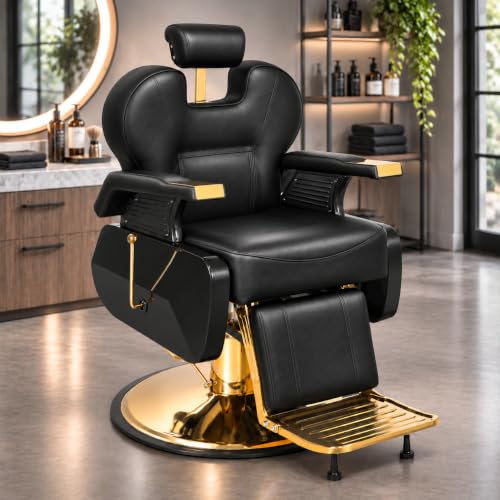
Heavy Duty Hydraulic Barber Chair Reclining — Best Straightforward Workhorse
Some shops want their chairs to disappear into the work, and this is the chair for them. Its listing describes a heavy-duty hydraulic reclining styling chair built for the hair salon and barbershop floor: 360 degree swivel base, a backrest shaped for support through a recline, and a footrest in place. There is no vintage theatre and no novelty styling — the design energy has gone into the mechanism and the seating geometry, which is where a working chair’s energy belongs. For a first shop, a rental chair, or a second station that must simply perform, that plainness is a feature.
The working rhythm this chair supports is the everyday one: pump up for the cut, spin for the angle, ease back for the finish. A chair like this earns its money in the cuts-per-day middle of the market, where reliability at a sensible tier matters more than a showpiece silhouette. The shaped backrest deserves its mention because clients sit longer in a barber chair than they expect to — a full service with a beard trim can run past the half hour — and a back that supports rather than merely pads keeps those minutes comfortable without any drama.
Buyers should go in with clear eyes about what the plain approach leaves out. The listing’s appeal is mechanical rather than luxurious, and shops building a heavily branded, photograph-first interior may find its looks too quiet. But chairs are replaced for failed pumps and torn seams, not for insufficient glamour, and a workhorse specification at an honest tier is the purchase most single-chair shops actually need.
There is a rental-shop scenario where this chair makes particular sense. Barbers who rent a chair in someone else’s shop — the classic booth-rental arrangement — need equipment that is unmistakably competent without being so personalised that it argues with the room. A plain heavy-duty recliner threads that needle: the shop owner sees a professional tool, clients see a proper barber chair, and the renting barber owns an asset that can move with them to the next shop or into a first shop of their own. Portability between premises is rarely listed on a specification sheet, yet for the first five years of many careers it is the specification that matters most.
- Type: hydraulic reclining barber chair
- Base: 360 degree swivel
- Backrest: ergonomically shaped for reclined work
- Footrest: included
- Setting: barbershop and salon floors
Strengths
- Heavy-duty hydraulic brief covers daily commercial rhythm.
- Full swivel keeps the barber planted and the client moving.
- Unfussy design suits any shop interior.
Trade-offs
- Styling is utilitarian beside the vintage options here.
- Fewer headline figures than the 700 lb class chairs.
- Plain finish will not anchor a themed interior.
Best for: new shops and second stations needing a dependable daily chair. Not suited for: traditional rooms built around vintage theatre.

All Purpose Reclining Barber Chair 140 Degree — Best Deep Recline
The headline here is an angle: 140 degrees of recline, the deepest in this guide, delivered by a heavy-duty hydraulic pump on a 360 degree swivel. Five degrees sounds like nothing on paper. In the chair, it is the difference between a client who is leaning back and a client who is settled back — chin presented, neck relaxed, face at the angle a straight razor or a careful beard line actually wants. Shops whose menu leans into shaves, hot towels and beard sculpting should read that figure as the chair’s whole argument, and it is a good one.
The all-purpose half of its name matters too. The listing positions the chair for the barbershop and the home studio alike, with adjustable height doing the diplomatic work between different barbers and different clients. A chair that reclines deeply must also return gracefully, and the recline mechanism on a chair of this class is worked by the barber’s hand and foot in a practised rhythm; what you are buying is not just the angle but the smoothness of arriving at it and leaving it, several dozen times a day, without the client ever feeling transported rather than positioned.
Consider floor space before falling for the angle. A chair at full 140 degree recline occupies a longer footprint than its upright self, and a tight shop laid out for upright cutting can find its walkways swallowed. Measure the chair’s reclined length against your station spacing, and this becomes the shave specialist’s pick; skip the measuring and it becomes an argument with your own floor plan.
Hot-towel work is where the deep recline quietly earns a second living. A client settled at 140 degrees with a towel over the face is a client whose whole body has been given permission to stop holding itself up, and barbers who offer the ritual know it converts first-time visitors into regulars at a rate no discount matches. If your shop’s growth plan involves premium services rather than faster chairs, the recline angle is not a detail — it is the platform those services are delivered on, and it should be bought with the same seriousness as the clippers themselves.
- Recline: 140 degrees per the listing
- Pump: heavy-duty hydraulic
- Base: 360 degree swivel
- Height: adjustable for barber and client
- Settings: barbershop and home studio
Strengths
- Deepest recline in the guide for shave-focused menus.
- Heavy-duty pump supports the reclined load arc.
- All-purpose positioning suits shop and home use.
Trade-offs
- Full recline needs generous floor space behind the chair.
- Shave-light shops will rarely use its party trick.
- Deep-recline comfort depends on headrest fit for each client.
Best for: shops where shaves and beard services anchor the menu. Not suited for: compact stations with no room for a full recline footprint.

Artist hand Vintage Barber Chair 700 lb — Best Vintage Statement
Traditional barbering sells an atmosphere as much as a haircut, and this chair is built to be that atmosphere’s centrepiece: vintage styling, the kind of silhouette that reads as heritage from the pavement outside. Underneath the period looks, though, the specification is thoroughly modern and thoroughly serious — a heavy-duty pump in the 700 lb class per the listing, hydraulic height adjustment, a 135 degree recline, full swivel, an adjustable headrest and a flip-up footrest. It is a modern working machine wearing its grandfather’s clothes, and for the right shop that combination is not a compromise but the entire business model.
The flip-up footrest deserves attention beyond its convenience. Clients mounting and leaving a chair dozens of times a day catch feet on fixed rests; a rest that flips away clears the exit, which matters for older clients and for the end-of-service moment when a client stands up slightly dazed from a hot towel. The adjustable headrest completes the shave geometry, and the 135 degree recline — a touch more upright than the deepest chair here — suits shops whose reclined work is beard shaping and finishing rather than full traditional shaves.
What you are paying for, beyond the mechanics, is presence, and presence should be bought deliberately. A vintage chair in a minimalist modern shop looks like a prop; the same chair among timber, tile and tonic bottles looks like a promise. If your shop’s identity is traditional, this is the strongest single purchase in the guide. If your identity is still undecided, buy the workhorse first and let the shop’s character declare itself before investing in theatre.
One more consideration belongs to shops in older buildings with character floors. A vintage-styled chair over a heavy base concentrates real weight on a small footprint, and period rooms often sit on period floorboards. Spread the load with a suitable mat or board beneath the base — a practical step that also happens to suit the aesthetic, since traditional shops have always used mats at the chair. Heritage done properly is a system, not a single purchase, and the floor is part of the system.
- Pump class: 700 lb per the listing
- Recline: 135 degrees
- Headrest: adjustable
- Footrest: flip-up design
- Styling: vintage traditional
Strengths
- Heaviest-duty pump class with period styling.
- Flip-up footrest eases client entry and exit.
- Adjustable headrest completes the shave setup.
Trade-offs
- Vintage look commits the room’s whole aesthetic.
- Recline is deep but not the deepest here.
- Statement pricing tier compared with plain workhorses.
Best for: traditional shops selling heritage atmosphere. Not suited for: minimalist interiors or undecided shop identities.

BarberPub Heavy Duty Barber Chair 2008 — Best for Busy Shops
BarberPub builds for the trade, and the 2008 model reads like a chair specified by someone who has run a Saturday queue. The pump is in the 700 lb class per the listing — the figure that matters when your clientele includes everyone who walks in off the street — and the backrest and headrest both adjust, because a chair worked by three different barbers across a week must fit three different working styles, not one. The padding is described in the language of comfort for a reason: in a busy shop the chair is occupied almost continuously, and its comfort is experienced in aggregate, by the fortieth client as much as the first.
Multi-chair shops should pay particular attention here, because consistency is a purchasable virtue. A row of matched heavy-duty chairs gives a shop a uniform silhouette, interchangeable working heights, and a maintenance routine the whole team learns once. When one chair eventually needs attention, the others carry the floor without the shop’s rhythm changing shape. That operational calm is worth real money to a business, and it is why trade-focused models like this one, short on novelty and long on duty ratings, dominate working floors.
The honest limitation is individuality: this chair will not be the photograph that defines your shop’s social media, and solo barbers building a one-chair studio around a single statement piece may find more joy in the vintage Artist hand. But for chairs bought in pairs or rows, for shops where Saturday decides the week’s takings, the 2008’s specification is the one written in the right order — pump, adjustments, padding, and looks last.
BarberPub’s trade focus shows in a place buyers overlook: the chair assumes it will be cleaned aggressively and often. Working shops wipe chairs down between every client with products chosen for speed, and upholstery and finishes specified for commercial rhythm tolerate that treatment in a way domestic furniture does not. When you compare a trade chair with a prettier domestic alternative at a similar tier, that tolerance is frequently the real difference — invisible in the showroom, decisive in the second year.
- Pump class: 700 lbs per the listing
- Adjustments: backrest and headrest
- Base: 360 degree swivel
- Padding: comfort cushioning for continuous use
- Model: BarberPub 2008
Strengths
- 700 lb class pump for unrestricted walk-in clientele.
- Adjustable backrest and headrest suit multiple barbers.
- Trade-focused design for matched multi-chair rows.
Trade-offs
- Working looks rather than statement styling.
- Heavier-duty build means a heavier chair to position.
- Solo studios may prefer a more distinctive single piece.
Best for: busy multi-chair shops and barbers who share stations. Not suited for: one-chair studios built around a vintage centrepiece.

Artist hand Professional Reclining Barber Chair — Best All-Purpose Versatility
The second Artist hand chair in this guide takes the opposite brief from its vintage sibling: instead of specialising in heritage, it generalises across the whole map of seated client work. The listing describes a professional all-purpose reclining chair with a heavy-duty hydraulic pump, multi-functional design, 360 degree swivel and adjustable height, positioned for barbershops, homes and spa and beauty work. That breadth suits a real and growing class of buyer — the home barber with a converted garage, the single-chair studio offering cuts and beard work and the occasional facial-adjacent service, the newly qualified barber whose menu is still evolving.
Versatility in a chair is mostly about not being wrong anywhere. The recline serves shaves; the swivel serves cutting; the adjustable height serves barbers of different statures sharing one station across a week. A specialist chair beats it at its specialism — the vintage model out-styles it, the 140 degree model out-reclines it — but a chair that is good at everything and wrong for nothing is precisely what a developing business needs, because the business does not yet know which service will carry it.
Buy it as a foundation and it also makes a sensible future second chair: when the shop grows and a specialist arrives, the all-purpose chair slides into the second station without complaint. Few purchases in a young shop offer that kind of forward compatibility, and it is why this model, the least theatrical in the guide, may be the most commercially sensible of the five.
Garage and garden-room barbers — a larger population than the industry sometimes admits — will find one more virtue here: the chair’s all-purpose design does not demand a commercial interior to make sense. Set among home surroundings it still reads as professional equipment rather than shop surplus, which matters when your clients are neighbours and friends whose trust is your entire marketing. A chair that dignifies a home studio helps charge professional prices in it, and that return dwarfs any small saving from buying domestic furniture and hoping nobody notices.
- Pump: heavy-duty hydraulic
- Design: multi-functional, all-purpose reclining
- Base: 360 degree swivel
- Height: adjustable
- Settings: barbershop, home and beauty work
Strengths
- Broadest brief in the guide — cuts, shaves and beauty work.
- Heavy-duty pump beneath the versatility.
- Ideal first chair that later serves as a second station.
Trade-offs
- Out-specialised by rivals at styling and at recline depth.
- Generalist looks will not define a themed shop.
- Jack-of-all-trades brief may not satisfy purists.
Best for: home barbers, new shops and evolving service menus. Not suited for: established traditional shops wanting heritage styling.
Cast-Iron Antique Barber Chairs, Discussed Generically — Heritage Option, Prose-Only
Every barber eventually stands in front of a genuine antique: a century-old cast-iron chair, porcelain and nickel and worn leather, heavy as a motorcycle and beautiful as sculpture. This guide covers the idea in prose only, because such chairs are bought from restorers, auctions and estate sales rather than listings, and their condition varies more than any specification could capture. What can be said generically is this: a restored antique from a reputable specialist is a working chair with unmatched presence, priced at a heritage tier, and an unrestored one is a project — seized hydraulics, perished leather, missing parts that must be machined rather than ordered.
The working cautions are equally general. Antique mechanisms were built for a different era’s maintenance culture, and they expect regular oiling and sympathetic handling; parts are not a phone call away. Their weight makes them effectively permanent once positioned, which suits an owned shop and punishes a rented one. And their seating geometry predates modern expectations, so clients experience charm and novelty alongside a firmer, narrower sit than a modern chair offers. None of that disqualifies the antique — shops built around one genuine piece have an atmosphere no reproduction fully matches — but it should be bought as a long-term restoration commitment, ideally after the shop already owns a modern chair that can carry the floor while the antique is serviced.
Best for: established traditional shops buying a restored centrepiece from a specialist. Not suited for: new shops needing a chair that simply works from the day it arrives.
One hybrid strategy deserves a mention for shops torn between eras: buy the modern vintage-styled chair for the working floor — the Artist hand above exists precisely for this — and acquire a genuine antique later, when the business can absorb a restoration as a labour of love rather than a gamble. The shop gets its heritage look immediately, its clients get modern mechanics, and the antique, when it comes, arrives as a celebration instead of a risk. Sequencing is an underrated skill in fitting out a shop, and chairs are where it pays most visibly.
What Should You Expect on Delivery and Assembly Day?
A barber chair arrives as a heavy, awkward promise, and planning its arrival is part of buying it well. Measure the doorway it must pass through — shop doors, and especially the doors of houses hosting home studios, are narrower than memory suggests — and clear its route to the station before the courier is standing in it. These chairs are two-person lifts in any sensible world; recruit the second person in advance rather than discovering the chair’s weight with your spine. Keep the packaging until the chair has passed its first week of tests, because returns and warranty claims travel far more smoothly in original boxes.
Assembly on chairs of this class is usually a matter of joining base, pump and seat sections with substantial fixings, and it rewards patience over speed: leave every bolt finger-loose until the sections are aligned, then tighten in sequence, then sit in the chair and work it before reaching for the final quarter-turn. Position it on its station only once assembled, and make the first placement provisional — live with the chair for a day’s appointments before deciding its exact spot, because the right place is discovered by working, not by looking. A chair placed with that care tends to stay placed for years, which is exactly what a heavy chair wants.
What Should You Check in the First Week of Owning a New Barber Chair?
Treat the first week as a commissioning period, not a victory lap. Work the pump through its full travel with a heavy volunteer seated, and listen: a healthy hydraulic lift is nearly silent, and any grinding, clicking or uneven descent in week one is a warranty conversation to have immediately, while the chair is new and the seller’s goodwill is warm. Test the recline under load at several points in its arc, spin the chair a full turn with someone seated, and check that the headrest holds its set position when a real head leans into it rather than merely when a hand pushes it.
Then look at the chair’s relationship with your floor and your station. Roll your trolley past it, stand where you stand, and confirm the working triangle — chair, mirror, tools — has not acquired an awkward corner. Small placement adjustments in week one are free; the same adjustments discovered in month three have usually hardened into daily irritations that nobody fixes because the shop has learned to walk around them. Finally, photograph the chair and record its purchase details somewhere durable. When a part is needed in year four, that small archive turns a research project into a phone call.
How Do the Picks Compare on the Figures That Matter?
| Pick | Pump class | Recline | Standout trait |
|---|---|---|---|
| Heavy Duty Hydraulic Barber Chair Reclining | Heavy duty | Reclining | Plain workhorse specification |
| All Purpose Reclining Barber Chair 140 Degree | Heavy duty | 140 degrees | Deepest recline for shave work |
| Artist hand Vintage Barber Chair 700 lb | 700 lb class | 135 degrees | Vintage styling, flip-up footrest |
| BarberPub Heavy Duty Barber Chair 2008 | 700 lbs class | Adjustable backrest | Built for continuous multi-barber use |
| Artist hand Professional Reclining Barber Chair | Heavy duty | Reclining | All-purpose, multi-setting versatility |
| Cast-Iron Antique Barber Chairs, Discussed Generically | Varies by restoration | Varies | Heritage presence, project commitment |
Notice what the table treats as a footnote: looks. That is not because appearance is unimportant — the vintage row exists because appearance can be a business strategy — but because appearance is the one quality you can judge perfectly from a photograph, while the pump and the recline must be taken on the listing’s word and tested on delivery. Spend your scepticism where photographs cannot help you, and your taste where they can, and a comparison table like this one will have done its job.
Read the pump column before the recline column and the recline column before everything else, and the table becomes a shortlist machine. Shops serving unrestricted walk-in trade should start in the 700 lb class rows; shave-led menus should start at the 140 degree row; everyone else can let budget tier and interior decide among the heavy-duty workhorses.
What About the Client’s Experience of the Chair?
Barbers naturally evaluate a chair from behind it; clients evaluate it from inside it, and their criteria are worth a section of their own. A client notices the mount first — whether the chair feels steady as they step onto the footrest and turn to sit, a moment of genuine vulnerability for older clients and anyone with a knee that complains. They notice the lift next: a smooth rise feels like professionalism, while a jerky one feels like a fairground. And they notice the recline most of all, because being tipped backward by another person is an act of trust, and a chair that reclines in one controlled motion, with their head met by a headrest that is actually where heads are, converts that trust into the relaxation that makes them book again.
Small sensory details accumulate into the verdict. A footrest that does not rattle. Armrests at a height where hands rest rather than dangle. Upholstery that is neither cracked nor cold through a shirt. None of these appear on a specification sheet, yet they are precisely what a client means when they tell a friend the shop is “proper”. When you test chairs — and you should sit in any chair before it earns a floor — test them as a client, in order: mount, lift, spin, recline, dismount. Your clients will run exactly that sequence, in exactly that order, and judge you by the worst moment in it.
How Should You Position and Work a Barber Chair Through a Service?
Set the chair’s height to the work, not to habit. Cutting happens with the client’s head at a height where your elbows stay relaxed and your wrists neutral; pumping the chair two inches higher and working with dropped shoulders beats hunching over a low client all day, every day, for a whole career. Spin the chair rather than walking around it whenever the floor allows, and make the recline a deliberate, communicated movement — a hand steadying, a word of warning — because clients who are tipped back by surprise grip the armrests, and a gripped client cannot relax into a shave.
Height discipline deserves its own sentence in any barber’s training, because the pump makes it effortless to be lazy. It is always easier to leave the chair where the last client left it and bend yourself to fit — for one cut. Across six days a week and a working lifetime, those small bends are the job’s physical price, and the chair’s whole purpose is to pay it instead of you. Pump the chair to the work every single time; the half-second it costs is the cheapest occupational health measure in the building.
Between clients, the chair gets its thirty-second service: hair swept from the footrest and base, headrest wiped, recline returned upright, pump tested with a press of the foot. That tiny ritual is not fussiness. Hair in a caster or a pump seal is tomorrow’s mechanical complaint arriving early, and a chair that is visibly reset between clients tells the next person in it that the shop runs on standards. Busy barbers fold the reset into the farewell — by the time the door closes, the chair is ready, and so are they.
How Do You Clean and Maintain a Barber Chair Day to Day?
Daily care divides into what happens between clients and what happens at close. Between clients the routine is measured in seconds: clippings swept from the seat, footrest and base, the headrest and armrests wiped, the chair returned upright. Hair is the enemy in residence — it works into casters, pump seals and recline pivots with the patience of water — and a shop that treats sweeping as part of the service rather than a separate chore will get years more from the same chair. Keep a brush at the station for exactly this purpose; a brush that lives elsewhere will not be used, and everyone in the trade knows it.
At close of day, the chair earns five slower minutes. Wipe the upholstery with a cleaner suited to its material, because the tonics, oils and disinfectants of the trade dry coverings out when they are left sitting on them overnight. Check the base for the day’s accumulation, work the pump once through its range, and glance at the recline mechanism for anything working loose. Weekly, that routine extends to the underside and the floor beneath, where hair and product conspire quietly. None of this requires a technician; it requires only the recognition that a barber chair is maintained in minutes daily or repaired in days annually, and the minutes are cheaper.
Know, finally, which jobs are yours and which are a service engineer’s. Tightening accessible fittings, cleaning, and lubricating where the maker directs are owner work. A pump that sinks under load, a recline that drops suddenly, or a base crack are professional work, and attempting them yourself converts a service bill into a replacement bill with impressive reliability. Build the engineer’s number into the shop’s contacts the day the chair arrives, not the day it fails.
How Does a Barber Chair Pay for Itself?
It is worth doing the arithmetic the way an owner does, because it reframes every figure in this guide. A working chair delivers several thousand services across its life. Spread its purchase price across those services and the chair’s share of each haircut is remarkably small — small enough that the difference between a cheap chair and a properly rated one amounts to a trivial sum per client, while the difference in reliability is experienced at full size, in public, on the busiest day of the month. Owners who have replaced a failed chair mid-season rarely buy on price again; the lesson is taught once and remembered permanently.
The chair also earns indirectly. Clients judge a shop’s standards by its most visible equipment, and a chair that lifts smoothly, reclines without shuddering and looks cared for is a silent argument for the price on the board. Barbers feel the return in their own bodies: a chair that positions clients correctly, at the right height, all day, is a chair whose owner goes home with shoulders that still work. When a purchase touches revenue, reputation and the barber’s own longevity at once, buying the properly rated version stops looking like spending and starts looking like the business it is.
What Mistakes Do Shops Make When Buying Barber Chairs?
Buying the chair for the photograph instead of the pump is the expensive classic. A chair can be the most beautiful object in the shop and still be a poor purchase if its hydraulics are rated close to your heaviest client, because pumps do not fail on the quiet Tuesday — they fail under load, mid-service, in front of an audience. The second mistake is forgetting the floor: a reclining chair needs space behind it, a heavy base needs a floor that can take point loads, and a swivelling chair needs clearance from the station behind. Measure the working footprint, not the catalogue footprint.
Shops also underestimate delivery reality: a heavy chair that cannot pass the doorway, or that arrives during Saturday trading because nobody scheduled it, starts its life as a problem in the middle of the floor. And a subtler error is buying a chair whose parts and support are a mystery — when a pump eventually needs attention, the shop with a documented model, a purchase record and a maker who answers is back at work in days, while the shop with an anonymous bargain is shopping for a whole chair under pressure.
A third error is mixing chairs in a row to save money, then discovering that three different heights, recline angles and footrest designs make every barber’s day a series of small re-learnings. Matched chairs are a workflow decision, not a vanity. And the quietest mistake is neglecting the headrest test: sit in the chair, recline it, and put your own head back before your first client does. If the headrest misses your head, it will miss theirs, and no amount of pump capacity compensates for a shave position that does not hold the head still and comfortable.
A word for the buyer still hesitating between the two 700 lb class chairs, since they are the guide’s twin peaks. Choose the vintage Artist hand when the chair must carry the room’s identity as well as its clients; choose the BarberPub when the chair must carry a queue, a team and a cleaning rota, and let other furniture do the decorating. Both decisions are defensible, both chairs will work for years, and the hesitation usually dissolves once the question is asked in that order — identity first, or operations first — because every shop honestly knows which one it is.
Final Recommendation
Let your menu choose. Shave-led shops should take the 140 degree all-purpose chair and give it the floor space its recline deserves. Traditional rooms should invest in the vintage Artist hand and build the interior around its presence. Busy multi-chair floors belong to the BarberPub 2008, bought in matched rows, while new and evolving businesses get the most from the professional all-purpose Artist hand or the plain heavy-duty workhorse, according to taste. Whichever chair you choose, test its headrest with your own head and its pump with your heaviest friend before the first paying client sits down — a barber chair earns trust mechanically, one smooth lift at a time.
Frequently Asked Questions
What does the pump weight rating on a barber chair actually mean?
It is the load the hydraulic lift is built to raise and hold smoothly, as stated on the listing. Think of it the way you would think of a bridge’s rating rather than a guess at its strength: the figure exists so that ordinary use happens well inside it, with margin left for the unusual day. A shop that knows its clientele can buy close to its needs; a shop that takes all comers should buy the margin without debating it, because the one client who exceeds a modest pump will arrive, as such clients always do, on the busiest afternoon of the year. Treat it as a working ceiling rather than a target: a chair whose clients regularly approach its rating will age faster than one working comfortably inside it. Shops with unrestricted walk-in trade buy headroom deliberately, which is why the 700 lb class chairs exist in this guide.
How far should a barber chair recline for shaves?
The chairs here cluster between 135 and 140 degrees, and that band is the trade’s settled answer: far enough that a client’s face presents upward and their neck can relax into the headrest, not so far that the client feels tipped or the barber must lean awkwardly over them. Shops doing occasional beard trims manage happily at the upright end; traditional wet-shave menus should shop at the deeper end.
Can a home barber use a professional barber chair?
Yes — the all-purpose models here are explicitly positioned for home studios as well as shops. The checks are practical rather than professional: floor strength for a heavy base, doorway width for delivery, and recline clearance in a room that may also be a garage or spare bedroom. A professional chair in a home studio is not overkill; it is the same daily mechanics, simply with fewer witnesses.
What flooring works best under a barber chair?
Hard, level and cleanable is the whole brief: tile, sealed concrete, commercial vinyl and well-finished timber all serve, while carpet fights the casters, harbours clippings and lets a heavy base settle unevenly. Whatever the surface, a mat or load-spreading board under the base protects it from the concentrated weight, and the floor immediately around the chair should be part of the shop’s sweeping routine rather than its weekly one. Floors are judged with the chair, fairly or not — clients look down while they are being spun.
How do I keep a barber chair’s hydraulics healthy?
Keep hair and grit away from the pump and base, wipe spills before they reach seals, and work the lift through its full range regularly rather than leaving the chair parked at one height for months. A pump that begins to sink slowly or descend unevenly is asking for attention early, when a service visit is cheap, rather than later, when it is a replacement. Treat the chair like the machine it is and it will behave like one.
How many chairs should a new shop start with?
Start with the number of barbers working simultaneously, not the number you hope to employ next year. One excellent chair per working barber beats a room of empty stations, both financially and atmospherically — a busy single chair looks like success, while three idle chairs look like a warning. Add chairs when the booking pattern proves the need, and buy the same model again if you can, because the matched-row workflow advantages described in this guide compound with every identical chair you add.
Is a heavier chair always a better chair?
Weight in the base is stability, and stability matters when a client reclines. Judge it by behaviour rather than by the scale: a well-weighted chair stays composed when a heavy client sits down near its edge, shifts during a cut, or pushes up from the footrest to leave. If a chair you are testing rocks, creeps across the floor or asks to be steadied, its weight is in the wrong places regardless of what it totals. But total weight also decides whether you can reposition the chair for cleaning or a shop refit without recruiting help, and whether a first-floor shop’s floor is happy about it. The goal is a base heavy enough to feel planted under a reclined client — not the heaviest chair you can find for its own sake.
Related Guides
A barbershop is one room in a wider world of seating decisions. Readers furnishing the rest of a building may also enjoy Best Chairs for the Bathroom for another hard-working, water-adjacent seat, Best Chairs for the Head of a Dining Table for the chair as a statement piece, and Best Chairs for Long Board Game Sessions for comfort measured in hours rather than minutes. For the chair as pure evening furniture, see Best Black Leather Chairs for a TV Room.


