What's inside
- Key Takeaways
- Quick Picks
- How We Chose These Picks
- How Do the Six Compare at a Glance?
- How Should You Organise Five or Six Shelves So Nothing Gets Forgotten?
- Where Does a Six Cubic Foot Upright Actually Fit in a Real House?
- How Do You Defrost a Small Upright Without the Drama of a Chest?
- When Does Converting Between Fridge and Freezer Actually Pay?
- How Does a Small Freezer Change the Way a Household Shops?
- What Running Habits Keep a Small Upright Efficient for a Decade?
- How Should Renters and Landlords Think About This Class?
- Which Mistakes Do Small Upright Buyers Make Most Often?
- What Should the First Shop for a New Small Freezer Look Like?
- How Quiet Is Quiet Enough When the Freezer Lives Indoors?
- Final Recommendation
- Frequently Asked Questions
- Related Guides
As an Amazon Associate I earn from qualifying purchases. This post may contain affiliate links at no extra cost to you.
cottageverdict.com is reader-supported. When you buy through links on our site, we may earn an affiliate commission.
Where to buy: each upright below links to its Amazon listing, where the exact dimensions and door configuration can be checked against the alcove, closet, or garage corner you have in mind. The best 6.0 cu ft upright freezers occupy the sweet spot of second-freezer ownership — tall enough to organise a household’s overflow, slim enough to fit where a chest cannot — and this guide begins with a disclosure the class deserves: the first two picks are the same Commercial Cool 6.0 cubic foot freezer in black and in white, one platform wearing two finishes, presented here as twins rather than as rivals.
That twinship frames the whole class honestly. Around the two 6.0 models sit a 6.4 cubic foot Frigidaire with a retro-styled platinum finish, a 5.0 cubic foot Commercial Cool for tighter households, a 7.1 cubic foot Midea that converts between freezer and refrigerator, and a Hamilton Beach convertible with glass shelves. The real spread is therefore 5.0 to 7.1 cubic feet around the six in the title, and every model’s own number is stated in its own review rather than rounded toward the headline. A household that reads capacities exactly will choose better than one that shops the search phrase.
Why upright at all, at this size? Because six cubic feet behind a door, on fixed shelves, is the freezer a small household actually uses daily: ice cream visible, vegetables filed, the good leftovers rescued from the kitchen freezer’s crush. The upright tax — cold air spilling at each opening — is real but modest at this scale, and it buys the visibility that keeps food rotating instead of fossilising. If that trade suits your kitchen, this class is your territory.
Key Takeaways
- The black and white Commercial Cool picks are the same 6.0 cubic foot platform in two finishes; choose by room and by delivery terms, not by specification.
- True capacities in this guide run 5.0, 6.0, 6.4, and 7.1 cubic feet, and each review states its model’s number exactly.
- Fixed shelves define the Commercial Cool design, while the two convertible picks — Midea and Hamilton Beach — can serve as refrigerators when the household needs change.
- Reversible doors appear across the Commercial Cool line, a practical mercy for alcoves and left-or-right corners.
- The Frigidaire’s retro platinum styling makes it the pick when the freezer will live in sight of the kitchen rather than in a garage.
- At this size, organisation beats capacity: a well-run 5.0 serves a small household better than a chaotic 7.1.
Quick Picks
| Pick | Badge | Why it earns its place |
|---|---|---|
| Commercial Cool 6.0 Cu Ft Upright Freezer Black CCUL60B6 | The Black Original | Six cubic feet on five fixed shelves with a reversible door, in the finish garages forgive. |
| Commercial Cool 6.0 Cu Ft Upright Freezer White CCUL60W6 | Same Freezer, in White | The identical CCUL60 platform in white for laundry rooms and bright utility spaces. |
| Frigidaire Upright Freezer 6.4 Cu Ft Platinum | Retro Platinum Pick | 6.4 cubic feet in a Platinum Design Series cabinet with retro script and a reversible door. |
| Commercial Cool 5.0 Cu Ft Upright Freezer CCUL50W | Compact Step-Down | Five cubic feet on four fixed shelves for couples and small households that fill honestly. |
| Midea 7.1 Cu Ft Upright Freezer Convertible Black | Largest, and Convertible | 7.1 cubic feet converting between fridge and freezer on adjustable glass shelves, in black. |
| Hamilton Beach Upright Convertible Fridge Freezer HBFRF6892 | Glass-Shelf Convertible | A convertible fridge-freezer with removable glass shelves and a reversible door for flexible rooms. |
How We Chose These Picks
We anchored the class at 6.0 cubic feet and then admitted the neighbours a real shopper would cross-shop: one step down to 5.0 for the small household, a step up to 6.4 and 7.1 for the household whose overflow keeps growing. Every capacity in this guide is the manufacturer’s own figure for that model, printed in its review’s specification list without rounding, because a guide that fudges the numbers it exists to clarify has failed at its only job.
The twin Commercial Cool models were handled the way duplicates should be: disclosed in the introduction, given parallel reviews that concentrate on finish and placement, and never dressed as competing machines. Beyond the twins, we weighed what distinguishes small uprights in lived use — shelf design, door reversibility, convertibility, and styling for the models destined to live in sight. Fixed shelves suit owners who load the same categories weekly; glass shelves suit owners who want light and wipe-clean surfaces; convertibility suits households whose cold-storage needs swing with seasons, guests, and renovations.
What we did not do is import frost-free claims, temperature ranges, or efficiency ratings that a listing does not state. Small freezers live or die on placement and habits more than on exotic systems, so the guidance sections of this guide carry the practical weight: where to put a six-footer, how to organise five or six shelves, and how to keep a modest cabinet earning its electricity across a decade.

Commercial Cool 6.0 Cu Ft Upright Freezer Black CCUL60B6 — The Black Original
Model CCUL60B6 is the reference point for this class: 6.0 cubic feet of upright freezer on five fixed shelves, with a reversible door and adjustable levelling legs, finished in black. Fixed shelves are a deliberate philosophy at this size. They cannot be rearranged, which sounds like a limitation until a household realises its categories never change — ice cream and desserts at eye level, proteins low, vegetables and bread between — and that fixed geometry removes a whole class of shelf-collapse and lost-clip frustrations. The shelves also carry the airflow design the manufacturer intended, spacing loads so cold circulates as engineered.
Black is the working finish. In a garage it shrugs off the scuffs of bicycles and toolboxes; in a basement it recedes into the corner’s shadow; in a rental it reads as intentional. The reversible door is the placement hero: alcoves that open left, corners that open right, and laundry rooms where the washer’s door has already claimed the good swing are all accommodated by hanging the door to suit the room. Adjustable legs finish the installation story, letting a slightly honest old floor still give the cabinet a level, sealing stance.
Six cubic feet, honestly assessed, is the overflow of a family kitchen or the whole frozen estate of a couple that shops monthly. It will not swallow a side of beef — the chest freezers in our larger guide exist for that — but it swallows the weekly shop’s surplus, the batch-cooking Sunday, and the ice cream economy of a household with children, all in a footprint a closet can host. Owners who match the machine to that mission report the particular satisfaction of a freezer that is always nearly full, which is also, not coincidentally, the state in which freezers run most efficiently.
Because this platform also wears white in the very next review, the buying advice is unusually free: compare the two listings’ delivery arrangements and choose the finish your room prefers. There is no wrong twin. There is only the room, the colour, and a decade of opening the door to find dinner exactly where you filed it.
- Capacity: 6.0 cu. ft. exactly
- Model: CCUL60B6, upright
- Shelves: five fixed freezer shelves
- Door: reversible, adjustable levelling legs, black finish
Strengths
- Reference capacity for the class with a stable fixed-shelf layout.
- Reversible door adapts to alcoves and awkward corners.
- Black finish forgives garage and basement wear.
Trade-offs
- Fixed shelves cannot be rearranged for outsized items.
- No convertible refrigerator mode for seasonal flexibility.
- Manual defrost class ownership, as with most small uprights.
Best for: families wanting a dependable six cubic foot overflow freezer in a working finish. Not suited for: buyers needing convertible modes or adjustable shelving.

Commercial Cool 6.0 Cu Ft Upright Freezer White CCUL60W6 — Same Freezer, in White
Plainly, once more: CCUL60W6 is the CCUL60 platform in white — the same 6.0 cubic feet, the same five fixed shelves, the same reversible door and adjustable legs as the black model reviewed above. This guide will not manufacture differences where the manufacturer made a colour. What a white finish changes is the room’s experience of the machine, and that is a legitimate subject for a short review, because freezers live for years in rooms their owners see daily.
White belongs in bright utility spaces: the laundry room with white machines already in residence, the pantry corner where a black box would glower, the basement finished in pale colours where the freezer is a citizen rather than an exile. White also shows frost, dust, and seal grime honestly, which tidy owners count as a feature — the machine tells you when it wants attention. In a household standardising on white appliances across a gradual refresh, this twin keeps the suite coherent without any specification compromise whatsoever.
The shared platform means the shared guidance applies in full: load the five shelves by stable category, hang the reversible door for your swing, level the legs until the door seals with a soft, even pull, and keep the cabinet mostly full for efficiency. Delivery logic between the twins is a free choice, so let the listing that reaches your home on the better day carry the colour your room prefers. Identical twins are a gift to decisive shoppers, and this guide’s only insistence is that you know they are twins before you choose.
If a salesperson or a listing ever suggests the white model is a different grade of machine, you now hold the model numbers to check the claim: CCUL60B6 and CCUL60W6 differ by a letter that denotes finish. That is the whole story, and it is enough — a good freezer, in the colour your laundry room asked for.
- Capacity: 6.0 cu. ft. exactly — identical platform to the black pick
- Model: CCUL60W6, upright
- Shelves: five fixed freezer shelves
- Door: reversible, adjustable levelling legs, white finish
Strengths
- Same proven six cubic foot platform in a bright-room finish.
- Matches white laundry and utility suites seamlessly.
- Twin listings let delivery terms guide the choice freely.
Trade-offs
- White shows garage grime and scuffs more readily than black.
- No specification difference to justify deliberation beyond colour.
- Shares the fixed-shelf, non-convertible platform limits.
Best for: white-suite laundry rooms and bright utility spaces wanting the CCUL60 platform. Not suited for: buyers hoping the colour signals a different machine.

Frigidaire Upright Freezer 6.4 Cu Ft Platinum — Retro Platinum Pick
Frigidaire’s entry is the stylist of the class: 6.4 cubic feet — the honest figure, a step above the headline six — inside a Platinum Design Series cabinet finished with the brand’s retro script and a vintage-inflected look the listing itself leans into. A reversible door keeps the practical box ticked. This is the small upright for the freezer that will live in the kitchen’s sightline, the studio’s open plan, or the scullery of a house where appliances are allowed to have personalities, and its extra four-tenths of a cubic foot over the Commercial Cool pair is a genuine, if modest, capacity dividend.
Retro styling is easy to mock and wrong to dismiss. Appliances occupy visual space for a decade, and a freezer whose design pleases its owner gets maintained, kept clean, and placed thoughtfully rather than exiled to the worst corner where its seals gather dust. The platinum finish walks a useful line — warmer and more designed than appliance white, less stark than black — pairing with both farmhouse and mid-century kitchens that the plainer picks would interrupt. Frigidaire’s name carries its own weight here: few brands are as woven into American cold-storage history, and the script on the door is a deliberate nod to that inheritance.
Functionally, expect the upright pattern executed by an experienced maker: shelved visibility, a door to hang either way, and capacity sized for a household’s overflow plus a little ambition. It does not claim convertibility, so its job is freezing, full-time — a clarity some households prefer. Put the entertaining overflow, the batch soups, and the ice cream reserve in it, in a room where people will see it, and let it be the rare second appliance that earns compliments instead of apologies.
Choose the Frigidaire when placement is visible and taste is a criterion, and when 6.4 honest cubic feet matches the household’s appetite. It is the pick that treats a utility purchase as a design decision without sacrificing the utility — which, in a guide full of garage machines, is a refreshing change of key.
- Capacity: 6.4 cu. ft. exactly
- Series: Platinum Design Series, retro script styling
- Door: reversible
- Format: upright deep freezer
Strengths
- Largest non-convertible capacity among the fixed freezer picks.
- Designed finish suits kitchens where the freezer is visible.
- Reversible door preserves placement flexibility.
Trade-offs
- No refrigerator conversion for seasonal role changes.
- Styled finish is a matter of taste some rooms will not share.
- Sits above the class headline size, so check the footprint twice.
Best for: visible placements and design-conscious households wanting 6.4 cubic feet. Not suited for: buyers needing a convertible fridge-freezer.

Commercial Cool 5.0 Cu Ft Upright Freezer CCUL50W — Compact Step-Down
CCUL50W is the class’s honest small: 5.0 cubic feet, four fixed shelves, a reversible door, and adjustable legs, in white. One cubic foot below the headline is not a failure of ambition; it is the correct size for the couple, the small household, the apartment with a utility closet, and the second home whose freezer works weekends. A freezer’s efficiency and usefulness both peak when it runs mostly full, and five cubic feet is the capacity a modest household can actually keep full of food that turns over, rather than half-full of good intentions and frost.
The platform kinship with the 6.0 twins is evident in the details — the same fixed-shelf philosophy, the same door flexibility, the same levelling practicality — scaled to the smaller cabinet. Four shelves divide naturally: proteins, vegetables, breads and batch cooking, desserts and ice. Owners of small uprights become, by necessity, the best organisers in the freezer world, and the CCUL50W rewards that virtue with a cabinet whose every shelf can be surveyed in one glance and reached without a stretch.
Placement is where the step-down shines. The smaller footprint slips into closets, under-stair spaces, and garage corners that refuse a six-footer, and its lighter demands suit rental properties where the freezer is a landlord’s amenity. Electricity appetite scales with size, so the smaller cabinet is also the modest bill — another quiet argument for sizing to the household rather than to the search phrase. Buy the freezer you will fill, and if your honest audit says five, this is the most sensible machine in the guide.
Households on the cusp — growing family, new batch-cooking habit — should weigh the twins above, because outgrowing a freezer in year two is the expensive outcome. But households certain of their scale will find the CCUL50W the class’s best-mannered appliance: present, organised, and never echoing.
- Capacity: 5.0 cu. ft. exactly
- Model: CCUL50W, upright, white
- Shelves: four fixed freezer shelves
- Door: reversible, adjustable levelling legs
Strengths
- Right-sized for couples and small households to run full.
- Small footprint fits closets and tight utility corners.
- Familiar Commercial Cool platform virtues at a smaller scale.
Trade-offs
- One cubic foot below the class headline, by design.
- Growing households may outgrow it within a few years.
- No convertible mode or adjustable shelving.
Best for: couples, apartments, and second homes with modest frozen stock. Not suited for: families whose overflow already strains six cubic feet.
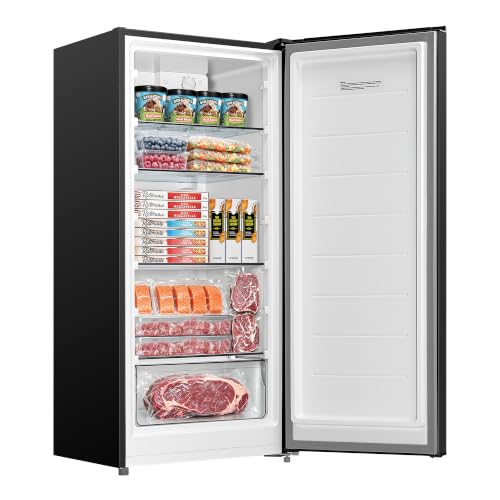
Midea 7.1 Cu Ft Upright Freezer Convertible Black — Largest, and Convertible
Midea brings the class’s ceiling and its party trick in one black cabinet: 7.1 cubic feet — stated exactly, the largest figure in this guide — that converts between freezer and refrigerator operation, with four adjustable glass shelves rather than fixed ones. Convertibility at this size is a household strategy. The cabinet freezes through the autumn glut and the holiday season, then turns refrigerator for the summer party, the kitchen renovation, or the month the main fridge is full of a wedding’s flowers and cakes. A second appliance that can hold either job rarely sits idle, and idle is the enemy of appliance value.
Adjustable glass shelves change the loading grammar compared with the Commercial Cool fixed racks. Tall items — the stockpot of soup, the upright turkey to chill, bottles standing in refrigerator mode — can be given a tall bay, while flat packages file densely elsewhere. Glass contains spills and wipes clean, and it lets light fall through the cabinet so the lowest shelf stays visible. The black finish suits the same garages and modern utility rooms as the black Commercial Cool, at a noticeably grander scale.
Seven-point-one cubic feet also demands the household be honest in the other direction: this is no longer a closet appliance. Measure the footprint, the door swing, and the delivery path with the seriousness the size deserves, and be sure the household’s stock justifies the cabinet, because a convertible run half-empty in either mode is floor space wearing a costume. For the growing family, the entertainer, and the household whose cold storage needs genuinely swing, though, the Midea is the most capable machine in this guide by a clear margin.
Midea’s global scale in appliances underwrites the proposition with parts and presence. Choose it when flexibility and headroom top the brief, and enjoy the peculiar luxury of a freezer whose hardest question is not what fits, but which mode next month wants.
- Capacity: 7.1 cu. ft. exactly — largest in this guide
- Modes: convertible freezer and refrigerator
- Shelves: four adjustable glass shelves
- Finish: black, upright format
Strengths
- Convertible operation covers two household jobs in one cabinet.
- Adjustable glass shelves accept tall and awkward items.
- Headroom for growing households and entertaining seasons.
Trade-offs
- Largest footprint here; closets and small alcoves need not apply.
- Half-empty running wastes the space the size was bought for.
- Glass shelves ask for weight awareness with heavy loads.
Best for: entertainers, growing families, and households with swinging cold-storage needs. Not suited for: tight footprints or households certain they only ever freeze.

Hamilton Beach Upright Convertible Fridge Freezer HBFRF6892 — Glass-Shelf Convertible
Hamilton Beach’s HBFRF6892 closes the guide with the second convertible proposition, built around removable glass shelves and a reversible door. Where the Midea sells scale, this model sells adaptability of layout: shelves that come out entirely let the cabinet swallow the occasional outsized item — the party platter to chill, the tall stockpot, the celebration cake — and return to filed order afterward. In refrigerator mode that flexibility is the whole game, since fridge loads are taller and more various than freezer loads; in freezer mode it lets a household reconfigure around a bulk delivery without a permanent commitment to one geometry.
The listing does not headline a capacity figure in the material this guide works from, so we will not invent one; check the listing’s own specification for the exact cubic footage and dimensions before ordering, and measure your space against them. That restraint aside, the format places it squarely in this class’s company — an upright second cabinet for overflow duty in kitchens, garages, and utility rooms — wearing a familiar American brand whose kitchen appliances have stocked homes for generations.
Convertible ownership suits households in transition: the renovation year, the growing family, the home that hosts every holiday. A cabinet that can be the drinks fridge in July and the freezer in November follows a household’s life rather than freezing it at purchase day. The reversible door supports the same adaptability in placement, letting the machine move rooms across its life — garage this year, pantry next — and still hang correctly for each.
Choose the Hamilton Beach when layout flexibility matters more than the last cubic foot, and when a removable-shelf interior matches the irregular shapes your household actually stores. Verify the dimensions on the listing, plan the door swing, and this adaptable cabinet will keep changing jobs as gracefully as your household does.
- Format: upright convertible fridge and freezer
- Model: HBFRF6892
- Shelves: removable glass shelves
- Door: reversible — confirm exact capacity and dimensions on the listing
Strengths
- Convertible modes adapt the cabinet to changing household needs.
- Removable shelves accept tall and outsized items.
- Reversible door lets the machine move rooms across its life.
Trade-offs
- Capacity figure must be confirmed on the listing before ordering.
- Glass shelves require sensible weight distribution.
- Jack-of-two-modes design will not out-freeze a dedicated chest.
Best for: households in transition wanting a reconfigurable second cabinet. Not suited for: buyers who need a stated capacity without checking the listing.
How Do the Six Compare at a Glance?
| Model | Capacity | Shelves | Standout |
|---|---|---|---|
| Commercial Cool 6.0 Cu Ft Upright Freezer Black CCUL60B6 | 6.0 cu. ft. | Five fixed | Black working finish |
| Commercial Cool 6.0 Cu Ft Upright Freezer White CCUL60W6 | 6.0 cu. ft. | Five fixed | Same freezer, white finish |
| Frigidaire Upright Freezer 6.4 Cu Ft Platinum | 6.4 cu. ft. | Upright shelving | Retro platinum styling |
| Commercial Cool 5.0 Cu Ft Upright Freezer CCUL50W | 5.0 cu. ft. | Four fixed | Compact step-down |
| Midea 7.1 Cu Ft Upright Freezer Convertible Black | 7.1 cu. ft. | Four adjustable glass | Convertible, largest here |
| Hamilton Beach Upright Convertible Fridge Freezer HBFRF6892 | See listing | Removable glass | Convertible flexibility |
How Should You Organise Five or Six Shelves So Nothing Gets Forgotten?
Small uprights reward a filing system more than large freezers do, because their whole virtue is visibility. Assign each shelf a category and defend the assignment: proteins on the lowest, coldest shelf where any drip is contained; vegetables and fruits above them; breads, doughs, and batch-cooked meals in the middle band the household reaches first; desserts and ice cream at eye level, where their morale function belongs. Door storage, where fitted, suits small, hardy items that tolerate temperature fluctuation — butter, nuts, herbs — rather than the proteins that deserve the cabinet’s steadiest cold.
Freeze flat and label relentlessly. Soups, sauces, and minced meats in thin bags file like books between frozen peas and pastry, thaw in minutes under water, and use the cubic footage the household paid for instead of the air around bulky tubs. A marker and a date on every package convert the freezer from a memory test into a menu. Then work the menu: one freezer meal a week, chosen from the oldest stock, keeps rotation honest and proves to the household, regularly, that the little cabinet in the corner is saving money rather than storing it.
Leave air its pathways. Even a small upright needs circulation gaps; a cabinet crammed until the door strains will run warm in its corners and frost at its vents. The discipline is the same as the big freezers’ — mostly full, never bursting — scaled to a cabinet where a single overambitious warehouse run can tip the balance. Shop to the shelves you own, and the shelves will serve you for years.
Where Does a Six Cubic Foot Upright Actually Fit in a Real House?
The candidate rooms are more numerous than buyers first think. A laundry room corner, a pantry alcove, the space under a stair, a garage bay’s edge, a basement wall near the steps — each offers the level floor and the outlet the machine needs, and the reversible doors across this guide exist because those rooms disagree about which way a door should swing. Measure the chosen spot in three dimensions, then measure the path to it: the hallway turn and the doorway that a six-footer must travel are the classic points where a good plan meets a wall.
Ventilation and temperature frame the placement. Leave the clearance the manual specifies at the back and top so the cabinet can shed its heat, and think about the room’s own climate: a garage that bakes or freezes deserves the same range check described in our larger freezer guide, while an indoor closet needs a thought about the warmth the machine exhales into a small air volume. Keep the freezer off circuits shared with hungry appliances where you can, and give it a floor that will forgive the occasional defrost drip. Placed with that modest care, a six cubic foot upright disappears into a household’s geography so completely that owners forget it was ever an addition — the surest sign of a second appliance chosen well.
How Do You Defrost a Small Upright Without the Drama of a Chest?
Manual defrosting frightens owners of small uprights less once they have done it once, because the scale is merciful: five or six shelves of food fit into a single cooler and a couple of insulated bags, and the cabinet itself melts out in hours rather than across a day. Schedule the job for a week when stocks are low — a deliberate run of freezer meals in the preceding days is the professional’s trick — then switch off, leave the door open, and lay towels at the base to catch the melt. Warm bowls of water on the shelves hurry the frost politely; knives and screwdrivers are forbidden for the same reason as in any freezer, since a punctured lining converts a chore into a catastrophe.
Use the empty hour well. Wipe the interior, wash removable shelves if your model has them, clean the door seal’s folds where crumbs and drips collect, and check that the seal still grips evenly by closing the door on a banknote at several points — resistance as you pull it free is the sign of a healthy seal. Restart the cabinet, let it reach temperature empty, and reload in the organised order your shelf system prescribes, dating anything whose label has faded. Twice a year of this rhythm, at most, keeps a manual-defrost upright in this class performing as it did when it arrived, and most owners find the second occasion so routine they wonder why the first one worried them.
Frost’s pace is diagnostic, too. A cabinet that frosts heavily within weeks is telling you something — a door left ajar by a package corner, a seal failing, a household opening the door twenty times a day in a humid room. Treat sudden frost as information rather than as fate, fix the cause the frost reported, and the defrost calendar stretches back to its proper, leisurely spacing.
When Does Converting Between Fridge and Freezer Actually Pay?
The convertible owners who profit are those whose year has a shape. Consider the patterns honestly: the household that hosts every major holiday and needs a drinks-and-desserts refrigerator in November and December; the garden household drowning in produce each September, when the cabinet must freeze; the renovation household whose kitchen fridge will be unplugged for a month; the hunting or fishing household with a short, intense freezing season and a long, quiet one. In each pattern the cabinet changes jobs at least twice a year, and each change displaces a rental, a borrowed fridge, or a crisis purchase of ice and coolers.
Conversion itself is a small ritual: empty, clean, switch the mode, allow the cabinet to settle at its new temperature, and load for the new role — refrigerator loads standing taller and airier than freezer loads, which is where the adjustable and removable glass shelves in this guide earn their keep. Keep a note of the date and the setting with the appliance paperwork, because the one convertible error that stings is forgetting which mode the cabinet is in and storing accordingly. A strip of tape on the door naming the current mode is the low-technology solution owners swear by.
If your year’s shape is flat — the same overflow, month after month — a dedicated freezer will serve you as well for less deliberation, and the Commercial Cool twins exist for exactly that household. Convertibility is a virtue only when the calendar uses it; bought as insurance for a life you do not lead, it is merely a feature. Read your year before you read the listings, and the right side of this guide will be obvious.
How Does a Small Freezer Change the Way a Household Shops?
Six cubic feet sounds modest until it is expressed as behaviour. It is the difference between buying the family’s proteins when they are well priced and buying them when the week demands, between a batch-cooking Sunday that stocks four future dinners and a Sunday that stocks one, between the garden’s beans blanched and kept and the garden’s beans given away. Small-freezer households shop less often and cook more deliberately, because the cabinet turns the weekly shop from a just-in-time scramble into a stocked system with a buffer.
The buffer’s value shows in the unplanned weeks: the illness week, the deadline week, the week the car is in the shop. A household with a filed freezer eats from its shelves while life happens, and that resilience — not the arithmetic of bulk savings, real as it is — is what owners mention when they describe the little upright as the best appliance decision they made. Size the cabinet to your household’s honest appetite, keep it organised enough to trust, and six cubic feet will punch far above its footprint in the household’s sense of security.
What Running Habits Keep a Small Upright Efficient for a Decade?
Small cabinets live or die by small habits. Keep the condenser area dusted, because a small machine shedding heat through a felt of garage dust works measurably harder for the same cold. Keep the door seal clean and its path unobstructed — one bag corner holding a door ajar overnight can frost a cabinet more thoroughly than a month of normal use. Set the temperature to properly cold and leave it there; a freezer is not a dial to be negotiated with weekly, and stability is both a food-quality and an efficiency virtue.
Loading temperature matters more than owners expect. Let cooked food cool before it enters, freeze in shallow portions that chill quickly, and avoid introducing a shelf of warm groceries in one heroic shop when two trips would do. The machine’s job is to hold cold, not to manufacture it against a weekly avalanche, and households that respect that division get faster freezing, better texture, and a compressor that ages at the pace the manufacturer intended. In a power cut, the same discipline reverses: keep the door shut, let the frozen mass do its slow, silent work, and judge the contents afterward by temperature rather than by anxiety.
Finally, listen and look monthly. A new vibration often means a levelling leg has settled or a shelf is touching the wall; a developing frost pattern points at the seal or the door habit; a longer-running compressor in mild weather suggests dust or a blocked vent before it suggests failure. Small uprights are honest machines that report their troubles early and cheaply — provided someone is paying the modest attention this paragraph describes.
How Should Renters and Landlords Think About This Class?
For landlords, a small upright is an amenity with unusual leverage: it makes a property feel provisioned, it suits the bulk shopping that tenants in car-light areas depend on, and at five or six cubic feet it fits the utility spaces rental homes actually have. Choose the durable, simple end of this guide — the Commercial Cool platform in whichever finish the property wears — document the defrost rhythm in the house notes, and leave the tenant a machine whose operation needs no explanation beyond its shelves. For renters buying their own, the same models’ modest footprints and reversible doors respect the reality that the next home’s alcove will swing the other way.
Second homes deserve a sentence of their own. A freezer that sits idle between visits should be left clean, dry, and ajar against odours if it will stand empty, or stocked and monitored if it will hold food — with the temperature alarm this batch of guides keeps recommending, since the cost of an unnoticed failure at a distance is a whole cabinet of food and a smell that greets the next holiday. The convertible picks add a graceful option for such homes: refrigerator for the occupied weeks, freezer for the departure stock of prepared meals, one cabinet following the house’s rhythm.
Which Mistakes Do Small Upright Buyers Make Most Often?
The twin trap is the first, and this guide was built to spring it: assuming two finishes are two machines, or — the mirror error — assuming a colour change hides a specification change elsewhere. Read model numbers, as the CCUL60 pair teaches. The second mistake is capacity rounding in the buyer’s own head, treating the whole class as “about six” when the difference between 5.0 and 7.1 is the difference between a couple’s overflow and a family’s second pantry. State your household’s honest number before shopping the class.
Third comes the convertible misunderstanding: buying a convertible and never converting it is harmless, but buying a fixed freezer while needing seasonal refrigerator space is a year of regret, so interrogate your calendar before choosing. Fourth, owners block the interior vents with a heroic first shop and conclude the machine is weak, when the machine is merely suffocated. Fifth, the door swing gets measured at the shop and forgotten at home, where the washer’s door has prior claim. And sixth, households skip the inventory habit because the cabinet is small — the very households whose small cabinet most needs rotation to shine. Every one of these errors is cheap to avoid at the ordering stage and expensive to live with afterward.
What Should the First Shop for a New Small Freezer Look Like?
Buy for the system, not for the celebration. The first load should establish the shelf assignments this guide described — proteins low, produce mid, batch meals where hands reach first, desserts at eye level — with everything dated and the flat-freezable items pressed thin from the start. Include the unglamorous staples that make a freezer useful on a tired Tuesday: the frozen vegetables, the butter, the bread, the portioned proteins, the one or two complete emergency meals. A freezer stocked for real life justifies itself within a fortnight; a freezer stocked with novelty items becomes a museum of good intentions.
Leave a little room in that first shop. Air must circulate, the household’s categories will shift as you learn your own patterns, and next week’s shop deserves a welcome rather than a wrestling match. Within a month the cabinet will have settled into its working fullness, its shelves will carry your household’s actual signature, and the little upright will have begun the long, quiet career this class is bought for.
How Quiet Is Quiet Enough When the Freezer Lives Indoors?
Apartment and open-plan living promote sound from a footnote to a criterion. A small upright’s compressor hum is modest beside a chest’s, but in a studio it joins the room’s permanent soundscape, so placement becomes acoustic design: against a solid wall rather than a hollow partition, away from the bed’s headboard wall, on a level floor that does not drum. Levelling deserves emphasis indoors, because a cabinet rocking almost imperceptibly through each compressor start will announce itself all night, while the same cabinet levelled and sealed settles into the background hum that households stop hearing within a week.
None of the listings in this guide headline a decibel figure, so this page will not rank them by a number nobody published. Instead, buy the placement: choose the room, the wall, and the floor with the machine’s voice in mind, keep its vents dusted so the compressor never strains, and any of these six will live indoors politely. The household that thinks acoustically at the ordering stage rarely thinks about freezer noise ever again, which is the entire goal.
Final Recommendation
The class reference remains the Commercial Cool 6.0 platform, and the choice between its finishes is the easiest in this guide: the Commercial Cool 6.0 Cu Ft Upright Freezer Black CCUL60B6 for working rooms, the Commercial Cool 6.0 Cu Ft Upright Freezer White CCUL60W6 for bright ones — same freezer, same shelves, same honest six cubic feet. Households whose freezer will be seen and judged should step to the Frigidaire Upright Freezer 6.4 Cu Ft Platinum and enjoy both the styling and the extra capacity it quietly carries.
One final rehearsal is worth the four strips of tape it costs: outline the footprint on the floor of the room you have chosen, stand in the outline’s doorway, and act out a week’s interactions — the shop unloaded, the Tuesday dinner retrieved, the ice cream negotiated at eye level. If the rehearsal feels easy, the cabinet and the room agree, and the only remaining decision is the finish on the twin or the mode on the convertible. If it feels awkward, believe the tape rather than the listing photograph, and move the outline before you move the money.
Below and above the anchor size, the logic stays exact: five cubic feet for the household that fills five, seven-point-one convertible cubic feet for the household whose needs swing with the seasons, and the Hamilton Beach for the household whose loads change shape. Match the number to the appetite and the mode to the calendar, and a small upright stops being a compromise beside the big chests — it becomes the freezer that fits the house, the shop, and the cook, precisely.
Frequently Asked Questions
Are the black and white Commercial Cool 6.0 models really identical?
Yes. CCUL60B6 and CCUL60W6 are the same 6.0 cubic foot platform with five fixed shelves and a reversible door; the letter difference denotes the finish. Choose by the room’s colour scheme and by whichever listing’s delivery suits you.
What capacities does this class actually include?
Exactly as reviewed: 5.0 cubic feet for the smaller Commercial Cool, 6.0 for the twins, 6.4 for the Frigidaire, and 7.1 for the convertible Midea. The Hamilton Beach convertible’s figure should be confirmed on its listing, where its dimensions are also stated.
Fixed shelves or glass shelves: which should I prefer?
Fixed shelves suit households with stable categories and a set-and-forget loading pattern. Glass shelves — adjustable on the Midea, removable on the Hamilton Beach — suit households storing tall or changing items, and they contain spills and wipe clean more easily.
Is a convertible freezer as good at freezing as a dedicated one?
For household overflow duty, yes; convertibles are engineered to hold freezer temperatures in freezer mode. Dedicated chests still win for very large bulk storage, but within this upright class the convertibles freeze the weekly shop and the batch cooking without apology.
How do I know whether 5.0 or 6.0 cubic feet is right for us?
Audit your current kitchen freezer’s overflow for a month. If the surplus is a shelf’s worth of batch cooking and ice cream, five will serve and stay full; if you regularly run out of room during holidays or bulk shops, take the six and enjoy the headroom.
Should the freezer share a circuit with other appliances?
Prefer a circuit with headroom. A freezer is a continuous, quiet load that suffers when a heater, a workshop tool, or a kettle on the same line trips the breaker in its absence — the failure nobody notices until the food announces it. If the chosen room’s wiring is busy or elderly, an electrician’s brief assessment before installation is inexpensive insurance for the cabinet’s whole working life.
How long do foods keep well in a freezer this size?
Size changes nothing about storage life; temperature steadiness and packaging decide it. Kept properly cold and wrapped against air, the same guidance applies as in any deep freezer — ground meats at their best within months, roasts and vegetables considerably longer, everything dated and rotated. The small cabinet’s advantage is behavioural: its visibility makes rotation likelier, so its contents are, in practice, often eaten younger and better than a big chest’s forgotten depths.
What temperature should a small upright hold?
The same zero degrees Fahrenheit standard as any freezer, checked with a small thermometer kept among the packages. Small cabinets recover quickly after loading, which tempts owners to trust the dial; verify once after installation and again after any mode change on the convertible models, and the number on the thermometer — not the number on the control — becomes the household’s fact.
What should I do with the freezer during a long holiday away?
If the cabinet will hold food, leave it running, mostly full, with its temperature verified before departure and — ideally — an alarm watching it in your absence. If it will stand empty, clean it, dry it thoroughly, and leave the door ajar so the interior stays fresh rather than musty. The one arrangement to avoid is a closed, damp, switched-off cabinet, which returns from any holiday in a state nobody wants to meet.
How do I stop frost from building up so quickly?
Work on causes rather than symptoms. Keep door openings brief and purposeful, check that no package corner is holding the seal open, wipe moisture from items before they enter, and let cooked food cool before freezing it so its steam does not become the cabinet’s frost. If frost still accumulates within weeks, test the door seal with the banknote method described in this guide and treat a failing seal as a repair, not a personality trait.
Does an upright freezer use much electricity at this size?
Modest amounts by appliance standards, scaling with size, room temperature, and door habits rather than with brand. The household levers are the ones this guide repeats: keep it mostly full, keep the seal honest, keep the condenser area dusted, and place it out of heat sources’ company. A small upright run with those habits is among the cheapest insurance policies a kitchen owns, measured against the food it rescues in a single saved bulk shop.
What is the first thing to check if the cabinet seems warm?
Check the obvious before fearing the mechanical: the door fully closed and its seal unobstructed, the vents inside unblocked by packages, the temperature control undisturbed, and the room itself not in the grip of a heatwave the cabinet is fighting honestly. Most warm-cabinet alarms resolve at one of those four checkpoints; the remainder deserve a service call made promptly, while the food is still cold enough to save.
Can a small upright live in a closet?
Often, provided the manual’s clearances are respected, the floor is level, and the closet’s air can exchange the warmth the machine sheds. Measure the doorway and the swing as carefully as the alcove itself, and prefer a reversible-door model so the closet’s geometry can be accommodated.
Related Guides
Ventilation for the kitchen that feeds these freezers is planned in Best 48 Inch Ventilation Hoods Wall Mount Chimney Stainless, a guide to moving serious air over serious cooktops. Narrow refrigerator problems are solved in Best 24 Inch Counter Depth Refrigerators, and the drinks station that completes a hardworking kitchen is compared in Best Carbonator Machines.



[…] smaller upright class gets its own dedicated comparison in Best 6.0 Cu Ft Upright Freezers, useful when the freezer must fit a tighter footprint than this guide’s machines allow. […]