What's inside
- Key Takeaways
- Quick Picks
- How Did We Choose These Picks?
- Comparison Table
- What Does a Lab-Tested Rating Actually Tell You?
- Which Filtration Type Suits an Allergy Household?
- How Should You Size a Purifier for a Bedroom?
- How Do You Keep Performance Honest Over Time?
- What Are the Most Common Mistakes Allergy Buyers Make?
- How Can You Sanity-Check a Purifier Once It Is Home?
- Final Recommendation
- How Do You Read a Product Listing Like a Tester Would?
- Which Machine Fits Which Allergy Household?
- What Does a Pollen Season Routine Look Like?
- How Do Running Costs Compare Across These Six?
- Can a Purifier Help With Dust Mites and Their Debris?
- Do Sensors and Smart Features Earn Their Keep?
- Frequently Asked Questions
- Related Guides
As an Amazon Associate I earn from qualifying purchases. This post may contain affiliate links at no extra cost to you.
cottageverdict.com is reader-supported. When you buy through links on our site, we may earn an affiliate commission.
Where to buy: every model below links to its Amazon listing, where you can check price on Amazon and, just as usefully, read the manufacturer’s stated room rating and filter specification before committing. For this guide the listing page matters almost as much as the machine, because the whole point is comparing documented performance rather than promises.
People who search for the best lab-tested air purifiers for allergies usually want one thing: evidence. Not a badge invented by a marketing team, not a testimonial, but numbers produced under a recognised test method that another household can rely on in the same way. That instinct is sound. Air purifiers are one of the few home appliances where independent verification genuinely exists, through programmes such as AHAM Verifide, which confirms a manufacturer’s Clean Air Delivery Rate claims under a standard chamber method, and through published filter standards that describe exactly what a filter media can capture and at what efficiency.
An honesty note before the picks. This guide is written by editors, not by a testing laboratory, and no score in it was produced in our own chamber. Where a figure appears, it is a figure the manufacturer publishes or a verification body confirms, and the text says which. What an allergy household actually needs from that evidence is narrower than most roundups admit: strong capture of fine particles such as pollen, dust mite debris and pet dander, enough clean-air delivery to cycle a real bedroom several times an hour, and filtration that keeps working quietly at night, because a purifier switched off for being loud cleans nothing at all.
One more boundary, stated plainly. A purifier improves the air in a room; it is not a medical device and it does not treat allergy conditions. Households managing diagnosed conditions should treat cleaner air as one comfort measure among several and keep following the advice of their own clinician. With that settled, the six machines below earned their places on documented filtration, verified or clearly stated output, and ownership costs that stay sane over years of filter changes.
Key Takeaways
- Verified output beats headline coverage: an AHAM-confirmed rating describes tested performance, while a bare square-foot claim may assume ideal conditions.
- Allergy particles are mostly fine particles, so true HEPA or better filtration matters more than extra features.
- Size for the middle speeds, because overnight cleaning happens at the quiet settings, not at maximum.
- Carbon quantity decides odour performance; thin carbon sheets barely touch cooking smells or traffic fumes.
- Filter replacement cost over three years can exceed the purchase price of the cheaper machines here.
- The IQAir HealthPro Plus XE offers the deepest filtration; the Coway Airmega Mighty remains the balanced household default.
Quick Picks
| Pick | Badge | Why it made the list |
|---|---|---|
| IQAir HealthPro Plus XE | Deepest filtration on the list | HyperHEPA media rated beyond ordinary HEPA, in a Swiss-built housing made for households that take particle control seriously. |
| Coway Airmega Mighty AP-1512HH | The balanced household default | A long-running four-stage design with an air quality monitor, auto mode and a filter set that stays reasonably priced. |
| Winix 5510 | Strong value with app control | True HEPA plus a washable carbon pre-filter and PlasmaWave, sized for large rooms and now app-connected. |
| Levoit Vital 200S | Pet-household favourite | A wide U-shaped intake that traps hair before it loads the main filter, with AHAM verification behind its rating. |
| Blueair Blue Pure 311i+ Max | Quietest large-room option | HEPASilent filtration that moves serious air at bedroom-friendly noise levels, with a washable fabric pre-filter. |
| Rabbit Air MinusA2 SPA-780N | The wall-mounted design pick | A slim panel that hangs like artwork, offers a customised filter slot and runs WiFi-connected and whisper-quiet. |
A pattern runs through those six: none of them asks you to trust a slogan. Each publishes a room rating, a filter specification or a verification mark that a sceptical buyer can check in minutes, and each has been on the market long enough for its filter supply and failure habits to be public knowledge. That combination, documented output plus a track record, is the closest thing to lab confidence a shopper can reasonably get without hiring a chamber.
How Did We Choose These Picks?
The first filter applied to candidates was documentary. A machine needed at least one of three things: an AHAM Verifide listing, a clearly published CADR or room rating tied to a stated air-changes assumption, or a filter specification precise enough to evaluate, such as a named HEPA class. Models whose listings offered only adjectives were set aside, however handsome their industrial design. This single rule removed most of the category, which says something about how the category is usually sold.
Next came the allergy-specific screen. Pollen grains, dander flakes and dust mite debris span a range of sizes, but the fraction that stays airborne longest, and therefore reaches a sleeper’s breathing zone, is the fine fraction. Filtration rated to capture particles down to 0.3 microns at high efficiency is the baseline; media that goes finer, such as IQAir’s HyperHEPA, earns credit. Ionisation features were treated neutrally at best: households with sensitive airways generally prefer capture over chemistry, and any model leaning on an ioniser as its main mechanism did not survive this round.
Noise was scored the way a bedroom experiences it, not the way a spec sheet flatters it. A purifier’s useful output is its output at the speed a person can sleep beside, roughly the level of a quiet room. Machines whose middle settings still move substantial air ranked above machines whose impressive numbers exist only at a roar. Physical ownership rounded out the scoring: filter prices checked as annualised cost, pre-filters that can be vacuumed or washed counted as genuine savings, and physical footprint judged against real bedrooms rather than showroom floors.
Two candidate types were excluded on principle, and the exclusions deserve recording. Desktop novelty purifiers with filters the size of a paperback failed the documentary screen almost without exception, because their tested output, where it exists at all, suits a car footwell rather than a bedroom. Whole-house promises from single portable units failed the sizing mathematics in the same way: no portable machine cycles the air of several closed rooms, and a guide about evidence should not pretend otherwise. Readers whose homes genuinely need multi-room coverage will find the honest answer is two mid-sized machines placed where people sleep and sit, a conclusion the comparison table supports by pricing its roles per room.
Finally, each survivor was assigned the role it actually performs best instead of being forced into a single ranking. Allergy households differ: one fights spring pollen in a small flat, another manages two shedding dogs in an open-plan house, a third wants the bedroom sealed as tightly as filtration allows. The detailed reviews below keep those households distinct, because a recommendation that ignores the household is only half a recommendation.

IQAir HealthPro Plus XE — Deepest filtration on the list
The HealthPro Plus XE is what happens when a manufacturer treats a home purifier like laboratory equipment. Its HyperHEPA final stage is rated to capture particles far below the 0.3-micron benchmark ordinary HEPA is tested at, including much of the ultrafine fraction from traffic and combustion that drifts indoors and stays suspended for hours. Upstream of it sit a pre-filter and a granular gas-phase stage, so the expensive final filter is protected from the coarse dust and chemical load that would otherwise shorten its life.
In an allergy household the practical effect is a bedroom that feels sealed against the outdoors even on high-pollen days when windows elsewhere in the house stand open. The unit is large, heavy and unapologetically functional, with casters that acknowledge its weight rather than pretend it away. The XE generation adds WiFi control and refined electronics to the long-running HealthPro formula. Running costs are the honest catch: the filter set is premium-priced, and the HyperHEPA stage in particular should be budgeted as a multi-year commitment rather than an annual consumable, though its long service life softens that arithmetic.
There is also a construction argument that rarely appears in roundups. The housing is rigid, the filters seat against proper gaskets, and the whole unit feels built to be serviced rather than replaced, which matters when the machine is expected to guard a bedroom for a decade. Owners upgrading from mass-market purifiers notice the difference in small ways: no rattles at speed, no flex in the casing when it is moved, and controls that respond like instruments rather than toys. None of that cleans air by itself, yet it correlates with the engineering discipline that produced the filtration numbers, and in a purchase this size the correlation is worth money.
- Filtration: pre-filter, granular gas and odour stage, HyperHEPA final stage
- Stated coverage: large rooms around 1,125 sq ft
- Controls: onboard panel plus WiFi app control
- Form: floor-standing tower on casters
Strengths
- Finest particle capture available in a consumer floor unit
- Granular carbon stage handles odours and gases that sheet filters ignore
- Individual filter life monitoring takes the guesswork out of changes
Trade-offs
- Largest and heaviest machine in this guide by a wide margin
- Replacement filters carry genuinely premium pricing
- Industrial styling will not blend into a softly furnished bedroom
Best for: households that want the strongest documented particle capture available and have floor space to give it. Not suited for: small flats, tight budgets, or anyone who moves rooms often. Check price on Amazon.

Coway Airmega Mighty AP-1512HH — The balanced household default
Few appliances in any category stay in production, largely unchanged, for as long as the Airmega Mighty has, and that longevity is itself a form of evidence. Its four-stage system pairs a washable pre-filter with an odour stage, a true HEPA element and a light ionisation function that can be left off entirely. An optical air quality sensor drives an auto mode that responds visibly to real events: shake a duvet across the room and the indicator shifts colour and the fan steps up, then settles again as the air clears.
For allergy households the Mighty hits a sweet spot of size and output. It is rated for rooms far larger than a typical bedroom, which means its quieter middle speeds still deliver several air changes an hour where it matters, beside the bed. The eco mode stops the fan entirely when the air reads clean for a sustained period, saving both energy and filter life. Replacement filters arrive as a single combined pack with a predictable annual rhythm, and because the model has sold for years, that supply chain is about as secure as consumables get.
- Filtration: washable pre-filter, odour filter, true HEPA, optional ioniser
- Stated coverage: rooms up to about 1,748 sq ft at low air-change rates
- Controls: air quality indicator, auto and eco modes, timer
- Form: compact tower, modest footprint
Strengths
- Responsive auto mode that visibly reacts to dust events
- Filter pack pricing stays reasonable for a machine of this output
- Long production run means parts and filters are easy to find
Trade-offs
- No app control, which some households now expect
- Carbon stage is a sheet, so heavy odour loads overwhelm it
- Design looks dated beside newer sculptural rivals
Best for: most allergy households wanting proven, self-managing cleaning in a bedroom or living room. Not suited for: homes needing app scheduling or serious gas and odour removal. Check price on Amazon.

Winix 5510 — Strong value with app control
The 5510 continues the Winix formula that made its predecessor a fixture of recommendation lists: true HEPA filtration, a carbon stage you can rinse and reuse at the pre-filter level, and PlasmaWave technology that can be switched off by anyone who prefers filtration only. This generation adds proper app support, which sounds like a garnish until the machine lives in a child’s bedroom or a guest room, where adjusting schedules from the hallway beats creeping in after bedtime.
Output is sized for large rooms, and the auto mode leans on both particle sensing and a light sensor, dimming its display and dropping to a sleep setting when the room goes dark. That detail matters for allergy relief, because the hours a purifier earns its keep are the sleeping hours. The air quality display reads as a simple coloured indicator rather than a numeric particle count, which some evidence-minded buyers will miss. Filter replacements are mid-priced, and the washable carbon pre-filter stretches the interval between purchases in dusty homes.
Ownership reports for the Winix line share a reassuring theme: the machines keep their composure. The fan note stays even rather than developing the rattle that afflicts cheaper towers in their second year, and the filter indicator behaves conservatively, prompting changes a little early rather than a little late. For an allergy household, that conservatism is a feature; a filter changed with ten percent of its life unused costs a few coins, while one stretched past its seal costs the room’s whole cleaning rate. The 5510 inherits that temperament and adds connectivity its predecessor’s owners asked for, which is the correct order of priorities.
- Filtration: washable carbon pre-filter, true HEPA, switchable PlasmaWave
- Stated coverage: large rooms up to about 1,881 sq ft in one hour
- Controls: app control, auto mode, sleep mode with light sensor
- Form: mid-size tower
Strengths
- App scheduling suits bedrooms you do not want to enter at night
- Washable pre-filter cuts consumable costs in dusty houses
- Sleep mode genuinely dims and hushes the machine after dark
Trade-offs
- Air quality feedback is a colour, not a measured particle number
- PlasmaWave will be left off by some buyers, narrowing its edge
- Taller body needs clearance in tight corners
Best for: families wanting documented HEPA performance with modern remote control at a mid-level price tier. Not suited for: buyers who want granular particle data on the unit itself. Check price on Amazon.

Levoit Vital 200S — Pet-household favourite
Dander is the allergy load that arrives attached to hair, and the Vital 200S is shaped around that fact. Its intake wraps the body in a wide U, pulling air across a broad pre-filter area that catches fur before it can mat against the main HEPA element. In a home with a shedding dog, that geometry is the difference between a filter that lasts its rated season and one that chokes by midsummer. The model carries AHAM verification, which puts its room rating on the documented side of the line this guide cares about.
The air quality monitor reports an actual particle reading on the display, a small thing that evidence-minded owners appreciate at pollen season when the number climbs after the windows have been open. App control, a proper sleep mode and a quiet low gear round out a machine clearly designed by people who thought about bedrooms. The carbon in the combined filter is adequate for ordinary household smells, though a home beside a busy road will want the granular approach of the IQAir instead.
A detail worth copying whatever you buy: the Vital’s pre-filter lifts out without tools and shakes clean outdoors in seconds, and that thirty-second habit, done monthly, is the difference between the main filter reaching its rated life and suffocating early under a felt of fur. Levoit clearly designed the routine for people who own animals and therefore own no spare time, and the rest of the category would do well to imitate it.
- Filtration: U-shaped pre-filter intake, combined HEPA and carbon filter
- Stated coverage: large rooms up to about 1,875 sq ft
- Controls: app control, numeric air quality display, sleep mode
- Verification: AHAM Verifide rating
Strengths
- Intake design genuinely slows hair loading on the main filter
- Numeric particle display makes pollen days visible at a glance
- Verified rating rather than a bare marketing claim
Trade-offs
- Combined filter means replacing carbon and HEPA together
- Wide body takes more floor width than tower rivals
- Pet focus is wasted in a pet-free home that could buy simpler
Best for: allergy households with dogs or cats, especially in larger bedrooms and open living spaces. Not suited for: pet-free minimalists or homes dominated by odour problems. Check price on Amazon.

Blueair Blue Pure 311i+ Max — Quietest large-room option
Blueair builds around a hybrid method it calls HEPASilent, combining mechanical filtration with an electrostatic assist so the fan can push high volumes through the media at lower pressure, and therefore at lower noise. The published floor for this model sits around the level of a whisper-quiet room, which is not a footnote for allergy use: the machine you can run all night at a useful speed outperforms the stronger machine banished to the hallway.
The fabric pre-filter wraps the lower body like a sock, comes in colours that acknowledge furniture exists, and washes clean in a machine, which keeps the main filter’s life honest in dusty homes. AHAM verification backs the room rating, and auto mode with a particle sensor handles the daily rhythm without attention. Gas and odour capture is the known soft spot, since the carbon layer is modest; this is a particle specialist. Kitchens with heavy cooking fumes or homes near traffic should read its role narrowly and happily.
The fabric pre-filter deserves one more sentence of praise, because it turns the ugliest maintenance chore in the category into laundry. Pull it off, wash it with the towels, stretch it back over the body, and the machine looks new while its main filter stays young. Small kindnesses like that decide which appliances are still running in year five.
- Filtration: washable fabric pre-filter, HEPASilent main filter
- Stated coverage: rooms up to about 2,107 sq ft at low change rates
- Controls: app control, auto mode, particle sensor
- Verification: AHAM Verified rating
Strengths
- Exceptionally low noise for the volume of air moved
- Washable pre-filter in fabric finishes that suit living spaces
- Verified output sized generously for bedrooms
Trade-offs
- Light carbon stage limits odour and gas performance
- Main filter replacements sit in the upper-mid price band
- Electrostatic assist will not suit buyers wanting purely mechanical capture
Best for: light sleepers and open-plan homes where noise decides whether a purifier runs at all. Not suited for: odour-heavy homes or strict mechanical-only filtration preferences. Check price on Amazon.
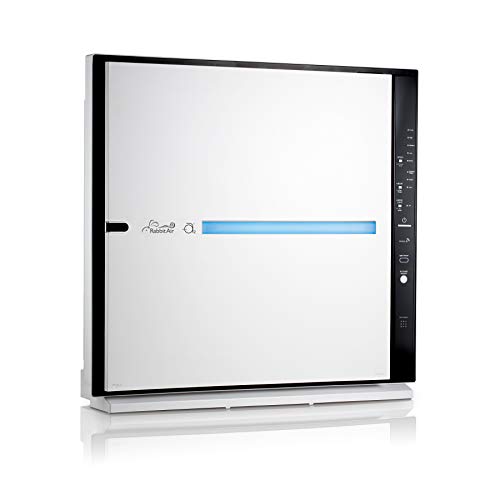
Rabbit Air MinusA2 SPA-780N — The wall-mounted design pick
The MinusA2 solves a problem the other five ignore: floor space. Its slim panel hangs on a wall like a framed print or stands on small feet, and in a small bedroom that difference decides whether a serious purifier fits at all. Inside, a staged system runs from pre-filter through a medium filter and HEPA to a carbon stage, with one slot customisable at purchase toward pet, odour, germ or toxin emphasis, so an allergy household can weight the stack toward its own trigger.
Operation is notably quiet, with a sleep mode that dims its lights and drops the fan to a murmur, and the mood light feature can be turned fully off for those who want darkness. Air quality sensing drives an auto mode that behaves sensibly. The trade for the sculpture-like form is throughput: this is a one-room machine for bedrooms and studies rather than open-plan spaces, and its coverage claims should be read with the air-changes caution explained later in this guide. Filter sets are mid-priced and the customised slot means ordering the right variant matters.
Guests tend to ask about the MinusA2 before they notice it is an appliance at all, and there is a real argument that the purifier a household enjoys looking at is the purifier that stays plugged in. Rabbit Air leans into that with optional artwork fronts, yet the machine underneath the panel is a serious staged filter rather than a picture frame with a fan. In a nursery or a small study, where every floor tile is already spoken for, that combination of discretion and genuine HEPA is difficult to find elsewhere at any price tier.
- Filtration: pre-filter, medium filter, HEPA, carbon, customisable filter slot
- Stated coverage: single rooms and bedrooms
- Controls: WiFi app, auto mode, sleep mode with light dimming
- Form: slim panel, wall-mountable or free-standing
Strengths
- Wall mounting frees floor space in compact bedrooms
- Customisable filter stage lets households weight toward their trigger
- Among the quietest machines here at sleep settings
Trade-offs
- Output suits one room rather than open-plan areas
- Wall mounting needs a drill and commitment to placement
- Replacement sets cost more than the Levoit or Winix equivalents
Best for: small bedrooms, nurseries and design-conscious homes needing real HEPA in minimal floor space. Not suited for: large open areas or renters who cannot fix to walls. Check price on Amazon.
Comparison Table
| Pick | Filtration headline | Stated coverage | Standout trait |
|---|---|---|---|
| IQAir HealthPro Plus XE | HyperHEPA plus granular gas stage | Large rooms, about 1,125 sq ft | Finest particle capture here |
| Coway Airmega Mighty AP-1512HH | True HEPA four-stage | Up to about 1,748 sq ft | Proven auto mode, modest footprint |
| Winix 5510 | True HEPA, washable carbon pre-filter | Up to about 1,881 sq ft | App control with light-sensing sleep mode |
| Levoit Vital 200S | HEPA with U-shaped intake | Up to about 1,875 sq ft | Hair-trapping intake, numeric display |
| Blueair Blue Pure 311i+ Max | HEPASilent hybrid | Up to about 2,107 sq ft | Lowest noise at useful speeds |
| Rabbit Air MinusA2 SPA-780N | HEPA with customisable stage | Single rooms | Wall-mounted slim panel |
What Does a Lab-Tested Rating Actually Tell You?
The number at the centre of independent purifier testing is CADR, the Clean Air Delivery Rate. In the standard chamber method, a purifier runs in a sealed test room while instruments track how quickly particle concentrations fall compared with natural settling, and the result is expressed as a volume of cleaned air per minute. Separate figures are produced for tobacco smoke, dust and pollen, because a machine’s efficiency differs by particle size, and the smoke figure, covering the finest particles, is usually the most conservative of the three.
AHAM Verifide is the programme that lets a buyer trust those figures without trusting the brand. Manufacturers submit units, the ratings are verified under the standard, and the listing can be checked in a public directory. The widely used sizing rule follows from the same method: a room needs a smoke CADR of at least two-thirds of its square footage to achieve the air-change rate the standard assumes. When a box instead advertises coverage for a room several times that size, it has quietly assumed fewer air changes per hour, which is not fraud but is a different promise, and allergy households should know which promise they are buying.
Filter standards supply the second half of the evidence. A true HEPA element is defined by capture efficiency at the most penetrating particle size, around 0.3 microns, and media such as HyperHEPA extends tested capture well below that. What no rating tells you is how a machine behaves in month nine, with a loaded pre-filter, in a room with the door open. That gap between chamber and home is why this guide weighs filter maintenance and real-world noise alongside the verified numbers rather than beneath them.
Which Filtration Type Suits an Allergy Household?
Mechanical HEPA filtration remains the reference approach because its behaviour is predictable: particles are trapped in a fibre mat, performance declines gradually as the mat loads, and nothing is emitted in exchange. Hybrid systems like Blueair’s add electrostatic charging to let air move more freely, trading a measure of that purity for quietness and flow. Granular carbon, present in quantity only in the IQAir here, addresses the gas phase: odours, volatile compounds and traffic fumes that pass straight through fibre filters untouched.
Ionisers deserve a calm, specific answer. Some designs generate ozone as a by-product, and ozone is itself an airway irritant, which is why this guide favours machines whose ionisation is optional or absent for bedroom allergy use. Ultraviolet lamps inside consumer purifiers act on air that passes the bulb in a fraction of a second, far too briefly to matter much either way. The honest hierarchy for an allergy household is therefore simple: capture first, carbon quantity second, everything else a distant third.
How Should You Size a Purifier for a Bedroom?
Start with the room’s floor area, apply the two-thirds rule to get a minimum smoke CADR, and then buy headroom above it. The headroom is not indulgence; it is the mechanism by which the machine stays quiet. A purifier rated for twice the room’s need can deliver the required air changes on its middle settings, where the fan note drops from noticeable to negligible. Allergy relief is disproportionately earned at night, across eight still hours, so the speed you can sleep through is the only speed that counts.
Ceiling height quietly edits the maths. The standard sizing assumptions presume ordinary ceilings; a vaulted bedroom holds half again the air of its floor plan, and the purifier must cycle all of it. Measure the room’s volume in your head before ordering, and if the ceiling soars, promote the machine one size class. The same logic applies to rooms that open onto stairwells, which behave like much larger spaces than their floor suggests because warm air trades places with the landing all night.
Placement completes the sizing decision. A purifier needs breathing room around its intake, a position near the bed rather than across the room where cleaned air must fight the whole space, and a door habit: closed at night, the bedroom becomes a small, well-cycled volume the machine can genuinely keep ahead of. In open-plan homes, accept that one unit serves a zone, not the floor, and place it where the allergic person actually spends their evening.
How Do You Keep Performance Honest Over Time?
Vacuum or wash the pre-filter monthly; it is the cheapest performance in the whole system, because a clogged pre-filter starves every stage behind it. Respect the main filter’s indicator or calendar life rather than stretching it into a second year of declining output, and when you replace it, note the date on the housing in pencil. Keep the particle sensor’s small lens or inlet clean, since auto mode is only as truthful as its sensor. Finally, run the machine continuously at a low setting rather than in heroic bursts: particle levels rebound within an hour of switching off, and steady, modest cleaning beats intermittent drama.
What Are the Most Common Mistakes Allergy Buyers Make?
The classic error is buying to the headline coverage figure and discovering the machine only achieves it at a volume no one tolerates. Close behind comes placing the purifier in the largest room of the house when the allergy sufferer sleeps in the smallest, as if cleaned air respected intentions. Buyers also over-value features aimed at the gas phase while under-buying particle capture, when their actual trigger floats in on the spring breeze. A quieter mistake is neglecting the pre-filter until the expensive HEPA behind it has done a season of work it was never meant to do. The last is treating the purchase as a cure rather than as one layer alongside bedding hygiene, humidity control and medical advice where a clinician is involved.
How Can You Sanity-Check a Purifier Once It Is Home?
You cannot reproduce a chamber test on a landing, but you can catch a machine that is not doing its job. The tissue test is crude and useful: at a working speed, a light tissue held at the outlet should stream steadily, confirming real airflow rather than a fan stirring its own housing. The dust-event test is better. In a sunbeam, shake a cushion or a duvet near the running machine on auto and watch both the sensor’s response and the visible settling over the following half hour; a responsive unit changes gear within moments and the room’s floating dust visibly thins. Models here with numeric or colour indicators, the Levoit, Coway and Blueair among them, make that response legible without any instruments at all.
Over the first month, keep a simple diary if your household’s comfort is the question: note the nights the bedroom felt stuffy or the mornings that started with a tickling throat, alongside pollen counts if your region publishes them. Patterns in that diary are household evidence, weaker than a laboratory’s but aimed at the only outcome you actually bought. If the diary shows nothing changing, work through placement, door habits and filter seating before blaming the machine, because a HEPA element seated slightly askew leaks unfiltered air around its gasket and quietly cancels the specification you paid for. Reseating a filter takes a minute and has rescued more disappointing purchases than any upgrade.
Final Recommendation
For the household that wants the strongest documented capture and can house it, the IQAir HealthPro Plus XE stands alone in this list. For everyone else, the Coway Airmega Mighty remains the recommendation that needs the fewest caveats: proven, verified in spirit by years of scrutiny, and priced like an appliance rather than an instrument. Pet homes should look first at the Levoit Vital 200S, light sleepers at the Blueair, and small bedrooms at the Rabbit Air. Whichever you choose, size it generously and run it through the night, because the best-tested purifier in the world only helps while its fan is turning.
How Do You Read a Product Listing Like a Tester Would?
Open any listing in this guide and scroll past the lifestyle photographs to the specification block. A tester reads four fields first. The room rating matters only alongside its assumption, so look for an air-changes note or an AHAM mark that pins the number to a method. The filter description should name a class or a capture size rather than a mood: phrases like HEPA-type or HEPA-style describe media that resembles the standard without meeting it, and the gap shows up precisely at the fine sizes allergy households care about. The noise figures deserve the same scepticism; a single decibel number usually describes the lowest speed, so look for a range and mentally promote the middle of it to the figure you will live with.
The fourth field is the one most shoppers skip: the replacement filter’s price and stated life, sitting in the same listing a click away. Divide one by the other and you hold the machine’s true annual rent. Two purifiers with identical verified output can differ by a factor of three on that rent, and over a five-year ownership span the cheaper box is frequently the dearer appliance. Listings for the six models here all expose that arithmetic, which is partly why they are here; a manufacturer willing to publish its consumable pricing is usually willing to publish its test basis too, and the correlation held across the whole candidate pool for this guide.
Reviews from other owners play a supporting role, read for failure patterns rather than enthusiasm. A scattering of complaints about a rattling fan at month fourteen tells you more than a hundred happy unboxings. Filter availability complaints matter doubly, because a purifier whose consumable goes out of stock becomes furniture. None of the six below carries that pattern in any volume, which, again, is evidence of the boring and valuable kind.
Which Machine Fits Which Allergy Household?
Consider the spring-pollen household first: two adults, one sensitised, a bedroom of ordinary size and windows that face a garden. Their load arrives seasonally and predictably, and their machine works hardest across perhaps four months. The Coway Mighty suits them almost exactly, because its auto mode idles through the clean months and answers the pollen weeks without being asked, and its annual filter rhythm lands conveniently each spring. Overspending on the IQAir would buy capture depth their load never requests.
The year-round pet household faces a different arithmetic. Dander production never takes a season off, hair loads pre-filters continuously, and the living room matters nearly as much as the bedroom because that is where the animals spend the day. The Levoit Vital 200S earns its place here on intake geometry alone, while households with the budget and floor space sometimes pair the IQAir in the bedroom with a mid-tier unit in the living room rather than asking one machine to commute. That two-room pattern, unglamorous as it sounds, outperforms a single flagship moved from room to room and forgotten in the wrong one.
The urban household near traffic adds a gas-phase problem to the particle problem, since nitrogen compounds and volatile organics drift in with ventilation air. Among these six, only the IQAir carries granular carbon in meaningful quantity, and that single fact can settle the choice despite its size and price. The light sleeper’s household inverts the usual ranking entirely: the Blueair’s low working noise decides, because a machine that runs at a genuinely useful speed all night removes more over a month than a stronger unit throttled down or switched off. The small-flat household, finally, should start from the Rabbit Air and ask what else could possibly fit, because a purifier that hangs on the wall keeps working in rooms where a floor unit would be tripped over, unplugged and quietly retired.
What Does a Pollen Season Routine Look Like?
Evidence-minded ownership has a rhythm. A fortnight before the local pollen season historically starts, service the machine: vacuum or wash the pre-filter, check the main filter’s remaining life honestly, and confirm the sensor inlet is clean. Move the unit into the bedroom if it wintered elsewhere, and set a schedule that has it running at a useful speed before bedtime rather than starting its work when the sleeper does. Pollen that settles on bedding during the day becomes the night’s exposure, so an hour of pre-cleaning the closed room changes what the night feels like.
During the season itself, habits around the machine matter as much as the machine. Outer clothes worn on high-count days carry pollen to the wardrobe and the bed; changing in another room is a filtration measure that costs nothing. Windows in the bedroom stay shut on high-count afternoons, with ventilation borrowed from a hallway or a cooler hour. Bedding washed hot and often removes the reservoir that no air cleaner can reach. None of this replaces medical management for anyone whose clinician has prescribed it; it simply ensures the purifier is not fighting a load the household keeps carrying in by hand.
When the season ends, resist switching the machine off until autumn. Dust mite debris and ordinary household particles are a twelve-month load, and the low running cost of a modern unit at its quiet speed is trivial beside the filter life already paid for. Owners who keep the habit find the second season easier than the first, because the routine, like the machine, works best when it never fully stops.
How Do Running Costs Compare Across These Six?
Ownership cost divides into electricity, which modern efficient motors have made the smaller half, and filters, which dominate. A purifier running its quiet speed around the clock typically draws about as much power as a modest LED bulb left burning, so even the largest machine here costs little to run continuously; the IQAir at high speed is the exception worth scheduling rather than defaulting to. Filter economics vary far more. Combined HEPA-and-carbon cartridges, as in the Levoit and Blueair, simplify ordering but force you to discard whichever element still had life left, while staged systems like the Coway’s and Rabbit Air’s let each layer retire on its own schedule.
The IQAir inverts the usual pattern: its purchase price and individual filters are the highest in this guide, yet its final-stage element is rated for years rather than seasons because the stages ahead of it absorb the load. Annualised honestly, it lands closer to the pack than its shelf price suggests, though the household must still fund the spikes when a change falls due. The Winix and Coway occupy the comfortable middle, with combined annual filter costs that most households will not feel, and the Rabbit Air sits a step above them, the price of its slim customisable stack. The discipline that matters is identical for all six: price the second filter set before buying the first machine, and treat any model whose consumables are hard to source as a risk regardless of its verified output.
There is also a hidden cost in undersizing that rarely gets counted. A small machine run permanently at maximum to cope with a large room wears its filter faster per unit of clean air delivered, makes more noise doing it, and still loses. The generous sizing this guide keeps recommending is therefore not a luxury preference; it is the cheapest way to buy quiet, filter life and actual performance in a single decision.
Can a Purifier Help With Dust Mites and Their Debris?
Dust mites themselves live in bedding, upholstery and carpet, beyond the reach of any air cleaner, and honesty requires saying so at the top of the answer. What reaches the air is their debris, fragments of cast skins and droppings light enough to become airborne whenever bedding is disturbed, a bed is made or a sleeper turns over. That airborne fraction is exactly what a bedside purifier is built to intercept, and a machine cycling a closed bedroom’s air several times an hour removes it steadily through the night rather than letting it resettle on the pillow.
The purifier is therefore one layer in a stack that allergy households assemble piece by piece: encasement covers on mattress and pillows that isolate the reservoir, bedding washed at temperatures that kill mites, bedroom humidity held low enough to discourage them, and hard floors or diligently vacuumed carpet under the bed. Within that stack the purifier’s contribution is the air itself, and households commonly report the bedroom simply feeling fresher and less stuffy, which is the comfort outcome this guide is willing to stand behind. Anyone whose symptoms are significant belongs in a clinician’s care for the medical layer; the stack described here is household hygiene, and it supports rather than replaces that care.
Practically, mite-focused households should weight two features from the picks above: continuous quiet running, because the debris load peaks while the bed is occupied and disturbed, and a pre-filter that tolerates frequent cleaning, because bedrooms generate lint and fibre at a rate kitchens never see. The Coway and Blueair both fit that description comfortably, and the Rabbit Air’s wall position keeps its intake in the room’s breathing zone rather than at skirting-board level where the coarsest dust gathers.
Do Sensors and Smart Features Earn Their Keep?
A particle sensor earns its place when it changes behaviour you would otherwise get wrong. Left to manual control, most owners run a purifier hard for an evening, decide the air feels fine, and switch it down or off, after which particle levels quietly rebuild. A sensor-driven auto mode removes that judgement error entirely: the Coway visibly answers a shaken duvet, the Levoit reports a number you can watch fall after the windows close, and the Blueair modulates without announcing itself. For allergy households, whose load arrives in events — a dog shaking off the rain, a bed being made, a pollen-heavy coat coming through the door — that responsiveness is the feature, and the display is merely its receipt.
App control divides more honestly. It is genuinely useful for machines in children’s rooms, guest rooms and anywhere a schedule must survive a busy household, and the Winix, Levoit, Blueair and Rabbit Air all offer some version of it. It is useless when it substitutes for a readable control panel, and every model here keeps physical controls for the day the router fails. Voice assistants and air-quality histories are garnish. Buy the sensor, accept the app if it comes, and ignore the rest of the smart vocabulary; the filtration stack and the verified output remain the machine, and everything electronic is in service to them.
One caution belongs with sensors: they measure particles, not allergens specifically, and a low reading does not certify that a particular person’s trigger is absent. Treat the number as a trend instrument. A bedroom that habitually reads lower after the machine has run, across weeks, is telling you something real about your air, even if it cannot name the particles it counted.
Frequently Asked Questions
Does AHAM verification guarantee a purifier will help my allergies?
No verification can promise a health outcome, and you should distrust any seller who says otherwise. Verification confirms that a machine delivers the clean air output it claims under a standard method. Whether cleaner air improves a particular person’s comfort depends on their triggers and circumstances, which is a conversation for their clinician; the purifier’s part of the bargain is measurable air cleaning, and verification is how you confirm that part.
Is a higher CADR always better for a bedroom?
Only up to the point where the machine can run quietly. Beyond that, extra capacity buys headroom to use lower speeds, which is valuable, but a very large unit in a tiny room may short-cycle its sensor and crowd the space. Match the rating to the room with generous margin, then stop; the returns diminish quickly after roughly double the two-thirds rule figure.
How often will I actually replace filters?
Follow each model’s indicator and stated life, which for the main HEPA stages here runs from about a year in combined filters to several years for the IQAir’s protected HyperHEPA stage. Dusty homes, pets and wildfire smoke shorten those spans. Budget the annualised figure before buying; a cheap machine with costly yearly filters often overtakes a pricier rival by year three.
Can one purifier cover a whole apartment?
Air does not turn corners politely. A single unit cleans the room it sits in and lends some benefit to connected open space, but closed doors defeat it. Allergy households get better results from one well-sized machine in the bedroom, where exposure lasts all night, than from a larger unit stationed in a hallway hoping to serve everywhere at once.
Should I avoid ionisers completely?
Prefer machines where ionisation can be switched off, as with the Winix and Coway here, or designs that rely on capture alone. Some ionising products can produce ozone, and sensitive airways are exactly the wrong audience for an avoidable irritant. Filtration gives you the benefit with no by-product to weigh.
Where should the purifier sit in the bedroom?
Near the bed, with clear space around its intake and outlet, and away from a corner that traps it. Keep it off thick carpet if the intake sits low, and let it run with the door closed overnight. Proximity matters because the cleanest air in the room is the air nearest the machine’s output.
Related Guides
Readers comparing evidence standards will also want our guide to Best Air Purifiers by Verified Lab Ratings, while households weighing raw output against morning wakefulness can continue with Best Alarm Clocks for Heavy Sleepers and ADHD. For students furnishing a first shared space, see Best Alarm Clocks for College Students, and anyone tackling the damp corner of a bathroom should not miss Best Bath Mats for Cleanliness.


