What's inside
- Key Takeaways
- Quick Picks
- How We Chose These Picks
- How Do the Six Sinks Compare at a Glance?
- Why Does the Fifty-Fifty Split Still Win So Many Kitchens?
- What Does Undermount Installation Actually Require?
- How Should a Stainless Double Sink Be Cared For?
- How Should the Faucet Be Matched to Two Equal Bowls?
- What Does a Garbage Disposal Change Under a Double Sink?
- Which Reveal Should You Choose at the Counter’s Edge?
- Do Bottom Grids and Accessories Earn Their Place?
- How Do Two Cooks Share a Double Sink Without Colliding?
- What Should You Verify in the Week Before the Counter Is Templated?
- How Does a Double Sink Change Dishwasher and Drying Habits?
- What Is the Honest Lifespan of a Stainless Undermount Sink?
- How Do You Brief a Counter Fabricator About Your Chosen Sink?
- How Do You Live With the Sink During the Counter Renovation Gap?
- What Does a Second Sink or a Pot Filler Add to the Story?
- How Do You Choose Between a Grid, a Mat and a Bare Bowl?
- What Mistakes Do Double Sink Buyers Make Most Often?
- Final Recommendation
- How Should You Photograph and Measure Your Existing Sink Before Shopping?
- Frequently Asked Questions
- Related Guides
As an Amazon Associate I earn from qualifying purchases. This post may contain affiliate links at no extra cost to you.
cottageverdict.com is reader-supported. When you buy through links on our site, we may earn an affiliate commission.
Where to buy: the six sinks below are sold on Amazon, and their names in the Quick Picks table, the review headings and the comparison table link to the listings, where cutout dimensions, bowl depths and included accessories can be verified before a countertop is cut. The best undermount double kitchen sinks share one defining arrangement: two bowls of equal size, a fifty-fifty split, mounted beneath the counter so the worktop’s edge runs clean into the sink and crumbs sweep straight off the surface into the water. Equal bowls suit a particular kind of cooking — wash in one, rinse in the other; soak the roasting pan here, drain the pasta there — a rhythm as old as the double sink itself, now executed in stainless steel at two gauges, sixteen and eighteen, whose difference you can hear every time a pan lands.
Gauge is the quiet headline of this guide. Sixteen-gauge steel is thicker, deader under impact and more resistant to denting; eighteen-gauge is lighter, easier on the budget and entirely respectable in a well-made sink. Five of these six picks are stainless in one of those two gauges, from established sink makers and value brands alike, and the sixth — a Kohler that can mount under or over the counter — brings a famous name’s take on the same fifty-fifty brief. Bowl configuration may be identical across the list, but build, finish and included hardware are not, and those are the grounds on which the reviews compete.
Undermount installation is the other shared truth. These sinks hang beneath stone, quartz or solid-surface counters, supported by the cabinet and clips, sealed at the rim, and they cannot be dropped into a laminate top or swapped casually later. Choosing one is choosing with the countertop, ideally before the countertop is templated. Plan in that order and a double undermount becomes the hardest-working metre of the kitchen.
Key Takeaways
- All six picks split fifty-fifty, giving two equal bowls for wash-and-rinse teamwork.
- Sixteen-gauge steel is thicker and quieter; eighteen-gauge is lighter and gentler on budget.
- Undermount fitting needs a suitable counter and proper support — plan sink and counter together.
- Low dividers, where fitted, let long pans rest across both bowls while keeping them separate.
- Included strainers vary by brand and are worth checking before you price the whole job.
- A brushed finish hides the scratches of daily service better than a mirror polish.
Quick Picks
| Pick | Badge | Why it earns its place |
|---|---|---|
| Lanxlic 32 Inch Undermount Double Bowl Sink | Best Dimensions-Up-Front Value | Full measurements in the listing, 304 steel and a strainer in the box. |
| KRAUS Premier 32 Inch Undermount 50/50 Double Bowl | Best Low-Divider Design | Kraus’s low divider and a pair of strainers make pan-washing genuinely easier. |
| Ruvati 32 Inch Undermount Double Bowl Sink RVM4350 | Best Sixteen-Gauge Build | Thick T-304 steel with a brushed finish chosen to hide scratches. |
| ATTOP 32 Inch Double Bowl Undermount Kitchen Sink | Best Scratch-Resistant Finish | A nano anti-scratch surface treatment with a strainer included. |
| Kichae 33 Inch Undermount Double Bowl Sink | Best Handmade Sixteen-Gauge | A handcrafted thirty-three-inch basin in sixteen-gauge steel with accessories. |
| Kohler Verse 33 Inch Double-Bowl Kitchen Sink | Best Dual-Mount Flexibility | Kohler’s Verse can install as top-mount or undermount as kitchens change. |
How We Chose These Picks
The brief was strict: undermount fitting and an equal double bowl, in the thirty-two to thirty-three-inch class that standard thirty-six-inch sink cabinets are built around. Within it, we weighed steel first — its grade, since T-304 is the food-safe, corrosion-resistant standard worth insisting on, and its gauge, since thickness decides how the sink sounds and dents across a decade. Finish followed, because a sink is scrubbed, stacked in and stared at daily; brushed and treated surfaces that disguise wear scored over finishes that publish every scratch.
Divider design separated the thoughtful from the standard. A conventional divider rises to the rim and forbids long items from lying across the sink; a low divider keeps the bowls separate for washing while letting a roasting pan or a long tray rest level across both. Two picks here make that their signature, and the reviews treat it as the genuine innovation it is in a category that otherwise changes slowly. Included hardware was counted honestly — strainers in the box are money and errands saved — and brand support was weighed where a listing leans on it.
Finally, we checked the installation story each listing tells. Undermount sinks live or die by cutout accuracy and support, so makers who publish full dimensions up front earned trust over those who make a buyer hunt for them. Every pick here gives a renovator enough information to plan with, which in this category is a form of quality in itself.

Lanxlic 32 Inch Undermount Double Bowl Sink — Best Dimensions-Up-Front Value
Lanxlic earns its opening position by doing the renovator’s favourite thing: publishing everything. The listing states the full footprint — thirty-two and five-sixteenths by eighteen and a half by nine inches — alongside 304 stainless steel, eighteen-gauge thickness, a commercial-grade satin finish and a strainer included. That nine-inch bowl depth deserves attention, because depth is where double sinks earn or lose their keep: deep enough to hide a day’s pans below the counter line and to contain the splash of a filling stockpot, without turning every reach into a shoulder workout. In a fifty-fifty layout, two nine-inch bowls give a household a genuine wash station and a genuine rinse station, neither apologising for the other.
The satin finish is the pragmatic choice for a working sink. It diffuses light, forgives the fine scratches that cutlery and pan bases inevitably engrave, and wipes down without the water-spot theatre of a polished surface. Eighteen-gauge steel keeps the unit manageable during installation — undermount fitting involves holding the sink up against the counter’s underside while clips and sealant do their work, and installers quietly appreciate every pound not present. Lanxlic positions the build as commercial grade, and while that phrase should always be read as intent rather than certification, the specification underneath it here is honestly stated and complete.
As a value-brand listing, support rests on the specification’s clarity rather than a famous name, and buyers should confirm cutout requirements against their counter fabricator’s template before the stone is cut — advice that applies to every pick in this guide but matters most where the brand is youngest. Get that verification done and this sink delivers the category’s essentials, fully dimensioned and strainer included, without asking the budget to admire a logo.
- Overall size: 32-5/16 by 18-1/2 by 9 inches per the listing
- Steel: 304 stainless, eighteen gauge
- Finish: commercial-grade satin
- Configuration: fifty-fifty double bowl, undermount
- Included: strainer in the box
Strengths
- Complete dimensions published for confident templating.
- Nine-inch bowls hide pans and contain splashes.
- Strainer included saves a separate purchase.
Trade-offs
- Eighteen-gauge steel is less deadened than sixteen.
- Younger brand offers thinner support history.
- Satin finish is practical rather than luxurious.
Best for: renovators who plan by the numbers on a sensible budget. Not suited for: buyers who want the heaviest gauge available.

KRAUS Premier 32 Inch Undermount 50/50 Double Bowl — Best Low-Divider Design
Kraus’s Premier solves the double bowl’s oldest frustration with a single, elegant compromise: a divider that does not rise all the way. In a conventional fifty-fifty sink, the wall between the bowls reaches the rim, and anything longer than one bowl — a roasting pan, a grill rack, a long tray — must be washed at a tilt, one end in the air, water everywhere. The low divider keeps the two bowls functionally separate for ordinary washing while letting long items lie flat across both, and it also makes overflow between bowls gentler when one side is filled deep. It is the kind of improvement that sounds minor in a listing and feels major by the second Sunday roast.
The rest of the specification is Kraus being Kraus: eighteen-gauge stainless in the Premier line, a thirty-two-inch undermount footprint for the standard cabinet, and — a detail cheap listings omit — two strainers in the box, one for each bowl’s drain. A double sink with one strainer is a sentence half finished; Kraus finishes it. The brand’s long presence in the sink market also means cutout templates, support documentation and replacement parts exist in the world, which matters for a fixture intended to outlive its countertop’s fashion cycle.
Eighteen gauge rather than sixteen is the honest concession here, and busy cooks who drop heavy cast iron should weigh it. The low divider, meanwhile, slightly reduces the bowls’ independence when both are filled to the brim, since water can travel over it — a fair price for the pan-washing freedom, and one most households will pay gladly after the first holiday cleanup. For the classic wash-and-rinse household that also roasts in big pans, this is the most intelligently compromised sink in the guide.
- Overall size: thirty-two inches, undermount format
- Steel: eighteen-gauge stainless, Premier line
- Divider: low profile, allows pans to span both bowls
- Configuration: fifty-fifty double bowl, model KBU32
- Included: two strainers, one per bowl
Strengths
- Low divider ends the tilted-roasting-pan wash.
- Both strainers included, as a double sink deserves.
- Established maker with documentation and parts support.
Trade-offs
- Water can cross the low divider at full fills.
- Eighteen-gauge steel dents more readily than sixteen.
- Premium positioning above the value-brand picks.
Best for: roasting households that wash long pans by hand. Not suited for: cooks who fill both bowls to the brim simultaneously.
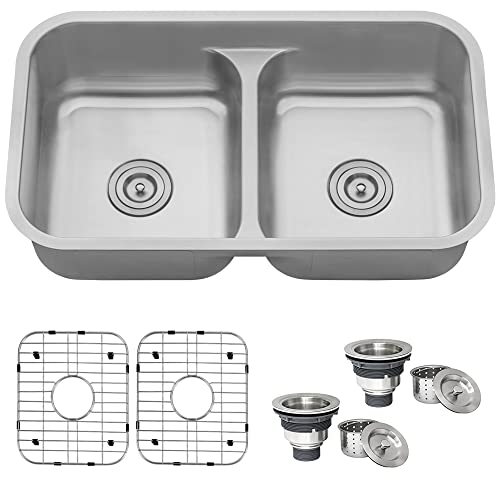
Ruvati 32 Inch Undermount Double Bowl Sink RVM4350 — Best Sixteen-Gauge Build
Ruvati’s RVM4350 is the heavyweight argument in this guide, built from sixteen-gauge T-304 stainless steel — the thickest construction on offer here — with a brushed finish the listing says is chosen to hide scratches. Thickness announces itself the first time a cast-iron skillet meets the bowl: a deeper, deader sound, less of the drumming flex that thin steel answers with, and a rim that feels machined rather than folded. In an undermount installation, where the sink must hold its shape against clips, sealant and years of thermal cycling, that rigidity is not vanity. It is the structure the whole mounting depends on.
The brushed finish is the other half of the Ruvati philosophy. A working sink accumulates fine scratches no matter how careful the household, and a brushed grain absorbs that history into its texture instead of displaying it. Combined with the heavier gauge, the result is a sink designed to look correct in year ten, not just in the renovation photographs. Ruvati has built its name in exactly this corner of the market — substantial steel, commercial styling, residential sizing — and the RVM4350’s fifty-fifty layout in a thirty-two-inch frame is its most classical expression.
Weight is the trade, felt at installation when the heavier shell must be supported and aligned under the counter, and felt in the budget where thick steel prices itself honestly. Households planning a garbage disposal should also appreciate the deader bowl, since disposal vibration has less thin metal to excite. For buyers who rank build above all else and intend this to be the last sink the kitchen needs, the Ruvati is the guide’s straightforward answer.
- Overall size: thirty-two inches, undermount format
- Steel: sixteen-gauge T-304 stainless, the thickest here
- Finish: brushed, selected to hide scratches
- Configuration: fifty-fifty double bowl, model RVM4350
- Character: rigid, deadened bowl under impact
Strengths
- Sixteen-gauge build resists dents and drumming.
- Brushed finish ages gracefully under daily service.
- Rigid shell suits undermount loads and disposals.
Trade-offs
- Heavier shell demands care during installation.
- Thick steel carries a thicker price than rivals.
- Utilitarian styling favours function over softness.
Best for: build-first buyers and heavy pan households. Not suited for: tight budgets or installers working solo.

ATTOP 32 Inch Double Bowl Undermount Kitchen Sink — Best Scratch-Resistant Finish
ATTOP’s contribution to the fifty-fifty brief is written on its surface: a nano anti-scratch treatment, per the listing, over a thirty-two-inch double bowl undermount body, with a strainer included. Surface treatments live or die by the household’s habits, and the household this one imagines is busy — pans stacked in the bowl awaiting their turn, cutlery cascading in after dinner, a sink that works as the kitchen’s landing strip rather than its display case. A finish engineered to shrug at scratches addresses the exact way real sinks age, which is not by failing but by slowly looking tired.
The honest framing matters here. Anti-scratch is a direction, not an immunity: cast iron dragged with intent will mark any steel, treated or not, and this guide will not pretend otherwise. What a good surface treatment buys is time and forgiveness — the thousand small contacts of a year arriving as a patina rather than a scar map. Paired with the fifty-fifty layout, the ATTOP suits households that cook daily and clean honestly but do not intend to handle their sink like laboratory glassware.
The listing is leaner than some rivals on published detail, so the pre-purchase discipline from earlier in this guide applies with full force: confirm bowl depth, gauge and cutout dimensions on the listing and with your fabricator before stone meets saw. What is stated — the treatment, the format, the included strainer — is stated clearly, and for kitchens whose current sink looks tired beyond its years, a finish-first design is a rational rebellion. ATTOP is the pick for cooks who would rather spend their attention on dinner than on the archaeology of every scratch.
- Overall size: thirty-two inches, undermount format
- Surface: nano anti-scratch treatment per the listing
- Configuration: double bowls in equal split
- Included: strainer in the box
- Design intent: a finish that resists visible ageing
Strengths
- Treated surface forgives daily pan and cutlery contact.
- Strainer included keeps the purchase complete.
- Suits high-traffic kitchens that stack and soak.
Trade-offs
- Treatment resists scratches; it cannot abolish them.
- Listing detail is leaner than the big brands’.
- Gauge and depth must be confirmed before ordering.
Best for: busy daily cooks whose sinks age by accumulation. Not suited for: buyers who need exhaustive published specifications.

Kichae 33 Inch Undermount Double Bowl Sink — Best Handmade Sixteen-Gauge
Kichae builds its case on craft and calibre: a thirty-three-inch undermount double bowl, handmade, in sixteen-gauge stainless steel, thirty-three by nineteen inches with accessories included per the listing. Handmade in sink language means the bowls are formed and finished with tighter, squarer geometry than pressed production usually achieves — the near-vertical walls and crisp corners that let trays sit flat and maximise usable bowl floor. In a fifty-fifty layout, that geometry is worth real capacity: two bowls whose floors genuinely fit the pans their rim dimensions promise.
Sixteen gauge puts the Kichae in the Ruvati’s weight class for sound and dent resistance, and the extra inch of width over the thirty-two-inch picks buys a little more elbow room at the divider — a difference cooks feel when both bowls hold large items at once. The included accessories spare the usual second order, and the handmade basin’s sharper lines suit contemporary kitchens whose counters and cabinetry are already speaking in right angles. This is a sink with a point of view about how a bowl should be shaped, and kitchens that share the view will find it deeply satisfying.
Crisp geometry asks one thing in return: cleaning attention in the corners, where a handmade basin’s tighter radii collect what a soft, pressed curve would shed. A brush pass during the weekly clean answers it. The thirty-three-inch width also deserves a tape measure’s respect — confirm the cabinet and the counter run can host it before the heart commits. Verified and maintained, the Kichae is the craftsman’s choice in this guide: thick steel, honest corners, full floors.
- Overall size: thirty-three by nineteen inches
- Steel: sixteen-gauge stainless construction
- Build: handmade basin with crisp, square geometry
- Configuration: fifty-fifty double bowl, undermount
- Included: accessories per the listing
Strengths
- Handmade corners maximise usable bowl floor.
- Sixteen-gauge steel matches the guide’s heaviest build.
- Extra width eases two-bowl work with big items.
Trade-offs
- Tight corners need a brush during cleaning.
- Thirty-three inches must be verified against cabinet.
- Craft pricing sits above the value picks.
Best for: design-led kitchens wanting thick, handmade steel. Not suited for: thirty-two-inch cutouts or minimal-cleaning households.

Kohler Verse 33 Inch Double-Bowl Kitchen Sink — Best Dual-Mount Flexibility
Kohler’s Verse breaks this guide’s pattern in one deliberate way: it is a thirty-three-inch double-bowl sink designed to install as top-mount or undermount, and that flexibility is a genuine strategy rather than indecision. Kitchens change in stages. A household may need a sink now, over an existing counter, and intend a stone counter — and an undermount conversion — in two years. The Verse can serve both chapters of that story, dropping in today and tucking under tomorrow, carrying a famous maker’s engineering and support network through the whole renovation instead of being discarded at its second act.
The Verse name carries Kohler’s long sink-making history, and with it the ecosystem renovators quietly value: published templates, standard drain geometry, accessories designed to fit rather than approximately fit, and a brand that will answer for its product in five years’ time. The double-bowl layout follows the equal-split brief of this guide, in stainless steel, at a thirty-three-inch width that suits the standard cabinet with a little presence to spare. In undermount mode it delivers the same clean counter sweep as every pick here; in top-mount mode it forgives counters that undermounts cannot use.
The compromise is specialisation. A dual-mount rim is, by definition, a rim designed to be seen from above as well as sealed from below, and purists planning a one-time, forever undermount installation may prefer a shell designed for that single job. Gauge and accessory details should be confirmed on the listing for the same reason. But for staged renovations, rental upgrades with ambitions, or any household whose counter plans are still moving, the Verse’s two-chapter versatility is the smartest money in this guide.
- Overall size: thirty-three inches, model 75791-1-NA
- Mounting: top-mount or undermount from one design
- Material: stainless steel double-bowl construction
- Maker: Kohler Verse line with full support ecosystem
- Configuration: equal double bowls
Strengths
- One sink serves both renovation chapters.
- Kohler documentation and parts support are extensive.
- Works over counters an undermount-only sink cannot.
Trade-offs
- Dual-mount rim is less specialised than pure undermounts.
- Accessories are typically a separate consideration.
- Brand name carries its customary premium.
Best for: staged renovations and households with evolving counters. Not suited for: purists wanting a shell designed only for undermounting.
How Do the Six Sinks Compare at a Glance?
| Pick | Badge | Distinguishing detail |
|---|---|---|
| Lanxlic 32 Inch Undermount Double Bowl Sink | Best Dimensions-Up-Front Value | 32 inch, 18 gauge, 9 inch bowls, strainer included |
| KRAUS Premier 32 Inch Undermount 50/50 Double Bowl | Best Low-Divider Design | 32 inch, low divider, two strainers included |
| Ruvati 32 Inch Undermount Double Bowl Sink RVM4350 | Best Sixteen-Gauge Build | 32 inch, 16 gauge T-304, brushed finish |
| ATTOP 32 Inch Double Bowl Undermount Kitchen Sink | Best Scratch-Resistant Finish | 32 inch, nano anti-scratch surface, strainer included |
| Kichae 33 Inch Undermount Double Bowl Sink | Best Handmade Sixteen-Gauge | 33 inch handmade, 16 gauge, accessories included |
| Kohler Verse 33 Inch Double-Bowl Kitchen Sink | Best Dual-Mount Flexibility | 33 inch, top-mount or undermount installation |
Why Does the Fifty-Fifty Split Still Win So Many Kitchens?
Equal bowls encode a workflow: one side works, the other side waits. Washing happens in hot, soapy water on the left while the right holds rinsed items, soaking cutlery, or the colander draining pasta. Baking days run both bowls as staging — flour-dusted tools soaking here, produce washing there. The symmetry also simplifies the household’s mental map; nobody has to remember which side is the big one, and two cooks can share the sink without negotiating territory. For households whose cooking is varied rather than specialised, that democratic layout has outlasted every fashion in sink design for good reason.
The honest counterpoint is the single vast bowl, which swallows anything but forces washing, rinsing and draining into one shared puddle, and the unequal split covered by this guide’s companion article, which specialises the two sides for different jobs. Fifty-fifty is the generalist’s answer, and generalists cook most of the world’s dinners. Choose it when your kitchen’s days vary; specialise only when one task — giant pans, constant produce prep — clearly dominates your sink’s working life.
What Does Undermount Installation Actually Require?
An undermount sink is a collaboration between three trades. The counter material must tolerate a finished, sealed cutout edge — stone, quartz and solid surface are the natural partners, while ordinary laminate is not, because water at the cut edge is its undoing. The cabinet must host the sink’s width with room for clips and plumbing, and the sink itself must be supported by more than adhesive optimism: clips, rails or a support frame carry the loaded weight of two full bowls, which is a considerable and sometimes underestimated burden.
Sequence matters as much as hardware. The sink decision precedes the counter template, because the cutout is made for a specific model’s dimensions and reveal — the small ledge of sink rim visible or hidden at the edge is an aesthetic choice with cleaning consequences either way. Faucet holes are drilled in the counter behind the sink, so faucet reach must be checked against the bowls’ centres. Households that walk this sequence in order find installation almost boring. Households that buy the counter first and the sink second inherit the improvisation.
How Should a Stainless Double Sink Be Cared For?
Stainless steel’s care doctrine is mostly about water and direction. Rinse and wipe the bowls after heavy use, dry them when you can, and clean along the grain of the brushed finish rather than across it, because cross-grain scrubbing is how fine finishes acquire their tired look. Avoid leaving cast iron, steel wool or wet cleaning pads sitting in the bowl overnight; dissimilar metals and trapped moisture can leave marks on stainless that are preventable in seconds and tedious in retrospect. A paste of bicarbonate of soda handles most dullness honestly, and the sink rewards a weekly five minutes with a decade of good appearance.
The undermount seam deserves its own glance during cleaning. The sealed joint where sink meets counter is the kitchen’s hardest-working caulk line, flexing with load and temperature; inspect it seasonally, and renew the seal if it ever parts, because water that enters that seam works unseen against cabinet and counter alike. Grids, where a household uses them, lift the wear off the bowl floor entirely and are worth considering for the sixteen-gauge and treated picks alike — protection that also quiets the sink’s daily music.
How Should the Faucet Be Matched to Two Equal Bowls?
A double sink asks its faucet to commute. The spout’s reach must land water comfortably in both bowls, not merely in the one directly beneath it, so measure from the faucet’s mounting point to each bowl’s centre and compare against the spout’s stated reach before either is bought. A pull-down sprayer forgives a multitude of reach sins and has become the default partner for double bowls precisely because it travels to the work instead of asking the work to travel. Height matters in the other direction: a tall gooseneck clears stockpots filling in either bowl, while a low, sculptural faucet may strand big items at an angle under its arc.
Single-hole, widespread and bridge configurations all work over an undermount, because the holes live in the counter rather than the sink — which also means the decision is permanent in stone. Drill once, correctly. Households replacing a faucet later will bless the planner who left standard spacing and honest access beneath. The KRAUS Premier 32 Inch Undermount 50/50 Double Bowl and its peers are indifferent to your faucet choice, but your daily washing will not be, so let the bowls’ centres dictate the tap’s geometry rather than the showroom’s silhouette.
What Does a Garbage Disposal Change Under a Double Sink?
A disposal under one bowl converts that bowl into the kitchen’s waste throat, and the choice of bowl shapes the workflow for years. Under the left bowl suits households that scrape and wash in one motion on that side; under the right suits the mirror image. Either way, the disposal’s weight and vibration join the sink’s support calculation, which is one more argument for the deader, thicker shells in this guide — the Ruvati 32 Inch Undermount Double Bowl Sink RVM4350 in sixteen gauge will shrug at vibrations that set thinner steel humming through the countertop.
Plumbing beneath a double bowl with a disposal is a small city: two drains converging, the disposal’s outlet, the dishwasher’s feed and drain, all competing for the cabinet’s finite air. Plan the city’s layout before the sink is sealed in place, because access afterwards is measured in contortions. A household that maps it once, photographs it, and leaves the cabinet’s contents organised around it will find every future plumbing conversation shorter. The sink is the visible tenth of the installation; respect the submerged nine-tenths.
Which Reveal Should You Choose at the Counter’s Edge?
The reveal is the small decision with daily consequences: how the counter’s cut edge relates to the sink’s rim beneath it. A negative reveal hides the rim entirely, the counter overhanging slightly, for the cleanest sweep of crumbs into the bowl — at the price of a ledge where moisture and debris can gather unseen. A positive reveal exposes a step of the sink’s rim, giving fingers a purchase and eyes a finished line, while asking the cloth to negotiate that step at every wipe. A flush reveal attempts the best of both and demands the most precise fabrication of the three.
There is no correct answer, only a correct match to the household’s cleaning temperament. Meticulous wipers can enjoy the negative reveal’s seamlessness; busy households often prefer the positive reveal’s honesty, where nothing hides. Decide with your fabricator while the template is still pencil, and photograph the choice in a showroom under raking light if you can, because the reveal is the detail your hand will meet ten thousand times across the sink’s life with your kitchen.
Do Bottom Grids and Accessories Earn Their Place?
A bottom grid suspends cookware above the bowl’s floor on a rack of steel wires, and its benefits compound quietly: pans land on the grid rather than engraving the finish, glasses drain elevated in moving air, and the bowl’s surface keeps its youth years longer. For the treated and brushed finishes in this guide, a grid is less a necessity than an insurance policy with daily dividends. The costs are a grid to lift and clean around, and a small ransom of bowl depth surrendered to its height — in a nine-inch bowl, a fair trade; in a shallow one, a real negotiation.
Cutting boards shaped to the sink, colanders that span a bowl, and roll-up racks extend the same philosophy: the sink as a workstation rather than a hole. Equal bowls host these accessories symmetrically, which is one of the fifty-fifty layout’s underappreciated virtues — a board that fits one bowl fits the other. Buy accessories after a month of living with the bare sink, when your actual habits have revealed which ones you will reach for, rather than equipping a fantasy kitchen on day one.
How Do Two Cooks Share a Double Sink Without Colliding?
The choreography that works assigns territories by task rather than by person. One bowl becomes the dirty zone — soaking, scraping, the landing strip for everything leaving the stove — while the other stays clean for rinsing, produce and hand-washing. Cooks cross between zones as their tasks demand, but the zones themselves never blur, so a clean colander never lands in the soaking water and a greasy pan never contaminates the salad’s rinse. The fifty-fifty split is built for exactly this treaty, since neither zone is the small one.
Households that adopt the treaty find the sink stops being the kitchen’s narrowest bridge. Add the dishwasher’s position to the map — ideally a step from the rinse bowl — and the whole cleanup system flows in one direction, from dirty zone to rinse zone to machine, without a single backtracking trip. It is a small piece of kitchen design that pays out at every single meal, which is more than can be said for most renovations.
What Should You Verify in the Week Before the Counter Is Templated?
Assemble the sink, or at minimum its certified template, and walk the whole installation in conversation with the fabricator: cutout dimensions, reveal choice, faucet hole positions and spacing, the disposal’s bowl, and the support method beneath. Confirm the cabinet’s interior width with the sink physically present if possible, because published cabinet sizes and built reality occasionally disagree by the width of a drawer runner. Photograph the listing’s dimension page and keep it with the renovation paperwork; if any figure on the delivered sink disagrees with it, that photograph is the conversation.
Finally, rehearse the loaded question one last time: two bowls of water, a disposal, and the household’s heaviest pans represent a serious suspended weight, and the support plan — clips, rails or a framed cradle — should be named out loud by whoever is installing it, not assumed. The Lanxlic 32 Inch Undermount Double Bowl Sink publishes its dimensions for exactly this week of verification; every pick in this guide deserves the same rigour applied to it. Kitchens that survive this checklist proceed to installation with the pleasant boredom of a plan working.
How Does a Double Sink Change Dishwasher and Drying Habits?
Households with dishwashers sometimes wonder whether two bowls become redundant, and experience answers no — they become specialised. The machine takes the volume; the sink takes the exceptions, and exceptions are numerous: the wooden boards and good knives that never machine-wash, the pan that needs soaking before its cycle, the delicate glass, the oversized tray the racks refuse. With two bowls, those exceptions can soak, wash and drain in parallel rather than queueing across the counter, and the dishwasher’s loading becomes a calm transfer from the rinse bowl instead of an archaeological excavation of a single crowded basin.
Drying habits shift too. A bowl with a rack or grid becomes the air-drying station for hand-washed items, keeping the counter clear and the workflow one-directional. In small kitchens that reclaimed counter is the difference between cooking with elbow room and cooking in a negotiated truce with the washing-up. The double sink, far from competing with the dishwasher, turns out to be its staging area, its overflow and its partner for everything the machine cannot take — which, in a serious cooking household, is a great deal of what matters most.
What Is the Honest Lifespan of a Stainless Undermount Sink?
Steel sinks do not wear out so much as accumulate history, and a well-chosen one should serve for decades — plausibly for the life of the counter it hangs beneath, which is precisely why the choice deserves this much deliberation. The failure points, when they come, are rarely the bowls themselves: they are the seal at the rim losing its integrity, a clip corroding unnoticed, or a disposal’s years of vibration loosening what installation once made tight. All three are maintenance events, not mortal ones, and the seasonal seam inspection recommended in this guide exists to catch them while they are still small.
Gauge buys insurance against the other lifespan thief, which is damage: the dropped pan that dents thin steel permanently will often leave thick steel unmarked, and a sink that never dents never gives its owner a daily reminder of one bad evening. Choose the gauge your household’s clumsiness honestly requires, keep the seam sound, and the sink becomes one of the few renovation purchases you may never need to think about again — the highest compliment infrastructure can earn.
How Do You Brief a Counter Fabricator About Your Chosen Sink?
Bring the sink’s template, its dimension sheet and your reveal decision, and then ask the fabricator three questions that reveal their experience: how they finish the cut edge, how they prefer the sink supported, and how the faucet holes should be positioned relative to the bowls’ centres. A fabricator who answers all three fluently has done this marriage of stone and steel many times; hesitation on any of them is information worth weighing before the slab is committed. Agree the sequence too — template, cut, polish, deliver, mount — and who is responsible for the sink’s physical presence at each stage.
Keep the paperwork together: listing dimensions, template, the fabricator’s drawing and your own photographs of the cabinet’s interior. Renovations generate amnesia at exactly the moments precision matters, and the household that can produce the right number in ten seconds saves the phone calls, the remakes and the temper. It is unglamorous, it is entirely within your control, and it is the difference between a sink that arrives as a plan and one that arrives as a negotiation.
How Do You Live With the Sink During the Counter Renovation Gap?
Most undermount projects include an interregnum: old counter gone or going, new counter templated and days away, and a household still producing three meals a day. Plan the gap like a camping trip conducted in your own kitchen. A temporary plywood top with the old sink dropped in, however ugly, preserves running water and morale; a utility tub in the laundry becomes the washing station if the kitchen must go fully dark. Paper plates are a legitimate strategy, and the slow cooker, which asks almost nothing of a sink, becomes the week’s hero.
Protect the new sink during its own installation window. It will arrive before the counter does, and it should wait in its box, indoors, away from the renovation’s traffic and temptations — a new sink makes a seductive workbench for every trade on site, and the household that forbids that use explicitly will receive an unmarked fixture. When the counter lands and the sink rises to meet it, keep the protective film and the installer’s offcuts between the steel and the world until the final clean. First impressions of a renovation are disproportionately powerful; a sink revealed pristine, in a finished room, starts its decade with the household already pleased.
What Does a Second Sink or a Pot Filler Add to the Story?
Large kitchens sometimes answer the double sink’s limits by adding water rather than bowls: a small prep sink in an island, or a pot filler at the stove. These are complements, not competitors. The main double sink remains the washing and soaking headquarters; the prep sink gives a second cook a water point that never queues, and the pot filler removes the heaviest carry in cooking from the routine. Households planning such additions should still choose the main sink by this guide’s criteria, because the exceptions and the volume will always migrate back to it.
For most kitchens, though, the honest answer is that a well-chosen double undermount already solves the problem these extras address at greater cost. Spend first on the main sink’s gauge, depth and support, and on the faucet that serves it, before plumbing a second act. Infrastructure money follows the same rule as the water in this guide: it should flow to where the work actually happens, every day, rather than to where it might happen impressively twice a year.
How Do You Choose Between a Grid, a Mat and a Bare Bowl?
Three philosophies protect a bowl’s floor, and households tend to live happily with exactly one of them. The grid household likes infrastructure: a permanent rack that takes every landing, drains everything above the wet floor and turns the bowl into a workstation. The mat household prefers softness and silence, accepting that a mat must be lifted and cleaned beneath, where it quietly collects what it hides. The bare-bowl household trusts the steel itself — especially in sixteen gauge or with a treated finish — and accepts the patina as the sink’s honest diary, in exchange for the easiest cleaning and the full, unobstructed depth.
Choose by your cleaning temperament rather than your aspirations. A grid neglected becomes its own chore; a mat unwashed beneath becomes its own ecosystem; a bare bowl in a careless household becomes a scratch archive. Each system works beautifully for the household whose habits match it and poorly for the household performing someone else’s diligence. The sink will outlast several changes of heart, fortunately, so the choice can evolve — start bare, observe a month of real landings, and let the evidence, not the showroom, sell you the protection.
What Mistakes Do Double Sink Buyers Make Most Often?
The first is ordering the counter before the sink, then discovering the dream cutout and the bought sink disagree by half an inch of consequence. The second is choosing by rim dimensions alone and never checking bowl depth or floor size, which decide what the sink actually holds. Third comes gauge blindness — buying the thinnest shell because the photograph looked identical, then living with its drum and dent personality for a decade. Fourth is forgetting the accessories in the budget: strainers, grids and a disposal flange are small individually and annoying collectively when unplanned.
Fifth, households underestimate the loaded weight of two full bowls and skimp on support, an economy that announces itself later as a flexing seam. Sixth, and most human, is choosing the split by habit rather than by cooking: a household that has not washed-and-rinsed in years may be happier with the unequal layout in the companion guide, while a two-cook household may need this guide’s equality more than it knows. Let the last month of actual dinners, honestly reviewed, make the decision.
Final Recommendation
Build-first households should start with the heavy steel: Ruvati’s sixteen-gauge RVM4350 for its deadened, brushed permanence, or Kichae’s handmade sixteen-gauge basin where crisp geometry and an extra inch of width suit the design. The Kraus Premier is the thinking cook’s alternative, its low divider solving the long-pan problem that every fifty-fifty owner eventually meets, with both strainers thoughtfully included. Lanxlic is the planner’s value — full dimensions, nine-inch bowls, satin finish — while ATTOP serves the high-traffic kitchen whose enemy is visible ageing, and Kohler’s Verse remains the staged renovator’s masterstroke, one sink for both chapters of a kitchen’s transformation. Whichever you choose, choose it before the counter is templated, support it like the loaded structure it is, and it will repay you every single day — two bowls, side by side, quietly dividing the work of feeding a household the way good partners divide everything.
How Should You Photograph and Measure Your Existing Sink Before Shopping?
Start the whole project with evidence rather than memory. Photograph your current installation from above, from the front and from inside the cabinet, where the plumbing’s true layout lives. Measure the existing sink’s rim, its bowls, the cabinet’s interior width and depth, and the distance from the wall to each drain’s centre, then write those numbers on the photographs themselves or in a note kept with them. When a listing’s dimensions later promise a fit, you will be comparing paper against paper instead of against a hopeful recollection formed in a showroom.
Bring the largest pan you own into the evidence file too — its length, width and height, handles included — because that pan is the sink’s future examiner. A household that shops with its own measurements buys once. A household that shops with a mood buys, returns, and buys again, and undermount sinks are among the least returnable objects in the home. Fifteen minutes of measurement is the cheapest professionalism a renovator can buy.
Frequently Asked Questions
What cabinet size do these thirty-two and thirty-three-inch sinks need?
They are designed around the standard thirty-six-inch sink cabinet, but interior clearances vary with cabinet construction and plumbing. Verify the listing’s minimum cabinet size against your actual cabinet before ordering, especially for the thirty-three-inch and handmade picks. Measure the cabinet’s inside, not its face frame, and leave honest room for the clips, the disposal and the supply lines that will share the space for the next several decades of daily service in your kitchen.
Is sixteen gauge really worth it over eighteen?
If your household drops heavy pans, runs a disposal, or plans to keep the sink for decades, the thicker steel’s dent resistance and quieter sound are tangible daily benefits. Lighter-duty households will find eighteen gauge entirely respectable, particularly in well-made designs.
Can an undermount sink be installed in a laminate counter?
Standard laminate is a poor partner because its cut edge cannot be sealed reliably against constant water. Undermounts belong with stone, quartz or solid-surface counters. If laminate is what you have, the dual-mount Kohler used as a top-mount is this guide’s practical answer.
What is a low divider actually for?
It keeps two bowls separate for ordinary work while letting long items — roasting pans, trays, grill racks — rest flat across both bowls for washing. It trades a little separation at very full fills for a great deal of everyday convenience.
Do I need a garbage disposal flange or special strainers?
Each bowl needs a strainer or a disposal flange depending on your setup, and the included-hardware column in this guide’s table shows which picks supply strainers in the box. Confirm drain opening compatibility on the listing before ordering accessories.
How do I stop a stainless sink sounding tinny?
Thicker gauge is the structural answer, and sound-deadening pads and undercoating — fitted to many quality sinks — are the acoustic one. A bottom grid also softens the daily percussion of pans meeting steel in a busy family kitchen, and a full bowl of water is quieter than an empty one, which is why a sink always sounds worst in the showroom and best in service. If noise genuinely matters to your household, weight it in the purchase rather than the remedy: choose the thicker steel now, position the disposal under the bowl whose use is mostly liquid and light debris, and let the heavy washing happen in the bowl without machinery beneath it. Small decisions, permanently audible consequences.
Related Guides
When an equal split is not the right shape for your cooking, the unequal alternative is explored in Best Kitchen Sinks Undermount 60 40, the grinder-equipped coffee station that shares so many counters is covered by Best Coffee Makers With Grinder and Easy to Clean, and the floors beneath the sink run get their own treatment in Best Canister Vacuums for Tile Floors.



[…] in Best Kitchen Island Range Hoods. Elsewhere in the house, water does the heavy lifting in Best Undermount Double Kitchen Sinks, and cold storage for bulk cooking lives in Best Garage Ready […]