What's inside
- Key Takeaways
- Quick Picks
- How Did We Choose These Picks for Tight Rooms?
- How Do the Six Picks Compare Side by Side?
- What Size Rug Actually Fits a Small Room?
- Why Does Low Pile Matter More in Compact Homes?
- How Can Pattern Make a Small Floor Look Bigger?
- How Do You Wash a Rug in a Small Home Without a Garden?
- Should a Small Rug Sit Under Furniture Legs or Float Free?
- Do Small Spaces Need a Rug Pad Underneath?
- How Should You Arrange a Rug in a Studio Flat?
- What Colours Help a Compact Room Feel Calm?
- How Do You Store or Move a Rug in a Home With No Spare Space?
- When Is a Runner Better Than a Small Area Rug?
- How Do You Keep a Small Rug Looking Fresh Between Washes?
- Can One Rug Serve a Whole Open-Plan Small Home?
- What Should Renters Check Before Putting a Rug Down?
- How Long Should a Washable Small-Space Rug Last?
- How Do You Pair a Small Rug With Existing Furniture?
- What About Allergies, Dust and Bare Floors in Tiny Homes?
- How Do You Test a Rug in the First Fortnight?
- Why Does the Rug’s Edge Matter So Much at This Scale?
- A Final Measurement Habit Worth Keeping
- What Mistakes Make Small Rooms Feel Even Smaller?
- Final Recommendation
- Frequently Asked Questions
- Related Guides
As an Amazon Associate I earn from qualifying purchases. This post may contain affiliate links at no extra cost to you.
cottageverdict.com is reader-supported. When you buy through links on our site, we may earn an affiliate commission.
Where to buy: every linked name in this guide opens its Amazon listing, where you can check price on Amazon and confirm the exact folded size, backing type and washing directions before you order. The best area rugs for small spaces earn their floor by solving a geometry problem first and a decorating problem second, because in a studio, a box room or a narrow rental living room, a rug that fights the door swing or swallows the walking lane makes the whole room feel smaller than it is.
A small room punishes guesswork. A rug bought a size too large disappears under every piece of furniture until only a border shows, and a rug bought a size too small floats like a bath mat in the middle of the floorboards. The sizes that actually work in compact homes cluster tightly: 4×6 for a reading corner, a single bed or a desk zone, 5×7 for a two-seat sofa arrangement, and 2×3 for the strip beside a bed where bare feet land first thing in the morning.
Pile height is the second quiet decision. Doors in small flats rarely have generous clearance underneath, and a thick rug can catch the door’s lower edge every single time it opens, which quickly stops feeling like a minor annoyance. Low pile slides under that swing, lets a vacuum glide instead of labouring, and keeps dining chairs level when they are pulled in and out several times a day.
Washing matters more in a small home than in a large one, simply because the rug covers a bigger share of the life of the room. It is the picnic surface, the exercise patch, the place the laundry basket gets sorted and the spot where guests sit when the sofa fills up. A rug that folds into a household machine and comes out flat again will actually get cleaned, while a bulky one gets spot-wiped and quietly resented.
Pattern, finally, is a tool rather than decoration here. A pale ground opens a room that receives little daylight, a vintage fade forgives the scuffs of a busy floor, and a bold abstract can define a living zone inside an open-plan studio without a single wall being built. The six picks below were chosen to cover those jobs at the sizes small rooms genuinely use.
Key Takeaways
- A 4×6 suits corners, single beds and desk zones; a 5×7 anchors a compact two-seat sofa layout.
- Low pile clears tight door swings and keeps chair legs level on small dining sets.
- Foldable, machine-washable rugs suit homes where the rug doubles as play, exercise and sorting space.
- Pale or faded patterns make a small floor read larger; a strong print can zone a studio flat.
- One small fluffy 2×3 beside the bed covers the coldest step of the day without crowding the room.
- Measure the walking lane first: leave a visible border of floor around the rug on at least two sides.
Quick Picks
| Pick | Badge | Why it stands out |
|---|---|---|
| Keeko 4×6 Washable Memory Foam Rug | Softest Landing in a 4×6 | A memory foam 4×6 in brown and white that gives a small room a cushioned centre without raising the pile under the door. |
| Soalmost 4×6 Washable Rug Beige | Quietest Vintage Neutral | A thin, foldable beige 4×6 with a faded vintage pattern that brightens a small dining or bedroom corner. |
| Lahome Modern Abstract Area Rug 4×6 | Boldest Small-Room Statement | A colourful modern abstract 4×6 that zones an open-plan studio and gives plain rental walls a focal point. |
| Jainmy 5×7 Washable Low Pile Rug | Deepest Tone for a 5×7 | A midnight-toned 5×7 vintage farmhouse rug with grey accents that grounds pale furniture in a compact living room. |
| Rugcomf 5×7 Washable Vintage Rug Grey | Calmest Grey All-Rounder | A grey vintage 5×7 in soft low-pile polyester that fits living rooms, bedrooms and play corners without dominating any of them. |
| Ophanie Small Bedside Rug Fluffy Grey | Warmest First Step, 2×3 | A fluffy grey 2×3 made for the bedside strip, entryway or nursery corner where a full rug would crowd the floor. |
How Did We Choose These Picks for Tight Rooms?
Each candidate had to be sold in a genuinely small footprint, meaning 4×6, 5×7 or a bedside 2×3, rather than a large rug that a listing merely claims could be trimmed or folded down. We favoured low-pile or thin constructions that a door can pass over, non-slip backings that remove the need for a separate pad eating into the size budget, and surfaces described as washable, because small-space rugs work harder per square foot than any other rug in the home.
We also weighed how a pattern behaves at small scale. Busy prints that look rich across an 8×10 can turn frantic when only a 4×6 window of them is visible, so the set leans on faded vintage motifs, soft abstracts and quiet geometrics that stay calm in a cropped view. Colour range mattered too: renters with pale floors and renters with dark boards both needed an option that would not fight their existing furniture.

Keeko 4×6 Washable Memory Foam Rug — Softest Landing in a 4×6
The Keeko is the comfort outlier in this set, built on memory foam rather than a thin printed sheet, and in a small room that cushioning is felt constantly because you cross the rug dozens of times a day. Standing at a desk, kneeling to reach a low shelf or sitting on the floor with a laptop all become noticeably kinder, and the 4×6 footprint is large enough to define a zone yet small enough to leave a proper border of floor visible around it.
Its brown and white minimalist pattern suits the way small rooms are actually furnished, with one wood tone, one fabric sofa and very little spare visual space for a rug that shouts. The surface is described as washable and low pile despite the foam core, which is the combination a studio flat needs: softness underfoot that does not translate into a rug too bulky to clean or too tall for the door to clear.
- Size listed: 4×6
- Construction: memory foam core with a low-pile surface
- Pattern: brown and white minimalist design
- Backing: non-slip
- Care: washable per maker guidance
Strengths
- Foam cushioning makes floor sitting and standing work comfortable
- 4×6 footprint defines a zone while leaving floor border visible
- Muted two-tone pattern sits quietly beside mixed furniture
Trade-offs
- Foam core is bulkier to fold away than a flat printed rug
- Cushioned feel will not suit anyone wanting a firm, flat surface
- Brown palette limits it for rooms decorated in cool greys
Best for: studio dwellers who sit, stretch and work on the floor daily
Not suited for: homes needing a rug that folds into a very small storage gap

Soalmost 4×6 Washable Rug Beige — Quietest Vintage Neutral
The Soalmost takes the opposite route from foam: it is thin, foldable and deliberately understated, a beige vintage-look 4×6 that behaves almost like a washable floor cloth with better manners. In a small dining corner that thinness is gold, because chair legs stay level, the table does not rock when someone leans on it, and the rug can slide fully under a compact table without its edges curling against the wall.
Beige is sometimes dismissed as the safe choice, but in a room short on daylight a pale, warm ground genuinely lifts the floor plane, and the faded vintage motif hides the everyday evidence of a small home: crumbs, dust and the faint track marks of a much-used walking lane. It is also listed as stain resistant, which suits a rug living permanently within spill range of morning coffee.
- Size listed: 4×6
- Construction: low-pile, thin and foldable
- Pattern: vintage design in beige
- Backing: non-slip
- Care: washable per maker guidance
Strengths
- Thin profile keeps dining chairs level and doors clearing
- Foldable body stores in a drawer or narrow cupboard
- Faded pattern disguises crumbs and everyday dust well
Trade-offs
- Minimal cushioning for anyone who sits on the floor often
- Beige shows dark pet hair more than a mid-tone would
- Vintage fade may read too soft for a crisp modern scheme
Best for: small dining corners and pale bedrooms short on daylight
Not suited for: floor-sitters wanting real padding beneath them

Lahome Modern Abstract Area Rug 4×6 — Boldest Small-Room Statement
Where the Soalmost whispers, the Lahome abstract speaks up, and some small rooms need exactly that. In an open-plan studio where the bed, sofa and desk share one rectangle of floor, a confident contemporary print draws a boundary around the living zone more clearly than any arrangement of furniture can, because the eye reads the patterned patch as a room within the room.
The rug is soft and washable with a non-slip backing, sized 4×6 for the classic placement in front of a two-seat sofa or under a coffee table with the front legs resting on it. Its colour keeps it useful beyond the studio, too: the same print livens a nursery corner or a home office nook where the rest of the décor is plain rental white and needs one deliberate splash.
- Size listed: 4×6
- Construction: soft low-pile washable surface
- Pattern: colourful modern abstract
- Backing: non-slip
- Care: washable per maker guidance
Strengths
- Strong print zones a studio without furniture barriers
- Soft surface suits play corners and reading nooks
- Compact size fits sofa fronts and coffee-table layouts
Trade-offs
- Bold pattern can compete with patterned cushions or art
- Colourful ground shows pale dust and lint readily
- Less calming in a bedroom meant to feel restful
Best for: open-plan studios needing a defined living zone
Not suited for: rooms already busy with patterned textiles

Jainmy 5×7 Washable Low Pile Rug — Deepest Tone for a 5×7
The Jainmy is the anchor pick, a 5×7 in a midnight earth tone with grey accents, and it suits small living rooms furnished in pale fabrics that otherwise float without visual weight. A darker rug under light furniture creates the contrast that makes a compact arrangement look intentional rather than temporary, and the vintage farmhouse patterning keeps that darkness from feeling flat or heavy.
At 5×7 it covers the classic small-living-room layout: front sofa legs on, coffee table centred, and a walkway preserved behind. The construction is thin and low pile, listed as washable and non-slip, so it can also serve under a dining set in a kitchen-diner where chairs move constantly and spills are a weekly event rather than an emergency.
- Size listed: 5×7
- Construction: thin low-pile washable carpet
- Pattern: vintage farmhouse, midnight with grey accents
- Backing: non-slip
- Care: washable per maker guidance
Strengths
- Dark ground anchors pale sofas and light wood furniture
- 5×7 covers the standard compact living-room layout
- Thin body works beneath dining chairs without rocking
Trade-offs
- Deep tone shows pale lint and pet hair quickly
- Darkens a north-facing room that already lacks light
- Farmhouse styling may clash with sharp contemporary pieces
Best for: pale-furnished small living rooms needing visual weight
Not suited for: dim rooms where the floor must help bounce light
Rugcomf 5×7 Washable Vintage Rug Grey — Calmest Grey All-Rounder
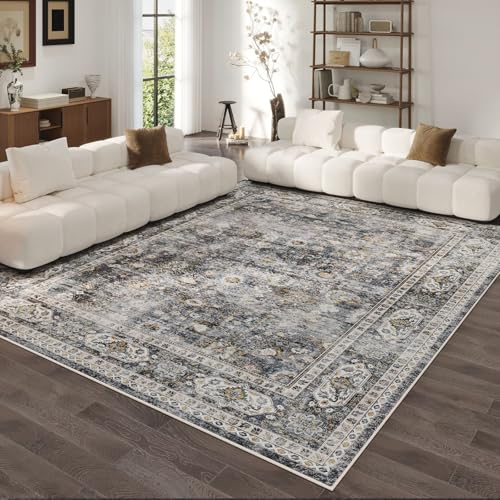
Grey vintage is the diplomat of small-space rugs, and the Rugcomf plays that role well: a 5×7 low-pile polyester with a worn-in pattern that neither darkens a dim room nor washes out a bright one. For renters who move often, that neutrality is a genuine asset, because the same rug can serve under a sofa this year and under a bed in a different flat next year without fighting either scheme.
The soft low pile keeps it practical in the rooms small homes ask rugs to cover, from a play corner where toys are dragged across it to an office chair rolling over it daily. It is listed as washable and non-slip, and polyester at this pile height dries reasonably quickly after a wash, which matters when the rug is the main soft surface the household owns.
- Size listed: 5×7
- Construction: low-pile polyester, soft finish
- Pattern: vintage design in grey
- Backing: non-slip
- Care: washable per maker guidance
Strengths
- Neutral grey transfers between rooms and future homes easily
- Low pile tolerates rolling office chairs and dragged toys
- Vintage patterning forgives the wear of a main living surface
Trade-offs
- Grey can feel cool beside warm wood and cream fabrics
- Polyester lacks the natural hand of wool or cotton
- Mid-tone pattern offers little zoning punch in a studio
Best for: renters wanting one rug that can move rooms and homes
Not suited for: schemes built entirely on warm, creamy tones

Ophanie Small Bedside Rug Fluffy Grey — Warmest First Step, 2×3
Not every small-space problem needs a room-size answer. The Ophanie is a fluffy 2×3, and its natural home is the narrow strip beside a bed where the floor is coldest and the space is tightest, the two feet of boards between bed and wardrobe that a 4×6 could never fit. In that slot its plushness is pure pleasure, a soft landing for the first steps of the day.
The same miniature footprint works at a front door inside a small hallway, beside a nursery chair for night feeds, or in front of a bathroom sink. It is listed with a non-slip backing in an upgraded design, which matters at this size because tiny rugs are the ones most likely to skate across smooth floors when stepped on at an angle in the dark.
- Size listed: 2×3
- Construction: fluffy plush surface
- Pattern: solid grey
- Backing: non-slip, upgraded grip design
- Care: follow maker guidance for plush fibres
Strengths
- Fits bedside strips and hall gaps no larger rug can use
- Plush surface warms the coldest step of the morning
- Small size is easy to lift, shake out and reposition
Trade-offs
- Too small to anchor any seating arrangement
- Fluffy pile traps crumbs more than low-pile rivals
- Not the choice under doors with very tight clearance
Best for: bedside strips, small entries and nursery chair corners
Not suited for: anyone needing a rug to organise a seating layout
How Do the Six Picks Compare Side by Side?
| Pick | Size | Surface | Backing or base | Care route |
|---|---|---|---|---|
| Keeko 4×6 Washable Memory Foam Rug | 4×6 | Memory foam, low-pile surface | Non-slip | Washable |
| Soalmost 4×6 Washable Rug Beige | 4×6 | Low-pile vintage print | Non-slip | Washable |
| Lahome Modern Abstract Area Rug 4×6 | 4×6 | Soft abstract print | Non-slip | Washable |
| Jainmy 5×7 Washable Low Pile Rug | 5×7 | Thin vintage farmhouse print | Non-slip | Washable |
| Rugcomf 5×7 Washable Vintage Rug Grey | 5×7 | Low-pile polyester vintage | Non-slip | Washable |
| Ophanie Small Bedside Rug Fluffy Grey | 2×3 | Fluffy plush solid | Non-slip | Shake out, spot clean |
Read the table by job rather than by looks. The Keeko buys comfort, the Soalmost buys thinness, the Lahome buys definition, the Jainmy buys weight, the Rugcomf buys neutrality, and the Ophanie buys warmth in a gap the others cannot enter. In a small home those jobs rarely overlap, which is why the honest first question is not which rug is prettiest but which problem your floor actually has.
What Size Rug Actually Fits a Small Room?
The reliable method is to tape the rug’s outline on the floor before ordering, using painter’s tape at the corners, then live with the outline for a day. Walk your normal routes, open every door that crosses the space, pull out the dining chairs and sit where you usually sit. If the taped border forces you to sidestep furniture or catches a door, the size is wrong no matter how good it looks in a listing photograph taken in a warehouse-sized room.
In a compact living room, a 5×7 usually works when the sofa’s front legs rest on the rug and at least a hand’s width of floor shows between rug edge and wall. A 4×6 suits a loveseat or a pair of armchairs, and it is also the size that slides most naturally under a single bed or a desk setup. The visible floor border is not wasted space; it is what makes the room read as a room rather than a fitted carpet with furniture parked on it.
Bedrooms follow a different logic. Rather than one large rug under the whole bed, many small bedrooms do better with a 4×6 across the foot and side, or a pair of small rugs at each side, because the area hidden under the bed base earns nothing. The Ophanie’s 2×3 format exists precisely for that exposed strip, and pairing two small rugs often costs less effort to wash and move than one oversized piece.
Why Does Low Pile Matter More in Compact Homes?
Clearance is the practical reason. Interior doors in flats and small houses are often hung with only a few millimetres of gap, and a plush rug can drag against the door’s bottom edge hundreds of times a month, wearing both the pile and the paint. Low-pile picks such as the Soalmost, Jainmy and Rugcomf pass under that swing quietly, which is also why they suit entry-adjacent living rooms where the front door opens straight into the seating area.
Movement is the second reason. Small rooms ask furniture to multitask: chairs are pulled out and pushed in, a coffee table shifts for exercise, a desk chair rolls between desk and shelf. Short, dense fibres let legs and castors travel instead of digging in, and they spring back rather than holding a crushed track. Anyone who has watched a high-pile rug develop a permanent pale path from door to sofa understands the difference within a month.
Cleaning speed completes the case. Short fibres release dust to a vacuum in fewer passes and hold far less water after washing, so a low-pile rug can be washed in the morning and walked on again by evening. In a one-rug household that turnaround is the difference between a cleaning routine that happens and one that keeps being postponed until the rug is beyond a home wash.
How Can Pattern Make a Small Floor Look Bigger?
Scale is the trick most people miss. A large, open pattern with plenty of pale ground reads as spacious because the eye travels across it without interruption, while a dense, tiny motif can make the same floor feel busy and enclosed. Faded vintage designs, like those on the Soalmost and Rugcomf, sit in the sweet spot: enough pattern to hide daily wear, enough softness of contrast that the floor plane still reads as one calm surface.
Direction helps too. A rug whose pattern or placement runs along the room’s longer axis pulls the eye down that axis and stretches the perceived length, a useful illusion in the corridor-like living rooms common in converted flats. Placing the rug so its long edge parallels the longest wall, rather than centring it by habit, costs nothing and quietly changes how the room’s proportions feel.
There is also the zoning use, which the Lahome abstract demonstrates. In a studio, pattern is a wall you can roll up: a defined print under the sofa tells guests where the living room is and tells you where the bedroom begins, without a screen or shelving unit consuming floor. Used that way, a bolder rug is not a risk in a small space but the very tool that makes one room behave like two.
How Do You Wash a Rug in a Small Home Without a Garden?
Start by checking the folded bulk, not the flat size. A thin 5×7 folds into a standard drum far more willingly than a stiff 4×6, which is why foldability is listed among the strengths of the thinner picks here. Shake the rug thoroughly outdoors or over a bath first, vacuum both sides, then wash cold on a gentle cycle and let the machine finish a full spin, because every extra cup of water left in the fibres is drying time you must find space for.
Drying without a garden means thinking vertically. A flat-weave or low-pile rug draped over a door, a folding airer or a shower rail dries from both sides and gives up its moisture within a day in a heated room. Keep it away from direct radiator heat, which can make backings brittle, and do not relay it until the underside feels completely dry to the palm, since trapped damp against floorboards helps nobody.
Between washes, small rugs reward little and often. A two-minute vacuum every few days lifts grit before it grinds into the pile, a damp cloth lifts most fresh spills from these synthetic surfaces, and rotating the rug a half turn every couple of months evens out the fading and wear that a single walking lane would otherwise carve into it. The Ophanie’s size makes it the easiest of the six to keep on that rhythm.
Should a Small Rug Sit Under Furniture Legs or Float Free?
The front-legs rule exists because a rug that touches nothing looks accidental. Resting the sofa’s front legs on the rug ties the seating into one group, stops the rug creeping when people sit down, and lets a 5×7 do the visual work of a much larger piece. In a small room that anchoring matters doubly, because loose rugs drift on smooth floors and a drifted rug instantly makes a tidy room look unsettled.
Floating a rug is sometimes right, though. A 4×6 centred under a coffee table between two armchairs can float if the chairs’ feet frame it closely, and a bedside 2×3 should float by design, since its job is a landing strip rather than an anchor. The test is whether the rug’s edges relate to something: a bed, a table, a doorway. An edge that relates to nothing reads as a mistake at any size.
Dining layouts follow the strictest version of the rule. The rug should extend beyond the table far enough that chairs stay on it when pulled out, which in a small dining corner usually means the rug is sized to the pulled-out chair line, not to the tabletop. The Soalmost’s thin 4×6 handles that duty in tight corners precisely because its edges stay flat where chair legs cross them all evening.
Do Small Spaces Need a Rug Pad Underneath?
Most of the picks in this guide carry their own non-slip backing, which removes the pad question for everyday use, but there are two situations where a thin pad still earns its place. The first is a very smooth floor, polished boards or glossy tile, where even a good backing can creep a few centimetres a week until the rug sits crooked. A slim grip layer underneath stops that slow migration without adding noticeable height.
The second is sound. In flats, footsteps on a thin rug over hard floors carry to the room below, and a pad adds a muffling layer that neighbours appreciate more than any apology. Keep the pad thinner than the rug’s own pile ambitions, though: stacking a thick pad under a low-pile rug in a small room raises the surface into door-swing territory and defeats the clearance you chose the rug for.
If you do add one, cut it slightly smaller than the rug so its edge never peeks out, and check compatibility with your floor finish, since some rubber compounds can mark certain sealed boards over time. For most readers of this guide, the honest answer is to start without a pad, live with the backed rug for a fortnight, and add grip only if the rug actually travels.
How Should You Arrange a Rug in a Studio Flat?
A studio asks one rug to perform the work of a wall, so placement starts with the bed. Keep the sleeping zone rug-free or give it its own small bedside piece, then let the main rug define the living territory at the sofa. That separation, even when it is only a metre of bare floor between zones, gives the brain the boundary it needs to treat one room as two.
Leave a deliberate gap between the rug’s edge and the kitchen units if your studio runs kitchen, living and sleeping in one line. The gap is the corridor, and protecting it keeps cooking splashes off the rug and keeps the living zone feeling like a destination rather than a spillover. A 5×7 such as the Rugcomf or Jainmy usually fills the living territory of a typical studio without invading that corridor.
Lighting can reinforce what the rug starts. A lamp placed at the rug’s far corner pools light inside the zone at night, and a low bookshelf or the back of the sofa along one rug edge completes the enclosure. None of this requires the rug to be large; it requires the rug to be placed with intent, which is the recurring theme of every successful small-space layout.
What Colours Help a Compact Room Feel Calm?
Pale grounds are the obvious lighteners, and beige, soft grey and cream picks dominate this guide for good reason, but calm is not the same as pale. A mid-tone grey like the Rugcomf’s can feel calmer than a bright cream in a sun-flooded room, because it does not glare at midday and it hides the dust that pale rugs advertise. Judge colour against your room’s actual light at the hour you use the room most.
Warm and cool balance matters at small scale because there is nowhere for a clash to hide. Warm woods and cream walls welcome the Soalmost’s beige or the Keeko’s brown and white, while grey floors and white walls sit happier with the Rugcomf or the cooler accents in the Jainmy. When in doubt, hold your largest cushion or curtain fabric against the screen images and choose the rug that shares a tone with it.
Pattern temperature counts too. A faded vintage pattern reads calm even in a stronger colour, because its contrasts are softened, whereas a crisp geometric in a pale colour can still feel energetic. Small bedrooms usually want the faded end of that spectrum, while a studio living zone can carry the crisper Lahome abstract without disturbing anyone’s sleep a few metres away.
How Do You Store or Move a Rug in a Home With No Spare Space?
Foldability is a storage feature, and the thin picks in this set fold into a drawer, a shelf top or the gap beside a wardrobe, which is where small homes actually keep things. Before folding for storage, wash and dry the rug completely, then fold with the pile facing inward so the surface is protected, and avoid sharp creases by refolding along different lines if it stays stored for months.
Rolling suits longer storage but demands a tube or a clear stretch of wall, luxuries small homes rarely have, so folding is the realistic default for 4×6 and 5×7 washable rugs. The exception is the foam-cored Keeko, which prefers to be rolled loosely or stored flat under a bed rather than compressed into a tight fold that its cushioning will remember.
Moving house is where these choices pay off twice. A washable 5×7 that folds into a laundry basket can travel in a car boot and be washed on arrival, while a stiff, heavy rug needs a van slot and a professional clean before it can face a new floor. Renters who expect to move within a couple of years should weigh that future afternoon as heavily as today’s pattern.
When Is a Runner Better Than a Small Area Rug?
Some small spaces are not small squares but small journeys: the galley kitchen, the hall between front door and living room, the strip alongside a long bedroom wall. A runner serves those journeys better than a square rug chopped by doorways, because its long shape matches the walking line and gives muddy shoes or bare feet a continuous soft path.
Area rugs win where life gathers rather than passes. A reading chair, a play corner or a coffee table creates a pool of activity that a runner slices through awkwardly, and the 4×6 sizes in this guide exist for those pools. Many small homes end up with one of each: a runner for the journey, a 4×6 for the gathering, and a 2×3 where feet first meet the floor.
Whichever shape you choose, keep the walking line honest. A rug that covers only half a doorway or ends mid-corridor creates a trip edge exactly where people turn, so measure from door swing to destination and let the rug cover the whole movement or none of it. Partial coverage is the one layout that is worse than bare floor.
How Do You Keep a Small Rug Looking Fresh Between Washes?
Grit is the enemy, and it arrives on shoes. A stiff brush or a short vacuum pass at the doorway end of the rug, where most grit lands, removes the particles that would otherwise grind through fibres with every step. In a small home the whole rug is effectively a doorway rug, so that habit matters more here than in a house where the living room sits three rooms from the street.
Sunlight fades one side of a small rug faster because the whole piece often sits inside a single window’s light path. Rotating the rug end to end every couple of months spreads that exposure, and it also moves the walking lane’s wear to fresh fibres. The washable picks in this guide tolerate that handling easily; rotation takes two minutes and doubles the even life of the surface.
Spills should be blotted, never scrubbed, because scrubbing a low-pile print pushes liquid sideways into a wider stain and roughens the fibres into a visible patch. Lift what you can with a spoon, blot with a clean cloth from the outside of the mark inward, and let the rug’s washability handle the rest at the next machine cycle rather than attacking it with every cleaner under the sink.
Can One Rug Serve a Whole Open-Plan Small Home?
It can, if you accept that the rug’s job is to define the main living territory rather than to soften every step in the home. One well-placed 5×7 under the sofa and coffee table gives the flat a heart, and the remaining bare floor becomes circulation space, which open-plan homes need in order to feel calm rather than crowded with textiles competing for attention.
The risk is choosing a rug so neutral that the single territory it defines feels bland, since there is no second rug elsewhere to carry the home’s personality. That is the case for letting the Lahome’s abstract or the Jainmy’s deep vintage tone do some talking, balanced by plain cushions and throws. One rug, one voice, clearly heard, beats three timid rugs murmuring over each other.
Practically, a single-rug home should choose the most washable construction it can, because that rug will absorb every spill, crumb and muddy paw the household produces. Thin, foldable, machine-washable designs are not a compromise in this arrangement; they are the only category that survives being the whole home’s soft floor on a real cleaning schedule.
What Should Renters Check Before Putting a Rug Down?
Photograph the floor before the rug goes down, especially any existing marks near doors and windows, so the rug is never blamed for damage it merely covered. Then check the backing against your floor type: the non-slip backings on these picks suit most sealed wood, laminate and tile, but freshly oiled boards and delicate finishes deserve a protective layer and a patch test in a corner first.
Lease terms occasionally restrict anything that could mark flooring, and a washable rug with a modern non-slip backing is far easier to defend than older rubber-backed designs known for discolouring vinyl. Keep the listing details and care instructions; showing a landlord a washable, low-pile, backed rug’s specifications ends most conversations before they start.
Finally, think about the exit. A rug that folds into a basket leaves with you cleanly and owes the landlord nothing, while a rug that must be professionally cleaned or that leaves a ghost outline of trapped dust creates work at the worst possible moment. Small-space renting rewards choosing the rug you can remove as gracefully as you laid it.
How Long Should a Washable Small-Space Rug Last?
Longevity in this category is governed less by fibre quality than by washing rhythm and grit control. A low-pile synthetic rug that is vacuumed often, washed a few times a year and rotated will look presentable for years of daily use, while the same rug left unwashed under a dining table will mat and grey no matter how well it was made.
Edges tell the truth first. Curling corners, a backing that no longer grips, or a surface that stays dull after washing are the signs that a rug has given its service. Because these picks are modest, foldable pieces rather than heirloom investments, replacing a tired one is a normal household decision, and the old rug often retires usefully to a balcony, a storage unit or a pet corner.
Buying with that lifecycle in mind changes the choice. Rather than hunting for a forever rug in a size your next home may not want, choose the rug that fits this home, this door swing and this washing machine, and let it work hard. The six picks here were selected on exactly that basis: honest service in small rooms, not promises of permanence.
How Do You Pair a Small Rug With Existing Furniture?
Start with the largest textile already in the room, usually the sofa, and decide whether the rug should echo it or contrast it. Echoing creates calm: a grey sofa over the Rugcomf’s grey vintage pattern layers tone on tone and lets cushions carry the colour. Contrasting creates focus: the same sofa over the Jainmy’s midnight ground gains definition, and the room’s centre of gravity drops pleasantly toward the floor.
Wood tone is the second anchor. Warm oak and walnut welcome beige and brown rugs, while ash, painted white furniture and chrome lean cooler and suit greys and blue-grey accents. In a small room there is no distance to soften a temperature clash, so this single check prevents the common disappointment of a rug that looked right online and wrong the moment it met the bookcase.
Legs and skirts change the maths as well. Furniture with exposed legs shows more rug and lets a pattern breathe, while a skirted sofa or a bed with a valance hides the rug’s edges and argues for a simpler design whose centre does the work. Walk around your arrangement mentally before ordering; the rug you see from the doorway is the rug you bought, whatever the listing’s overhead photograph promised.
What About Allergies, Dust and Bare Floors in Tiny Homes?
A hard floor in a small home concentrates dust where you live and breathe, and a low-pile rug that is vacuumed often and washed regularly acts as a trap that can be emptied, unlike dust that migrates under furniture. The key is the washing: a rug that never gets washed becomes a reservoir, while these washable, quick-drying designs can be kept genuinely clean on a household schedule.
Households sensitive to dust should favour the thinnest, tightest surfaces in this set, the Soalmost and Jainmy style of low-pile print, because they release debris to a vacuum most completely and dry fastest after washing. Plush pieces like the Ophanie are best kept small and specific, at a bedside, where they can be shaken out frequently rather than covering a whole room.
This is household comfort advice, not medical guidance, and anyone managing a diagnosed condition should follow their clinician’s recommendations for their home. Within those boundaries, a washable low-pile rug, a doormat habit and a regular vacuum rhythm make a small hard-floored home feel noticeably fresher day to day.
How Do You Test a Rug in the First Fortnight?
Live with it before you judge it. Walk your real routes at real hours, open every door across it, pull the chairs out for an actual meal and sit on the floor if that is your habit. Note where it creeps, where it catches, and where your feet wish it extended another few inches. Those notes, not the first unboxing impression, describe the rug you actually own.
Check the backing’s behaviour on your specific floor during that fortnight, lifting a corner every few days to confirm nothing is marking or sticking. Washable rugs also deserve an early test wash if you plan to rely on machine cleaning, so you learn how the piece folds, spins and dries in your machine and your space while the purchase is still fresh in mind.
If the size is wrong, the fortnight tells you in which direction: edges that vanish under furniture argue smaller, a seating group that spills off the sides argues larger, and a door that grazes argues thinner rather than smaller. Every pick in this guide sits within one step of a neighbouring size or construction, so a measured disappointment converts easily into the right second choice.
Why Does the Rug’s Edge Matter So Much at This Scale?
In a large room a rug’s edge is a distant detail, but in a small room you stand on or beside that edge all day, so its finish decides whether the piece feels tailored or temporary. Bound or neatly finished edges lie flat, resist the curl that chair legs and door draughts encourage, and give the eye a clean line to follow around the arrangement. When you inspect a new rug, run a hand along all four sides before the first wash and note any waviness, because an edge that will not lie flat on day one rarely improves with use.
Edge behaviour also decides where the rug can work. A crisp-edged low-pile piece can sit half under a desk or run close to a kitchen unit without looking unfinished, while a soft or fringed edge belongs in open floor where it can be seen and left alone. Small homes benefit from treating the edge as part of the furniture plan: align it with a sofa front, a bed side or a doorway line, and the whole room reads as measured rather than approximate, which is ultimately what makes a compact space feel generous.
A Final Measurement Habit Worth Keeping
Before any rug in this guide is ordered, write the room’s three numbers on one note: the taped rug footprint, the lowest door clearance above the floor, and the washing machine’s realistic folded capacity as you judge it from your bulkiest washable item. Those three numbers, kept in a phone photograph, will settle nearly every argument a listing can start, because they describe your home rather than a showroom. When the rug arrives, check it against the same note before the packaging goes out, and a small-space purchase becomes a measured decision instead of a hopeful one, which is the quiet difference between rooms that feel arranged and rooms that feel accumulated.
What Mistakes Make Small Rooms Feel Even Smaller?
Buying the largest rug that physically fits is the classic error. Wall-to-wall coverage removes the floor border that gives a room its sense of proportion, and it guarantees the rug will fight every door and skirting board. If you cannot see floor on at least two sides of the rug, step down a size and let the room breathe.
Choosing plush pile for a room with tight doors runs a close second. The drag marks, the door that never quite closes and the crushed path across the pile all arrive within weeks. Match pile height to your lowest door clearance before you fall for a photograph of a cloud-soft rug in a room with no door in sight.
A third mistake is centring the rug in the room rather than on the furniture. A rug belongs to the arrangement it serves: front legs on for a sofa grouping, fully under a small dining set, or aligned with the bed. A rug centred on empty floor while the sofa sits off its edge looks like a landing pad and makes both the rug and the room feel lost.
Finally, skipping the tape test because measuring feels tedious. Ten minutes with painter’s tape prevents the most common small-space disappointment, which is a beautiful rug in the wrong footprint being folded, returned or lived with resentfully. Every pick in this guide comes in a size worth taping out first.
Final Recommendation
If only one of these six can come home, match it to the room that bothers you most. For a living zone that needs defining, the Rugcomf 5×7 is the safest pair of hands, neutral enough for any scheme and sized for the standard compact layout. For a studio that needs a boundary, choose the Lahome abstract; for a floor you live on at ground level, choose the Keeko and its foam.
Small rooms do not need smaller ambitions, only better-fitting ones, and a rug chosen by tape measure, door clearance and washing drum will quietly make a compact home feel arranged rather than squeezed, so measure your walking lane tonight and let that honest strip of floor, not a listing photo, pick your size.
Frequently Asked Questions
Can a rug be too big for a small living room?
Yes, and it is the most common sizing error. When a rug runs wall to wall it removes the visible floor border, catches doors and makes the room read as one fitted surface. A 5×7 with the sofa’s front legs on it, or a 4×6 under a loveseat grouping, almost always looks larger in effect than a bigger rug that touches every skirting board.
Will a low-pile rug feel cold or hard underfoot?
Low pile feels firmer than plush, but firm is not the same as uncomfortable, especially over wood or laminate that already has some give in the room’s acoustics. If softness is the priority, the Keeko’s memory foam construction delivers cushioning while keeping its surface low, and a fluffy bedside piece like the Ophanie can add plush exactly where bare feet land without raising pile across the whole room.
How do I stop a small rug from sliding on smooth floors?
All six picks here carry non-slip backings, which handle most smooth floors without help. Position the rug fully flat, avoid placing it half on a floor transition strip, and check the backing after each wash, because a backing clogged with lint grips poorly. Very small rugs benefit from being placed where feet land squarely rather than at an angle, such as directly beside a bed.
Is a dark rug a mistake in a small room?
Not when the furniture is pale. A deeper rug like the Jainmy grounds light sofas and stops a compact arrangement looking washed out. The caution is light: in a room that already receives little daylight, a dark floor covering absorbs more of what light there is, so pair it with pale walls and textiles, or choose one of the lighter picks instead.
How often should a small-space rug be washed?
Because a small home’s rug serves as play surface, exercise patch and seating overflow, a full wash every few months suits most households, with vacuuming several times a week and spills dealt with at once. Thin, foldable rugs make that schedule realistic; if your current rug has not been washed in a year because it will not fit the machine, its replacement should be chosen by drum size first.
Related Guides
If your small-space search widens, these companion guides cover neighbouring problems, from play surfaces to natural fibres and whole-apartment planning: Best Area Rugs for Toy Rooms, Best Wool Area Rugs, Best Bamboo and Seagrass Rugs, Best Apartment Rugs.


