What's inside
- Quick Picks
- How We Chose These Picks
- Key Takeaways
- Detailed Reviews
- Comparison Table
- How to Choose Between a Camp Bootie and a House Bootie
- Why Does Loft Matter More Than Thickness?
- Common Mistakes When Buying Down Booties
- How Should You Store and Dry Down Footwear?
- What Is a Cold Bed, and Why Does It Deserve Its Own Footwear?
- How Do Down Booties Behave on a Hut or Cabin Trip?
- Why Do Two Identical-Looking Listings Deserve Separate Reviews?
- What Should a First-Time Down Buyer Pack Beside the Booties?
- Final Recommendation
- Frequently Asked Questions
- Related Guides
As an Amazon Associate I earn from qualifying purchases. This post may contain affiliate links at no extra cost to you.
As an Amazon Associate, cottageverdict.com earns from qualifying purchases made through links in this guide — at no extra cost to you.
Where to buy: the six pairs that follow are all listed on Amazon, and each name links onward to its listing from the Quick Picks table, from the review heading beneath its photograph, and from the comparison grid near the end — so please check price on Amazon and confirm the size, the fill wording and the intended use before ordering the best down slippers for your home or your tent.
Here is the truth this guide must tell before it tells any other: the phrase down slippers describes two different families of footwear that happen to share a filling. In one family live insulated booties born in the camping world — soft, packable, mid-height or sock-like shoes filled or insulated for warmth inside tents, sleeping bags and cold cabins. Four of the six listings below belong to that family, and two of them say so in almost those words, calling themselves sleeping socks and camp foot warmers. In the other family lives the house bootie: a structured slipper boot worn around a home, represented here by a water-resistant insulated hybrid from a winter boot maker and by a chenille velvet slipper boot whose title, notably, does not claim down at all.
That honesty shapes every review that follows. A down sleeping sock is a magnificent thing inside a sleeping bag at a frosty campsite and a peculiar thing at a kitchen sink, because it has no structure to stand in for an hour and no outsole designed for a wet floor. A house bootie reverses the virtues. Shoppers who understand which family they are buying from will be delighted; shoppers who buy a camp bootie expecting a structured house slipper, or a house bootie expecting to pack it into a rucksack’s corner, will feel misled by a purchase that was only ever misdescribed. This guide therefore reviews each pair inside its own family’s terms, names fills exactly as each title words them — goose down where the title says goose down, down where it says only down, and no down claim where the title makes none — and lets the reader choose a family before choosing a pair.
Warmth in this class comes from loft: down clusters trap still air, and still air is the insulation. That is why these booties feel warm out of proportion to their weight, and why several listings use the word ultralight without exaggeration. It is also why compression is the enemy — a down bootie stored crushed, or worn under a tight outer layer, loses the loft that does the work. Around a house, the same physics applies at a gentler scale: a lofted bootie on a cold floor warms the whole foot, ankle included in the mid-height designs, in a way no open slipper attempts. Keep that picture in mind as the six reviews divide themselves between tent, cabin and hallway.
Quick Picks
| Pick | Badge | Why it earns its place |
|---|---|---|
| Baffin Cush Booty | Best House-Ready Insulated Bootie | A mid-height, water-resistant hybrid slipper with a reinforced nylon upper and a wool blend footbed, in black, X-Large. |
| Naturehike Goose Down Booties | Best Goose Down Camp Pair | Ultralight goose down booties described as warm sleeping socks and camping foot warmers for cold weather. |
| Naturehike Down Booties | Best Ultralight Camp Sock | Down booties for camping and backpacking, framed as ultralight winter warm socks for men and women. |
| RANDDER Down Booties | Best Sleeping Bag Foot Warmer | Down booties and warm socks for camp and backpacking, in black, large, pitched as tent down slippers. |
| RANDDER Down Booties 10D Nylon | Best Specified Shell Fabric | A 10D nylon variant of the down sleeping sock idea, ultralight, in a large R02 listing. |
| LongBay Slipper Boots | Best Non-Down House Bootie | Women’s slipper boots in black 7-8 with chenille velvet and a fuzzy fleece interior; its title states no down fill. |
How We Chose These Picks
We began by reading fills with a lawyer’s care. One listing in this set says goose down in so many words. Two say down without naming the bird. One says down in the context of a 10D nylon shell. One insulated hybrid describes its warmth through a wool blend footbed and water-resistant construction rather than through a down claim in its title. And one slipper boot makes no down claim whatsoever, which this guide states plainly in its review, its spec box and its comparison row, presenting that pair as the non-down bootie alternative for readers who want the shape without the filling. Any guide that smoothed those five different situations into one phrase would be inventing products, and inventing products is the one failure this page refuses.
Intended use was the second filter, applied as respectfully as the first. Camp booties were judged as camp booties: packability, loft, sleeping-bag manners and the honesty of their sock-like structure. House booties were judged as house booties: footing, structure and the ability to cross a cold kitchen. We deliberately kept both families in one guide because the keyword gathers both kinds of shopper, and because many households genuinely live in both worlds — a pair for the tent in October, a pair for the stone floor in January. What we refused to do was rank a sleeping sock against a house boot on a single ladder, since that contest has no honest winner, only a category error wearing a medal.
Key Takeaways
- Four of these six pairs are insulated camp booties or down sleeping socks, designed for tents, sleeping bags and cabins rather than for structured house wear.
- Fill claims differ by listing: goose down is stated once, plain down three times, and the LongBay title states no down fill at all.
- The Baffin hybrid is the most house-shaped pair here, with a reinforced nylon upper, a slip-resistant bottom and a wool blend footbed.
- Down warms through loft, so storage and wear that crush the fill quietly remove the insulation you paid for.
- Sock-like booties have no meaningful outsole for wet floors; their territory is the sleeping bag, the tent and the dry cabin.
- The LongBay pair is the non-down alternative, a chenille velvet slipper boot with a fleece interior and a non-slip outsole.
Detailed Reviews

Baffin Cush Booty — Best House-Ready Insulated Bootie
Baffin builds winter boots for serious cold, and the Cush Booty is what happens when that heritage is asked to make something for indoors. The title describes a unisex, water-resistant, insulated hybrid slipper at mid-height, with a reinforced nylon upper, a warm breathable wool blend footbed and a slip-resistant bottom, in black, X-Large. Notice what that specification does not do: it does not rest its warmth claim on a down fill named in the title. The insulation story here is told through construction — a weather-minded shell, a wool blend underfoot, a bottom designed to grip — and this review honours that story in the maker’s own terms rather than dressing the pair in a filling its title never mentions.
Mid-height changes the experience of a cold house. Warmth that stops at the ankle leaves the ankle to the draught that slides under doors and across stone floors, while a bootie that rises past it closes the gap between slipper and sock in one garment. The reinforced nylon upper shrugs off the scuffs of firewood baskets, door frames and the edges of furniture, and water resistance answers the melted snow and kitchen splashes that destroy softer house shoes in a single season. The slip-resistant bottom completes the house argument: this is a bootie intended to be walked in, across real floors, by a person carrying things.
Campers will recognise the hybrid logic too, since a bootie like this serves the cabin, the hut and the cold caravan better than a pure sleeping sock, precisely because it can cross a floor and step onto a frosty porch. What it will not do is pack into a rucksack’s spare corner like the down socks below, and the X-Large sizing of this listing targets the bigger end of the unisex range. For the reader whose cold problem is a house rather than a tent — a farmhouse kitchen, a stone cottage, a workshop with a wood stove — the Baffin is the pair in this guide that was actually built for the problem, and its maker’s winter pedigree shows in every clause of its title.
- Height: mid-height, per the title
- Upper: reinforced nylon upper, water-resistant
- Footbed: warm breathable wool blend footbed
- Bottom: slip-resistant bottom
- Colour and size in title: Black, X-Large
- Down fill claim in title: not stated in the listing
Strengths
- Winter-boot construction suits real houses and cabins
- Mid-height closes the ankle gap against floor draughts
- Water resistance and grip answer snowmelt and splashes
Trade-offs
- Too structured to pack like a sleeping sock
- This listing’s X-Large size targets bigger feet
- Warmth story is construction-based, not a down claim
Best for: cold houses, cabins and workshops needing a walkable insulated bootie. Not suited for: ultralight backpackers who need footwear that vanishes into a pack corner.

Naturehike Goose Down Booties — Best Goose Down Camp Pair
Naturehike speaks the language of the lightweight camp fluently, and this listing is unambiguous about what it is selling: ultralight goose down booties for men and women, warm sleeping socks, soft and cosy camping foot warmers for cold weather, winter down socks for camping, backpacking and sleeping. Goose down is stated outright, which makes this the one pair in the guide whose fill can be described with that specific phrase, and the intended habitat is stated just as plainly. These are not house slippers that happen to travel. They are sleeping equipment that happens to be shaped like footwear, and every honest judgement about them flows from that identity.
Inside a sleeping bag, the design makes perfect sense. Feet are the first part of a sleeper to cool and the hardest to rewarm, because a bag’s insulation compresses beneath the body while the feet sit in its loosest, coldest corner. A lofted down sock restores insulation exactly where the bag is weakest, weighs almost nothing in the pack, and compresses into a corner when the morning comes. Around a tent, the same softness that serves the bag defines the limit: there is no outsole here for wet grass, sharp gravel or a midnight walk over frozen ground, and wearing them as camp shoes in rough terrain will shorten their lives and chill their wearer through the sole.
At home, the pair finds a narrower, legitimate role: the cold bed. Readers whose feet stay cold under blankets, in houses where heating rests overnight, will understand immediately why a down sleeping sock earns drawer space beside the pyjamas. What it should not become is a kitchen slipper, because a sock asked to do a shoe’s work on wet tile will fail at both jobs. Bought for the bag, the tent and the cold bed, the Naturehike goose down booties are the purest expression of this guide’s title — actual goose down, honestly framed, doing the job its maker describes in the environment its maker names.
- Fill: goose down, per the title
- Intended use: sleeping socks, camping foot warmer
- Activities in title: camping, backpacking, sleeping
- Weight wording: ultralight
- Intended wearers: men and women
- Outsole for outdoor walking: not given
Strengths
- Goose down is claimed in the title’s own words
- Sleeping-bag warmth where bags are weakest
- Ultralight and packable for genuine backpacking
Trade-offs
- Sock structure offers no footing on rough ground
- Not a house slipper for kitchens or wet floors
- Loft needs uncrushed storage between trips
Best for: campers and cold-bed sleepers wanting stated goose down insulation. Not suited for: anyone seeking a structured slipper for walking around a house.

Naturehike Down Booties — Best Ultralight Camp Sock
A second Naturehike listing invites careful distinction rather than a repeated review. This title says down booties for men and women, a camping foot warmer, ultralight winter warm socks for camping and backpacking — and it does not say goose. The fill here is therefore described in this guide exactly as its maker words it: down, unspecified. That difference is not a pedant’s footnote. Fill species and quality are part of what a buyer is paying for in any down product, and a guide that upgraded this listing’s plain down into goose down would be spending the reader’s money on a claim nobody made. Read on its own terms, the pair remains a coherent offering: an ultralight down sock for the same sleeping-bag and tent duties as its sibling.
The shorter title also leaves more unsaid, and the review follows it into that restraint. No shell fabric is named, no size is printed in the title provided, and no softness adjectives are offered beyond the warmth framing. What a buyer receives is the essential proposition — down insulation in a bootie sock for camp — and the product page must supply the rest. For backpackers, the calculus is familiar: a sleeping sock is judged at the end of a cold night, not at the checkout, and its virtues are loft, weight and the discipline to keep it dry, since down of any species loses its warmth when soaked and recovers it only with patient drying.
Two Naturehike pairs in one guide might look like duplication until their titles are read side by side, at which point they become a lesson in specification. One states its goose down and its softness; the other states its down and its purpose, and stops. Buyers who care about the named fill know which listing answers them, while buyers who care chiefly about an ultralight down sock for a bag may find this plainer pair entirely sufficient. Either way, the family’s territory remains the tent and the cold bed, and this pair should be bought, packed and judged inside that territory.
- Fill wording: down, per the title
- Intended use: camping foot warmer, warm socks
- Activities in title: camping, backpacking
- Weight wording: ultralight
- Intended wearers: men and women
- Fill species beyond down: none stated in the listing
Strengths
- Plain down claim keeps the proposition honest
- Ultralight sock suits sleeping bags and tents
- Shares the family’s cold-bed usefulness at home
Trade-offs
- Title omits shell fabric and size details
- Wet conditions defeat down’s loft quickly
- No structure for walking beyond the tent door
Best for: backpackers wanting an ultralight down sleeping sock without extra claims. Not suited for: buyers who need the fill species named, or any house-walking duty.

RANDDER Down Booties — Best Sleeping Bag Foot Warmer
RANDDER’s title reaches for the widest possible description of a camp bootie — down booties, warm socks for men and women, an ultralight sleeping sock for camp and backpacking, soft and cosy, a camping sleeping bag tent down slipper and foot warmer — and then pins the variant down to black, large. The phrase tent down slippers deserves the same honest framing applied throughout this guide: inside a tent, on a sleeping mat, within a bag, the description is fair, because that is the environment where a lofted sock is footwear enough. Outside that environment, the pair remains a sock, and the review will keep calling it one in every context where structure matters.
Within its environment, the virtues compound. Down loft around a resting foot warms without the weight or stiffness of a boot, the soft construction lets a sleeper move and curl naturally through the night, and the pack cost is so small that the pair earns its place even on trips where it serves only two cold nights out of seven. Campers who sleep cold know that foot warmth changes the whole night’s arithmetic: a sleeper whose feet are warm stops waking at three in the morning, and a single unbroken night is worth more on a trail than any specification printed on a stuff sack.
Care is the price of admission for all down, and this pair is no exception. Keep the booties dry in a waterproof stuff sack, air them at every camp, loft them in the sun when the trail allows, and store them uncompressed at home so the fill arrives at the next trip with its warmth intact. The black colour forgives the dust of tent floors and cabin bunks, and the large size serves the bigger end of the unisex range. As a foot warmer for bags and tents, the RANDDER design states its purpose in more words than any rival here — and on the evidence of its own title, that purpose is the whole product.
- Fill wording: down, per the title
- Intended use: sleeping sock for camp, backpacking
- Colour and size in title: Black, Large
- Comfort wording: soft and cozy, per the title
- Setting in title: sleeping bag, tent
- Outsole construction: not stated in the listing
Strengths
- Purpose stated exhaustively in its own title
- Lofted warmth improves whole nights of camp sleep
- Black colour forgives tent and cabin dust
Trade-offs
- A sock, not a shoe, beyond the tent door
- Down demands dry storage and careful packing
- Large size in this listing suits bigger feet only
Best for: campers who sleep cold and want a dedicated bag-and-tent foot warmer. Not suited for: house wear, wet ground or anyone expecting an outsole.

RANDDER Down Booties 10D Nylon — Best Specified Shell Fabric
One number separates this RANDDER listing from its sibling: 10D. In fabric language, denier measures the weight of the yarn, and a 10D nylon is a very light, fine cloth of the kind ultralight equipment makers choose when every gram argues for its place in the pack. The title builds around that specification — down booties, warm socks in 10D nylon, an ultralight sleeping sock for camp and backpacking, a camping sleeping bag tent down slipper and foot warmer, variant R02, size large. Where the sibling listing sold softness, this one sells specification, and the buyer it addresses is the gram-counting backpacker who reads fabric numbers the way cooks read oven temperatures.
A finer shell carries a known trade. Ten-denier cloth keeps weight and packed size at their minimum and feels silky against a sleeping sock or bare skin, yet it asks its owner for gentleness: snags, rough tent floors and careless stuffing all punish fine nylon sooner than they punish a heavier weave. Inside a sleeping bag, where the bootie actually works, the environment is kind, and the trade makes sense. The down fill is worded as down, without a species claim, and this review keeps that wording intact. Warmth will depend on loft and dryness exactly as with every pair in this family, whatever the shell’s number says.
Distinguishing the two RANDDER pairs is therefore straightforward. Choose the plainer black listing for general camp duty and a softer sales pitch; choose the 10D variant when pack weight is a genuine discipline and your handling habits are careful enough to protect a fine shell. Both pairs live in bags and tents, both warm resting feet through the night, and neither should be asked to cross a wet campsite at midnight. Specification, in the end, is a promise about a single property, and the honest buyer reads the 10D as a statement about cloth — nothing more, and nothing less.
- Shell fabric: 10D nylon, per the title
- Fill wording: down, per the title
- Intended use: ultralight sleeping sock, camp, backpacking
- Variant and size in title: R02, Large
- Setting in title: sleeping bag, tent
- Fill species beyond down: not given
Strengths
- Shell weight is specified in the title itself
- Ultralight build suits gram-conscious backpacking
- Fine nylon feels smooth inside a sleeping bag
Trade-offs
- Fine 10D cloth needs gentle handling to last
- Down fill is not given a species in the title
- Sock structure excludes walking beyond the tent
Best for: ultralight backpackers who read fabric specs and handle gear gently. Not suited for: rough camp use or anyone wanting a house slipper.
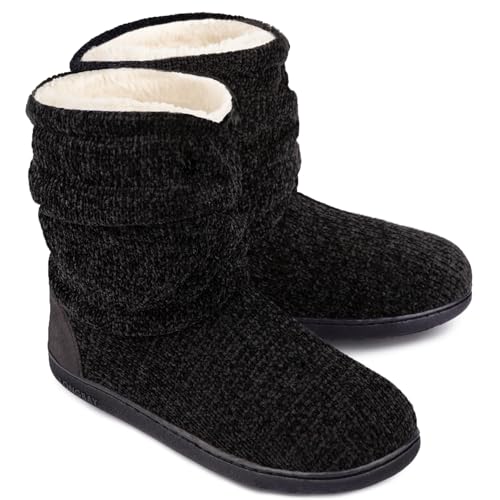
LongBay Slipper Boots — Best Non-Down House Bootie
The final pair in this guide requires the plainest sentence on the page: the LongBay title does not state down fill. What it states is a women’s slipper boot in black, sized 7-8, described as warm winter gift house shoes with a cute bootie design, indoor outdoor use, a non-slip outsole, cosy chenille velvet, a fuzzy fleece interior and a cloud-like comfort insole. Presented honestly, that is not a lesser product; it is a different one — a house bootie in the traditional sense, built for floors, stairs and doorsteps, offering the boot shape that down shoppers often picture while making no claim about the filling that gives this guide its name. It is included, and labelled, as the non-down alternative.
Judged as a house bootie, the specification is coherent and complete. Chenille velvet gives the exterior a soft, composed finish, the fleece interior warms the foot and ankle, the bootie height closes the draught gap that open slippers leave, and a named non-slip outsole supports the indoor outdoor framing in a way no sleeping sock in this guide attempts. The cloud-like insole phrase is the maker’s comfort language rather than a material specification, and this review treats it as such. For a reader whose real desire is a warm boot to wear around a cold house — whatever keyword brought them here — this pair may quietly be the most suitable product on the page.
The gift framing in the title is also plausible on its own terms: a black bootie in a central size band, warm and presentable, is an easy winter present. What the pair will not do is compress into a rucksack corner or line a sleeping bag, and it should never be bought by a camper on the strength of this guide’s title. Its presence here is a service rather than a confusion: it shows the down-curious reader exactly what the house-shaped alternative looks like, with its fill status stated in daylight, so the choice between a camp sock and a house boot can be made as a choice, with both products honestly described.
- Fill status: down not stated in the listing title
- Upper: cosy chenille velvet, per the title
- Interior: fuzzy fleece interior
- Outsole: non-slip outsole; indoor outdoor use
- Colour and size in title: Black, 7-8
- Insole wording: cloud-like comfort insole
- Construction type: slipper boots, house shoes
Strengths
- A true house bootie with an outsole for real floors
- Boot height and fleece interior warm foot and ankle
- Clear non-down status lets buyers choose knowingly
Trade-offs
- Not a down product, despite appearing in this guide
- Too bulky for backpacking or sleeping-bag use
- Insole description is comfort language, not a spec
Best for: home wearers wanting a warm bootie shape without a down fill. Not suited for: campers, or any buyer specifically seeking down insulation.
Comparison Table
The grid keeps each pair inside its own family’s vocabulary. Read the fill column with particular care, since it records exactly what each title claims — including, in the final row, a claim that is not there.
| Pick | Fill as titled | Construction as titled | Defining note from title |
|---|---|---|---|
| Baffin Cush Booty | Down not claimed in title | Reinforced nylon, mid-height | Wool blend footbed; slip-resistant bottom |
| Naturehike Goose Down Booties | Goose down | Sleeping sock construction | Camping foot warmer; ultralight |
| Naturehike Down Booties | Down | Sleeping sock construction | Ultralight winter warm socks |
| RANDDER Down Booties | Down | Sleeping sock construction | Black, Large; tent foot warmer |
| RANDDER Down Booties 10D Nylon | Down | 10D nylon shell | Ultralight; R02, Large |
| LongBay Slipper Boots | Down not stated in title | Chenille velvet bootie | Non-slip outsole; fleece interior |
How to Choose Between a Camp Bootie and a House Bootie
Ask where the pair will spend its hundredth hour, not its first. If the honest answer is inside a sleeping bag, on a tent floor or curled in a cold bed, the down socks in this guide are specialised instruments built for exactly those hours, and their lack of structure is irrelevant because the environment asks for none. If the hundredth hour is at a kitchen counter, on a staircase or crossing a yard to a woodpile, structure becomes the whole purchase, and the Baffin hybrid or the LongBay boot — one insulated by construction, one fleece-lined and explicitly not down-filled in its title — will serve while a sleeping sock fails within a week. Most disappointment in this category is born when a first-hour photograph outvotes a hundredth-hour answer.
Fill literacy is the second skill. Goose down, stated once in this guide, names a species. Plain down, stated three times, names a family of fills without that specificity. A wool blend footbed names a different warmth strategy altogether, and a title silent about fill, like the LongBay’s, should be read as a title making no fill promise. None of those wordings is a trick; each is a precise statement that rewards a precise reader. When two listings look identical in photographs, their fill sentences are usually where the real difference — and the real explanation of any price gap — is hiding, so read those sentences aloud before comparing anything else.
Fit divides the families as sharply as fill does. A sleeping sock should fit like a generous sock: close enough to stay on a turning sleeper, loose enough to preserve loft around the toes, since crushed down at the toe box warms nobody. A house bootie should fit like a shoe: heel seated, toes clear, ankle held by the boot’s rise. Buyers between sizes should therefore move in opposite directions depending on family — toward room in a camp sock, toward precision in a house boot — and any guide that gives one sizing rule for both is quietly mis-serving half its readers.
Finally, consider the wet question, because down and water have an old quarrel. Down insulation loses its loft when soaked and regains it slowly, so camp booties live in waterproof sacks, dry at every opportunity, and never serve as the shoe for a dewy midnight walk. A house bootie with a water-resistant upper or a proper outsole treats splashes as weather rather than as damage. Readers whose lives involve snowmelt, wet porches and muddy thresholds should weight that difference heavily; readers whose booties will live between a bed and a tent can ignore it entirely and buy on loft and weight alone.
Why Does Loft Matter More Than Thickness?
Down insulates by trapping air, not by being a substance that is warm in itself. A down cluster is a tiny three-dimensional thicket, and thousands of clusters together hold a still layer of air that body heat warms once and the cold outside cannot easily cross. Thickness is merely loft made visible; compress the same fill into half the height and half the air leaves with the squeeze, which is why a bootie crushed under a tight outer shoe or stored in a tight sack arrives at the cold with only a fraction of its rated comfort. Every care instruction in this guide — loft before use, store uncompressed, keep dry — is that single piece of physics wearing different clothes.
The same physics explains the family’s astonishing warmth-to-weight reputation. Air weighs nothing, and down is mostly a structure for holding air, so a bootie can carry a winter’s worth of insulation at a weight a boot maker would use for a single toe cap. It also explains the fragility: the structure is delicate, its enemy is sustained compression and moisture, and its lifespan is measured in how kindly its owner packs, stores and dries it. A reader who understands loft stops asking how thick a bootie is and starts asking how it will be treated — which is, not coincidentally, the question that predicts satisfaction with every pair in this family.
Common Mistakes When Buying Down Booties
The governing mistake is the one this guide opened with: buying a sleeping sock as though it were a house slipper. The photographs share a silhouette, the keyword gathers both, and a hurried buyer discovers the difference on a wet bathroom floor at midnight. Read the intended-use words in every title — sleeping, camping, backpacking on one side; house shoes, indoor outdoor, outsole on the other — and let those words, not the silhouette, assign the product to its family. The second mistake is upgrading fills in your head. A title that says down has not said goose down, and a title that says nothing about fill has not whispered it either; buyers who need a specific fill should purchase the listing that states it.
Storage mistakes quietly ruin more down than wear does. A bootie stuffed into a tight sack in a damp garage in March emerges in October with flattened clusters and a smell no airing fully cures, and its owner blames the fill for a failure of housekeeping. Store down lofted, dry and breathing, in a large cotton sack or loose on a shelf, and shake it back to life before the first cold night. The fourth mistake is wearing camp booties as camp shoes — across wet grass to a wash block, over gravel to a viewpoint — which soaks the fill, abrades the shell and teaches the owner to hate a product that was performing beautifully inside its actual job description.
The last mistake is expecting one pair to span both families because a holiday includes both a tent and a cottage. Two specialised pairs, each modest, will outperform one compromise across such a trip, and the total packed weight of a down sock beside a house bootie remains trivial next to the comfort of having the right thing on your feet in each place. Specialisation is not upselling; in footwear built around loft, it is simply how the physics prefers to be respected.
How Should You Store and Dry Down Footwear?
On the trail, the routine is defensive: a waterproof sack inside the pack, booties aired inside-out whenever the tent is pitched in dry weather, and a strict rule that the socks never leave the tent’s clean groundsheet zone. If a pair does dampen — through condensation, a spilled bottle or a sleeper’s own warmth across a freezing night — dry it with patience: turned out, shaken gently, hung in moving air, and given sun when the day offers it. Forcing down dry with fierce heat damages both fill and fine shells, including the 10D nylon variant in this guide, whose cloth deserves the gentlest handling of any pair here.
At home, storage decides next season’s warmth. Wash only when genuinely needed, with a down-appropriate detergent and a long, complete dry, since clusters left damp in the centre will clump and lose their thicket structure. Store the pair uncompressed in a breathable sack, never in the tight stuff sack that serves on the trail, and never under weight. House booties ask for simpler manners — dry soles, an aired interior, a shelf rather than a heap — yet the principle rhymes: insulation of every kind in this guide works by holding air, and everything that crushes, soaks or seals it away is quietly spending the warmth the buyer paid for.
What Is a Cold Bed, and Why Does It Deserve Its Own Footwear?
There is a domestic cold that heating systems never quite reach: the last two feet of a bed in a room whose warmth rests overnight. Sleepers who know it develop rituals — socks worn to bed and kicked off by midnight, a hot water bottle that migrates and cools, a partner’s warmer feet borrowed without negotiation. A down sleeping sock answers that small nightly problem with embarrassing completeness, because it brings sleeping-bag technology to the exact place a sleeping bag would have been used. The loft warms without the tightness of a fitted sock, the softness lets toes move and settle, and the pair waits in a drawer rather than demanding a place in the shoe rack’s front row.
This is also the role in which camp booties forgive their owners’ curiosity. A reader who bought a down pair for a trip that happens twice a year can employ it nightly at home without abusing it, since a bed is as gentle an environment as a bag. The booties should stay in the bedroom’s dry territory, away from bathroom tile and kitchen rounds, and be aired on the bed each morning rather than sealed in a drawer while still holding the night’s warmth. Used so, a camp purchase quietly becomes a sleep purchase, and the cost per warm night falls to almost nothing across a single winter.
How Do Down Booties Behave on a Hut or Cabin Trip?
Between the tent and the house sits a third territory where this family shines: the hut, the bothy, the rented cabin with a wood stove and a floor of cold boards. Here a sleeping sock gains a floor to cross, yet the floor is dry, familiar and short — bunk to stove, stove to door for a look at the weather. Camp booties handle those crossings gracefully in dry conditions, warm the feet that a day of boots has chilled, and pack away to nothing when the party moves on. The Baffin hybrid, with its reinforced upper and slip-resistant bottom, stretches the territory further, to porches and woodpiles, which is why cabin parties so often end with one structured pair and several sock pairs sharing a stove-side shelf.
The cabin also teaches the family’s one social rule: booties stay inside. A pair worn onto wet grass for a midnight sky-watch returns soaked, and down that enters a sleeping bag wet steals warmth from the whole night rather than adding to it. Experienced hut users keep a battered pair of outdoor shoes by the door for exactly that errand and treat the boundary as absolute. Within the boundary, few pieces of equipment earn their pack space as completely as a lofted pair of down socks on a frosty night in the hills.
Why Do Two Identical-Looking Listings Deserve Separate Reviews?
This guide contains two pairs of siblings — two Naturehike listings and two RANDDER listings — and a hurried reader might ask why each sibling receives its own review rather than a shared paragraph. The answer is the discipline of the titles themselves. One Naturehike states goose down; the other states down and stops. One RANDDER sells softness in black; the other sells a 10D nylon shell by number. Those are different promises made to different buyers, and collapsing them would erase precisely the information a careful shopper came to find. In a category where photographs converge and specifications diverge, the review’s job is to stand where the divergence lives.
The habit generalises beyond this page. Whenever two listings look like twins, compare their sentences about fill, shell and intended use before comparing anything else, and distrust any summary — including, on other sites, summaries of these very products — that describes the siblings in interchangeable words. A fill upgraded in retelling, a shell invented in a headline, a sock promoted to a shoe: each small liberty spends a reader’s money on a product that does not exist. The six reviews above were written pair by pair, title by title, so that the money spent after reading them lands on the product that was actually described.
What Should a First-Time Down Buyer Pack Beside the Booties?
A short supporting cast multiplies the value of a first down purchase. A waterproof stuff sack defends the loft through river crossings, wet tents and the condensation that gathers in any pack on a cold morning. A thin pair of ordinary socks worn inside the booties keeps skin oils and the day’s dust off the fill, extending the intervals between washes, which down prefers to be rare. A small, patient habit completes the kit: ten seconds of shaking and lofting when the booties come out of the pack, restoring the air that compression borrowed, before the feet ever go in.
House buyers have their own supporting cast. A boot tray by the door gives a water-resistant hybrid somewhere honourable to live, a shelf keeps lofted pairs uncrushed, and a spare pair of ordinary warm socks covers the evenings when a bootie is drying after a wash. None of these companions costs much, and each one protects the central purchase in a different way, which is the quiet arithmetic behind every long-lived piece of insulated footwear in this guide.
One further scene belongs in an honest guide to this family: the three-in-the-morning wakefulness of a cold sleeper who has finally solved the problem. Anyone who has lain awake bargaining with chilled feet understands that foot warmth is not a luxury specification but the gatekeeper of sleep itself, and that a sleeper who drops off warm tends to stay asleep through the coldest hour before dawn. A down sock earns its keep in that hour without machinery, batteries or noise, which is why campers guard theirs and why the cold-bed drawer at home so often contains a pair that began its life on a mountain. Judge the family by that hour and its value stops needing any defence at all.
Conversely, the family’s value collapses the moment it is asked to be something else at that same hour — to cross a wet yard, to stand at a stove, to grip a stair. Warmth was never the missing property in those scenes; structure was. Keeping the two judgements separate is the entire editorial policy of this page, compressed into a single habit of mind that a reader can carry to every future listing in the category.
Weight deserves one last clarification for readers comparing the families on a screen. Ultralight in these camp titles describes the whole bootie, fill and shell together, and it is a genuine property earned by down’s structure rather than a marketing mood. A house bootie will always outweigh a sleeping sock many times over, because structure, soles and linings are made of sterner stuff than trapped air. Neither weight is a virtue in isolation. The sock’s lightness serves the person carrying it up a hill; the boot’s substance serves the person standing on it in a kitchen, and each should be praised only in the company of the job it was built to do.
Price, similarly, should be read inside each family rather than across the whole page. A sleeping sock is priced against other sleeping equipment, where its cost per warm night on the trail is the honest measure, while a house bootie is priced against a winter of cold floors. Cross-family price comparisons produce confident nonsense, because they compare a gram of loft with a gram of structure as though the two were interchangeable currencies.
Before the grid, a word for the reader who arrived wanting one pair to do everything and feels vaguely scolded by a page that keeps dividing the world in two. The division is a kindness. A household that owns a camp sock for the tent and a boot for the hallway stops experiencing the small daily frictions — the soaked fill, the sliding sock, the chilly ankle — that make people abandon good products for the wrong reasons. Each pair in this guide is excellent company inside its own borders, and the borders, once seen, are easy to respect: dry or wet, resting or standing, packed or shelved. Choose by border first and by brand second, and winter becomes a season your feet are equipped for in every room it reaches.
That is the whole method, and it travels well: it will serve you in every future category where one keyword shelters two honest products wearing a single silhouette.
Keep it beside the size chart and the fill sentence, and the three together will make you a difficult customer to mislead.
Final Recommendation
Campers should begin with the Naturehike Goose Down Booties, the one listing that names goose down outright, while cold-house readers should begin with the Baffin Cush Booty, whose reinforced, water-resistant build was made for real floors. Anyone who wants the bootie shape for the home without a down fill should choose the LongBay Slipper Boots knowingly, as the non-down alternative it honestly is. Decide first whether your cold lives in a tent or in a hallway, and the right pair will step forward on its own, lofted, dry and exactly as described.
Frequently Asked Questions
Are down booties the same thing as down slippers?
In listings, the words overlap, but the products divide into camp sleeping socks and structured house booties. Four pairs here belong to the camp family, while the Baffin hybrid and the LongBay boot serve the house. The intended-use words in each title tell you which family you are buying.
Which pair in this guide actually contains goose down?
Only the Naturehike goose down listing states goose down in its title. Two Naturehike and RANDDER listings state down without naming a species, and this guide keeps those wordings separate because the distinction is part of what a buyer is paying for.
Is the LongBay pair filled with down?
Its title does not state down fill. It describes a chenille velvet slipper boot with a fuzzy fleece interior and a non-slip outsole, and this guide presents it plainly as the non-down house bootie alternative rather than as a down product.
Can I wear down sleeping socks around the house?
On dry carpet for a short, gentle evening, they will feel warm, but they have no outsole for wet floors, no structure for standing, and their fill suffers under hard daily use. Their designed home is the sleeping bag, the tent and the cold bed.
How do I keep down booties warm across many seasons?
Keep them dry on the trail, air them at every camp, and store them uncompressed in a breathable sack at home. Loft is the insulation, so anything that crushes or soaks the fill spends the warmth; gentle handling returns it season after season.
What does 10D nylon mean on the RANDDER variant?
Denier describes the yarn’s weight, and 10D is a very fine, light nylon of the kind ultralight gear favours. It minimises pack weight and feels smooth in a sleeping bag, while asking its owner for gentler handling than a heavier shell would.
Which pair suits a cold stone cottage best?
The Baffin hybrid, with its reinforced water-resistant upper, wool blend footbed, mid-height coverage and slip-resistant bottom, was built for walkable cold floors. The LongBay boot is the alternative for readers who prefer a fleece-lined house bootie and do not need a down product.
Related Guides
The slipper shelf continues toward durability and synthetic plush in the neighbouring guides below.



[…] Best Down Slippers […]