What's inside
- Key Takeaways
- Quick Picks
- How Did We Choose Among So Many Talalay Claims?
- How Do the Best Natural Latex Pillows Compare at a Glance?
- What Is Talalay Latex, and How Is It Different From Other Latex?
- Why Does Latex Feel So Different From Memory Foam?
- How Should You Match Latex Height and Firmness to Your Sleep Position?
- How Do You Care for a Latex Pillow So It Lasts?
- What Mistakes Do First-Time Latex Buyers Make?
- How Long Does a Natural Latex Pillow Keep Its Shape?
- Solid, Shredded or Blended: Which Form of Latex Suits You?
- How Heavy Is a Latex Pillow, and Why Does the Weight Matter?
- What Should You Expect in the First Week With Latex?
- How Does Latex Behave Across the Seasons?
- How Should You Test a Latex Pillow During Its First Nights at Home?
- Should a Couple Buy Two Different Latex Pillows?
- Final Recommendation
- Frequently Asked Questions
- Related Guides
As an Amazon Associate I earn from qualifying purchases. This post may contain affiliate links at no extra cost to you.
cottageverdict.com is reader-supported. When you buy through links on our site, we may earn an affiliate commission.
Where to buy: all six pillows below are sold on Amazon, and their names in the Quick Picks table, the review headings and the comparison table link to their listings, so you can check price on Amazon and confirm the latex type in the listing wording before you order. The best natural latex pillows share one quality no other pillow material quite reproduces: they answer pressure instantly. Press a hand into latex and it pushes back while your hand is still moving, then returns to shape the moment you lift away. There is no slow sink, no waiting for foam to warm and soften, and no morning valley where your head used to be.
Every pick in this guide is natural latex or Talalay latex according to its own listing. That filter mattered during selection: at least one famous pillow markets a latex-like experience while actually being built from a gel-flex grid, and it was excluded on purpose, because a reader searching for natural latex is usually searching for the material itself — tapped from rubber trees, whipped and baked into an open-cell foam — not for a synthetic impression of its bounce. What remains is a line-up that spans firm to soft, solid to shredded, and one deliberate blend, so the differences worth arguing about are differences of feel rather than of honesty.
Latex also asks something of its owner. It is heavier than the pillows most people are used to, it dislikes harsh washing, and it costs more than polyester fill by a wide margin. In exchange it offers the longest working life of any common pillow material and a consistency of support that does not quietly fade across the years. This guide treats those trade-offs plainly, pick by pick, so you can decide whether the material’s character suits the way you actually sleep.
Key Takeaways
- All six picks are natural latex or Talalay latex per their listings; a gel-grid pillow that imitates latex was deliberately left out of this guide.
- Heights are stated on two picks — 6.2 inches for the ECQOLRA and 5.5 inches for the JOTOM — while the rest describe firmness without a number.
- Firmness runs the full range here, from the Queen Firm build of the ORGANIC TEXTILES pillow to the explicitly Soft Queen Talalay at the end of the list.
- Two picks are adjustable: the Talatex, filled with shredded Talalay, and the Coop Home Goods, which blends Talalay latex with microfiber.
- Solid latex should not be machine washed; the removable covers on several picks are the washable part of the product.
- Latex is dense and heavy compared with fibre pillows, so check your tolerance for a pillow that stays planted rather than drifting.
Quick Picks
| Pillow | Badge | Why it earns its place |
|---|---|---|
| ECQOLRA 100% Natural Talalay Latex Pillow | Best Medium Talalay | A full Talalay build at a stated 6.2 inches in Standard, medium feel, with a removable breathable cotton cover. |
| ORGANIC TEXTILES Natural Latex Bed Pillow Queen Firm | Best Firm Latex | The firm end of the range: natural latex in Queen, wrapped in a GOTS certified organic cotton cover. |
| JOTOM Talalay Natural Latex Pillow | Best Mid-Height Talalay | Talalay at a stated 5.5 inches and medium firmness, the measured middle option for mixed-position sleepers. |
| Talatex Talalay Shredded Latex Pillow | Best Adjustable Shredded Latex | Shredded Talalay you can add or remove, with an adjustable neck support area for sleepers who tune by handfuls. |
| Coop Home Goods Adjustable Latex Pillow Queen | Best Blended Adjustable | A Queen adjustable blend of Talalay latex and microfiber, medium firm, for households wary of an all-latex leap. |
| 100% Natural Talalay Latex Pillow Breathable | Best Soft Talalay | The soft landing: a breathable Queen Talalay with a removable, washable cotton cover for gentler support. |
How Did We Choose Among So Many Talalay Claims?
The first filter was material truth. A pick had to describe itself as natural latex or Talalay latex in its own listing, and any construction that merely borrows latex language while being built from something else was set aside. That single rule removed the best-known impostor in this category and left a field where comparisons could be honest: every pillow below is genuinely latex, so the argument becomes about height, firmness and form rather than about whether the word on the box means anything.
The second filter was range. Latex buyers split into tribes — the firm loyalists, the soft converts, the adjusters who want to tune by hand — and a guide that recommended six near-identical medium pillows would serve none of them. So the final six deliberately span the spectrum: two stated heights, one explicitly firm Queen, one explicitly soft Queen, one shredded and adjustable, and one blend that softens latex’s character with microfiber. Where a brand offered the same pillow in several firmness grades, only one grade was admitted as a pick, so the six slots went to six genuinely different products rather than to one product wearing three labels.
Finally, each listing was read for what it does not say. Several of these pillows carry no stated height, no stated size beyond a name, or no firmness number, and the reviews below flag those gaps rather than papering over them. Latex is a considered purchase, usually kept for years, and a buyer deserves to know which facts are printed and which must be confirmed on the listing page before ordering.

ECQOLRA 100% Natural Talalay Latex Pillow — Best Medium Talalay
The ECQOLRA leads the guide because it states the two facts latex shoppers most need and most listings withhold: it is 100% natural Talalay latex, and it stands 6.2 inches tall in its Standard, medium version. Talalay is the more involved of the two classic latex processes, producing a foam with a notably even, airy cell structure, and at this height and medium rating the result is a pillow with real presence — tall enough to fill the shoulder gap of many side sleepers, responsive enough that back sleepers feel held rather than sunk.
The listing addresses side, back and stomach sleepers together, which for a 6.2 inch medium pillow should be read with a grain of salt: stomach sleepers generally do better lower, and this is not a low pillow. Where the ECQOLRA genuinely shines is versatility between back and side sleeping, the combination most households actually contain. The removable breathable cotton cover is the practical finishing touch, since the latex core itself should never meet the inside of a washing machine; the cover is the part you launder, and a cover that comes off easily gets laundered more often.
Expect the standard latex sensations on first contact: noticeable weight, an immediate spring when you press it, and a faint natural rubber smell that airs out over the first days. None of that is a defect. It is the material announcing itself, and sleepers who like a pillow that feels engineered rather than fluffy usually convert within the week. If you are buying one latex pillow to learn whether the material suits you, a stated height and a medium rating make this the most legible place to start.
- Material: 100% natural Talalay latex, per the listing
- Height: 6.2 inches (medium version)
- Size: Standard
- Cover: removable, breathable cotton
- Stated sleep positions: side, back and stomach
- Firmness: medium, per the listing
- Pack count: not stated in the listing
Strengths
- Stated height removes the biggest guessing game in latex shopping
- Full Talalay construction with no blended fill diluting the material
- Removable cotton cover keeps hygiene simple without endangering the core
Trade-offs
- At 6.2 inches it is too tall for most stomach sleepers despite the inclusive listing
- Standard size only here, so Queen-case owners face a loose fit
- Latex weight surprises buyers arriving from featherweight synthetic pillows
Best for: back and side sleepers who want a true Talalay pillow with its height printed on the label.
Not suited for: stomach sleepers, or anyone who wants a pillow they can toss around the bed one-handed.

ORGANIC TEXTILES Natural Latex Bed Pillow Queen Firm — Best Firm Latex
ORGANIC TEXTILES supplies the firm pole of this guide. The listing describes a natural latex bed pillow in Queen, rated Firm, sold singly, and finished with a GOTS certified organic cotton cover. Firm latex is a distinct experience from firm foam: the surface resists, but it resists elastically, distributing pressure across the whole side of the head rather than creating a single hard point. Sleepers who have complained that every pillow eventually collapses into a pancake are usually describing a wish for exactly this — a pillow whose tenth month feels like its first week.
The Queen sizing matters at this firmness. A firm pillow in a small size can feel like a block; spread across a Queen footprint, the same density becomes a broad, stable platform that suits sleepers who stay in one position and want the landscape unchanged when they wake. The organic cotton cover, certified rather than merely claimed, will please buyers who track the provenance of everything that touches their skin, and it keeps the natural story of this pillow consistent from core to surface.
Be honest with yourself about firmness before ordering, because latex does not soften its way toward you over a break-in period the way some foams do. What arrives is very close to what you will sleep on for years. That permanence is the pick’s virtue for the right sleeper and its risk for the wrong one. If your history says you abandon firm pillows by the third night, the medium options in this guide will treat you kinder. If your history says every pillow you have loved was the firmest one in the shop, this is your pillow and the search can end here.
- Material: natural latex, per the listing
- Size: Queen
- Firmness: Firm, per the listing
- Cover: GOTS certified organic cotton
- Pack: single pillow
- Height: not stated in the listing
- Adjustability: none stated in the listing
Strengths
- A genuine firm option in a category that clusters timidly around medium
- Certified organic cotton cover matches the natural core’s standards
- Queen footprint turns firmness into stability rather than hardness
Trade-offs
- No stated height, so shoulder-gap maths must be done by feel after delivery
- Firm latex does not break in; a wrong guess stays wrong
- Sold singly, so a pair is two full-price decisions
Best for: committed firm-pillow loyalists and still, single-position sleepers on Queen bedding.
Not suited for: restless sleepers, stomach sleepers, or anyone whose past firm purchases ended in the guest room.

JOTOM Talalay Natural Latex Pillow — Best Mid-Height Talalay
The JOTOM occupies the measured middle of the guide: Talalay natural latex, medium firmness, Standard size, and a stated height of 5.5 inches. That half-inch step down from the ECQOLRA is more meaningful than it sounds. Five and a half inches of latex sits in the band where many back sleepers find their chin stays level rather than tipping, while side sleepers with narrower shoulders can still fill their gap without climbing onto a pillow that feels like furniture. If the ECQOLRA is the confident recommendation, the JOTOM is the calibrated one.
Its listing mirrors the leader’s in structure — side, back and stomach sleepers addressed, a removable breathable cotton cover fitted — and again the stomach claim deserves a cooler reading than the side and back claims. At 5.5 inches, a determined stomach sleeper who sleeps toward the pillow’s edge may manage comfortably; a face-down sleeper who centres themselves will likely want something lower, and this guide’s soft Talalay or a thinned shredded option would serve them better. Honest guides rank claims; they do not merely repeat them.
What recommends the JOTOM day to day is the absence of drama. Medium Talalay neither resists like the firm Queen nor yields like the soft one, the cotton cover comes off for washing, and the Standard size drops into the pillowcases already folded in most linen cupboards. For a first latex purchase by a sleeper who changes position through the night, this balance of stated facts and middle settings is the lowest-risk door into the material.
- Material: Talalay natural latex, per the listing
- Height: 5.5 inches (medium version)
- Firmness: medium, per the listing
- Size: Standard
- Cover: removable, breathable cotton
- Stated sleep positions: side, back and stomach
- Pack count: not given in the listing
Strengths
- Stated height and medium rating make its behaviour the most predictable here
- A half-inch lower than the guide’s leader, suiting level-chin back sleeping
- Standard sizing fits the cases most homes already own
Trade-offs
- Middle settings delight generalists and underwhelm devotees of either extreme
- Still too tall for a committed face-down sleeping style
- No Queen or King variant appears in this listing
Best for: combination sleepers buying their first latex pillow and wanting its key numbers printed plainly.
Not suited for: firm loyalists, soft-pillow devotees, or anyone furnishing a King bed.

Talatex Talalay Shredded Latex Pillow — Best Adjustable Shredded Latex
The Talatex breaks the solid-slab pattern: this is Talalay latex in shredded form, 100% natural latex per its listing, packed loose so the sleeper can add, remove and redistribute the fill. Shredding changes latex’s personality in one crucial way. A solid core presents a single engineered height; a shredded fill presents a landscape you sculpt, piling it under the neck, hollowing it beneath the ear, thinning it on the nights your shoulders feel wide. The listing highlights an adjustable neck support area, which is the design acknowledging that most tuning happens at the pillow’s lower edge.
That freedom suits a particular kind of sleeper: the experimenter. If you have ever unzipped a pillow at midnight to remove a handful of fill, this product was designed by people who understand you. Back, stomach and side sleepers are all addressed in the listing, and for once the breadth is credible, because the same pillow can be built low for the stomach sleeper and banked high for the side sleeper — though not, obviously, both on the same night, which is why couples should buy one each.
The shredded format’s costs are texture and tidiness. Loose pieces can feel less uniform than a solid core, especially to sleepers sensitive to lumpiness, and a shredded pillow needs a morning shake to redistribute what the night compressed. It will also never give the clean, tailored silhouette on a dressed bed that a solid Talalay slab gives. Accept those, and you gain the only pick in this guide whose height is a decision you can revise every single evening.
- Material: Talalay shredded latex, 100% natural latex per the listing
- Form: loose shredded fill, adjustable
- Feature: adjustable neck support area, per the listing
- Stated sleep positions: back, stomach and side
- Size: none stated in the listing
- Firmness: set by the sleeper’s fill quantity
- Cover details: not given in the listing
Strengths
- Height and firmness are revisable nightly rather than fixed at the factory
- Shredded Talalay keeps the material’s spring while adding mouldability
- One purchase can serve changing positions, injuries and preferences across years
Trade-offs
- Loose fill can feel uneven to sleepers who love a solid core’s uniformity
- Needs regular shaking and redistribution to stay at its best
- Key facts like size are absent from the listing and must be checked before ordering
Best for: hands-on sleepers who tune their pillow the way they tune everything else in the house.
Not suited for: anyone who wants a pillow that arrives perfect and is never opened again.
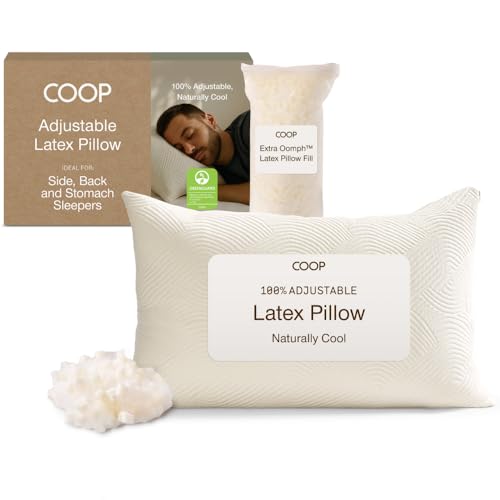
Coop Home Goods Adjustable Latex Pillow Queen — Best Blended Adjustable
Coop Home Goods takes the adjustable idea and blends it: the fill combines Talalay latex with microfiber, in a Queen pillow rated medium firm and described by its listing as ergonomic and naturally cooling. The blend is a deliberate softening of latex’s character. Pure latex answers pressure with a distinct bounce; mixing in microfiber rounds that bounce toward the plush feel most sleepers grew up with, while the latex shreds keep the fill from packing down into the dead flatness that pure microfiber reaches within a year.
This is the pick for the cautious. A household curious about latex but wary of committing to its full spring — or sharing a bed with a partner who finds pure latex too lively — gets a dial rather than a switch. Because the pillow is adjustable, you can also shift the balance of the experience over time, running it fuller and firmer in winter and leaner in summer. The Queen size suits the beds most likely to host this kind of shared compromise, and the listing addresses back, side and stomach sleepers at its medium firm setting.
Name the compromise clearly, as this guide has tried to do throughout: the microfiber share means this is not a 100% natural latex pillow, and buyers whose search is driven by material purity should choose the ECQOLRA, the JOTOM or the soft Talalay instead. Buyers whose search is driven by sleep quality rather than fibre accounting will find the blend pragmatic — latex’s durability and response, moderated by a familiar softness, at the cost of a label that needs an asterisk.
- Fill: Talalay latex and microfiber blend, per the listing
- Size: Queen
- Firmness: medium firm, per the listing
- Adjustability: adjustable, per the listing
- Stated sleep positions: back, side and stomach
- Height: not stated in the listing
- Cover details: none stated in the listing
Strengths
- Blended fill tempers latex’s bounce toward a familiar plush feel
- Adjustable quantity lets one pillow serve two different sleepers across a week
- Latex content should outlast a pure microfiber fill by a wide margin
Trade-offs
- Not a fully natural fill, which matters to purity-driven shoppers
- Medium firm is a compromise setting that extremes on either side may reject
- Height must be inferred from fill quantity rather than read off the listing
Best for: couples and cautious first-timers who want latex’s benefits moderated by a softer, tunable fill.
Not suited for: natural-material purists, or sleepers who already know they want solid-core latex.

100% Natural Talalay Latex Pillow Breathable — Best Soft Talalay
The guide closes at the gentle end of the range: a 100% natural Talalay latex pillow in Queen, rated Soft, with breathability as its headline and a removable, washable cotton cover. Soft latex surprises people who equate softness with collapse. A soft Talalay still responds — it yields quickly, then holds you in a shallow, even cradle and recovers the moment you roll away. Nothing about it resembles the slow sink of soft foam or the drifting shapelessness of a worn fibre pillow, and that distinction is why soft latex has devoted followers who cannot find their feel in any other material.
The listing addresses side and back sleepers, a pairing that makes sense at this rating. A side sleeper with a narrower frame, or one who sleeps with an arm beneath the pillow, often needs less height and more give than the standard side-sleeper prescription assumes, and a soft Queen Talalay supplies give without surrendering the shoulder span entirely. Back sleepers who find medium pillows push their chin forward will feel the difference in the first night: the head settles lower, the neck stays nearer neutral, and the pillow still springs back for the next evening.
Breathability is the honest supporting claim. Latex’s open-cell structure moves air in a way solid foam cannot, and Talalay’s even cells are the airiest version of the material; paired with a cotton cover that itself breathes, the result is a pillow that feels fresh-faced through a warm night. It makes no medical promises and neither does this review. It simply offers the softest true latex landing in this line-up, for sleepers who have been waiting for the material to stop arguing with them.
- Material: 100% natural Talalay latex, per the listing
- Size: Queen
- Firmness: Soft, per the listing
- Cover: removable, washable cotton
- Stated sleep positions: side and back
- Height: not given in the listing
- Pack count: none stated in the listing
Strengths
- The softest genuine Talalay here, with responsiveness intact rather than collapsed
- Open-cell Talalay plus a cotton cover makes the strongest breathability case in the guide
- Washable removable cover keeps the soft surface fresh without risking the core
Trade-offs
- Broad-shouldered side sleepers may still sink lower than their alignment wants
- No stated height, so the soft landing’s depth must be judged after arrival
- Firm-pillow loyalists will read its give as a lack of support
Best for: back sleepers and lighter-framed side sleepers who want latex’s spring at its gentlest setting.
Not suited for: anyone who equates support with firmness, or broad side sleepers needing maximum height.
How Do the Best Natural Latex Pillows Compare at a Glance?
| Pillow | Material | Size | Height | Firmness | Cover |
|---|---|---|---|---|---|
| ECQOLRA 100% Natural Talalay Latex Pillow | 100% natural Talalay | Standard | 6.2 in | Medium | Removable cotton |
| ORGANIC TEXTILES Natural Latex Bed Pillow Queen Firm | Natural latex | Queen | Not stated | Firm | GOTS organic cotton |
| JOTOM Talalay Natural Latex Pillow | Talalay natural latex | Standard | 5.5 in | Medium | Removable cotton |
| Talatex Talalay Shredded Latex Pillow | Talalay, shredded | Not stated | Adjustable | Set by fill amount | Not stated |
| Coop Home Goods Adjustable Latex Pillow Queen | Talalay and microfiber blend | Queen | Not stated | Medium firm | Not stated |
| 100% Natural Talalay Latex Pillow Breathable | 100% natural Talalay | Queen | Not stated | Soft | Removable washable cotton |
The empty cells in this table are information too. Latex listings are inconsistent about height, and a guide that invented the missing numbers would be lying to you in a grid; confirm any unstated figure on the listing page before you commit.
What Is Talalay Latex, and How Is It Different From Other Latex?
Latex pillow foam begins as liquid rubber tapped from rubber trees, whipped with air and baked until it sets into a springy, open-cell solid. Two production traditions dominate. The older Dunlop method pours the mixture into a mould and lets it settle before baking, which produces a foam that is slightly denser toward the bottom. The Talalay method adds vacuum and flash-freezing steps before baking, which distributes the cells more evenly and gives a lighter, more consistent feel from surface to core. Five of the six picks in this guide name Talalay in their listings; the ORGANIC TEXTILES pillow says natural latex without naming a process.
In the hand, the difference is subtle but real. Talalay feels airier and more uniform, with a gentle, immediate bounce. Dunlop-style latex feels a touch denser and more grounded. Neither is objectively better; they are two settings of the same material, rather like the firm and soft versions of a single pillow. What matters more for most buyers is the rating and the height, which is why this guide keeps returning to those two facts wherever a listing provides them.
One caution about vocabulary: natural describes the rubber’s origin, not a guarantee about every ingredient in the factory. These listings claim natural or 100% natural Talalay latex, and this guide reports those claims as the brands state them. A shopper who needs certification paperwork for allergy or sourcing reasons should ask the seller directly, because the listings summarised here do not publish certificates, and inventing assurances would help nobody.
Why Does Latex Feel So Different From Memory Foam?
The contrast is timing. Memory foam is viscoelastic: it softens with body heat and yields slowly, so your head sinks over several seconds and the pillow holds the impression when you move. Latex is elastic: it yields the instant pressure arrives and recovers the instant pressure leaves. Roll over on memory foam and you climb out of a shallow crater and wait for a new one to form. Roll over on latex and the surface is simply there, at full height, immediately.
That timing changes who sleeps well. Restless sleepers who change position a dozen times a night usually prefer latex, because the pillow never lags behind them. Still sleepers who settle once and love being cradled often prefer foam’s slow mould. Temperature follows the same split: latex’s open cells pass air freely, while dense foam insulates, which is why gel infusions and ventilation holes — the subject of the memory gel guide linked below — were invented to patch foam’s weakness.
Neither material wins in the abstract, and this guide will not crown one. But if your complaint about your current pillow is that it feels dead, slow or warm, latex addresses all three complaints by its basic physics. If your complaint is that pillows feel bouncy and push back, latex will feel like more of the problem, and the soft Talalay at the end of this line-up is the only pick worth your attention.
How Should You Match Latex Height and Firmness to Your Sleep Position?
Side sleeping asks the most of a pillow: it must occupy the full distance from the mattress surface to the side of your head, holding your neck level with your spine. In this guide that points to the taller, firmer end — the ECQOLRA at its stated 6.2 inches, or the firm Queen from ORGANIC TEXTILES if your shoulders are broad and your mattress soft enough to let your shoulder sink. Narrower frames can step down to the soft Talalay, especially if an arm habitually sleeps beneath the pillow and adds its own height.
Back sleeping wants the middle: enough loft to support the neck’s curve, not so much that the chin tips toward the chest. The JOTOM at 5.5 inches medium is the guide’s calibrated answer, with the Coop blend as the tunable alternative. Stomach sleeping wants the opposite of the side prescription — as little height as possible — which is why the adjustable Talatex, thinned by hand, is the honest recommendation for face-down sleepers in a latex guide, rather than any solid slab.
Combination sleepers should buy for their hardest position, not their favourite one. A pillow that serves your side sleeping will merely feel generous on your back, while a pillow bought for your back will abandon your neck entirely when you roll onto your side at 4 a.m. When in doubt between two ratings, remember that latex does not soften much with age: choose the feel you want in year three, not the feel that flatters you in the shop.
How Do You Care for a Latex Pillow So It Lasts?
The governing rule is simple: wash the cover, never the core. Solid latex that goes through a machine wash can tear, crumble at the edges and absorb water it releases only grudgingly. Four of these six picks provide removable covers for exactly this reason; launder those as you would any cotton bedding, and let the core air in a shaded, ventilated room whenever you strip the bed. Direct sun is latex’s other enemy, degrading the surface over time, so air it in daylight’s neighbourhood rather than in its full glare.
Daily care is lighter still. Latex needs no fluffing ritual — it recovers its shape unaided — but a weekly shake and a rotation end-for-end keeps wear honest across the surface. Use a breathable protector if you like, understanding that a thick waterproof layer will mute the very airflow that makes latex pleasant. Spot clean any mark on the core with a barely damp cloth and mild soap, then dry it thoroughly before the cover goes back on.
Handled this way, latex outlasts every other fill in this batch of guides. Where a fibre pillow is a two-year purchase and foam a mid-term one, a latex pillow commonly serves until its cover wears out, at which point the core is usually still springing back like the first month. That longevity is the real answer to latex’s higher shelf price, and it is why the care rules above are worth the small effort they ask.
What Mistakes Do First-Time Latex Buyers Make?
The commonest mistake is buying latex for the wrong sleeper — specifically, ordering a tall, firm slab for a stomach sleeper because a chart said firm equals supportive. Support is position-relative. The same pillow that aligns a side sleeper’s spine will crank a stomach sleeper’s neck upward all night, and no material quality redeems a wrong geometry. Use the position guidance in this guide before you use the badge order.
The second mistake is washing the core in a moment of spring-cleaning enthusiasm, which can end a good pillow in one cycle. The third is judging latex by a ten-second squeeze in a doorway: the material’s virtues — consistency across the night, instant recovery between positions, coolness at hour six — are all time-based, and none of them shows up in a squeeze. Give any latex pick a full week before you verdict it, unless the height is plainly wrong for your position.
The fourth mistake is subtler: assuming every product with latex in its name is latex all through. Blends exist — one appears in this guide, labelled as a blend — and grid or foam hybrids borrow the word for its bounce associations. Read the material line of any listing as carefully as this guide read these six, and a pillow that is honest about being part latex can still be the right purchase, as long as you bought it with open eyes.
How Long Does a Natural Latex Pillow Keep Its Shape?
Latex’s party trick is that it barely ages in the ways sleepers notice. The cell structure that gives it instant recovery also resists the permanent compression that flattens fibre fills and the slow softening that turns foam pillows into their own ghosts. A latex pillow’s fifth year feels remarkably like its first, which is why owners often replace the cover, grow bored, or move house before the core gives them a reason to shop again.
Decline, when it comes, announces itself at the edges: a slight crumbliness where hands grip the pillow to move it, a surface that feels drier and less supple. Kept out of direct sun and away from machine washing, that stage sits many years out. This durability reframes the price conversation honestly — latex asks more at the till and less across the decade, and for a sleeper who hates re-shopping for bedding, that exchange is the entire appeal.
It also means a wrong latex purchase lingers. A fibre pillow you dislike will flatten into the guest room within a year; a latex pillow you dislike will confront you, springy and unchanged, for a long time. Measure your shoulder width, think hard about your true position, and use the stated heights in this guide before ordering. Latex rewards the careful buyer more than any other material here, and punishes the casual one with equal consistency.
Solid, Shredded or Blended: Which Form of Latex Suits You?
The six picks divide into three forms, and choosing the form matters as much as choosing the firmness. A solid core — the ECQOLRA, the ORGANIC TEXTILES, the JOTOM and the soft Talalay — offers the purest version of the material: one uniform surface, instant recovery, a pillow that looks tailored on the bed and behaves identically every night. Solid latex suits sleepers who know their position and want the equipment to disappear from their attention entirely.
Shredded latex, represented by the Talatex, trades that uniformity for authorship. The fill moves, so the pillow can be rebuilt nightly, but it also moves when you did not ask it to, and the surface feel is knobbly compared with a slab’s calm plane. Sleepers who already fidget with their pillow will call that a feature. Sleepers who hate fidgeting will call it a flaw, and both will be right about their own beds.
The blend, Coop’s latex-and-microfiber fill, is the diplomat of the three forms. It exists for beds where one sleeper loves latex’s response and the other misses the plush surrender of a fibre pillow, and for buyers who want latex’s durability threaded through a softer first impression. Judge it as a compromise and it succeeds; judge it as a natural product and it was never claiming to be one. The form question, answered honestly, usually decides the pick before firmness is even discussed.
How Heavy Is a Latex Pillow, and Why Does the Weight Matter?
New latex owners mention the weight before they mention anything else. Latex foam is dense, and a solid Queen core carries the kind of heft that makes changing a pillowcase a two-handed job. That density is not a side effect; it is the same property that gives the pillow its recovery and its lifespan. A pillow that weighs almost nothing is usually a pillow whose fill will compress into nothing on a similar schedule.
Practically, weight decides small habits. A heavy pillow stays where the bed is made, which neat sleepers love and pillow-fight households forgive. It travels badly — nobody packs a solid latex Queen for a holiday — and it makes the nightly shake-and-settle routine more deliberate. Shredded and blended picks lighten the experience somewhat, since loose fill shifts rather than lifting as one mass, but no pick in this guide qualifies as a travel pillow, and pretending otherwise would set up disappointed buyers.
If your current routine involves carrying your pillow from bed to sofa and back daily, weigh that habit before you weigh the specs. Latex suits a pillow with a fixed post. For the sofa end of your evening, keep a lighter spare and let the latex rule the bed, where its consistency matters for the eight hours that count.
What Should You Expect in the First Week With Latex?
Expect a smell, briefly. Natural latex carries a mild rubber scent out of the packaging, stronger in the first day and fading across the first week of airing. It is the material’s normal signature, not a fault, and it disappears fastest if you strip the cover off and let the core breathe in a ventilated room before the first night. Sleepers who are sensitive to new-product smells should plan that airing day into the purchase rather than judging the pillow from the first hour.
Expect also a short negotiation with your neck. Any change of pillow height or response alters the angle your head rests at, and latex’s instant support can feel assertive for the first nights if you arrive from a flattened fibre pillow. Judge the pillow at the end of the week, by how your mornings feel, rather than by the unfamiliar first night. The exception is geometry: if the height is plainly wrong for your sleep position — chin jammed down on your back, or head propped at an angle on your stomach — no adjustment period fixes that, and the pick should be exchanged rather than endured.
By the second week, latex owners usually report the same small discovery: they have stopped thinking about the pillow. It is at full height every night, cool enough, quiet, and identical to yesterday. That disappearance is the product working as designed, and it is why latex inspires a loyalty out of proportion to its glamour.
How Does Latex Behave Across the Seasons?
Foam pillows change character with the weather; memory foam famously firms in a cold room and softens in a warm one, because its softening is triggered by heat. Latex is far steadier. Its elasticity is structural rather than thermal, so a January bedroom and an August bedroom meet much the same pillow. For sleepers in unheated houses or hot climates, that steadiness removes a whole category of seasonal disappointment.
What does change with the seasons is everything around the pillow. In summer, the cotton covers on these picks do the breathability work, and a lighter pillowcase weave keeps the surface feeling fresh. In winter, latex’s neutrality means it never delivers the cold shock of a gel pillow or the chill of a down pillow that has sat in a cold room; it simply starts at room temperature and stays near it. Pair it with the season’s bedding and the pillow itself asks for no seasonal adjustment at all.
Storage follows the same calm logic. A latex pillow kept as a spare should rest flat, in its cover, away from windows, since sunlight is the one environmental factor that genuinely ages the material. No vacuum bags — compressing latex for months in a sealed bag is a risk the manufacturers of these listings do not invite, and the pillow’s longevity is worth more than the cupboard space saved.
How Should You Test a Latex Pillow During Its First Nights at Home?
Run the trial like an experiment with one variable. Keep your sheets, your room temperature and your bedtime steady, and change only the pillow, so that a better or worse morning has an obvious author. Sleep the first two nights without judging, since any new height rearranges familiar muscle patterns; from the third night, start scoring two things on waking — how your neck feels in the first minute upright, and whether you remember wrestling the pillow in the night. Latex should win the second score almost immediately, because it never needs the rebuilding that fibre pillows demand at 3 a.m.
Use the pillowcase you intend to keep. A slippery case lets a heavy latex pillow feel oddly mobile, while a grippy cotton case settles it into the planted behaviour owners praise. If the pillow still feels wrong after a fair week, check the geometry before blaming the material: measure the gap between your neck and the mattress in your main position, and compare it honestly with the pillow’s stated height where the listing gives one. Most latex disappointment is a sizing error wearing a material’s name.
Should a Couple Buy Two Different Latex Pillows?
Usually, yes — and latex makes the argument more strongly than softer materials do. Because a latex pillow keeps its exact character for years, a compromise firmness is not a temporary truce but a permanent one, renewed every night. Two sleepers with different shoulder widths or different main positions are better served by two different picks from this page than by one shared medium they both tolerate. The bed still looks matched if the covers and cases match; nobody’s neck can see the pillow inside the case.
The exception is the adjustable route. A shredded Talatex or the Coop blend on each side of the bed lets each sleeper tune a nominally identical purchase into two different pillows, which keeps the shopping simple and the tuning personal. For couples who travel between positions — one reading upright, one sleeping flat — that adjustability often outranks any fixed specification either could choose.
One last practical note for households with a spare room: a retired latex pillow makes an unusually good guest pillow precisely because it does not retire. Where a flattened fibre pillow apologises to your visitors, a five-year-old latex pillow still presents its original height and spring, and guests regularly sleep better on the hand-me-down than on the new budget pair bought to replace it. Buy latex once, buy it well, and let it cascade through the house across the years.
Final Recommendation
Start from the stated numbers. The ECQOLRA 100% Natural Talalay Latex Pillow is this guide’s default recommendation because it prints its height, uses full Talalay, and sits at a medium rating that suits the widest band of back and side sleepers. The JOTOM Talalay Natural Latex Pillow is the same idea tuned a half-inch lower, and the ORGANIC TEXTILES Natural Latex Bed Pillow Queen Firm serves the firm loyalists with a certified organic cotton cover over a natural latex core.
From there, choose by temperament. Tuners should take the shredded Talatex or the blended Coop and treat the pillow as equipment they adjust; gentle sleepers should take the soft Queen Talalay and stop apologising for liking a soft pillow. Every route in this guide stays inside genuine latex, which was the point of the search in the first place.
Buy latex the way you would buy a good mattress — by its printed measurements, for the position you actually sleep in, expecting it to outlast the bedding around it — and the pillow you choose this week will still be answering your head instantly, years after softer purchases have flattened into the guest-room pile.
Frequently Asked Questions
Is Talalay latex really natural?
The listings in this guide describe their Talalay as natural or 100% natural, meaning the rubber base comes from rubber trees rather than petroleum synthesis. Talalay names the production process — vacuum and freezing steps that even out the cell structure — not a synthetic ingredient. If you need formal certification for a purchase, ask the seller, since these listings do not publish certificates.
Why was the famous grid pillow not included?
Because it is not latex. Its sleeping surface is a gel-flex grid, which is a legitimate material with its own fans, but a guide to natural latex pillows that included it would be misleading readers who searched for the material itself. Every pick here is natural or Talalay latex according to its own listing.
Can I wash a latex pillow in the machine?
No — wash the removable cover and air the core. Machine washing can tear latex and waterlog its cells. Four of the six picks here include removable covers for that reason. Spot clean the core with a barely damp cloth if a mark gets through, and dry it fully in shade before re-covering it.
Which of these suits a stomach sleeper?
The adjustable Talatex, thinned down by removing fill, is the most honest answer in a latex line-up, because solid latex slabs are rarely low enough for face-down sleeping. The Coop blend can also be run lean. The stated-height solid picks, at 5.5 and 6.2 inches, are aimed at back and side sleepers and should be chosen for those positions.
Does latex sleep hot?
Latex’s open-cell structure passes air far more freely than solid memory foam, and Talalay’s even cells are the airiest form of it. Most sleepers experience latex as temperature-neutral rather than actively cool. Pair it with the cotton covers several of these picks provide, and avoid thick waterproof protectors, which block the airflow that does the work.
How long will one of these pillows last?
Longer than fibre or foam equivalents, as a rule. Latex resists permanent compression and keeps its recovery for years when it is kept out of direct sun and never machine washed. Expect to replace a worn cover before the core loses its spring, and judge end of life by edge crumbliness rather than by flatness.
Related Guides
If latex’s instant response is not your feel, the slow mould of the pillows in Best Memory Gel Pillows is the natural counterpoint; for the rest of the bed, Best Blankets with Sleeves for Adults covers the layer you read under, and Best Hotel Quality Bath Towels extends the same buy-it-once logic to the bathroom.



[…] comparing natural materials often continue to Best Natural Latex Pillows for a springier plant-based option, keep the natural theme going with Best Cotton Thermal Blankets […]