What's inside
- Where to buy these picks
- Quick Picks
- How these picks were chosen
- The picks in detail
- Fibre, documentation and build: the six natural rugs compared
- How to choose a natural rug without fooling yourself about labels?
- What organic and OEKO-TEX actually certify, in plain terms
- Placing natural rugs through the house
- Natural rug care: the calendar that keeps wool honest
- Reading rug titles the way this guide does
- Where natural rugs earn their keep, room by room
- The price of honesty: what natural rugs cost and why
- Natural rugs and the allergy-conscious household
- Sizing natural rugs: the furniture-legs rule
- Second-hand, vintage and the natural rug afterlife
- A short glossary for the natural rug shelf
- Natural rugs in rented homes
- Trust, but verify: a household habit worth keeping
- A note on patience with natural things
- Common mistakes
- Final recommendation
- Frequently asked questions
As an Amazon Associate I earn from qualifying purchases. This post may contain affiliate links at no extra cost to you.
As an Amazon Associate, cottageverdict.com earns from qualifying purchases.
Shoppers hunting the best non toxic organic area rugs deserve a straight answer before any recommendations: almost no rug listing certifies the words non-toxic, and only some certify organic. What the honest end of this market actually offers is natural fibre, wool and jute woven or tufted by hand, with a small number of listings printing an organic claim or a recognised safety standard in the title itself. This guide is built on exactly that evidence, and it keeps the boundary visible in every review.
Of the six picks, two state organic in the title, the Flokati’s one hundred percent organic wool and the Neu Looms organic wool design. One, the LIANLAM, states OEKO-TEX safe natural materials over a wool and cotton weave. The remaining three, a knotted wool SAFAVIEH, an eighty percent wool Shilucheng and a jute-and-wool weave, are natural-fibre rugs whose titles say nothing about organic or non-toxic status, and this guide claims nothing of the sort for them. They earn their places on fibre, construction and size.
Read the spec boxes as the conscience of each review: certifications appear only where the title prints them, and a short silence note appears wherever a listing says nothing. A household can furnish a low-synthetic living room from this row with confidence, provided it chooses with its eyes open about which claims are documented and which are simply the nature of the materials.
Where to buy these picks
LIANLAM’s handwoven 8×10 leads on documentation: eighty percent merino wool with cotton, OEKO-TEX safe natural materials stated in the title, washable and non-slip.
The Flokati is the certification purist’s texture pick: one hundred percent organic wool stated outright, in a low-profile 4×6 shag for smaller rooms.
Neu Looms brings the design statement, a hand-tufted abstract organic wool rug at 8×10 in beige taupe for modern living rooms.
SAFAVIEH’s Natura is the established natural option: a knotted wool 5×8 in ivory, a three-eighths-inch pile, with no organic claim made or implied here.
Shilucheng’s 8×10 blends eighty percent wool with a cotton backing, non-slip, the practical large rug whose title stays silent on certification.
The jute and wool 8×10 closes with texture and proportion: seventy-five percent jute, a thick 0.6-inch pile and a four-inch border, natural fibres throughout.
Quick Picks
| Pick | Best for | What the listing title puts up front |
|---|---|---|
| LIANLAM Handwoven Wool Rug 8×10 | Documentation-led buyers wanting a certified-standard, washable wool 8×10 | 80% merino wool and 20% cotton, OEKO-TEX safe natural materials, washable |
| Flokati Organic Wool Low Profile 4×6 | Small rooms wanting stated organic wool with flokati texture, lowered | 100% Organic Wool flokati, low-profile shag, 4×6 |
| Neu Looms Organic Wool Rug 8×10 | Modern living rooms wanting an organic-titled abstract design at 8×10 | Hand tufted abstract organic wool, beige taupe, 8×10 |
| SAFAVIEH Natura NAT620A Wool 5×8 | Mid-size rooms wanting knotted wool durability from an established rug line | 5×8 knotted wool in ivory, 3/8 inch pile, kid and pet friendly per title |
| Shilucheng Wool Rug 8×10 | Practical large rooms: an 80/20 wool-cotton 8×10 with non-slip backing | 8×10 blend of 80% wool and 20% cotton, non-slip, cotton backing |
| Natural Jute & Wool Rug 8×10 | Texture-led farmhouse rooms: jute and wool with a thick pile and border | 75% jute and 25% wool, handwoven mini check, 0.6 inch pile, 4 inch border |
How these picks were chosen
Evidence discipline governed this row more than any other in the batch. Picks were sorted into three honesty tiers before any were chosen: titles stating organic, titles stating a recognised safety standard over natural materials, and titles stating natural fibres with no certification language at all. All three tiers are represented, labelled as what they are, because a guide that only admitted certified rugs would have almost nothing to recommend, and a guide that blurred the tiers would be lying by atmosphere.
Fibre verification came second. Every pick’s title names its fibres and their proportions where blends occur: wool with cotton twice at eighty-twenty, jute with wool at seventy-five-twenty-five, and two rugs at one hundred percent wool. Synthetic-faced rugs and jute-look substitutes were excluded; if the title did not commit to natural fibre, the rug did not enter the row.
Construction and size formed the third filter: handwoven, hand-tufted, knotted and flokati builds across 4×6, 5×8 and 8×10, so that small reading corners, standard living rooms and large open floors each find a candidate. Washability and non-slip backing appear only where titles claim them, on the LIANLAM and Shilucheng, and are never extended by implication to their neighbours.
The picks in detail
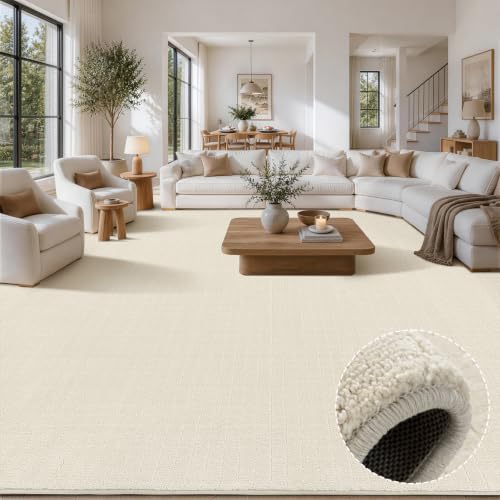
LIANLAM Handwoven Wool Rug 8×10
LIANLAM’s 8×10 is the best-documented rug in this guide, and its title shows why: eighty percent merino wool and twenty percent cotton, handwoven, with OEKO-TEX safe natural materials printed in the listing. Precision matters here. The title does not claim organic, and this review does not either; what it claims is a recognised textile safety standard applied to natural materials, which for many households auditing a room’s chemistry is the more relevant document anyway. The colour is listed as Beige2, a neutral ground for a living room or bedroom.
- Size: 8×10 (8 x 10 ft)
- Fibres: 80% Merino Wool + 20% Cotton
- Construction: Handwoven
- Safety wording: OEKO-TEX safe natural materials, per the title
- Organic status: Not stated in the listing title
- Care: Washable; stain-resistant and non-slip claimed
Strengths
- OEKO-TEX wording in the title gives this row’s clearest third-party safety reference
- Merino wool is named specifically, a finer fibre than generic wool claims
- Washable and non-slip are both claimed, rare practicality in natural rugs
Trade-offs
- OEKO-TEX wording is not an organic certification, and the review keeps them distinct
- Twenty percent cotton softens the all-wool purity some buyers seek
- An 8×10 handwoven rug is a serious object to move and wash
Merino is the fibre detail worth pausing on. Naming the wool type signals a finer, softer fibre than an unqualified wool claim, relevant for a rug that will meet bare feet and children on the floor. Handwoven construction at 8×10 gives the rug a made-object character machine tufting cannot imitate, with the small irregularities that read as craft rather than defect. The practical claims complete an unusual package for a natural rug: washable, stain-resistant and non-slip, all stated in the title and all reported here as maker claims. Natural-fibre purists should note the cotton fifth of the blend, which typically softens hand-feel and helps the weave, and which this guide counts as a design choice rather than a contamination, since the title declares it openly.
Choose the LIANLAM for a main living room where the household wants natural fibre, a safety standard in writing and family practicality in one purchase. It is the row’s easiest recommendation to a cautious buyer. Those whose requirement is the word organic itself should continue to the Flokati and Neu Looms, whose titles carry it, while remembering that this rug’s documentation is stronger than many organic claims elsewhere.
One more household will appreciate this rug specifically: the one with a crawling baby. Floor time happens on the rug, and a title that prints a recognised safety standard over natural materials gives parents a document to point to rather than a hope to rely on, while the washable claim addresses the practical sequel to babyhood. None of that upgrades the rug’s documentation beyond what its title states, and this review has been careful not to; it simply notes that the combination it does state, merino blend, OEKO-TEX wording, washability, non-slip, is the combination floor-level family life actually asks for.
Best for: households wanting OEKO-TEX wording, merino wool and washability across a full 8×10.
Not suited for: a checklist that requires the word organic in the title — this listing does not claim it.
Find the LIANLAM handwoven wool 8×10 on Amazon

Flokati Organic Wool Low Profile 4×6
The Flokati carries the strongest fibre sentence in this guide: one hundred percent organic wool, stated plainly in its title. Around that claim sits a characterful rug type, the flokati, a Greek-style shaggy wool rug, here in a low-profile interpretation the title describes as all the thickness with a lower shag pile. At 4×6 it is also the row’s small-room specialist, sized for a reading corner, a nursery floor or the side of a bed rather than the centre of a large living room.
- Size: 4 x 6 ft
- Fibre: 100% Organic Wool, per the title
- Construction: Flokati, natural wool shaggy
- Pile: Low profile shag; all the thickness with a lower pile, per the title
- Certification body: None named in the listing title
- Backing: The title names no backing
Strengths
- One hundred percent organic wool is stated in the title, the row’s purest fibre claim
- Low-profile flokati keeps the shag character while easing doors and chairs
- 4×6 suits reading corners, nurseries and small bedrooms the 8x10s cannot
Trade-offs
- Organic is the maker’s title claim; no certifying body is named in the listing
- Shag, even lowered, holds crumbs more than flat weaves and needs shaking out
- 4×6 is a zone rug, not a whole-room foundation
Honesty requires two footnotes, and this review prints both. First, the organic wording is the maker’s claim as it appears in the title; no certifying organisation is named there, unlike the GOLS-style acronyms a shopper meets in the pillow category, so buyers who audit certificates should treat this as a stated claim to verify on the listing rather than a documented certification. Second, flokati texture is a lifestyle choice: the shag that feels wonderful underfoot also collects what falls into it, and even a lowered pile wants regular shaking and airing. The low profile is the design’s own answer to shag’s usual problems, letting doors swing and chair legs move more freely than a full-depth flokati allows, while keeping the unmistakable woolly surface that is the entire point of the type.
Buy the Flokati for a defined, personal zone: beside a bed where feet land first, under a nursing chair, in a child’s reading nook where one hundred percent wool matters to the household’s materials policy. It is the most romantic rug in the row and the least general-purpose. Large living rooms should take their organic claim from the Neu Looms 8×10 instead, and treat this one as the accent it is sized to be.
Flokati rugs carry a sensory reputation that deserves translating for buyers who have never owned one: the pile invites touch, children gravitate to it, cats claim it within the hour, and a reading corner furnished with one becomes the household’s contested territory. The low-profile cut makes that invitation practical in modern rooms, where a full shag would swallow chair legs and door swings. Keep a simple ritual, a weekly shake outdoors and a comb-through when the pile mats, and the rug’s organic wool will keep its character for years, ageing into the kind of textile that moves house with a family rather than being left behind.
Best for: small-zone furnishing where stated organic wool and flokati texture are the whole point.
Not suited for: whole-room coverage, and buyers who need a named certifying body behind an organic claim.
See the Flokati organic wool 4×6 on Amazon

Neu Looms Organic Wool Rug 8×10
Neu Looms supplies the row’s design-led organic option: a hand-tufted abstract rug in beige taupe at 8×10, its title describing organic wool and a modern abstract organic design over handmade natural wool. The double use of the word organic, once for the material and once for the design language of soft, irregular shapes, is the listing’s own phrasing, and the review reads the material claim as the substantive one. For a modern living room that finds oriental patterns fussy and flat weaves cold, this is the rug that resolves the floor.
- Size: 8×10
- Fibre: Organic wool, per the title; handmade natural wool
- Construction: Hand tufted
- Design: Modern abstract organic design, beige taupe palette
- Certification body: None named in the listing title
- Washability: The title claims no washability
Strengths
- Organic wool and an 8×10 footprint combine, the row’s large certified-claim option
- Abstract design suits modern rooms that traditional patterns overwhelm
- Beige taupe palette is the neutral most contemporary furniture already speaks
Trade-offs
- As with the Flokati, organic is a title claim without a named certifier
- Hand-tufted wool sheds early on, a normal behaviour worth expecting
- No washability is claimed, so cleaning is spot care and professional help
Hand tufting explains both the appeal and the early behaviour of such a rug. Tufted wool gives a cushioned, sculptural surface that suits abstract designs, and it commonly sheds loose fibre in its first weeks, which is a property of the construction rather than a defect; households should expect the vacuum to fill quickly at first and then settle. The organic claim carries the same footnote as the Flokati’s: stated in the title, with no certifying body named there, so it is reported here as the maker’s stated claim. No washability is claimed either, a real dividing line against the LIANLAM: an 8×10 tufted wool rug is cleaned by blotting, airing and occasionally professionals, and households with toddlers and dogs should weigh that maintenance honestly against the design they love.
Choose the Neu Looms for a grown-up living room or main bedroom where the rug is the art and the household’s materials policy wants organic wool in writing. It pairs naturally with low modern furniture, pale woods and linen upholstery. Families needing machine-washable forgiveness should return to the LIANLAM, and traditional rooms to the SAFAVIEH below; this one’s modernism is its identity, not a setting to adjust.
Abstract design has one more virtue in a family home: it refuses to show its age in any particular place. A traditional pattern announces wear by fading at its motifs; an abstract field absorbs traffic, furniture rearrangement and the slow migration of a room’s layout without ever looking misaligned, because it never promised alignment. For households whose living room reconfigures around hobbies, holidays and growing children, that visual forgiveness may matter as much as the organic wool claim that headlines the listing, and it is a reason to choose this rug even in a home where certification is a preference rather than a policy.
Best for: modern living rooms wanting a large abstract rug with organic wool stated in the title.
Not suited for: spill-heavy family rooms needing washability, and traditional schemes the abstract design would fight.
See the Neu Looms organic wool 8×10 price on Amazon

SAFAVIEH Natura NAT620A Wool 5×8
The SAFAVIEH Natura NAT620A begins the row’s third honesty tier, and its review says so in the first paragraph: this is a natural wool rug whose title makes no organic or non-toxic claim, and it is recommended on fibre and construction alone. What it offers is considerable: a knotted wool rug at 5×8 in ivory, with a printed pile height of three-eighths of an inch, described by its maker as durable, kid and pet friendly and easy care, aimed at bedrooms and home offices.
- Size: 5×8
- Fibre: Wool fibers
- Construction: Knotted
- Pile: 3/8 inch
- Organic or safety certification: Not stated in the listing title
- Positioning: Durable, kid and pet friendly, easy care, per the title
Strengths
- Knotted wool construction is the durability traditionalist’s choice
- A printed pile height, three-eighths of an inch, is genuinely useful information
- The Natura line and model code make the rug easy to research and match
Trade-offs
- No organic or non-toxic claim appears in its title, and none is made here
- Ivory is the least forgiving colour in the row for pet households
- 5×8 is a mid-size that large living rooms will find short
Knotted construction is the connoisseur’s detail. Knotting is the traditional rug-making method, slow and dense, and wool knotted at a low three-eighths pile produces a rug that lies flat, wears evenly and shrugs off the chair castors of a home office better than lofty alternatives. The printed pile height deserves praise because it lets a buyer predict door clearance and underfoot character precisely, a courtesy several rivals in this row omit. Ivory is the gamble: it lifts a room’s light beautifully and records a pet household’s life without mercy, so the maker’s kid and pet friendly wording should be read as a durability claim about the rug’s construction, not a promise that ivory hides anything. Easy care, in wool terms, means vacuuming without a beater bar’s violence and prompt blotting, not the washing machine the LIANLAM claims.
Buy the Natura for a bedroom or study where a mid-size natural wool rug from an established line, with a model number you can research, beats a bigger claim from a vaguer listing. It is the row’s heritage choice. Buyers whose project brief literally requires organic wording should stay with the two picks above; buyers whose brief is natural fibre, honestly labelled, will find this rug the easiest to live with for a decade.
The Natura’s ivory ground deserves a styling note: it is at its best in rooms with controlled traffic, a main bedroom, a study, a guest room that hosts adults, where its pale knotted wool lifts the light and shows the furniture’s silhouettes cleanly. Treated as a deliberate, placed object rather than a whole-house solution, it behaves like the heirloom category it descends from. Households often discover that one beautiful, honestly natural rug in the quiet room satisfies the materials conscience more completely than a house full of louder claims in the busy ones, and the Natura is this row’s candidate for that role.
Best for: bedrooms and home offices wanting knotted wool durability at a mid size, honestly unlabelled.
Not suited for: certification-led shoppers, since its title states none, and ivory-averse pet households.
View the SAFAVIEH Natura wool 5×8 on Amazon

Shilucheng Wool Rug 8×10
Shilucheng’s 8×10 shares its recipe with the LIANLAM, eighty percent wool and twenty percent cotton, and its review must therefore draw the comparison honestly: same declared blend, same full size, but no OEKO-TEX wording and no washability claim in this title, and no organic claim either. What this listing offers instead is a non-slip claim, a cotton backing described in the title, and a modern beige-and-white ground for living room, bedroom and dining room, spelled Dinning in the original listing, a typo this guide notes only so the delivered box surprises nobody.
- Size: 8×10
- Fibres: Blend 80% Wool and 20% Cotton
- Backing: Cotton backing; non-slip per the title
- Colour: Beige/White
- Organic or safety certification: The title carries no such wording
- Rooms named: Living room, bedroom, dining room
Strengths
- The same honest 80/20 wool-cotton recipe as the LIANLAM, at full 8×10 size
- Non-slip is claimed, addressing natural rugs’ tendency to wander on hard floors
- A cotton backing suits buyers avoiding synthetic latex backings
Trade-offs
- No organic or safety certification appears in its title, unlike the LIANLAM
- Beige and white is a light ground that will show dining and pet evidence
- Soft and durable are maker adjectives rather than measured properties
The cotton backing is the construction point natural-fibre shoppers actually hunt for. Many rugs hide a synthetic latex backing under a natural face; a title that names a cotton backing lets a low-synthetic household choose knowingly, and this guide credits the listing for printing it. Non-slip matters at 8×10 more than at accent sizes, because a large rug that creeps on hardwood becomes a daily straightening chore and a tripping edge at its corners. Soft and durable are the maker’s adjectives, reported as such. Against the LIANLAM, the trade is documentation for simplicity: buyers who need the safety standard in writing have their pick, while buyers who simply want a declared natural blend, a natural backing and a big neutral rug may find this the more direct purchase, provided the absence of a washable claim suits their cleaning reality.
Choose the Shilucheng for a large, calm room on hard floors where rug creep is the known enemy and a cotton backing fits the household’s materials rules. It is the pragmatist’s 8×10 in this row. Households with heavy spill traffic should weigh the LIANLAM’s washable claim seriously before settling, and certification shoppers should not let the shared blend blur the documentation gap between the two.
The cotton backing invites one practical habit: check it twice a year. Natural backings age gracefully but appreciate airing, and lifting an 8×10 to vacuum beneath it, removing the grit that abrades any backing, doubles as the inspection. Households on smooth floors will also find the non-slip claim testable within a week; if the rug still creeps at one corner, a natural-fibre pad under that half settles it without changing the rug’s chemistry story. These small stewardships are the real content of owning natural textiles, and this rug, with everything declared in its title, makes them easy to plan.
Best for: hard-floor living rooms wanting a declared wool-cotton blend with a cotton, non-slip backing.
Not suited for: buyers needing OEKO-TEX or organic wording in writing, who should choose the LIANLAM or the organic pair.
On Amazon, check the Shilucheng wool 8×10 price

Natural Jute & Wool Rug 8×10
The jute and wool rug closes the row with texture and transparency. Its title prints everything a natural-fibre buyer asks: seventy-five percent jute and twenty-five percent wool, handwoven in a mini check, a thick 0.6-inch pile and a four-inch border, at 8×10 in a neutral farmhouse palette. It also, to be exact, prints no organic or non-toxic claim, and this review assigns it none; its place here rests on declared natural fibres and a construction suited to living room, bedroom and dining room, all named in the listing.
- Size: 8×10
- Fibres: 75% Jute & 25% Wool fiber
- Construction: Handwoven mini check, boho farmhouse
- Pile: Thick 0.6 inch pile
- Border: 4 inch border
- Organic or safety certification: Not stated in the listing title
Strengths
- Full fibre proportions are printed, 75/25, the most transparent blend in the row
- A 0.6-inch pile is genuinely thick for a natural rug, with a defined 4-inch border
- Jute brings a hard-wearing, textured face that hides foot traffic well
Trade-offs
- No organic or non-toxic claim appears in its title, and none is made here
- Jute is coarser underfoot than wool; bare-feet softness is not its offer
- Thick pile and jute fibre make machine washing unrealistic; care is spot and air
Jute changes the underfoot contract. Where the wool rugs above offer softness, jute offers structure: a firm, textured, almost architectural surface that takes boots, chair legs and dog claws with indifference and hides the evidence in its check pattern. The wool quarter softens that contract somewhat and adds resilience, while the 0.6-inch pile, the thickest stated in this row, gives the rug a presence flat weaves lack. The four-inch border frames the mini check field the way a mount frames a print, which helps the rug organise a room whose furniture floats. Care follows fibre logic: jute dislikes soaking, so this is a shake, vacuum and spot-blot rug, and households should buy it with that regime accepted rather than discover it at the first flood of spilled tea.
Buy this rug for a farmhouse or boho living space that wants the floor to feel made rather than manufactured, and for high-traffic rooms where wool’s softness would be wasted under shoes. It is the row’s durability-and-texture pole, opposite the Flokati’s softness pole. Barefoot loungers who read rugs with their feet should stay with the wool picks; everyone else may find this the most characterful honest rug in the guide.
Jute’s texture also performs an acoustic kindness in echoing rooms, breaking the slap of hard floors under a dining table where chair legs and conversation otherwise ricochet. The 0.6-inch pile stated in the title is doing that work, along with the handwoven check’s irregular surface. Hosts in open-plan spaces with hard surfaces throughout will feel the difference at the first dinner party. Accept the fibre’s terms, no soaking, no bare-feet promises, and this becomes the rug visitors remember, the one that made the room feel built rather than bought, which is the highest compliment a floor textile can earn.
Best for: farmhouse and high-traffic rooms wanting declared jute-wool texture with a thick, bordered build.
Not suited for: barefoot softness seekers, and buyers requiring any certification wording in the title.
See the natural jute and wool 8×10 on Amazon
Fibre, documentation and build: the six natural rugs compared
| Pick | Fibres as stated in the title | Documentation in the title | Construction |
|---|---|---|---|
| LIANLAM Handwoven Wool Rug 8×10 | 80% merino wool, 20% cotton | OEKO-TEX safe natural materials | Handwoven |
| Flokati Organic Wool Low Profile 4×6 | 100% organic wool | Organic stated; no certifier named | Flokati shag, low profile |
| Neu Looms Organic Wool Rug 8×10 | Organic wool | Organic stated; no certifier named | Hand tufted |
| SAFAVIEH Natura NAT620A Wool 5×8 | Wool fibers | No certification wording | Knotted |
| Shilucheng Wool Rug 8×10 | 80% wool, 20% cotton | Silent on certification | Cotton backing, non-slip |
| Natural Jute & Wool Rug 8×10 | 75% jute, 25% wool | No such claim printed | Handwoven mini check |
The documentation column is the one this guide most wants read slowly. One pick carries a named safety standard, two carry an organic claim without a named certifier, and three carry no certification language at all while offering fully declared natural fibres. Those are three different kinds of assurance, and a careful household will decide which kind it actually needs before it decides which rug it likes, because reversing that order is how natural-fibre shopping goes wrong.
How to choose a natural rug without fooling yourself about labels?
What level of documentation does your household actually need?
Start by naming your standard precisely. If the requirement is a third-party safety framework in writing, the LIANLAM’s OEKO-TEX wording is the only entry in this row that supplies one. If the requirement is the word organic attached to the fibre, the Flokati and Neu Looms state it, while printing no certifier’s name, a gap a rigorous buyer will verify on the listing before purchase.
If the requirement is simply natural fibre with declared proportions, the second half of the row opens up, and it contains excellent rugs: knotted wool, an 80/20 blend with a cotton backing, and a jute-wool weave with the most transparent percentages here. None of them should be described, by this guide or by a salesperson, as certified organic or certified non-toxic, because their titles do not say so, and a household is entitled to buy them for what they are.
Which fibre matches the room’s traffic and feet?
Wool is the barefoot fibre: resilient, warm, naturally soil-hiding in its lanolin-rich way, and the face of five picks here in pure, merino or blended form. Cotton blended at twenty percent softens and stabilises weaves, as both 80/20 rugs show. Jute is the traffic fibre, firm and textured, unbothered by shoes and claws, and correspondingly indifferent to tender feet.
Pile edits the answer further. The jute rug’s stated 0.6-inch pile is the row’s thickest, the SAFAVIEH’s three-eighths the most precise low profile, and the Flokati’s lowered shag the texture event. Match pile to doors and chairs as much as to feet: a thick rug under a dining table must let chairs move, and a shag in a hallway must let doors swing.
What cleaning regime will the rug actually receive?
Natural rugs divide sharply on care, and the titles here mark the divide: the LIANLAM claims washable, the others do not, so their regimes are vacuuming, shaking, blotting and professional cleaning. A household with toddlers, dogs and red wine should let that single word, washable, weigh heavily, because a natural rug that cannot be washed will be replaced by one that can, at twice the total cost.
Sun and air are the natural rug’s free maintenance: a morning out of direct harsh light freshens wool wonderfully, and rotating the rug twice a year evens the traffic lanes. Build those habits into the purchase decision, and any rug in this row will age gracefully; buy against your real habits, and even the finest knotted wool will look tired by its second year.
What organic and OEKO-TEX actually certify, in plain terms
Organic, in rug titles, speaks about how the fibre was produced: wool from sheep raised under organic practices, cotton grown without the standard synthetic inputs. It is a production claim. OEKO-TEX wording speaks about the finished textile’s safety testing for harmful substances. It is a product claim. They answer different questions, which is why this guide never treats them as interchangeable and why the LIANLAM’s documentation and the Flokati’s organic claim are both valuable without being the same.
Non-toxic, by contrast, is a phrase with no single certifying scheme behind it in rug listings, which is exactly why it appears in this article’s title, matching how people search, and then is handled with tongs throughout: repeated only where a listing’s own safety wording supports a careful paraphrase, and never pasted onto the three rugs whose titles are silent. A guide willing to say that out loud is a guide whose other claims can be trusted.
Readers carrying the same materials audit into the bedroom’s soft goods will find Best Summer Slippers a relevant neighbouring read for warm-weather footwear choices at home.
Placing natural rugs through the house
Natural fibre rugs reward zoning. Put the softest wool where skin meets floor longest, bedside and reading corners, which is the Flokati’s and SAFAVIEH’s natural territory. Put the hardest-wearing weaves where shoes and chairs live, the jute blend’s dining and living brief, and let the big neutral 8x10s, LIANLAM, Neu Looms and Shilucheng, anchor the rooms where the household gathers, each with its own documentation story told honestly above.
Layering extends a natural rug’s life and a room’s comfort: a thin rug under a chair’s castor zone, a washable runner where the dog enters, rotated seasonally so no single traffic lane deepens. The border on the jute rug and the medallion-like fields of patterned rivals elsewhere show how design can pre-forgive wear; plain ivory, by contrast, asks for a household ready to maintain it.
The audit mindset travels well beyond flooring: Best Indoor Grills With Removable Plates applies the same title-evidence method in the kitchen, and Best Sunrise Simulation Alarm Clocks does the same for the bedroom’s wake-up shelf.
Natural rug care: the calendar that keeps wool honest
Natural rugs repay a calendar more than a crisis response. Weekly, vacuum the traffic lanes without aggressive beater bars, which wool and jute both resent. Monthly, shake or air the smaller rugs outdoors, the Flokati especially, whose pile stores the month in its depths. Seasonally, rotate every rug a half-turn so sun and feet distribute their work, and lift the large ones to clear the grit that gathers beneath and grinds quietly at backings.
Annually, consider professional cleaning for the rugs whose titles claim no washability, and inspect backings and edges while they are lifted. This rhythm sounds like effort only until it is compared with the alternative: a neglected natural rug replaced at year three costs more money, more waste and more shopping than a decade of these small attentions, which is the environmental argument for natural fibre completing its circle.
Reading rug titles the way this guide does
Any shopper can borrow this guide’s method in ninety seconds per listing. First, find the fibre sentence and its percentages; a title that will not state its fibres has told you something important. Second, find the documentation words, organic, a named standard, or silence, and refuse to let atmosphere upgrade silence into certification. Third, find the construction, handwoven, tufted, knotted, because construction predicts care and lifespan better than any adjective in the listing.
Applied honestly, that method sorts the entire natural rug market into the same three tiers this row is built on, and it travels: the same suspicion of unstated claims improves pillow, bedding and upholstery shopping alike. A household that learns to read titles this way stops needing guides to protect it, which is, in the end, the most useful thing a guide can teach.
Where natural rugs earn their keep, room by room
The bedroom is natural wool’s strongest brief: bare feet, long contact hours and a household’s most deliberate materials policies all meet there, which is why the SAFAVIEH and the Flokati aim at it so naturally. The living room is the contested zone, where documentation, washability and design fight it out among the three 8x10s, and where the honest answer depends on whether the household’s children are grown, its dogs are calm and its standards are written or felt.
The dining room is jute’s argument and the washable LIANLAM’s, texture and practicality over softness. Hallways belong to runners and patience rather than to any pick here. Furnishing room by room, with each rug’s stated evidence matched to that room’s real life, produces a house that feels coherent without forcing one product philosophy onto floors that live very different lives.
The price of honesty: what natural rugs cost and why
Natural fibre rugs carry their costs visibly. Wool is an agricultural product with a real supply chain, handwork is slow, and certification, where it exists, is paperwork somebody paid to maintain. A shopper comparing this row against synthetic rugs of the same size will feel the gap, and the honest defence is lifespan and end-of-life: a wool rug that serves a decade and returns to the earth differently from a plastic one is not the same product at a higher price, but a different proposition entirely.
That framing also disciplines the purchase. A decade-long textile should be bought slowly, measured twice, matched to the room’s real traffic and documented claims checked in the title, exactly as this guide has modelled. The cheapest natural rug is the one bought once; the most expensive is the charming one bought three times because its fibre, size or care regime never matched the household that owned it.
Natural rugs and the allergy-conscious household
Households managing dust sensitivity often arrive at natural fibre with a theory, and the reality deserves a balanced paragraph. Wool’s fibres trap dust within the pile where vacuuming can reach it, rather than letting it skate across hard floors into the air, and a low, regularly vacuumed wool rug can suit such homes well. Jute’s open texture stores more and releases more when disturbed, asking for more frequent attention. None of this is medical advice, and no title in this row makes a health claim this guide would repeat.
The listings do support material statements: declared natural fibres, one title’s OEKO-TEX wording about tested substances, and constructions that can be aired outdoors, a maintenance option synthetic backings often forbid. Households with clinical concerns should take the documentation tier of their chosen rug, printed in its spec box here, to their own clinician conversation, rather than asking a rug guide to practise medicine.
Sizing natural rugs: the furniture-legs rule
Living room rugs obey the same geometry as dining rugs, softened: at minimum, the front legs of every seat should stand on the rug, uniting the furniture into one island; at best, whole seats sit within its field. The 8×10 trio here serves the full-island ambition in ordinary rooms, while the 5×8 SAFAVIEH and the 4×6 Flokati serve the front-legs rule and the single-zone corner respectively. Tape the footprint on the floor and live with the tape for a day, walking the room’s real paths, before committing a handwoven object’s price to a guess.
Door swing and hearth clearance finish the measurement: a thick jute pile under a door’s arc will announce itself daily, and natural fibres near open fires deserve the respect their flammability earns. None of these checks appears in a listing title, and all of them decide satisfaction more reliably than pattern does, which is why this guide returns to measurement in every category it covers.
Second-hand, vintage and the natural rug afterlife
Natural rugs are among the few home textiles with a genuine second life. Wool and jute weaves can be cleaned, repaired at their edges, resized by a rug workshop and resold or handed down in a way synthetic rugs rarely survive, which strengthens the long-ownership argument running through this guide. Households furnishing a first home on a budget should know that the second-hand market in knotted and handwoven wool is deep, and that the title-reading method taught here works on vintage listings too, fibre first, claims second, construction third.
When a natural rug finally retires, its fibres part from the waste stream more gracefully than plastic textiles, a closing argument that belongs to the materials themselves rather than to any certification. Buying fewer, better, honestly documented rugs is the entire philosophy of this page expressed as a habit, and it is available at every tier of the row, certified and uncertified alike.
A short glossary for the natural rug shelf
Handwoven describes a rug made on a loom by hand, the LIANLAM and the jute blend here, with the slight irregularities that authenticate the process. Hand-tufted, the Neu Looms’ method, punches yarn through a backing to build pile quickly, giving plush, design-led rugs that shed early. Knotted, the SAFAVIEH’s construction, ties each tuft individually, the slowest and traditionally most durable method. Flokati names a Greek wool tradition of long, shaggy pile, represented here in lowered form.
Pile height is the fibre’s standing height, printed for the SAFAVIEH at three-eighths of an inch and the jute rug at 0.6, and it predicts door clearance, chair behaviour and underfoot character in one number. A shopper fluent in these five terms can read any rug title in the market and know what kind of object is actually being offered, which is the literacy this entire guide has been quietly teaching.
Natural rugs in rented homes
Renters face the natural rug question with extra arithmetic: the rug must protect a floor they do not own, move when they move and suit rooms they have not met yet. The mid-size, neutral, honestly documented picks travel best, the SAFAVIEH’s 5×8 and the Flokati’s 4×6, while an 8×10 commits to a room size a next lease may not offer. A natural rug bought for a rental should therefore be the one whose fibre and construction will serve three future rooms, not the one perfectly married to the present one’s palette.
Trust, but verify: a household habit worth keeping
Every claim honoured in this guide can be re-checked by its reader in the listing itself, and that checkability is the point. When a rug arrives, read its label against the title you bought from: fibres, proportions, care. Mismatches happen in marketplaces, and a household that verifies on arrival, while returns are easy, protects itself better than any guide can. Keep the habit for every category in the house, and the words organic, natural and certified will keep their meaning on your shelves because you insisted on it.
A note on patience with natural things
Natural rugs ask for a slower judgement than synthetic ones: a week for fibres to settle, a month for shedding to calm, a season for the weave to take the room’s shape. Households willing to grant that patience are repaid with textiles that improve under ownership, and households that cannot should choose accordingly, honestly, rather than blame the wool.
Common mistakes
Reading natural as certified
Natural fibre and certified organic are different claims, and three rugs in this very row are natural without any certification in their titles. Buy them proudly for their fibres if you like, but do not let the word natural upgrade itself in your head on the way home.
Treating OEKO-TEX and organic as synonyms
One addresses the finished product’s tested safety, the other the fibre’s production. The LIANLAM carries the first and not the second; the Flokati claims the second without naming a certifier. Confusing them leads to buying the wrong document for your actual concern.
Soaking a jute rug after a spill
Jute and flooding are enemies; a soaked jute rug can stain, stiffen and smell. Blot, lift, dry with air movement, and accept that the jute blend’s care regime is part of its price, however low its tolerance for your schedule.
Ignoring early shedding on hand-tufted wool
A new hand-tufted rug, like the Neu Looms, sheds loose fibre for its first weeks. Households that panic and return it miss the settled rug it becomes; households that expect it simply vacuum more and wait it out.
Putting ivory wool in a mud-season hallway
The SAFAVIEH’s ivory is beautiful and completely unsuited to the traffic of a wet-weather entrance. Place light natural rugs where their colour can survive, and let the darker, textured weaves take the doorways.
Skipping a pad under handwoven rugs
Only two titles here claim non-slip. Handwoven natural rugs on polished floors wander, and a natural-fibre rug pad both grips and cushions, protecting the weave from the friction of the floor it slides on.
Final recommendation
If documentation leads your decision, the LIANLAM is the row’s most complete purchase: declared merino blend, OEKO-TEX wording in the title, washable and non-slip claimed, at full living-room size. If the word organic leads, the Flokati states it at one hundred percent wool for small zones and the Neu Looms states it at 8×10 for modern rooms, both as maker claims without a named certifier, which this guide has flagged rather than hidden.
And if honest natural fibre leads, the SAFAVIEH’s knotted wool, the Shilucheng’s backed 80/20 blend and the jute-wool weave are all strong rugs that claim nothing they cannot show. That restraint, theirs and this guide’s, is what a non-toxic, organic search deserves: real fibres, real documents where they exist, and silence where they do not.
Frequently asked questions
Are any rugs here actually certified non-toxic?
No title in this row uses a non-toxic certification, because rug listings rarely carry one. The closest documentation is the LIANLAM’s OEKO-TEX safe natural materials wording. Two picks state organic wool as a maker claim, and three picks state natural fibres only, with no certification language, which is why this guide tiers its language per pick.
Which rugs in this guide are organic?
Two titles say so: the Flokati, at one hundred percent organic wool, and the Neu Looms organic wool rug. Neither names a certifying body in its title, so the claim is reported as the maker’s. The LIANLAM is not described as organic here, since its title claims OEKO-TEX wording instead, a different kind of assurance.
Is wool better than jute for a living room?
They serve different rooms within the room. Wool is softer, warmer and more resilient under bare feet, suiting lounging zones. Jute is firmer, highly textured and unbothered by shoes and claws, suiting traffic lanes and dining areas. The blend pick here, seventy-five percent jute with twenty-five percent wool, deliberately splits the difference.
Can natural wool rugs be washed?
Only where the title claims it: the LIANLAM states washable, the others do not. Wool rugs generally prefer vacuuming, airing, prompt blotting and periodic professional cleaning, and jute should never be soaked. Buying against that regime is the most common natural-rug disappointment.
Why include rugs with no certification in an organic guide?
Because the honest market for this search is natural fibre, and excluding every uncertified rug would leave the guide recommending almost nothing while pretending the category is larger than it is. Each uncertified pick is labelled as such in its review, so a reader can choose documented assurance or declared fibre with full knowledge of the difference.
Choose the rug whose paperwork and fibres both satisfy you, and your floor becomes the calmest, cleanest argument in the whole house.


