What's inside
- Where to buy these dawn-simulating clocks
- Quick Picks
- How these picks were chosen
- Side-by-side: the six dawns at a glance
- How do you choose a sunrise clock that fits your mornings?
- What changes after the first month with a wake-up light?
- Can a sunrise clock share a bedroom with a partner on another schedule?
- A first-week setup plan that gives the light a fair trial
- Shift workers, north-facing rooms and other awkward bedrooms
- Matching each of the six to a sleeper type
- Common mistakes
- Reading brightness claims without a light meter
- Final recommendation
- FAQ
As an Amazon Associate I earn from qualifying purchases. This post may contain affiliate links at no extra cost to you.
As an Amazon Associate, cottageverdict.com earns from qualifying purchases.
Waking before daylight in winter feels less like a routine and more like an interruption, because the room is still dark, your body expects another hour, and a phone alarm simply shouts into that darkness. A sunrise simulation alarm clock approaches the same moment from the opposite direction: light builds gradually beside the bed, colour warms, and sound arrives after brightness has already started doing quiet work. This guide to the best sunrise simulation alarm clocks compares six wake-up lights that differ in how long that brightening lasts, how much sound choice they bundle, whether two separate alarms can live on one device, and how much of the evening wind-down they also try to handle.
Some households need one dependable dawn for a single sleeper who rises at the same hour all week. Others share a bedroom between partners leaving ninety minutes apart, raise children who respond better to colour than to beeping, or work rotating shifts where sunset simulation matters as much as the morning. Those differences decide which of these six listings earns a bedside place, because a clock with thirty soothing sounds solves a different problem from a clock whose main strength is a pair of independent alarms plus an FM tuner. Read the gradual-light window first, then the sound library, then the controls you will actually touch while half asleep.
Brightness language in these listings also deserves a calm reading. Several titles promise light that is bright and loud enough for dark mornings, which is a claim made by the seller rather than a measured output figure, and none of the six titles prints a lumen value you could rank mathematically. What can be compared honestly is structure: a ten-to-sixty-minute ramp behaves differently from a fixed short fade, a thirty-two-step volume control gives finer low-end adjustment than a handful of levels, and a dedicated sunset mode turns the same lamp into an evening signal. Those structural facts, all taken from the listing titles themselves, organise the whole comparison below.
Where to buy these dawn-simulating clocks
All six picks are sold through Amazon, and each review further down carries its own purchase link beside the product name.
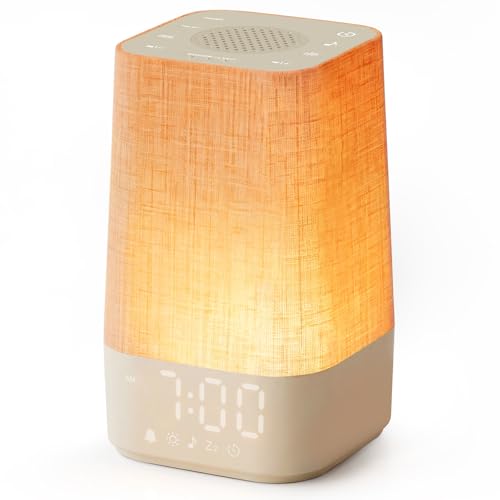
The Generic Sunrise Sound Machine Gradual Light opens the set with the clearest statement of the core idea, pairing a ten-to-sixty-minute brightening window with thirty soothing sounds on one bedroom unit.
Anyone whose partner keeps a different schedule might look first at the Generic Sunrise Dual Alarm Heavy Sleepers model, because its listing builds two alarms, an FM radio and a seven-colour night light into the same housing.
Philips brings the longest track record in this category through the SmartSleep HF3650/60, a lamp whose title leans on simulated sunrise and sunset plus a guided RelaxBreathe wind-down routine.
Hatch Restore 3 takes the most connected route of the six, tying circadian lighting to more than eighty sleep sounds and meditations delivered through the Hatch Sleep App.
Families will notice the ANTDALIS Sunrise Alarm Clock quickly, since its listing speaks directly to children as well as adults and heavy sleepers, with eight night-light colours and seven nature sounds.
Closing the group, the iEasy Wake Up Light Sunrise packs the longest feature inventory into a compact body, counting thirteen colour modes, twenty-three sleep sounds and twenty-eight built-in alarm tones.
Quick Picks
| Pick | Best for | Điểm nổi bật theo title |
|---|---|---|
| Generic Sunrise Sound Machine Gradual Light | A long, adjustable dawn with plenty of sound choice | 10-60 mins gradual light, 30 soothing sounds, 32-level volume |
| Generic Sunrise Dual Alarm Heavy Sleepers | Two schedules in one bedroom | Dual alarms, sunrise/sunset simulation, FM radio, 7 colours |
| Philips SmartSleep HF3650/60 | A guided evening routine alongside the morning ramp | Simulated sunrise and sunset, RelaxBreathe to Sleep |
| Hatch Restore 3 | App-led routines and a deep audio library | Circadian lighting, 80+ sleep sounds, meditations via app |
| ANTDALIS Sunrise Alarm Clock | Children, adults and heavy sleepers sharing one model line | Dual alarms, 7 nature sounds, 8 colours, FM radio |
| iEasy Wake Up Light Sunrise | Maximum tone and colour variety in a compact unit | 13-colour modes, 23 sleep sounds, 28 alarm tones, 32 volumes |
How these picks were chosen
Every clock in this set had to simulate a sunrise as its primary wake method, not merely include a lamp beside a conventional buzzer. That single filter removed ordinary digital alarms with night lights, because a static glow switched on at full brightness does not reproduce the gradual brightening that defines the category. Each surviving listing states its ramp in the title itself, either as an explicit minute range or as named sunrise simulation, and that wording is what the reviews rely on.
Sound mattered second. Waking to light alone works for some sleepers, yet most bedrooms benefit from audio that can follow the light rather than replace it, so preference went to listings naming a counted sound library, nature recordings, white noise or radio. The counts vary widely across the six, from seven nature sounds on the ANTDALIS up to more than eighty sleep sounds on the Hatch, and that spread is useful rather than embarrassing: a short, well-chosen library suits people who pick one favourite and never browse again, while a deep catalogue rewards listeners who tire of repetition.
Household fit came third. Dual alarms appear on three of the six titles, and that detail changes who a clock can serve, because two independent wake times let partners share one device instead of crowding the nightstand with two. Children appear explicitly in two titles, heavy sleepers in three, and a compact footprint in one, so the set deliberately spans shared family bedrooms, guest rooms and small student spaces rather than repeating six versions of the same single-sleeper lamp.
Evening behaviour separated the final candidates. A clock that only brightens in the morning occupies the nightstand for one job; a clock with sunset simulation, sleep aid sounds or a breathing routine can also mark the start of the night, which matters in homes trying to push phones out of the last half hour before bed. Four of these listings claim some form of wind-down help in their titles, and the reviews note exactly which mechanism each one names, because a fading sunset lamp and an app-delivered meditation are not interchangeable experiences.
Finally, anything the titles leave unquantified stays unquantified here. No listing in this group publishes a lumen figure, a colour temperature range in kelvin, or a measured decibel ceiling inside its title, so this guide compares ramps, counts, colours and controls instead of inventing laboratory numbers. Where a seller uses enthusiastic phrasing about brightness for dark mornings, the text below reports it as the seller’s claim, in the seller’s spirit, without converting it into a specification.
Generic Sunrise Sound Machine Gradual Light
Of the six listings, this unbranded unit states the dawn mechanism most precisely: light that builds across a window you can set anywhere from ten to sixty minutes. That range is the whole personality of the product. A ten-minute ramp suits someone who wants a gentler version of a normal alarm, while the full hour turns waking into a slow environmental change, the room simply becoming morning around you while the audio stays low. Thirty soothing sounds ride alongside the light, and volume adjusts across thirty-two levels, which matters at the quiet end where coarse controls jump from inaudible to intrusive in a single step.
- Gradual light window: 10-60 mins, per the listing title
- Sound library: 30 soothing sounds
- Volume steps: 32 levels
- Brightness: adjustable; no lumen figure given in the title
- Radio: none mentioned in the listing
- Second alarm: absent from the title
Strengths
- The ten-to-sixty-minute span covers both brisk and very slow risers without forcing one fixed dawn length on everyone.
- Thirty sounds is the second-deepest library in this set, giving light sleepers and sound-sensitive partners real alternatives to a buzzer.
- Thirty-two volume steps allow genuinely fine control at low loudness, where most bedroom listening actually happens.
Trade-offs
- The title names no FM radio, so broadcast listeners must look at the dual-alarm generic, ANTDALIS or iEasy listings instead.
- Only one alarm is implied by the wording, which limits couples keeping separate weekday schedules on a shared nightstand.
- Brightness is described with a seller claim about dark mornings rather than a measurable output number anyone could verify beforehand.
Treat this clock as a study in doing the central job thoroughly. The gradual window is wider than the fixed ramps elsewhere in the group, the sound count is generous, and the volume granularity respects the reality that a sound machine often plays to a room where another person is still asleep. Its evenings are quieter in ambition than the Philips or Hatch, since the title promises soothing sounds but no named sunset programme or breathing routine, yet many buyers honestly only need the morning half of the concept executed well. The adjustable brightness also makes it a plausible fit for rooms that receive some street light, because you can push the lamp harder against ambient glow, or for near-blackout bedrooms where a modest ceiling of brightness suffices.
One practical habit improves any long-ramp clock: set the end of the ramp, not the start, to the moment you must be upright, then let the sixty-minute setting pull the beginning earlier automatically. People who instead treat the alarm time as the start of brightening often oversleep through the gentle phase and blame the lamp. With thirty sound choices, resist rotating daily; settling on one consistent pairing of light and sound trains a faster association, and the library then serves as insurance for travel weeks or illness rather than a nightly browsing exercise.
Best for: a single sleeper who wants the longest, most adjustable brightening window in this group paired with a deep sound library. Not suited for: households needing two independent alarms on one unit, because the listing describes only a single wake programme. Check price on Amazon

Generic Sunrise Dual Alarm Heavy Sleepers
Sharing a bed with someone whose shift starts two hours before yours exposes the weakness of most wake-up lights: one dawn, one time, one loser. This generic model answers with dual alarms plus both sunrise and sunset simulation, and its title aims the package squarely at heavy sleepers, the group least convinced that light alone can move them. Natural sounds and a snooze function cover the audio side, an FM radio adds live broadcast as an alternative wake source, and a seven-colour night light keeps the unit useful after dark as low-level bedroom lighting rather than dead plastic.
- Alarms: dual, independently set
- Simulation: sunrise and sunset
- Audio: natural sounds plus FM radio
- Night light: 7 colours
- Snooze and sleep aid: both named in the title
- Gradual ramp length in minutes: not stated in the listing title
Strengths
- Two alarms on one nightstand device solve the staggered-schedule problem without buying a second clock.
- Sunset simulation gives the same unit an evening role, fading light down as a cue to settle.
- FM radio offers news, music and voices as wake audio for people who habituate to recorded loops.
Trade-offs
- The title gives no minute range for the brightening ramp, so buyers wanting a guaranteed hour-long dawn cannot confirm one here.
- Sound count goes unnumbered in the listing, unlike the counted libraries of the first pick and the iEasy.
- Seven night-light colours are pleasant but fewer than the eight or thirteen offered by the ANTDALIS and iEasy listings.
Heavy-sleeper positioning deserves a moment of honesty. Light-based waking works through closed eyelids and ambient brightening, and it genuinely helps many deep sleepers, yet the prudent setup for someone who has slept through fire-alarm volume is to run this clock as the first stage and keep a conventional backup for critical mornings until trust is earned. The dual-alarm design actually supports that experiment well: set the sunrise alarm early as the gentle attempt, and the second alarm later as the non-negotiable one, and within a fortnight you will know which stage actually wakes you. That self-knowledge is worth more than any seller promise.
The gift angle in the title is also understandable. A clock combining radio, colour night light and two alarms lands well in guest rooms and student halls, places where the recipient’s habits are unknown and breadth beats specialisation. For the giver, the sunset mode is the feature to demonstrate, because most people grasp sunrise simulation instantly but only discover the wind-down half if someone shows them during setup.
Best for: couples or housemates running two different wake times from one bedroom, especially where one partner sleeps deeply. Not suited for: a household that must confirm a sixty-minute ramp length before purchase, since this listing leaves the ramp duration unspecified. See the dual-alarm listing on Amazon
Philips SmartSleep HF3650/60
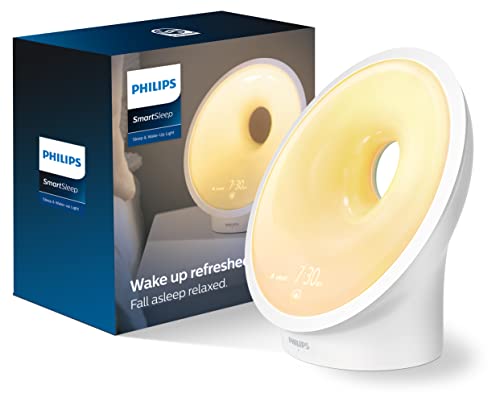
Philips effectively created the modern wake-up light category, and the HF3650/60 is its full-routine expression: simulated sunrise in the morning, simulated sunset in the evening, multiple lights and sounds to choose between, and a feature called RelaxBreathe that guides breathing as part of getting to sleep. Where the generic listings compete on counted features, this title competes on programme design. The lamp is presented less as an alarm that happens to glow and more as a bookend for the whole sleep period, with a structured wind-down at one end and a brightening wake at the other.
- Model: HF3650/60
- Simulation: sunrise and sunset, both simulated
- Wind-down: RelaxBreathe to Sleep
- Choice: multiple lights and sounds (exact counts not given in the title)
- Radio: absent from the title
- App control: none mentioned in the title
Strengths
- RelaxBreathe gives the evening a guided structure that plain fading lamps in this set do not name.
- Both ends of the night are addressed by one device, morning brightening and evening dimming under a single routine.
- The SmartSleep line carries the category’s longest design heritage, reflected in a title built around programmes rather than raw counts.
Trade-offs
- No sound-library number appears in the title, so catalogue-depth shoppers cannot compare it directly with the Hatch’s eighty-plus.
- Radio listeners get no FM mention here, unlike three other listings in this group.
- Buyers who dislike guided routines may find a breathing programme more involvement than they want from a bedside lamp.
The interesting question with the Philips is whether a routine changes behaviour. A sunset lamp that merely fades asks nothing of you; a breathing guide asks for a few attended minutes, and that small demand is precisely what helps some restless sleepers disengage from the day. If your difficulty is falling asleep rather than waking, this is the only listing in the six whose title names a specific technique for that half of the night. Conversely, if you fall asleep easily and simply hate dark mornings, you would be paying attention to the wrong half of its skill set, and the first pick’s longer stated ramp may serve you better.
Placement matters more with a programme-led lamp. Put it close enough that the sunset light genuinely dominates your visual field in the last minutes before sleep, rather than leaving it across the room where ceiling lights overpower it. In the morning the same closeness helps the sunrise register through peripheral vision even when you face away, a detail heavy sleepers in particular should test during the first week rather than assuming the brightest setting fixes everything.
Best for: sleepers whose problem spans both ends of the night and who will actually use a guided breathing wind-down. Not suited for: radio fans or catalogue browsers wanting a counted sound library, neither of which this title offers. View the Philips listing on Amazon

Hatch Restore 3
Hatch Restore 3 arrives in Putty, a soft neutral finish, and its title reads like a small manifesto: science-backed sleep audio, circadian lighting, a white noise machine and sunrise alarm light combined, more than eighty sleep sounds, and a screen-free bedtime routine whose meditations arrive through the Hatch Sleep App. That last pairing needs unpacking. The routine at the bedside is screen-free, which is the point of the product, yet configuration and meditation content live in an app, and the pool notes for this batch are explicit that the app is required for full features. Buyers should hold both facts at once rather than discovering the second one later.
- Finish named in title: Putty
- Audio library: 80+ sleep sounds
- Lighting: circadian lighting plus sunrise alarm light
- Content: meditations via Hatch Sleep App
- Routine style: screen-free bedtime routine
- Radio tuner: not stated in the listing title
Strengths
- Eighty-plus sounds dwarf every other library here, suiting listeners who rotate content and notice repetition quickly.
- Circadian lighting frames brightness as a day-long rhythm tool, not only a morning trigger.
- A screen-free bedside routine directly serves households banishing phones from the bedroom.
Trade-offs
- Full features depend on the companion app, an ongoing relationship some buyers actively avoid with bedside hardware.
- No FM radio appears in the title, closing off live broadcast as a wake option.
- The app-led design asks for setup effort up front, unlike the plug-in simplicity claimed by simpler listings.
Consider who thrives with the Hatch approach. If your evenings already run on guided meditations and your mornings on white noise, consolidating both into one lamp with a serious catalogue is genuinely convenient, and the sunrise function becomes one element of a system you use twice daily. If instead you want a clock you can hand to a grandparent or a teenager with no account creation, the app requirement is friction in exactly the wrong place. Neither reaction is wrong; they describe different households, and the title is unusually transparent about which household it wants.
There is also a subtle advantage to a deep library that rarely gets mentioned: houseguests and partners. Eighty-plus sounds give a second listener a realistic chance of finding a tolerable overnight texture, where a seven-sound library forces compromise. Couples negotiating between rainfall, fan noise and silence-adjacent brown noise will feel that difference nightly, long after the sunrise novelty fades.
For readers weighing a gentler category altogether, our companion piece on Best Gentle Alarm Clocks for Light Sleepers looks at soft-sound clocks built around quiet waking rather than full dawn simulation.
Best for: app-comfortable sleepers who want meditations, white noise and sunrise waking unified in one bedside system. Not suited for: anyone determined to avoid a companion app, because the listing ties full functionality to the Hatch Sleep App. Explore the Hatch Restore 3 on Amazon
ANTDALIS Sunrise Alarm Clock
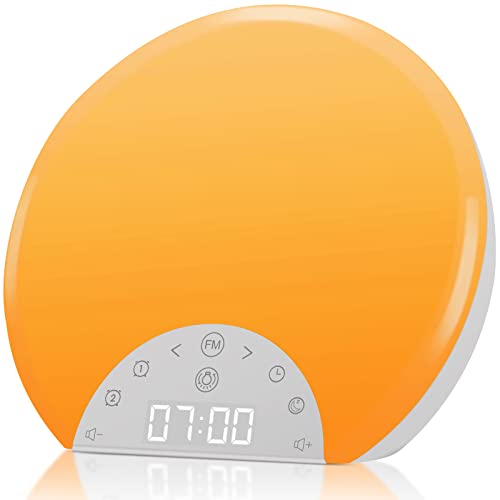
ANTDALIS writes its title like a family meeting: kids, adults and heavy sleepers are all named, and the feature list tries to give each constituency something. Dual alarms handle parents rising before children. Seven nature sounds provide the audio. Eight colours of night light give younger sleepers a choice they can own, turning the clock into a small piece of bedroom identity rather than parental equipment. An FM radio rounds out the unit for households that still wake to broadcast, and snooze plus sleep aid functions fill the standard roles at both ends of the night.
- Audience named: kids, adults, heavy sleepers
- Alarms: dual, with snooze
- Sounds: 7 nature sounds
- Night light colours: 8
- Radio: FM included
- Gradual ramp minutes: none stated in the listing
Strengths
- Explicit child suitability plus colour choice makes this the easiest listing here to place in a family bedroom.
- Dual alarms and radio together cover the two most common shared-household demands in one purchase.
- Heavy sleepers are addressed in the title alongside children, a rare acknowledgement that one home contains both.
Trade-offs
- Seven nature sounds form the smallest library in the set, which repetitive listeners may exhaust within a month.
- The brightening duration goes unquantified, frustrating buyers comparing ramp lengths across listings.
- No sunset simulation is claimed, so the evening side relies on the sleep aid sounds and night light alone.
Children change the design brief in ways adult-focused listings ignore. A colour a child picked themselves gets defended, used and kept on the nightstand; a colour imposed by a parent becomes furniture. Eight options is enough for that ownership effect without becoming a toy menu. Nature sounds also suit younger ears better than abrupt tones, and pairing a favourite birdsong with brightening light builds a wake pattern that does not start the school day with a jolt. Parents should still expect a learning week: set the clock together, let the child choose sound and colour, and treat the first mornings as rehearsal.
For the heavy sleeper in the same house, the honest reading is that this unit’s claim rests on light plus dual alarms rather than any specialised high-volume system. Use the second alarm as insurance, position the lamp on the deep sleeper’s side of the room, and let the FM option provide a changing, harder-to-ignore audio texture on days when recorded nature loops have become too familiar to register.
Best for: families wanting one clock model that can serve a child’s room and a parents’ room with colour choice and two alarms. Not suited for: solo listeners craving a vast sound catalogue, since seven nature sounds is the leanest offering here. Check the ANTDALIS listing on Amazon

iEasy Wake Up Light Sunrise
If the Philips competes on programme design, iEasy competes on inventory. Thirteen colour modes, twenty-three white noise sleep sounds, twenty-eight built-in alarm tones and thirty-two volume levels are all counted in the title, wrapped in a compact body the listing says suits everyone. Dual alarms and FM radio join the list, along with sunset simulation and sleep aid functions. On paper this is the maximalist entry: nearly every mechanism found anywhere in this group appears here in some counted form, and the compact footprint targets small nightstands, dorm rooms and travel-adjacent living where the bigger lamps crowd the surface.
- Colour modes: 13
- Sleep sounds: 23 white noise sounds
- Alarm tones: 28 built in
- Volume levels: 32
- Alarms: dual, plus FM radio and snooze
- Form: compact, per the title
Strengths
- Twenty-eight distinct alarm tones let chronic tone-habituators rotate before a sound becomes invisible to them.
- Thirteen colour modes exceed every rival here, useful for children and for matching a room’s evening mood.
- Compact sizing fits narrow nightstands and student desks where the larger lamps physically crowd out books and water.
Trade-offs
- A compact body necessarily means a smaller light surface, which may spread dawn less broadly across a large master bedroom.
- Feature density brings menu complexity; technophobes may prefer the simpler generic listings.
- Sunrise ramp length in minutes is not given in the title, despite the otherwise exhaustive counting.
Maximalism has a genuine use case beyond novelty. People who share a room across changing shifts, semesters or seasons reconfigure their wake system often, and a unit holding twenty-eight tones and thirteen colours absorbs that churn without replacement. The thirty-two volume steps echo the first pick’s fine low-end control, valuable when a partner’s schedule flips and tonight’s sleeper becomes tomorrow’s early riser. Where this listing asks for trust is light output: no brightness measure appears, and compact lamps earn their dawn by proximity, so place it near the pillow rather than across the room and judge it there.
The sunset simulation also deserves its compact-context reading. In a studio flat or dorm, one small lamp that warms and dims the whole living-sleeping space in the evening, then reverses the trick at dawn, replaces several single-purpose lights. That spatial economy, more than any single count in the title, explains who this product is really for.
Best for: small rooms and restless configurers who want the widest counted choice of tones, colours and volumes in a compact unit. Not suited for: large bedrooms needing dawn light thrown across a wide space, where a bigger lamp body will serve better. See the iEasy options on Amazon
Side-by-side: the six dawns at a glance
| Clock | Ramp evidence in title | Audio depth | Alarms | Evening role |
|---|---|---|---|---|
| Generic Sunrise Sound Machine Gradual Light | 10-60 mins stated | 30 soothing sounds | Single implied | Sound machine playback |
| Generic Sunrise Dual Alarm Heavy Sleepers | Simulation named, minutes unstated | Natural sounds + FM | Dual | Sunset simulation, sleep aid |
| Philips SmartSleep HF3650/60 | Sunrise and sunset simulated | Multiple sounds, uncounted | Not emphasised | RelaxBreathe routine |
| Hatch Restore 3 | Circadian lighting + sunrise light | 80+ sounds via app ecosystem | App routines | Meditations, screen-free routine |
| ANTDALIS Sunrise Alarm Clock | Wake-up light, minutes unstated | 7 nature sounds + FM | Dual | Sleep aid, 8-colour night light |
| iEasy Wake Up Light Sunrise | Sunset simulation named | 23 sleep sounds, 28 tones | Dual | Sunset simulation, sleep aid |
How do you choose a sunrise clock that fits your mornings?
Start with the ramp, not the extras
Decide how slowly you personally surface. People who spring up within minutes gain little from an hour of brightening and may sleep through its early stages out of habit, while reluctant risers benefit from the longest stated window in this set, the ten-to-sixty-minute range on the first generic pick. If a listing does not state minutes, treat the ramp as unknown rather than assuming generosity, and let other strengths carry the decision.
Count the sleepers the clock must serve
One clock can serve two people only when it holds two alarms or runs inside an app routine each person controls. Three listings here state dual alarms outright. A single-alarm lamp in a two-schedule household quietly becomes one partner’s clock while the other returns to a phone, which defeats the bedroom-purifying purpose many buyers start with.
Decide what your evenings need
Grade your wind-down honestly. If falling asleep is easy, sunset features are decoration. If your mind races at midnight, the Philips breathing routine or the Hatch meditation library addresses a real second problem, and paying for the evening half stops being indulgence. Sleep aid sounds on the generic and ANTDALIS listings sit between those poles, offering texture without instruction.
Match audio habits to library size
Some listeners pick rain forever; others hear a loop’s seam within a week and cannot unhear it. The first group should ignore sound counts entirely and buy on ramp and alarms. The second group should weight the Hatch’s eighty-plus catalogue or iEasy’s twenty-eight tones heavily, because habituation, not audio quality, is what usually kills a wake system in month three.
Think about who resets the clock after a power cut
An underrated household question is recovery. Clocks in this category differ in how gracefully they resume after an outage or an accidental unplugging by a cleaner, and the titles do not settle the matter, so treat it as a first-week experiment: unplug your chosen unit briefly during setup week, watch what returns automatically, and learn its behaviour while the stakes are low. App-run systems may restore routines from the account side, while simple standalone units may need their alarms re-entered by hand. Knowing which situation you own prevents the particular misery of discovering it on the morning of a flight.
Place the lamp before you judge it
Distance quietly governs every dawn lamp. A unit glowing from a dresser four metres away delivers a fraction of the pillow-level brightness of the same unit on a nightstand, and compact models like the iEasy depend on closeness most of all. Clear a near-bed spot with a socket, keep the lamp unshaded by books or plants, and angle it toward the bed rather than the ceiling.
What changes after the first month with a wake-up light?
The first week with any of these clocks is theatre: you watch the room brighten, notice colours, experiment with sounds. By week four the experience should have become invisible infrastructure, and that transition is the real test. Owners who keep waking well usually share two habits. They fixed a single sound-light pairing early, letting repetition build a conditioned response, and they kept wake times consistent at weekends, because a dawn lamp cannot reconcile a 6 a.m. weekday body with a 10 a.m. Saturday one. The clock supplies the cue; regularity supplies the effect.
There is also a social phase nobody warns buyers about. Around week two, partners, children or housemates start having opinions: the ramp is lovely, the birdsong is not, the night light colour in the hallway-facing bedroom reads oddly through a doorway. Treat these negotiations as part of installation rather than interference. A wake system imposed on a household without consultation tends to be quietly sabotaged, its volume lowered or its plug borrowed, while one that survived a family meeting becomes shared infrastructure nobody questions by month two.
Seasonality also reshapes value. In summer, early natural light may reach the bedroom before the lamp does, and the device earns its keep mainly on sound and evening routine. In deep winter the same unit becomes the only dawn available, which is why purchases made in November get judged harshly and purchases made in May get judged on features nobody needs until October. If you are buying in bright months, weight the evening functions; they carry the product through summer until its main season returns.
Can a sunrise clock share a bedroom with a partner on another schedule?
Yes, with caveats that the dual-alarm listings handle best. Light is inherently shared: when the room brightens for a 5:30 riser, the 7:00 sleeper receives that dawn too, whether invited or not. Practical couples soften this by aiming the lamp toward the early riser’s side, keeping the ramp’s early phase dim, and letting audio stay personal through low volume. Blackout curtains for the later sleeper sound contradictory beside a light alarm, yet an eye mask for the second phase of sleep solves the conflict more cheaply than any product redesign. Households with truly opposed shifts sometimes conclude that the early riser should wake in another room’s light, and no listing here can argue with physics.
Readers planning the kitchen end of an early morning as carefully as the bedroom end may enjoy our slow-brewing notes in Best Sous Vide Cookers, which cover set-and-forget cooking that can run while a household wakes in stages.
A first-week setup plan that gives the light a fair trial
Night one should be boring by design. Choose the sound you already know you tolerate, set brightness to a middling level rather than maximum, and place the lamp where your phone used to charge, because displacing the phone is half the intervention. Resist demonstrating every colour to visitors. The goal of the first evening is an unremarkable bedtime followed by a wake you can describe in one sentence the next morning: too early, too late, too dim, too loud, or about right. That sentence, not a feature tour, tells you the single adjustment to make on night two.
Nights two and three are for one variable at a time. If the light felt weak, raise brightness before lengthening the ramp; if you surfaced before the sound began but drifted back, shorten the gap between full brightness and audio; if a partner complained, lower volume before touching anything else, since audio complaints are usually about level rather than content. Changing three settings at once feels efficient and teaches nothing, because any improvement cannot be credited and any worsening cannot be reversed intelligently. Keep a few words on your phone, or better on paper by the lamp, because memory of 6 a.m. impressions is unreliable by breakfast.
By nights four and five, introduce the evening half if your model has one. Run the sunset simulation or sleep sounds at the same clock time you intend to sleep, not when you happen to finish scrolling, and notice whether the fading light exposes how late your other habits run. Many owners discover the lamp is not failing their mornings at all; it is indicting their evenings, revealing a bedtime that wandered ninety minutes later than the wake time assumes. Correcting that mismatch does more than any brightness increase, and it costs nothing.
Sequencing sound against light deserves its own experiment during those middle nights. Most owners settle on audio beginning at or shortly after peak brightness, allowing the glow a solo opening phase. Starting sound earlier compresses that phase and suits very deep sleepers who need two stimuli stacked together. Delaying it, where a unit permits, protects a partner: the sleeper nearer the lamp often surfaces on brightness alone while the room remains quiet for the other person’s extra half hour. Neither arrangement is the correct one in the abstract; the right sequence is the one your household’s two alarm times can both live with.
The weekend is the honest examination. Keep the wake time within an hour of the weekday setting, watch whether the conditioned pairing of light and sound still surfaces you without negotiation, and decide then whether the model deserves permanence. A clock that only works when willpower is fresh on Monday has not solved the problem it was bought for. Conversely, a clock that gets a tired household up on a grey Saturday has passed the only review that matters, whatever its sound count or colour menu looked like on paper.
Shift workers, north-facing rooms and other awkward bedrooms
Rotating-shift households bend every assumption behind these products. Your dawn may need to arrive at 4 p.m. before a night shift, in a room darkened against afternoon sun, with a partner beginning their normal evening in the next room. Wake-up lights handle this better than expected because they are indifferent to the actual sky: blackout curtains create the night, the lamp creates the morning, and the body follows the stronger local signal. The discipline required is scheduling honesty. Program the ramp for the shift you are actually on this week, and change it deliberately at rotation boundaries instead of letting last week’s settings ambush a rest day.
North-facing bedrooms and basement flats present the opposite problem: no competing daylight at all, in any season. There the lamp is not supplementing a weak natural dawn but replacing an absent one, and placement plus ramp length matter more than raw feature counts. A long stated ramp, like the sixty-minute ceiling on the first pick, earns its keep in these rooms, because the entire transition from darkness to day must be manufactured. Residents of such flats often report the evening sunset mode mattering equally, since without an outdoor light cue the boundary between afternoon and night blurs in both directions.
Guest bedrooms deserve a mention because they punish complexity. A visiting parent confronted by an app-paired lamp with an account, a menu tree and thirteen colours will simply unplug it and use their phone. For spare rooms, choose from the standalone listings, set one kind sound and a moderate ramp before guests arrive, and write nothing down: if the clock needs instructions, it is the wrong clock for that room. The ANTDALIS and the simpler generics fit this philosophy, while the Hatch belongs in the bedroom of the person who configured it.
Finally, small flats where the bedroom doubles as a workspace create a boundary problem a lamp can genuinely help with. A sunset simulation at a fixed hour becomes a closing ritual for the working day in a room that never physically changes, and the morning ramp reopens it. That ritual use has little to do with sleep science claims and everything to do with giving one room two recognisable modes, which is why studio dwellers often keep wake-up lights long after house-dwellers with separate rooms have moved on.
Matching each of the six to a sleeper type
The gradual-light generic suits the methodical riser, the person who will genuinely experiment with ramp lengths across a fortnight and keep the winner for years. Its appeal is adjustability without an account, a menu or a subscription-shaped shadow, and its thirty sounds quietly cover the possibility that your taste at forty differs from your taste today. Buy it when the morning itself is the project and the evening can look after itself.
Its dual-alarm sibling suits the diplomat, the partner negotiating peace between two timetables. Radio matters more in this household than sound counts, because live voices anchor a wake to the real world’s morning in a way loops cannot, and the sunset mode gives the later sleeper something from the same purchase. Buy it when fairness between schedules is the purchase’s true purpose.
The Philips suits the structured improver, someone who responds to named programmes and guided practice rather than raw settings. RelaxBreathe either intrigues you immediately or leaves you cold, and that instant reaction predicts satisfaction better than any comparison table. Buy it when bedtime, not the alarm, is where your sleep routine breaks down, and when a lamp that coaches appeals more than a lamp that merely glows.
Hatch Restore 3 suits the system builder who already tracks, logs and curates other parts of life through apps. For that buyer the phone configuration is not friction but the familiar front door, and the catalogue depth becomes a long-term asset as seasons and stresses change what sounds restful. Buy it when you expect to keep refining the routine for months and want content headroom for that refinement.
The ANTDALIS suits the family pragmatist equipping more than one bedroom, possibly with more than one copy of the same clock so children and parents learn one interface. Colour choice does social work here, letting a child personalise a device adults chose, and dual alarms future-proof the purchase against changing school and work times. Buy it when the household, rather than an individual sleeper, is the customer.
The iEasy suits the restless optimiser in a small room, the student or studio dweller whose preferences swing with workload and season. Twenty-eight tones sound excessive until the third time a favourite becomes unhearable through familiarity, at which point the bench of substitutes justifies the whole design. Buy it when space is tight, tastes are unstable, and one compact unit must be reconfigured rather than replaced.
Notice what this matching exercise deliberately avoids: ranking the six from best to worst on a single scale. A wake-up light succeeds inside a specific bedroom ecology of schedules, room orientation, partner tolerance and evening habits, and fails outside it for reasons unrelated to build quality. The most useful question is never which clock wins, but which description above sounds embarrassingly like your household at 6 a.m. on a wet Thursday.
Common mistakes
Judging the lamp from across the room on night one. A dawn clock placed on a far dresser for its first trial will look feeble, get returned, and never receive the nightstand trial that represents its actual design brief. Give any model three mornings at pillow distance before forming a verdict.
Setting the alarm time as the start of brightening. On ramps you configure by duration, the alarm moment should be when light peaks and sound begins, not when the glow commences. Misreading this shifts your effective wake time later by exactly the ramp length and manufactures a false story about light alarms not working.
Rotating sounds nightly out of curiosity. Novelty is the enemy of the conditioned response that makes gentle waking reliable. Browse freely during the first weekend, then lock a pairing for a fortnight and let your nervous system learn it.
Ignoring the partner’s light exposure. Buying a sunrise clock is a household decision disguised as a personal one. Discuss aiming, eye masks and second alarms before the first 5 a.m. experiment, not after a week of resentful half-waking.
Expecting light to fix a chaotic sleep schedule. A lamp can cue a consistent rhythm; it cannot create one from rotating bedtimes. Buyers who keep midnight-to-2 a.m. variability will blame the product for a problem located in their calendar.
Reading brightness claims without a light meter
None of these six titles publishes a lumen or lux figure, so shoppers must triangulate brightness from indirect evidence. Body size offers one clue: a larger lamp face generally spreads light across more of the room, while a compact unit concentrates its output near the pillow. Seller language offers another, weaker clue; phrases promising performance in dark mornings tell you the maker expects blackout-curtain customers, not that any threshold was measured. The most reliable evidence is behavioural and comes after purchase, which is why the first-week plan earlier in this guide matters more than pre-purchase anxiety about output.
Room colour quietly changes the equation too. Pale walls bounce a dawn lamp’s output back toward the bed, multiplying its effect, while dark paint and heavy furniture absorb it. Two identical clocks can feel a full setting apart in different rooms, which explains contradictory owner reports about the same model and should temper how much weight you give any single stranger’s verdict on brightness. Judge your unit in your room, at your distance, against your curtains, and treat outside opinion as a rough prior rather than a verdict.
If, after a week at proper distance on high settings, a lamp still leaves you unmoved, the honest conclusion may be that light is not your lever. Some sleepers respond primarily to sound, temperature or a partner’s movement, and for them the money belongs in the gentler sound-led category examined elsewhere in this batch rather than in a brighter lamp. Recognising your own lever is the purchase skill underneath every comparison in this guide.
Final recommendation
For most single sleepers, the Generic Sunrise Sound Machine Gradual Light is the safest first dawn: its ramp window is the only one stated in minutes at both ends, its thirty sounds cover taste changes, and its thirty-two volume steps respect sleeping partners. Couples should step directly to a dual-alarm model, with the second generic pick suiting radio listeners and the ANTDALIS suiting families with children. Choose the Philips when falling asleep is your harder problem, the Hatch when you want an app-run sleep system with a serious catalogue, and the iEasy when the room is small and your preferences change often. Each route is defensible; the indefensible purchase is a single-alarm lamp for a two-schedule bedroom.
FAQ
Do sunrise clocks work through closed eyelids? Light registers through closed eyelids and via the brightened room once eyes open briefly, which is why gradual ramps outperform sudden lamps. Deep sleepers should still pair light with sound during the first weeks, as several listings here anticipate with their heavy-sleeper positioning and backup-friendly dual alarms.
How long should the brightening phase last? Listings in this set that state a range offer ten to sixty minutes. Slow, reluctant risers generally use the longer end; people who wake easily often prefer twenty to thirty minutes so the room reaches full brightness near their alarm moment rather than long before it.
Is an app essential for a good wake-up light? No. Only the Hatch Restore 3 ties full features to an app among these six. The Philips runs its programmes on-device, and the generic, ANTDALIS and iEasy listings operate as standalone bedside units with onboard sounds, radio or tones.
Can children use these clocks safely as night lights? Two listings name children directly, ANTDALIS and iEasy, and both provide multi-colour night lights. Pick a colour and brightness with the child, keep cords managed as with any bedside electrical item, and treat the wake time as a routine you rehearse together.
What if my bedroom already gets early daylight? In bright months the lamp’s marginal effect shrinks, and its value shifts to sound, sunset simulation and routine. Curtains that darken the room restore the lamp’s morning role; many owners run blackout curtains precisely so their artificial dawn stays in charge year-round.
When the lamp finally lifts you out of sleep before the room would have done it alone, an ordinary Tuesday starts to feel less like an ambush and more like weather you chose.
After early starts, households often rethink the rest of the home’s comfort kit too, and our roundup of Best Slippers for Guests covers the small hospitality touches that make overnight visitors feel expected rather than accommodated.


