What's inside
- Where to buy these silk and silk-look rugs
- Quick picks: the three families at a glance
- How these picks were chosen
- The six rugs, reviewed family by family
- The honest comparison: fibre first, then everything else
- How do you choose between real silk, faux silk, and viscose?
- A short, honest glossary of silk words
- Caring for sheen fibres without ruining them
- Further silk-category judgements, made slowly
- Common mistakes when shopping for silk rugs
- Final recommendation
- Frequently asked questions about silk rugs
As an Amazon Associate I earn from qualifying purchases. This post may contain affiliate links at no extra cost to you.
As an Amazon Associate, cottageverdict.com earns from qualifying purchases.
Here is the honest starting point for anyone searching for the best silk rugs: the word silk on a rug listing covers at least three different materials, and this guide will not pretend otherwise. Of the six picks below, exactly three contain real silk according to their titles — two wool and silk rugs and one wool and silk blend. The other three contain no silk fibre at all: one is openly faux silk, and two are viscose, the plant-based fibre the trade calls art-silk for its similar sheen. Each family is labelled plainly in its review, because which one you are buying changes the price logic, the care, and the feel.
Why include the non-silk rugs at all? Because shoppers searching this category meet all three families on the same results page, often at wildly different sizes and constructions, and a guide that quietly mixed them would mislead exactly where clarity matters most. The viscose and faux-silk picks earn their places on stated merits — handmade construction, washable low pile, large footprints — but they earn them under their real names. Read the family first, the rug second, and no listing language will ever be able to blur the two for you again.
The six span 3×6 to 8×10, hand-tufted to handmade to washable machine-made styles, floral carving to scalloped stripes to abstract modern. That spread is deliberate: once the fibre question is answered honestly, the remaining decisions — size, pattern, pile, upkeep — are the ordinary rug decisions, and this guide treats them that way. If you are comparing natural-fibre categories more broadly, our flokati guide covers the deep-pile wool end of the same honest-labelling approach.
Where to buy these silk and silk-look rugs
All six are sold through Amazon under the exact labels below, and each label is written to keep its fibre family visible — silk, faux silk, or viscose — before you ever click.
- Rug Barn Wool and Silk Floral Rug 3×6: a genuine wool and silk rug, hand-tufted, with a multi-colour floral design and cotton backing in a 3×6 accent size.
- Handmade Floral Silk and Wool Rug 5×8: a handmade silk and wool rug at 5×8 in light maize, with carved high-low texture across its floral pattern.
- Handmade Scalloped Wool and Silk Blend Rug: the largest real-silk option, a 7×10 wool and silk blend with a scalloped edge, striped chevron pattern, and sky green colouring.
- UKISS Faux Silk Vintage Rug 8×10 Blue: the practical one — an 8×10 washable rug in openly-labelled faux silk with a vintage blue design, low pile, and a non-slip, non-shedding brief.
- AADI Viscose Area Rug Silver Grey 7×9: a viscose rug — art-silk, not silk — in silver grey with a modern abstract design at a slightly unusual 7×9 size.
- SAFAVIEH Mirage Viscose Rug Charcoal: a handmade viscose rug from the Mirage collection, 8×10 in charcoal, with a named model code for exact verification.
Quick picks: the three families at a glance
| Pick | Best for | What the title highlights |
|---|---|---|
| Rug Barn Wool and Silk Floral Rug 3×6 | A silk accent beside a bed or in an entry | Hand-tufted wool and silk with cotton backing |
| Handmade Floral Silk and Wool Rug 5×8 | A living room or dining room centrepiece | Carved high-low texture, handmade, 5×8 |
| Handmade Scalloped Wool and Silk Blend Rug | Large rooms wanting real silk blend plus pattern | 7×10 wool and silk blend, scalloped, sky green |
| UKISS Faux Silk Vintage Rug 8×10 Blue | Busy rooms needing washable, low-pile ease | Faux silk, washable, non-slip per the title |
| AADI Viscose Area Rug Silver Grey 7×9 | Modern rooms wanting sheen on a quiet palette | Viscose fibre, silver grey abstract, 7×9 |
| SAFAVIEH Mirage Viscose Rug Charcoal | Formal rooms wanting handmade sheen in charcoal | Handmade viscose, Mirage collection, MIR801C |
How these picks were chosen
The first rule of selection was that the fibre had to be identifiable from the title itself. Real silk picks had to say silk alongside their wool; the faux-silk pick had to admit faux in its own title, which it does; and the viscose picks had to name viscose, which both do. Any listing that used silk as a mood while hiding its fibre entirely was excluded, because a buyer cannot verify what a seller will not state.
The second rule was balance across the three families. Three real silk blends anchor the guide, since that is what the search promises. One faux-silk washable rug represents the practical end of the market. Two viscose rugs — one modern abstract, one handmade from an established collection — represent the art-silk tradition that has shared this shelf for decades. The proportions mirror what a shopper actually faces.
Construction and size formed the third filter. Hand-tufted appears in the silk family, handmade in the viscose family, and a washable low-pile construction in the faux-silk pick, across footprints from a 3×6 accent to two 8×10 room anchors. A guide of six identical rugs would have answered one buyer’s question six times and everyone else’s not at all.
Finally, every claim in the reviews below is tied to its title. Carved high-low texture, cotton backing, non-slip, non-shedding — each appears because its listing states it, attributed as a listing claim. Where a title is silent, most notably on fibre percentages within the blends, the review leaves the silence visible. A blend’s ratio is a real buying factor, and pretending to know it would be its own kind of mislabel.
The six rugs, reviewed family by family

Rug Barn Wool and Silk Floral Rug 3×6
This is a real silk rug — the title says wool and silk outright — and it is built like an accent rather than an anchor: 3 by 6 feet, hand-tufted, with a floral design in blue, yellow, pink, and green and a cotton backing named in the title. The listing describes a plush pile with a soft sheen, which is precisely the quality silk brings to a blend: lustre that shifts as light moves across the flowers. At this size it suits a bedside, a dressing area, or an entry that deserves better than a mat.
Listing details at a glance
- Fibre, per the listing title: wool and silk
- Construction named in the title: hand-tufted
- Size stated in the title: 3 x 6 feet
- Backing named in the title: cotton backing
- Design described in the title: rectangular multi-colour floral in blue, yellow, pink, and green
Strengths
- Real silk content, stated in the title alongside the wool
- The cotton backing is named, a detail many rug titles omit
- A 3×6 accent size puts genuine silk within reach of smaller budgets and smaller rooms
Trade-offs
- The title does not state the silk-to-wool ratio, so the blend proportion is unconfirmed
- A busy multi-colour floral will steer the palette of any room it enters
- At 3×6 it is an accent piece, not a foundation for a seating group
The sheen claim deserves a moment of respect, because it is the one promise silk can actually keep. Wool gives a rug body and resilience; silk fibres catch light, so a carved or patterned surface in a wool and silk blend seems to change tone as you cross the room. A floral design is the classic vehicle for that effect — petals brighten, leaves recede — and this rug’s four named colours suggest it leans into the effect rather than muting it. Place it where daylight reaches it, and the material does the decorating.
The 3×6 format is the strategic part of this pick. Genuine silk rugs at room size are serious purchases; at accent size, the same fibre family becomes a way to own the real material in the spot you cross most — beside the bed, in front of a vanity, along a favourite chair. The cotton backing named in the title is a practical comfort for placing it on smooth floors, though a separate pad is still the cautious move under any accent rug that takes daily footsteps.
Best for: buyers who want genuine silk in the listing, in a colourful accent size with a named cotton backing. Not suited for: anyone furnishing a full seating area, or who needs the blend ratio stated before buying.
Check price on Amazon — the wool and silk wording is right in the title, where it should be.

Handmade Floral Silk and Wool Rug 5×8
The second genuine silk pick steps up in both size and craft language: a handmade, hand-tufted silk and wool rug at 5 by 8 feet in a colour the title calls light maize, with a carved high-low texture worked into its floral pattern. The title names living room, bedroom, and dining room as its stages, and the 5×8 footprint supports that ambition — large enough to front a sofa properly or sit under a modest dining set, with the carved texture giving the floral design a sculpted, shadowed depth.
Listing details at a glance
- Fibre, per the listing title: silk and wool
- Construction named in the title: handmade, hand-tufted
- Size stated in the title: 5 x 8 feet
- Colour named in the title: light maize
- Texture described in the title: carved high-low floral
Strengths
- Real silk and wool, both named in the title
- Carved high-low texture adds dimension flat prints cannot imitate
- The 5×8 size works as a true room rug rather than an accent
Trade-offs
- The blend ratio of silk to wool is not stated in the title
- A pale maize ground will show spills sooner than a darker rug
- Carved texture traps crumbs in the low channels, asking more of vacuuming
Carving is the detail to understand. In a high-low rug, parts of the pattern are clipped lower than the surrounding pile, so the design is felt as much as seen — and in a silk and wool blend, the two fibres respond to that clipping with different light, deepening the sculpted effect. It is labour-intensive finishing, and its presence in the title signals a rug aiming at craft rather than coverage. If you run a hand across one rug in a showroom this year, this is the kind of surface that explains itself.
Light maize is a warm, pale neutral that behaves like a softened gold in daylight. It will flatter wood floors and warm up grey upholstery, but it asks the usual pale-rug honesty about shoes and spills. The title calls the rug durable — a listing claim, noted as such — while the more checkable facts are its size, fibres, and construction. Buyers choosing between this and the Rug Barn pick are really choosing scale: accent or anchor, same honest fibre family.
Best for: a living or dining room that wants genuine silk and wool with sculptural, carved texture. Not suited for: high-spill dining under young children, or buyers who need blend percentages in writing.
Check price on Amazon — look for the carved high-low wording in the title to confirm the finish.
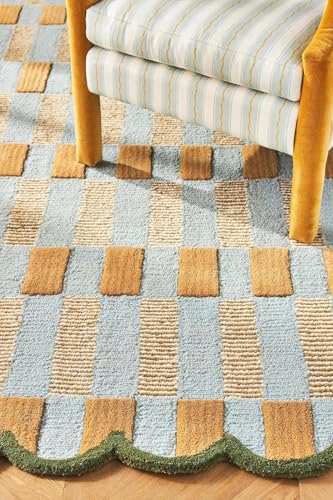
Handmade Scalloped Wool and Silk Blend Rug
The third genuine silk pick is the largest of the family: a handmade, hand-tufted wool and silk blend at 7 by 10 feet, in sky green, with a striped chevron pattern and a scalloped profile the title names directly. Its styling language — Scandinavian, boho, modern — points at the lighter, patterned end of decorating, and the scalloped edge is a genuine design decision: it breaks the rectangle’s hard geometry and gives the rug a finished, furniture-like presence on the floor.
Listing details at a glance
- Fibre, per the listing title: wool and silk blend
- Construction named in the title: handmade, hand tufted
- Size stated in the title: 7 x 10 feet
- Colour named in the title: sky green
- Pattern described in the title: striped chevron with a scalloped form
Strengths
- Real silk in the blend, stated in the title
- The largest footprint among the three genuine silk picks
- Scalloped edges and chevron stripes give it design presence beyond a plain foundation
Trade-offs
- Blend proportions are not given in the title
- A scalloped edge complicates placement under furniture with straight lines
- Sky green is a committed colour that will direct the room palette
Scale changes what silk does in a room. At 7×10, the blend’s sheen is not an accent glint but a broad, shifting field under the main furniture, and the chevron striping gives that field a rhythm the eye can follow. The title describes the pile as thick and plush, a listing claim worth noting alongside the checkable facts of size and fibre. For a large living room or a generous bedroom, this is the pick that lets genuine silk carry a whole scheme rather than garnish one corner of it.
The scallop deserves practical thought. Wavy edges look best fully visible, which argues for floating this rug in open floor rather than tucking it under a sofa’s front legs in the usual way. Rooms with the floor space to show the edge will get the design’s full value; rooms where most of the border hides under furniture are paying for a silhouette they will not see. Measure with that in mind, and let the sky green — a soft, greyed green — be tested against your room’s light before committing.
Best for: large, open rooms that can show off a scalloped, patterned rug in a real silk blend. Not suited for: tight layouts where the edge disappears, or neutral-only palettes.
Check price on Amazon — the scalloped shape is named in the title, so what you see described is the silhouette you get.

UKISS Faux Silk Vintage Rug 8×10 Blue
Now the honesty test, passed in plain sight: this listing calls itself faux silk in its own title. There is no silk fibre in this rug, and the listing does not pretend otherwise — what it offers instead is a silk-look sheen on a washable, low-pile, non-slip 8×10 with a vintage design in blue, described as ultra-soft and non-shedding. That is a completely legitimate product; it is simply a different product from the three rugs above, and it is reviewed here under its real name.
Listing details at a glance
- Fibre, per the listing title: faux silk — no silk content stated or implied
- Size stated in the title: 8 x 10 feet
- Pile described in the title as low-pile
- Care feature claimed in the title: washable
- Performance claims in the title: non-slip and non-shedding
Strengths
- Honest faux labelling in the title itself
- Washable and low-pile, the easiest upkeep profile in this guide
- A full 8×10 footprint at the practical end of the category
Trade-offs
- Contains no silk, so it cannot deliver silk fibre behaviour or longevity
- Low pile gives a sheen look without the plush feel of the tufted picks
- Vintage blue pattern is a strong style commitment
Judge this rug by the job it actually applies for. Under a dining table, in a family room with pets, in a rental where the rug must survive real life and go in a wash — the silk-look surface with washable, low-pile construction is arguably the smartest specification in this entire guide. The sheen reads as elegance from standing height; the upkeep reads as relief every week after. Buyers who came for fibre romance should return to the three picks above; buyers who came for a beautiful, forgiving floor covering have found their rug.
The non-slip and non-shedding claims are the listing’s own, flagged here as claims, and they matter because they address the two classic complaints about budget large rugs: creeping across hard floors and fluffing onto dark clothes. If those claims hold on the product page’s fuller description, this is the lowest-friction 8×10 in the six. What it will never be is silk — and thanks to its title, nobody buying it will be confused about that. More listings should label this clearly. Shoppers weighing upkeep across the home may also appreciate our guide to Best Towels for Hard Water, where fibre claims get the same plain reading.
Best for: busy, wash-and-go rooms that want a silk-look sheen at 8×10 without silk or silk-level care. Not suited for: anyone actually shopping for silk fibre — this is not that, and says so.
Check price on Amazon — the word faux is printed in its own title, which is exactly how it should be.
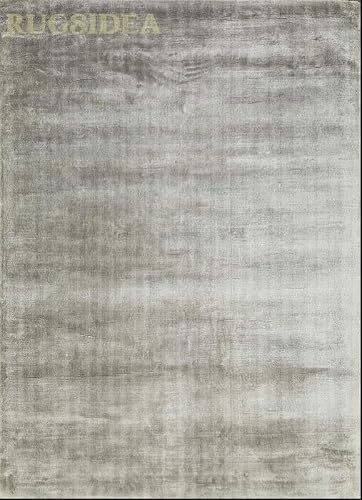
AADI Viscose Area Rug Silver Grey 7×9
The shortest title in this guide carries the most important word in it: viscose. This AADI rug is a 7 by 9 foot area rug in silver grey with a modern abstract design, and its fibre is viscose — a plant-derived fibre prized for a silk-like lustre and long sold under the nickname art-silk. It is not silk, it does not claim to be silk in its title, and it is reviewed as what it is: a sheen-forward modern rug whose appeal is its liquid, light-shifting surface.
Listing details at a glance
- Fibre, per the listing title: viscose
- Size stated in the title: 7 x 9 feet
- Colour named in the title: silver grey
- Design described in the title: modern abstract
- Construction and pile details: none stated in the listing title
Strengths
- Viscose is named plainly in the title, no silk ambiguity
- Silver grey abstract suits modern rooms that find florals fussy
- The 7×9 size fills gaps between standard 5×8 and 8×10 footprints
Trade-offs
- Not silk — viscose behaves differently with water and wear, so set expectations by its real fibre
- The title states no construction or pile information to compare
- Abstract designs date faster than classics; choose it because you love it now
Viscose earns its art-silk nickname honestly at the level of appearance: few fibres take dye and throw light with the same watery brightness, which is why a silver grey abstract is such a natural vehicle for it — the design and the fibre are both about shifting tones. In a modern living room with pale upholstery and metal or glass accents, that surface can look genuinely luxurious. The honesty requirement runs the other way for care: viscose is known across the rug trade as a fibre that dislikes soaking and heavy traffic, so this rug’s best home is a lower-traffic, style-led room.
The 7×9 footprint is a quiet advantage. Many rooms fall between sizes — too big for a 5×8 to anchor, too small for an 8×10 to breathe — and 7×9 threads that needle while covering more floor than either neighbour in feel. Because the title offers no construction details, the product page carries unusual weight for this pick: check pile and backing there before ordering, since the title alone cannot confirm them. What the title does confirm — fibre, colour, design family, size — is exactly the set of facts this review has used.
Best for: style-led, lower-traffic modern rooms that want maximum sheen from a clearly-labelled viscose rug. Not suited for: buyers seeking actual silk, or heavy-traffic and spill-prone placements.
Check price on Amazon — viscose is the first fibre word in its title; read the product page for the construction details the title omits.

SAFAVIEH Mirage Viscose Rug Charcoal
The second viscose pick is the formal one: an 8×10 from SAFAVIEH’s Mirage collection, handmade in viscose, in charcoal, with the model code MIR801C printed in the title. Like the AADI, it contains no silk and claims none — its case rests on handmade construction, a large footprint, and the deep, light-absorbing drama of charcoal with a viscose sheen. The title names living room, bedroom, office, and dining space as its territory, the widest room list of any pick here.
Listing details at a glance
- Fibre, per the listing title: viscose
- Construction named in the title: handmade
- Size stated in the title: 8 x 10 feet
- Colour named in the title: charcoal
- Collection and model in the title: Mirage collection, MIR801C
Strengths
- Handmade construction stated in the title
- The model code makes exact-product checking straightforward
- Charcoal grounds light furniture and hides everyday dust better than pale sheens
Trade-offs
- Viscose, not silk — the sheen is real, the fibre is different
- Charcoal shows pale lint and pet hair prominently
- An 8×10 handmade rug is a considered purchase to place and maintain
Charcoal is the clever colour choice for a sheen fibre. On pale viscose, light bounces brightly and every mark announces itself; on charcoal, the same lustre turns moody and directional, glowing where light rakes across it and settling elsewhere. In a formal living room or a primary bedroom with light bedding, that contrast is the decoration. The handmade claim, attributed to the listing, adds the expectation of slight irregularity — the small variations that read as character in a handmade surface and would read as flaws in a machine brief.
Within this guide, the Mirage is the natural rival to the Scalloped blend pick: same 8×10-class footprint ambitions (7×10 against 8×10), opposite fibre stories. The Scalloped rug offers real silk blended with wool and a visible pattern; the Mirage offers viscose sheen, handmade construction, and a solid dramatic colour. Neither is the other’s substitute, and the choice between them is the whole silk question in miniature — fibre authenticity against fibre effect, at room scale, with the labels finally clear enough to choose on purpose.
Best for: formal rooms that want handmade construction and deep charcoal sheen, knowingly choosing viscose. Not suited for: silk seekers, or homes with pale-shedding pets.
Check price on Amazon — search the MIR801C code from the title to land on this exact rug.
The honest comparison: fibre first, then everything else
Read the first column of substance — fibre — before size or pattern, because in this category the fibre is the fact most often blurred and most worth knowing.
| Rug | Fibre, stated plainly | Size and look |
|---|---|---|
| Rug Barn Wool and Silk Floral Rug 3×6 | Wool and silk, hand-tufted | 3 x 6 ft floral accent |
| Handmade Floral Silk and Wool Rug 5×8 | Silk and wool, handmade hand-tufted | 5 x 8 ft, light maize |
| Handmade Scalloped Wool and Silk Blend Rug | Wool and silk blend, hand tufted | 7 x 10 ft, sky green chevron |
| UKISS Faux Silk Vintage Rug 8×10 Blue | Faux silk, washable low pile | 8 x 10 ft vintage blue |
| AADI Viscose Area Rug Silver Grey 7×9 | Viscose, modern abstract | 7 x 9 ft silver grey |
| SAFAVIEH Mirage Viscose Rug Charcoal | Viscose, handmade | 8 x 10 ft charcoal |
How do you choose between real silk, faux silk, and viscose?
Decide what the word silk must mean in your purchase
Start by answering a question only you can: are you buying a material or an appearance? If the material matters — for its feel, its ageing, its place in a collection of real textiles — then your shortlist is the three wool and silk picks, full stop, and the only remaining questions are size and pattern. If the appearance matters most, the viscose and faux-silk picks compete honestly, and upkeep and footprint should decide. Trouble only starts when a buyer pays for one and receives the other.
Budget follows from that answer rather than preceding it. Genuine silk blends concentrate cost in fibre; viscose and faux silk concentrate value in size and construction. A large viscose rug and a small silk rug can sit at similar prices for entirely respectable reasons. Knowing which you bought — which this guide’s labels make unavoidable — is what turns either purchase from a gamble into a decision.
Match the family to the room traffic
Real silk blends reward gentle rooms: bedrooms, formal living rooms, low-traffic sitting spaces where shoes are optional and spills are rare. Their sheen and hand are the luxury; their delicacy relative to pure wool is the tax. The carved floral and scalloped picks both belong in rooms that will treat them as the furnishing event they are.
Viscose asks for similar respect with an extra caution about water, since the fibre is known in the trade to dislike soaking — keep both viscose picks in dry, lower-traffic rooms. The faux-silk pick is the outlier that welcomes chaos: washable, low-pile, non-slip by its listing’s claims, it is the only one of the six that belongs under a family dining table. Traffic-matching, more than taste, is what separates a rug that ages gracefully from one that ages publicly.
Use size and pattern as the tiebreakers they should be
Once fibre family and traffic are settled, the ordinary rug logic applies cleanly. Accent spots take the 3×6; sofas and modest dining sets take the 5×8; full rooms take the 7×9, 7×10, and 8×10 picks. Tape the footprint before ordering, as with any rug, and check the door swings against pile where the listing states one.
Pattern is the last dial. Florals in the two smaller silk picks carry rooms that need softness and colour; the chevron scallop carries rooms that need rhythm; the abstract and the solid charcoal carry rooms that need calm with a sheen. A household furnishing several rooms at once might also look at Best Blankets for Moving — not for the rugs, but because protecting floors and furniture during the shuffle is its own project.
Read the title like a contract before you buy
Every fact used in this guide came from six titles, and the same reading skill protects you anywhere in this category. Find the fibre word first. Distinguish silk from silk blend, faux silk, and art-silk’s modern name, viscose. Note what is absent — blend ratios, pile heights, backings — and treat absences as questions for the product page, not as details you may assume in your favour.
This habit generalises beyond rugs. Listings are written to sell, and the fibre word is where selling language and material fact most often part company. A buyer who reads titles literally — claiming only what is claimed, in the words used — will rarely be surprised by what arrives. Surprises belong in gifts, not in floor coverings.
A short, honest glossary of silk words
Silk, unqualified, should mean the fibre from the silkworm — in rugs, almost always blended with wool for strength, as in this guide’s first three picks. Silk blend means silk is present alongside something else, in proportions the seller may or may not state; none of the three genuine picks here states its ratio, which is common and worth knowing rather than resenting.
Art-silk is the historical trade nickname for fibres made to imitate silk’s shine, and its modern, honest name on a listing is viscose (also called rayon in some markets). Viscose is made from plant cellulose, takes dye beautifully, and produces the watery lustre these two picks trade on. Faux silk is the plainest label of all — it announces imitation in the name itself, as the UKISS title does. None of these materials is a scam. The only scam in this category is a label that lets you believe one fibre while shipping another, and every title in this guide avoids it.
One more term: hand-tufted, which appears in the silk family’s titles, describes pile yarns punched through a backing by hand-guided tools — faster than hand-knotting, more individual than machine weaving, and typically finished with a cloth backing, which is why the Rug Barn title’s cotton backing makes construction sense. Handmade, in the Mirage title, is the broader claim. Both are repeated here as the listings’ own words.
Caring for sheen fibres without ruining them
Sheen is a surface effect, and surfaces are what cleaning touches first. Across all three families, the safe instincts rhyme: vacuum without aggressive beater bars on the delicate picks, blot spills rather than scrubbing them, and keep soaking water away from viscose especially, since the fibre weakens when wet and can mark as it dries. The titles here make few care promises — the washable claim belongs to the faux-silk pick alone — so treat each product page’s care section as required reading, not fine print.
Sunlight is the quieter hazard. Strong, direct sun fades dyed sheen fibres unevenly, and a rug half in a sun patch ages in two tones. Rotate sheen rugs periodically where the layout allows, and use curtains or film on the fiercest windows if a prized pick lives in the blast zone. These are gentle habits, but sheen fibres repay gentleness disproportionately — the glow is the product, and it is preserved or lost at the surface.
Further silk-category judgements, made slowly
Notice how the three fibre families age differently in reputation. Real silk blends are discussed like heirlooms, viscose like a beautiful risk, faux silk like a workhorse. Those reputations are roughly earned, and matching your own temperament to one is as important as matching size to room. A worrier with a viscose rug owns a chore; a relaxed owner with the same rug owns a bargain.
The scalloped pick raises a point worth generalising: shaped edges are a commitment to visibility. Any rug whose border is part of its design must be placed where the border shows, which usually means more open floor and less furniture overlap than standard layouts allow. If your room cannot show the edge, a straight-edged rug of equal quality will quietly serve you better.
Colour naming in titles is poetry, not specification. Light maize, sky green, silver grey — each is a starting hint that must be checked against product photographs in lighting resembling your own room. Sheen fibres amplify this uncertainty because their whole effect is light-dependent; the same rug can read silver at noon and graphite by lamplight.
Consider the second room before buying the first rug. Households often discover that the silk blend bought for the living room would have been happier in the bedroom, and the washable faux silk would have carried the living room’s traffic better. There is no failure in that swap — but buying with both rooms in mind from the start produces it deliberately instead of by eviction.
A final word in defence of the honest faux. The UKISS title’s plain use of the word faux is the most consumer-friendly writing in this entire category, and it deserves the reward of being judged on its merits — washable, low-pile, large — rather than sneered at for its fibre. Clarity is a feature. Listings that practise it tend to be clearer about everything else too.
It is worth asking why the silk confusion persists, because the answer explains the whole category. Sheen photographs beautifully, and a listing’s first job is to be clicked. Fibre names that promise lustre — silk, art-silk, silk-like — gather clicks whether or not silk is present, and the honest listings in this guide compete against that gravity every day. A buyer who reads fibre words literally is not being pedantic; they are correcting for a market-wide tilt in how these products are presented.
Think of the three families as three different relationships with time. A wool and silk rug is bought for decades and priced accordingly in care if not in money. A viscose rug is bought for its present-tense beauty, with an acceptance that heavy years will show. A washable faux-silk rug is bought for this season of life — the toddler years, the puppy year, the rental — and retired without grief when the season turns. None of those relationships is the wrong one. Buying one while expecting another is the only wrong one.
The carved floral pick raises a point about pattern scale that applies across the guide. A floral large enough to read from the doorway behaves like art; a floral small enough to blur behaves like texture. Neither is better, but they furnish differently — art demands plain surroundings, texture tolerates company. Stand in your doorway, picture each pattern at that distance, and the right scale usually announces itself before any other detail does.
Underfoot truth-telling: silk blends feel cooler and smoother than pure wool, viscose feels coolest and silkiest of all at first touch, and faux silk’s feel depends entirely on its construction — here, a low pile that reads more like a velvet mat than a rug. Bare feet are honest instruments. If the feel is the purchase, weight the reviews’ construction details heavily and the sheen descriptions lightly, because sheen is for the eyes and you live in the room with both.
A word in defence of buying the small real thing. The Rug Barn 3×6 is the easiest genuine silk in this guide to own, and small luxuries placed exactly where life happens — the bedside step, the dressing table, the favourite chair — deliver more daily pleasure than large luxuries admired across a room. Households that cannot justify a room-size silk can still own silk, honestly labelled and daily used, at the scale where their feet actually land.
Conversely, a word in defence of the large unreal thing. The washable 8×10 faux silk will be walked on, dined over, and lived with by more people, more often, than any delicate rug in a formal room. Use is a form of value that fibre snobbery undercounts. If the measure is pleasure delivered per day of ownership, the workhorse picks in this guide have a case that the heirlooms cannot laugh off — which is precisely why this guide reviews them seriously and labels them plainly.
Sunlight management, one more time, because sheen rugs live or die by it. A rug half in a window’s daily sun patch will age in two tones, and the boundary will be exactly as straight as the light. If your chosen spot has that patch, rotate the rug a quarter turn with the seasons, or choose the placement where the whole rug shares the same light. The fibres cannot even this out for you; the habit has to come from the owner.
Second-hand buyers should carry this guide’s method into the resale market, where titles vanish and sellers guess. Real silk blends can be suggested by a burn-test fibre behaviour and by weight and hand, but certainty is rare and confident claims should be priced as guesses. The lesson generalises: wherever a fibre cannot be verified, pay for the appearance, not the alleged material, and you will never be cheated by your own hopes.
Notice what the scalloped pick teaches about edges generally. A rug’s border is its handshake with the room — the part that meets bare floor and declares whether the rug was placed or merely dropped. Straight borders ask for alignment with walls and furniture; shaped borders ask for open space and confidence. Walk your room’s sightlines before choosing, because the edge is the part of the rug your eye will cross most often, every day, for years.
Charcoal, in the Mirage pick, deserves a practical footnote about dust. Dark rugs do not hide dust; they display pale dust the way pale rugs display dark dirt. The honest difference is which evidence your household produces. Pale pet hair and lint argue for the light picks; muddy paw prints and dark crumbs argue for charcoal. Match the rug to your household’s actual debris and the cleaning schedule writes itself kindly.
If two picks still tie after fibre, size, and pattern have had their say, let maintenance break the tie. Ask which rug’s care rhythm — gentle vacuuming and spot care for the silk blends, water caution for the viscose, machine washing for the faux — fits the household you actually run. A rug whose upkeep matches your habits will look better in year two than a theoretically superior rug whose upkeep you resented into neglect.
Finally, hold onto the glossary habit beyond this purchase. The same three-way split — real, imitation honestly named, imitation renamed — recurs in leather, linen, marble, and cashmere, and the reading skill transfers intact: find the material word, check whether it names a substance or a resemblance, and price accordingly. A shopper who learns it here, on rugs, is armed for every category that sells a look by borrowing a material’s good name.
A note on mixing families within one home, because few households buy all their rugs in one season. A genuine silk blend in the formal room and a washable faux silk under the kitchen table is not inconsistency; it is zoning, the same logic that puts marble in the hall and lino in the pantry. The dishonesty this guide fights lives in labels, not in variety. Buy each room the fibre its life requires, and let the titles say what they say.
Appraise the border before the field. On any rug, the edges and corners reveal construction quality fastest — how the pattern resolves, whether the shape lies true, whether the finish looks considered. Listing photographs usually include one corner shot; study it the way you would read a contract’s last page. A rug whose corners were made carefully tends to have been made carefully throughout, in silk, viscose, and faux alike.
The psychology of sheen deserves one honest paragraph. Humans read shine as value because water, silk, and polished stone — rare, useful, beautiful things — shine. Viscose and faux silk borrow that signal legitimately when they are labelled plainly, the way costume jewellery borrows the signal of gems. The offence was never the borrowing; it is passing the copy off as the original at the original’s price. These six titles, to their credit, mostly decline that offence in writing.
Think about what sits on the rug, not just what it sits on. Glass and chrome furniture lets a sheen rug perform — light passes, reflects, doubles. Heavy dark wood absorbs the performance and asks the rug for contrast instead. The charcoal Mirage under pale upholstery and the silver AADI under glass are the natural pairings in this guide; reverse them and both rugs work harder for less effect, through no fault of their fibres.
Last, a word about patience in this category. Silk-family rugs reward the buyer who waits for the right size rather than seizing the available one, because a sheen rug at the wrong footprint draws the eye to its wrongness daily. The 5×8 handmade floral and the 7×10 scalloped are close enough in spirit to tempt substitution; they furnish different rooms. Measure, tape, and let the room’s dimensions cast the deciding vote, as they have throughout this guide.
One more test for the showroom or the screen: view the rug from the side you will actually enter the room. Sheen rugs are directional — pile lies one way, light answers accordingly — and a rug that glows from the shop’s angle may sit quiet from your doorway. Photographs from multiple angles, or a return-friendly purchase for the one room that matters, are the practical defences. Direction is not a flaw; it is the physics of every lustrous fibre in this guide.
Common mistakes when shopping for silk rugs
The category invites confusion, but the errors below are avoidable with the same title-reading habit this guide has practised throughout.
Reading silk-look as silk
Sheen is an appearance several fibres can produce. If the title does not name silk as a fibre — or names faux silk or viscose instead — the rug does not contain silk, whatever the photographs suggest. Read the fibre word, not the glow.
Assuming a blend ratio that was never stated
None of the three genuine picks here states its silk percentage. A blend can be silk-rich or silk-kissed, and the title alone will not tell you. If the ratio matters to your decision, it must be confirmed on the product page before money moves.
Putting viscose where water lives
Viscose and soaking are enemies across the rug trade. Entryways in wet climates, under plant stands, beside pet bowls — these placements punish the fibre for a weakness it never hid. Choose the washable faux-silk pick for damp duty instead.
Hiding a scalloped edge under furniture
A shaped border tucked beneath a sofa is money spent on an invisible feature. Shaped rugs need open floor. If your layout cannot provide it, the straight-edged picks will give you more visible value per rug.
Judging sheen from one photograph
Sheen fibres change with light direction, which a single studio image cannot show. Look for photographs from multiple angles, and expect the rug to read darker from one side of the room than the other — that shift is the material working as intended.
Skipping the model code when one is offered
The Mirage title prints MIR801C for a reason: it pins the exact product among dozens of near-identical listings. When a title offers a code, use it to verify you are buying the rug that was reviewed, not its cousin.
Final recommendation
For genuine silk, the Handmade Floral 5×8 is the centre of this guide: real silk and wool, carved texture, a true room size. The Rug Barn 3×6 serves the same fibre family at accent scale with a named cotton backing, and the Scalloped 7×10 serves it at full-room scale with the boldest design. Those three are the answer when the material itself is the point — and they are the only three answers to that question here.
For sheen without silk, choose by temperament: the handmade charcoal Mirage for formal rooms that want drama, the silver grey AADI for modern rooms that want light play, and the washable UKISS faux silk for any room where real life will be spilled, tracked, and washed away weekly. Each is a good rug under its real name. Households planning a full move-in might pair this guide with Best Dog Bathtubs for the four-legged member’s own furnishing decisions — different category, same read-the-title discipline.
Whatever you buy, buy it knowing its fibre. That single piece of knowledge — stated in every review above, checkable in every title — is worth more than any other sentence in this guide.
Frequently asked questions about silk rugs
Which of these six rugs actually contain silk?
Three: the Rug Barn wool and silk rug, the handmade floral silk and wool rug, and the scalloped wool and silk blend. The UKISS is faux silk with no silk content, and the AADI and SAFAVIEH Mirage are viscose. Each review states its family in the first paragraph so the distinction cannot be missed.
Is viscose a bad fibre for a rug?
No — it is a different fibre, with a beautiful lustre and a known dislike of soaking and heavy traffic. In a dry, lower-traffic room, a viscose rug like the Mirage or the AADI delivers sheen that wool alone cannot. The mistake is buying it believing it is silk, not buying it at all.
Why do the silk picks blend silk with wool?
Wool gives the rug body, resilience, and pile recovery that pure silk lacks at rug scale, while silk contributes the sheen. The blend is the traditional rug construction, not a dilution — though the exact ratios are not stated in these titles and should be checked on the product pages if they matter to you.
Can I put a silk blend rug under a dining table?
You can, but the faux-silk washable pick will forgive the arrangement more. Dining brings spills, chair movement, and crumb-trapping, all of which tax delicate fibres and carved textures. If the silk blend must dine, choose the smoothest placement and accept a prompt spot-cleaning habit as part of the bargain.
What does art-silk mean?
It is the older trade nickname for fibres made to imitate silk, most commonly viscose. Modern listings increasingly use the honest fibre name instead, as both viscose picks here do. When you meet art-silk in the wild, read it as viscose until the listing proves otherwise.
Buy the fibre by its real name — silk where silk is stated, viscose and faux where they are honestly labelled — and the rug that arrives will be the rug you chose.


