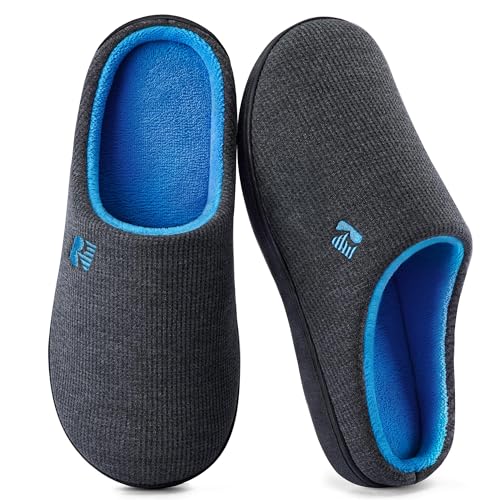
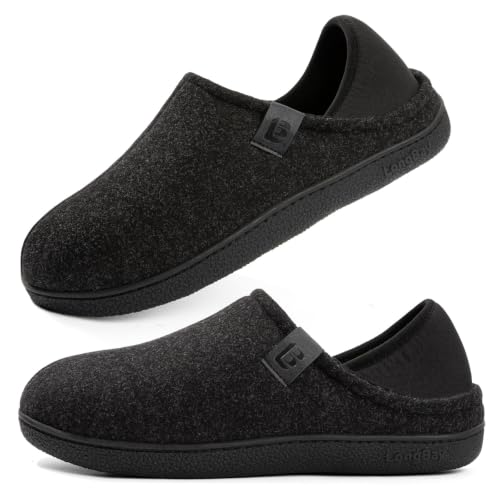
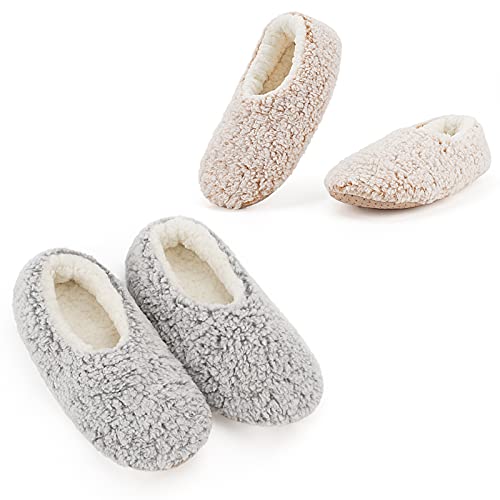
Our Top Picks



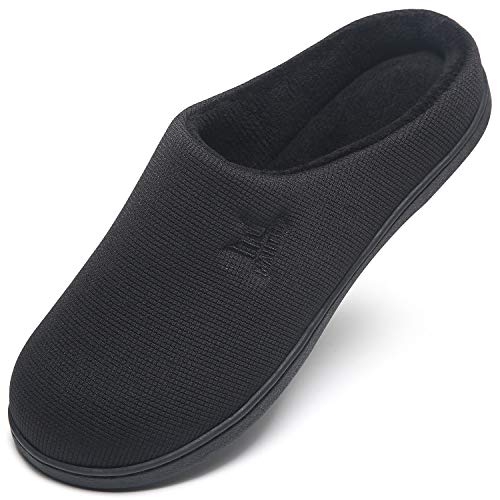
What's inside
- Why stairs punish ordinary house footwear
- Outsoles: compounds, tread patterns and grip
- Heel retention: straps, cups and collars
- Fit: heel slip, socks and sizing
- Sole structure: torsional stiffness, shanks and thickness
- Toe shape, protection and the weight of the shoe
- Matching slippers to real stair surfaces
- Care, wear and knowing when to replace a pair
- Check prices on Amazon
- When slippers are not the answer
As an Amazon Associate I earn from qualifying purchases. This post may contain affiliate links at no extra cost to you.
A staircase asks more of house footwear than any flat hallway ever will. On level ground a loose slipper is mostly an annoyance, shuffling a little with each stride and settling again before the next one begins. On steps the margin disappears. Part of the foot hangs over an edge, the contact patch shrinks, body weight shifts forward during descent, and a heel that lifts at the wrong moment can turn a routine trip for laundry or tea into a scramble for the handrail. Choosing slippers for stairs is therefore less about softness underfoot and more about control: how the outsole meets the tread, how firmly the heel stays seated, and how predictably the sole behaves when only its front half is loaded.
This guide works through those mechanics in practical terms, without medical promises and without treating any slipper as a guarantee. No footwear can make a steep, dim, cluttered staircase safe on its own. What a well-chosen pair can do is remove several avoidable sources of instability: a slick or polished sole, a backless shape that migrates under the foot, a squishy platform that rolls at a step edge, and a fit so roomy that the toes must claw to keep the shoe attached. Each section below isolates one of those variables, explains how it behaves on wood, carpet, painted treads and damp surfaces, and describes what to look for in product descriptions, photographs and construction details before buying.
Readers who live in older houses deserve a particular note. Cottage stairs are often narrower, steeper and less uniform than modern flights, with tread depths that barely accommodate a full foot and riser heights that vary by a fraction that the body notices even when the eye does not. Worn carpet runners, glossy varnish and rounded nosings compound the challenge. The recommendations here assume that reality rather than a perfect showroom staircase, and they favour secure, moderate designs over plush novelty shapes that look inviting beside a bed but behave badly halfway down a flight carrying a basket.
Why stairs punish ordinary house footwear
Walking downstairs reverses much of what the body expects from level gait. Instead of pushing off and rolling forward over a planted foot, the descending leg reaches, the heel or midfoot seeks the tread below, and the supporting knee flexes to lower the body in a controlled drop. During that lowering phase the standing foot carries nearly all the load while its partner searches for the next surface. If the standing slipper rotates, slides or separates from the heel, there is no second foot already grounded to absorb the error. That single-support interval, repeated on every step, is why descent deserves more attention than ascent in any discussion of indoor footwear.
How the heel meets the nosing first
On many descents the rear edge of the foot arrives close to the nosing, the rounded or square front lip of the tread. Contact may begin at the heel and slide forward slightly as weight transfers, or the forefoot may land first on a shallow tread and the heel may never fully settle before the next step begins. Either pattern concentrates force on a small area near an edge rather than spreading it across a full footprint. A sole that is rounded up at the back, heavily bevelled or worn smooth at the heel loses precious contact exactly where the first touch happens. Flat, full-length outsoles with a defined heel breast keep more rubber engaged during that initial placement.
The nosing itself matters as much as the shoe. Metal strips, worn wood lips and thick carpet wrapping all change the effective edge. A slipper heel can catch on a raised strip if its rear profile is blocky, or skate across a polished lip if its compound is hard and smooth. Looking at your own staircase before shopping is worthwhile: note whether nosings project, whether a runner ends before the edge, and whether the first contact zone on each tread looks shiny from years of use. Those observations point toward the outsole texture and heel shape that will cooperate with the steps you actually climb several times a day.
Why a staircase is the riskiest surface in the home
Flat floors forgive small slides because the foot can recover within the same stride and the body stays roughly above its base of support. A tread offers no such room. The surface ends abruptly, the drop to the next level sits directly beyond it, and momentum during descent already points forward and downward. Add carried objects that block the view of the feet, socks that reduce friction inside the slipper, or a pet waiting on a middle step, and the number of simultaneous demands rises quickly. This is not a reason for alarm; it is a reason to treat stair footwear as equipment with a job, separate from the softest pair kept for sitting with feet up in the evening.
Height amplifies modest defects. A two-millimetre heel slip on a kitchen floor is invisible. The same movement on a tread can shift the sole backward so its front edge no longer reaches as far as the brain assumed, shortening the landing zone for the next placement. Repeated small shifts also erode confidence, and hesitant gait creates its own problems: shortened steps, sideways descent, and gripping with the toes that fatigues the forefoot. Secure footwear supports a normal, rhythmic pattern, one step after another, with the handrail used for balance rather than as a rescue device after something has already gone wrong.
Children, guests and anyone carrying a child introduce another layer. Adults adjust their gait when holding extra weight, often leaning back slightly and placing the foot more blindly because the load hides the treads. A slipper that needs constant small corrections becomes a liability in that posture. Likewise, a pair bought mainly for warmth in winter may be worn with thick socks that change its internal volume, while the same pair in summer sits loose over bare feet. Seasonal fit changes, discussed later in this guide, are part of why a model that felt secure in January deserves a fresh assessment when worn differently in July.
Outsoles: compounds, tread patterns and grip
The outsole is the only part of the slipper that negotiates directly with the step, so its material and pattern deserve first scrutiny. Marketing language tends to emphasise cushioning, yet for stair use the thin layer at the very bottom matters more than the plush layers above it. Three broad families dominate the market: natural or synthetic rubber, foam compounds such as EVA, and soft textile bottoms made from felt, suede or fabric. Their behaviour diverges sharply on smooth indoor surfaces, and the differences widen as soles age, collect dust or encounter moisture tracked in from a garden door.
Rubber, EVA and textile bottoms compared
Rubber outsoles, especially softer compounds with fine surface texture, generally provide the most reliable purchase on sealed wood, laminate, tile and painted treads. The material deforms slightly under load, increasing real contact with microscopic surface irregularities. A thin rubber layer bonded over a foam midsole offers a useful compromise, preserving some cushioning while keeping a grippy skin against the step. Buyers should look for descriptions that name rubber explicitly for the outsole rather than for decorative sidewalls, and for underside photographs showing continuous coverage at heel and forefoot instead of small rubber pods surrounded by exposed foam.
EVA foam soles are light, inexpensive and comfortable for standing, but their stair behaviour depends heavily on moulded texture. Fresh EVA with deep, sharp-edged patterning can hold adequately on carpet and dry wood, yet the material tends to polish with use, its edges rounding until the tread blocks become smooth domes. Foam also compresses unevenly at a step edge, which can feel vague during descent. A pair intended mainly for stairs should therefore treat EVA as acceptable only when the pattern is substantial, the foam is relatively firm, and the owner is willing to inspect and replace it sooner than a rubber-soled equivalent.
Felt, suede and fabric bottoms sit at the other end of the scale. They are quiet and kind to delicate floors, and on carpet they can feel perfectly stable, but on varnished wood or painted treads they offer little resistance to sliding, particularly once household dust coats the fibres. Suede can develop a nap that grips dry surfaces moderately when new, then glazes into a slick finish. For a home whose stairs are hard-surfaced, textile bottoms are a poor match regardless of how luxurious the upper feels. If quietness matters, a soft rubber compound achieves much of it without surrendering traction.
Siping, lugs and the geometry of grip
Tread pattern translates compound into performance. Siping refers to thin slits cut into tread blocks, originally developed for tyres and now common on boat shoes and quality indoor soles. Each slit opens under pressure, creating extra biting edges and allowing the block to flex so more of its surface stays in contact on a hard tread. On stairs, siped rubber is especially useful at the heel strike zone and beneath the ball of the foot, the two areas that carry the load during descent. Fine siping also helps channel a thin film of water aside on a damp tread, preserving patches of direct rubber contact.
Larger lugs and herringbone or chevron patterns serve a different purpose. On carpeted steps, modest lugs and directional grooves engage the pile and resist the forward shear that occurs as weight transfers down. On smooth wood, however, very deep or widely spaced lugs can reduce the amount of rubber actually touching the surface, leaving the foot balanced on a few raised islands. The sweet spot for mixed indoor stairs is usually a moderately textured pattern: many contact points, grooves in more than one direction so grip does not depend on foot angle, and no large smooth medallion in the middle of the heel or forefoot where brands sometimes mould a logo into the worst possible place.
Edge design deserves a look as well. A sole whose pattern stops well short of its perimeter leaves a smooth border that is precisely the part contacting a nosing when the foot overhangs. Better designs carry texture close to the edges and keep the side profile fairly vertical at the heel and toe, rather than tapering dramatically. Photographs taken straight from below are the most revealing product images for stair suitability, more informative than lifestyle pictures on rugs. If a listing hides the underside entirely, that absence is itself a signal about where the maker expected attention to fall.
Wet grip separates adequate soles from good ones. A tread just inside an exterior door, a bathroom landing or a kitchen stair can carry moisture even in a tidy house. Rubber with siping and multiple drainage paths handles thin water films best; smooth foam and felt deteriorate fastest when damp, felt because wet fibres mat down, foam because water fills its surface texture and reduces friction. Anyone whose route downstairs ends at a frequently wet floor should weight wet behaviour heavily and should also keep a mat at the stair base, since no indoor sole performs at its best while still wet from the previous surface.
For readers comparing wet-room footwear with stair footwear, the priorities overlap in outsole texture but diverge in upper design and drainage, and a closer look at tread choices for slick tile can sharpen what to demand from rubber here.
best anti slip bathroom slippers
Grip on dry wood, painted treads and carpet
Dry unfinished or matte-finished wood is relatively cooperative: its grain provides micro-texture and most rubber compounds hold it confidently. Varnished and painted treads are less forgiving because the coating fills the grain and presents a smoother, sometimes slightly soft surface that dust can turn treacherous. On such stairs, soft rubber and fine patterning outperform hard, glossy soles, and keeping both tread and sole free of loose dust matters as much as the original purchase. Painted steps in older cottages may also be slightly crowned or uneven, rewarding a sole flexible enough front-to-back to follow the surface while remaining resistant to twisting, a distinction explored in the structure section below.
Carpet changes the problem from friction to engagement and stability. A very smooth sole can aquaplane across deep pile in a small way, sliding on the fibres rather than through them, while an aggressively lugged sole can feel grabby and catch during the swing phase. Low-pile carpet and bound runners suit almost any textured rubber sole. Deep pile favours moderate tread and a firmer platform so the foot does not tilt as the pile compresses unevenly near the nosing, where carpet often wraps and creates a rounded, less defined edge. On carpeted stairs the heel-retention questions in the next section usually matter more than raw outsole friction.
Heel retention: straps, cups and collars
A slipper can have an excellent outsole and still be a poor stair shoe if the foot moves inside it. Heel retention describes everything that keeps the rear of the foot centred over the rear of the sole: the depth and shape of the heel cup, the height and stiffness of the back, the presence of a strap, and the way the upper wraps the midfoot so the whole assembly travels as one unit. During descent the heel tends to lift and shift with each lowering step, and any gap at the back invites the sole to lag behind, twist sideways or slip forward under the arch. Secure retention is therefore a safety feature in the plainest mechanical sense, not a matter of preference for a snug feel.
Back straps and deep heel cups
An adjustable back strap is the most direct solution. It closes the system, preventing the foot from sliding out backward and reducing the need to grip with the toes. Straps work best when they sit low enough to cross behind the heel bone rather than riding up toward the Achilles, when their adjustment range accommodates both bare feet and socks, and when the buckle or hook-and-loop closure lies flat enough not to catch on carpet edges or bedding. Elasticated straps offer convenience and some give during the stride, though elastic weakens with age and should be checked for the same stretching that loosens any textile component over months of daily use.
A deep, moulded heel cup achieves retention without a strap by cradling the calcaneus in a shaped pocket. Depth matters: a shallow dish with a low rear rim looks structured in photographs yet allows the heel to ride up and out under the repeated lifting of stair gait. A useful cup combines a firm rear wall, sides that rise around the heel, and interior padding that compresses enough for comfort without collapsing into a flat bed after a few weeks. Footbeds with a defined cup also centre the heel over the thickest part of the cushioning, which keeps the sole’s balance point where its designer intended instead of letting the foot drift toward an edge.
Slip-on mules and backless scuffs sit at the weak end of this spectrum. They are easy to step into for a short trip across one room, and many people keep them for exactly that convenience, but the open back provides nothing to resist the backward relative movement that stair descent produces. Wearers compensate by curling the toes or shortening their stride, strategies that grow unreliable when hands are full or attention is elsewhere. For regular stair use, a closed back or a strap converts the slipper from something balanced on the foot into something attached to it, and that distinction outweighs small differences in cushioning or warmth.
Shoppers who want that closed, centred feeling as their starting point, rather than as an afterthought added to a mule shape, will find the construction details in a dedicated closed-back roundup worth comparing against the strap designs above.
best closed toe and heel slippers
Uppers that hold, and materials that stretch
Retention also depends on the midfoot. An upper that wraps and can be adjusted, through laces, a strap across the instep or a snug elastic panel, stops the foot sliding forward during descent, when gravity and momentum encourage exactly that movement. Forward slide is easy to overlook because the toes eventually stop it, but by then the heel has left its cup and the sole’s front has extended beyond the toes, changing both balance and the effective length of the shoe near a nosing. A secure instep keeps the whole foot registered in the right position step after step.
Materials change over time. Knitted uppers and soft fleece conform beautifully in the first week and then relax, sometimes by enough to turn a firm fit into a sloppy one. Leather and structured woven fabrics stretch less and more slowly, while memory-foam insoles compress and deepen the interior, effectively increasing volume around the foot. None of this makes soft materials unsuitable; it means the initial fit should be genuinely snug rather than merely adequate, and that a pair relying on plush compression for its fit will loosen twice over as both upper and footbed settle. Checking retention monthly, by walking a flight deliberately and noticing any new movement, catches this drift before it becomes a habit the gait has quietly absorbed.
Collars and cuffs contribute in a supporting role. A padded ankle collar on a boot-style slipper limits side-to-side heel wander and adds warmth, though height alone does not equal retention if the interior is wide and the foot can still piston up and down inside it. What matters is contact and shape around the heel itself. Conversely, a low shoe with a well-formed cup and an instep strap can outperform a tall, baggy boot. Photographs of the interior are rare in listings, so descriptions of footbed contour, rear height and closure type carry unusual weight for this category and deserve careful reading.
Fit: heel slip, socks and sizing
Fit is where stair safety is won or lost quietly. Heel slip, the vertical or backward movement of the heel relative to the shoe during a stride, is normal in tiny amounts for many types of footwear, but in slippers on stairs it deserves a low tolerance. Each lift-and-reseat cycle is a moment when the sole is not fully registered under the foot. If that moment coincides with weight transfer on a tread, the landing that follows can arrive with the sole angled, displaced or partly folded at the back. Understanding how slip develops, and how socks and sizing feed it, helps buyers choose a pair that stays boringly consistent from the first step to the last.
How heel slip turns into a trip mechanism
The sequence is mechanical. As the body lowers onto a tread, the heel loads, then unloads as the other foot reaches down. A loose heel rises inside the slipper, and friction from socks or a rough insole may drag the slipper partly with it or leave it behind, depending on surfaces. When the heel drops again it may land off-centre, on the rim of the cup or on a folded section of upper. The foot then stands on a slightly tilted, shifted platform for the next lowering phase. Most of the time the error is small and corrected unconsciously, but the correction itself consumes attention and balance that a narrow tread may not spare, especially when the wearer is tired, hurried or carrying something awkward.
Slip also lengthens the shoe functionally. A foot that has slid backward leaves empty space at the toes while the heel overhangs the rear, so the sole extends behind the foot where it can catch on the riser of the step above during ascent, or strike a nosing early during descent. A foot slid forward does the opposite, pushing toes toward the front edge and leaving the heel cup empty. Both states defeat the outsole geometry discussed earlier, because tread zones no longer sit under the parts of the foot they were shaped for. Retention features reduce the range of this movement; correct sizing reduces its starting point.
Thick socks, bare feet and seasonal volume
Socks change fit in two directions at once. A thick sock fills volume and can make a roomy slipper feel secure, while its surface may be smoother than skin and allow more sliding against a synthetic lining. A thin sock adds little volume but can reduce the clammy grip that bare feet develop against some footbeds. The practical rule is to judge fit in the configuration worn most often on stairs, typically the evening or morning routine when stairs are used repeatedly. If a pair only feels secure over the thickest socks in the drawer, it will spend the rest of the year loose, and a strap with genuine adjustment range becomes more valuable than a fixed shape that assumes one sock thickness.
Barefoot wear exposes another detail: insole texture. A slightly textured or suede-like footbed surface helps the heel stay planted, whereas a glossy synthetic lining lets a warm foot glide. Some slippers use removable insoles; replacing a worn, smoothed insole can restore part of the original fit without replacing the whole shoe, provided the outsole and upper remain sound. Households that share a hallway pair between different wearers should expect accelerated loosening and inconsistent fit for everyone, a false economy on stairs where the same pair is expected to behave identically for different feet.
Half sizes, wide fittings and the thumb rule problem
Sizing advice borrowed from outdoor shoes misleads here. A generous thumb of space at the toes, sensible in a hiking boot for long descents outdoors, leaves too much room inside a house slipper whose closure cannot be laced firmly. For stair use the toes should sit close to the front without pressing it, and the heel should seat fully in its cup with the instep closure at a mid-range setting, leaving adjustment in both directions. When between sizes in a closed-back design with a strap, the smaller size often settles better once the footbed compresses, whereas in a rigid, structured model the larger size with an added insole may be the safer route. Brand-specific size notes and return policies matter because indoor footwear sizing varies widely.
Wide fittings deserve respect rather than improvisation. Squeezing a wide foot into a standard slipper distorts the upper, pushes the foot toward the lateral edge and can force the heel off-centre, while buying a standard model two sizes long to gain width creates the forward-slide problems described above. A true wide option preserves the intended geometry: heel centred, tread zones aligned, upper closing where it should. Feet that swell during the day add a final wrinkle; a pair fitted in the morning may feel tight by evening and vice versa, so an adjustable closure earns its keep again by accommodating ordinary daily change without tools or replacement insoles.
Sole structure: torsional stiffness, shanks and thickness
Beneath the outsole skin sits the structure that decides how the slipper behaves at an edge. Three properties dominate: torsional stiffness, meaning resistance to twisting along its length; longitudinal flex, meaning how readily it bends at the forefoot; and thickness, which sets both cushioning and the wearer’s sense of the tread below. Good stair slippers occupy a middle ground on each. They flex where the foot flexes, resist twisting that would let the heel and forefoot point in different directions, and keep the foot close enough to the step for small surface changes to register through the sole.
Twist, shanks and edge behaviour
Torsional weakness shows itself when the front of the foot lands on a tread while the heel is still angled from the previous step. A sole that twists easily lets the forefoot flatten onto the surface while the heel remains rotated, storing a small spring that releases as weight transfers, sometimes with a sideways nudge. A shank, a stiffening element embedded in the midsole and common in structured slippers and house shoes, limits that twist and also prevents the sole from draping over a nosing like cloth. Draping sounds comfortable but it moves the contact patch unpredictably and can let the middle of the sole sag into the gap at the edge of a shallow tread.
At the nosing itself, stiffness distribution matters. A sole that is uniformly board-stiff forces the foot to balance on a small section when placed near an edge, because the rest cannot conform. A sole that is uniformly soft folds around the edge, which feels secure for a moment but offers little platform for the lowering phase and can roll outward if the placement is slightly off. Better constructions pair a stable heel and midfoot with a forefoot that bends at the natural joint line. Product descriptions mentioning a shank, a firm midsole or a supportive footbed are pointing at this architecture, though only handling the shoe, twisting it gently by hand and bending it at the ball reveals how the layers actually behave.
Thickness, softness and feeling the step
Thick, very soft soles create a particular stair problem: they compress more on one side than the other when the foot lands near an edge, tilting the platform at the moment stability is needed. Tall foam also raises the foot, lengthening the lever through which a small ankle movement acts, and it muffles the sensory information that tells the wearer where the tread ends. Proprioception through the sole is a real input to balance, and slippers that preserve some of it, with moderate thickness and a firm-ish base layer, help the foot make the small, early corrections that prevent larger ones. This is one reason minimalist-feeling house shoes often inspire more confidence on stairs than cloud-like platforms, despite offering less cushioning for standing on hard kitchen floors.
Balance involves trade-offs that depend on the wearer and the house. Someone who stands for long periods while cooking may accept a thicker sole for flat-floor comfort and choose a model whose thickness comes from dense, stable foam rather than airy softness. A home with thin treads and many flights argues the other way, toward lower, firmer designs. What should be avoided at either extreme is a sole whose softness varies unpredictably, with a heel that collapses more than the forefoot, producing a backward tilt on every landing. Pressing a thumb firmly into heel and forefoot in a shop, or comparing compression in the first days at home during a returns window, gives a rough sense of that consistency.
Weight interacts with structure too. Moderate weight, concentrated low in the sole rather than in a bulky upper, tends to track the foot most faithfully during each swing between treads.
Toe shape, protection and the weight of the shoe
The front of the slipper works in confined space. Treads are shallow, risers sit close behind the swinging foot, and the toes approach the edge on nearly every descent. Whether the toe is open or closed, how much structure surrounds it, and how much mass the swing leg must place accurately all influence both comfort and the chance of a painful, balance-breaking stub against a riser or nosing. These details rarely headline a product listing, yet on a narrow cottage flight they are encountered physically, step after step, in a way that flat-floor wear never reveals.
Closed toes and the riser problem
A closed toe protects against the most common minor stair injury to the foot itself: catching bare toes on a riser during ascent or knocking them into a nosing when a step is misjudged in low light. A structured toe box, with enough height that the upper does not press on the nails and enough firmness to deflect a glancing blow, turns a potential flinch into a non-event. That flinch matters beyond the toe. A sudden pain response shifts weight abruptly, and on stairs an abrupt shift is exactly what the rest of the system is trying to avoid. Closed designs also keep the foot from sliding forward and protruding beyond the sole, preserving the alignment discussed in the fit section.
Open-toe slippers have genuine virtues in warm weather and for wearers who dislike enclosed feet, but on stairs they expose the toes, allow forward migration, and often pair with backless shapes that compound the retention problem. If an open design is chosen for summer, it should at least offer a back strap, a contoured footbed that discourages forward slide, and a sole that extends slightly beyond the toes so first contact with an obstacle is rubber rather than skin. Seasonal rotation between a closed winter pair and a secured open summer pair is a reasonable pattern for households that use stairs constantly.
Toe spring and front profile affect clearance as well. A sole that curves up strongly at the front can help the swing foot clear a nosing, reducing scuffs and catches, but excessive upward curve shortens the flat contact area when the forefoot lands near an edge. A modest rise balances clearance against contact. Similarly, a very square, protruding toe may catch on carpeted risers where a gently tapered shape slides past. Looking at the slipper in profile, and imagining it moving through the tight arc between two treads, is a surprisingly effective way to judge these small geometries before purchase.
For colder months, the taller silhouettes that combine a closed toe with insulation and a higher collar bring their own clearance and weight questions, which a focused look at boot-style designs can help untangle before choosing between height and agility.
Weight, swing and rhythm
Every step on stairs is a placement task performed by a swinging leg that cannot see its target clearly when the body or a carried load blocks the view. Heavier footwear demands more muscular effort to position and is harder to correct mid-swing; very light footwear offers little momentum and can be deflected by brushing a riser or catching a carpet edge. The practical consequence is rhythm. A pair whose weight feels unremarkable during a deliberate walk down a flight, neither dragging nor floating, supports the steady cadence that keeps balance organised. Novelty slippers shaped as animals or oversized plush objects fail this criterion in several directions at once: extra length beyond the toes, uneven weight, soft structure and smooth soles, a combination best kept far from any flight.
Matching slippers to real stair surfaces
Houses rarely present a single surface. A typical route might cross a carpeted landing, descend wooden treads with a runner, and finish on a tiled hall floor, asking one pair of slippers to behave well on all three within a dozen steps. Choosing for the most demanding surface on the route, usually the smoothest or wettest one, is a sound principle, provided the choice does not create problems elsewhere, such as an aggressive tread that catches on the runner. This section walks through the common surfaces and treatments found in real homes and what each asks of the shoe.
Runners, bare varnish and anti-slip treatments
Carpet runners narrow the usable tread and introduce edges of their own. The transition from bare wood margin to raised carpet can tilt a foot that lands half on each, and a wide slipper may straddle that boundary more often than a narrower one. A sole with moderate tread and a stable midfoot handles the transition best, neither skating on the wooden margin nor tripping on the carpet lip. Runners that are themselves loose or worn into ripples are a hazard no footwear can offset; securing or replacing the runner belongs on the same list as choosing the slippers, and a handrail-side habit of stepping fully onto the carpeted centre keeps placements consistent.
Bare varnished treads reward the soft rubber and fine siping described earlier and punish dust. A thin layer of household dust on varnish behaves like ball bearings under a hard sole, which is why a staircase can feel treacherous in socks or smooth slippers even when it looks clean. Regular sweeping of treads and wiping of soles restores much of the grip that the materials inherently offer. Painted stairs behave similarly, with the added note that some paints remain slightly tacky in warm weather and squeak or grab under rubber, a harmless quirk that can startle on a quiet night landing but does not indicate a problem with either surface or shoe.
Adhesive anti-slip strips and textured tread covers change the interface again. Gritty strips provide high friction in narrow bands; a slipper sole landing partly on a strip and partly on smooth wood experiences two grip levels under one foot, which a firmer sole bridges more predictably than a very soft one. Rubber strips and ribbed covers are gentler and suit bare feet in the household as well. Whatever treatment is fitted, its edges must lie flat, because a curling strip catches toes and sole fronts during ascent. Slippers and stair treatments work as a system, and inspecting both together, ideally in the evening light in which the stairs are most often used, reveals interactions that separate checklists miss.
Landings, thresholds and the steps beyond the flight
The first and last steps deserve disproportionate attention. The top step often involves a turn from a landing, so the foot arrives at an angle and the slipper must grip while rotated, favouring tread patterns that work in multiple directions. The bottom step transitions to a floor that may be smoother, wetter or covered by a loose mat. A pair chosen purely for carpeted treads may slide on the hall tile at the exact moment the wearer relaxes, believing the descent finished. Extending the assessment to the full route, including any single step down into a kitchen, garden room or garage, prevents that mismatch and sometimes argues for a more versatile sole than the staircase alone would demand.
That versatility is also why many households end up wanting one dependable pair that can continue past the back door onto a dry path or step, rather than changing shoes for a thirty-second errand, and the trade-offs of soles built for both worlds are worth weighing carefully.
Outdoor excursions change the maintenance equation, because grit picked up outside can scratch floors and, more relevantly here, lodge in tread grooves and reduce grip on the next descent until it is brushed out. A pair that regularly goes outside should have its soles checked and cleaned at the door as a habit, and a household that cannot sustain that habit may do better keeping a dedicated indoor pair by the stairs. The distinction is practical rather than precious: clean, intact tread is a functional requirement for the grip figures a sole can deliver, not an aesthetic preference.
Care, wear and knowing when to replace a pair
Slippers degrade gradually, and because the change is slow, wearers adapt without noticing that the shoe under them is no longer the shoe they bought. Outsole texture rounds off, rubber surfaces glaze, foam compresses into permanent thin spots, straps stretch and linings smooth out. Each change is small; together they can convert a secure pair into a vague one over a season or two of daily stair use. A simple inspection routine, performed every month or two and after any noticeable slide, keeps the assessment honest and gives clear signals for cleaning, adjustment or replacement.
Glazing, dust and cleaning the sole
Glazing is the shiny, hardened surface that develops on rubber and foam outsoles through heat, pressure and embedded grime. A glazed sole looks clean but grips poorly, especially on smooth wood, because its fine texture has been sealed. Washing the outsole with warm water, a little household soap and a stiff brush restores surprising amounts of traction by removing the film of oils and dust and reopening the surface texture. The grooves deserve particular attention: packed lint and pet hair fill siping and tread channels in carpeted homes, effectively converting a patterned sole into a smooth one from underneath, invisible until the shoe is turned over.
Uppers and footbeds need gentler handling. Many slippers tolerate a cool machine wash, but heat can warp foam, loosen bonded soles and shrink textiles unevenly, changing fit in ways that matter on stairs. Air drying away from radiators preserves shape. After any wash, the first stair descent should be deliberate, confirming that the restored sole grips as expected and that a cleaned, slightly shrunken upper has not altered heel retention. Insoles that have compressed into a hard, shiny bed can sometimes be replaced individually, extending the life of a pair whose outsole and upper remain sound, though a replacement insole of different thickness will change internal volume and should be judged like a sizing change.
Wear patterns that announce retirement
Turn the pair over and read the soles. A heel worn smooth on its outer rear corner, forefoot tread worn flat in the centre, or one shoe visibly more worn than the other all indicate that grip and alignment have drifted from their original state. Cracks across flex points, separation where outsole meets midsole, and a midsole that stays compressed in a thumbprint rather than rebounding are structural warnings rather than cosmetic ones. On stairs, retirement should come earlier than for a pair used only on flat floors: when the heel zone has lost its texture, the shoe has lost the very surface that makes first contact on descent, and no amount of careful walking fully compensates for that absence.
Retention wear is equally decisive. A strap whose adjustment no longer holds its setting, elastic that stays stretched after a night’s rest, a heel cup whose rear wall has folded or softened, and an upper that the foot can twist inside without resistance all mark the end of a pair’s reliable service for stair use, even if it remains pleasant for sitting. Keeping a retired pair for the sofa and a sound pair for moving around the house is a sensible division, provided the two are not confused in the dark at the top of a flight; storing the stair pair in a consistent place removes that ambiguity.
Recording a rough purchase date helps households with several wearers judge age honestly, since a pair worn by two people accumulates stair cycles twice as fast. There is no universal lifespan in months, because surfaces, body weight and daily flight counts vary so widely, but any pair approaching a second winter of heavy use deserves the full inspection above rather than the benefit of the doubt. Replacement is inexpensive insurance compared with the disruption of a fall on the stairs, and framing it as routine maintenance, like changing a smoke-alarm battery, makes the decision easier to take promptly.
Check prices on Amazon
Live listings for the shortlist in this guide are pulled from Amazon below, so prices and availability are always current at the moment you look.


When slippers are not the answer
Honest guidance ends by acknowledging limits. Slippers are light house footwear with inherent compromises, and some situations call for a different tool: a laced shoe with a firm sole, a bare handrail used properly, better lighting, or simply slowing down and making two trips instead of one overloaded descent. Recognising those situations is part of using slippers well, because confidence placed in footwear beyond what it can deliver is itself a risk factor on a staircase. The points below are practical household measures, not medical advice, and they complement rather than replace a sound pair chosen with the criteria in this guide.
Rails, light and clear treads
A handrail only helps if a hand is on it, or close enough to grab without reaching across the body. Descending with one hand lightly following the rail costs nothing in speed and converts many would-be falls into recoverable stumbles, because the arm can arrest a slide that the feet alone could not. Rails should be continuous where possible, firmly fixed, and graspable in profile rather than flat decorative boards. Where a flight has a rail on one side only, carrying loads in the opposite hand keeps the rail hand free, a small habit with outsized value on narrow stairs.
Lighting shapes foot placement more than most people realise. A single ceiling light at the top of a flight can leave lower treads in the shadow of the wearer’s own body, flattening the visual contrast that distinguishes one nosing from the next. Low-level lighting along the skirting, a lit landing, or simply the discipline of switching on a light for night descents restores that contrast. Glasses wearers should note that looking down through the reading segment of varifocal lenses distorts step edges; on stairs, looking through the distance portion and tilting the head rather than only the eyes gives a truer picture of where each tread begins.
Clear treads are the cheapest intervention of all. Shoes, post, toys, books and sleeping cats on steps force the awkward, off-line placements that defeat good footwear, because a foot landing half on an object has neither grip nor a level platform. A household rule that stairs are never storage, enforced with a basket at the bottom that travels up when someone is going anyway, removes the hazard at its source. Loose rugs at the top or bottom of a flight deserve the same scrutiny, since a mat that slides on a landing undermines the first and last steps where direction changes concentrate.
Situations that call for a real shoe
Some loads and tasks exceed what any slipper should be asked to handle. Carrying heavy, bulky or fragile items that block the view of the feet, moving furniture, or making repeated trips with tools during home repairs all justify changing into laced shoes with firm soles and full heel counters before using the stairs. The two minutes spent changing are repaid in ankle support, retention that no strap matches, and outsoles designed for varied surfaces. The same applies after a drink in the evening, during illness or dizziness, and on any occasion when balance feels off for reasons unrelated to footwear; those are moments for shoes, a free hand on the rail, and an unhurried pace.
Visitors and overnight guests form a final, often overlooked group. A guest offered oversized borrowed slippers, or padding down unfamiliar stairs in socks at night, faces the worst combination of loose fit and unknown geometry. Hosts in stair-heavy houses do guests a genuine kindness with a clear path, a lit landing, and either well-fitting spare house shoes in a couple of sizes or the simple suggestion that their own shoes are welcome indoors during the visit. It is hospitality in its most practical form, and it closes the subject where it began: on stairs, what surrounds the foot matters, and a little deliberate attention to that fact makes every flight in the house a more ordinary, unremarkable journey.
Disclosure: This article is based on published product descriptions, construction details and general footwear guidance rather than on any promise of medical benefit, and it aims to help readers compare designs for their own homes and routines. As an Amazon Associate we earn from qualifying purchases.
Choose the pair that lets you forget your feet entirely on the way down, hand near the rail and mind already on the kettle, and let every other detail in this guide serve that quiet, ordinary confidence.