What's inside
- Where to buy these six swim towels
- Quick Picks
- How these picks were chosen
- Side-by-side: the six towels at a glance
- How do you choose the right swim towel for race day?
- Chamois craft: getting the most from a shammy
- The rest of the house, briefly
- A meet day, hour by hour, through your towels
- Training towels and racing towels are different purchases
- Washing, chlorine and the long life of a swim towel
- Open water, triathlon and the travelling swimmer
- Buying for a child, a teen or a whole relay squad
- Common mistakes when buying swim towels
- Final recommendation
- Frequently asked questions
As an Amazon Associate I earn from qualifying purchases. This post may contain affiliate links at no extra cost to you.
As an Amazon Associate, cottageverdict.com earns from qualifying purchases.
Anyone hunting for the best swim towels for competition swimming quickly discovers that the pool deck runs on two completely different kinds of cloth. One kind is the chamois, often called a shammy: a small, flat, thirsty sheet that pulls water off skin in a few passes, gets wrung out, and goes straight back to work. The other kind is a full-size microfiber towel, big enough to wrap around shoulders between races, that happens to dry far faster than the bulky cotton towels most of us grew up hauling to the pool. Mixing those two families up is the single most common buying mistake in this category, so this guide keeps them clearly separated from the first page to the last.
Competition days explain why both families exist. A swimmer may climb out of the water a dozen times in one session: warm-up, a first event, a cool-down length, another event, a relay leg. Staying warm and reasonably dry between those climbs matters, and a towel that stays soggy after the first use becomes dead weight in a kit bag. Chamois sheets answer that problem with speed and tiny packed size. Microfiber towels answer it with coverage. Neither answer is wrong; they simply solve different halves of the same long morning.
Honesty about labels matters here too. Of the six products gathered below, only two listings actually use the words Competitive Swimming: the Flow Microfiber Quick Dry Swim Towel and the Flow hooded towel. The remaining four earn their place because their listings describe swimming, diving, triathlons and other water sports, and because their formats match what racers genuinely carry. Four of the six come from one maker, Flow, yet they are four distinct products — a chamois, a hydro sport microfiber towel, a competitive microfiber towel and a hooded microfiber towel — and the reviews treat them that way rather than as near-identical variants.
Where to buy these six swim towels
Deck space at a meet is measured in inches, so begin with the Flow Swim Chamois in blue, the classic wring-and-reuse sheet for swimmers who want water gone in seconds and a towel that folds into almost nothing afterward.
Pairs suit training partners and siblings, which is where the SmoothNovelty two pack steps in, offering two small chamois towels in blue and aqua for households that would rather not share one damp sheet.
Clubs and big families think in fours, and the Tisancy four pack answers with four larger chamois sheets in a neutral tone, sized generously enough to handle a full torso pass before a wring.
Coverage seekers should look at the Flow Hydro Sport microfiber towel in navy, a large format built for swimming, pool sessions and triathlon days when a wrap matters more than a wipe.
Racers who want the competition wording on the label itself will land on the Flow Microfiber Quick Dry Swim Towel, the listing that names competitive swimming outright and offers medium and large options.
Cold morning warm-ups make the case for the Flow hooded towel in gray, a microfiber design with a hood that keeps heat around the head and shoulders while a swimmer waits on the blocks.
Quick Picks
| Pick | Best for | Standout detail from the listing |
|---|---|---|
| Flow Swim Chamois Quick Dry Towel Blue | Fast deck-side drying | Chamois format for swimming, diving and triathlons |
| SmoothNovelty Swim Chamois Towel 2 Pack 13×17 | Two swimmers sharing a bag | Two small chamois towels, blue and aqua |
| Tisancy Swim Chamois Towels 4 Pack 26×17 | Clubs and group training | Four larger chamois sheets in a neutral shade |
| Flow Hydro Sport Microfiber Swim Towel Navy Large | Full wrap coverage | Large microfiber towel for swim, pool and triathlon |
| Flow Microfiber Swim Towel Competitive Navy Large | Race-day regulars | Listing names competitive swimming directly |
| Flow Hooded Quick Dry Swim Towel Gray | Chilly early sessions | Microfiber towel with an attached hood |
How these picks were chosen
Selection started with format, because format decides nearly everything a swim towel can and cannot do. Chamois products were judged as chamois: small absorbent sheets meant to be used wet, wrung out and used again within the same session. Microfiber products were judged as towels in the ordinary sense: cloth you wrap, drape and sit on. Any product whose listing blurred that line without clarifying its size was set aside, since a buyer expecting a bath-size towel and receiving a hand-size shammy has been failed by the guide, not by the product.
Stated dimensions carried real weight. The SmoothNovelty pack lists thirteen by seventeen inches per towel, and the Tisancy sheets list twenty-six by seventeen, so both could be placed honestly on the small end of the spectrum. The two large Flow microfiber towels list sixty by thirty inches, full body coverage by any reasonable measure. Where a listing gave no dimensions at all, the review below says so plainly instead of guessing, and the pick had to justify itself through format and stated uses instead.
Pack count formed the third filter. Solo racers, pairs and whole squads shop differently, and a useful shortlist should span that range: single chamois sheets, a two pack, a four pack, then single large towels for individuals who dry off rather than wipe down. Colour was treated as a minor but real factor, since deck bags get mixed up constantly and a recognisable shade saves arguments. Finally, every product had to name swimming or water sports in its own listing; general gym towels with no aquatic brief were left out entirely.

Flow Swim Chamois Quick Dry Towel Blue
Think of this one as a tool rather than a towel. The Flow chamois is a flat absorbent sheet in blue, sold singly, and its listing aims it at swimming, diving, triathlons and other water sports. Divers in particular have loved this format for decades, because a chamois lives happily in a small pouch, comes out damp, wipes a swimmer or diver down in moments, and never turns into the sodden lump that cotton becomes by mid-session. If your mental picture is a fluffy towel, reset it now: this sheet is about water removal, full stop.
- Format: chamois sheet, single pack
- Colour: blue
- Stated uses: swimming, diving, triathlons, other water sports
- Dimensions: not given in the listing title
- Material blend: none stated in the listing
Strengths
- Wringing restores absorbency mid-session, so one sheet covers a whole meet
- Packs down to a fraction of the space a regular towel demands
- One listing covers swimmers, divers and triathletes without separate models
Trade-offs
- No wrap, no warmth layer, no sitting pad for cold bleachers
- Single pack means households with two racers buy twice
- Texture is smooth and flat, which some swimmers simply dislike
Using a chamois well is a small skill. It works best slightly damp, drawn across the skin with light pressure rather than scrubbed, then wrung firmly before the next pass. Swimmers who adopt that rhythm dry off startlingly fast, and the sheet goes back into its place in the bag without soaking everything around it. Anyone who treats it like a bath towel — bunching it, rubbing hard, expecting plushness — will judge it harshly for failing at a job it never claimed.
For race-day routines, the appeal compounds. Between warm-up and a first event, a quick wipe keeps muscles from chilling the way standing around wet does. After the final swim, the same sheet handles the last dry-off before clothes. Its blue colour is easy to spot in a crowded bag, and because it is a single-purpose item, it tends to stay in the swim bag permanently rather than wandering into bathroom rotation. That permanence is quietly valuable: the towel is always there because it lives nowhere else.
One more habit separates happy chamois owners from frustrated ones: the rinse at the end of the day. Pool water left in the sheet carries chlorine into storage, and a ten-second rinse under a tap before the drive home extends the material’s useful life noticeably. Divers, who often use the same sheet on salt water, already know this rhythm from boat decks, where a chamois might serve a whole charter of divers between stops. Swimmers borrowing that discipline find the sheet stays supple, stays thirsty and never develops the stiff, papery feel that makes newcomers think the format itself is at fault rather than the routine around it.
Best for: racers and divers who dry off repeatedly in one session and travel light. Not suited for: swimmers wanting warmth, coverage or a towel to sit on between events. Check price on Amazon if a pocket-size deck tool sounds like your kind of upgrade.
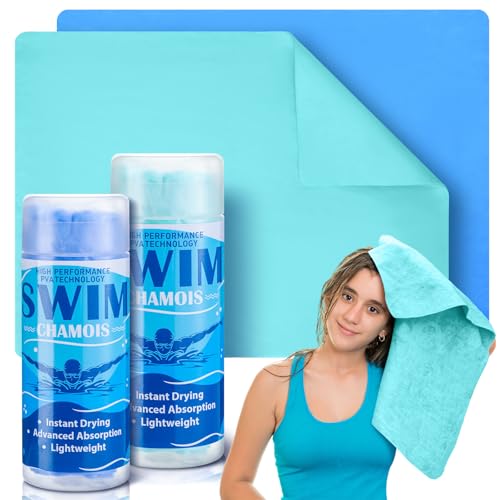
SmoothNovelty Swim Chamois Towel 2 Pack 13×17
Two small chamois towels, one blue and one aqua, make up this SmoothNovelty pack, and the listing is admirably blunt about size: thirteen by seventeen inches each. That is hand-towel territory, deliberately so. These are wiping sheets for swimmers at the pool, the beach or the shower, and the listing also mentions diving and even car use, which tells you the maker sees them as general absorbent shammies rather than race-specific kit. Read them that way and they make sense; read them as miniature bath towels and nothing about them will.
- Format: chamois towels, pack of two
- Size: 13 x 17 inches each
- Colours: blue and aqua
- Stated uses: pool, beach, shower, diving, car, water sports
- Weight per towel: not stated
Strengths
- Two colours let two swimmers keep their own towel straight
- Dimensions are printed right in the listing, no guesswork
- Small size slips into a crowded kit bag without a fight
Trade-offs
- Thirteen inches of width covers a face and shoulders, not a torso
- Generalist listing, so nothing is tuned specifically for racing
- Aqua shows pool-deck grime faster than darker shades
Households with two young swimmers will feel the logic immediately. Each child gets a colour, each colour lives in its own mesh pocket, and the post-practice wipe-down stops depending on one shared sheet that somebody always forgets. The towels also suit adults who keep a shammy in the car for fogged windscreens or spilled water bottles; the listing itself nods toward car use, so that second life is part of the pitch rather than an improvisation.
Expectations should stay proportionate. A thirteen-by-seventeen sheet dries a swimmer the way a chamois does: pass, wring, pass again. It will not wrap a shivering eight-year-old after an outdoor meet, and it is nobody’s beach towel. Bought as a pair of quick wipes for the bag, though, the format is honest and the sizing is transparent, which counts for plenty in a category where dimensions are often buried or missing altogether.
There is also a quiet training benefit to giving young swimmers their own small towel early. Managing personal kit — drying it, packing it, remembering it — is part of how children learn the self-sufficiency that competitive swimming quietly teaches. A thirteen-by-seventeen sheet is exactly the scale a seven-year-old can wring without help, which a full-size towel is not. Parents who have watched a small swimmer wrestle a bath sheet into submission will understand why starting with a towel the child can actually operate is a developmental choice as much as a purchasing one.
Best for: families equipping two swimmers, or one swimmer who likes a spare. Not suited for: anyone shopping for post-swim warmth or full-body coverage. When a matched pair of pocket wipes fits the plan, Check price on Amazon and note the two colours before ordering.

Tisancy Swim Chamois Towels 4 Pack 26×17
Scale changes the chamois conversation, and Tisancy scales twice at once: four towels per pack, each twenty-six by seventeen inches, in a neutral tone. That is the largest chamois footprint in this guide and the largest count, aimed squarely at squads, swim schools and families who burn through wipes. The listing describes the material as soft microfiber and the towels as fast drying shammies for swimmers, divers and triathletes, so the pitch blends the chamois habit — use, wring, reuse — with a bigger sheet that can take in a whole back or both legs in one draw.
- Format: chamois towels, pack of four
- Size: 26 x 17 inches each
- Colour: neutral
- Material as listed: soft microfiber
- Stated uses: swimming, diving, triathlons, other water sports
Strengths
- Four sheets mean spares for lost, loaned or laundry-day towels
- Bigger sheet area shortens the wipe-down between events
- Neutral colouring sidesteps team-colour clashes and mix-ups
Trade-offs
- Four identical towels invite mix-ups unless each gets marked
- Still a wipe, not a wrap, despite the larger dimensions
- Neutral fabric shows chlorine marks and deck dirt honestly
Coaches running age-group sessions will recognise the use case at once. A stack of identical shammies by the timing table lets swimmers grab, dry and drop without hunting for personal kit, and the twenty-six-inch length means fewer passes per swimmer when the next heat is already marshalled. For a family with three kids in the same club, the arithmetic is similar: one pack covers the roster with a spare left over, and identical towels end the nightly argument about whose towel is whose — by making the argument pointless.
Care habits matter more with a shared pack. Chamois-style sheets prefer to be stored slightly damp rather than baked dry and stiff, and a four pack rotates naturally: while one sheet airs, three remain in service. The listing’s microfiber description also hints at a softer hand-feel than classic chamois, which younger swimmers often prefer against the face. None of that turns these into comfort towels; they remain working cloths for people who get wet repeatedly and need the water off quickly.
Budget officers for clubs will also note what a four pack does to replacement planning. Towels in shared service disappear at a predictable rate, and a pack format lets a club reorder the identical item mid-season without re-litigating the decision. Uniformity has a hygiene angle too: identical sheets can be laundered as one load on one setting, with no sorting by fabric or colour, and the neutral tone means a fresh sheet blends invisibly with veterans. For volunteer-run organisations, where every decision competes with pool hire and entries, that administrative simplicity is a genuine feature.
Best for: squads, swim schools and multi-swimmer households buying in one go. Not suited for: a lone swimmer who wants one premium-feeling towel and nothing else. Stocking a whole lane’s worth of wipes is easiest through Check price on Amazon, where the four pack count is confirmed on the listing.
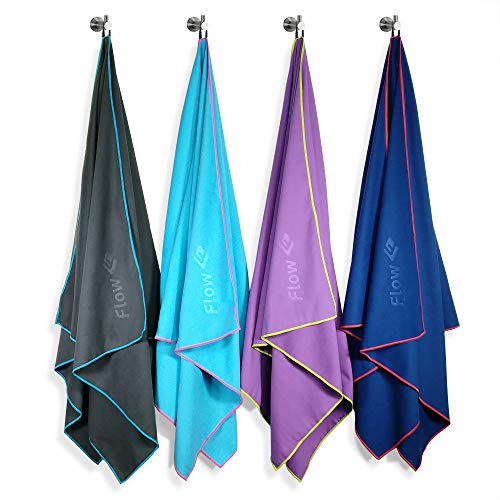
Flow Hydro Sport Microfiber Swim Towel Navy Large
Crossing over to the wrap-and-warm family, the Hydro Sport is Flow’s generalist microfiber towel: the listing offers medium, large, extra large and even hooded sizes under the same product family, and this pick is the navy large at sixty by thirty inches. Its stated territory is swimming, pool time, triathlon and other water sports — broad, deliberately so. Where the chamois sheets are specialists, this towel is the all-rounder a swimmer throws over shoulders, spreads on a bench, or wraps up in on the drive home.
- Format: microfiber towel
- Size: large, 60 x 30 inches
- Colour: navy
- Family sizes named in listing: medium, large, extra large, hooded
- Stated uses: swim, pool, triathlon, other water sports
Strengths
- Sixty inches of length gives genuine wrap coverage for adults
- Navy hides the visual wear that pool decks dish out
- One family spans several sizes if a household standardises
Trade-offs
- Takes more bag space than any chamois in this guide
- General water-sports brief rather than a competition-specific one
- Once wet, it stays wet for the session, unlike a wrung chamois
Triathletes may appreciate this towel most. Transition areas reward one cloth that does everything: dry feet before shoes, a clean patch to stand on, a quick wipe of arms and legs. Sixty by thirty is enough cloth for all three jobs in sequence. For pool racers, the same towel plays the between-events role — draped over shoulders in the stands, spread across a cold bench, wrapped around a swimmer eating a snack while staying warm. It is the towel equivalent of a reliable training partner: not flashy, present for everything.
Microfiber behaviour is the other half of the story. The listing promises quick drying, and microfiber as a class sheds water faster than cotton terry, which is why these towels dominate travel and sport bags. They also pack flatter than cotton of equal coverage, so the large size here does not translate into a stuffed bag the way a big cotton towel would. What microfiber will not do is match a chamois for repeated same-session use; after a thorough soaking it needs air and time, not a wring.
Beach crossover is the Hydro Sport’s bonus life. A towel bought for the pool that also handles sand, grass and festival seating earns its shelf space twelve months a year rather than during the swim season alone. Microfiber shakes sand loose more willingly than looped cotton, which matters at the car door. Households that prefer every purchase to work two jobs will find this the easiest pick in the guide to justify, and the navy colourway survives the transition from deck to dunes without looking like borrowed pool kit.
Best for: swimmers and triathletes who want one big towel for the whole day. Not suited for: minimalists counting every litre of bag space. A navy wrap this size earns its keep quickly, so Check price on Amazon if the all-rounder role is the one missing from your bag.
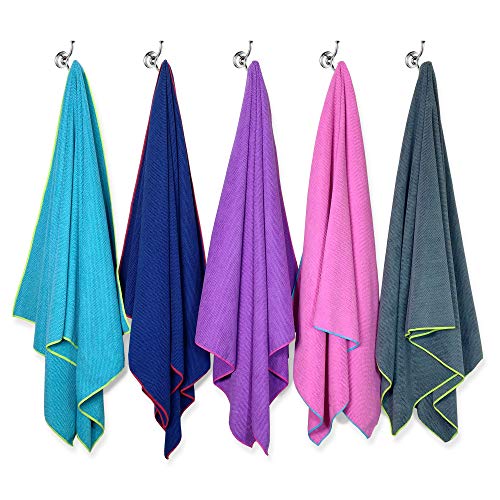
Flow Microfiber Swim Towel Competitive Navy Large
Here is the listing that says the quiet part out loud: a microfiber quick dry swim towel for competitive swimming, in navy, large at sixty by thirty inches, with a medium option also available. That explicit wording matters because most swim towels gesture at the pool generally; this one names the racing context, and its size matches the claim. Sixty inches wraps an adult properly, thirty inches gives enough width to matter, and microfiber keeps the whole thing light in a bag that already carries a racing suit, caps and goggles.
- Format: microfiber swim towel
- Size: large, 60 x 30 inches; medium also offered
- Colour: navy
- Stated use: competitive swimming and other water sports
- Hood: none stated in the listing for this model
Strengths
- Competition use is named in the listing, not implied
- Two sizes let shorter swimmers avoid dragging excess cloth
- Navy colourway stays presentable across a long season
Trade-offs
- No hood, for swimmers who like head coverage between races
- Shares its size with the Hydro Sport, so choose by brief, not dimensions
- One towel per purchase; no multi-pack option in the listing
How does this differ from the Hydro Sport above, given both are navy Flow microfiber at the same size? By intention. The Hydro Sport spreads itself across pool, triathlon and water sports generally, while this towel’s listing centres competitive swimming first. In practice a buyer is choosing which description matches their calendar: a season of meets with occasional open-water fun points here; a mixed calendar of beach, pool and triathlon points to the Hydro Sport. Owning the distinction keeps the right towel in the right bag.
Race-day warmth is where a large microfiber proves itself. Standing wet in a draughty sports hall saps energy that belongs in the next race, and a fast wrap plus a towel that itself dries quickly between uses changes the feel of a long meet. The medium option deserves a mention for younger or smaller swimmers, for whom sixty inches of cloth can trail on wet floors; matching towel size to swimmer size is a small decision that prevents a season of minor annoyance.
Consider also the swimmer returning after injury or a long break, rebuilding a routine piece by piece. Familiar, purpose-named kit lowers the friction of the first meet back: the towel that says competitive on its listing is a small declaration that the comeback is real. That may sound sentimental for a buying guide, yet anyone who has stood on a deck after a year away knows the value of equipment that treats the day as a competition rather than a casual swim. Tools carry meanings, and this one carries the right one.
Best for: meet-focused swimmers who want their towel’s brief to match their calendar. Not suited for: buyers wanting a hood or a multi-pack. If the competition wording is what you have been scanning listings for, Check price on Amazon and pick between medium and large there.

Flow Hooded Quick Dry Swim Towel Gray
A hood changes a towel’s job description. Flow’s hooded microfiber towel, in gray, is listed for competitive swimming and other water sports, and the hood is the whole point: pull it up after warm-up and the heat that escapes through a wet head stays with the swimmer instead. Parents of young racers know this design from children’s swim lessons, where it keeps small swimmers warm and keeps the towel on shoulders that shrug off flat rectangles. The same logic serves adults at outdoor meets and dawn training, scaled up.
- Format: hooded microfiber towel
- Colour: gray
- Stated use: competitive swimming and other water sports
- Dimensions: not given in the listing title
- Closure or pockets: none stated in the listing
Strengths
- Hood keeps the towel in place on restless younger swimmers
- Head coverage speeds up warming between events
- Gray is a forgiving shade for a hard-working towel
Trade-offs
- No dimensions in the listing title, so sizing needs a careful look
- Hood adds bulk that a flat towel avoids
- Less useful as a flat bench pad than the unhooded towels
Consider the outdoor meet in early season: wind across the pool, long waits between a swimmer’s events, and a child or teenager who will not sit still under a draped towel. The hood solves the mechanical problem first — the towel stays on — and the thermal problem second, because a covered wet head loses far less heat. Coaches who herd groups of young swimmers between marshalling and the blocks often prefer hooded designs for exactly this herd-management reason, quite apart from comfort.
For adult swimmers the case is narrower but real. Open-water and outdoor-pool racers finishing a dawn session in cool air get genuine value from pulling a hood up while they change or debrief. The listing’s quick-dry microfiber brief matches the rest of the Flow family, so the towel should air out faster than a cotton equivalent on the drive home. Just go in clear-eyed about the missing dimensions in the title: coverage is the one thing a hooded towel must deliver, and the listing page itself is where to confirm the fit for your swimmer.
Spectators underestimate how much of a young swimmer’s meet happens while standing still. Marshalling queues, medal waits, team photos in wet hair — the hooded towel is present for all of it, functioning as garment as much as cloth. That dual role explains why hooded designs persist across generations of swim teaching despite costing more to make than flat towels. For families photographed at pools for a decade, the gray hood in the team picture becomes a small piece of family history, which is a strange and lovely thing for a buying guide to be able to say about a towel.
Best for: young racers, outdoor swimmers and anyone who chills quickly after warm-up. Not suited for: buyers who want a towel that doubles as a flat mat or bench cover. Warmth with a hood attached is a specific pleasure, and Check price on Amazon will show the gray colourway in full.
Side-by-side: the six towels at a glance
| Towel | Format | Size or count headline | Natural home |
|---|---|---|---|
| Flow Swim Chamois Blue | Chamois sheet | Single | Race bag, dive kit |
| SmoothNovelty 2 Pack | Chamois | 13 x 17 in, two towels | Two-swimmer households |
| Tisancy 4 Pack | Chamois | 26 x 17 in, four towels | Squads and clubs |
| Flow Hydro Sport Navy Large | Microfiber towel | 60 x 30 in | Triathlon and pool days |
| Flow Competitive Navy Large | Microfiber towel | 60 x 30 in, medium offered | Meet calendars |
| Flow Hooded Gray | Hooded microfiber | Hood attached | Young and cold-prone swimmers |
How do you choose the right swim towel for race day?
Start with the wipe-versus-wrap question
Everything branches from one honest answer: do you mostly wipe water off, or mostly wrap up? Wipers belong with chamois. A chamois sheet handles repeated exits from the pool without ever becoming waterlogged, and it suits swimmers whose between-race routine is measured in minutes. Wrappers belong with microfiber. A large microfiber towel gives warmth, modesty while changing, and a dry place to sit — comforts a chamois cannot offer at any size. Many serious swimmers eventually carry one of each, which is not indecision; the two tools cover different moments of the same meet.
Count the swimmers, then count the towels
Pack counts in this guide run from one to four, and the right number depends on how many people the bag serves. A solo adult racer needs one chamois or one large towel. Two siblings sharing transport need the SmoothNovelty pair or two large towels, because shared damp cloth is where morning arguments breed. A coach or a parent equipping a whole group should look hard at the Tisancy four pack, where identical towels simplify everything from distribution to laundry. Buying count first and brand second prevents the classic error of owning three towels and still being one short.
Match dimensions to the swimmer, not the dream
Sixty by thirty inches is generous on an adult and a trip hazard on a small child. The medium option in the competitive Flow listing exists for that reason. At the chamois end, thirteen by seventeen inches is a face-and-shoulders wipe, while twenty-six by seventeen reaches a full back. Write the swimmer’s rough shoulder width on a note before ordering if you need to; thirty seconds of honesty about size beats a season of dragging hems through puddles on the deck.
Think about where the towel lives between sessions
A towel’s home matters more than shoppers expect. Chamois sheets are happiest stored slightly damp in their container, ready for the next session. Microfiber wants air: draped over a rail or hook after training, washed regularly, and kept away from fabric softeners that coat fibres. Apartment swimmers with no outdoor line should favour whichever format their space can actually dry. The best towel is the one your routine can maintain without resentment.
Finally, let the calendar arbitrate ties. A swimmer entering a block of weekly galas needs reliability and rotation; a swimmer with one big meet a term needs the towel that makes that single day feel organised. Both are legitimate briefs, and the six products above divide cleanly between them once the calendar is admitted as evidence.
Chamois craft: getting the most from a shammy
New chamois owners often judge the sheet on its first dry use and conclude it does nothing. That first use is misleading. Chamois material wakes up when damp: run it under the tap, wring it to a cool, pliable sheet, and only then take it to wet skin. Long, unhurried draws pull water off in sheets. Short scrubbing motions mostly move water around. Between passes, a firm two-handed wring resets the surface, and the sheet is ready again immediately — a rhythm competitive swimmers have relied on since long before microfiber existed.
Storage separates long-lived chamois from cracked ones. Left bone dry for weeks, many chamois sheets stiffen; a soak revives them, but regular swimmers avoid the cycle by keeping the sheet in its tube or a sealed bag with a little moisture. Rinse pool chemicals out after heavy use, since chlorine is unkind to every material in this guide. Treat the sheet as equipment, like goggles, and it repays the care with seasons of service.
The rest of the house, briefly
Swim families tend to be towel families generally, and the same read-the-dimensions discipline applies at home. Guest bathrooms, for instance, run on small cloths that shoppers often research through guides such as Best Linen Like Fingertip Towels, where eleven-to-eighteen-inch towels are the entire point rather than a disappointment. The pool lesson transfers directly: a small towel is only a mistake when the buyer expected a large one. Size honesty, in the listing and in the buyer’s head, is ninety percent of towel satisfaction.
Water also has a way of appearing in household projects that start dry. Anyone planning a bathroom refresh around a soaking tub will find the research trail leads through roundups like Best Wooden Bathtubs, and the floors under all that splashing deserve their own homework, which is why washable, stain-shedding floor coverings get compared in guides such as Best Stain Resistant Rugs. Different rooms, same principle as the pool deck: match the material to how the water actually behaves.
A meet day, hour by hour, through your towels
Picture the alarm at half past five. The bag was packed the night before, and the first towel decision of the day was made then: chamois in the side pocket where a hand finds it without looking, large towel folded flat at the bottom. At the pool, warm-up ends with water sheeting off every swimmer on deck, and this is the chamois hour. A few draws across the back and legs, a wring over the gutter, and the swimmer is dry enough to pull on a warm top and eat something. The big towel stays in the bag, saved for later, because a towel used at warm-up is a towel already damp for the rest of the morning.
Mid-morning belongs to the waiting. Heats crawl forward, friends race, and the swimmer’s own events sit an hour apart. Now the large microfiber earns its place: over the shoulders in a draughty hall, spread along a bench that has hosted a hundred wet swimsuits, wrapped around legs during a long conversation with a teammate. Warmth is not vanity here. Muscles that cool completely between swims need warming again, and that costs energy the race itself would rather spend. A hooded towel compresses this whole routine into one gesture, which is why the gray Flow design keeps appearing in this guide’s thinking about younger swimmers.
Finals and last events change the texture again. By late afternoon the chamois has been wrung forty times and works exactly as it did at dawn — the format’s great virtue. The large towel, by contrast, has absorbed a day of incidental duty and hangs heavy. The last dry-off before clothes belongs to whichever cloth is driest, and experienced swimmers plan backwards from that moment: the towel reserved for the end stays folded and untouched until the end. It sounds fussy for the first meet of a season and completely obvious by the third.
Travel home is the forgotten fifth act. A microfiber towel draped over a headrest or spread across a car seat dries meaningfully during a forty-minute drive, arriving home merely damp instead of sodden. The chamois goes back into its container slightly moist, ready for Tuesday training. Both then get their weekly wash, and the cycle resets. None of this requires expensive kit; it requires assigning each cloth a role and letting the roles stay stable week after week, which is the real secret behind swimmers who always seem to have a dry towel when nobody else does.
Training towels and racing towels are different purchases
Weekly training is a war of attrition fought by laundry. A towel that trains five days a week needs to survive constant washing, constant chlorine and constant being forgotten in a locker until Thursday. This is where pack counts quietly dominate: the Tisancy four pack and the SmoothNovelty pair exist because rotation is the only laundry strategy that never fails. While one sheet airs, another works. Training is also where a generalist earns respect — the Hydro Sport’s broad brief suits the swimmer whose week mixes pool sets, open-water dips and the occasional beach day, and whose towel must follow all of it.
Racing inverts the priorities. A race towel is handled perhaps twenty days a year, and on those days its job is partly psychological: the familiar cloth, the familiar routine, the small ritual of the wrap before marshalling. Swimmers are creatures of routine, and the towel that travels to every meet becomes part of the pre-race script. That is a fair reason to own the competition-named Flow towel even if a training towel already hangs at home. The two purchases solve different problems, and conflating them — racing with the threadbare training cloth, or training daily with the cherished race towel — shortchanges both.
Age changes the balance too. Young swimmers lose towels with a consistency that borders on talent, and for them the economics of multi-packs and forgiving colours win every argument; a lost Tisancy sheet is an annoyance, a lost treasured towel is a crisis. Teenagers, suddenly conscious of appearance in a way nine-year-olds are not, may care about navy over neon and a hood that reads as sporty rather than childish. Adults buying for themselves can finally optimise for pure function, which usually means a chamois for the deck and one large microfiber chosen slowly and kept for years.
Washing, chlorine and the long life of a swim towel
Chlorine is the slow antagonist of every product in this guide. It fades navy toward slate, weakens fibres over seasons, and punishes towels that sit wet and untreated. The countermeasures are humble: rinse or wash after heavy meet days rather than letting the bag ferment until the weekend, dry towels fully between sessions whenever the format allows, and keep a rotation so no single cloth takes every exposure. Microfiber rewards an extra habit — skip fabric softener, which coats the fibres that do the absorbing, and the towel keeps the quick, grippy thirst that made it appealing in the first place.
Chamois sheets ask for the opposite instinct in one respect: they dislike being stored bone dry for long stretches, stiffening until a soak brings them back. Regular swimmers never notice, because the sheet cycles between bag and pool too quickly to dry out fully. Seasonal swimmers should soak a stiffened chamois before judging it dead; the revival rate is high. When a chamois finally does give up — tearing at a fold, staying slick instead of thirsty — it tends to do so after long service, and replacing like with like keeps the routine intact.
Smell is the honest auditor of towel care. A towel that smells sour out of the bag was stored damp and warm, whatever its material, and no format in this guide is immune. Air is the cure and the prevention: drape first, bag later. Swimmers who build that single habit into the walk from pool door to car park will get more years from a mid-range towel than careless owners get from the finest cloth sold, which is as close to a universal law as towel buying offers.
Open water, triathlon and the travelling swimmer
Open-water swimmers dry off in car parks, on shingle and beside lakes where the wind does half the work and the ground offers nowhere clean to stand. A large microfiber towel becomes a changing robe substitute, a windbreak and a mat in quick succession, and the Hydro Sport’s sixty-inch length is the sort of specification that matters standing on gravel at seven in the morning. The chamois still travels, but its role shrinks to the first wipe; after that, coverage rules. Anyone whose swimming year leans outdoors should weight the big towels in this guide more heavily than the deck-bound racer does.
Triathlon transition deserves its own paragraph because the towel there is infrastructure. Laid beside the bike, it marks territory, dries feet before socks, and catches the wetsuit’s drip. Bright or distinctive colours help an athlete spot their patch at speed, which is an argument for the blue chamois or a recognisable towel in a sea of similar setups. The listing for the Flow chamois names triathlons directly, and the Hydro Sport listing does the same, so both picks carry that brief in writing rather than by this guide’s extrapolation.
Travelling to away meets adds the suitcase test. Microfiber folds thin, chamois thinner, and a swimmer flying to a competition can carry both families for less space than one cotton towel. Hotels forgive many things but a bag that smells of damp cotton by day three is a burden; quick-drying formats are the traveller’s quiet advantage. Pack the chamois in its container, roll the microfiber around the racing suit to cushion it, and the whole drying system weighs less than the shoes it travels beside.
Buying for a child, a teen or a whole relay squad
Children’s towel needs are embarrassingly practical: warmth fast, ownership clear, loss survivable. The hooded Flow answers the warmth and ownership halves at once, since a hood stays on and a distinctive design ends mix-ups at the lesson pool. For loss, the multi-pack chamois options spread risk; a SmoothNovelty towel left at the pool hurts less when its twin is already in the bag. Marking names on tags remains the cheapest technology in the entire category, and it outperforms every colour system ever devised.
Teenagers racing seriously begin to resemble adults in their needs, with one addition: the towel is visible kit, part of the deck uniform, and they will use the one they are not embarrassed by. Navy dominates this guide’s large towels for good reason — it reads as serious sporting equipment, photographs well and hides a season of chlorine fade gracefully. A parent choosing between the competitive Flow and the Hydro Sport for a teen might simply ask which description the swimmer would rather have attached to their bag; the honest answer predicts which towel actually gets used.
Squads buying collectively should think like the Tisancy pack thinks: uniform, plentiful, replaceable. A club that issues identical shammies stops a dozen small frictions — forgotten towels, borrowed towels, towels of mysterious origin — and the neutral colour keeps the peace across age groups. Add one large towel per team bench for the shivering and the system is complete, at a scale where individual preference matters less than the simple fact that dry swimmers listen better, warm up better and complain less.
Common mistakes when buying swim towels
Expecting a chamois to behave like a bath towel. A shammy is a wiper, thin by design, and judging it on plushness guarantees disappointment. Buy it for speed and reuse, or do not buy it at all.
Ignoring the printed dimensions. Thirteen by seventeen inches is stated plainly on one listing in this guide, and swimmers still order such towels expecting body coverage. Read the numbers, compare them against a towel you already own, and let the tape measure settle the question.
Buying one towel for a two-session day. Morning heats and evening finals punish the single-towel swimmer, whose microfiber is still damp from the morning. A chamois as backup, or a second towel, ends that misery cheaply.
Treating the four Flow products as interchangeable. A chamois, a hydro sport towel, a competitive towel and a hooded towel from one maker are four tools with four briefs. Ordering by brand alone, without reading which format is in the cart, is how hooded towels arrive for swimmers who wanted sheets.
Storing microfiber wet in a sealed bag. Quick-dry fabric still needs air eventually, and a sealed, warm, wet bag undoes the hygiene advantage within a day. Drape the towel the moment you get home; future you, opening that bag at the next session, will be grateful.
Final recommendation
Build the bag around your most common session. If that session is a meet with repeated swims, anchor it with a chamois: the single Flow sheet for a solo racer, the SmoothNovelty pair for two swimmers, the Tisancy four pack for a group. If your swimming life centres on one long session with real downtime, anchor it with coverage: the competitive Flow towel for a race calendar, the Hydro Sport for a mixed water-sports life, the hooded Flow for anyone who feels the cold. Layering one of each family is the connoisseur’s answer and, for households with both racers and loungers, honestly the practical one.
A word about sequencing the purchase, because order matters more than brand here. Buy the format your next four weeks demand, not the format your championship in six months might. A swimmer in heavy training gets daily value from rotation packs and a dependable chamois; the cherished race towel can wait until the taper begins. Conversely, a swimmer whose season is nearly over should not stockpile training cloth that will sit until autumn. Towels are consumables on a long fuse, and timing the purchase to the calendar keeps money in the phase of the season where it actually dries somebody. When in doubt, the chamois comes first: it is the cheapest experiment in this guide, the easiest to pack, and the fastest way to learn whether the wring-and-reuse rhythm suits the way you swim.
Frequently asked questions
Is a chamois towel really a towel?
By material and habit, it is better understood as a drying tool. It absorbs, it wrings out, it repeats. It does not wrap, cushion or warm. Swimmers who accept that definition tend to love chamois sheets; swimmers who keep waiting for the plush moment tend to return them.
Which of these listings actually mention competitive swimming?
Two do: the Flow Microfiber Quick Dry Swim Towel and the Flow hooded towel both name competitive swimming in their listings. The others describe swimming, diving, triathlons and water sports generally, which is why this guide frames them as suitable for racers without pretending their listings say more than they do.
How big is sixty by thirty inches in practice?
Picture a towel that reaches from an adult’s shoulders to below the knees when wrapped, with enough width to overlap properly. It is a full body towel by swim standards, far beyond the footprint of the chamois sheets in this guide, and it folds to a slim microfiber slab rather than a cotton brick.
Can one swimmer manage with only a chamois?
Plenty do, especially divers and short-session racers. The gap appears in the gaps: waiting between events, sitting on cold benches, changing discreetly. If your meets involve long waits, pair the chamois with any large towel, even an ordinary one from home, and the system is complete.
How many swim towels should one racer own?
Two is the honest minimum for anyone swimming more than twice a week: one in the bag, one drying at home. Meet swimmers do better with the layered system this guide keeps returning to — a chamois for the deck plus a large towel for the waits — which is still only two items, just two different species. Add a training rotation if laundry is a weekly rather than daily event in your house, and the count rises to three or four, preferably bought as a pack so replacements match.
Why do so many of these picks come from one brand?
Because that brand, Flow, lists distinct formats for distinct jobs — chamois, general microfiber, competition microfiber and hooded — and this guide values the distinctions. Treat each listing on its own stated brief rather than as a house recommendation, and choose the format that matches your swimming, whoever makes it.
Pick the format that matches how you actually leave the water, and your next meet morning will feel calmer from the very first dry-off.


