What's inside
- Where to Buy Top-Load Washers That Stay Balanced, Plus the Accessories That Rescue the Others
- Key Takeaways
- Quick Picks
- How Did We Judge Balance Claims Without a Test Lab?
- Machines and Accessories in One View
- Why Do Top-Load Washers Go Unbalanced in the First Place?
- How Do You Load a Top-Loader So It Rarely Unbalances?
- How Do You Level and Settle a Machine That Walks?
- A Diagnostic Walk: From First Thump to the Right Fix
- Floors Ranked: Where Washers Behave and Where They Complain
- Spin Speed, Suspension, and Sensing: The Three Legs of a Calm Cycle
- Repair or Replace: Reading the Tea Leaves of an Ageing Washer
- What Quiet Actually Buys a Household
- Fitting Pads Without Hurting Yourself or the Machine
- Special Cases: Trainers, Pet Beds, and the Dreaded Bath Mat
- What to Ask a Seller Before Trusting a Balance Claim
- New Machine, Old Habits: The First Month With a Balance System
- Landlords, Tenants, and the Shared Laundry Room
- A Note on Children, Pets, and the Laundry Room Door
- The Two-Minute Weekly Check That Prevents Most Drama
- Balance Mistakes That Make Good Machines Look Bad
- Final Recommendation
- Frequently Asked Questions
- Related Guides
As an Amazon Associate I earn from qualifying purchases. This post may contain affiliate links at no extra cost to you.
cottageverdict.com is reader-supported. When you buy through links on our site, we may earn an affiliate commission.
Where to Buy Top-Load Washers That Stay Balanced, Plus the Accessories That Rescue the Others
Everyone who has lived with the best top-load washers that don’t go unbalanced remembers the alternative: the spin cycle that starts as a hum, builds to a thump, and ends with the machine walked halfway across the laundry room and the load sitting in grey water, redistributed by hand for the third time. This guide attacks that problem from both ends. It presents two washers whose listings name a balance or low-vibration system outright, three anti-vibration accessories that can calm a machine you already own, and one prose-only discussion of the balance systems found in two well-known top-load lines, for readers researching a purchase beyond this page’s links.
Honesty first, because this category invites overclaiming: no washer on earth can promise it will never unbalance. A single soaked bath mat in an otherwise empty drum will defeat any suspension ever built. What good balance technology does is detect a developing imbalance early, redistribute the load or adjust the spin, and turn most would-be thumping cycles into finished ones. Loading habits do the rest, and this guide covers those habits in as much detail as the hardware.
The linked machines and accessories are sold through Amazon; follow a linked name to check price on Amazon and confirm the current listing. The accessories are labelled as accessories everywhere they appear — in the quick picks, in their reviews, and in the comparison table — because a set of rubber feet, however effective, is not a washing machine and will not be dressed up as one here.
Key Takeaways
- Only two picks are complete washers with balance technology named in the listing: a Samsung pair claiming low-vibration washing and an LG washer naming a TrueBalance anti-vibration system.
- Three picks are accessories — two sets of anti-vibration pads and one pad-and-mat set — that reduce walking, noise, and floor damage under a machine you already own.
- Accessories calm vibration; they do not repair a worn suspension or fix a drum loaded with one heavy, waterlogged item.
- Level feet and even loading prevent more unbalance shutdowns than any technology can correct after the fact.
- One pick is prose-only: a discussion of the balance approach in GE and Maytag top-load lines, included for research rather than as a linked recommendation.
- The cheapest fix in this guide is a habit — mixing large and small items so the drum never spins a single dense lump.
Quick Picks
| Pick | Badge | Why it earns its place |
|---|---|---|
| Samsung Smart Top-Load Pair — Low Vibration Washer | Best low-vibration washer pair | A smart 4.7 cu. ft. top-load washer whose listing claims low-vibration quiet washing, bundled with a 7.4 cu. ft. sensor dryer. |
| LG 4.1 Cu. Ft. Top-Load Washer with TrueBalance Anti-Vibration | Best named anti-vibration system | TrueBalance anti-vibration is stated in the listing, with a direct drive motor, eight cycles, and SmartDiagnosis. |
| Anti-Vibration Foot Pads for Washers and Dryers | Best accessory — isolation feet | A set of four rubber isolation feet that lift the machine onto a grippy, shock-absorbing footing. |
| Evelots 8-Pack Anti-Vibration Washer Pads | Best accessory — pads for two machines | Eight pads cover a washer and dryer together, reducing vibration and movement while protecting the floor. |
| Anti-Vibration Anti-Walk Washer and Dryer Mat Set | Best accessory — mat and feet set | Four rubber isolation feet in a mat set aimed at vibration reduction, shock absorption, and noise dampening. |
| GE and Maytag Top-Load Balance Systems (research pick) | Prose-only research pick | Two established top-load lines known for load-sensing and balance correction, discussed qualitatively for buyers shopping beyond this page. |
How Did We Judge Balance Claims Without a Test Lab?
By reading listings the way an engineer reads a brochure: only a named system counts. The Samsung pair’s listing claims low-vibration quiet washing; the LG’s listing names TrueBalance anti-vibration directly, alongside a direct drive motor, which matters because a motor coupled directly to the drum can adjust spin behaviour with a finesse belt systems struggle to match. Everything else in the machine category that merely looked sturdy was excluded, because a heavy cabinet is not a balance system.
For the accessories, we judged by mechanism. A pad or isolation foot works by gripping the floor, absorbing high-frequency vibration, and slightly decoupling the machine from a resonant floor — real effects with real limits, which each review states. And for the prose-only pick, we confined ourselves to what is generally known about the two lines’ approach — load sensing that adds water or redistributes when the drum runs unevenly — without inventing model names, figures, or technology trademarks. Readers who want the wider top-load landscape can continue to Best Economy Top-Load Washers, where several straightforward machines make their own case on simplicity rather than on balance electronics.
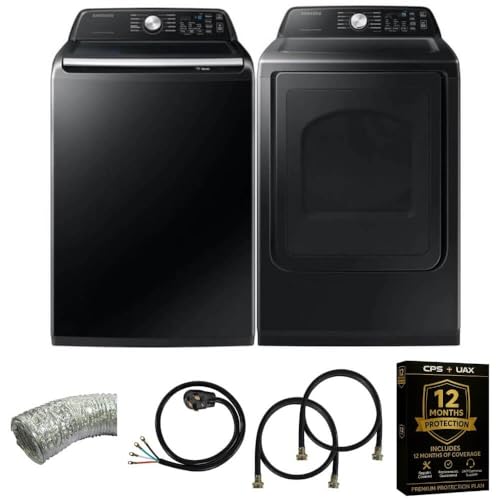
Samsung Smart Top-Load Pair — Low Vibration Washer — Best low-vibration washer pair
This Samsung bundle returns from our smart laundry coverage wearing a different hat: here, the relevant claim in its listing is low-vibration quiet washing on the 4.7 cu. ft. top-load washer. Low vibration is the felt experience of a balance system doing its job — the spin that stays a hum instead of becoming a percussion performance — and in a pair that also includes a 7.4 cu. ft. electric dryer with a sensor that stops overdrying, plus power cords, hoses, a vent duct, and a 1-year CPS protection plan, it is the complete-package answer to a noisy laundry room.
Place the claim correctly. The listing promises low vibration, not immunity from physics: a balanced system manages the ordinary unevenness of mixed laundry — a towel-heavy load, a duvet cover that has swallowed two pillowcases — and it is exactly those ordinary cases that produce most real-world unbalance shutdowns. The extraordinary cases remain the user’s responsibility, and the how-to section below exists for them. As a pair purchase, this also suits a household replacing both machines at once, where the dryer’s own balance on its feet contributes to the quiet.
- Washer capacity stated in the listing: 4.7 cu. ft., top-load
- Balance-relevant claim in the listing: low vibration, quiet wash
- Dryer stated in the listing: 7.4 cu. ft. electric, sensor stops overdrying
- Bundle contents named: power cords, hoses, vent duct, 1-year CPS protection
- Wash feature also named: WaterJet
- Finish named in the listing: black
Strengths
- Low-vibration design targets the spin cycle’s noise and walking at the source, inside the machine.
- A complete bundle with connection hardware makes correct, level installation easier to achieve.
- The sensor dryer completes a laundry pair that is considerate of both fabrics and floors.
Trade-offs
- It is a pair: households needing only a washer pay for a dryer they may not want.
- Low vibration describes behaviour, not a guarantee — absurd loads will still defeat it.
- Black finishes show the dust that laundry rooms generate in unusual abundance.
Best for: households replacing both machines whose laundry room sits over or beside living space. Not suited for: washer-only shoppers, or anyone expecting technology to excuse careless loading.

LG 4.1 Cu. Ft. Top-Load Washer with TrueBalance Anti-Vibration — Best named anti-vibration system
If you want the balance technology named like a headline, this is your machine. The listing for the LG WT6105CW states a 4.1 cu. ft. top-load washer in white with TrueBalance anti-vibration, eight wash cycles, a direct drive motor, and SmartDiagnosis. A named anti-vibration system signals that the manufacturer engineered the suspension and spin control around the balance problem specifically — sensing uneven rotation and compensating — rather than relying on cabinet weight to sit still.
The supporting cast reinforces the theme. A direct drive motor removes the belt from the drivetrain, which suits fine spin adjustments and removes a wear item. SmartDiagnosis gives the machine a way to communicate fault information when something does go wrong, which shortens the path from symptom to answer. Eight cycles is a sensible menu for a 4.1 cu. ft. family drum. None of this makes the washer immune to a drum loaded with one wet blanket — nothing is — but for the everyday distribution problems of mixed laundry, this is the most explicitly engineered answer in the guide.
- Capacity stated in the listing: 4.1 cu. ft., top-load
- Model stated in the listing: WT6105CW
- Balance system named in the listing: TrueBalance anti-vibration
- Motor stated in the listing: direct drive
- Cycles stated in the listing: 8 wash cycles
- Support feature named: SmartDiagnosis
Strengths
- The anti-vibration system is named in the listing, so the balance engineering is a stated design goal.
- Direct drive suits precise spin control and removes belt wear from the maintenance list.
- Diagnosis support shortens repairs when a genuine fault, rather than a loading error, appears.
Trade-offs
- At 4.1 cu. ft. it is mid-sized; the largest bedding loads may still need splitting.
- A single washer purchase leaves an older, possibly wobblier dryer beside it.
- Anti-vibration engineering manages ordinary imbalance; it cannot repeal the physics of a single soaked rug.
Best for: washer-only buyers who want balance technology named, engineered, and supported. Not suited for: households needing the largest drums, or anyone whose real problem is a broken suspension on the current machine.

Anti-Vibration Foot Pads for Washers and Dryers — Best accessory: isolation feet
Now the accessories, presented as what they are: rubber isolation feet that sit under a washer or dryer’s own feet. This set of four uses rubber technology to grip the floor, absorb shock, and reduce the vibration transmitted into the building — the listing frames them for vibration reduction and shock absorption, as anti-slip and anti-walk support. The machine does not become better balanced internally; the floor simply hears and feels less of the spin, and the machine stops its slow migration across the tiles.
Who benefits most? Anyone whose washer is mechanically sound but lives on a resonant surface — a timber floor upstairs, a hollow platform, tiles over a void — and anyone whose machine walks rather than thumps. Installation is the honest catch: the machine must be lifted corner by corner, ideally by two people with the power off and hoses slack, and the feet levelled afterwards. A pad installed under an unlevel machine merely preserves the unlevelness in rubber, so level first, then isolate.
- Product type: accessory — isolation feet, set of 4
- Fits: under a washer or dryer you already own
- Functions stated in the listing: anti-vibration, anti-walk, anti-slip, shock absorption
- Material described in the listing: rubber technology
- Effect on internal balance: none — it isolates, it does not rebalance
- Price check: open the Anti-Vibration Foot Pads for Washers and Dryers listing on Amazon
Strengths
- Directly attacks walking and floor-transmitted noise, the two complaints owners feel most.
- One set serves whichever machine misbehaves more, washer or dryer.
- No tools beyond a level and a helper’s pair of hands are needed to fit them.
Trade-offs
- It cannot help a machine whose unbalance shutdowns come from worn suspension or bearings.
- Lifting a full-size washer safely is a two-person job, whatever the listing’s simplicity suggests.
- Raising the machine slightly may matter in a tight alcove with overhead shelving.
Best for: owners of sound machines on lively floors, especially upstairs laundry rooms. Not suited for: anyone hoping pads will silence a machine with a mechanical fault — that machine needs a technician first.

Evelots 8-Pack Anti-Vibration Washer Pads — Best accessory: pads for two machines
The Evelots entry doubles the count: eight pads in black, described as washer and dryer support that reduces vibration and movement, with non-slip support that protects floors and fits most washers and dryers. Eight is the right number for the commonest real-world case — a laundry pair where both machines contribute to the noise and both could use the grip. Treating only the washer while the dryer dances beside it solves half the household’s complaint and leaves the other half auditioning nightly.
The floor-protection angle is real and worth separating from the vibration claim. Pads spread the machine’s foot pressure and stop metal feet scuffing or rust-marking tiles and vinyl, which matters in rented homes where the floor’s condition is a deposit question. As with the isolation feet, the sequence is level, then pads, then level again — pads compress, and a machine levelled before fitting may sit a degree off afterwards. And the same limit applies: pads manage the symptoms of ordinary imbalance at the floor; they do not reach inside the drum.
- Product type: accessory — anti-vibration pads, 8-pack
- Fits: washer and dryer together, most models per the listing
- Functions stated in the listing: reduces vibration and movement, non-slip support
- Floor benefit stated in the listing: protects floors
- Colour named in the listing: black
- Effect on internal balance: none — support and isolation at the feet
Strengths
- Eight pads treat the whole laundry pair in one purchase, matching how noise actually happens.
- Floor protection gives renters and vinyl-floor owners a benefit beyond vibration control.
- Simple format with no fitting beyond lifting, placing, and re-levelling.
Trade-offs
- Pad-style support isolates less than a deep isolation foot on very lively floors.
- Eight pads under two machines means two lifting sessions, not one.
- They will not stop a shutdown caused by a badly distributed load inside the drum.
Best for: laundry pairs where both machines wander or sing, and floors worth protecting. Not suited for: single-machine households, who can buy the four-piece sets and keep the change.

Anti-Vibration Anti-Walk Washer and Dryer Mat Set — Best accessory: mat and feet set
The third accessory takes the mat-set form: four rubber isolation feet presented as an anti-vibration, anti-walk washer and dryer mat set, aimed at vibration reduction, shock absorption, and appliance noise dampening. The vocabulary difference between this and the first accessory is small — isolation feet doing isolation work — but the set framing suits buyers who think of the under-machine area as one system: grip, cushioning, and a defined footprint that also catches the odd drip before it reaches the floorboards.
Choose between the accessory picks by your floor and your noise. Deep isolation feet give the most decoupling on a springy timber floor. A mat-style set spreads support and suits hard floors where the complaints are walking and ringing rather than deep thump. In both cases the diagnostic order matters: if the machine shuts down mid-spin with an error, the problem lives in the drum or the suspension, and accessories are the finishing touch after the real fix, not a substitute for it.
- Product type: accessory — anti-walk mat set with rubber isolation feet, 4 pieces
- Fits: washing machines and dryers, per the listing
- Functions stated in the listing: vibration reduction, shock absorber, noise dampening
- Anti-walk purpose: stated in the listing name
- Effect on internal balance: none — it works at the floor, not in the drum
- Price check: open the Anti-Vibration Anti-Walk Washer and Dryer Mat Set listing on Amazon
Strengths
- Combines grip, shock absorption, and noise dampening in one under-machine system.
- Mat-set format gives the machine a defined, drip-catching footprint.
- Suits hard floors where walking and ringing are the main annoyances.
Trade-offs
- Overlaps heavily with the other accessory picks; most households need only one approach.
- As with all pads, levelling before and after fitting is part of the job.
- It cannot correct an unbalanced load, only soften how the floor experiences one.
Best for: hard-floor laundry rooms fighting walk and ring rather than deep structural thump. Not suited for: buyers expecting an accessory to cure error-code shutdowns from inside the drum.
GE and Maytag Top-Load Balance Systems (research pick) — Prose-only research pick
Some readers arrive at this guide researching two of the most established names in top-load laundry, and it would be a poorer guide for pretending those lines do not exist simply because they are not linked here. GE and Maytag top-load washers, as a class, are widely known for building load-sensing into their wash systems: the machine gauges the load, manages water accordingly, and — when the spin begins unevenly — pauses, redistributes, or adjusts rather than simply enduring the thump. Maytag’s top-load reputation leans on durable, commercial-inspired construction; GE’s on broad cycle choice and sensing. We describe that approach qualitatively and deliberately stop there: no model numbers, no figures, and no technology claims beyond that general character are made for either line in this guide.
If one of these lines is your direction, shop for it the way this guide has taught: find the exact model, look for the balance or sensing behaviour named in that model’s own documentation, and weigh it against the linked LG and Samsung picks whose claims are printed above. Should you buy through a local appliance dealer, ask them to confirm the model’s sensing and spin-correction behaviour in writing; should you buy through a national retailer, search the model on the maker’s own site and read the specification sheet rather than the marketing summary.
- How to find them: search the makers’ own sites or a national appliance retailer by brand plus top-load washer
- What to ask for: the exact model’s load-sensing and spin-correction behaviour, confirmed in its specification sheet
- What to compare: drum size and cycle menu against the linked picks above, like for like
- Buying note from us: a dealer who will put the model’s behaviour in writing is worth more than a vague floor demonstration
- Why no link appears here: this pick is included for research completeness, and its details belong to the model’s own documentation
Strengths
- Two long-established top-load lines with deep service networks in most regions.
- Load-sensing approaches address imbalance at the water-and-distribution stage, early.
- Wide model ranges let a buyer match drum size and budget closely.
Trade-offs
- Behaviour varies by model, so the line’s reputation cannot substitute for checking the specific machine.
- Without a linked listing here, prices and bundles must be gathered where you shop.
- Marketing summaries blur sensing features; only the specification sheet settles what a model does.
Best for: researchers loyal to these brands who will verify the exact model’s behaviour before buying. Not suited for: anyone who wants a one-click answer from this page — the two linked washers above serve that need.
Machines and Accessories in One View
| Pick | Kind | Balance approach | What it cannot do |
|---|---|---|---|
| Samsung Smart Top-Load Pair — Low Vibration Washer | Washer and dryer pair | Low-vibration quiet wash design | Defy a single soaked bath mat |
| LG 4.1 Cu. Ft. Top-Load Washer with TrueBalance Anti-Vibration | Washer | TrueBalance anti-vibration system, direct drive | Repair a worn suspension by itself |
| Anti-Vibration Foot Pads for Washers and Dryers | Accessory, set of 4 | Rubber isolation at the feet | Rebalance anything inside the drum |
| Evelots 8-Pack Anti-Vibration Washer Pads | Accessory, 8-pack | Non-slip support under both machines | Stop shutdowns from a badly loaded drum |
| Anti-Vibration Anti-Walk Washer and Dryer Mat Set | Accessory, mat set of 4 | Isolation feet with noise dampening | Cure a mechanical fault |
| GE and Maytag Top-Load Balance Systems (research pick) | Prose-only research pick | Load sensing and redistribution, by model | Be judged without checking the exact model |
Why Do Top-Load Washers Go Unbalanced in the First Place?
A spinning drum is a physics argument. Dry clothes distributed evenly weigh the same in every direction, and the drum spins true. Add water and the argument changes: fabrics absorb unevenly, heavy items migrate, and a duvet cover can swallow smaller items into one dense parcel that swings the drum’s centre of mass off its axis. The suspension absorbs small offences silently. Past its capacity, the machine must choose between shaking itself apart and stopping — and a well-designed machine stops, drains, redistributes, or asks you to. That shutdown is not the washer failing at its job; it is the washer doing the last part of its job.
Three root causes produce nearly every case. Loading is the first: single heavy items, or loads sorted so that everything absorbent sits on one side. Installation is the second: feet uneven by a few millimetres, a shipping bolt left in place, or a floor that flexes under the machine’s feet and amplifies every wobble into a walk. Wear is the third: suspension rods and dampers age, and a machine that handled a load happily at year two may protest the same load at year nine. Diagnosing which cause you have is the whole game, because each has a different cure — habit, a wrench, or a technician — and the accessories and machines in this guide map onto those cures in that order.
How Do You Load a Top-Loader So It Rarely Unbalances?
Load in a ring, not a pile. Place items one at a time around the agitator or drum wall, alternating heavy and light, so the finished load resembles a doughnut with the centre open rather than a mound with a peak. Never wrap sheets or long items around the agitator, where they braid into a single swinging mass. Mix sizes deliberately: a bath towel wants company from shirts and underwear, not from three other bath towels that will find each other and conspire.
Treat the notorious items as soloists with an escort. A bath mat, a single blanket, or a pair of trainers should be balanced by a few mid-weight items on the opposite side, or washed with a second similar item so the drum has symmetry to work with. Zip duvet covers closed so they cannot swallow the rest of the load. And respect the fill line: an overloaded drum cannot redistribute, because redistribution is movement and movement needs room. Households that adopt the ring habit typically find their unbalance shutdowns fall to near zero on any healthy machine — which is the honest benchmark against which the balance systems above then add their margin. For the sitting side of a hard-working home, readers sometimes pair this kind of practical upgrade spree with Best Heavy-Duty Recliner Chairs, bought with the same check-the-actual-claim discipline.
How Do You Level and Settle a Machine That Walks?
Start with the floor’s verdict: kneel and press each corner of the machine. A corner that rocks is a foot asking for adjustment. With the machine empty, adjust the front feet until a spirit level laid across the top reads true in both directions, then lock the nuts against the cabinet so vibration cannot unwind your work. Rear feet on many top-loaders self-level when the machine is tilted forward and set down — check your manual rather than assuming, because forcing a self-levelling foot teaches it nothing but damage.
Then run an empty rinse-and-spin and watch. A level machine hums and stays; a machine on a flexing floor may still tremble, and that is the accessories’ cue — fit the pads or isolation feet, re-level, and test again with a real mixed load. If a properly levelled machine on a solid floor still shuts down on ordinary loads, stop buying accessories and call a technician: the suspension is telling you its age, and no rubber foot has ever talked it out of retirement. Renters should note the whole procedure is reversible and mark-free, especially with the floor-protecting pads — a point worth making to a landlord before, not after.
A Diagnostic Walk: From First Thump to the Right Fix
When a washer starts misbehaving, work the problem in the order of cost. Step one costs nothing: watch a full cycle with a typical load you loaded in a ring. If the machine completes it calmly, the earlier failures were loading, and the cure is the habit, practised until it is boring. If it thumps during agitation rather than spin, suspect overloading or a wrapped sheet before anything mechanical — redistribution problems announce themselves early, suspension problems announce themselves at speed.
Step two costs a spirit level and ten minutes. Check level in both directions, press each corner for rock, and inspect the feet for a lock nut that has vibrated loose. Run an empty spin. An empty drum that spins true on a level machine clears the suspension of the worst suspicions and points back at loads and floors. An empty drum that wobbles or bangs is the machine confessing: stop here and price a technician, because everything further is spending money around a mechanical truth.
Step three is the floor’s turn. If the machine is level and mechanically calm empty, but walks under load, stand beside it during a spin and watch the floor as much as the machine — a joist bay flexing underfoot is visible in a glass of water set on the boards nearby. This is the accessories’ home ground, and it is also where a platform or a relocation to a slab, if the house offers one, outranks every product in this guide. Step four, only after the first three: consider that the machine has simply aged out of its suspension, and weigh repair against replacement with the numbers in front of you rather than in a mood.
Floors Ranked: Where Washers Behave and Where They Complain
A concrete slab is the washer’s favourite address in the world: rigid, massive, and indifferent to vibration. Machines that thump scandalously upstairs often run like appliances in a showroom when moved to a slab, which is why a garage or basement laundry point forgives machines that a second-floor cupboard condemns. If your home offers a slab option and the plumbing allows it, relocation is a legitimate fix that no accessory can match.
Tiled floors over solid substrate rank next — hard, flat, and honest, though a walking machine will still travel across their low friction, which is what the anti-walk accessories grip against. Timber floors are the interesting case: their behaviour depends on span and stiffness, and the same machine can be calm over a joist and lively mid-span. Placing the washer as close to a supporting wall or joist line as the room allows is a free improvement hiding in plain sight. Carpet and floating floors sit at the bottom of the ranking: both compress unevenly under feet, defeat levelling, and should be cut away or platformed beneath any washer expected to spin in peace. A rigid platform, levelled once, converts a bad address into a workable one.
Spin Speed, Suspension, and Sensing: The Three Legs of a Calm Cycle
Balance is not one technology but a negotiation among three. Suspension is the passive leg: springs and dampers that absorb the drum’s offences up to a designed limit, silently, on every cycle, with no intelligence involved. Spin control is the active leg: the motor ramping speed gradually, pausing to let the load settle, reversing briefly to untangle, and only committing to full speed when the drum’s behaviour suggests it is safe. Sensing is the informing leg: the system that detects uneven rotation early, while correction is still cheap, rather than late, when the only remaining option is a shutdown.
The picks in this guide distribute their strengths across those legs differently, and understanding the legs explains their reviews. The LG names its sensing-and-control system; the Samsung pair claims the felt outcome, low vibration; the accessories stand outside the negotiation entirely, improving the floor’s side of the argument. When you shop beyond this guide — the prose-only lines included — ask of any machine the three questions the legs suggest: how is the drum suspended, how does the spin ramp and recover, and how early does it know a load is uneven? A seller who can answer all three is selling you a calm decade; a seller who answers with cabinet weight is selling you furniture.
Repair or Replace: Reading the Tea Leaves of an Ageing Washer
Suspension wear rarely arrives alone, and the decision it forces deserves a framework rather than a feeling. Ask first how the machine washes: if cleaning performance, fill, and agitation remain strong and only the spin has grown dramatic, a suspension repair on an otherwise sound machine is often the rational spend, particularly on a model whose parts are plentiful. Ask second what else is ageing in sympathy — a pump that groans, a lid switch that needs coaxing, hoses at their decade — because a repair that reveals three more repairs is a replacement wearing a disguise.
Ask third where the machine lives. A washer exiled to a lively upstairs floor will test even a new suspension, and replacing it with a named anti-vibration model, fitted on pads, levelled with ceremony, may solve in one purchase what repair plus accessories solve in three. And ask finally what the household’s loads have become: families grow into bedding-heavy laundry that a mid-size drum handles by protesting, and sometimes the unbalance problem is really a capacity problem that has learned to speak in thumps. The LG and Samsung picks above are the replacement answers this guide stands behind; the accessories are the reprieve for machines whose only crime is their address.
What Quiet Actually Buys a Household
It is easy to treat vibration as a mere annoyance, but a calm spin cycle pays rent in several currencies. It pays in sleep, in flats where the laundry cupboard shares a wall with a bedroom and night washing is the only washing there is. It pays in the building’s fabric: a machine that walks works its hoses and connections with every cycle, and the slow loosening it causes is the prologue to leaks that no one budgets for. It pays in the machine’s own life, because a suspension that is not being asked to absorb chaos lasts longer before it joins the wear statistics. And it pays in temper — the least measurable and most honestly felt currency — because a household that trusts its washer to finish a cycle stops organising its evenings around supervising one. Balance, in the end, is not a feature. It is the difference between a machine that serves the household’s rhythm and one that interrupts it, weekly, at full volume.
Fitting Pads Without Hurting Yourself or the Machine
Because two picks in this guide require lifting a washing machine, the method deserves print. Empty the drum, switch off the power, and close the water valves before anything moves. Recruit a second adult — this is not a solo lift, and a washer’s weight sits awkwardly high. Tip the machine just enough, corner by corner, rather than hauling it upright into the air: a few centimetres of clearance slides a pad under a foot, and the machine never leaves the floor’s neighbourhood. Work diagonally opposite corners in turn so the cabinet is never twisted against its own frame.
Once all four feet stand on their pads, the real work starts: levelling again, because the pads have changed every foot’s height and compression. Rock-test each corner, adjust, lock the nuts, and only then reopen the valves and restore power. Run the empty spin test, then a real load, and re-check the level after the first week — pads settle, floors settle, and a quarter-turn in week two is the difference between a permanent fix and a slow relapse. Keep the spare pads, if your pack had them, in the laundry room rather than the garage; the dryer will ask for them eventually, and it will ask at 9 p.m.
Special Cases: Trainers, Pet Beds, and the Dreaded Bath Mat
Some loads deserve their own doctrine. Trainers and shoes concentrate weight into two dense, asymmetric lumps that migrate together; wash them inside a mesh bag, cushioned by towels, and accept a slower spin programme as the price of their survival and the machine’s. Pet beds arrive pre-loaded with hair that mats into felted clumps when wet — shake and brush the bed outdoors first, wash it with a couple of towels for ballast and balance, and clean the filter afterwards, because the hair that leaves the bed goes somewhere and that somewhere is your pump filter.
The bath mat remains the undefeated champion of unbalance, rubber-backed, water-hoarding, and exactly the wrong shape. Wash it with a second mat or an equivalent weight of towels, folded rather than rolled, and if your machine offers a bulky or bedding programme, this is its moment. When a load defeats the machine twice, believe the machine: split the load, spin the halves separately, and dry your pride along with the mat. No balance system in this guide — or in the prose-only research pick — was designed to repeal the arithmetic of one sodden rectangle orbiting a drum alone.
What to Ask a Seller Before Trusting a Balance Claim
Three questions separate a balance system from a balance slogan, and any seller of any brand should survive them. First: what does the machine do when it detects an uneven load — redistribute with water, reverse and settle, slow the ramp, or simply stop? A named behaviour is engineering; a shrug is marketing. Second: is the system named in the model’s own specification, the way TrueBalance is named in the LG listing here? Documentation outlives salesmanship. Third: what does the machine ask of the floor — a level tolerance, a rigid surface, a minimum clearance — and does your laundry room honestly provide it?
Carry the same scepticism to accessories, including the ones recommended here. Ask what the pad is made of, how it grips, and whether it suits your floor type, because a pad that glides beautifully on tile may wander on polished concrete. The listings above answer in their own words — rubber technology, non-slip support, shock absorption — and where a listing is silent, treat the silence as your ceiling of expectation. In this category more than most, the honest sentence is the product.
New Machine, Old Habits: The First Month With a Balance System
Owners of a first sensing washer often misread its manners as faults. The machine pauses before the spin and turns the drum slowly, back and forth — that is the system interrogating the load, and interrupting it to help almost guarantees the shutdown you were trying to prevent. It may add water unexpectedly during a redistribution, which looks wasteful and is in fact the machine floating the load loose so it can settle evenly. It may take longer over a bulky load than your old machine did, because the old machine’s method was to fail faster.
Give the system a month of honestly loaded washes before forming the verdict, and keep a small mental log: which loads still protest, and what they had in common. Patterns in that log are the machine teaching you its limits — a particular blanket, a particular pairing — and a household that learns them reaches the state this guide has been describing all along, where the technology and the habits meet in the middle and the thump simply stops being a feature of laundry day.
Landlords, Tenants, and the Shared Laundry Room
In rented homes the balance conversation has a third participant: the person who owns the floor. Tenants should treat levelling and pads as the ideal interventions precisely because both are reversible and leave no mark — the Evelots set’s floor protection is practically a deposit-protection device. Landlords, for their part, should know that a tenant’s walking washer is quietly abusing the property’s plumbing connections, and that supplying a level, rigid laundry point is cheaper than one leak. In shared laundry rooms, where machines serve strangers, the calculus favours the named-system washers and commercial habits: loads will be loaded badly by someone, weekly, and the machine that redistributes patiently earns its place by forgiving them.
A Note on Children, Pets, and the Laundry Room Door
A walking washer is not only a noise problem; it is a small safety brief. A machine that travels can pinch a hose against a wall, strain a fill connection into a slow leak, or — in a house with toddlers — migrate into a doorway’s swing. None of this is a reason for alarm, and all of it is a reason to treat persistent walking as a maintenance item rather than a personality trait. Keep the laundry door’s latch working, teach children that a running washer is furniture that moves and is never a climbing frame, and let pets learn the room’s rule early: the calm machine this guide is helping you achieve is also, not coincidentally, the one that never surprises anything with four legs or two small hands.
The Two-Minute Weekly Check That Prevents Most Drama
Balance problems announce themselves quietly before they announce themselves loudly, and a two-minute weekly glance catches the quiet stage. Glance one: is the machine still where you left it, or has it crept a centimetre toward the door? Glance two: do the feet still sit squarely, with lock nuts snug, or has one foot’s nut spun loose under vibration? Glance three: behind the machine, are the hoses relaxed and dry at their connections, or is one pulled taut by the machine’s travels? A centimetre of creep, a loose nut, a taut hose — each is a five-minute correction today and a flooded floor’s prologue next season. Households that fold this glance into the weekly laundry rhythm rarely meet the loud stage at all.
Balance Mistakes That Make Good Machines Look Bad
The leaderboard of self-inflicted unbalance starts with the single-item wash: one bath mat, one blanket, one pair of soaked jeans, alone in a drum built for company. Second is the helpful shove — pushing a walking machine back into place mid-cycle instead of stopping, levelling, and finding the cause. Third is installing a new machine with its shipping restraints still fitted, a mistake that announces itself immediately and can damage the suspension it was shipped to protect. Fourth is stacking the laundry pair’s feet on carpet or a flexing platform and blaming the machine for the floor’s choreography.
Fifth, and most relevant to this guide: buying accessories to treat a symptom whose cause is wear. Pads under a machine with tired suspension rods produce a quieter failing machine, not a fixed one. Diagnose first — habit, level, or wear — and spend second. Readers furnishing a patio with the same diagnose-first discipline may appreciate Best Reclining Adirondack Chairs, where distinguishing a true recliner from a fixed chair is the same skill in outdoor dress.
Final Recommendation
If you are buying a machine, buy the named system: the LG’s TrueBalance washer for a washer-only purchase, or the Samsung pair when both machines are due and low-vibration washing tops the list. If your machine is healthy but your floor is lively, buy the isolation feet for one machine or the eight-pack for the pair, level carefully, and let rubber do its quiet work. If you are loyal to GE or Maytag, take the research pick seriously and verify the exact model’s sensing behaviour in its own documentation before paying.
One sentence of expectation-setting belongs in every household conversation about this purchase: the goal is a machine that finishes ordinary loads without drama, not a machine that can never be defeated. Set the goal there and every pick in this guide can meet it; set it at perfection and no machine at any price will survive your bath mat.
And whatever you buy, adopt the ring-loading habit tonight, on the machine you already own — because the calmest spin cycle in this entire guide is the one that was loaded evenly, on a level floor, by a household that understood what its machine was asking of it.
Frequently Asked Questions
Can anti-vibration pads stop my washer shutting down mid-spin?
Only if the shutdowns are really the floor’s fault — a level, healthy machine on a resonant surface that walks until a sensor intervenes. If the machine stops on ordinary loads while standing level on solid ground, the cause is inside: load distribution, suspension wear, or a fault. Pads are the finishing touch for the first case and a distraction in the second.
Why does my washer unbalance only with towels and bedding?
Because absorbent items hold water unevenly and clump. A towel load becomes a few heavy, wet masses that migrate together, and bedding adds the swallowing problem — a duvet cover collecting smaller items into one dense parcel. Load towels mixed with lighter items, zip covers closed, and keep the drum no more than comfortably full so the load can redistribute.
Is a direct drive motor really better for balance?
It helps at the margins. Removing the belt lets the motor control the drum’s speed and direction changes more precisely, which is what redistribution and gentle spin ramps are made of. It is not a balance system by itself — the LG pick pairs it with a named anti-vibration system, which is the combination that matters.
How do I know if my suspension is worn out?
Clues include a machine that once handled loads it now rejects, a drum that sits visibly off-centre or can be bounced with little resistance, and banging that occurs even with small, evenly loaded washes on a level floor. Any of those earns a technician’s inspection. Suspension work is not a pad problem, and continuing to run a failing suspension can damage the drum and cabinet.
Should I put pads under the dryer too?
If the dryer walks, thumps with trainer loads, or shares a lively floor with the washer, yes — that is exactly the case the eight-pack exists for. A dryer is lighter and its loads tumble rather than spin, so its demands are gentler, but the floor hears both machines, and treating the pair together gives the laundry room one calm standard.
My washer only walks an inch or two per cycle. Is that harmless?
It is a symptom rather than an emergency, but it is not harmless: a machine that travels is working its hoses, its power cord, and its drain connection with every trip, and it is telling you the floor-machine partnership is off. Level it, consider the pads, and find the cause while the travel is measured in inches rather than in a pulled hose and a wet floor.
Do balance systems add much to the price?
They are usually part of a machine’s general engineering tier rather than a separate line item, which is another reason to compare whole machines instead of hunting the feature in isolation. The accessories, by contrast, are small, separate purchases — and for a healthy machine on a bad floor, they can deliver most of the felt benefit for a fraction of a new washer’s cost.
Related Guides
Before you go: take one photograph of your current machine standing in its place, feet and floor visible. Whether you end up levelling it, padding it, or replacing it, that photograph is the before picture of a quieter laundry room — and comparing it with the after, a month from now, is the most satisfying verification this guide can offer.
For the full landscape of agitator machines and water-level control that this guide’s balance discussion builds on, continue to Best Top-Load Washers With Agitators and Water-Level Choice.


