What's inside
- Where to Buy Top-Load Washers With an Efficiency Story, and the Honest Truth About the Label
- Key Takeaways
- Quick Picks
- How Did We Choose Washers for an Energy Star Guide Without a Single Title Saying So?
- The Six Contenders in One Honest Table
- How Do You Verify a Washer’s Energy Credentials Before Buying?
- What Actually Drives a Top-Loader’s Water and Energy Use?
- Agitator, Impeller, or Hybrid: Which Washes Efficiently and Well?
- Rebates, Paperwork, and the Folder Worth Keeping
- Doing the Ten-Year Arithmetic Without Inventing Numbers
- Five Habits That Make Any of These Machines More Efficient
- Buying Efficient Machines for Rentals, Guest Houses, and Second Laundry Rooms
- What the Next Decade of Efficient Top-Loaders Will Probably Bring
- A Walkthrough: Comparing Two Drums on Paper Before Comparing Them in Person
- Water Quality, Detergent, and the Efficiency Nobody Labels
- Listening to Owners: The Complaints That Repeat, and What They Teach
- Installation Choices That Protect the Figures You Verified
- Teaching the Household the New Machine’s Logic
- The Septic, Well, and Metered-Water Cases
- A Short Glossary for the Product Page
- Efficiency Mistakes That Cost More Than the Label Saves
- Final Recommendation
- Frequently Asked Questions
- Related Guides
As an Amazon Associate I earn from qualifying purchases. This post may contain affiliate links at no extra cost to you.
cottageverdict.com is reader-supported. When you buy through links on our site, we may earn an affiliate commission.
Where to Buy Top-Load Washers With an Efficiency Story, and the Honest Truth About the Label
Anyone searching for the best Energy Star top-load washers deserves one fact before any product names: almost none of the listings in this category print the words Energy Star in their titles at all. That is not a scandal — it is how appliance retail works — but it changes how a responsible guide must be written. So this guide does two things. It presents six top-load washers whose listings describe high-efficiency designs, agitator systems, and cycle menus that belong to the modern efficiency era, and it teaches you, step by step, how to verify the certification status of the exact model you are considering using the EnergyGuide label and the official registry. No pick below is described as certified in its spec box, because no pick’s listing title claims it, and we will not upgrade a claim the manufacturer did not make.
All six machines are sold through Amazon, and the linked names take you to their listings so you can check price on Amazon and — just as importantly — read the full product page, where certification logos and model numbers usually live. The model number is the key that unlocks verification: with it, you can check the product’s EnergyGuide figures and search the model on the official Energy Star product finder before any money moves.
Why chase the label at all? Because a washer’s purchase price is the small half of its cost. The large half is a decade of water and energy, load after load, and top-load machines vary enormously in thirst. High-efficiency top-load designs — the HE category — exist precisely to close that gap while keeping the top-loading format people love. This guide is about finding those machines honestly.
Key Takeaways
- Listing titles in this category rarely print the certification, so verification happens by model number on the EnergyGuide label and the official product finder — a five-minute habit this guide walks through.
- High-efficiency design is the thread through these picks: one listing says so outright, while others bring modern agitator systems and cycle menus from the same era.
- Capacities run from 3.5 to 4.6 cu. ft., so the efficiency conversation here covers small households and family laundry alike.
- An agitator and efficiency are not enemies: several picks pair a real agitator with a modern high-efficiency platform.
- Water use, not electricity alone, is where top-load models differ most — and where the label’s figures help you compare.
- Never let a retailer photograph of a yellow label substitute for checking your exact model’s numbers.
Quick Picks
| Pick | Badge | Why it earns its place |
|---|---|---|
| KoolMore 4.0 Cu. Ft. High-Efficiency Top-Load Washer with Agitator | Efficiency stated outright | The one listing here that says high-efficiency in so many words, in a 25-inch, 4.0 cu. ft. frame with an agitator. |
| Kenmore 4.4 Cu. Ft. Top-Load Washer with Triple Action Agitator | Best family-size agitator wash | A 4.4 cu. ft. drum, a triple-action agitator, and time-cutting Express Wash and AccelaWash cycles behind touch controls. |
| Kenmore 4.1 Cu. Ft. Top-Load Washer with Triple Action Agitator | Best mid-size Kenmore | The same triple-action cleaning idea in a 4.1 cu. ft. drum for households that do not need the largest tub. |
| BLACK+DECKER 4.1 Cu. Ft. Top-Load Washer with Agitator | Best visibility and cycle choice | A glass lid, stainless steel tub, LED display, and ten wash cycles in a full-size 4.1 cu. ft. frame. |
| Amana 3.5 Cu. Ft. Top-Load Washer | Best straightforward small drum | A 3.5 cu. ft. white top-loader with the model named in the listing and no theatrics — efficiency through simplicity. |
| GE 4.6 Cu. Ft. Top-Load Washer with Stainless Steel Basket | Best big-basket cycle menu | The largest drum here at 4.6 cu. ft., a stainless steel basket, and thirteen cycles to match water to load. |
How Did We Choose Washers for an Energy Star Guide Without a Single Title Saying So?
By being transparent about the method. We selected top-load washers whose listings describe the machinery of efficiency: an explicitly high-efficiency platform in the KoolMore’s case, modern triple-action agitator systems and accelerated wash cycles in the Kenmores’ case, and full-size drums with broad cycle menus that let a household match water and time to the load in front of it. Then we applied the rule that governs this entire guide: certification language appears nowhere as a claim about a specific pick, because the listings do not make that claim in their titles. The certification question is answered by you, in five minutes, using the method below — and that answer will be worth more than any badge a guide could paste beside a name.
Here is the verification method, in order. First, take the exact model number from the product page — several listings here print it in the title itself, which helps. Second, find the EnergyGuide label among the product images or documents: it states estimated yearly energy use and, for washers, lets you compare the model against its class. Third, search that model number on the official Energy Star product finder; a certified model appears there with its figures, and a model that does not appear is not certified, whatever a marketplace bullet implies. Fourth, if your local utility offers rebates, check its list too, because rebate eligibility often follows the same registry. Readers who care about the mechanics that keep big top-load drums calm while they save water will also want Best Top-Load Washers That Don’t Go Unbalanced, since balance systems and efficiency systems increasingly arrive in the same machines.

KoolMore 4.0 Cu. Ft. High-Efficiency Top-Load Washer with Agitator — Efficiency stated outright
The KoolMore leads this guide because its listing does the thing the others do not: it calls the machine high-efficiency in plain words. The format is a 25-inch, 4.0 cu. ft. top-load washer with an agitator, in white, described as a clothes washer for home laundry. That combination — HE design plus a physical agitator — is exactly what many households ask for and assume does not exist: the water discipline of a modern platform with the mechanical scrubbing action they trust on genuinely dirty clothes.
A 25-inch width deserves attention too. Standard laundry spaces swallow it easily, but older homes with narrower utility closets and tight doorways will appreciate a full-capacity machine that does not demand a renovation to install. Four cubic feet handles a family of three or four washing in a normal rhythm. As with every pick here, the listing does not print a certification claim in its title, so run the model through the verification steps in the How We Chose section before treating any efficiency figure as settled.
- Capacity stated in the listing: 4.0 cu. ft.
- Width stated in the listing: 25-inch
- Design stated in the listing: high-efficiency top-load
- Wash action: agitator
- Finish named in the listing: white
- Certification wording in the listing title: the title claims high-efficiency design; check the model on the official finder for certification status
Strengths
- The clearest efficiency positioning in this guide, stated by the listing itself rather than implied by styling.
- An agitator inside an HE platform answers the common fear that efficient means gentle to a fault.
- A narrower cabinet widens the range of laundry spaces the machine can serve.
Trade-offs
- The listing title is brief, so cycle count and feature detail must be gathered from the product page.
- Four cubic feet is family-adequate, not family-generous; duvet households should compare the GE below.
- Certification still requires your model-number check — the HE wording is a design claim, not the label itself.
Best for: efficiency-first buyers who want the claim in writing and an agitator in the drum. Not suited for: households needing maximum capacity, or buyers unwilling to spend five minutes on verification.

Kenmore 4.4 Cu. Ft. Top-Load Washer with Triple Action Agitator — Best family-size agitator wash
Kenmore’s larger entry pairs a 4.4 cu. ft. drum with a triple-action agitator — a design that moves clothes through the water in more than one pattern, aimed at tough dirt and stains. The listing names two time-cutting cycles, Express Wash and AccelaWash, and touch controls, in a white finish. Time is an efficiency too: a cycle that finishes a lightly soiled load quickly uses less water and power than a full programme run out of habit, and a household with school uniforms and work shirts cycling constantly will feel that saving weekly.
The agitator question deserves a direct answer in an efficiency guide. Traditional agitator machines earned their thirsty reputation honestly, but the modern generation — this class of machine — pairs the agitator with load sensing and controlled fill levels, so the drum is not automatically brimmed for three shirts. Whether this exact model carries the certification is, again, a model-number question for the official finder; what the listing establishes is a modern platform with the cycle tools to wash efficiently when the user chooses them.
- Capacity stated in the listing: 4.4 cu. ft.
- Agitator stated in the listing: triple action
- Cycles named in the listing: Express Wash, AccelaWash
- Controls stated in the listing: touch controls
- Finish named in the listing: white
- Certification wording in the listing title: no certification claim printed; verify by model
Strengths
- Family-size capacity with an agitator system built for genuinely dirty loads, not just freshening.
- Named quick cycles give the household an efficient option for the lightly soiled majority of laundry.
- Touch controls keep the panel wipe-clean and the cycle selection unambiguous.
Trade-offs
- Efficiency depends on the user choosing the quick cycles; the longest programmes remain available for habit to abuse.
- A 4.4 cu. ft. agitator drum gives bulky items less tumble freedom than an impeller design would.
- White-only finish limits laundry-room styling choices.
Best for: busy families whose loads are large, dirty, and frequent. Not suited for: delicates-heavy wardrobes, or buyers who want the efficiency claim printed rather than verified.

Kenmore 4.1 Cu. Ft. Top-Load Washer with Triple Action Agitator — Best mid-size Kenmore
Everything said about its larger sibling applies in a slightly smaller drum: a 4.1 cu. ft. top-load washer with the triple-action agitator, Express Wash and AccelaWash cycles, and touch controls, in white. The interesting question is who should deliberately choose the smaller machine. The answer is any household whose typical load is two people’s weekly rhythm rather than a family’s daily one — because an efficient wash is partly about drum-to-load fit. A half-empty large drum still fills, heats, and spins at large-drum cost; a right-sized drum runs nearer its design point on every cycle.
There is also a space argument. A 4.1 cu. ft. machine generally arrives in a cabinet that fits older laundry rooms more gracefully, and the purchase leaves room — physical and financial — for the dryer beside it to be the household’s drying upgrade instead. Treat the certification question exactly as with the 4.4: the listing makes no title claim, so the model number and the official finder settle it.
- Capacity stated in the listing: 4.1 cu. ft.
- Agitator stated in the listing: triple action
- Cycles named in the listing: Express Wash, AccelaWash
- Controls stated in the listing: touch controls
- Finish named in the listing: white
- Certification wording in the listing title: no certification claim printed; verify by model
Strengths
- Right-sized capacity for couples and small households, which is itself an efficiency feature.
- The same triple-action cleaning system as the larger model, so cleaning ambition is not downsized.
- Quick cycles suit the small, frequent loads this size of household actually runs.
Trade-offs
- King-size bedding will test its limits; measure your largest regular item honestly.
- Feature detail beyond the title requires the product page, as with its sibling.
- Buyers often upsell themselves to the 4.4 out of habit and then never fill it.
Best for: couples and small families who wash modest loads often. Not suited for: large households, or anyone whose weekly wash includes multiple bulky bedding sets.

BLACK+DECKER 4.1 Cu. Ft. Top-Load Washer with Agitator — Best visibility and cycle choice
BLACK+DECKER’s full-size entry states its model — BTLW41MW — right in the listing, a small act of transparency that makes the verification routine easier than on any other pick here. Around that model number: a 4.1 cu. ft. top-load washer with an agitator, a glass lid, a stainless steel tub, an LED display, ten wash cycles, and 120V operation. The glass lid is more than styling: watching a cycle teaches a household how its machine actually fills and moves, and an informed user chooses water levels and cycles better than a guessing one.
Ten cycles is a genuinely useful menu size — enough to match water and agitation to load types without the paradox of a thirty-programme dial. The stainless tub resists the chipping and rust staining that enamel can develop over years, which protects light fabrics late in the machine’s life. And the stated 120V operation simplifies placement in homes where the laundry point offers a standard receptacle, though you should always confirm your circuit suits a full-size washer’s draw.
- Capacity stated in the listing: 4.1 cu. ft., full size
- Model stated in the listing: BTLW41MW
- Tub stated in the listing: stainless steel
- Cycles stated in the listing: 10 wash cycles, LED display
- Lid stated in the listing: glass
- Power stated in the listing: 120V
Strengths
- A model number printed in the title makes certification verification and parts lookup straightforward.
- The glass lid turns every wash into a small lesson in how full the drum really gets.
- Stainless tub and a ten-cycle menu give the machine a long, adaptable working life.
Trade-offs
- The listing does not use high-efficiency wording, so its efficiency case rests on cycle choice and verification.
- A glass lid invites watching, which is charming, and fingerprints, which are less so.
- Standard-voltage convenience still requires a circuit check in older homes.
Best for: buyers who like to see their wash working and verify their model precisely. Not suited for: shoppers who want the HE claim made for them in the title — that is the KoolMore’s role here.

Amana 3.5 Cu. Ft. Top-Load Washer — Best straightforward small drum
The Amana’s listing is the shortest in this guide — a model, NTW4516FW, a capacity of 3.5 cu. ft., a colour, white, and the words top load washer — and there is a kind of honesty in that brevity worth respecting. Amana built its name on straightforward machines for households that want laundry done without a learning curve, and a smaller drum is an efficiency argument in itself: less water per fill, less energy per warm wash, and a machine whose every cycle is sized for the loads a small household actually generates.
Who buys a 3.5 cu. ft. washer in a world of giants? Singles, couples, rental properties, and anyone replacing a machine in a tight laundry closet where the old drum’s size was chosen by a previous decade’s family. The risk is only mismatch: a household that has quietly grown to five people will run this drum twice as often and erase its thrift. Judge by your largest regular week, not your average day. And as ever here, certification for this exact model is a finder search away — the model number is printed in the listing, waiting to be checked.
- Capacity stated in the listing: 3.5 cu. ft.
- Model stated in the listing: NTW4516FW
- Format: top-load washer
- Finish named in the listing: white
- Cycle detail in the listing title: none given in the listing title
- Certification wording in the listing title: no certification claim printed; verify by model
Strengths
- A right-sized drum for small households wastes neither water nor the space it stands in.
- The model’s long-standing, no-frills positioning suits rentals and second laundry points.
- A printed model number keeps verification, manuals, and parts simple for years.
Trade-offs
- The listing title offers almost no feature detail, so the product page must do the talking.
- Capacity is the ceiling: growing households will outrun it and pay in extra cycles.
- Buyers wanting quick-cycle variety should compare the Kenmore menus before deciding.
Best for: small households, landlords, and tight laundry closets that value simplicity. Not suited for: families washing bulky loads daily, or feature shoppers who want a long cycle menu.
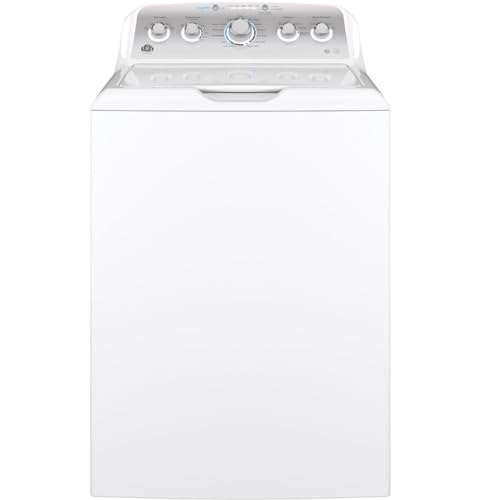
GE 4.6 Cu. Ft. Top-Load Washer with Stainless Steel Basket — Best big-basket cycle menu
GE’s entry is the capacity leader of this guide: a 4.6 cu. ft. top-load washer with a stainless steel basket, thirteen cycles, in white, with the model GTW500ASNWS printed in the listing. Thirteen cycles on a big drum is the efficiency strategy of range: the household that can choose a short, low-water programme for the gym kit and a full treatment for the towel load wastes less across a year than the household with one programme and a prayer. The stainless basket, as on the BLACK+DECKER, is a longevity feature that keeps the drum kind to fabrics as the years accumulate.
Big drums carry one efficiency trap, and it is behavioural: a large basket invites waiting until it is full, which is good, and then overfilling it past the point where water can move, which is not. Loaded to a sensible loft, a 4.6 cu. ft. drum washes a family’s day in one cycle instead of two half-cycles in a smaller machine — and one full cycle is nearly always thriftier than two partial ones. That arithmetic, plus your model-number verification, is this machine’s honest efficiency case.
- Capacity stated in the listing: 4.6 cu. ft.
- Model stated in the listing: GTW500ASNWS
- Basket stated in the listing: stainless steel
- Cycles stated in the listing: 13
- Finish named in the listing: white
- Certification wording in the listing title: no certification claim printed; verify by model
Strengths
- The largest drum here consolidates family laundry into fewer, fuller, thriftier cycles.
- Thirteen cycles give real range for matching water and time to each load’s needs.
- A printed model and stainless basket make verification and long service straightforward.
Trade-offs
- Small households will rarely fill it, and half-empty big drums are the opposite of efficient.
- Its size needs a laundry space and doorway that accept a full family machine.
- Cycle abundance only saves resources when someone actually selects thoughtfully.
Best for: families who consolidate laundry into full loads and use a cycle menu with intent. Not suited for: singles and couples, whose loads would swim in a drum this size.
The Six Contenders in One Honest Table
| Pick | Drum size | Wash action | What the listing itself claims |
|---|---|---|---|
| KoolMore 4.0 Cu. Ft. High-Efficiency Top-Load Washer with Agitator | 4.0 cu. ft. | Agitator | High-efficiency design, 25-inch width |
| Kenmore 4.4 Cu. Ft. Top-Load Washer with Triple Action Agitator | 4.4 cu. ft. | Triple-action agitator | Express Wash and AccelaWash, touch controls |
| Kenmore 4.1 Cu. Ft. Top-Load Washer with Triple Action Agitator | 4.1 cu. ft. | Triple-action agitator | Express Wash and AccelaWash, touch controls |
| BLACK+DECKER 4.1 Cu. Ft. Top-Load Washer with Agitator | 4.1 cu. ft. | Agitator | Glass lid, stainless tub, 10 cycles, 120V |
| Amana 3.5 Cu. Ft. Top-Load Washer | 3.5 cu. ft. | Top-load wash action; type not detailed in the title | Model NTW4516FW, white |
| GE 4.6 Cu. Ft. Top-Load Washer with Stainless Steel Basket | 4.6 cu. ft. | Top-load wash action; basket in stainless steel | 13 cycles, model GTW500ASNWS |
How Do You Verify a Washer’s Energy Credentials Before Buying?
Slow down and treat verification as a small ritual with four beats. Beat one: capture the exact model number, including every letter suffix, because certification attaches to a model, not to a product family — a suffix can mark a variant with different figures. Beat two: open the EnergyGuide information for that model, which the seller must make available, and note the estimated yearly energy use and the comparison range for machines of its class; a model sitting at the frugal end of its range is telling you something real. Beat three: search the model on the official Energy Star product finder. Presence there, with matching figures, is certification. Absence is also an answer. Beat four: if a utility rebate matters to your budget, check the rebate list separately, since programmes set their own qualifying models and paperwork.
Two cautions keep the ritual honest. Photographs of labels in a listing gallery may show a sibling model, so always match the number, never the picture. And retailer marketing phrases — eco, green, energy-saving — are adjectives, not certifications; only the registry entry and the model’s own EnergyGuide are evidence. Readers applying the same evidence-first habit to the drying side will find Best High-Capacity Clothes Dryers useful, since a dryer’s appetite dwarfs a washer’s and deserves the same scrutiny.
What Actually Drives a Top-Loader’s Water and Energy Use?
Water dominates. A top-load washer’s fill level is the single largest variable in its lifetime resource use, which is why load sensing and honest cycle choice matter more than any single component. A machine that weighs the load and fills accordingly saves water on every small wash without asking the user to think; a machine with manual levels saves the same water only when the user chooses well. Neither is automatically superior — but know which discipline you are buying, your own or the machine’s.
Temperature is the energy lever. Heating water costs far more than moving it, so a household that shifts everyday loads to cool water cuts the washer’s energy story dramatically, whatever model stands in the corner. Modern detergents are formulated for exactly this, and the loads that genuinely benefit from heat — heavily soiled work clothes, the occasional hygiene wash — are the minority in most homes. Spin speed is the hidden third lever: a thorough spin leaves clothes drier, and every minute shaved off drying time is energy the dryer never spends. When you compare two models, you are really comparing how they help you manage fill, temperature, and spin — the label figures simply summarise how well the machine’s defaults do that job.
Agitator, Impeller, or Hybrid: Which Washes Efficiently and Well?
Every pick in this guide with a stated wash action uses an agitator, which surprises buyers who absorbed the idea that efficiency requires an impeller plate. The truth is narrower: early high-efficiency top-loaders favoured impellers because they free drum space and use less water, but agitator designs have since been engineered into HE platforms — the KoolMore states exactly that combination. An agitator’s advantage is mechanical action on dirty loads; its historical cost was water volume, and modern fill control is what closes that gap.
Choose by your laundry’s character. Mud, ground-in grime, and work clothes argue for the agitator’s scrub. Bulky items that need room to roll argue for space, which either a larger agitator drum or an impeller provides. And delicate wardrobes argue for gentler cycles whichever mechanism turns below them. Efficiency, in the end, is a property of the whole system — machine, load, cycle, and user — and the best choice is the one whose defaults match how your household already behaves on laundry day.
Rebates, Paperwork, and the Folder Worth Keeping
Efficiency purchases often come with money attached after the sale, and the households that collect it are simply the ones who kept the paperwork. Utility rebates for efficient washers are common in many regions, and they typically ask for three things: proof of purchase, the exact model number, and evidence that the model qualifies — which is the registry entry your verification ritual already produced. Save the invoice, a screenshot or print of the model’s registry page, and the EnergyGuide for the machine, together, in one folder, physical or digital. Rebate windows close; a claim assembled in an afternoon from a ready folder beats a claim abandoned because a document went missing.
The same folder earns its keep for a decade. Warranty claims want the purchase date and model. Service technicians identify parts by model and serial. A future buyer of your home will ask what the laundry machines are and how old they stand. Even the humble manual matters: cycle recommendations and filter locations live there, and the household that can find its manual uses its machine better. None of this is glamorous, and all of it is the difference between an efficient purchase and an efficiently owned purchase.
One more document deserves a sentence: your old machine’s figures. Photograph its label before it leaves, because the comparison between old and new — the actual water and energy story of your upgrade — is the only honest answer you will ever have to the question of whether the efficient machine was worth it, and it is satisfying, years later, to know rather than to guess.
Doing the Ten-Year Arithmetic Without Inventing Numbers
Guides that promise a precise payback period are usually selling something, because the arithmetic depends on numbers only your household knows. But the shape of the calculation is universal, and you can run it honestly with your own figures. Start with loads per week — count for one real week rather than estimating, because households routinely undercount by a third. Multiply by fifty-two, and by ten years, and you have the number of times the machine will fill, heat, agitate, and spin across its life. Against that total, even a modest per-load difference in water or energy becomes a large absolute number, which is why the efficient machine’s case strengthens with household size and laundry volume, and weakens for the single person washing twice a week.
Then set the other side of the ledger honestly. The efficient choice sometimes costs more upfront; sometimes, as with right-sized drums, it costs less. Installation, hoses, and a possible circuit check belong in the first column. Maintenance belongs in both. And the dryer — which typically consumes several times the washer’s energy per load — belongs in the household’s total picture even when this purchase is only the washer, because a washer that spins drier loads is quietly subsidising every drying cycle for a decade. Run the arithmetic with your numbers, from your models’ verified guides, and the answer you get will be one you can defend at the kitchen table.
Five Habits That Make Any of These Machines More Efficient
First, wash full but not stuffed: clothes should move freely when the drum turns, with roughly a hand’s width of space at the top of the load. Second, default to cool water and reserve warmth for the loads that genuinely need it — heavily soiled workwear and the periodic hygiene wash. Third, choose the cycle by the load in front of you rather than by yesterday’s habit; the quick cycles on the Kenmore picks exist for the lightly soiled majority, and using them is the entire point of their presence.
Fourth, dose detergent by the measure, not by the glug — excess detergent forces extra rinsing, dulls fabrics, and films the machine, and high-efficiency designs are especially sensitive to overdosing because they rinse with less water. Fifth, keep the machine itself efficient: clean the inlet screens when fills slow, leave the lid open between washes so the drum dries, and run the manufacturer’s cleaning cycle on schedule. Habits compound like interest; five small ones, repeated across thousands of loads, are worth more than any single feature on any specification sheet in this guide.
Buying Efficient Machines for Rentals, Guest Houses, and Second Laundry Rooms
Not every washer in this guide will serve its buyer’s own laundry, and the efficiency logic shifts when the user is a tenant, a guest, or a houseful of holiday relatives. In a rental, durability and simplicity outrank the last drop of efficiency, because a machine that confuses its users gets run on its longest, hottest programme forever — which is an argument for the straightforward Amana, or for any model whose default cycle is a sensible one. Landlords should also weigh the service network behind a name, since a rental machine’s downtime is measured in tenant goodwill.
In a guest house or holiday home, loads arrive in bursts and sit in the drum forgotten, so quick cycles and a drum that dries itself with the lid up matter as much as consumption figures. In a second laundry room — the basement or garage point for garden clothes and dog towels — the calculus inverts entirely: a modest, right-sized machine that handles filthy loads without complaint protects the main machine upstairs, and its efficiency is measured in the main machine’s longer life. Match the pick to the post it will serve, and the label conversation becomes one factor among several rather than the whole decision.
What the Next Decade of Efficient Top-Loaders Will Probably Bring
The direction of travel is visible in this very guide: agitators engineered into high-efficiency platforms, cycle menus that adapt time to soil, and controls that report consumption honestly. Expect load sensing to become universal, detergent dosing to automate, and the registry figures to keep tightening as standards rise. None of that is a reason to wait — a household washing weekly cannot bank the savings of a future machine — but it is a reason to buy the platform whose manufacturer publishes clear model information and documents its machines well, because the well-documented machine is the one whose parts, manuals, and figures remain findable in year nine. Documentation, unglamorous as ever, is the future-proofing that actually works.
A Walkthrough: Comparing Two Drums on Paper Before Comparing Them in Person
Suppose a household of four stands between the 4.4 cu. ft. Kenmore and the 4.6 cu. ft. GE, and suppose — as is common — that both listings look equally plausible on the screen. The paper comparison proceeds in a fixed order. First, the largest regular load: this household washes a king duvet cover and two sets of bedding weekly, so both drums pass, and the question becomes how the load sits — the GE’s extra room lets bedding roll rather than pack, while the Kenmore’s agitator gives the week’s grime a more mechanical answer. Neither fact is decisive; both are real.
Second, the everyday load: school and work clothes, five days a week. Here the Kenmore’s named quick cycles speak directly to the household’s dominant pattern, while the GE’s thirteen-cycle menu answers with range. Third, the paperwork: both listings print model numbers, so both machines can be verified in the registry in minutes, and the household should actually do it — the verified figures, not this paragraph, are the tiebreaker that counts. Fourth, the room: measure the laundry space and the doorway, because a machine that cannot enter the house has an efficiency of exactly zero. The walkthrough’s lesson generalises: capacity fit, dominant-load fit, verified figures, physical fit — in that order — will settle nearly any two machines in this guide without a showroom visit.
Water Quality, Detergent, and the Efficiency Nobody Labels
Two households can buy the same verified machine and live different efficiency stories, because water and detergent mediate everything the drum does. Hard water dulls detergent’s effectiveness, tempting users to dose more and wash hotter to compensate — a quiet tax on every load. If your area’s water is hard, the efficient response is at the water’s level: a softener where justified, or a detergent formulated for hard water, dosed by measure. The machine’s figures were earned in test water; your kitchen tap writes the real ones.
Detergent format matters in HE machines specifically. High-efficiency detergent is formulated to suds less, because excess foam cushions the wash action and forces longer rinsing in a machine designed around low water. Using a conventional detergent in an HE drum, at a conventional dose, is the single most common self-inflicted wound in this category — the machine is blamed for grey, stiff clothes that its owner effectively soaped into existence. Read the drum’s requirements, dose with the cap, and let the verified machine do the job it was tested doing.
Listening to Owners: The Complaints That Repeat, and What They Teach
Read enough owner discussion of efficient top-loaders and the same handful of themes recur, each carrying a lesson a buyer can bank in advance. The first theme is cycle length: efficient machines often wash longer than the thirsty ancestors they replace, trading time for water. Households that plan around it — loading before dinner, drying after — never notice; households that discover it during a school-uniform emergency remember it forever. The second theme is the learning curve of load sensing: a machine that fills by weight feels stingy to eyes trained on brimming tubs, and the clothes emerging clean are the only argument that settles the doubt.
The third theme is sound. Efficient spins run fast, and a fast spin on an unlevel floor is a drum solo. The fourth is detergent discipline, already covered, which owners reliably describe as the thing they wish they had known on day one rather than month three. And the fifth, cheeringly, is the utility bill conversation: households that tracked their figures — the folder keepers from earlier in this guide — are the ones who report genuine, if modest, satisfaction rather than vague disappointment. Expectation, set by evidence, is the whole secret.
Installation Choices That Protect the Figures You Verified
A verified-efficient machine can be installed into inefficiency. Long, kinked inlet hoses and partially closed supply valves slow the fill and confuse load sensing; the machine compensates, the cycle stretches, and the savings leak away invisibly. Fit new hoses of the right length, open the valves fully, and confirm the drain hose’s height matches the manual — a drain set too low can siphon water out mid-cycle, and a machine refilling a siphoning drum is burning water to stand still.
Levelling belongs in the same paragraph, because an unlevel efficient washer is a contradiction: the spin slows itself to protect the cabinet, clothes emerge wetter, and the dryer inherits the difference with interest. Four feet, a spirit level, and ten patient minutes on delivery day defend a decade of figures. Finally, place the machine where its lid can open fully and its drum can dry between washes — a mildewed drum demands hotter, longer cleansing washes, and the household pays for its own storage decision every week.
Teaching the Household the New Machine’s Logic
Every efficient washer arrives with an invisible opponent: the previous machine’s habits, installed in everyone who does laundry. The person who always chose the longest cycle, the one who filled by eye to the brim, the one who dosed detergent by optimism — all of them will operate the new machine the old way unless the household spends one conversation on the new logic. Explain the load sensing before someone concludes the machine is broken because the water looks low. Agree the household’s default cycle, and write the detergent measure on a card taped inside a nearby cupboard door.
Give the machine a month of honest use before judging it. Fabrics washed in less water feel different at first; cycles run longer; the sounds change. Households that pre-commit to the month, and track one utility figure if they are so inclined, almost always end it converted. Households that judge on the first load are usually judging their own unfamiliarity — and the machine, verified and capable, deserves the fairer trial.
The Septic, Well, and Metered-Water Cases
Three households feel a washer’s thirst in ways the average guide underplays. A home on a septic system sends every gallon the washer uses through a tank sized for a gentler era, and an efficient machine is effectively a septic-life extension device. A home on a well spends electricity on every gallon twice — once to pump it, once to heat or move it — and feels drought summers in its laundry choices directly. And a home on metered water watches the bill translate each fill into currency with no ambiguity at all. If any of these is your house, the verification ritual matters doubly, and the right-sized drum argument in the Kenmore and Amana reviews deserves your closest attention.
A Short Glossary for the Product Page
Four terms recur on every product page in this category, and each translates plainly. High-efficiency, or HE, describes a design class built around reduced water and energy use, with detergent to match. Load sensing means the machine estimates the load’s size or weight and sets its fill accordingly. An EnergyGuide figure is the standardised estimate that lets models be compared like for like. And a model suffix — the letters after the base number — marks a specific variant whose figures may differ from its siblings, which is why the whole of this guide keeps returning to one instruction: check the exact model, in the registry, before the purchase, and keep the proof with the invoice afterwards.
Efficiency Mistakes That Cost More Than the Label Saves
The classic mistake is buying the efficient machine and running it inefficiently: full-hot washes for lightly worn clothes, the longest programme as a default, and half-loads run daily out of impatience. Second comes ignoring the drum-fit question — a couple running a 4.6 cu. ft. drum at one-third capacity is paying family-sized fills for single-sized laundry. Third is trusting a listing photograph of a label instead of verifying the model, the very trap this guide opened with. Fourth is forgetting the dryer: an efficient washer feeding an ancient, vent-choked dryer is a relay team with one runner. Households furnishing a whole laundry-and-living refresh in this evidence-first spirit might also browse Best Stackable Outdoor Dining Chairs, where checking what a listing actually claims pays off outdoors too.
Sixth comes a subtler error: assuming the efficient machine excuses the household from sorting. Efficient cycles still assume a load of similar fabrics and soil levels; the muddy rugby kit washed with the office shirts makes both loads worse and often triggers a rewash, which is the least efficient cycle of all — the one run twice.
Fifth, and most quietly expensive: neglecting the machine itself. A washer with a clogged inlet filter fills slowly and unevenly; a dryer-side equivalent problem doubles drying time. Efficiency is maintained, not merely purchased, and ten minutes of filter care a few times a year protects the figures you verified so carefully.
Final Recommendation
Start with the KoolMore if you want the efficiency design stated by the listing itself in a sensible family size. Choose between the two Kenmores by drum fit — 4.4 for family volume, 4.1 for a couple’s rhythm — when an agitator built for dirty loads matters most. Take the BLACK+DECKER for its printed model, glass lid, and stainless tub; the Amana for small-household simplicity; and the GE when consolidating laundry into fewer, fuller cycles is your household’s real efficiency strategy.
A closing word on expectations, because this category attracts both true believers and reflexive sceptics, and both can shop badly. The believer buys the badge and never checks a figure; the sceptic dismisses the whole enterprise and buys the thirstiest drum on the floor. The evidence supports neither. Efficient top-load design is a real, measurable, registry-documented thing — and like every real thing, it rewards the buyer who verifies it model by model and then cooperates with it load by load.
Whichever name you land on, run the verification ritual before you buy and the cool-water, right-cycle habits after it arrives — because in this category the honest label is the one you check yourself, and the efficient household is the one that keeps behaving efficiently long after the delivery van has gone.
Frequently Asked Questions
Why don’t the listings just say Energy Star in the title?
Marketplace titles are written for search and brevity, and certification is only one of many facts competing for those characters. Sellers also know certification attaches to an exact model and can vary between variants, so the claim often lives on the product page, the EnergyGuide document, and the official registry instead. That is precisely why this guide teaches verification rather than repeating badges.
How much can an efficient top-loader actually save?
The honest answer is that it depends on your current machine, your water heating fuel, and your habits — which is why we print no invented savings figures. The EnergyGuide for your exact model states estimated yearly energy use, and comparing that number against your old machine’s guide is the only arithmetic worth trusting. Water savings follow the same model-by-model logic.
Does an agitator machine use more water than an impeller machine?
Historically yes, but modern agitator models with load sensing and controlled fills have narrowed the gap considerably, and one pick here is an explicitly high-efficiency agitator design. Your cycle and level choices move the total more than the mechanism does. Judge by the model’s verified figures rather than by the shape of the thing in the drum.
What is the EnergyGuide label, and where do I find it?
It is the standard yellow label that states a model’s estimated yearly energy use and how that figure compares with similar models. Sellers must provide it for covered appliances, and it usually appears among the product page’s documents or images. Match its model number to the machine you are buying — a label for a sibling model is not evidence about yours.
Do efficient washers clean as well as thirsty ones?
Yes, when the load is sized and sorted sensibly. High-efficiency designs trade water volume for longer, smarter agitation and better chemistry contact. The loads that expose any washer — a drum stuffed solid, or a single mud-caked item among delicates — are loading errors, not efficiency failures. The triple-action agitator picks here exist for households whose dirt is the real thing.
Are rebates for efficient washers worth chasing?
Often, yes — the sums are meaningful and the paperwork is the same folder this guide recommends keeping anyway: invoice, model number, and the registry entry for your exact machine. Check your utility’s programme before buying rather than after, because some rebates require the model to appear on a specific qualifying list, and that list is one more verification your five-minute ritual can cover.
Should I replace a working washer purely for efficiency?
Usually not on economics alone: a functioning machine replaced early carries the cost and footprint of its own manufacture. The stronger case is replacement at natural end of life, or when the old machine’s water use is extreme and your household washes constantly. When you do replace, the verification habit ensures the new machine’s advantage is real rather than advertised.
Related Guides
One more piece of housekeeping belongs in that folder: a note of the day the machine was installed and the name of the installer, if a professional fitted it. Warranty conversations, rebate audits, and insurance questions all become shorter when those two facts are written down rather than reconstructed from memory years later.
Keep the registry habit for every appliance that follows this one into your home — refrigerator, dryer, dishwasher — because the five minutes it takes scales into the most reliable money-saving routine in this entire guide.
To explore the broader high-efficiency top-load field beyond this shortlist, continue to Best HE Top-Load Washers, which covers the category the certification conversation starts from.


