What's inside
- Key Takeaways
- Quick Picks
- How We Chose These Picks
- At a Glance: Drums, Systems, and the Honest Gap
- How Do You Actually Verify a Sanitize Programme Before Buying?
- What Does Hot Washing Actually Accomplish, Load by Load?
- Mistakes Buyers Make When Chasing a Sanitizing Label
- How Should You Run a Top-Loader for Thorough, Hot Results?
- What Separates the Three LG Picks From Each Other?
- How Do You Keep a Top-Loader Itself Clean Enough to Clean?
- What About Water Use, Septic Systems, and Wells?
- Reading the Room: Who Should Not Buy a Top-Loader at All?
- How Long Do These Machines Last, and What Kills Them Early?
- A Buyer’s Checklist for the Listing Page, in Order
- What Do Owners of Big Top-Loaders Learn in the First Month?
- How Does This Guide’s Honesty Rule Apply to the Rest of Your Shopping?
- A Note on Laundry for Babies, Illness, and Other Serious Loads
- How Should You Sort When Thoroughness Is the Goal?
- What Happens If You Simply Buy the Biggest Drum and Hope?
- Why Do Makers Name Programmes So Differently, Anyway?
- One Last Practical Pattern: The Weekly Hot Rotation
- How Do You Compare Two Machines When Their Titles Say Different Amounts?
- What Should Landlords and Shared Houses Take From This Guide?
- Final Recommendation
- Frequently Asked Questions
- Related Guides
As an Amazon Associate I earn from qualifying purchases. This post may contain affiliate links at no extra cost to you.
cottageverdict.com is reader-supported. When you buy through links on our site, we may earn an affiliate commission.
Where to buy: Every machine below links to its Amazon listing, where you can check price on Amazon and, just as importantly, open the maker’s cycle chart to verify programme names for yourself.
This guide to the best top-load washers with sanitizing begins with a disclosure most roundups would bury: across the verified pool for this article, not one top-load listing title names a Sanitize cycle. We searched repeatedly and the result held. So the six machines below are presented for exactly what they are — the strongest hot-wash and high-performance top-loaders in the verified pool — and not one of them is described anywhere in this guide as having a sanitize cycle, because no fetched title says so. If a true, maker-named Sanitize programme is your non-negotiable requirement, the honest path is to open each maker’s cycle chart from the listing, look for the exact word Sanitize in the programme list, and buy only when you see it in the manufacturer’s own documentation. Readers who prefer a front-load format for hot, thorough washing will find the gentle-motion discussion in Best Washers With a Handwash Cycle useful alongside this guide.
Why publish the guide at all, then? Because the need behind the search is real and these machines serve most of it. Households typing sanitizing into a search box usually want towels, bedding, cloth nappies, work clothes, and sick-room laundry washed hot and thoroughly, with strong mechanical action. Top-load design answers that need with deep fills, vigorous agitation or impeller action, and simple, repairable mechanics. What it cannot do in this verified pool is wear the Sanitize label, and this guide would rather lose a little marketing shine than invent a programme name. The picks are excellent top-loaders. Judge them as such, verify the cycle name yourself if the label matters, and the purchase will rest on facts.
Key Takeaways
- No listing in the verified pool names a Sanitize cycle in its title; this guide says so plainly and credits no pick with one.
- The picks are the strongest hot-wash-capable top-loaders verified: three LG models, a Samsung, a GE Profile, and an agitator-equipped KoolMore.
- Capacity spans 4.0 to 5.0 cubic feet, so family bedding and towel volume is genuinely covered.
- Agitator versus impeller is the real mechanical choice here, and the KoolMore is the pick whose title names an agitator.
- Washer-cleaning tablets are not picks in this guide and are never linked as machines; they are a maintenance product, not a washer.
Quick Picks
| Pick | Badge | Why it is here |
|---|---|---|
| LG WT6105CW 4.1 Top Load Washer | Best balanced hot-wash performer | TrueBalance anti-vibration, direct drive motor, and eight cycles in a 4.1 cubic foot drum. |
| LG 5.0 Smart Top Load Washer | Best capacity with sensing | Five cubic feet with TurboWash, Easy Unload design, and AI Sensing in Alpine White. |
| LG 4.3 Ultra Large Capacity Top Load Washer | Best straightforward LG capacity | An ultra large capacity 4.3 cubic foot top-loader for buyers who want size without ceremony. |
| Samsung WA50R5200AW 4.5 Top Load Washer | Best familiar mid-size | A 4.5 cubic foot white top-loader from Samsung’s long-running WA50 family line. |
| GE Profile PTW605BSRWS Top Load Washer | Best smart wash technology | Smarter Wash Technology and FlexDispense in a 4.9 cubic foot cabinet. |
| KoolMore 4.0 Top Load Washer with Agitator | Best agitator action | A 25-inch, 4.0 cubic foot high-efficiency top-loader whose title names its agitator. |
How We Chose These Picks
The method deserves its own section because the honesty of this article lives in it. We began with the verified pool assembled for this batch, in which every candidate listing title was fetched and recorded. We then read those titles specifically for the word Sanitize and its variants. The result, stated in the introduction and repeated here so no reader can miss it, is that no top-load title in the pool names a Sanitize cycle. One front-load compact elsewhere in this batch does name a sanitize programme, which proves the search could find the word when a maker used it; the top-load makers in this pool simply did not put it in their titles.
Faced with that result, the guide had two honest options: publish nothing, or publish the strongest hot-wash top-loaders with the gap declared. We chose the second because the underlying need — hot, thorough, high-volume washing — is well served by these machines, and because readers deserve a map of the real market rather than a fiction built to match a keyword. Selection within the pool favoured capacity for bedding and towels, mechanical action for heavily soiled loads, sensing and balance systems that keep big top-load drums civilised, and one true agitator model for households whose laundry genuinely needs it. No cleaning tablet, hose, filter, or accessory from the searches was admitted as a pick, because accessories are not washers.
Every specification below comes from the fetched titles. Where a title does not state a figure, the review does not invent one, and the recurring advice of this guide applies: if the exact programme name Sanitize matters to you, verify it on the maker’s cycle chart before ordering, because that chart — not this article, not the search keyword — is the authority on what a machine’s programmes are called.

LG WT6105CW 4.1 Top Load Washer — Best balanced hot-wash performer
The WT6105CW is the most completely described top-loader in this set: 4.1 cubic feet in white, TrueBalance anti-vibration, eight wash cycles, large capacity positioning, a direct drive motor, and SmartDiagnosis. Direct drive matters for hot, heavy work because the motor turns the drum or impeller without a belt, giving strong, controlled action and one less wear part in the drivetrain. TrueBalance addresses the top-load category’s oldest complaint — the walking, thumping spin with an uneven towel load — by sensing and correcting imbalance rather than surrendering to it.
Eight cycles is a modest count that suits this machine’s character: the essential programmes, clearly chosen, including the hot washes that households seeking thorough cleaning will live on. SmartDiagnosis helps when something does go wrong, letting the machine communicate fault information to support rather than leaving the owner describing a noise over the phone. At 4.1 cubic feet it handles family towels and bedding honestly, and its balance of action, capacity, and civility makes it the guide’s default recommendation for buyers who want hot washing done well without paying for the largest drum in the room.
- Capacity: 4.1 cu. ft. top load, white
- Systems: TrueBalance anti-vibration, Direct Drive Motor, SmartDiagnosis
- Cycles: 8 wash cycles per listing title
- Where to buy: the LG WT6105CW 4.1 Top Load Washer listing on Amazon — check price on Amazon
Strengths
- Direct drive gives strong action with fewer wear parts.
- Anti-vibration system keeps heavy hot loads civilised.
- Diagnosis support shortens any future repair conversation.
Trade-offs
- Eight cycles is a lean menu beside sensing-heavy rivals.
- No programme named Sanitize appears in its title — verify on the cycle chart if the label matters.
- Mid-size drum asks the largest households to split bedding days.
Best for: households wanting hot, thorough washing with balanced, belt-free mechanics.
Not suited for: buyers who require a maker-named Sanitize programme confirmed before purchase and find none on its chart.

LG 5.0 Smart Top Load Washer — Best capacity with sensing
Five cubic feet is the largest drum in this guide, and LG pairs it with TurboWash, an Easy Unload design, and AI Sensing in an Alpine White finish. The sensing is the story as much as the size: a drum this large invites careless loading, and AI Sensing that reads load weight and fabric character to set water and action is the difference between a big machine that washes well and a big machine that merely washes a lot. TurboWash then attacks the time cost of large loads, using vigorous water movement to shorten the path for everyday family volume.
Easy Unload deserves its sentence because top-load ergonomics are real: a deep five-foot drum asks shorter users to reach, and design that brings the load within easier reach decides whether the machine is loved or resented by everyone in the house. For the hot-wash mission of this guide, the combination is potent — maximum volume for bedding and towel days, sensing to keep that volume washing properly, and speed for the routine loads between. Households on septic or water-conscious routines should balance this capacity against the low-water thinking in Best Washers for Well Water, where inlet care and water discipline get full treatment.
- Capacity: 5.0 cu. ft. smart top load, Alpine White
- Systems: TurboWash, Easy Unload, AI Sensing
- Positioning: largest drum in this guide
- Where to buy: the LG 5.0 Smart Top Load Washer listing on Amazon — check price on Amazon
Strengths
- Largest capacity here, with sensing to manage it intelligently.
- TurboWash keeps big-load days from consuming the whole day.
- Unload-friendly design respects shorter users and deep drums.
Trade-offs
- Big drum tempts overloading, which sensing can only partly forgive.
- No Sanitize programme is named in the title; check the maker’s chart.
- Smart features add complexity some households neither need nor want.
Best for: large households whose hot-wash volume is the week’s defining laundry fact.
A poor fit for: small households that will rarely fill even half its drum.

LG 4.3 Ultra Large Capacity Top Load Washer — Best straightforward LG capacity
Some listings say little and mean it. This LG’s title offers an ultra large capacity top-load washer at 4.3 cubic feet and stops there, and the review respects that economy: what is verified is a generously sized LG top-loader positioned on capacity, from a maker whose top-load engineering fills two other slots in this guide. Buyers who distrust feature inflation may find that restraint refreshing, and the correct way to evaluate this machine is to open its listing and read the full cycle chart and specification panel, where the details its title omits will be stated by the seller.
At 4.3 cubic feet it sits in the practical heart of the category — large enough for family bedding in single loads, small enough to stay balanced and water-sensible in ordinary weeks. For the hot-wash purpose, it offers the top-load format’s deep-fill, vigorous-action character in LG’s execution. It is the pick for buyers who have decided on the brand and the format and simply want the capacity point that fits a family of four, verified against the listing’s own full description before ordering.
- Capacity: 4.3 cu. ft. top load
- Positioning: ultra large capacity per listing title
- Verification note: read the listing’s full cycle chart for programme names
- Where to buy: the LG 4.3 Ultra Large Capacity Top Load Washer listing on Amazon — check price on Amazon
Strengths
- Practical family capacity without flagship complexity.
- LG top-load platform with a capacity-first proposition.
- Sized to stay balanced through ordinary weekly loads.
Trade-offs
- Title states few specifics, so the listing itself must be read carefully.
- No Sanitize programme is named in the title.
- Fewer headline systems than its sensing-heavy sibling above.
Best for: brand-decided buyers who want honest capacity and will verify details on the listing.
Not the right match for: feature-comparison shoppers who want every system named up front.
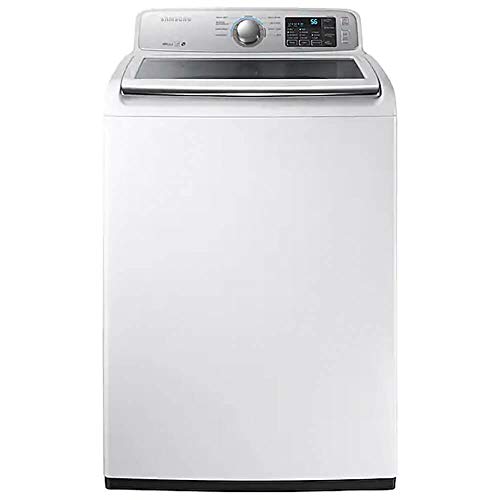
Samsung WA50R5200AW 4.5 Top Load Washer — Best familiar mid-size
Samsung’s WA50R5200AW is the known quantity of the group: a 4.5 cubic foot white top-loader from a model family that has furnished a great many laundry rooms, which carries practical advantages — familiarity among repair technicians, a deep pool of owner experience, and controls that visiting family members can operate without instruction. Its title, like the LG 4.3’s, is brief, and this review accordingly claims for it only what is verified: the capacity, the format, the finish, and the model identity.
For hot washing, the format does the work: deep water, room for bulky loads to move, and a drum sized for family towels and bedding at 4.5 cubic feet. Households replacing an earlier Samsung top-loader will find the transition painless, and households furnishing a rental or a first home gain a machine whose behaviour is thoroughly documented by years of owners. Verify its cycle chart on the listing for the hot programme details, as with every pick here, and let its familiarity count for what it is genuinely worth in ownership rather than in advertising.
- Capacity: 4.5 cu. ft. top load, white, model WA50R5200AW
- Positioning: established Samsung top-load family line
- Verification note: programme names to be confirmed on the maker’s cycle chart
- Where to buy: the Samsung WA50R5200AW 4.5 Top Load Washer listing on Amazon — check price on Amazon
Strengths
- Long-running model family with broad technician familiarity.
- Family-right capacity for bedding and towel volume.
- Controls that need no household training programme.
Trade-offs
- Title gives few specifics beyond capacity and format.
- No Sanitize programme is named in the title.
- Less sensing sophistication than the newest rivals here.
Best for: households replacing a Samsung top-loader or furnishing a first laundry room with a known quantity.
Poorly suited to: buyers shopping primarily for the newest sensing and smart systems.

GE Profile PTW605BSRWS Top Load Washer — Best smart wash technology
GE Profile’s PTW605BSRWS brings the guide’s most explicit wash-intelligence language: Smarter Wash Technology and FlexDispense in a 4.9 cubic foot white cabinet. Smarter Wash, as GE presents the concept, adapts the wash to the load rather than running a fixed script, which serves the hot-wash mission well because heavily soiled loads and lightly soiled loads should not receive identical treatment. FlexDispense addresses the other half of cleaning quality — getting detergent and additives into the wash at the right moment and in the right way, rather than dumped onto dry fabric at the start.
At 4.9 cubic feet it is the second-largest drum here, close enough to the LG 5.0 that the choice between them turns on systems and brand rather than size. Households that have fought detergent residue on dark clothes or uneven cleaning in mixed loads will understand exactly what this machine is selling. As ever in this guide, its title names no Sanitize programme, and readers for whom that exact label is decisive should consult GE’s cycle chart for this model before ordering — the chart, not the keyword, decides.
- Capacity: 4.9 cu. ft. top load, white, model PTW605BSRWS
- Systems: Smarter Wash Technology, FlexDispense
- Positioning: near-largest capacity with dispensing intelligence
- Where to buy: the GE Profile PTW605BSRWS Top Load Washer listing on Amazon — check price on Amazon
Strengths
- Adaptive wash technology suits mixed-soil family laundry.
- Managed dispensing improves detergent timing and residue control.
- Near-largest drum keeps bedding days simple.
Trade-offs
- No Sanitize programme is named in the title; verify on GE’s chart.
- Smart systems mean more to learn than a basic top-loader asks.
- Large cabinet needs its space measured, like every big drum here.
Best for: households whose complaint is uneven cleaning and detergent residue in big loads.
A weak match for: buyers who want the simplest possible control panel and nothing more.

KoolMore 4.0 Top Load Washer with Agitator — Best agitator action
The KoolMore closes the guide with the mechanical traditionalist’s choice: a 25-inch, 4.0 cubic foot top-load washing machine whose title names its agitator, described as a high-efficiency clothes washer for home laundry in white. The agitator question divides laundry households more than any other in this category. A central agitator moves clothes through the water with physical authority that impellers imitate with water currents; on ground-in workwear soil, farm clothes, and the loads that come home from building sites and playing fields, that authority is visible in the results.
The costs are equally visible: an agitator occupies drum centre, so bulky items wrap around it, and its action is harder on delicate fabrics than an impeller’s gentler roll. High-efficiency design tempers the category’s old water appetite. At 25 inches wide and 4.0 cubic feet, this is also the most space-manageable full performer here, suiting laundry closets that reject the biggest cabinets. Households whose laundry leans delicate should choose an impeller model above; households whose laundry leans filthy have found their pick. And to close the loop on this guide’s founding honesty: its title names an agitator, not a sanitize cycle, and it is recommended for the first of those facts alone. Larger operations comparing formats should also see Best Coin-Operated Washers and Dryers, where duty and payment systems enter the picture.
- Capacity and size: 25-inch, 4.0 cu. ft. top load, white
- Action: agitator, named in the listing title
- Efficiency positioning: high-efficiency clothes washer for home laundry
- Where to buy: the KoolMore 4.0 Top Load Washer with Agitator listing on Amazon — check price on Amazon
Strengths
- True agitator action for heavily soiled, hard-wearing loads.
- Narrower cabinet fits closets the biggest drums cannot.
- High-efficiency design moderates the traditional agitator thirst.
Trade-offs
- Agitator post reduces room for bulky bedding.
- Firmer action is wrong for delicate-heavy wardrobes.
- No Sanitize programme is named in the title.
Best for: workwear, farm, and sports households whose soil is physical and stubborn.
Not suited for: delicates-heavy wardrobes or anyone whose must-have is a named sanitize label.
At a Glance: Drums, Systems, and the Honest Gap
| Model | Drum | Headline systems from title | Sanitize named in title? |
|---|---|---|---|
| LG WT6105CW | 4.1 cu. ft. | TrueBalance, Direct Drive, 8 cycles | No |
| LG 5.0 Smart | 5.0 cu. ft. | TurboWash, AI Sensing, Easy Unload | No |
| LG 4.3 Ultra Large | 4.3 cu. ft. | Capacity positioning | No |
| Samsung WA50R5200AW | 4.5 cu. ft. | Established model family | No |
| GE Profile PTW605BSRWS | 4.9 cu. ft. | Smarter Wash, FlexDispense | No |
| KoolMore Agitator | 4.0 cu. ft. | Agitator, high-efficiency | No |
How Do You Actually Verify a Sanitize Programme Before Buying?
The verification takes five minutes and this guide begs you to spend them. From the listing, find the manufacturer’s own page or manual for the exact model number, and open the cycle chart — the table that lists every programme with its temperature, duration, and load guidance. Search that chart for the word Sanitize. If it appears as a programme name, the machine offers it as the maker defines it, and you can read its temperature and duration right there. If the chart offers hot, heavy, or allergen-style programmes under other names, you have learned something equally valuable: the machine washes hot and thoroughly under honest labels, and you can decide whether the capability or the word is what you truly need.
Apply the same scepticism in reverse to any source — including search results and roundups elsewhere — that attaches the word sanitize to a machine without pointing at the maker’s chart. Programme names are cheap to type and expensive to verify, and the gap between the two is where disappointed purchases live. This guide’s pool was built from fetched titles precisely so that its claims could be checked, and its central negative claim — no top-load title here names Sanitize — can be checked the same way by any reader in minutes.
What Does Hot Washing Actually Accomplish, Load by Load?
Hot water helps detergent dissolve and work faster, loosens body oils from towels and bedding, and supports the thorough cleaning households want for sick-room laundry and cloth nappies. It is a tool with costs: energy, colour fade on darks, gradual harm to elastic, and setting of certain protein stains if applied before rinsing. The skilled pattern is selective heat — hot for towels, bedding, underwear, and whites that tolerate it; warm for everyday loads; cold for colours, delicates, and anything with elastic you value. Every machine here offers that range through its programme design, and the household that sorts by temperature gets the sanitizing-adjacent benefit they came for, honestly labelled or not.
Mechanical action is heat’s partner. Deep fills let bulky items move; agitators push; impellers roll loads through water currents; sensing systems adjust both to the load actually present. When readers ask which machine cleans most thoroughly, the truthful answer is that the best-run mid-range machine outperforms the worst-run flagship, because temperature discipline, load discipline, and detergent discipline are set by the user at every wash.
Mistakes Buyers Make When Chasing a Sanitizing Label
The first mistake is buying the word instead of the wash: choosing a lesser machine because a headline promised sanitizing, over a stronger machine honestly described. The second is assuming a hot programme sanitizes delicate or elastic items safely, when heat damages them regardless of the programme’s name. The third is treating cleaning tablets as a machine feature — tablets maintain a washer; they do not wash clothes, which is why they appear nowhere in this guide’s picks. The fourth is neglecting the washer itself: a neglected machine with residue in its tub undermines every hot programme run in it, so monthly cleaning cycles and door-ajar drying are part of thorough washing, not housekeeping trivia.
How Should You Run a Top-Loader for Thorough, Hot Results?
Load loose and even. Top-load drums clean by moving clothes through water, and a load packed to the rim moves as one stiff mass that the centre items never leave. Fill to roughly three-quarters, distributing weight around the drum so the spin starts balanced, and place the dirtiest items where the action is strongest — throughout the load for an impeller, not all wrapped against the agitator post on the KoolMore. Choose the hottest temperature the care labels allow, the longest programme the schedule tolerates, and a measured detergent dose matched to the soil rather than to optimism.
Pre-rinse or pre-soak the worst loads. Protein-based stains set under immediate heat, so a cool soak first, then the hot wash, outperforms a single hot blast on everything from baby clothes to sports kit. Use the soak to your advantage on towel days too: a short soak loosens the detergent residue and body oil that make towels go stiff and sour, and the hot wash that follows restores absorbency that owners often think the towels have lost permanently. Finish by unloading promptly and drying thoroughly; a hot wash followed by three damp hours in the drum undoes its own good work.
What Separates the Three LG Picks From Each Other?
Buyers often ask why one guide needs three machines from one maker, and the answer is that they occupy genuinely different points. The WT6105CW is the engineered all-rounder: direct drive, anti-vibration, diagnosis, and a mid-size drum, aimed at households that want the category’s fundamentals executed well. The 5.0 Smart is the capacity flagship, where the drum is the headline and sensing exists to govern it. The 4.3 is the capacity-value point, an ultra large drum with the least ceremony, for buyers who have already decided the format and brand and want size without a smart premium. A household choosing among them should decide which of those three sentences describes its laundry, and the choice will usually make itself.
The Samsung and the GE Profile then frame the LG trio from outside: the Samsung offering familiarity and a long service shadow, the GE offering the most explicit adaptive-wash and dispensing story in the guide. The KoolMore stands apart mechanically as the agitator. Six machines, six distinct reasons — which is what a verified pool is for, since it lets a guide recommend by difference rather than by ranking theatre.
How Do You Keep a Top-Loader Itself Clean Enough to Clean?
Thorough washing starts with a clean machine. Top-loaders hide residue under the agitator or impeller plate, in the dispenser, and along the tub rim where splash dries between washes. Run the machine’s cleaning programme, or the hottest longest empty cycle, monthly — more often in households washing daily or in humid climates. Wipe the rim and dispenser at the same sitting, leave the lid open between wash days so the tub dries, and treat any sour smell as a maintenance report rather than a mystery.
This is also where cleaning tablets belong in the conversation: as one optional aid inside that maintenance routine, bought as a consumable and judged as such. They were excluded from this guide’s picks because a roundup of washers must recommend washers, and confusing the two categories is how readers end up owning excellent tablets and a mediocre machine. Keep the categories straight and both purchases improve.
What About Water Use, Septic Systems, and Wells?
Top-loaders use more water than front-loaders by design, and households on septic systems or wells feel that difference in ways city households do not. Deep fills and hot washes are the thorough-cleaning tools this guide celebrates, and they should be spent deliberately: full loads rather than half loads, hot programmes reserved for the laundry that benefits, and everyday loads run on the efficient settings these machines also provide. Several picks here carry high-efficiency design language, and using their sensing rather than overriding it is the practical compromise between thorough washing and a septic tank’s patience.
Well-water households face an additional wrinkle: sediment and mineral content that dull detergent and spot the tub. Inlet screens deserve periodic checks, and a household that notices grit in the dispenser should address the supply rather than the machine. None of this disqualifies a top-loader on a well or septic routine; it simply asks the owner to run the machine as a system, water included, which careful owners in every setting end up doing anyway.
Reading the Room: Who Should Not Buy a Top-Loader at All?
Households whose laundry leans delicate, whose members cannot comfortably reach into a deep drum, or whose space demands stacking should look at front-load alternatives, several of which appear elsewhere in this batch with steam and hygiene programmes of their own. Top-load virtues — deep water, vigorous action, simple mechanics, no bending to a low door — are real but specific. A buyer with a bad back may find the low front-load door worse; a buyer with bad knees may find the deep top-load reach worse. Ergonomics are personal, and the honest guide names the trade rather than declaring a winner for all bodies.
Likewise, buyers for whom the named Sanitize programme is a genuine requirement — a care setting with a policy, a household following clinical guidance — should not let this guide talk them into a substitute. Verify charts, consider the front-load compact elsewhere in this batch whose title names a sanitize programme, and buy the documented feature. This guide’s loyalty is to the match between reader and machine, and sometimes the match is a machine it does not list.
How Long Do These Machines Last, and What Kills Them Early?
Top-loaders are the longevity traditionalists of laundry: simple drivetrains, especially in direct-drive and agitator forms, can be serviced for many years, and parts for established model families remain available long after purchase. What kills them early is rarely the motor. It is chronic overloading that strains suspension and bearings, residue neglect that corrodes and smells, unbalanced spinning ignored until the machine walks itself into damage, and water quality left unmanaged until valves and inlets suffer. Every one of those is a habit, and the habits are cheaper than the repairs by an embarrassing margin.
Buy accordingly: a household that will maintain the machine can buy any pick here with confidence; a household that will not should weight the simplest mechanics and the strongest local service network, because their machine’s life will be decided by other people’s wrenches. Either way, keep the manual and the cycle chart — the document this guide keeps sending you back to — because it is the machine’s true specification and its owner’s best protection.
A Buyer’s Checklist for the Listing Page, in Order
Work through the listing in this order and the decision will usually settle itself. First, the model number: confirm the title, the specification panel, and the photos all describe the same machine, because marketplace listings occasionally drift. Second, the cycle chart: look for the programme names you care about, including the word Sanitize if that is your requirement, and note the hottest programme’s actual name and temperature guidance. Third, capacity against your bulkiest load, remembering that agitator drums surrender their centre. Fourth, dimensions and the door or lid swing in your space. Fifth, delivery and installation terms for a large appliance, including who connects it and who removes the old machine.
Sixth, and last because it should be last, the price on the day — check price on Amazon at the listing rather than trusting any figure quoted elsewhere, since appliance pricing moves with stock and season. A buyer who runs this checklist buys the machine that exists, with the programmes it actually has, in the size that actually fits. That sounds obvious, and the return statistics of large appliances suggest it is anything but.
What Do Owners of Big Top-Loaders Learn in the First Month?
They learn that capacity is a discipline before it is a convenience: the drum that swallows a week of laundry also swallows a week of sorting mistakes, and the households that thrive with five cubic feet sort at the hamper, not at the machine. They learn that sensing systems reward even loading and punish the single heavy blanket spun alone. They learn that hot programmes are a weekly instrument, not a default, and that towels washed hot and dried promptly stay pleasant in a way that no scented product imitates. And they learn the location of the manual’s cycle chart, usually after the first load that came out wrong, which is exactly the education this guide has been trying to give away for free.
How Does This Guide’s Honesty Rule Apply to the Rest of Your Shopping?
The same test travels well beyond washers. Whenever a product category’s marketing word — sanitizing, medical-grade, professional, smart — does the persuading, ask for the document behind the word: the cycle chart, the certification listing, the specification panel. Makers who have earned a label print it in their own documentation; sellers who merely repeat a keyword are borrowing authority they have not verified. This guide applied that rule to its own pool and published the uncomfortable result, because a roundup that will not say no to its own headline cannot be trusted when it says yes to a product. Hold every source, this one included, to the maker’s chart, and your laundry room will fill with machines that do what their paperwork says.
A Note on Laundry for Babies, Illness, and Other Serious Loads
Households wash some loads with more than cleanliness at stake — cloth nappies, bedding during illness, clothes after a flood or an accident — and they deserve plain guidance rather than label hunting. Wash those loads hot where fabrics allow, with a full measured detergent dose, an extra rinse for anything against sensitive skin, and prompt thorough drying, ideally with heat. Keep the machine itself clean so each serious load starts from a clean tub. Where a clinician or a care policy specifies a named programme or a temperature, follow that specification and verify it on the maker’s chart for the exact model, because a policy is a document and should be matched against a document. This guide discusses laundry practice only and offers no medical advice; the washing guidance above is household craft, and it is the same craft whether the programme that delivers it is called Sanitize or simply the hottest, longest cycle the chart honestly names.
How Should You Sort When Thoroughness Is the Goal?
Sorting for thorough washing differs from sorting for colour safety, and serious laundry days need both systems in sequence. First divide by destination temperature: the hot pile, the warm pile, the cold pile. Within the hot pile, divide again by soil, because a load of lightly used bath towels and a load of nappies should not share water even at the same temperature. Within every pile, keep weights together so the drum balances and the action stays even. This sounds laborious and becomes, after two wash days, a thirty-second habit at the hamper — especially if the household uses divided baskets that make the piles physical rather than mental.
Detergent follows the same logic. Dose for the soil in the drum, not for the drum’s size: a full load of lightly worn clothes needs less than a half load of workwear. Additives belong in the dispenser systems designed for them, such as the GE Profile’s FlexDispense arrangement, rather than poured over dry clothes where they can spot and waste. Thoroughness, in the end, is mostly this: the right items, at the right temperature, with the right dose, given enough time — a formula no programme name can replace and every machine here can execute.
What Happens If You Simply Buy the Biggest Drum and Hope?
Hope is not a wash programme. The biggest drum in this guide, the LG 5.0, is also one of the best-sensed, which rescues many hopeful loads — but even sensing cannot fix a drum filled past its balance, a hot programme chosen for elastic sportswear, or detergent poured by mood. Buyers who choose capacity first and discipline second usually end up running the machine at half its ability while blaming its size for noise that loading caused. Buyers who choose the drum their laundry actually fills, then run it with the sorting and temperature habits above, report the boring outcome everyone actually wants: laundry that comes out clean, in a machine that stays quiet, for years at a stretch.
Why Do Makers Name Programmes So Differently, Anyway?
Programme naming is part engineering, part marketing, and part legal caution, which is why the same hot, long, thorough wash appears across brands under entirely different labels. A maker that uses a word like Sanitize accepts a definitional burden for it in some markets, so legal teams prefer names they can define precisely, while marketing teams prefer names that sound decisive. The result is a landscape where capability and vocabulary drift apart, and where the cycle chart — temperatures, durations, load guidance — is the only reliable translator. This guide’s insistence on the chart is not pedantry; it is the reader’s one defence against a vocabulary designed to be impressive first and precise second.
That drift also explains why search keywords mislead. A shopper typing sanitizing meets pages written to match the word, whether or not the products carry it. The verified-pool method used here inverts the flow: fetch what makers actually claim, in their own titles, and build the guide on that record, even when the record contradicts the headline the guide was assigned. The discomfort of this article’s introduction is the sound of that method working, and readers should demand the same discomfort from any roundup whose headline promises a feature its picks cannot document.
One Last Practical Pattern: The Weekly Hot Rotation
Households that adopt these machines happily tend to converge on a rotation. One hot load anchors the week — towels and bedding together, sorted by fabric tolerance — run at the weekend when time allows the full programme. Workwear and sports kit form a second deliberate load, warm or hot by label, with pre-soaking when the week has been muddy. Everything else flows through everyday programmes at cooler temperatures, protecting colours and elastic and keeping energy use honest. The machine’s hottest capability is thus used weekly, purposefully, and never wastefully, which is precisely the outcome the sanitizing search was hoping for, achieved under whatever names the cycle chart honestly provides.
How Do You Compare Two Machines When Their Titles Say Different Amounts?
Uneven titles are the normal condition of appliance shopping, and this guide contains the full spectrum, from the densely specified LG WT6105CW to the nearly silent LG 4.3. The fair method is to compare at the level of the fullest documentation available for both: title first, then the listing’s specification panel, then the maker’s manual. Never penalise a machine for a quiet title if its manual is thorough, and never reward a loud title whose manual retreats from its claims. Where this guide could verify a fact, it printed the fact; where it could not, it printed the instruction to verify, and a reader comparing any two picks here should simply follow those printed instructions in order. The work takes an evening at most and governs a decade of laundry, which is the best hourly rate in all of appliance buying.
What Should Landlords and Shared Houses Take From This Guide?
Shared laundry punishes delicate complexity and rewards the familiar, the capacious, and the hard to break. The Samsung’s long model history and the LG 4.3’s straightforward capacity suit houses where five adults with five habits share one machine, and the KoolMore’s agitator suits the workwear-heavy shared house in particular. Whoever buys for a shared house should also buy the laminated version of the sorting and temperature rules and fix it above the machine, because in shared laundry the user manual that matters is the one on the wall. And if the house’s tenants ask whether the machine sanitizes, the honest answer — the one this entire article exists to make sayable — is that it washes hot and thoroughly on its named programmes, which are listed on the chart beside it.
One closing observation from the verification work itself: the absence of a sanitize label in these titles does not read as makers hiding capability. The same brands publish detailed cycle charts, name their sensing and dispensing systems precisely, and describe capacities and motors in checkable figures. The vocabulary gap is a naming choice, and naming choices are exactly what a careful buyer can see through with five minutes and a chart. That is the spirit in which these six machines are recommended — strong, checkable, honestly described — and it is the spirit in which you should read every appliance claim you meet from here on, including the next one that promises, in a single word, more than its paperwork can prove.
Final Recommendation
Choose the LG WT6105CW for balanced, belt-free hot washing, the LG 5.0 for maximum sensed capacity, the GE Profile for adaptive washing and dispensing, and the KoolMore when a true agitator matches your soil. Take the LG 4.3 or the Samsung when brand familiarity and honest capacity are the priorities. And hold this guide’s central fact in view while you choose: none of these titles names a Sanitize cycle, so if that exact programme is your requirement, verify it on the maker’s chart for the specific model — or reconsider whether hot, thorough, well-run washing under other programme names is, in the end, the thing your laundry actually needed all along.
Frequently Asked Questions
Do any of these washers have a sanitize cycle?
No listing title in the verified pool names one, and this guide credits none of them with it. Check the manufacturer’s cycle chart for the exact model if you need the named programme; that chart is the only authority.
Why write a sanitizing guide without sanitize picks?
Because the need behind the search — hot, thorough washing of towels, bedding, and heavily used laundry — is real, and these are the strongest verified top-loaders for it. Declaring the gap honestly serves readers better than inventing programme names.
Are washer cleaning tablets a substitute for a sanitize programme?
No. Tablets clean the machine, not the laundry. They are a maintenance product, are not picks in this guide, and should never be confused with a wash programme.
Agitator or impeller for heavily soiled loads?
The KoolMore’s agitator gives the most physical action for ground-in soil on hard-wearing clothes. Impeller models roll loads more gently and leave the drum centre free for bulky items.
What temperature should towels and bedding get?
Hot washes suit cotton towels and bedding and help detergent clear body oils. Follow care labels for anything with elastic, down, or delicate filling, and let the label overrule habit.
Can I add a sanitizing product to make any cycle a sanitize cycle?
Laundry additives exist and their own labels describe what they do; follow those labels if you choose to use them. But an additive does not rename a machine’s programme, and this guide’s distinction stands: a sanitize cycle is a maker-defined programme verified on the cycle chart, while additives are separate products with separate claims that you should evaluate on their own packaging, never as a washer feature.
Which of these is easiest for an elderly user?
The familiar Samsung and the straightforward LG 4.3 ask the least learning, with the caveat that deep drums require reach. Households buying for an elderly user should test the reach question in a showroom if possible, because the kindest control panel cannot compensate for a drum its user cannot comfortably empty.
Does a deep fill use a lot more water than a front-loader?
Yes, by design: top-load thoroughness trades water for movement and soaking room, moderated by the high-efficiency engineering several picks here carry. Households for whom water use is the first priority should compare the front-load guides in this batch; households for whom deep, hot, vigorous washing is the priority accept the trade with full loads and deliberate temperatures.
How often should I run the machine’s cleaning cycle?
Monthly suits most households; weekly washers in humid homes may prefer every three weeks, and light users can stretch to six. Pair it with wiping the rim and dispenser and leaving the lid open between wash days, and the machine stays fresh enough that its hot programmes start from a clean tub every time.
Is the agitator model safe for bedding?
Sheets and pillowcases wash well around an agitator; thick duvets and blankets wrap the post and clean unevenly, so bulky bedding belongs in the impeller models here or in a split load. Match the load to the mechanism and both perform as designed.
What if the cycle chart is not on the listing?
Search the manufacturer’s support site by the exact model number, where manuals and cycle charts are published as documents, or ask the seller to confirm the programme list in writing before you order. A large appliance bought without its chart is a purchase made on trust, and trust is a poor substitute for a table of programme names that the maker has already printed somewhere.
Should I choose capacity or systems if I cannot have both?
Choose the capacity your bulkiest weekly load requires, then take whatever systems fit the remaining budget, because an undersized drum cannot be upgraded by software while a simpler machine can still be run skilfully by its owner. Households whose loads are modest should reverse the order: a sensing, adapting machine repays its cost on varied small laundry, while drum volume you rarely fill repays nothing.
Related Guides
Our earlier verified coverage of the high-efficiency end of this same category, Best HE Top-Load Washers, pairs naturally with the hot-wash discussion above and compares the format on efficiency grounds.



[…] also need a hot, high-agitation top-load routine for workwear should read our companion guide to Best Top-Load Washers With Sanitizing alongside this one, because the two formats solve different laundry […]