What's inside
- Key Takeaways
- Quick Picks
- How Did We Choose These Back Door Rugs?
- How Do the Six Back Door Rugs Compare Side by Side?
- Why Does the Back Door Need a Different Rug From the Front Door?
- How Much Absorbency Does a Back Door Rug Actually Need?
- What Size Back Door Rug Fits a Narrow Runner Space?
- How Should You Wash and Dry a Back Door Rug Without Ruining Its Backing?
- How Do You Stop Grit From a Back Door Rug Scratching Hard Floors?
- Should a Back Door Rug Match the Kitchen or Disappear Into It?
- What Changes When the Back Door Is Also the Dog’s Door?
- When Should a Back Door Rug Be Replaced Rather Than Washed Again?
- What Mistakes Do People Make With Back Door Rugs?
- Final Recommendation
- Frequently Asked Questions
- Related Guides
As an Amazon Associate I earn from qualifying purchases. This post may contain affiliate links at no extra cost to you.
cottageverdict.com is reader-supported. When you buy through links on our site, we may earn an affiliate commission.
Where to buy: each linked name below leads to its Amazon listing, where you can check price on Amazon and confirm the exact dimensions against your doorway before ordering. The best back door rugs have an unglamorous job that front-door mats never face. The back door is where the garden comes indoors: boots carrying clay from the vegetable patch, paws wet from the evening lawn, a trail of leaf litter every time someone hauls the recycling out. Nobody wipes their feet ceremonially at a back door, the way guests do at the front. People stride through mid-task, hands full, mind elsewhere, and the rug has to do all the work they skip.
That single fact shapes everything about choosing well here. A back door rug must scrape, absorb and hold dirt without any cooperation from the person crossing it, then survive being shaken, hosed or machine washed far more often than any other rug in the house. It must sit low enough that the door swings over it without catching, because back doors often open inward across the very spot where the rug needs to live. And it must grip hard floors firmly, since a mat that skates under a hurrying cook carrying a hot tray is worse than no mat at all.
The six options below are all low-profile dirt trappers built for exactly this threshold work, but they divide by household. Some are compact mats sized for a single step and a shake over the bin. Others are wide, thirsty rectangles that give a dog room to turn around and drip. Colours lean practical — grey, beige, taupe, one deep blue — because a back door rug that shows every mark will look defeated within a fortnight even when it is performing beautifully underneath.
Think about your own traffic before choosing among them. A gardener crossing twenty times a day in mud season needs absorption and washability above all. A household where the back door mostly serves a paved patio needs grip and a slim profile more than capacity. A dog door changes the maths again, adding paw traffic at hours when nobody is awake to notice a shifted mat. The reviews that follow try to match each mat to the doorway it will actually serve, rather than crowning one winner for every house.
One habit separates households whose back halls stay clean from those whose do not, and it has nothing to do with money spent. The successful ones treat the mat as a consumable in rotation, washed on a rhythm and replaced without sentiment when the backing finally gives up. The struggling ones buy a single handsome mat, wash it when it embarrasses them, and wonder why the floor beyond it never improves. Keep that rhythm in mind as you read the picks; each review notes the laundry temperament a mat rewards.
Key Takeaways
- Back door rugs work unsupervised, so absorption and dirt-holding matter more than looks or softness underfoot.
- Low profile is non-negotiable where the door swings inward; measure the clearance under your door before choosing thickness.
- A 32×48 mat suits households with dogs or garden traffic, giving wet paws and boots room to land and turn.
- Machine washability decides long-term success, because back door mats need washing far more often than front door ones.
- Rubber-backed mats must dry fully after washing or hosing, or the backing ages early and grip fades.
- Mid-tone mottled colours hide the interval between washes; pale flat colours at a working back door rarely stay presentable.
Quick Picks
| Pick | Badge | Why it earns its place |
|---|---|---|
| Mibao Super Absorbent Door Mat 30×18 | Best Compact Dirt Trapper | A small, thirsty grey mat that drinks puddle water at narrow back doors and shakes clean in seconds. |
| BEQHAUSE Dirt Trapper Door Mat 20×32 Beige | Best Everyday Step Mat | A mid-size beige trapper that balances coverage, absorbency and easy washing for ordinary family back doors. |
| Dirt Trapping Door Mat 32×48 Grey | Best for Mud and Dogs | The big grey workhorse: 32×48 inches of low, washable trapping surface with a faux jute look that hides a week of weather. |
| BEQHAUSE Dirt Trapper Door Mat 32×48 Beige | Best Large Light-Tone Mat | The same generous 32×48 trapping layout in beige, for big back doors in bright rooms that reject dark mats. |
| BEQHAUSE Door Mat 20×32 Taupe | Best Mud-Hiding Colour | Taupe is the shade garden soil dries to, and this 20×32 trapper uses that camouflage between washes. |
| JSEI Dirt Trapper Door Mat 24×36 Blue | Best Mid-Size for Wet Shoes and Paws | A 24×36 blue trapper pitched squarely at wet shoes and dog paws, sized between the step mats and the big rectangles. |
How Did We Choose These Back Door Rugs?
We started from the threshold outward. Every candidate had to be low in profile, because a back door that drags on its own mat trains the whole household to kick the mat aside, and a kicked-aside mat protects nothing. Listings were checked for stated thickness where given, for non-slip backing, and for a surface designed to trap rather than merely receive dirt — ribbed, looped or textured faces that scrape soles as people cross without thinking.
Washability came next, and it eliminated more products than any other test. A back door rug lives a filthy life; if it cannot go in a machine or at least take a thorough hosing and shake, it becomes a permanent dirt reservoir that redistributes grit across the kitchen floor. Each pick below is sold as washable, and the reviews note how its size behaves in a real drum, because a 32×48 mat and a 20×32 mat ask very different things of a household washing machine.
We also weighed absorption claims against construction. A mat can hold water in a deep looped pile, spread it across a wide flat surface to evaporate, or trap it in channels; each approach suits a different climate and traffic pattern. Rather than rank one method as universally best, we matched methods to scenarios — heavy rain and dogs, dry dust and grit, paved patio versus muddy garden path — and said plainly where each mat’s method runs out of capacity.
Finally, we looked for honest sizing. Back doorways vary from narrow cottage doors to wide modern sliders, and a mat that leaves a hand’s width of bare floor on each side simply moves the dirt line sideways. The set below spans 30×18 up to 32×48 so most thresholds can be covered edge to edge, and the comparison table lays the footprints side by side so you can measure your own doorway once and choose with confidence.
A note on colour, because we treated it as a functional specification rather than decoration throughout the selection. Every shade in the final six was matched against the colour of dried household dirt, which is the state a back door mat displays for most of its working life. Mats that only look good clean were set aside, however handsome their listing photographs, in favour of tones that keep their dignity at the midpoint between washes — the condition in which a back door rug actually earns its place in the house.

Mibao Super Absorbent Door Mat 30×18 — Best Compact Dirt Trapper
The Mibao is the smallest mat in this set, and that smallness is its strategy. At 30 by 18 inches it covers the single step zone of a narrow back door — the exact patch of floor where a boot lands first — without sprawling into the room or arguing with a swinging door. Its surface is built to be absorbent rather than merely textured, pulling water down off soles and paws instead of letting it sit on top waiting for the next foot to spread it across the kitchen tiles.
Grey is doing quiet work here too. Back door grime is mostly grey-brown, and this shade lets the mat go a week of ordinary traffic before it looks like it needs the wash it probably deserves sooner. When washing day comes, the compact footprint is the easiest in this roundup to live with: it folds into a standard drum without a fight, shakes out over a bin with two snaps of the wrist, and dries fast enough to be back on duty the same evening.
The honest limit is capacity. One person crossing with wet boots is well within its talent; a spaniel arriving at speed, shaking, and turning two circles is not. Water and mud beyond the mat’s small border simply continue into the room, and no surface technology can compensate for missing square inches. Treat the Mibao as a precision tool for modest traffic through a tight doorway, not as a whole-room solution, and it performs its narrow brief very well indeed.
Position it with the long edge tight to the threshold and resist the urge to centre it decoratively in the doorway. The first six inches inside the door collect a disproportionate share of everything a shoe carries, and a mat floated a few inches into the room leaves exactly that dirtiest strip unprotected. Against the sill, flat, and fully under the door’s swing is where this small mat does the work its size allows.
It also travels well between roles across a year. In summer, when the back door stands open and traffic is sandals and watering cans, the little Mibao is enough; households that own it often find a second one migrating to the greenhouse door or the caravan step, which is a compliment few mats earn.
- Footprint: 30 x 18 inches, the tightest fit in this set
- Profile: low, intended to sit under a swinging door
- Surface job: absorbent face aimed at wet soles and paws
- Backing: non-slip, per the maker’s listing
- Colour in the listing checked: grey
- Care route: washable, sized for an easy drum load
Strengths
- Absorbent face handles the first wet step better than flat mats
- Small footprint washes, shakes and dries with minimal fuss
- Grey tone forgives several days of ordinary garden traffic
Trade-offs
- Limited area overflows quickly with dogs or multiple arrivals
- Too small to serve wide sliders or double back doors
- Needs a partner mat or towel station in serious mud season
Best for: narrow cottage or side doors with one or two regular users and mostly paved outdoor access.
Not suited for: households where muddy dogs and children arrive together through a wide doorway.

BEQHAUSE Dirt Trapper Door Mat 20×32 Beige — Best Everyday Step Mat
BEQHAUSE sells this mat as a dirt trapper, and the phrase describes its method accurately: the surface is made to catch soil and moisture as feet cross, holding both down in the pile rather than letting shoes skate across a wet film. At 20 by 32 inches it gives a fuller landing than the Mibao — roughly two footprints deep — which suits the common pattern of stepping in, turning, and closing the door behind you while still standing on the mat.
The beige colourway is warmer than the greys elsewhere in this set and suits back halls that double as boot rooms with painted woodwork or pale tiles. It will show dark mud sooner than a charcoal mat would, and buyers should accept that trade knowingly: in exchange for a lighter, friendlier look, you commit to washing a little more often. Fortunately the size is cooperative in the machine, and the low profile means it can live permanently under most inward-opening doors without being nudged aside.
Where this mat earns its keep is unremarkable daily competence. It does not have the sprawling capacity of the 32×48 mats reviewed below, nor the tiny shake-and-go convenience of the smallest pick, but for a family back door serving a garden that is lawn and patio rather than ploughed field, it covers the real traffic pattern without excess. It is the mat we would hand to someone who asked simply for a good one and did not want a lecture.
Boot rooms with a bench change its role slightly for the better. Placed where seated people swing their feet down while pulling boots off, the absorbent face catches the drips that fall from soles during the whole undressing ritual, not merely the entry step. That second job — drip tray for the bench zone — is where compact thirsty mats quietly outperform larger, thinner trappers in cottage layouts.
- Footprint: 20 x 32 inches, a two-step landing zone
- Profile: low, sold for use at front and back doors alike
- Surface job: dirt-trapping, absorbent entrance face
- Backing: non-slip, per the maker’s listing
- Colour in the listing checked: beige
- Care route: washable; moderate size for standard machines
Strengths
- Two-step depth matches how people actually enter and turn
- Trapping surface holds grit instead of spreading it onward
- Warm beige suits pale boot rooms and painted hallways
Trade-offs
- Beige shows dark mud sooner than grey or taupe versions
- Not wide enough for double doors or dog-plus-owner arrivals
- Absorbency is everyday-grade, not storm-grade
Best for: family back doors onto lawns and patios where traffic is frequent but not filthy.
Not suited for: farm or smallholding doors where boots arrive carrying field mud daily.
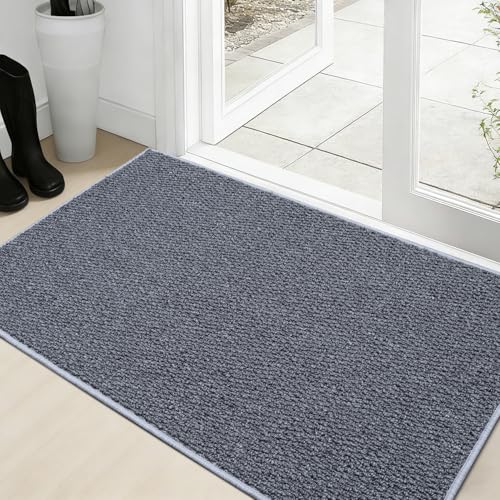
Dirt Trapping Door Mat 32×48 Grey — Best for Mud and Dogs
Size changes what a mat can promise, and this 32 by 48 inch grey mat promises the most in the set. Four feet of trapping surface means a dog can come in, turn, shake and sit while still on the mat; boots can be stamped twice; a child can drop a school bag and change shoes without anyone stepping onto bare floor. The listing states a 0.27 inch low profile, so all that area still slides under a swinging door instead of becoming a trip ridge at the threshold.
The faux jute face deserves a word, because it solves a real aesthetic problem. Genuine jute looks wonderful at a back door and behaves badly there, drinking water, staying damp and shedding fibres. This mat borrows the woven, natural look while keeping a washable, quick-to-manage construction underneath, so the boot room reads cottage rather than utility even though the mat is doing utility work. The grey colouring deepens the disguise, swallowing the visual evidence of the dirt the surface is holding.
Washing a mat this size is the commitment to weigh. It is sold as washable, but a 32×48 mat is a load in itself, happier in a large drum, and it takes longer to dry than its smaller siblings. Households that wash weekly without resentment will love it. Households that wash reluctantly might find a smaller mat they actually clean outperforming this bigger one they avoid — a theme that runs through this whole category and is worth honest reflection before ordering.
In rentals and shared houses, the big grey mat has another virtue: it covers tired flooring completely. Four feet of faux jute can hide a worn patch of lino or scuffed boards at the exact spot where landlords and guests both look first, while still being a working washable surface rather than a decorative rug pretending the threshold is a drawing room.
One more scenario flatters it: the allotment household in a wet autumn, where boots arrive genuinely caked rather than merely damp. Stamping and scraping need area to happen on, and four feet of forgiving grey surface turns that ritual from a floor-threatening event into a contained one, with the wash at week’s end resetting the whole arrangement.
- Footprint: 32 x 48 inches, the largest landing in this set
- Stated profile: 0.27 inch, low enough for door swing
- Surface job: dirt trapping with a faux jute woven look
- Backing: non-slip, per the maker’s listing
- Colour in the listing checked: grey
- Care route: washable; allow a large drum and longer drying
Strengths
- Four feet of surface contains dogs, boots and bag drops together
- Faux jute styling hides held dirt and suits cottage interiors
- Stated slim profile keeps the door swinging freely above it
Trade-offs
- Bulkiest wash and slowest dry of the six picks here
- May overwhelm a tiny porch or narrow utility doorway
- Grey faux weave still shows pale dust and dried light clay
Best for: dog-owning households and gardeners whose back door opens straight into daily living space.
Not suited for: small flats with compact washing machines and no room to dry a large mat.

BEQHAUSE Dirt Trapper Door Mat 32×48 Beige — Best Large Light-Tone Mat
This is the large-format sibling of the 20×32 BEQHAUSE reviewed above, stretched to 32 by 48 inches while keeping the same dirt-trapper brief: catch soil and water as feet land, hold both in the surface, and go through the wash when the week has been wet. The extra area transforms its use. Where the smaller mat serves a step and a turn, this one serves a small ceremony — boots off, dog dried, shopping set down — all on protected floor.
Beige at this size is a deliberate choice with a real cost, and we would rather state it plainly than let the photographs decide for you. A pale mat of four feet will map your household’s mud honestly: paw prints by the door edge, a darker arc where everyone turns. Some households find that map useful, a visible reminder that washing day has arrived. Others will watch it with rising irritation. The mat itself performs either way; your temperament is the variable.
In bright back halls — white tiles, pale stone, a glass door flooding the space with light — a dark mat can look like a hole in the floor, and this beige version keeps the room coherent while still doing serious trapping work. Pair it with a washing rhythm you can sustain, ideally a weekly slot, and it is the most room-friendly of the large mats here. Let the rhythm slip, and the grey 32×48 above will forgive you far more gracefully.
The beige large mat also pairs well with a boot tray beside it, dividing labour sensibly. The tray takes standing water and melting slush from boots left to dry; the mat takes the moving traffic of feet. Asking one surface to do both jobs usually ends with puddles migrating, so if your household stores wet boots indoors, let this mat handle people and give the boots their own shallow home.
- Footprint: 32 x 48 inches, full boot-room coverage
- Profile: low, made for entrance use under doors
- Surface job: absorbent dirt-trapping entrance face
- Backing: non-slip, per the maker’s listing
- Colour in the listing checked: beige
- Care route: washable; plan a regular weekly wash slot
Strengths
- Large landing handles boots-off routines without bare-floor steps
- Beige keeps bright, pale-floored back halls looking unified
- Same trapping approach as its smaller sibling, scaled up
Trade-offs
- Pale tone displays paw prints and turn-arcs honestly
- Large wash load; slower to dry than mid-size mats
- Needs a committed washing rhythm to stay presentable
Best for: bright, pale-floored back halls with heavy traffic and a reliable laundry routine.
Not suited for: mud-heavy households that know the wash will happen only occasionally.

BEQHAUSE Door Mat 20×32 Taupe — Best Mud-Hiding Colour
Colour science at a back door is really soil science. Wet mud arrives dark, dries mid-brown, and crumbles to a grey-tan dust; a taupe mat sits close to the middle of that journey, which is why this 20 by 32 inch BEQHAUSE can work hard for a fortnight and still look respectable when guests unexpectedly use the back door. It is the same dirt-trapper family as the beige versions in this set, with the same low profile and absorbent brief, wearing the most forgiving coat of the three.
The dimensions suit the commonest back door in older houses: a single door, a step in, a turn toward the kitchen, hooks and boots along one wall. Twenty inches of depth covers the landing and the turn without creeping under the fridge or the dog’s water bowl, and the width matches a standard doorway closely enough that dirt has few bare-floor escape routes at the edges.
We would place this mat in households that are honest about intervals. If the reality is a wash every ten days to two weeks, with a shake outside in between, taupe carries that rhythm with the least visual complaint of any colour here. It will not absorb like the big 32×48 mats in a downpour week, and it will not vanish into a white hallway the way the beige can, but as a set-and-mostly-forget workhorse for a real garden door, it is quietly the most practical pick in the line-up.
On stone and slate floors, which many older back halls have, the taupe version’s grip deserves respect. Cold stone sweats in winter as warm room air meets it, and a mat that holds its place on a faintly damp slab is performing a safety task as much as a cleaning one. Press it down dry, check the corners after the first week, and it should settle into invisibility.
- Footprint: 20 x 32 inches, matched to a standard single door
- Profile: low, sold for front and back door entryways
- Surface job: dirt trapping and absorbent welcome face
- Backing: non-slip, per the maker’s listing
- Colour in the listing checked: taupe
- Care route: washable; colour hides longer wash intervals
Strengths
- Taupe camouflages dried mud better than grey or beige
- Standard-door sizing leaves few bare gaps at the edges
- Low-effort rhythm: shake between washes, wash when ready
Trade-offs
- Mid-size area is outmatched by storm-week dog traffic
- Taupe can look muddy-toned in very white, minimal rooms
- Same capacity ceiling as other 20×32 mats in this set
Best for: garden doors in older houses where washing happens every week or two, not daily.
Not suited for: pristine white utility rooms where a brown-toned mat jars the scheme.

JSEI Dirt Trapper Door Mat 24×36 Blue — Best Mid-Size for Wet Shoes and Paws
The JSEI listing names its enemies directly — wet shoes and paws — and the 24 by 36 inch footprint is chosen to fight them. That extra depth over the 20×32 mats matters at a dog door in particular: a dog’s entry is not a single step but a small parade, front paws, back paws, a pause, a shake. Three feet of trapping surface gives the parade room to finish on the mat, which is where the water and grit need to be when it ends.
Blue is the extrovert of this set, and in the right back hall it is a pleasure rather than a compromise. Against white wainscoting, slate floors or a coastal-painted door it reads as a deliberate accent, and mid-blue hides dark wet marks respectably while showing pale dust more than grey would. Households with chalky soil or a gravel drive of light stone should know that their particular dirt will sit visibly on blue; clay and leaf-mould households will find it forgiving.
As a middle path, this mat asks middle effort: a wash load that behaves, a drying time measured in hours rather than overnight, a shake that one person can manage without theatrics. If the 32×48 mats feel like a commitment and the 30×18 feels like a gesture, the JSEI is the size most back doors would choose for themselves — enough ground to work on, not so much that laundry day becomes an event.
Gardeners who keep a trug or basket by the door will appreciate the blue mat’s depth for a less obvious reason: set-down space. Baskets of cuttings, a trug of beans, a carrier of eggs — all land briefly inside the door while hands are freed, and three feet of washable surface gives that cargo a landing strip that is not the kitchen floor. It is a small mercy that repeats daily in a working country kitchen.
For households split between a paved front and a muddy back, the blue mat makes a useful signal: colour-coding thresholds sounds fussy until children learn that blue means the wiping door. Small domestic systems like that, built into objects rather than announced as rules, are how back halls stay clean without anyone becoming their warden.
- Footprint: 24 x 36 inches, three feet of landing depth
- Profile: low, made for door use indoors and out
- Surface job: trapping face aimed at wet shoes and paws
- Backing: non-slip, per the maker’s listing
- Colour in the listing checked: blue
- Care route: washable; manageable single-person shake and dry
Strengths
- Three-foot depth contains a dog’s full entry routine
- Blue brings deliberate colour to plain back halls
- Mid-size washes and dries without large-mat logistics
Trade-offs
- Blue shows pale dust and light gravel dirt clearly
- Still short of the big mats for multi-dog households
- Colour limits it to rooms where blue is welcome
Best for: single-dog households and wet-climate back doors wanting more depth than a step mat.
Not suited for: pale-gravel driveways whose light dust will print plainly on blue.
How Do the Six Back Door Rugs Compare Side by Side?
| Pick | Format | Surface or build | Care route |
|---|---|---|---|
| Mibao Super Absorbent Door Mat 30×18 | Compact mat, 30×18 | Absorbent grey face | Washable; fastest dry of the set |
| BEQHAUSE Dirt Trapper Door Mat 20×32 Beige | Step mat, 20×32 | Trapping beige face | Washable; standard drum load |
| Dirt Trapping Door Mat 32×48 Grey | Large mat, 32×48, 0.27 in profile | Faux jute grey face | Washable; large load, longer dry |
| BEQHAUSE Dirt Trapper Door Mat 32×48 Beige | Large mat, 32×48 | Trapping beige face | Washable; weekly rhythm advised |
| BEQHAUSE Door Mat 20×32 Taupe | Step mat, 20×32 | Trapping taupe face | Washable; forgiving between washes |
| JSEI Dirt Trapper Door Mat 24×36 Blue | Mid mat, 24×36 | Trapping blue face | Washable; easy shake and dry |
Why Does the Back Door Need a Different Rug From the Front Door?
The front door is theatre; the back door is logistics. Guests at the front arrive in their better shoes, pause on the mat while the door is answered, and unconsciously perform the small shuffle that mats are designed around. Traffic at the back arrives mid-errand, carrying bins, trays, tools and dogs, and performs no shuffle at all. A rug chosen for front-door manners — decorative, moderately absorbent, sized for a posed step — is simply outclassed by back-door reality within the first wet week.
Frequency widens the gap further. A busy household crosses its back threshold many more times a day than its front, and each crossing imports a little of the garden: grit that scratches hard floors, moisture that spots wood, organic matter that feeds odours if it sits in a pile. The back door rug is therefore best understood as a filter that needs regular cleaning, like any filter, and its specification should be written around capture and washability rather than around how it photographs at a housewarming.
There is also a door-mechanics difference. Back doors in many homes open inward over a small, hard-worked patch of floor, often in a room that also holds laundry, boots and pet bowls competing for the same square metres. Clearance is tight, space is contested, and the rug must justify its footprint daily. Each pick here was chosen inside those constraints, which is why low profiles and honest sizing recur in every review above.
How Much Absorbency Does a Back Door Rug Actually Need?
Absorbency is a matching problem, not a maximising problem. The water arriving at your back door depends on what lies outside it: a covered porch sheds most rain before shoes land, an open path across lawn delivers soaked soles and worse, and a dog multiplies whatever the weather provides. A mat’s job is to hold one crossing’s worth of water long enough for the surface to be crossed again without re-wetting the next pair of socks — after that, evaporation and washing do the rest.
For paved access and ordinary rain, the compact and mid-size trappers here are honestly sufficient, and their faster washing and drying may serve you better than a huge reservoir you dread cleaning. For lawns, allotments, kennels and mud season in clay country, capacity wins: the 32×48 mats spread a crossing’s water across four feet of surface, so the tenth arrival of the day still finds a mat that can take moisture rather than a saturated sponge that gives it back.
A useful home test is the Monday question. Picture the wettest ordinary Monday your household produces — school run, dog walk, bins, garden — and ask whether the mat you are considering would still be functioning by the evening crossing. Buy for that Monday, not for the driest Sunday of the year, and the rug will feel correctly specified almost every day it serves.
What Size Back Door Rug Fits a Narrow Runner Space?
Many back doors open into a corridor rather than a room: a utility passage, a galley kitchen edge, a hallway running to the garden. In those spaces width is fixed by walls and units, and the useful question becomes how much length of trapping surface the passage can offer. A 24×36 or a 32×48 laid with its long side along the traffic direction turns a corridor into a cleaning gauntlet, giving each entering foot two or three contacts with the surface instead of one.
Measure the swing of the door first, then the run of floor beyond it, and leave a hand’s width of bare floor at the walls so the mat lies flat without climbing the skirting. A mat that curls at an edge because it was squeezed into a space a fraction too small will trip more dirt into the room than it traps. If your passage falls between sizes, choose the smaller mat and place it tight to the threshold, since the first step carries the most water and grit.
Narrow spaces also argue for the slimmest profiles in this set. Doors in older cottages often hang low over worn floors, and a mat that fits the run but jams the door will be dragged, folded and finally exiled to a cupboard. Check clearance with a coin stack at the door’s lowest point before ordering, and prefer the stated low-profile options when the gap is tight.
How Should You Wash and Dry a Back Door Rug Without Ruining Its Backing?
Shake first, always, outside and downwind: most of what a trapper holds is loose grit that should never meet your washing machine’s filter. A stiff brush over the surface after shaking lifts the embedded fraction, and only then does the mat earn its wash. Use a cool or lukewarm cycle and go easy on detergent, because soap residue left in a pile makes fibres sticky and quietly converts an absorbent mat into a dirt magnet over the following weeks.
Drying is where backings are saved or lost. Rubber and non-slip layers age fastest under heat and under being folded while damp, so dry the mat flat or draped over a broad rail, away from radiators, and let air reach the underside. A mat put back on the floor with a damp backing will smell before it looks dirty, and repeated damp storage is the usual reason a once-grippy mat begins to wander.
Between washes, a quick hose-down on the patio handles the worst weeks of the year. Stand the mat against a wall, rinse from top to bottom, and let gravity do the carrying. Households with dogs often find a fortnightly hose plus a monthly machine wash keeps any of the six picks here honest, while gardener households in clay country may swap that rhythm around in winter and relax it in summer.
How Do You Stop Grit From a Back Door Rug Scratching Hard Floors?
The scratching you hear as a faint crunch underfoot is the sound of a filter that has stopped filtering. Grit harms floors in two places: held loosely on a mat’s surface, where shoes grind it like sandpaper, and tracked beyond the mat onto wood or laminate, where every step drags it further. The defence is boring and total — shake the mat outside far more often than you wash it, because shaking removes the loose abrasive fraction in thirty seconds, while washing is for the bound dirt and the smells.
Vacuum the floor strip immediately inside the door on the same rhythm, even when it looks clean. Fine grit is nearly invisible on mid-tone floors and does its damage quietly over months, dulling finishes in an arc that exactly maps the household’s walking line. A thirty-second pass with a handheld vacuum twice a week protects a finish that would cost real money to restore, which makes it the best-value chore in the whole back hall.
Finally, retire mats honestly. When a backing has cracked into a mosaic or the surface has polished smooth with wear, the mat stops trapping and starts merely hosting dirt, and no washing schedule can reverse that. Every pick in this guide is inexpensive enough that replacement at the right moment is cheaper than refinishing a floor, and treating the mat as a renewable filter rather than a furnishing is the mindset the whole category rewards.
Should a Back Door Rug Match the Kitchen or Disappear Into It?
There are two schools, and both can be right. The disappearing school chooses grey, taupe or faux jute tones close to the floor and the dirt, aiming for a threshold nobody notices; it suits working houses where the back hall is a passage, not a room, and where the mat’s invisibility is precisely its elegance. Most of the picks above serve this school, because back door traffic punishes visual statements quickly.
The deliberate school gives the threshold one strong note — the blue JSEI is this set’s example — and lets the rest of the hall stay plain. It works best where the back door is also the family’s real front door, the entrance friends actually use, because then the mat is part of the welcome and deserves a colour chosen with intent rather than apology.
What fails is the accidental middle: a pale, pretty, patterned mat chosen from a photograph, which neither hides dirt nor commits to being a feature, and which spends its life looking like a mistake someone keeps meaning to replace. Whichever school you join, join it fully, match the washing rhythm to the colour you chose, and the threshold will look intentional even on the wettest Tuesday of the year.
What Changes When the Back Door Is Also the Dog’s Door?
A dog door or a dog-led routine rewrites the specification in three ways. First, traffic becomes round-the-clock and unaccompanied, so the mat must stay exactly where it was left; any tendency to creep becomes paw traffic’s opportunity to fold it into a corner by morning. Second, the load changes character — less boot grit, more water, leaf fragments and whatever the garden has deposited on a coat that now brushes the floor as its owner turns. Third, smell management joins dirt management, because a mat that holds a wet dog’s worth of water weekly needs drying air as much as it needs washing.
Size upward without hesitation in this scenario. The turning circle of even a medium dog covers more floor than a human’s entry step, and a mat that ends mid-turn simply relocates the wettest paw prints to the bare floor beside it. The 32×48 grey mat was reviewed with exactly this household in mind, and the JSEI’s three-foot depth is the minimum we would accept where a dog comes and goes freely through the day.
Place a towel on a hook at human height and a washable mat below, and accept that the pair is a system. The mat catches what falls; the towel handles what the mat cannot, the shake-off that sprays the walls and the door itself. Households that build this small station stop fighting the dog door and start merely servicing it, which is the realistic peace treaty available.
When Should a Back Door Rug Be Replaced Rather Than Washed Again?
Three signs say a mat has finished its service. The backing cracks or powders when flexed, shedding its grip in flakes and leaving the mat free to travel. The surface polishes smooth, so shoes skate across it carrying their load onward instead of surrendering it. And a sour smell survives a proper wash and a full dry, which means the pile’s depths are holding more than detergent can reach. Any one of these turns a filter into a distributor, and the kindest thing is a prompt retirement.
Timing that retirement to the seasons softens the cost. Buy the replacement in autumn, when the old mat faces its hardest quarter, and keep the retiree for one final duty — under the Christmas tree stand, beneath a painting project, inside the car boot — before it leaves the house entirely. A mat that has served two winters of thresholds has earned its keep many times over, and replacing it on schedule protects the floors whose preservation was the entire point of owning it.
What Mistakes Do People Make With Back Door Rugs?
Buying the front-door look for the back-door job. A decorative mat with a shallow face may charm at a porch, but at a working back door it saturates by midday and starts printing wet footprints deeper into the house, which is the precise failure the purchase was meant to prevent.
Guessing the size from the doorway’s appearance. Doors look narrower than the traffic they serve; people turn, dogs circle, bags land. Measure the floor where feet actually travel, including the turn toward the kitchen, and size the mat to that map rather than to the door leaf itself.
Ignoring door clearance until the mat arrives. A rug that the door drags on will be kicked aside within a week, and an exiled rug traps nothing. Test the gap under your door’s lowest point first, and treat low profile as a specification, not a preference.
Washing hot and drying on a radiator. Heat is the enemy of non-slip backings; it hardens and cracks the layer that keeps the mat planted, after which the mat creeps, curls at the corners and becomes the hazard it was bought to prevent. Cool washes and flat air-drying keep grip alive for years.
Letting a saturated mat stay in service. Once a trapper is full of water and grit, every new crossing squeezes the old load back out onto the floor beyond. A mat at capacity is worse than a smaller clean one, which is why two modest mats in rotation beat one large mat that never gets its wash.
Skipping the outdoor shake because the mat looks fine. Surfaces lie; a trapper can hold a startling amount of grit while presenting a clean face, and the load only announces itself when shoes start crunching. Shake on a schedule, not on evidence, and the mat’s washing life stretches considerably.
Final Recommendation
Start, if you can, by standing at your own back door on the next wet evening and watching three arrivals cross it. Where feet land, where they turn, and where the dog pauses will tell you more about the size and absorbency you need than any product photograph, and the right mat chosen from that small observation will feel obvious in hindsight.
If your back door serves one or two people over paving, start with the Mibao 30×18 or the taupe BEQHAUSE 20×32 and spend the savings on a second mat for rotation. If a dog owns your back door, the grey Dirt Trapping 32×48 is the honest answer, with the JSEI 24×36 as the slightly smaller, brighter alternative where four feet will not fit. Bright rooms that refuse dark mats should take the beige 32×48 BEQHAUSE and simply commit to its weekly wash.
Whichever you choose, judge it after a wet fortnight rather than a dry weekend, and judge it by the floor beyond it: a back door rug has done its job when the kitchen stays clean without anyone remembering to wipe their feet. For a back door, the best rug is the one still quietly catching the garden long after you have stopped thinking about it.
Frequently Asked Questions
Can a back door rug live outside the door instead of inside?
It can, and a coarse outdoor scraper paired with an absorbent indoor mat is the strongest arrangement of all. The picks here are sold as indoor entrance mats with non-slip backings that expect a floor beneath them; used outside alone on wet decking they will still trap dirt, but their absorbency is wasted on rain, so keep the thirsty layer indoors where it can work on soles rather than weather.
How often should a back door rug be washed?
Let traffic decide: a paved-access household may wash monthly, while a dog-and-garden household in winter may need a weekly wash with shakes between. The reliable signal is the surface itself — when the pile looks flat and the colour has gone dull with held grit, the mat is redistributing as much as it traps and the wash is overdue.
Will these mats work on carpeted back halls?
Non-slip backings are designed for hard floors and can creep or bunch on carpet pile, so a mat in this set is not the right tool there. A low-pile washable runner with a carpet-appropriate gripper underneath serves a carpeted hall better, and the trapping principle — catch dirt at the threshold, wash on a rhythm — stays exactly the same.
What is the best way to stop a back door mat sliding?
Start with a clean, dry floor and a fully dry backing, since dust and damp are the usual culprits when a non-slip mat wanders. If it still creeps, the backing may have aged from hot washing; a washable non-slip underlay cut slightly smaller than the mat restores the grip without replacing a surface that is otherwise performing well.
Should I buy one large mat or two smaller ones?
Two smaller mats in rotation guarantee that a clean, dry mat is always on duty while its partner is in the wash or drying, which matters most in wet seasons. One large mat gives a bigger landing for dogs and boots-off routines. Households with the laundry discipline for a weekly big wash can enjoy the large format; everyone else usually lives happier with the rotating pair.
Do back door rugs need a separate underlay on hard floors?
Most picks here carry their own non-slip backing and need nothing beneath them on wood, tile or stone. An underlay helps only when a backing has aged or a floor is unusually polished; choose a washable, thin gripper sheet rather than a thick pad, since added height can foul the door’s swing and undo the low profile you bought the mat for.
Related Guides
Readers sorting the whole garden-side threshold often pair this guide with Best Bamboo and Seagrass Rugs for the rooms beyond it, keep Best Non-Slip Bath Rugs in mind for the other wet doorway in the house, and browse Best Area Rugs for Toy Rooms when the back hall doubles as play space. For the front of the same muddy route, Best 3×5 Rugs for Mudrooms covers the larger airlock format in depth.


