What's inside
- Key Takeaways
- Quick Picks
- How Did We Choose These Washer Dryer Combos?
- How Do the Six Combos Compare Side by Side?
- Why Is Ventless Drying So Much Slower?
- How Should You Load a Combo for the Dry Phase?
- Where Can a 24-Inch Combo Actually Live?
- What Does Steam Care Do Inside a Combo Machine?
- How Do You Keep a Combo Running Sweetly for Years?
- Which Combo Fits a Dorm Room or First Studio?
- How Do Combos Handle Bedding and Bulky Items?
- What Will a Combo Cost You in Time Each Week?
- How Do You Choose Between the Two Steam Models?
- Can a Combo Serve as a Second Machine in a Larger Home?
- What Should You Confirm on the Listing Before a Combo Arrives?
- How Quiet Is a Combo When the Bedroom Is Next Door?
- What Mistakes Do Combo Buyers Make Most Often?
- Final Recommendation
- Frequently Asked Questions
- Related Guides
As an Amazon Associate I earn from qualifying purchases. This post may contain affiliate links at no extra cost to you.
cottageverdict.com is reader-supported. When you buy through links on our site, we may earn an affiliate commission.
Where to buy: all six machines below are sold through Amazon, and their names in the Quick Picks table, the detailed sections and the comparison table link to their listings so you can check price on Amazon and confirm capacity, spin speed and drying type before ordering. The best washer dryer combos with steam are all compact 24-inch machines that wash and dry in a single drum, and this guide will be honest with you about the bargain they offer, because it is a real bargain with real terms. The terms: drums hold between 1.6 and 2.7 cubic feet, drying on most models is ventless and therefore slow, and a full wash-and-dry cycle is measured in hours rather than minutes. In exchange, one machine the width of a dishwasher does the work of two, needs no vent run, plugs into ordinary household power, and fits the flats, dorms, boats and small houses where a separate pair simply cannot go.
Steam enters this category through two of the six listings. The COMFEE and the Midea both advertise a steam care function, which in a combo machine means steam introduced during the wash or refresh phase to loosen soil, soften fabrics and leave garments feeling renewed — a genuinely useful trick in a machine whose loads are small and frequent. The other four picks earn their places without steam, on capacity, programme range, convertible venting or sheer simplicity, and we say so plainly in each section rather than pretending the feature is universal. The guide’s title promises steam; its contents will tell you exactly which machines deliver it.
Who buys a combo? The classic owner has one laundry point and no vent: a flat with a kitchen-corner hookup, a dorm room, an accessory dwelling, an RV or boat, an elderly parent’s small home where carrying laundry between machines is the real problem. A second owner is the household adding a supplementary machine — a second-floor unit for baby clothes and delicates — beside a main laundry pair elsewhere. Both owners share a rhythm: smaller loads, run more often, started and forgotten, because the machine’s great social virtue is that a load put in at breakfast is clean and dry by lunch without anyone moving it between drums.
Set the expectation about dryness now and you will be happy later. Ventless drying — condensing or heat-pump style systems that wring moisture from the air inside the drum — is inherently slower and leaves laundry feeling different from vented drying: slightly softer, occasionally a touch humid to the first touch, best shaken out and folded promptly. Loads must be smaller for the dry phase than for the wash phase, because wet fabric needs tumbling room to give up its water. Every experienced combo owner runs the dry phase at roughly two-thirds of the wash load, and the sections after the picks explain how to build that habit and choose between these six honest machines.
Installation is the category’s reward for those compromises. These machines need a water supply, a drain and a standard outlet — the same trio a dishwasher asks for — and no vent hole through the wall, which makes them legal and practical in rentals and interior rooms where venting is impossible. Two Equator models add a convertible option, drying vented or ventless, for owners whose next home might offer a vent. Measure your 24-inch slot, check your doorway widths, and read on.
Key Takeaways
- All six picks are 24-inch compact all-in-one machines that wash and dry in one drum, with capacities from 1.6 to 2.7 cubic feet.
- Steam care appears on two listings — the COMFEE and the Midea — and this guide credits it only to those two machines.
- Ventless drying is slow by design: expect a full wash-and-dry cycle to take hours, and plan smaller loads for the dry phase.
- No vent run is needed, so these machines suit flats, dorms, RVs and interior laundry points where a vented pair cannot go.
- The two Equator models are convertible, able to dry vented or ventless, which suits owners who may move between homes.
- Spin speed matters in a combo: the 1400 RPM machines wring out more water before drying begins, shortening the slow phase.
Quick Picks
| Pick | Badge | Why it earns its place |
|---|---|---|
| COMFEE 24 Washer Dryer Combo Steam | Best Steam Combo | A 2.7 cubic foot combo whose listing pairs steam care with an overnight dry programme, in dorm-friendly white. |
| Hamilton Beach 2.65 Combo | Best Programme Range | A 2.65 cubic foot apartment-size combo with more than a dozen wash programmes and a delay start. |
| Midea 2.7 Combo | Best Fast Spin With Steam | Steam care and overnight dry plus the joint-fastest spin here, 1400 RPM, across 16 wash cycles. |
| Magic Chef 2.7 Combo | Best Simple Silver Pick | A straightforward 2.7 cubic foot combo in silver with five temperature settings and two dry cycles. |
| Equator 24 Convertible Combo | Best for Pet Owners | A compact 1.6 cubic foot convertible combo with a dedicated pet cycle for hair-heavy small loads. |
| Equator 2.5 Convertible Combo | Best Venting Flexibility | A 2.5 cubic foot combo that dries vented or ventless, adapting to whatever your next home offers. |
How Did We Choose These Washer Dryer Combos?
We restricted the field to true all-in-one machines — one drum that washes and dries — in the 24-inch compact class, because that is the product this keyword’s buyers are shopping for and because mixing in full-size pairs would corrupt every comparison. Within that class we verified each pick against its own listing for the facts that decide ownership: drum capacity, spin speed, drying method, and whether steam is genuinely claimed. Where a listing does not claim steam, the pick’s section says so and justifies the machine on other grounds.
Capacity spread mattered. The class runs from genuinely small to nearly apartment-standard, so the final six cover 1.6, 2.5, 2.65 and 2.7 cubic feet, letting a single dorm resident and a couple in a small flat each find a first choice. We also kept both convertible Equator models, because the ability to dry vented where a vent exists and ventless where it does not is a real ownership advantage for people whose housing changes — renters, boat owners, anyone mid-renovation.
Programme ranges were weighed by usefulness rather than count alone. A delay start and an overnight dry programme change how a slow machine fits a life — the load runs while you sleep and is ready when you wake — so those features earned real credit. Spin speed earned credit too, and for a mechanical reason: every extra measure of water the spin extracts is water the slow ventless dry phase does not have to remove, so the 1400 RPM machines hold a genuine cycle-time advantage over the 800 RPM one.
Finally we considered the rooms these machines live in. A combo under a kitchen counter must be quiet enough to share an evening with, shallow enough for standard cabinetry and simple enough to run without a manual in hand. The six below are the listings that balanced capacity, honesty about steam, programme usefulness and compact manners most convincingly.
One more filter deserves recording: we excluded machines whose listings blurred the line between a true combo and a washer with a drying claim it could not support, because a drum that merely air-fluffs is not a dryer and buyers plan their weeks around the difference. Every pick here completes the full journey from dirty to dry in one drum, which is the promise the category makes and the standard this guide holds it to.

COMFEE 24 Washer Dryer Combo Steam — Best Steam Combo
The COMFEE is the machine this guide’s title describes most directly: a 24-inch, 2.7 cubic foot washer dryer combo whose listing names steam care among its functions, alongside an overnight dry programme, in a white finish aimed squarely at dorms and small homes. The steam care phase earns its place in a combo specifically, because small frequent loads are exactly where a softening, freshening steam treatment shows — gym kit, work shirts, the baby clothes that cycle through twice a week. Garments come out of the wash phase treated rather than merely cleaned, and in a one-drum life that extra care is felt constantly.
The overnight dry programme is the second half of the machine’s personality, and it is designed around the honest physics of ventless drying: since the dry phase takes hours, let it take them while you sleep. Load the machine in the evening, set the programme, and wake to finished laundry — the listing even promises a no-shaking cycle character, a nod to the machine running in rooms where people are sleeping nearby. For a dorm resident or a studio dweller, that overnight pattern converts the combo’s slowness from a flaw into a schedule.
Capacity is the joint-largest in this guide at 2.7 cubic feet, rated by the listing at 26 pounds of washing, which in combo terms means a sensible load of everyday clothes for one or two people — remembering that the dry phase will thank you for running it at two-thirds of the wash load. The white finish and compact footprint suit kitchen-corner and bathroom installations alike. Check price on Amazon to confirm the current listing and its programme list.
- Format: 24-inch all-in-one combo, ventless
- Capacity: 2.7 cubic feet, 26 lbs wash load per the listing
- Steam: steam care per the listing
- Programme note: overnight dry for sleep-hours cycles
- Finish: white
Strengths
- Genuine steam care in the joint-largest drum of this guide.
- Overnight dry turns slow ventless drying into a sleep-friendly schedule.
- Compact white format suits dorms, studios and kitchen corners.
Trade-offs
- Ventless drying remains slow compared with any vented dryer.
- Dry loads must be smaller than wash loads for good results.
- No convertible vented option for a future home with a vent.
Best for: dorm and small-flat residents who want steam care and an overnight laundry rhythm. Not suited for: families with daily large loads, who need a full-size pair instead.

Hamilton Beach 2.65 Combo — Best Programme Range
Hamilton Beach’s combo competes on programmes and clarity: a 2.65 cubic foot apartment-size machine with more than a dozen wash programmes, an LED display, a delay start and an 800 RPM spin, all on standard 120-volt power. The programme range is the story — a dozen-plus cycles means the machine distinguishes between the loads a small household actually runs, from delicates and baby clothes to the heavier cotton of towels and bedding, rather than forcing everything through one compromise wash. The delay start pairs naturally with a slow machine: set it so the cycle finishes as you return home, and the dry phase’s length stops mattering.
Honesty box: this listing does not claim a steam function, and we credit it with none. Its case rests on programme breadth, a clear display that shows where a long cycle stands — genuinely reassuring on a machine whose cycles run for hours — and a brand with a long history in American homes. The 800 RPM spin is the gentlest in this guide, which is kinder to delicate fabrics but leaves more water in the load for the ventless dry phase to remove, so its full cycles sit at the slower end of an already slow category. Owners who run small, frequent loads will not feel that; owners timing a same-day turnaround should look at the 1400 RPM machines.
The machine’s apartment sizing and front-load format suit the classic combo placements — under a counter, in a bathroom alcove, in a utility closet with water and drain access. Its white styling is anonymous in the best way, disappearing into a rental kitchen without announcing itself. Check price on Amazon for the current programme list and dimensions.
- Format: 24-inch class all-in-one combo, ventless
- Capacity: 2.65 cubic feet
- Spin: 800 RPM, gentlest in this guide
- Programmes: 12+ wash programmes, LED display, delay start
- Steam: not claimed on this listing
Strengths
- Broad programme range tailored to varied small-household loads.
- Delay start and a clear LED display tame the long cycle times.
- Gentler spin treats delicates kindly.
Trade-offs
- No steam function, despite this guide’s theme.
- Slower spin means longer ventless drying than the 1400 RPM picks.
- Programme breadth is wasted on one-cycle households.
Best for: small households with varied fabrics who value programme choice and scheduling. Not suited for: steam seekers, or anyone needing the fastest possible turnaround.

Midea 2.7 Combo — Best Fast Spin With Steam
The Midea is the specification leader of this guide: 2.7 cubic feet, a 1400 RPM spin, 16 wash cycles, ventless drying, and — per its listing — steam care and an overnight dry programme. That combination is thoughtfully assembled, because the fast spin attacks the combo category’s core weakness directly. Every litre of water the spin wrings from a load is a litre the slow condensing dry phase never has to evaporate, so a 1400 RPM machine finishes the same laundry meaningfully sooner than an 800 RPM one, while the steam care handles the softening and freshening work on the wash side.
Sixteen wash cycles is the widest programme range here, and on a machine with this spin speed the range is usable rather than decorative: delicates can be spun gently by their own programme while cottons get the full extraction, so the owner is not forced to choose one spin philosophy for the whole wardrobe. The overnight dry mirrors the COMFEE’s scheduling wisdom, letting the long dry phase run through the sleeping hours. Between the two steam machines, the choice is one of emphasis — the Midea leans mechanical, with its spin and cycle count, where the COMFEE leans toward its dorm-ready simplicity.
The white finish and 24-inch format keep it in the standard combo placements, and ventless operation means the usual freedom: no vent run, just water, drain and a standard outlet. As with every pick here, the dry phase wants a reduced load, and the machine will repay owners who split a big wash into a wash-all, dry-in-two-batches rhythm for bulky items like bedding. Check price on Amazon to verify the cycle list on the current listing.
- Format: 24-inch all-in-one combo, ventless
- Capacity: 2.7 cubic feet
- Spin: 1400 RPM, joint-fastest in this guide
- Steam: steam care per the listing, plus overnight dry
- Programmes: 16 wash cycles
Strengths
- Fast spin shortens the slow ventless dry phase where it matters.
- Steam care and overnight dry both present, like the COMFEE.
- Widest programme range in this guide.
Trade-offs
- High spin needs selecting down for delicate loads.
- Sixteen cycles is a menu some owners will never fully explore.
- Still a compact drum — family laundry outgrows it.
Best for: buyers who want steam plus the quickest realistic turnaround a ventless combo can offer. Not suited for: households washing for more than two or three people daily.

Magic Chef 2.7 Combo — Best Simple Silver Pick
Magic Chef built its name on compact appliances for small spaces, and this 2.7 cubic foot combo in silver follows the house philosophy: a front-load all-in-one with five temperature settings and two dry cycles, presented without frills. The specification is the shortest in this guide, and for a certain buyer that is the recommendation. Two dry cycles and a handful of temperatures cover the overwhelming majority of real laundry; the owner who runs cottons on warm and everything else on cool will never open a sixteen-cycle menu with anything but regret. Simplicity is also a reliability strategy — fewer programmes, fewer decisions, fewer things to misunderstand at midnight in a studio flat.
The silver finish distinguishes it visually from the white crowd, suiting kitchens where the machine sits visible among stainless appliances rather than hidden in a closet. Capacity matches the largest here at 2.7 cubic feet, so the simplicity costs nothing in drum size, and the machine handles the standard one-to-two-person laundry rhythm: several modest loads a week, each washed and dried in the single drum while the owner is elsewhere. The listing does not claim steam, and we credit none — this is the guide’s honest economy of features, not a steam machine in disguise.
Expect the category’s standard terms: ventless drying at ventless pace, dry loads smaller than wash loads, and full cycles that reward scheduling rather than clock-watching. Within those terms the Magic Chef is the pick for the buyer who has read the other five sections, felt tired, and wants the machine that asks the fewest questions. Check price on Amazon for the current silver listing.
- Format: 24-inch class all-in-one combo, ventless
- Capacity: 2.7 cubic feet
- Controls: 5 temperature settings, 2 dry cycles
- Steam: not claimed on this listing
- Finish: silver
Strengths
- Full-size-for-class drum with the simplest control set here.
- Silver finish suits visible kitchen installations.
- Compact-appliance specialist brand with a long small-space history.
Trade-offs
- No steam, no programme breadth for varied fabrics.
- Two dry cycles give less control over delicate drying.
- Fewer scheduling features than the Hamilton Beach or Midea.
Best for: minimalists and rental kitchens that want a big compact drum without menus. Not suited for: fabric enthusiasts or steam seekers.

Equator 24 Convertible Combo — Best for Pet Owners
The smaller Equator is the specialist of the guide: a 24-inch convertible combo of 1.6 cubic feet and 15 pounds capacity, spinning at 1400 RPM, with a dedicated pet cycle — a programme aimed at the hair-covered reality of life with animals. That cycle matters more than its novelty suggests. Pet hair defeats ordinary small machines by matting into fabrics and clogging filters, and a programme designed around releasing and flushing hair addresses the single most common load in a pet owner’s week: the blankets, throws and bedding the animals actually live on. In a small flat with a dog, this machine is not the compromise choice; it is the correct one.
Convertible is the other key word: the machine can dry vented or ventless, so it adapts to the home it is in — ventless in the flat with no duct, vented in the house that has one, gaining speed whenever the vent is available. The 1400 RPM spin matches the guide’s fastest and squeezes loads properly before drying, while the 110-volt supply keeps installation to the standard compact pattern. The trade is capacity: at 1.6 cubic feet this is a machine for one person and their animals, running small loads often, not a couple’s weekly mountain.
Equator specialises in exactly these niches — apartments, condos, RVs, tiny homes, as its listing says — and the machine’s proportions reflect that focus. The listing does not claim steam; its specialism is hair, flexibility and compactness. Check price on Amazon to confirm the pet cycle details on the current listing.
- Format: 24-inch convertible combo, vented or ventless
- Capacity: 1.6 cubic feet, 15 lbs — smallest in this guide
- Spin: 1400 RPM
- Special programme: dedicated pet cycle per the listing
- Steam: not claimed on this listing
Strengths
- Pet cycle answers the hair-heavy loads other combos handle badly.
- Convertible drying adapts to homes with or without a vent.
- Fast spin in the guide’s most compact body.
Trade-offs
- Smallest drum here — strictly a small-load machine.
- No steam function.
- Couples without pets will outgrow it quickly.
Best for: pet owners in flats, RVs and tiny homes running small, hairy loads often. Not suited for: pet-free couples, who should take the larger Equator or a 2.7 model.
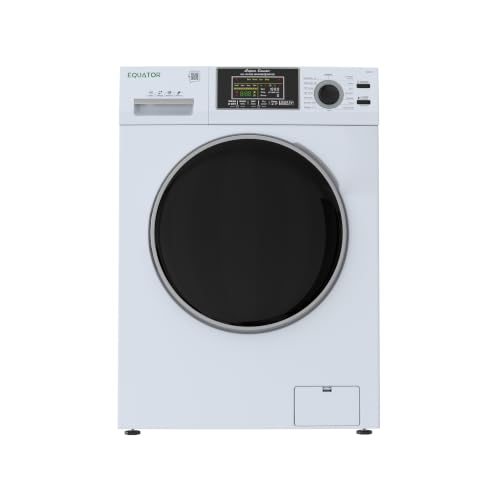
Equator 2.5 Convertible Combo — Best Venting Flexibility
The larger Equator generalises its sibling’s flexibility to a household scale: 2.5 cubic feet of drum, a 1400 RPM spin, 110-volt operation, and the convertible drying system that runs vented or ventless as the home allows. That convertibility is this machine’s whole argument, and it is a strong one for anyone whose housing is in transition. Buy it for a ventless flat today, and if next year’s house has a laundry vent, the same machine dries faster there without replacement — a hedge against the future that no fixed ventless model can offer.
Used vented, drying quickens noticeably compared with the condensing mode, because moist air leaves the drum instead of being wrung out of it; used ventless, it keeps the category’s placement freedom. The owner chooses per home, per season even, rather than per purchase. Capacity at 2.5 cubic feet sits just below the 2.7 leaders — a difference of a couple of shirts per load — and the fast spin keeps the dry phase honest in either mode. The listing does not claim steam or a pet cycle; this Equator’s specialism is adaptability itself.
For renovators the machine has a particular charm: it can serve ventless in the temporary kitchen-corner setup during works, then move to the finished laundry room and take the vent when the ducting is finally run. Few appliances survive a renovation plan unchanged; this one is designed to. Check price on Amazon for the convertible listing and its included venting details.
- Format: 24-inch convertible combo, vented or ventless
- Capacity: 2.5 cubic feet
- Spin: 1400 RPM
- Power: 110V standard supply
- Steam: not claimed on this listing
Strengths
- Only guide pick besides its sibling that can dry vented when a vent exists.
- Near-largest capacity with the joint-fastest spin.
- Survives moves and renovations without becoming the wrong machine.
Trade-offs
- No steam and no pet specialism — flexibility is the whole story.
- Slightly smaller drum than the 2.7 cubic foot leaders.
- Vented mode still needs a proper duct run to show its advantage.
Best for: movers, renovators and renters-to-owners who want one machine for both venting worlds. Not suited for: settled households that know they will never have a vent — the steam models serve them better.
How Do the Six Combos Compare Side by Side?
| Pick | Capacity | Spin | Drying | Steam |
|---|---|---|---|---|
| COMFEE 24 Washer Dryer Combo Steam | 2.7 cu ft | Not headlined | Ventless | Steam care, per listing |
| Hamilton Beach 2.65 Combo | 2.65 cu ft | 800 RPM | Ventless | Not claimed |
| Midea 2.7 Combo | 2.7 cu ft | 1400 RPM | Ventless | Steam care, per listing |
| Magic Chef 2.7 Combo | 2.7 cu ft | Not headlined | Ventless | Not claimed |
| Equator 24 Convertible Combo | 1.6 cu ft | 1400 RPM | Vented or ventless | Not claimed |
| Equator 2.5 Convertible Combo | 2.5 cu ft | 1400 RPM | Vented or ventless | Not claimed |
Why Is Ventless Drying So Much Slower?
A vented dryer throws its moist air outside and constantly replaces it with fresh, dry room air, which is why it finishes quickly. A ventless combo has nowhere to throw anything: it must condense the moisture out of its own circulating air, collecting the water and sending it down the drain, and condensation is a patient process. The drum heats, the air saturates, the condenser wrings it, and the cycle repeats — effective, quiet and vent-free, but measured in hours on a full load of cottons. Heat-pump and condenser designs differ in efficiency, yet both obey the same physics, so no ventless machine escapes the timescale.
The practical consequences shape combo ownership. Towels and denim, which hold the most water, take the longest and benefit most from a reduced dry load. Synthetics and light cottons finish far sooner, which is why experienced owners sort by drying behaviour and not only by colour. And the overnight pattern — load at bedtime, unload at breakfast — converts the slowness into irrelevance, which is why two of our picks build an overnight programme into their listings. Judge a combo by whether its schedule fits your life, not by whether it beats a vented dryer in a race it was never designed to run.
One by-product of the condensing process deserves a mention so it never surprises a new owner: the machine returns the extracted water to the drain and sheds a little warmth into the room as it works. In a small bathroom that warmth is barely noticeable; in a tiny sealed closet it is the reason we advise a louvred door. The water usage of the condensing system is modest, and the trade — no vent hole, no duct, no outside wall required — is the one every owner in this category has already decided is worth making.
How Should You Load a Combo for the Dry Phase?
The single most valuable combo habit is this: wash what the drum holds, dry less than that. A full 2.7 cubic foot wash load, spun and wet, packs too tightly for the condensing dry phase to circulate air through it, and the result is a long cycle that still ends unevenly — dry sleeves around a damp core. Pull out a third of the load before drying, or split the batch into two dry runs, and the same laundry finishes sooner and more evenly than the single heroic load would have. It feels like more work and is measurably less waiting.
Sorting helps the same cause. A load of similar fabrics dries uniformly because every piece surrenders water at roughly the same rate; a mixed load of bath towels and pillowcases forces a compromise time that bakes the light pieces while the towels finish. Shake garments out as they go in — a balled sheet dries as a ball, slowly — and give bedding its own cycle with a mid-cycle pause to untangle if your machine allows it. None of this is fussy technique; it is the difference between owners who call their combo slow and owners who call it set-and-forget.
Where Can a 24-Inch Combo Actually Live?
Anywhere a dishwasher could: that is the liberating answer. The machine needs cold water in, a drain out and a standard outlet, and it needs no vent, so the placements multiply — under a kitchen counter, in a bathroom with plumbing access, in a hallway closet near the soil stack, in a converted pantry, in an RV or on a boat with the right supply. Renters prize this because the installation is reversible; landlords tolerate it because no hole is cut in their wall. Measure the niche honestly: 24 inches of width is the class standard, but depth with hoses behind and height under a countertop deserve their own tape-measure moments.
Two placement cautions apply everywhere. The floor should be level and firm, because a combo spins at up to 1400 RPM in this guide and an unlevel machine walks and rattles; adjustable feet exist for this reason and ten minutes with a spirit level pays for itself in quiet. And the room needs some air: a sealed closet with the door shut traps the warmth the condenser sheds, so a louvred door or a door left ajar during cycles keeps the machine breathing. Plan those two details and the little machine will serve in rooms a laundry pair could never enter.
What Does Steam Care Do Inside a Combo Machine?
On the two listings that claim it — the COMFEE and the Midea — steam care introduces steam into the drum during the wash or a dedicated care phase. In a wash context, steam’s work is threefold: it helps the water and detergent penetrate fabrics and loosen soil before the main agitation, it softens fibres so creases release rather than set during the cycle, and it leaves garments with that freshly aired quality owners describe as the laundry feeling renewed rather than merely rinsed. In a small machine washing small loads frequently, those effects are noticeable precisely because the loads are small enough for steam to envelop evenly.
What steam care is not, in this class, is a separate high-powered sanitising system or a dryer-style wrinkle station of the kind full-size machines advertise; we describe it as the listings present it, a care function within a compact wash programme. Buyers for whom steam is the headline should choose between the COMFEE and the Midea on their other merits — the Midea’s spin and cycle count against the COMFEE’s dorm-ready overnight simplicity — confident that both genuinely offer the feature, while the other four picks in this guide honestly do not.
How Do You Keep a Combo Running Sweetly for Years?
Combos concentrate two appliances’ maintenance into one cabinet, and the routine is short but non-negotiable. The drain pump filter — the little trap that catches coins, hair and lint before they reach the pump — needs checking every month or two, and in a pet household more often; a clogged filter is the leading cause of the drainage faults owners blame on the machine. Wipe the door seal after the last load of the day and leave the door ajar between uses, because a sealed, damp drum is where musty smells are born, and in a combo that smell transfers to the next wash.
The condenser path wants its lint kept clear according to the manual’s schedule, since ventless drying depends on air moving through it. Use the right amount of detergent — compact drums and high-efficiency washing need less than instinct suggests, and chronic overdosing coats the drum, dulls fabrics and lengthens rinses. Run an empty hot maintenance cycle periodically to keep the system fresh. Do those few things and a combo repays its owner with the thing it was bought for: laundry that happens quietly in a corner, for years, without a second thought.
Which Combo Fits a Dorm Room or First Studio?
The dorm brief is specific: one person, small loads, irregular hours, neighbours through a thin wall and a premium on every square foot. The COMFEE was practically described by its listing for this life — dorm white, steam care for the small wardrobe that cycles constantly, and an overnight dry that runs while the resident sleeps and the corridor is quiet. Its 2.7 cubic feet is generous for one person’s week, which means fewer, fuller loads rather than daily small ones, and the steam care keeps a limited wardrobe feeling fresh through heavy rotation.
A studio dweller cooking, sleeping and laundering in one room should weigh the overnight pattern even more heavily than capacity. A ventless combo makes no vent noise and modest mechanical sound, but any machine is more welcome running at two in the afternoon than two in the morning if the bed is six feet away — unless its programme is designed for the night, as the COMFEE’s and Midea’s are. First-flat buyers without the steam priority might look at the Magic Chef for its simplicity and silver face among kitchen appliances. What a solo dweller should not buy is the 1.6 cubic foot Equator unless pets or extreme space argue for it: its smallness suits a boat or a single-occupancy niche, and a student with ordinary laundry will simply run it twice as often.
How Do Combos Handle Bedding and Bulky Items?
Bedding is the stress test of the compact class, and honesty serves better than enthusiasm. A 2.7 cubic foot drum accepts a queen-size sheet set or a light duvet cover and washes it well; the dry phase is where patience is required, because bulky cotton holds water and blocks its own airflow. The working method is to dry bedding alone, pause the cycle once to untangle and turn the bundle, and accept the longer programme as the price of doing bedding in a machine the width of a dishwasher. King-size duvets and heavy comforters exceed the class: they belong to a launderette trip or a full-size pair, and forcing them into a compact drum risks both a poor result and strain on the machine.
Towels sit between bedding and clothing in difficulty. A half-load of bath towels dries respectably in any of the 2.7 machines, especially behind a 1400 RPM spin, while a full drum of them is the classic combo disappointment — hours in, still cool and damp at the core. Owners who internalise the two-thirds rule for the dry phase report that towels stop being a problem entirely. Bulky single items like a washable rug or a padded jacket follow the bedding rule: alone, untangled once, given time. The combo rewards a rhythm of smaller, sorted loads, and bedding is simply where that rhythm is learned fastest.
What Will a Combo Cost You in Time Each Week?
Run the arithmetic for a two-person household and the category’s real price becomes clear. Four modest loads a week, each occupying the machine for roughly three to four hours of wash-and-dry, means the drum is working twelve to sixteen hours weekly — but the owner’s active minutes are a few per load: loading, adding detergent, pressing start, and later folding. The machine’s time is abundant and free; yours is the scarce resource, and a combo is engineered to spend its own time instead of yours. Compare the pair alternative: shorter cycles, but every load demands a mid-cycle visit to move wet laundry between drums, and in a small home without a dedicated laundry room that visit is the friction owners actually feel.
The scheduling features in this guide exist to hide the machine’s hours inside your absence. Delay start on the Hamilton Beach, overnight dry on the COMFEE and Midea — each lets a cycle occupy the hours you are at work or asleep. Households that adopt that pattern stop experiencing the combo as slow within a fortnight, because laundry is simply done when they come home or wake up. Households that stand and wait for it will find it exactly as slow as the physics says. Choose the pattern when you choose the machine, and the time cost mostly evaporates.
How Do You Choose Between the Two Steam Models?
Since steam narrows this guide to a pair, the COMFEE-versus-Midea decision deserves its own examination. Both are 2.7 cubic foot, 24-inch, ventless machines with steam care and an overnight dry programme, so the differences live one level down. The Midea spins at 1400 RPM and offers sixteen wash cycles; it is the machine for an owner who wants the dry phase shortened by extraction and who washes a varied wardrobe that benefits from programme choice. Its personality is mechanical thoroughness — the specification does the persuading.
The COMFEE’s listing speaks the language of small-home life instead: a 26-pound wash rating, dorm positioning, an emphasis on a gentle overnight cycle. It is the machine for the resident whose laundry is a background rhythm rather than a hobby, and who values a calm, simple programme set. Neither is the other’s inferior; they are two answers to two temperaments, and the honest tiebreaker is your own laundry: varied fabrics and time pressure point to the Midea, simple rotation and sleep-hours running point to the COMFEE. Either way, you are choosing between the only two listings in this class that put steam in writing.
Can a Combo Serve as a Second Machine in a Larger Home?
Increasingly, yes — and this use case may be the class’s happiest one. A main laundry pair handles the family’s bulk in the utility room, while a compact combo upstairs or in a guest suite handles the loads that are small, urgent or private: baby clothes that should not wait for the weekly wash, a teenager’s kit, guest towels in an annex, delicates the owner prefers to keep separate. Because the combo needs no vent and only standard connections, it can be added where a second pair never could — a large bathroom, a dressing room corner, a converted closet near the bedrooms where the laundry actually originates.
In that supporting role the combo’s weaknesses shrink to irrelevance. Its slowness does not matter because the loads are occasional; its small drum is exactly the right size for the loads it exists to catch; and its set-and-forget nature suits laundry that is nobody’s main chore. The steam models earn a special place here, since the upstairs loads are often the cared-about ones — the good shirts, the baby’s softest clothes. Households planning a renovation increasingly rough-in water and a drain for a future combo even before buying one, which tells you how the idea is travelling.
What Should You Confirm on the Listing Before a Combo Arrives?
Dimensions first, all three of them, plus the delivery path: a 24-inch width is standard across this guide, but depth varies with door and hose allowances, and a machine that fits its niche can still fail a narrow hallway turn. Confirm the capacity figure in cubic feet and, where given, in pounds, and be sure you are comparing the same measure between models. Check the drying type in writing — ventless for four of these picks, convertible for the two Equators — and if you are buying a convertible for a vented installation, confirm what venting parts the purchase includes.
Then verify the features your choice rests on, in the listing’s own words: steam care on the COMFEE and Midea, the pet cycle on the small Equator, the programme count and delay start on the Hamilton Beach. Confirm the electrical requirement is the standard household supply these machines advertise, and look for the spin speed, because it predicts your dry times better than any other single number. Finally, plan the niche itself — level floor, water, drain, a door that can stand ajar — before the delivery is booked. Ten minutes of this diligence is the entire difference between a smooth first week and a machine waiting in its box.
How Quiet Is a Combo When the Bedroom Is Next Door?
A combo’s sound profile changes across its long cycle, and small-space buyers should understand the shape of it. The wash phase is the quietest — a sloshing rhythm at conversational-floor level. The spin is the loudest moment, particularly on the 1400 RPM machines, when an unbalanced load can thump until the machine redistributes it; a level floor and sensible loading keep that moment brief. The ventless dry phase settles into a low, steady hum with the soft cycling of its pump, a sound most people compare to a dishwasher running in the next room.
Placement and scheduling do the rest. A machine on a firm, level floor behind a closable door is a background appliance; the same machine on a hollow floor in an open studio is a presence. This is the practical context for the overnight programmes: they are engineered by their makers to run through sleeping hours, and owners in dorms and studios do exactly that successfully — but the first overnight run is worth trialling on a weekend night, so you learn your own machine’s voice before trusting it on a work night. Judge the sound in your room, with your floor, rather than from any number printed in a specification.
A closing observation from owners of both formats: the combo’s greatest daily gift is not space but the absence of a transfer. Nobody who has owned one describes missing the moment of hauling wet laundry between machines, because that moment — small, damp, repeated thousands of times — turns out to have been the laundry chore itself, and the rest was only waiting. Machines that remove a chore entirely, rather than performing it faster, are the ones households replace like for like when they finally wear out.
What Mistakes Do Combo Buyers Make Most Often?
The first mistake is buying a combo as a cheaper substitute for a family laundry pair. It is not one: a household of five with daily loads will find a 2.7 cubic foot drum and multi-hour cycles a bottleneck that breeds resentment, and the machine will be blamed for a mismatch the buyer chose. The second mistake is drying full wash loads and concluding the machine is broken when a packed drum finishes unevenly after hours; the dry-phase reduction described above is the fix, and it is a habit, not a repair.
Third comes ignoring the drain and doorway measurements — a 24-inch machine still has depth, hoses and a delivery path to fit. Fourth, buyers sometimes choose on programme count alone, paying for sixteen cycles when their household runs two, or dismissing the simple Magic Chef when it is exactly their laundry life. And finally, steam hunters occasionally buy a non-steam model because the guide or the range name implied the feature; in this guide we have labelled steam’s presence and absence pick by pick, so read the section of the machine you are ordering, not the title of the page.
Final Recommendation
Choose the Midea 2.7 Combo if you want the most complete compact machine here: genuine steam care, the fastest spin, sixteen cycles and an overnight programme that makes ventless time disappear into sleep. Choose the COMFEE 24 Washer Dryer Combo Steam if dorm or studio simplicity with steam matters more than specification depth. And if your home might offer a vent someday, the Equator 2.5 Convertible Combo is the hedge that keeps its value across moves. Whichever drum you pick, run the dry phase at two-thirds of a load, keep its little filter clean, and let the machine work while you live your life elsewhere in the house.
Frequently Asked Questions
How long does a full wash and dry cycle take in a combo?
Expect hours rather than minutes — commonly three to five hours for a full cotton load washed and ventless-dried, depending on load size and fabric. Smaller loads and synthetics finish much sooner. Programmes like overnight dry exist precisely so that this timescale runs while you sleep instead of while you wait.
Which machines in this guide actually have steam?
Two: the COMFEE and the Midea, both of which name steam care in their listings. The Hamilton Beach, Magic Chef and both Equator models do not claim a steam function, and their sections in this guide recommend them on other strengths — programmes, simplicity, pet care and convertible venting.
Can a combo really dry clothes properly without a vent?
Yes, with the right load size. Ventless condensing drying removes moisture thoroughly but slowly, and it works best when the dry load is about two-thirds of the wash load so air can circulate. Laundry can feel slightly different at first touch compared with vented drying; a shake and a few minutes of airing finish the job.
Is a 2.7 cubic foot combo big enough for a couple?
For most couples, yes — provided laundry runs several times a week in modest loads rather than in one weekly mountain. Bedding fits, though a king duvet cover and sheets may prefer separate cycles. Households with children or heavy towel turnover should consider whether a full-size pair fits their space after all.
Do these machines need special plumbing?
No. They connect like a dishwasher or a standard washer: a cold water supply, a drain and an ordinary household outlet, with the models here running on standard 110–120 volt power. No vent duct is required for the ventless models, and the Equator convertibles add a vent only if you choose to use one.
Why does spin speed matter so much in a combo?
Because the spin is the dry phase’s first half. A 1400 RPM spin extracts considerably more water than an 800 RPM spin, and every drop removed mechanically is a drop the slow condensing system does not have to evaporate. In a ventless machine, spin speed is effectively a cycle-time feature.
Related Guides
Small-space living connects the laundry corner to the kitchen counter, so continue with Best Small Countertop Microwave Ovens for the cooking side of a compact home, rest properly with Best Mattresses for Back and Side Sleepers, and add a tiny luxury with Best Handheld Milk Frothers for the morning coffee ritual.



[…] project extends beyond a standalone dryer, our all-in-one research is the natural next read: see Best Washer Dryer Combos With Steam for single-drum machines, take a break with Best Travel Pillows for the rest side of the house, and […]