What's inside
- Key Takeaways
- Quick Picks
- How Did We Choose These Stackable Sets?
- How Do the Six Compare on Format, Capacity and Fuel?
- Tower or Pair: How Should You Actually Decide?
- Where Does Steam Actually Appear in This Guide?
- What Installation Does a Stacked Set Need?
- How Do You Live With a Tall Stack Day to Day?
- How Do You Match Washer and Dryer Capacities in a Stack?
- How Does a Stack Transform a Small Laundry Closet?
- What Does the First Month of Stacked Laundry Teach?
- How Should You Maintain Two Drums in One Column?
- When Is a Side-by-Side Pair Still the Better Answer?
- How Do Finishes and Design Work in a Laundry Room?
- What Should You Confirm on the Listing Before a Stack Arrives?
- How Does a Stack Serve a Growing or Shrinking Household?
- What Mistakes Do Stackable Set Buyers Make Most Often?
- Final Recommendation
- Frequently Asked Questions
- Related Guides
As an Amazon Associate I earn from qualifying purchases. This post may contain affiliate links at no extra cost to you.
cottageverdict.com is reader-supported. When you buy through links on our site, we may earn an affiliate commission.
Where to buy: all six laundry sets below are sold through Amazon, and their names in the Quick Picks table, the detailed sections and the comparison table link to their listings so you can check price on Amazon and confirm configuration, fuel type and dimensions before ordering. The best stackable front load washer and dryer sets with steam divide into two species that listings love to blur, and this guide will keep them separate from the first paragraph. Three picks are single-unit towers — one tall appliance with the washer below and the dryer above, built as a tower from the factory. The other three are pairs: two complete, separate machines sold together, designed to be stacked with a kit or stood side by side. Both species save the same floor space; they differ in installation, in what happens when one half fails, and in whether you can ever separate them again.
Steam runs through this category unevenly, and we will track it honestly rather than smearing it across all six. The LG WashTower’s listing carries steam in its name, and the Samsung Laundry Hub specifies steam wash for its washer half. Other listings headline different strengths — Electrolux leads with its SmartBoost wash technology, the Equator set with compact 110-volt flexibility — and where a listing does not claim steam for a machine, our sections say so and recommend the machine for what it actually is. A buyer who needs steam should shortlist from the sections that name it; a buyer who needs the tower format, the biggest washer or the compact footprint will find their machine labelled just as clearly.
Why stack at all? The arithmetic is floor space: a stacked pair occupies one machine’s footprint, roughly a 27-inch square, and returns the other half of the laundry area to storage, a folding surface or simply room to stand. In flats, closets and narrow utility rooms that arithmetic is the difference between in-home laundry and a launderette. The front-load format is what makes stacking possible — both machines load from the front, so the upper dryer remains reachable — and every pick here is front-load in both halves for exactly that reason.
Height becomes the buyer’s new measurement. A stacked configuration stands around six feet tall or more, so the upper dryer’s controls and lint filter must suit the household’s reach, and the room needs the ceiling and the door swing to match. The single-unit towers answer the reach problem elegantly — several place their controls in the middle of the unit, at the meeting point of washer and dryer, where everyone can use them — while pairs keep each machine’s own controls on its own face. Installation also differs: towers arrive as one heavy unit; pairs arrive as two manageable ones that a stacking kit unites. The sections after the picks work through venting, fuel and the steam question in full.
Fuel deserves an early word because this guide mixes it deliberately. The LG WashTower and the Samsung Hub listed here pair their washers with gas dryers, as does the Electrolux tower; the LG pair at the end uses an electric dryer; the Samsung package and the Equator set follow their own configurations, which their sections state from their listings. A gas tower needs the gas line discussed in our gas dryer guide; an electric pair needs its circuit. Confirm your laundry position’s services before falling for any particular tower, because the prettiest stack in the world is the wrong purchase on the wrong hookup.
Key Takeaways
- Three picks are single-unit towers built as one appliance; three are two separate machines sold as a pair for stacking — the sections label each clearly.
- Steam is claimed explicitly by the LG WashTower listing and by the Samsung Hub’s steam wash; other picks are recommended on different strengths.
- Stacking halves the floor footprint of a laundry pair, which is the format’s whole reason to exist in small homes.
- Dryer fuel varies across the guide — gas on the WashTower, Electrolux tower and Samsung Hub listings, electric on the LG pair — so check your hookups first.
- Single-unit towers often centre their controls between the two drums, solving the reach problem of a tall stack.
- The Equator set is the compact exception: a 110-volt pair for small spaces where the full-size towers cannot go.
Quick Picks
| Pick | Badge | Why it earns its place |
|---|---|---|
| LG WashTower Laundry Center | Best Single-Unit Tower | One factory-built tower: 4.5 cu ft washer, 7.4 cu ft gas dryer, steam, in black steel. |
| Electrolux Laundry Tower Gas | Best Wash Technology Tower | A single-unit tower with a 4.5 cu ft washer, the group’s largest 8.0 cu ft gas dryer and SmartBoost. |
| Samsung Front Load Laundry Package | Best Flexible Pair | Two separate Samsung machines in white that stack with a kit or stand side by side. |
| Samsung Bespoke AI Laundry Hub | Best Steam Wash Tower | A single-unit hub with 4.6 cu ft steam wash and a 7.6 cu ft gas dryer in white. |
| Equator Stackable Washer Dryer Set | Best Compact 110V Set | A compact two-machine set — 1.62 cu ft washer and 3.5 cu ft vented dryer — on standard 110V power. |
| LG 5.0 Washer 7.4 Dryer Pair | Best Big-Washer Pair | Two separate LG machines with the guide’s largest washer at 5.0 cu ft and a 7.4 cu ft electric dryer. |
How Did We Choose These Stackable Sets?
We required every pick to be a genuine front-load laundry solution sold for stacking: either a factory single-unit tower or a matched pair of separate machines whose design intends the stack. That requirement excluded improvised combinations and top-load pairs wearing a stackable label they cannot honour. Within the field, we verified each listing’s configuration in its own words — capacities of both halves, dryer fuel where stated, and the features each maker actually claims — and our sections report those facts rather than the category’s general reputation.
The tower-versus-pair balance was deliberate. A guide that listed only towers would ignore the substantial group of buyers who need to carry machines up stairs one at a time, replace one half someday, or unstack at the next house; a guide of only pairs would miss the towers’ centred controls and single-delivery elegance. Three of each gives both households a real shortlist. Capacities spread from the Equator’s compact drums to a 5.0 cubic foot washer, because “stackable” describes a format, not a size, and the format serves both the studio closet and the family laundry room.
Steam was tracked as a claimed feature, not an assumed one. Where a listing names steam — the WashTower, the Hub’s steam wash — the pick’s section builds on it. Where it does not, the section recommends the machine for its verified strengths and notes the absence, so a steam-first buyer can shortlist accurately and a format-first buyer is not misled. We consider that labelling the core honesty work of a guide with steam in its title.
Finally we weighed the ownership shape of each format: delivery weight and access, control reach at full stack height, venting and fuel requirements, and what replacement looks like in year nine when one drum fails. Those long-horizon questions decide satisfaction with laundry appliances more than any first-week feature, and the six below are the listings that answered them most convincingly across both species of stack.

LG WashTower Laundry Center — Best Single-Unit Tower
The WashTower is the machine that defined the modern tower category: a single factory-built unit, washer below and dryer above, with a 4.5 cubic foot front-load washer and a 7.4 cubic foot gas dryer in black steel, and steam named in its listing. Its signature idea is the centre control panel, placed at the junction between the two drums where a stacked pair’s controls would be split between knee height and a stretch. Everyone in the household — including the shorter members for whom a top dryer’s panel is a tiptoe affair — runs both machines from one comfortable position. In a tall appliance, that is not a styling flourish; it is the ergonomic core of the design.
As one unit, the tower arrives as one delivery, installs as one appliance and presents one unbroken face to the room — the black steel finish giving it the presence of a designed laundry wall rather than two boxes in a truce. The washer and dryer capacities are the classic family pairing, and the gas dryer brings the fuel’s quick heat to the upper drum, with the installation needs that implies: a gas line, a vent run and a water connection where steam functions require it. Plan those services once, for the single unit, and the laundry room is finished.
The tower’s trade is permanence. Its halves cannot be separated, unstacked or individually replaced; when one drum eventually fails, the unit is the unit. Buyers who value that integrity — one purchase, one installation, one coherent appliance — will find nothing else in this guide as resolved. Check price on Amazon for the WKGX201HBA listing and its full specification.
- Configuration: single-unit tower, factory stacked
- Washer: 4.5 cubic feet, front load
- Dryer: 7.4 cubic feet, gas
- Steam: named in the listing
- Finish: black steel, centre control layout
Strengths
- Centre controls solve the tall-stack reach problem outright.
- One delivery and one installation for the whole laundry.
- Steam and gas heat in the class’s most resolved design.
Trade-offs
- Halves cannot be separated, moved singly or replaced individually.
- Gas dryer needs the line, vent and installation planning.
- Single heavy unit demands a clear delivery path.
Best for: households renovating a laundry space once, properly, around a permanent tower. Not suited for: renters or movers who need machines that separate and travel singly.

Electrolux Laundry Tower Gas — Best Wash Technology Tower
Electrolux’s tower competes on the wash itself. It is a single-unit stacked design in titanium — a 4.5 cubic foot washer beneath an 8.0 cubic foot gas dryer, the largest dryer drum in this guide — and its listing headlines SmartBoost, the maker’s wash technology that premixes detergent with water before it meets the clothes, aiming at more even cleaning and fewer detergent residues. In a category where dryers usually steal the specification sheet, a tower that leads with wash quality is making a considered argument: the washer is the machine that touches every garment’s cleanliness, and its technology deserves the headline.
The 8.0 cubic foot dryer matters to the households this tower suits. Paired with a 4.5 washer, that oversized upper drum gives bedding and family loads tumbling room that a matched-size dryer cannot, and bulky items dry more evenly when they can open fully in the drum. The gas fuel brings brisk heat, with the standard gas installation planning. The titanium finish gives the tower a distinctive mid-tone presence, softer than black steel and more deliberate than white — a considered choice for a laundry room designed as a room.
Honesty about the headline: this listing leads with SmartBoost rather than steam, so steam-first buyers should read the current listing’s full feature set carefully and weigh the WashTower and the Samsung Hub if steam is the non-negotiable. What the Electrolux offers instead is arguably the strongest wash-and-dry capacity pairing in the guide inside one tower footprint. Check price on Amazon to confirm the tower’s current specification.
- Configuration: single-unit tower, factory stacked
- Washer: 4.5 cubic feet with SmartBoost per the listing
- Dryer: 8.0 cubic feet, gas — largest dryer here
- Steam: not the headline of this listing — verify if essential
- Finish: titanium
Strengths
- SmartBoost wash technology leads a wash-first specification.
- Largest dryer drum in the guide for bedding and bulk.
- Titanium finish gives a designed laundry room its anchor.
Trade-offs
- Steam is not this listing’s headline feature.
- Single-unit permanence, as with every tower here.
- Gas installation planning required for the dryer.
Best for: wash-quality devotees who want tower convenience and a huge dryer drum. Not suited for: steam-first buyers, who should shortlist the WashTower or the Hub.

Samsung Front Load Laundry Package — Best Flexible Pair
The Samsung package is the pair species in its purest form: two complete, separate front-load machines — the WF45T6000WPR washer and its matching dryer — sold together in white, to be stacked with the appropriate kit or stood side by side as the room allows. That separateness is the feature. The machines can be carried in one at a time through doors and up stairs that a tower cannot negotiate, installed in either configuration, rearranged at the next house, and — in the year-one-half-fails calculation every appliance owner eventually runs — replaced individually without disturbing the surviving half.
The washer’s 4.5-class capacity places the pair in the family mainstream, matched to a dryer sized for the same loads, and the white finish is the laundry room’s universal donor: it matches existing appliances, brightens small rooms and offends no scheme. Samsung’s front-load washers of this line are built around the everyday family programme set, and the package’s appeal is precisely that it asks no new philosophy of its owner — it is the standard good pair, bought in one transaction, with stacking as an option rather than a destiny.
The listing presents the package without making steam its headline, so treat this as the flexibility pick rather than a steam pick and verify the current feature list if steam matters to you. What is guaranteed by the format itself is the thing towers cannot offer: freedom of arrangement, forever. Check price on Amazon for the package listing, and confirm whether a stacking kit is included or a separate purchase.
- Configuration: two separate machines, sold as a package
- Washer: WF45T6000WPR front load, family capacity class
- Arrangement: stack with kit, or side by side
- Steam: not the headline of this listing — verify if essential
- Finish: white
Strengths
- Total arrangement freedom — stack now, separate later, replace singly.
- Two manageable deliveries instead of one heavy tower.
- White finish suits the widest range of existing laundry rooms.
Trade-offs
- Stacking kit may be a separate purchase — confirm on the listing.
- Controls sit on each machine, including the upper dryer’s stretch.
- Steam is not the package’s headline claim.
Best for: movers, stairwell homes and anyone who values replaceable halves. Not suited for: buyers wanting the towers’ single-unit elegance and centred controls.
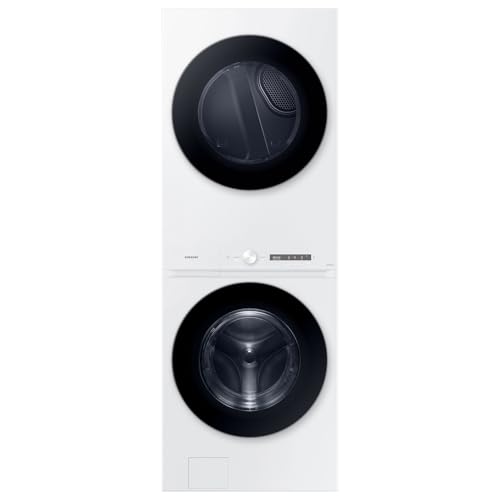
Samsung Bespoke AI Laundry Hub — Best Steam Wash Tower
Samsung’s Laundry Hub is the tower concept restyled for the Bespoke era: a single unit in white combining a 4.6 cubic foot washer — the listing specifies steam wash — with a 7.6 cubic foot gas dryer, under one control philosophy at the top of the unit. The steam wash is this guide’s most explicit steam claim on the washing side: steam introduced in the wash cycle to work on stains and freshen fabrics as they clean, in the half of the machine where steam does its deepest work. Households whose steam interest is about wash-day results — brighter loads, garments that emerge feeling renewed — should read this listing first.
The capacities are generously judged: the washer is a touch larger than the other towers’ here, the dryer a touch larger than the WashTower’s, and the pairing suits family laundry with bedding in the rotation. As a single unit it shares the tower virtues — one delivery, one installation, one face to the room — and the white Bespoke styling is deliberately furniture-calm, designed for laundry spaces that open off living areas where a black steel tower would glower. The Hub’s unified controls answer the reach question in Samsung’s own way, gathering operation into one panel rather than two.
Its trades are the tower’s trades plus a fuel note: the gas dryer needs its line and vent planned, and the unit’s permanence means the separation and single-replacement freedoms of the pair picks are surrendered. Buyers who accept those terms get the guide’s most complete steam-wash tower. Check price on Amazon for the WH46DBH100GWA3 listing details.
- Configuration: single-unit hub, factory stacked
- Washer: 4.6 cubic feet with steam wash per the listing
- Dryer: 7.6 cubic feet, gas
- Steam: steam wash — the guide’s clearest wash-side steam claim
- Finish: white, Bespoke styling
Strengths
- Steam wash specified in the listing, aimed at wash results.
- Largest washer of the three towers in this guide.
- Calm white design suits laundry spaces visible from living areas.
Trade-offs
- Single-unit permanence — no separating or single replacement.
- Gas dryer installation must be planned and fitted properly.
- White finish shows laundry-room scuffs more than darker towers.
Best for: steam-wash believers who want a tower’s simplicity in a light finish. Not suited for: households needing machines that can separate at the next move.

Equator Stackable Washer Dryer Set — Best Compact 110V Set
The Equator set changes the scale of the conversation entirely. This is a pair of compact machines — a 15-pound, 1.62 cubic foot washer and a 3.5 cubic foot vented digital dryer, both running on 110-volt household power — sold as a stackable set in white for the spaces the full-size towers cannot enter: the flat’s closet, the RV, the boat, the tiny home, the granny annex with one ordinary outlet. Where the towers ask whether your laundry room deserves a redesign, the Equator asks only whether you have a water supply, a drain and a corner.
Its compromises are the compact class’s own and are stated plainly: loads are small — this is a machine set for one or two people’s laundry run frequently — and the vented dryer needs its exhaust path considered, modest as it is. In exchange, the set delivers genuine in-home laundry, wash and dry, stacked in a footprint no full-size format can approach, on power that exists everywhere. For the households in its niche, that is not a compromise at all; it is the difference between laundry at home and laundry across town.
The listing does not claim steam, and in this size class that absence is normal — the set’s specialism is access, not features. Buy it for the space and the socket, and it will be the hardest-working small purchase in the home. Check price on Amazon to confirm the set’s dimensions against your closet or corner.
- Configuration: two separate compact machines, stackable set
- Washer: 1.62 cubic feet, 15 lbs, 110V
- Dryer: 3.5 cubic feet, vented digital, 110V
- Steam: not claimed on this listing
- Finish: white
Strengths
- Fits spaces and power supplies no full-size stack can use.
- True wash-and-dry laundry for flats, RVs and tiny homes.
- Two light machines are the easiest delivery in this guide.
Trade-offs
- Small loads only — family laundry outgrows it immediately.
- No steam or premium wash features.
- Vented dryer still needs an exhaust path planned.
Best for: compact living — flats, RVs, boats, annexes — on ordinary power. Not suited for: families, or anyone with room for a full-size tower or pair.

LG 5.0 Washer 7.4 Dryer Pair — Best Big-Washer Pair
The closing pick is the pair for households whose laundry is washer-led: two separate LG machines in black steel — a 5.0 cubic foot smart front-load washer, the largest washer in this guide, with a 7.4 cubic foot electric dryer — ready to stack with a kit or stand side by side. The washer’s extra capacity is the argument. Families whose loads are defined by bedding days, sports kits and the weekly everything-wash feel a 5.0 drum as a genuine reduction in weekly cycles, and pairing it with a full-size dryer keeps the dry side from becoming the bottleneck the wash side just escaped.
As a pair, it keeps the species’ freedoms: separate delivery and carrying, arrangement by the room rather than by the factory, and individual replacement in the far future. The electric dryer suits homes where the laundry position has its circuit ready and no gas line — the mirror image of the towers’ situation — and the black steel finish matches the WashTower’s palette for households that like LG’s dark laundry look but need the pair’s flexibility or the bigger washer. It is, in effect, the WashTower’s separable, larger-washing sibling.
The listing presents the pair on capacity and smart features rather than headlining steam, so verify the current feature set if steam is essential to you; the WashTower remains LG’s steam-named option in this guide. What this pair guarantees is throughput and freedom in a premium finish. Check price on Amazon for the pair listing and stacking kit details.
- Configuration: two separate machines, sold as a pair
- Washer: 5.0 cubic feet — largest in this guide
- Dryer: 7.4 cubic feet, electric
- Steam: not the headline of this listing — verify if essential
- Finish: black steel
Strengths
- Biggest washer here cuts weekly cycle counts for large households.
- Pair freedoms: separate carrying, arranging and replacing.
- Electric dryer suits homes without a gas line at the laundry.
Trade-offs
- Steam is not this listing’s headline — the WashTower carries LG’s steam banner.
- Electric dryer needs its proper circuit confirmed.
- Stacking kit may be separate — confirm before delivery day.
Best for: high-volume households wanting maximum wash capacity with pair flexibility. Not suited for: gas-ready homes set on steam, where the WashTower fits better.
How Do the Six Compare on Format, Capacity and Fuel?
| Pick | Format | Washer | Dryer | Steam position |
|---|---|---|---|---|
| LG WashTower Laundry Center | Single-unit tower | 4.5 cu ft | 7.4 cu ft gas | Steam named in listing |
| Electrolux Laundry Tower Gas | Single-unit tower | 4.5 cu ft | 8.0 cu ft gas | SmartBoost headlines instead |
| Samsung Front Load Laundry Package | Two separate machines | 4.5 class | Matched dryer | Not headlined |
| Samsung Bespoke AI Laundry Hub | Single-unit hub | 4.6 cu ft | 7.6 cu ft gas | Steam wash specified |
| Equator Stackable Washer Dryer Set | Two compact machines | 1.62 cu ft | 3.5 cu ft vented | Not claimed |
| LG 5.0 Washer 7.4 Dryer Pair | Two separate machines | 5.0 cu ft | 7.4 cu ft electric | Not headlined |
Tower or Pair: How Should You Actually Decide?
Decide by imagining three days in the appliance’s life: delivery day, an ordinary Tuesday, and the day one drum fails. Delivery day favours pairs in houses with stairs, turns and narrow doors, and favours towers in ground-floor laundry rooms with a straight run from the street — a tower is one heavy, tall object, and its path must be walked with a tape measure before it is booked. The ordinary Tuesday favours towers slightly, for their unified controls and single face, and pairs not at all less, since each machine simply does its job. The failure day favours pairs decisively: one machine is replaced, the other keeps working, and the laundry never fully stops.
Moves and renovations tip the scale further. A household expecting to move within the appliances’ life, or to reconfigure the laundry room, should buy the pair’s separability as insurance. A household building its laundry room once, around a permanent layout — the renovation that will not be repeated — is exactly the tower’s customer, and the towers’ centred controls and finished look repay that commitment daily. Neither species is the advanced one; they are answers to different housing biographies, and your own biography is the specification that matters most.
Where Does Steam Actually Appear in This Guide?
Let us gather the steam facts in one place, because the category’s marketing will not do it for you. The LG WashTower’s listing names steam as part of the unit’s identity. The Samsung Laundry Hub’s listing specifies steam wash for its 4.6 cubic foot washer — steam applied during washing, where it works on soil and fabric as the load cleans. Those are the two explicit steam claims among the six. The Electrolux tower headlines SmartBoost wash technology instead; the Samsung package and the LG pair present themselves on configuration and capacity; the Equator set claims no steam at all, consistent with its compact class.
The practical consequence is a clean shortlist. If steam is your headline requirement, your decision is WashTower versus Hub — tower versus tower, decided by finish, by the dryer’s size, and by whether your steam interest centres on the wash side, where the Hub is explicit. If steam is a preference rather than a requirement, the whole six open up, and format, capacity and fuel should lead. What no buyer should do is assume a tower or pair has steam because the category is associated with it; in laundry appliances, features live model by model, and the listing — read closely — is the only authority.
What Installation Does a Stacked Set Need?
The services are the laundry standard, arranged vertically. Water supply and a drain serve the washer at the base. The dryer needs its fuel — a gas line for the three gas listings here, a proper electrical circuit for the LG pair’s electric dryer — and a vent run to the outside for every dryer in this guide except where a model’s own listing states otherwise. A stacked installation concentrates all of that behind one footprint, which is convenient forever after and demanding for exactly one day: connections must be made in sequence as the stack is built, clearances checked before the upper unit goes on, and the whole assembly levelled so two drums spinning in one column do not set the stack swaying.
Practicalities follow. Measure the full stacked height against the ceiling and any shelving, and the depth with hoses and vent behind the units, not the cabinet depth alone. Confirm the floor is firm and level — a stack amplifies an unlevel floor’s misbehaviour. For pairs, order the correct stacking kit for the exact models and have it on site before delivery; for towers, confirm the delivery path can take the unit’s height through every doorway, tilted as crews tilt, with corners walked in advance. Gas connections belong to qualified installers, as our gas dryer guide insists. None of this is exotic, but all of it belongs before the truck, not during it.
How Do You Live With a Tall Stack Day to Day?
The daily ergonomics of a stack are better than newcomers fear and specific enough to plan for. Loading the upper dryer means lifting damp laundry to chest height — a full basket of wet towels is a genuine lift, and households divide loads or use a small step and a basket on a stool without thinking twice after the first week. The lint filter of the upper dryer sits high; the towers’ centre controls remove the worst reach, but the filter’s location is fixed by the drum, so shorter users should check the stacked height against their reach in a showroom or against the listing’s dimensions with a tape on the wall.
Sound and vibration concentrate in one column, which a level installation and a firm floor keep civilised; a stack on a hollow upper floor will announce its spin cycle to the room below more than a side-by-side pair would, and that is worth weighing in flats and timber houses. The compensations are real: one footprint, one laundry zone, a folding shelf where the second machine would have stood. Households adapt to a stack within days and then defend it — the space dividend is spent every single day, while the reach compromises shrink into routine.
One sentence of summary is worth adding for the reader who has scrolled a long way: a stack is not a compromise version of a laundry pair but a different arrangement of the same work, and the six sets here cover that arrangement’s full range — from a compact 110-volt pair that fits a cupboard to towers that anchor a renovated laundry room. The right choice is the one whose format, fuel and capacity match the room and the household in front of you, and every section above was written to make that match checkable rather than guessable.
There is a quieter benefit to the column worth naming before we leave the subject: everything in one place disciplines the household’s laundry geography. Detergent, baskets, the iron, the lost-sock basket — all of it gathers around a single point instead of trailing between two stations, and small homes feel measurably tidier for that gathering. Visitors notice it too, though they rarely name it: a laundry corner that reads as one composed appliance, with its supplies in one cupboard, looks intentional in a way that scattered equipment never quite manages.
How Do You Match Washer and Dryer Capacities in a Stack?
The dryer’s drum should be the larger of the two in usable terms, because washed laundry expands and needs tumbling room to dry evenly — a principle every pick here respects, from the towers’ 4.5-and-7.4 pairings to the Equator’s compact proportions. Where a set’s dryer is only modestly larger, as in the Samsung package’s matched class, ordinary loads remain fine and only the bulkiest bedding days ask for a split dry. Where the dryer is dramatically larger, as the Electrolux tower’s 8.0 cubic feet is, bedding becomes the set’s party trick: a full wash of sheets and a duvet cover dries in one open, tumbling load.
Households should size the washer to their real weekly volume first, since washing is the load-defining half, then confirm the dryer keeps pace. The LG pair inverts the usual temptation usefully: its 5.0 washer serves homes whose constraint is wash throughput, and its full-size dryer ensures the bigger loads still dry in one pass. Buying washer capacity you never fill wastes water and time on every cycle for a decade; buying the size your biggest ordinary week needs — not your biggest imaginable one — is the discipline this whole guide keeps returning to, in every category it covers.
How Does a Stack Transform a Small Laundry Closet?
The laundry closet is where stacking stops being an option and becomes the enabling technology. A standard closet fitted with water, drain and power for one machine can, with a stack, hold a complete laundry — and the half of the closet the second machine would have occupied becomes shelving for detergent, a hanging rail for shirts straight from the dryer, or the household’s linen store. Designers of small homes plan closets around the stack’s dimensions from the first sketch, because the format converts the least promising cupboard in the house into one of its hardest-working spaces.
Closet installations have their own disciplines. The door matters: louvred or vented doors let the machines breathe and shed the dryer’s warmth, while a solid door should stand open during cycles. Clearances shrink to the manufacturer’s minimums and no further, because heat and vibration both need their margins. A drain pan under the stack is cheap insurance in an upstairs closet, where a leak’s consequences multiply. And the closet’s stack should be the household’s deliberate choice of size — the full-size towers for a family closet, the Equator set for the studio’s cupboard — because a closet forgives nothing dimensionally. Get those details right and guests will never guess the cupboard does the whole house’s laundry.
What Does the First Month of Stacked Laundry Teach?
New stack owners report a consistent curriculum. The first lesson is choreography: laundry now moves upward, and the household invents its system — basket on a stool, loads divided by weight, the dryer loaded from the washer in two lifts rather than one heroic heave. Within a fortnight the choreography is invisible, simply how laundry is done. The second lesson is the folding dividend: the surface where the second machine stood becomes the folding station the household never had, and laundry that is folded at the machine actually reaches drawers, a domestic miracle owners mention with genuine surprise.
The third lesson concerns the upper dryer as an appliance in its own right. Its loads dry exactly as a side-by-side dryer’s would — the format changes nothing about the physics — but its finished loads are unloaded at a height that encourages promptness, since a basket left beneath a stack is a basket in everyone’s way. Households also learn to run the two drums in relay rhythm, the washer starting the next load while the dryer finishes the last, and discover that a stack’s throughput, used that way, matches a pair’s completely. The format, in other words, costs nothing in capacity of service; it only asks the household to learn a vertical habit, and repays it with floor.
How Should You Maintain Two Drums in One Column?
Maintenance doubles in count but not in kind. The washer wants its usual attentions — door seal wiped, door left ajar between washes, detergent dosed for a front-loader so residue does not build — and in a stack those habits matter slightly more, because the washer’s moisture lives beneath a warm dryer and the seal should be kept dry and clean. The dryer’s religion is the lint filter, cleaned every load, with the vent run checked annually; a stacked vent run is often shorter than a side-by-side’s, which is a quiet advantage of the format.
Once a season, give the column itself a minute: confirm the stack still sits level, that a pair’s stacking kit shows no loosening, that hoses and connections behind the units are dry to the touch. Vibration works on everything slowly, and a stack concentrates vibration in one footprint, so the seasonal glance is the format’s specific tax — ninety seconds, four times a year. Owners who pay it report the same uneventful decade as any laundry pair’s owners, which is the entire maintenance ambition: nothing to report, for years, while the laundry happens in half the space.
When Is a Side-by-Side Pair Still the Better Answer?
Stacking is a means, not a virtue, and three households should decline it even within this guide’s pair picks by standing their machines side by side. The first has the room and no use for the reclaimed footprint — a large utility room gains nothing from a stack and loses the easy reach of two front-facing machines at waist height. The second includes a household member for whom lifting damp laundry to chest height is a genuine difficulty; ergonomics outrank floor plans, always. The third runs the two machines as separate workflows — a household where the washer and dryer serve different people or purposes on different schedules, and physical separation is operational clarity.
The pair picks exist for these households as much as for stackers, which is why this guide treats arrangement as a property of the room rather than a command from the product. A tower, by contrast, must stack — that is its nature and its commitment — so the side-by-side household’s shortlist is the three pairs, chosen among by capacity, fuel and the steam labelling their sections state. The best laundry room is the one arranged for the bodies and habits that will use it for fifteen years, and no format evangelism in a buying guide should outrank that simple test.
How Do Finishes and Design Work in a Laundry Room?
Laundry rooms have become designed rooms — visible from kitchens, photographed for listings, lived in for an hour a week of folding — and the stack is usually their largest object, so its finish sets the room’s tone. The black steel of the WashTower and the LG pair gives a laundry the composed, appliance-as-furniture look that modern renovations aim for. The Electrolux’s titanium occupies the considered middle, and the white of the Samsung Hub, the Samsung package and the Equator set keeps small rooms bright and matches the installed base of white laundry appliances across the housing stock.
The practical side of finish is the usual one, sharpened by laundry chemistry: detergent drips, bleach splashes and basket scuffs are this room’s daily weather. Dark finishes hide scuffs and show pale lint; white shows scuffs and hides lint; titanium splits the difference with some grace. None of that should outrank format, capacity or fuel in the decision — but between two sets that tie on the engineering, the finish you will enjoy looking at while folding is a legitimate final vote, and the pairs in this guide exist partly so that vote can be cast freely.
What Should You Confirm on the Listing Before a Stack Arrives?
Configuration first, in the listing’s own words: tower or pair, and if a pair, whether the stacking kit is included or separate. Second, both capacities and the dryer fuel, checked against your laundry’s services — gas line present, or the correct electrical circuit — because a fuel mismatch discovered on delivery day is this category’s most expensive reading error. Third, the stacked dimensions as a single set of numbers: total height, depth with connections, and the door swings, walked against your room and your delivery path with a tape measure in hand.
Fourth, the steam question, settled from the listing rather than the category: in this guide, the WashTower and the Samsung Hub carry the explicit claims, and any buyer whose heart is set on steam should confirm the current listing still states it. Fifth, the installation scope — what the delivery includes, what your installer must supply, and whether the vent path you planned matches the dryer’s exhaust position. A stacked set is a decade-long fixture installed in a single day; the hour of verification that precedes it is the best-spent hour of the whole purchase.
How Does a Stack Serve a Growing or Shrinking Household?
Households change size under their appliances, and the two species age differently through those changes. A young family’s laundry doubles in five years; a stack sized for the family week — the towers’ 4.5-class washers, the LG pair’s 5.0 — absorbs that growth without a second purchase, which is why family buyers should size for the near future rather than the present couple. The pair format adds a different kind of future-proofing: when the household later shrinks or splits — children leaving, a house divided into flats — the machines can separate and serve two smaller laundries, a second life no tower can offer.
The Equator set plays the opposite role in the same story: it is the set a household buys for a chapter — the annex years, the boat, the first flat — knowing the chapter will end, and its modest scale and easy moving make it the natural hand-me-down to the next small household in the family. Thinking of a laundry set as belonging to a chapter or to a generation is the deepest version of the tower-versus-pair question, and the buyers who ask it tend to be the ones still satisfied in year ten.
What Mistakes Do Stackable Set Buyers Make Most Often?
The first mistake is buying a tower for a house it cannot enter — stairs, a turn, a low doorway — discovered with the unit on the drive. Walk the path with a tape measure before ordering any single-unit stack. The second is assuming steam from the category rather than the listing; two of these six claim it explicitly, and the others are excellent machines that should be bought for their real virtues. Third comes neglecting the stacking kit on a pair, or assuming any kit fits any machines, when kits are model-specific and the stack’s safety rides on the right one.
Fourth, buyers forget the upper dryer’s reach and the wet-basket lift until the first laundry day teaches both. Fifth, fuel surprises: a gas tower ordered for an all-electric laundry position, or an electric pair where no suitable circuit exists, converts a delivery into a project. Sixth, and quietest, is sizing for the imaginary household — the 5.0 washer for a couple, the compact Equator for a family of five — when the honest week, counted in loads, was knowable all along. Measure the path, read the listing, count your loads: the stack that results will serve without drama for a decade.
Final Recommendation
For the household building a permanent laundry around one elegant footprint, the LG WashTower Laundry Center remains the benchmark: steam in its listing, centred controls, family capacities and a finish that anchors a room. If your steam interest is specifically the wash, choose the Samsung Bespoke AI Laundry Hub and its explicit steam wash in white. And if your life involves stairs, moves or a washer that must be enormous, the LG 5.0 Washer 7.4 Dryer Pair gives you the stack’s space dividend without the tower’s permanence. Measure the path, confirm the fuel, and let the laundry take half the floor it used to — the reclaimed square will be used by something you love within the month.
Frequently Asked Questions
What is the difference between a laundry tower and a stacked pair?
A tower — the WashTower, the Electrolux tower, the Samsung Hub — is one factory-built appliance with washer and dryer in a single body. A pair — the Samsung package, the LG pair, the Equator set — is two separate machines stacked with a kit or stood side by side. Towers offer unified controls and one installation; pairs offer separability and individual replacement.
Which sets in this guide actually have steam?
The LG WashTower names steam in its listing, and the Samsung Laundry Hub specifies steam wash. The other four listings headline different strengths — SmartBoost wash technology, configuration flexibility, compact 110-volt access and washer capacity — and their sections in this guide note steam’s absence rather than implying it.
Can I stack any washer and dryer I already own?
Only front-load machines designed for stacking, using the manufacturer’s kit for those exact models. Never improvise a stack, and never place a dryer on a washer not rated for it. The sets in this guide are sold for the purpose, which is the safe way to buy the format.
Do stacked dryers need venting?
The dryers in this guide are vented designs, gas and electric, and need a proper duct run to the outside — including the towers. Plan the vent path as part of the installation, keep it short and smooth, and have gas connections made by a qualified installer where a gas dryer is involved.
Is a stacked set too tall for shorter users?
It depends on the model and the user, which is why the towers’ centred controls matter: they put operation at the middle of the unit rather than at the top. The upper dryer’s drum and lint filter still sit high, so check the listing’s stacked height against your household’s reach before ordering, ideally with a tape measure on the laundry room wall. A two-minute check with a tape and the shortest adult in the house will settle the question more reliably than any review, including this one, ever could on its own, however carefully it was written.
What happens when one half of a tower fails?
That is the tower’s honest trade: the halves are one appliance, so a major failure in one drum generally means servicing or replacing the unit as a whole. Buyers who cannot accept that should choose a pair, whose halves are replaced independently — the Samsung package and the two other pair picks in this guide exist for exactly that preference.
Related Guides
A laundry project pairs naturally with the rest of the home’s refresh, so continue with Best Organic King Size Flannel Sheet Sets for the bedding these machines will wash, sharpen the kitchen with Best Manual Meat Grinders, and plan the cooking wall with Best Freestanding Induction Ranges.



[…] styled kitchen deserves its laundry and utility choices to be equally deliberate, so continue with Best Stackable Front Load Washer and Dryer Sets With Steam for the laundry wall, add convivial cooking with Best Electric Hot Pots With Grill Plate, and […]