What's inside
- Key Takeaways
- Quick Picks
- How Did We Choose These 36 Inch Refrigerators?
- How Do the Six 36 Inch Refrigerators Compare Side by Side?
- What Does a 36 Inch Refrigerator Actually Measure?
- Counter-Depth or Full-Depth: Which Trade Suits Your Kitchen?
- How Much Clearance Does a Refrigerator Need Around It?
- How Do You Plan the Delivery Path Before Ordering?
- French Door or Side-by-Side: Which Layout Cooks Better?
- What Should You Check in the First Week of Ownership?
- How Should You Organise the Inside Once It Is Installed?
- What Do Ice and Water Dispensers Really Cost You?
- How Noisy Should a New Refrigerator Be?
- Which Energy and Certification Labels Are Worth Reading?
- How Long Should a 36 Inch Refrigerator Last, and What Shortens Its Life?
- What Should You Ask Before You Click Buy?
- How Do You Match a Refrigerator to the Way Your Household Actually Shops?
- What Happens to Resale, Rentals and Future Renovations?
- How Should You Clean and Maintain the Cabinet So Cooling Stays Even?
- When Is a Second Refrigerator the Better Answer?
- How Do Hinges, Handles and Finishes Change Daily Life?
- What Does Installation Day Actually Look Like?
- How Do You Read a Capacity Figure Honestly?
- What Mistakes Do Buyers of 36 Inch Refrigerators Make Most Often?
- Final Recommendation
- Frequently Asked Questions
- Related Guides
As an Amazon Associate I earn from qualifying purchases. This post may contain affiliate links at no extra cost to you.
cottageverdict.com is reader-supported. When you buy through links on our site, we may earn an affiliate commission.
Where to buy: the six best 36 inch refrigerators in this guide are all sold through Amazon, and the product names in the Quick Picks table, the detailed reviews and the comparison table link straight to the matching listing, where you can check price on Amazon and confirm the exact width, depth and capacity figures before you commit. A refrigerator is the least forgiving appliance purchase in the kitchen, because a quarter inch of misjudgement does not show up as a slightly awkward fit — it shows up as a delivery crew standing in your doorway explaining that the box cannot turn the corner, or a cabinet run with a steel slab jutting two inches proud of the counter line.
That is why this guide treats the tape measure as a buying tool rather than an afterthought. The nominal class is 36 inches, yet the cabinets behind these doors actually measure anywhere from about 35.75 to 36.5 inches wide depending on the maker, and depth splits the field even harder: full-depth models swallow party platters and warehouse-club trays, while counter-depth bodies trade some of that volume for a built-in look that keeps the front nearly flush with your cabinetry. Two of the six picks are honest counter-depth designs, one stretches counter-depth thinking to a much larger interior, and the rest use the full depth the class allows. Read the width and depth notes for your kitchen first, then let layout and features argue their case.
Key Takeaways
- A 36 inch label is a class, not a measurement: actual cabinet widths in this group run roughly 35.75 to 36.5 inches, so measure your opening at counter height and at the back wall.
- Counter-depth picks such as the Cosmo Lumin and the Kenmore 28.6 give up raw volume to sit nearly flush, while the Kenmore 29 side-by-side uses full depth for the largest capacity here.
- French door layouts keep fresh food at eye level and suit wide platters; side-by-side layouts give freezer access without bending and narrower door swings in tight galley kitchens.
- Door swing and the delivery path matter as much as the alcove: hinges, handles and a 90-degree open door all add inches the brochure width ignores.
- Dual evaporators, as fitted to the Kenmore 28.6 French door, keep freezer air dry and fridge air humid instead of forcing one compromise on both compartments.
- Smart features on the LG Counter-Depth MAX add alerts and app control, but they never rescue a refrigerator that does not physically fit the space.
Quick Picks
| Pick | Badge | Why it earns its place |
|---|---|---|
| Verona 36 French Door Refrigerator | Best Straightforward French Door | A clean stainless French door design without feature bloat, for buyers who want the layout and little else to learn. |
| Kenmore 29 cu ft 36 Wide Side-by-Side | Best Maximum Capacity | The biggest interior in this group, with a space-saving dispenser and fast-chill zones for bulk-shopping households. |
| Cosmo Lumin 36 French Door | Best True Counter-Depth Fit | A 22.4 cu ft counter-depth body that keeps the front line tidy in kitchens where every protruding inch is visible. |
| Verona 36 French Door Stainless Look | Best Stainless-Look Alternative | French door storage with a stainless-look finish for kitchens matching appliances by appearance rather than by metal. |
| LG Counter-Depth MAX 36 French Door | Best Smart Counter-Depth Capacity | Counter-depth shallowness with a 26 cu ft interior, dual ice and ThinQ app control layered on top. |
| Kenmore 28.6 French Door 36 Wide | Best Dual-Evaporator Cooling | Counter-depth French doors with separate evaporators for each compartment and an external dispenser. |
How Did We Choose These 36 Inch Refrigerators?
We started with the constraint that defines the class: every pick had to be a genuine 36 inch width model from its listing, not a narrower fridge marketed into the category or a wider built-in wearing a friendly label. From there we split the field by depth, because that single dimension decides whether the finished kitchen looks integrated or interrupted, and we kept both honest counter-depth bodies and full-depth capacity plays so the guide reflects the real choice buyers face rather than pretending one answer suits every room.
Layout came next. French door models dominate modern kitchens for good reason — fresh food sits at waist height and above, wide shelves accept sheet pans and pizza boxes, and the freezer drawer keeps frozen goods in one deep, visible bin. Side-by-side models answer with slimmer door swings, freezer shelving that organises small items instead of burying them, and no heavy drawer to haul open with wet hands. We kept one strong side-by-side in the group so that trade-off stays visible. Finally we weighed the details listings actually confirm: dispenser style, ice maker count, evaporator arrangement, smart connectivity and certifications such as ENERGY STAR, and we left unconfirmed features out rather than decorating picks with capabilities nobody documented.

Verona 36 French Door Refrigerator — Best Straightforward French Door
Verona’s VEBFD3620WIFS takes the position in this group for buyers who want the French door layout in stainless steel and are suspicious of feature lists that read like a phone specification sheet. The format is the familiar one: two half-width doors over a pull-out freezer drawer, fresh food shelved at comfortable standing height, and a front face that stays calm and uncluttered in an open-plan kitchen where the refrigerator is visible from the sofa.
That restraint cuts both ways, and honestly is the point. Households that batch-cook will appreciate the wide fresh-food cavity when a roasting pan or a party tray needs to rest overnight, and the drawer freezer swallows bags of frozen vegetables without the archaeological layering a chest compartment encourages. What you do not get here is a marketing headline — no app ecosystem, no camera tricks — so the value sits in the steel, the layout and the absence of systems you would never open twice.
- Configuration: French door refrigerator over a freezer drawer
- Finish: stainless steel
- Width class: 36 inch nominal; confirm the exact cabinet width on the listing against your opening
- Listing model reference: VEBFD3620WIFS
Strengths
- Wide fresh-food shelves accept trays and platters that defeat narrower layouts.
- Uncluttered stainless front suits kitchens where the fridge is always on view.
- Drawer freezer keeps bulky frozen goods in one deep, single space.
Trade-offs
- No smart connectivity or app alerts for buyers who want remote warnings.
- Deep freezer drawers can hide smaller items beneath larger bags.
- Listing information is lean, so confirm dispenser and ice details before ordering.
Best for: renovators who want a clean stainless French door anchor piece without paying for connected features. Not suited for: households that specifically want app alerts, door cameras or a through-door dispenser as a headline feature.

Kenmore 29 cu ft 36 Wide Side-by-Side — Best Maximum Capacity
Twenty-nine cubic feet is the number that organises everything about this Kenmore. It is the largest interior in the guide, arranged as a side-by-side so the freezer runs full height beside the fresh food instead of crouching underneath it. For a household that shops in bulk, freezes garden produce or keeps a second freezer’s worth of meat in the main kitchen, that vertical freezer column with real shelving beats a drawer you have to excavate.
Kenmore builds the convenience layer around the dispenser: the ice and water unit is described as space-saving, which matters in a side-by-side where the dispenser historically eats a shelf’s worth of freezer room. Accela Chill and Accela Freeze are the brand’s fast-cooling modes, aimed at the moment a warm grocery haul lands or a tray of leftovers needs to drop in temperature quickly. Adjustable glass shelving lets you re-stage the fresh side for tall bottles or stacked meal-prep containers, and the fingerprint-resistant stainless finish answers the oldest side-by-side complaint, which is a front covered in handprints at child height.
- Capacity: 29 cu ft as listed
- Configuration: side-by-side with full-height freezer column
- Dispenser: space-saving ice and water design
- Cooling extras: Accela Chill and Accela Freeze fast modes
- Finish: fingerprint-resistant stainless steel
Strengths
- Largest capacity in this group for bulk and warehouse shopping.
- Full-height freezer shelving organises small items visibly.
- Narrower door swings suit galley kitchens and island clearances.
Trade-offs
- Full-depth body projects further into the room than counter-depth picks.
- Very wide platters and sheet pans may not fit either narrower column.
- Side-by-side fresh shelves are less flexible for oversized party trays.
Best for: big households and bulk shoppers who measure a refrigerator by how much it swallows. Not suited for: cooks who regularly chill wide sheet pans or want a flush counter-depth front line.

Cosmo Lumin 36 French Door — Best True Counter-Depth Fit
The Cosmo Lumin, model COS-FDR223GWSS in the maker’s Lumin collection, is the pick that takes the counter-depth promise literally. Its 22.4 cu ft interior is the smallest in this group, and that is the honest price of a cabinet shallow enough to sit close to the counter line. In a kitchen designed around clean sightlines — handleless cabinets, a waterfall island, nothing visually shouting — a full-depth refrigerator front reads like a mistake, and this is the model that avoids it.
Within that shallower box, Cosmo keeps the expected French door equipment: a water dispenser and ice maker, digital touch temperature controls you can set precisely rather than nudging a dial between numbers, and a door alarm that complains when a door is left ajar by a distracted teenager. The capacity question deserves a straight answer: 22.4 cu ft serves a couple or a small family that shops weekly, but a household freezing bulk meat or storing multiple large trays will feel the ceiling quickly, and no shelf arrangement changes the physics of a shallower cabinet.
- Capacity: 22.4 cu ft as listed
- Depth: counter-depth cabinet
- Controls: digital touch temperature controls
- Equipment: water dispenser, ice maker, door alarm
- Listing model reference: COS-FDR223GWSS
Strengths
- Genuinely shallow cabinet keeps the front near the counter line.
- Precise digital controls beat vague numbered dials for temperature setting.
- Door alarm guards against slow warm-ups from a door left cracked.
Trade-offs
- Smallest capacity here; bulk storage runs out quickly.
- Shallower shelves can struggle with very deep roasting pans.
- Less interior flexibility for tall items than full-depth rivals.
Best for: design-led kitchens and smaller households that value the flush look over maximum volume. Not suited for: large families, bulk freezers-by-habit, or anyone whose weekly shop fills a trolley to the bar.
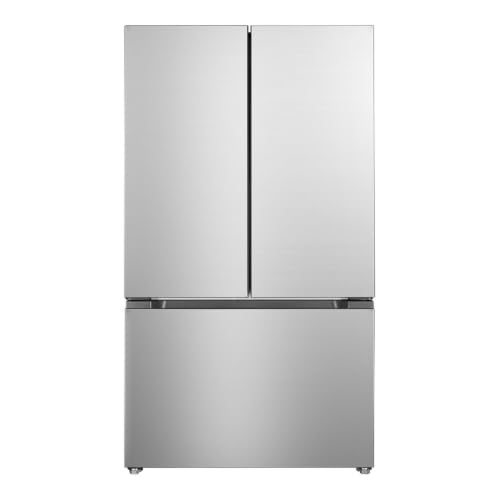
Verona 36 French Door Stainless Look — Best Stainless-Look Alternative
The second Verona in the group, model VEFFD3620RISL, wears a stainless steel look finish rather than the full stainless presentation of its sibling, and that distinction is the whole reason it exists. Kitchens are often matched by eye from across the room: a range, a dishwasher panel and a refrigerator that share a tone read as a set long before anyone touches the metal. A stainless-look finish aims squarely at that visual matching, usually at a gentler position in the range.
Under the finish, the layout repeats the family formula — French doors over a freezer drawer, fresh food at standing height, wide shelving for the trays and boards that dominate real cooking. Choosing between the two Veronas is therefore a finish and budget conversation, not a layout one, and it is worth standing in your own kitchen and asking whether the refrigerator needs to match true stainless appliances exactly or simply harmonise with them under warm evening light, which is when most guests actually see it.
- Configuration: French door refrigerator over a freezer drawer
- Finish: stainless steel look
- Width class: 36 inch nominal; verify exact cabinet width on the listing
- Listing model reference: VEFFD3620RISL
Strengths
- Stainless-look finish coordinates with steel-toned appliance suites.
- Same wide-shelf French door layout as its stainless sibling.
- A calmer front for open-plan rooms where the fridge never leaves view.
Trade-offs
- Finish is a look rather than solid stainless presentation.
- Magnets and surface care may behave differently than on true steel.
- Feature detail on the listing is brief; confirm ice and dispenser specifics.
Best for: buyers matching an existing steel-toned kitchen by appearance and prioritising the French door layout. Not suited for: purists who want genuine stainless surfaces, or buyers needing a long confirmed feature list before ordering.

LG Counter-Depth MAX 36 French Door — Best Smart Counter-Depth Capacity
LG’s Counter-Depth MAX design exists to answer the objection that shallow refrigerators are small refrigerators. By thinning the cabinet walls and reworking the interior, LG claims a 26 cu ft capacity inside a counter-depth French door body — a figure that would be respectable in a full-depth model and is remarkable in one designed to sit back in line with the counters. If your kitchen needs the flush look but your household shops like the Kenmore 29 exists for, this is the compromise engineered for you.
The ice story is doubled: a dual ice maker arrangement, including the Slim SpacePlus ice system that moves ice production into the door to free shelf space. Around that sits the connected layer — WiFi and ThinQ app control for temperature checks, alerts and settings from a phone. Connectivity is genuinely useful in one narrow scenario, the door-left-open or temperature-rising warning reaching you at work, and merely decorative the rest of the time; judge it as insurance rather than entertainment and its value settles into place.
- Capacity: 26 cu ft as listed, in a counter-depth cabinet
- Ice: dual ice maker with Slim SpacePlus door ice system
- Connectivity: WiFi enabled with ThinQ app control
- Configuration: smart French door with freezer drawer
Strengths
- Counter-depth fit without the usual steep capacity penalty.
- Two ice sources cope with parties and summer demand.
- App alerts can catch a warming fridge before food spoils.
Trade-offs
- Smart systems add cost and setup steps some households never use.
- Door-mounted ice still claims some door storage volume.
- App features depend on your home WiFi staying healthy.
Best for: households wanting a flush fit, serious capacity and connected alerts in one appliance. Not suited for: buyers avoiding app-linked appliances on principle, or kitchens where the fridge will never join the network.

Kenmore 28.6 French Door 36 Wide — Best Dual-Evaporator Cooling
This Kenmore pairs the two ideas buyers usually have to choose between: a counter-depth French door cabinet and a genuinely large 28.6 cu ft interior. The engineering detail that earns its badge is the dual evaporator system. A single-evaporator refrigerator cools the fresh compartment with air borrowed from the freezer, which is why lettuce can pick up a frozen edge and ice cream can absorb onion smells; separate evaporators let the freezer stay dry and cold while the fresh side keeps the humidity that leafy greens and cheese actually want.
The rest of the specification supports family duty: an external ice and water dispenser so nobody opens the doors to fill a glass during a heatwave, adjustable shelving for re-staging around tall items, fingerprint-resistant stainless to slow the smudge cycle, and ENERGY STAR certification confirming the efficiency testing behind the listing. In a group where several picks ask you to trade volume for fit, this one refuses most of the trade, and the dual evaporator gives the refusal a food-quality argument rather than a purely numerical one.
- Capacity: 28.6 cu ft as listed
- Depth: counter-depth cabinet
- Cooling: dual evaporator, separate systems per compartment
- Dispenser: external ice and water
- Certification: ENERGY STAR certified per listing
Strengths
- Separate evaporators protect fresh-food humidity and freezer dryness.
- Nearly full-depth capacity inside a counter-depth footprint.
- External dispenser reduces door-open time on hot days.
Trade-offs
- Dispenser machinery claims some fresh-door storage space.
- More cooling hardware means more components to service eventually.
- Counter-depth shelves remain shallower than true full-depth rivals.
Best for: produce-heavy households that want flush fit, big volume and better humidity control together. Not suited for: minimalists who prefer the simplest possible cooling system, or buyers needing maximum shelf depth above all.
How Do the Six 36 Inch Refrigerators Compare Side by Side?
| Pick | Layout | Capacity / depth note | Defining feature |
|---|---|---|---|
| Verona 36 French Door Refrigerator | French door | Full-depth class body | Uncluttered stainless design |
| Kenmore 29 cu ft 36 Wide Side-by-Side | Side-by-side | 29 cu ft, full depth | Space-saving dispenser, fast chill modes |
| Cosmo Lumin 36 French Door | French door | 22.4 cu ft, counter-depth | Digital touch controls, door alarm |
| Verona 36 French Door Stainless Look | French door | Full-depth class body | Stainless-look finish |
| LG Counter-Depth MAX 36 French Door | French door | 26 cu ft, counter-depth | Dual ice, ThinQ connectivity |
| Kenmore 28.6 French Door 36 Wide | French door | 28.6 cu ft, counter-depth | Dual evaporator cooling |
What Does a 36 Inch Refrigerator Actually Measure?
The class name describes the opening the appliance was designed for, not a promise about the cabinet. Across the industry, nominal 36 inch refrigerators measure roughly 35.75 to 36.5 inches across the cabinet, and makers assume a standard opening with a small breathing margin around the body. A cabinet at the wide end of that range slides happily into a true 36 inch alcove; the same cabinet wedged into an opening that has shrunk to 35.6 inches because of thick trim, a proud countertop edge or walls that lean will not go in at all, and no amount of delivery-day optimism changes that geometry.
Measure three widths, not one: at the front of the opening, at the back wall, and at counter height where base cabinets or a peninsula might narrow the passage. Measure height too, including the hinge caps, against the underside of any cabinet above the alcove, and note the floor: an unlevel slab tilts the cabinet and can make doors swing on their own. Write the smallest number down and shop against that figure, checking each listing’s stated cabinet width before you fall for a layout.
Counter-Depth or Full-Depth: Which Trade Suits Your Kitchen?
Depth decides how the finished room feels. A standard countertop runs about 25 inches deep, and a full-depth refrigerator cabinet can reach 30 inches or more before handles, so the front stands proud of the cabinetry by a hand’s width. In a large kitchen that projection barely registers; in a compact one it narrows the working aisle and catches hips and shopping bags. Counter-depth models pull the cabinet back toward the counter line, buying visual calm and aisle space with interior volume — the Cosmo Lumin’s 22.4 cu ft is the honest arithmetic of that exchange.
The newer designs in this group narrow the gap. LG’s Counter-Depth MAX reaches 26 cu ft and the Kenmore French door reaches 28.6 cu ft while keeping counter-depth cabinets, using thinner walls and smarter ice placement to defend volume. Even so, shelf depth is shelf depth: a deep roasting pan with handles, a stockpot or a watermelon will always test a shallower cabinet first. If your cooking leans on oversized vessels, favour capacity; if your kitchen leans on sightlines, favour depth discipline and shop more often.
How Much Clearance Does a Refrigerator Need Around It?
Refrigerators reject heat through their sides, top or rear depending on design, and the listing’s installation notes state the air gaps the maker expects — commonly a small clearance at the sides and top and a larger one behind. Starving those gaps makes the compressor work harder, run longer and die younger, and it can also push the cabinet forward so the doors bind on adjacent cabinetry. Treat the specified clearances as part of the appliance’s real dimensions when you measure the alcove.
Door clearance is the second half of the puzzle. A French door needs room for both doors to open past 90 degrees if you ever want to remove a shelf or a crisper drawer, and a side-by-side needs its narrower doors to clear an island edge. Stand in the kitchen and mime the swing with a tape measure before ordering. Handles add depth that brochures sometimes list separately, so add the handle projection to the cabinet depth when you check whether the front will clear a facing island.
How Do You Plan the Delivery Path Before Ordering?
More refrigerator purchases fail at the front door than at the alcove. Walk the route the delivery crew will take: the exterior door, any porch steps, the hallway turn, the kitchen doorway, and measure the narrowest point with doors and packaging in mind. Cabinets travel on dollies, sometimes with their doors removed by the crew, but stairwell turns and low bulkheads set hard limits that a tape measure reveals in five minutes and a refused delivery reveals at great inconvenience.
Prepare the destination as well. Clear the old appliance’s contents into coolers, confirm the water line position and shut-off if your pick has a dispenser, and check that the outlet sits where the new cabinet’s rear panel expects it. If the old refrigerator is leaving through the same path, measure it too — the route that admitted a 33 inch model a decade ago may not release a wider one without removing a door from its hinges, a small job that is far easier scheduled than improvised.
French Door or Side-by-Side: Which Layout Cooks Better?
French door layouts dominate this guide because they mirror how most households actually use a refrigerator: fresh food opened twenty times a day sits at standing height, wide shelves take the sheet pans and marinating dishes of real cooking, and the freezer, opened less often, waits below in a drawer. The cost is the drawer’s archaeology — small items migrate downward — and the wider door pair needs swing room on both sides.
Side-by-side answers with organisation. The Kenmore 29’s full-height freezer column shelves frozen goods where you can read every label, the narrower doors swing in tight kitchens without threatening an island, and tall items stand upright in both compartments. The tax is width inside each column: a frozen pizza box or a holiday turkey platter may fit neither side. Choose by your shopping, not by fashion — bulk freezers and label readers thrive in columns; platter cooks and tray bakers thrive behind French doors.
What Should You Check in the First Week of Ownership?
Give a new refrigerator a full day to settle at temperature before loading it heavily, then verify both compartments with an inexpensive appliance thermometer rather than trusting the display: fresh food should hold just above freezing and the freezer at or below zero on the Fahrenheit scale. Check door seals by closing each door on a sheet of paper at several points; a seal that releases the paper with no drag anywhere deserves a call while the warranty conversation is easy.
Listen during the first nights. New compressors and ice makers have voices — clicks, hums, the occasional clatter of cubes dropping — and learning the normal repertoire now means you will recognise the abnormal later. Level the cabinet so doors close with a gentle self-swing, register the warranty, photograph the model plate inside the fresh compartment, and keep the delivery paperwork until the first ice batch and the first full grocery load have both passed without complaint.
How Should You Organise the Inside Once It Is Installed?
A wide French door interior rewards a zoning habit from day one. Keep the top shelves for ready food — leftovers in clear containers, yoghurt, eggs where your household expects them — because eye-level storage is what the layout was bought for, and burying it under raw ingredients wastes the design. Raw meat belongs low, ideally on a tray on the lowest shelf, so gravity never carries its juices onto food eaten uncooked. Crisper drawers earn their keep when one is set more humid for leaves and herbs and the other drier for fruit and peppers, and the discipline of returning each item to its zone matters more than the exact map you choose.
Door bins are the warmest real estate in the cabinet, so fill them with the condiments, pickles and sauces that shrug off temperature wobbles, and resist parking milk there no matter how perfectly the gallon jug fits the bin’s moulding. In the freezer drawer, stand bags upright in a row once they are frozen flat on a tray; a drawer of flat, labelled bags behaves like a filing cabinet, while a drawer of lumpy sacks behaves like a dig site. Ten minutes of flattening and labelling at freezing time saves ten frustrated minutes at cooking time, every single week.
What Do Ice and Water Dispensers Really Cost You?
Dispensers trade three currencies: interior space, maintenance and plumbing. The through-door units on models like the Kenmore 28.6 and the Cosmo Lumin claim door or wall volume that would otherwise hold shelves, though slim designs such as LG’s SpacePlus system shrink that tax by moving ice production into the door itself. Every dispenser also carries a filter that wants replacing on the maker’s schedule; ignore it and flow slows to a dribble while water picks up the taste of the tank it sat in. Budget the filters as a running cost, the way you budget detergent for a dishwasher.
The plumbing side is simpler than most buyers fear but still deserves planning. A dispenser needs a cold-water supply line, a shut-off valve you can actually reach, and enough slack in the line that the cabinet can roll out for cleaning without straining the connection. If your kitchen has no line near the alcove, factor a plumber’s visit into the true cost of a dispenser model, or choose a pick whose appeal does not depend on one. Ice makers without dispensers still need that same supply, a detail that surprises buyers who assumed only the glass-filling models drink from the wall.
How Noisy Should a New Refrigerator Be?
Modern compressors hum at a level most households stop hearing within a week, but the character of the sound matters more than its volume. A steady low hum disappears into a home’s background; intermittent clicks, rattles and fan whirs draw the ear precisely because they start and stop. Ice makers add their own percussion — the clatter of a batch dropping, the buzz of a fill valve — and in a studio flat or an open-plan room where the sofa sits six feet from the cabinet, those small events land differently than they do behind a closed kitchen door.
You can soften a refrigerator’s footprint with placement discipline: level the cabinet so panels do not buzz against each other, keep the rear clearance the maker specifies so the fan is not straining, and avoid wedging the body hard against a side wall that turns into a sounding board. If a brand-new unit produces grinding, loud buzzing that vibrates the floor, or a fan strike sound, that is not character — it is a service call to make while the return window is still open and the conversation is easy.
Which Energy and Certification Labels Are Worth Reading?
ENERGY STAR certification, which the Kenmore 28.6 carries on its listing, means the model met a recognised efficiency threshold in standardised testing rather than merely claiming frugality in marketing copy. For an appliance that runs every hour of every day for a decade or more, that difference compounds quietly on the utility bill and also tends to correlate with better insulation and more modern compressor design. It is not a guarantee of the lowest running cost in the class, but it is a verified floor rather than a promise.
Beyond the label, your own habits decide most of the running cost: doors opened briefly, seals kept clean so they close fully, coils and rear vents kept free of dust, and temperatures set sensibly rather than at the coldest possible mark. A refrigerator set far colder than food safety requires works its compressor harder for no benefit anyone can taste. The certification gets the machine efficient; the household keeps it that way.
How Long Should a 36 Inch Refrigerator Last, and What Shortens Its Life?
A full-size refrigerator commonly serves somewhere in the low-to-mid teens of years, with simpler models often outliving feature-heavy ones simply because fewer systems exist to fail. The compressor and the sealed system are the heart; the ice maker, historically, is the component most likely to ask for attention first, followed by fans and control boards. None of that argues against features — it argues for buying features you will actually use, since every unused system is pure exposure to repair risk without any daily benefit in exchange.
Households shorten refrigerator life in predictable ways: starving the ventilation clearances so the compressor cooks in its own exhaust, letting door seals gum up until they leak cold air all night, and parking the cabinet where afternoon sun or a nearby oven bathes it in heat it must then pump out. The kindest placement is a shaded alcove with the maker’s clearances honoured, level feet, and a water line with slack. Given that, most of these six picks should outlast the kitchen design trends that surround them.
What Should You Ask Before You Click Buy?
Run a final checklist against the listing of the exact model you chose, because model families share names across variants that differ in the details that matter. Confirm the cabinet width and depth with handles, the capacity, whether the ice maker is factory installed, whether the dispenser needs a filter subscription or a standard cartridge, and which side the water line connection expects. Confirm also what the delivery includes: whether the crew levels the unit, removes packaging, and hauls the old appliance away, since those services vary and installation day is the wrong moment to discover the difference.
Then check the unglamorous documents: the warranty length on the sealed system versus the rest of the appliance, the return terms if the cabinet arrives damaged, and whether the model plate number on the listing matches the variant whose dimensions you measured against. Ten minutes with that checklist has saved more refrigerator purchases than any feature comparison ever written, because refrigerators fail households on logistics far more often than they fail them on cooling.
How Do You Match a Refrigerator to the Way Your Household Actually Shops?
Start by photographing your current refrigerator at its fullest, right after a normal big shop, and study the photograph the way a stranger would. If the fresh shelves are jammed while the freezer idles half empty, your household is fresh-led and a French door layout with generous crisper space will serve you better than raw total capacity suggests. If the freezer bulges with batch cooking, garden gluts and meat bought on offer, weight your choice toward freezer organisation — the Kenmore side-by-side’s shelved column or a drawer you commit to keeping in flat-bag order — because freezer chaos, not freezer size, is what wastes food.
Shopping rhythm matters just as much. A household that shops daily at small stores can thrive in the Cosmo Lumin’s 22.4 cu ft and enjoy the calmer kitchen its shallow cabinet creates. A household that drives to a warehouse club twice a month lives by surge capacity: the shop has to fit somewhere on day one, which is exactly the problem the Kenmore 29 and the LG’s 26 cu ft were designed to absorb. Neither rhythm is more virtuous; they simply buy different refrigerators, and honesty about yours is the cheapest feature in this entire guide.
What Happens to Resale, Rentals and Future Renovations?
A 36 inch refrigerator is close to a standard expectation in a mid-size kitchen, which makes it one of the safer appliance choices if the home may be sold or let. Real-estate photographs punish oddities: a full-depth cabinet jutting into a small kitchen reads as a mistake in every listing photo, while a counter-depth model photographs as if the kitchen were designed around it. If a renovation is planned within a few years, choose the depth that the future cabinetry will want, not the depth today’s temporary layout tolerates, because refrigerators usually survive the remodel and get designed around in their turn.
Landlords face a slightly different calculus: simpler models with fewer connected systems are cheaper to repair between tenancies, and a finish like fingerprint-resistant stainless hides the evidence of many hands. Tenants inheriting one of these machines should photograph the model plate, learn where the water filter lives, and test the ice maker in the first week — small diligence that prevents the slow discovery of a dead dispenser in the middle of a summer party.
How Should You Clean and Maintain the Cabinet So Cooling Stays Even?
Monthly habits carry most of the maintenance load. Wipe door seals with a damp cloth so crumbs and sticky spills cannot hold them open a crack, vacuum dust from the rear vent area and any exposed coils the maker allows you to reach, and clear the drain hole inside the fresh compartment if your model has one, since a blocked drain announces itself as water pooling under the crisper drawers. Glass shelves wash best at room temperature; a shelf taken straight from a cold cabinet into hot water can crack from the shock.
Once or twice a year, empty the freezer fully into coolers and inspect what returns: food that has been frozen beyond recognition is a labelling failure, not a storage failure, and a roll of masking tape and a marker on freezing day fixes it permanently. Check temperatures with the little appliance thermometer after any season change, because a kitchen that swings from winter cold to summer heat asks the cabinet to work across a wide range, and a two-degree drift is invisible to everyone except the lettuce.
When Is a Second Refrigerator the Better Answer?
Sometimes the honest conclusion of measuring is that no single 36 inch cabinet solves the household’s problem, because the problem is beverage volume, party overflow or a garage’s worth of garden produce rather than daily food. In that case, buy the main refrigerator for daily grace — the layout and depth that suit the kitchen — and let an inexpensive second unit in a utility space absorb the surges. That pairing often costs less than the largest premium model and leaves the kitchen calm, which is what most buyers were actually shopping for.
The reverse error is buying surge capacity for a once-a-year event. A refrigerator sized for the holiday week spends fifty-one weeks cooling empty air and crowding the room, and the holiday week itself can be handled with coolers, a neighbourly arrangement or a borrowed mini fridge. Size for the ordinary fortnight, plan separately for the feast, and the appliance will fit both the kitchen and the life lived in it.
How Do Hinges, Handles and Finishes Change Daily Life?
Small hardware decisions echo for years. French door models with zero-clearance or carefully profiled hinges can open within the cabinet’s own width, which rescues installations tight against a wall; standard hinges need a few inches of side room or the door stops short of the angle where shelves slide out. Handles divide households too: long bar handles double as towel rails whether you planned it or not and give children excellent leverage, while recessed or pocket handles keep the front sleek and remove the bruise point at hip height in a narrow aisle, at the cost of a grip some arthritic hands find awkward.
Finishes deserve the same practical eye. True stainless shows fingerprints honestly and cleans to a professional shine; fingerprint-resistant coatings, like those on both Kenmore models here, mute smudges with a slightly softer sheen; stainless-look finishes harmonise from a distance and forgive more. Stand in your kitchen at the hour it gets its strongest light and think about which of those behaviours you want to live with, because you will see this appliance more than any other object you own.
What Does Installation Day Actually Look Like?
Expect the crew to need clear floor from the door to the alcove, the old unit emptied, and an hour of reasonable access. A good installation ends with the cabinet level, the doors aligned so their top edges match, the water line tested for drips over several minutes, and the protective film removed only after positioning so the finish survives the journey through the house. Ask the crew to leave the manuals and any spare filter in a named drawer rather than the traditional pile on the counter that migrates to recycling within a week.
Resist loading the new cabinet the moment the doors close. Compressors that have travelled on their side or been jostled want a standing rest, and every maker wants the interior at temperature before food trusts it. Use the waiting hours to wash the shelves and bins with mild soap, plan your zones on paper, and photograph the empty interior — the one moment in the appliance’s life when it will ever look like the brochure again.
How Do You Read a Capacity Figure Honestly?
Cubic feet are measured by standards, but standards measure the whole interior volume, including corners no container will ever fill and the space behind the ice maker. Two refrigerators with identical stated capacity can differ by a full grocery bag in usable room depending on how the shelves, bins and machinery divide the box. Treat the figure as a comparison between models of the same layout rather than an absolute promise, and weight shelf flexibility — split shelves, sliding shelves, gallon door bins — as heavily as the headline number when you compare two French door models side by side.
The freezer deserves the same scepticism. Drawer freezers quote generous volumes, yet the usable share depends on how the drawer bins subdivide and whether the ice bucket squats in the middle of the space. Column freezers quote less dramatically but shelve almost everything they promise. When two picks in this guide sit within a cubic foot of each other on paper, choose by the shape of the space and the food you actually freeze, not by the decimal.
What Mistakes Do Buyers of 36 Inch Refrigerators Make Most Often?
The classic error is measuring the alcove once, at its widest point, and ordering against that number while the back of the opening sits narrower. Close behind comes forgetting the delivery path entirely, so a refrigerator that fits the kitchen cannot reach it. Buyers also fall for capacity figures without asking about depth, then discover the beautiful full-depth cabinet eats the aisle they cook in, or choose counter-depth for the look and discover their roasting pan has nowhere to live.
A quieter mistake is ignoring the hinge and handle allowances, which turns a paper fit into doors that kiss the wall and open three-quarters of the way — enough to annoy daily and to block crisper removal completely. Finally, many shoppers skip the water line question until installation day: a dispenser model needs a supply line and a shut-off within reach, and arranging that after the crew arrives costs a second visit. Every one of these errors is a measuring or planning failure, not a product failure, which is why they are all avoidable in an afternoon.
Final Recommendation
Start with your smallest measured width and your honest depth preference, and let those two numbers cut the field before features speak. Photograph the alcove, the doorway and the tightest hallway turn, and keep those pictures beside you while you compare listings, because a refrigerator purchase is one of the few where the room gets a vote equal to the appliance itself, and rooms, unlike brochures, never exaggerate in your favour. If capacity rules your kitchen, the Kenmore 29 cu ft 36 Wide Side-by-Side holds the most and organises its freezer best. If the flush look rules but you refuse to shop weekly for a small box, the LG Counter-Depth MAX 36 French Door defends 26 cu ft inside a shallow cabinet, while the Kenmore 28.6 French Door 36 Wide adds dual-evaporator food care to a similar trick. Design-first small households should look hardest at the Cosmo Lumin, and either Verona serves buyers who simply want the French door layout done cleanly. Measure twice, order once, and let the refrigerator you choose disappear into the daily rhythm of the kitchen — present at every meal, noticed at none.
Frequently Asked Questions
Will a 36 inch refrigerator fit a 36 inch opening?
Usually, yes, because the class is designed around that opening and most cabinets measure slightly under the nominal width. The exception is an opening narrowed by trim, tile or leaning walls, which is why you measure the actual space at several points and compare the smallest figure with the cabinet width stated on the listing.
How much capacity does a family of four need?
Most guidance lands somewhere in the high teens to mid twenties of cubic feet for four people, adjusted by shopping habits. Weekly shoppers who cook fresh can live happily in the Cosmo Lumin’s 22.4 cu ft, while bulk buyers and batch cookers should look at the Kenmore models and the LG, where the extra volume absorbs warehouse trips.
Is counter-depth worth the smaller interior?
It is worth it when the aisle or the sightline genuinely matters: a shallow cabinet restores working room in compact kitchens and keeps an open-plan space visually calm. It is not worth it when your cooking depends on deep pans and bulk storage, because no shelf trick fully replaces depth you did not buy.
What does a dual evaporator actually improve?
It lets the freezer and fresh compartments keep separate air. Freezer air stays dry, which slows freezer burn, while fresh-compartment air keeps humidity that leafy produce and cheeses prefer. The practical result is salad that stays crisper longer and frozen food that tastes less like the inside of the fridge.
Do I need a water line for these refrigerators?
Only models with a dispenser or ice maker need a supply line, and several picks in this group carry one or both. Check the listing for the model you choose, locate your shut-off valve before delivery day, and plan the line run so the cabinet does not pinch it when pushed home.
Should the refrigerator sit perfectly level?
It should sit level side to side and very slightly tilted back, front feet a touch higher, so the doors swing gently closed rather than drifting open. Most cabinets adjust at the front feet or rollers with a wrench or screwdriver. Take five minutes with a spirit level during installation week; doors that self-close forgive a hundred distracted moments over the appliance’s life, and level cabinets also run quieter because panels and fans sit as their designers intended.
Related Guides
Renovating the wettest rooms of the house alongside the kitchen? Our companion guides cover the bathing side of the project and the rest of the appliance run: Best Jacuzzi Bathtubs, Best Dishwashers With Fast Wash Cycles and Best Commercial Can Openers each apply the same measure-first thinking to their own category.


