What's inside
- Key Takeaways
- Quick Picks
- How Did We Choose Dishwashers for a Fast-Cycle Shortlist?
- How Do the Six Fast-Cycle Dishwashers Compare Side by Side?
- What Can a Fast Cycle Actually Clean, and What Defeats It?
- How Should You Load Differently When the Clock Matters?
- Why Does Drying Suffer First on Quick Programmes?
- Countertop or Built-In: Which Fast Is Yours?
- How Does Delay Start Cheat the Clock Honestly?
- When Should Two Quick Loads Replace One Long One?
- What Maintenance Matters More on a Machine Run Fast and Often?
- How Do Sensors Decide What a Quick Wash Cannot?
- What Does a Fast Cycle Cost in Energy and Water?
- How Should a Holiday Cottage Handle Turnaround Day?
- Can Glasses Survive a Life of Quick Washes?
- How Do You Fit a Fast Habit Around a Baby’s Bottles?
- What Should Renters Check Before Choosing a Countertop?
- How Loud Is a Sprint Beside a Sleeping Baby or a Film?
- Do Fast Cycles Exist on the Countertop Pair, or Is Small Just Quick?
- How Should You Test a New Machine’s Fast Programme in Week One?
- What Is the Place of the Half Load and the Top-Rack Wash?
- How Does a Fast Cycle Fit a Working Household’s Weekday?
- What About Water Spots When Everything Is Hurried?
- How Should Hosts Brief Guests on the Quick Wash?
- Can a Fast Programme Rescue a Forgotten Load?
- How Do the Two Countertops Differ Across a Month of Use?
- What Should You Measure Before Ordering Any of the Six?
- How Long Does a Fast Habit Take to Pay for Itself in Time?
- One Last Test: The Sunday-Lunch Standard
- What Mistakes Do Fast-Cycle Dishwasher Buyers Make Most Often?
- Final Recommendation
- Frequently Asked Questions
- Related Guides
As an Amazon Associate I earn from qualifying purchases. This post may contain affiliate links at no extra cost to you.
cottageverdict.com is reader-supported. When you buy through links on our site, we may earn an affiliate commission.
Where to buy: the six machines below are sold through Amazon, and their names in the Quick Picks table, the detailed reviews and the comparison table link to the matching listing, where you can check price on Amazon and read the exact programme names and stated times before ordering. Fast is the most abused word in the dishwasher aisle, so this guide holds every claim to the name and duration its own listing actually prints.
The search for the best dishwashers with fast wash cycles usually begins at a sink full of breakfast things with guests arriving at noon, or in a small flat where the lunch plates must be clean before the supper cooking starts. Speed in a dishwasher is a real and useful thing, but it is a narrower thing than the brochures imply: a quick programme trades time against soil, heat and drying, and it earns its keep on the right loads rather than on all of them.
So this guide names names. Where a listing gives its fast cycle a title — Speed60 on the Bosch, the Turbo idea in the LG’s designation, the rapid programme in the Midea countertop’s brief — the review uses that title and no invented stopwatch figures. Where a listing instead lists a high-temp or smart wash system, the review says that instead. Any duration quoted in a review below comes from the programme’s own name or listing wording, never from a guess dressed up as a specification.
The six split by format as much as by pace. Three are full-size 24-inch built-ins for family kitchens, one is the Bosch at a civilised 44 dBA, and two are countertop machines holding six place settings for flats, dorms, caravans and cottages where no cabinet can be spared. A fast cycle means something different in each format — a turnaround between courses in one, the day’s only wash in the other — and the reviews judge them in their own worlds.
Key Takeaways
- A fast cycle is a lightly-soiled-load tool: glasses, plates and cutlery from a normal meal, not the roast pan’s revenge.
- Trust programme names and listing wording over stopwatch folklore; this guide quotes no duration a listing does not support.
- Countertop machines turn small loads around without a cabinet, a plumber or a landlord’s permission slip.
- Drying is where quick programmes economise first, so plastic may still want a tea towel whatever the wash did.
- A delay-start timer, like the BLACK+DECKER countertop’s 24-hour option, can make an ordinary cycle feel fast by finishing when you wake.
- Running two quick loads back to back can beat one overloaded normal load for both time and results.
Quick Picks
| Pick | Badge | Why it earns its place |
|---|---|---|
| Kenmore 24in Hybrid Tub Dishwasher | Best Everyday Full-Size | Twelve settings, an adjustable rack and Kenmore’s wash systems in a white full-size body for the daily family churn. |
| Bosch SHP65DM5N Speed60 | Best Named Fast Cycle | The pick whose fast programme has a proper name: Speed60, in a 44 dBA stainless top-control smart machine. |
| LG LDTS5552S Turbo Cycle | Best for Mixed Loads | QuadWash arms, TrueSteam and a third rack under a Turbo banner, for households whose quick loads are also mixed loads. |
| Midea Countertop Dishwasher Rapid | Best Countertop for Small Spaces | Six settings on the counter, 6+2 cycles in the listing, and no installation beyond the tap for rented and temporary kitchens. |
| BLACK+DECKER Countertop Dishwasher | Best Countertop Programme Choice | Seven wash programmes on the counter, the widest countertop choice here, plus a 24-hour delayed start. |
| Kenmore 24in Dishwasher (shared with idx 13) | Best Big-Load All-Rounder | Fourteen settings and the deepest feature list of the six, shared with our sanitize guide, for big households that batch everything. |
How Did We Choose Dishwashers for a Fast-Cycle Shortlist?
Evidence came before enthusiasm. A machine qualified by having speed in its documented brief: a named fast programme, a listing that advertises its quick cycles, or a format — the countertop pair — whose small loads inherently turn around faster than a full tub’s. Machines with nothing to say about pace were left out however good their ordinary wash, because a guide about fast cycles that pads itself with unhurried models helps nobody standing at that sink.
Soil honesty was the second filter. Every review below states what its fast programme is for and what it is not for, in the same breath, because the disappointment that kills quick cycles is a baked-on casserole emerging merely warm and still crusted. Makers design these programmes around fresh, light soil; this guide refuses to pretend otherwise, and the how-to sections explain the loading and rinsing habits that let a fast programme succeed.
Format fairness finished the shortlist. Countertop machines were judged against countertop expectations — six settings, tap-fed convenience, a footprint on the worktop — and built-ins against built-in ones. Noise figures were taken from the listings as stated, 44 dBA on the Bosch up to 57 DBA on the larger Kenmore, because a fast cycle in a studio flat is also a loud decision if the machine is not a quiet one.

Kenmore 24in Hybrid Tub Dishwasher — Best Everyday Full-Size
This Kenmore is the sensible centre of the full-size group: a 24-inch white built-in with a hybrid tub, twelve place settings and a rack the listing calls MoreSpace Adjustable, washed by the UltraWash and SmartWash systems with a high-temp option in the brief. Nothing in its listing hands the buyer a named sprint programme, so its speed story is the everyday one — a machine sized and racked so that ordinary loads go in without a puzzle and come out without a second pass.
That ordinariness is a virtue in a family kitchen, where the fastest cycle is the one you do not have to repeat. The adjustable rack swallows the tall tumblers that defeat fixed racks, SmartWash exists to read the load rather than blast it by default, and the stated 54 DBA keeps the machine present but not dominant in a kitchen-diner. The Kenmore 24in Hybrid Tub Dishwasher is the pick for households whose pace problem is volume, not minutes.
Buyers chasing a named quick programme by the clock should look at the Bosch below instead, and buyers wanting fourteen settings should look at its bigger Kenmore sibling at the end of this guide. This one balances the two, and balance, in the machine that washes three hundred days a year, is what speed actually feels like from the inside.
- Width: 24-inch built-in
- Capacity: 12 place settings per the listing
- Sound level stated: 54 DBA
- Systems named: UltraWash, SmartWash, High Temp
- Rack: MoreSpace Adjustable per the listing
- Tub: hybrid construction
Strengths
- Adjustable rack ends tall-glass Tetris
- Smart wash sensing suits varied daily loads
- Twelve settings fit a family day
Trade-offs
- No named sprint programme in the listing
- White finish only in this listing
- Hybrid tub rather than full stainless
Best for: family kitchens whose problem is throughput. Not suited for: buyers timing a named quick cycle to the minute.

Bosch SHP65DM5N Speed60 — Best Named Fast Cycle
Here is the guide’s headline act, and it earns the position in its name: Speed60 is the fast programme this Bosch model is known by, a name that tells you the design target in plain figures — a lightly soiled load turned around in about the hour the name advertises. No other pick here puts its pace in the programme’s title, and in a category full of adjectives, a number in the name is a refreshingly checkable promise. Confirm the current cycle list on the listing, as programmes are revised, but the intent of the model line is unmistakable.
The machine around the programme is equally considered: stainless, top control, smart-connected, and rated at 44 dBA, quiet enough that a fast cycle can run through a dinner party’s main course and be ready for the dessert plates. The Bosch SHP65DM5N Speed60 is built for households that entertain in courses and for open-plan rooms where a loud sprint would defeat its own purpose.
Respect the programme’s brief and it delights; abuse it and it disappoints exactly as designed. Speed60 is for the glasses, side plates and cutlery of a meal still fresh, not for the lasagne dish that waited overnight. Keep a normal cycle for the heavy days, use the fast one as the turnaround tool it is, and this Bosch becomes the hardest-working hour in the kitchen.
- Width: 24-inch built-in
- Sound level stated: 44 dBA
- Fast programme: Speed60 by name
- Controls: top control, smart model
- Finish: stainless per the listing
- Positioning: quiet open-plan kitchens
Strengths
- Fast programme carries its target in its name
- 44 dBA lets a sprint run mid-evening
- Top controls keep the front clean
Trade-offs
- Fast cycle is for light soil only
- Smart features unused by many households
- Programme lists change; verify on the listing
Best for: hosts who wash between courses. Not suited for: anyone expecting an hour to defeat baked-on soil.

LG LDTS5552S Turbo Cycle — Best for Mixed Loads
LG loads this machine with systems — QuadWash spray arms reaching from multiple angles, TrueSteam for loosening and for gentler treatment of glass, Dynamic Dry, and a third rack for the cutlery and utensils that clutter the lower basket — and the model travels under a Turbo banner in its designation. In LG’s vocabulary that word signals the brisk programme in the cycle list, aimed at fresher loads that need turning around rather than scouring.
The third rack quietly changes what a fast load can be. Cutlery laid flat up top frees the lower rack for plates and bowls, so the quick turnaround load stops being a compromise shape and becomes the whole meal’s washing. PrintProof stainless answers the fingerprint complaint that follows every steel front into a busy kitchen, and the stated 46 dBA keeps the machine sociable in open-plan rooms.
Steam tempts buyers to over-read it, so be plain: TrueSteam helps soil release and can be kind to delicate items, but the fast programme’s success still depends on the load being the right load. The LG LDTS5552S Turbo Cycle suits the household whose quick washes are full, mixed and daily, and whose members will use the third rack rather than treat it as a novelty shelf.
- Width: 24-inch built-in
- Sound level stated: 46 dBA
- Systems named: QuadWash, TrueSteam, Dynamic Dry
- Rack: third rack for cutlery and utensils
- Finish: PrintProof stainless steel
- Controls: top control
Strengths
- Third rack makes fast loads complete loads
- Multi-angle spray suits mixed washing
- PrintProof front resists fingerprints
Trade-offs
- Feature list has a learning curve
- Steam is an assist, not a soil promise
- Fast programme still means light soil
Best for: mixed daily loads in steel-finished kitchens. Not suited for: buyers wanting one button and no systems to learn.

Midea Countertop Dishwasher Rapid — Best Countertop for Small Spaces
The countertop half of this guide begins with a machine that asks nothing of the cabinetry. This Midea sits on the worktop, holds six place settings, and its listing counts 6+2 cycles with a rapid programme in its brief — the reason it travels in this guide under a Rapid label. For a flat, a dorm room, a caravan or a cottage whose kitchen predates dishwashers, that combination is the whole argument: real machine washing, at small scale, without an installer.
Six settings is a couple’s day or a single cook’s two days, and the rapid programme matches that rhythm, turning breakfast and lunch around while supper is still a plan. The listing states 52 dB, modest for a machine that lives at ear height on a counter, and Energy Star appears in its brief, which matters when the machine runs often in small homes watching their bills.
The compromises are physical and permanent: counter space surrendered, a tap connection to manage, and no home for dinner-party quantities or the biggest pans. The Midea Countertop Dishwasher Rapid is not a small version of a family dishwasher but a different tool, and households that understand it that way tend to love it precisely because it never pretends to be more.
- Format: countertop, portable
- Capacity: 6 place settings per the listing
- Cycles: 6+2 per the listing, rapid included
- Sound level stated: 52 dB
- Certification wording: Energy Star in the listing
- Finish: silver
Strengths
- No cabinet or plumber required
- Rapid programme fits small daily loads
- Energy Star wording in its brief
Trade-offs
- Six settings cap every load
- Occupies permanent counter space
- Large pans and party loads excluded
Best for: renters, dorms and small cottages. Not suited for: families washing for five after one meal.
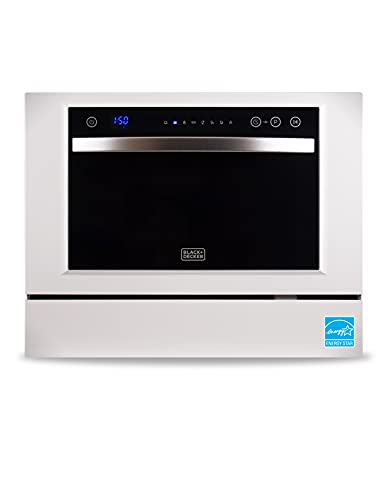
BLACK+DECKER Countertop Dishwasher — Best Countertop Programme Choice
BLACK+DECKER’s countertop entry argues on choice: seven wash programmes, the widest countertop selection in this guide, across six place settings in a white cabinet that sits where a microwave might. Programme variety on a small machine is not decoration; it lets the owner match the cycle to the day, a brisk pass for cups and plates, a fuller programme for the cooking load, and the listing’s 24-hour delayed start lets any of them finish at a chosen hour.
Delayed start is the unsung speed feature. A load set at midnight to finish at breakfast feels instant in the only way that matters to the person unloading it, and in homes with cheaper night electricity it is also the economical hour. The BLACK+DECKER Countertop Dishwasher thus offers two kinds of fast: the quick programme for now, and the timer for later, and small households use both more than they expect.
Its limits mirror the Midea’s, since physics gives countertop machines the same tub: six settings, worktop surrendered, the largest cookware washed by hand. Choose between the two countertops on programme count, finish and which listing’s wording you prefer, because in size, sound class and daily role they are close cousins serving the same small kitchens.
- Format: countertop, model BCD6W
- Capacity: 6 place settings per the listing
- Programmes: 7 wash programs per the listing
- Timer: 24-hour delayed start
- Certification wording: Energy Star Certified
- Finish: white
Strengths
- Seven programmes, most countertop choice here
- Delay start makes mornings feel instant
- Familiar maker, simple white cabinet
Trade-offs
- Same six-setting ceiling as any countertop
- Counter space is the real price
- Party quantities still wash by hand
Best for: small households that like programme choice. Not suited for: anyone whose daily load exceeds six settings.

Kenmore 24in Dishwasher (shared with idx 13) — Best Big-Load All-Rounder
This larger Kenmore returns from our sanitize guide wearing a different hat, and the overlap is honest: a machine with fourteen place settings, UltraWash and SmartWash systems, Sani Rinse, SmartDry and leak detection is also a machine whose pace story is capacity. When a household of six produces a mountain after Sunday lunch, the fastest wash is the single load that takes the whole mountain, and that is the trick this model performs.
Its listing names no sprint programme, so this review does not invent one. What it offers instead is the deepest feature bench of the six: a rinse with a hygiene name for the loads that worry you, drying with a name of its own, and leak detection guarding the weeks the house stands empty. The stated 57 DBA is the loudest figure here, the honest price of the package, and a utility-room or overnight household will never care.
Choose it when the household’s problem is scale, and look back up this page when the problem is minutes. The two Kenmores bookend the guide deliberately: the hybrid-tub model for balanced daily churn, and this one for families whose fast is spelled in place settings rather than in a programme’s name.
- Width: 24-inch built-in
- Capacity: 14 place settings per the listing
- Sound level stated: 57 DBA
- Named features: Sani Rinse, SmartDry, leak detection
- Systems named: UltraWash, SmartWash
- Certification wording: Energy Star Certified in the listing
Strengths
- Fourteen settings end batch washing
- Feature bench is the deepest here
- Leak detection guards empty houses
Trade-offs
- 57 DBA is the loudest here
- No named quick programme in the listing
- White finish only in this listing
Best for: large households washing in single big loads. Not suited for: studio flats that run cycles during conversation.
How Do the Six Fast-Cycle Dishwashers Compare Side by Side?
The pace column keeps each claim in its listing’s own terms — a named programme, a counted programme list, or a capacity argument — because flattening those into one invented minutes figure would mislead exactly the buyers this guide exists for.
| Pick | Format | Pace story | Stated sound | Standout trait |
|---|---|---|---|---|
| Kenmore 24in Hybrid Tub Dishwasher | 24-inch, 12 settings | Smart systems, daily churn | 54 DBA | Adjustable MoreSpace rack |
| Bosch SHP65DM5N Speed60 | 24-inch built-in | Speed60 named programme | 44 dBA | Quiet stainless smart |
| LG LDTS5552S Turbo Cycle | 24-inch built-in | Turbo designation, steam | 46 dBA | Third rack, QuadWash |
| Midea Countertop Dishwasher Rapid | Countertop, 6 settings | Rapid in 6+2 cycles | 52 dB | No installation needed |
| BLACK+DECKER Countertop Dishwasher | Countertop, 6 settings | 7 programmes, delay start | Check listing | Widest countertop choice |
| Kenmore 24in Dishwasher (shared with idx 13) | 24-inch, 14 settings | Capacity as speed | 57 DBA | Sani Rinse, leak detection |
What Can a Fast Cycle Actually Clean, and What Defeats It?
Picture the load a fast programme was designed around: plates from a meal eaten an hour ago, glasses, cutlery, a saucepan that held something water-based, the mug collection of a morning. The soil is fresh, still soft, and mostly a film rather than a crust. On that load a brisk programme with adequate heat genuinely finishes the job, and the household gains its hour with no apology needed.
Now picture its defeat: the lasagne dish from last night, porridge welded to its pan, a roasting tray with polymerised fat. That soil needs time, temperature and chemistry working together, and removing the time removes the result. The fast cycle will return such items warm, wet and still dirty, and the owner will conclude the machine is poor when the programme was merely misassigned. Fast cycles fail by appointment, not by defect.
How Should You Load Differently When the Clock Matters?
Speed forgives less, so loading matters more. Scrape, do not rinse — modern detergents and sensors expect some soil to work with, and pre-rinsed loads can confuse sensing systems — but remove the chunks that would redeposit. Face every surface toward the spray, keep bowls from nesting into sealed pairs, and leave gaps: a fast programme has fewer passes to forgive a shadowed plate than a long one does.
Cutlery mixed up and down in the basket, or laid in the LG’s third rack, separates instead of spooning together into unwashed nests. The largest items go where they cannot shield smaller ones from the arms’ path. None of this is new advice, but on a quick cycle it stops being good practice and becomes the difference between the programme’s promise and its parody.
Why Does Drying Suffer First on Quick Programmes?
Drying is time wearing a disguise. Condensation drying needs the tub’s heat and a cooling interval; heated drying needs minutes at temperature; both are easy places for a programme designer to find the minutes a fast cycle advertises. The result is predictable: ceramic and glass emerge fine, while plastic tubs, with their low thermal mass, keep their droplets. A fast load opened promptly and given five minutes of ajar door will dry itself better than one left sealed while its owner makes tea.
Households can stack the odds: rinse aid filled, the door cracked at the beep, plastics placed on the top rack where heat gathers, and the tea towel accepted as part of the fast system rather than as evidence against it. The countertop pair dry small loads quickly by the same physics, small tub, warm air, nowhere for moisture to hide.
Countertop or Built-In: Which Fast Is Yours?
The countertop machines win the first kind of speed, the speed of starting: no cabinet sacrificed, no installer booked, washing tonight. They also win on load turnaround for one or two people, because a six-setting tub fills daily and its programmes run against a small, honest load. Their ceiling is absolute, though, and a household of four will hit it before the starter is served.
Built-ins win the second kind, the speed of finishing everything at once. Fourteen settings washed in one programme, however long, beat three countertop relays, and the named fast programmes on the Bosch and the LG’s brisk option exist precisely to give big machines a small-load gear. Choose by household size first and by programme names second; a fast cycle on the wrong format is a fast cycle you will route around.
How Does Delay Start Cheat the Clock Honestly?
A timer does not shorten a cycle by a second, and yet the BLACK+DECKER’s 24-hour delayed start may be the most-used speed feature in this guide. A load arranged after supper and timed to finish as the household wakes delivers clean breakfast things at the moment of need, which is what most people mean by fast in the first place. Night running also moves noise to empty rooms and, on some tariffs, cost to cheaper hours.
Use the feature with its one discipline: do not let a loaded machine sit closed and damp through a hot day waiting for its hour, since yesterday’s supper will perfume the tub. Delay across the night, not across the day, scrape well, and leave detergent in its dispenser rather than loose in the tub. Timed well, the ordinary cycle on a timer outperforms the quick cycle on demand for most weekday mornings.
When Should Two Quick Loads Replace One Long One?
Entertaining exposes the arithmetic. A dinner for eight produces two waves of washing: the cooking and starter things, then the main-course and dessert things. One long programme started after dessert strands the host with everything at midnight; a fast programme after the starters returns the prep bowls and first glasses to service while the evening still needs them, and a second load, fast or normal, closes the night.
The same logic serves big cooking days at home, preserving sessions and bake-offs, where the tools of round one are the tools round two is waiting for. Think of the fast cycle as a relay baton rather than a shortcut, passing equipment back into use. Hosts who plan the two waves when they plan the menu stop experiencing the dishwasher as the evening’s bottleneck.
What Maintenance Matters More on a Machine Run Fast and Often?
Frequent quick cycles concentrate the habits that age a machine: filters loaded with the day’s film, seals wiped rarely, and a tub that never gets the long hot programme that doubles as its own bath. Schedule the machine’s cleaning cycle or a hot empty wash monthly, clean the filter on the maker’s rhythm, and let one ordinary full programme a week do the deep work the fast ones skip.
Countertop machines add their own list: the tap connector’s washer, the inlet filter where the hose meets the machine, and the counter seal beneath a unit that vibrates gently through every programme. Five minutes a month across either format protects the pace the buyer paid for, because a fast cycle in a neglected machine is merely a shorter disappointment.
How Do Sensors Decide What a Quick Wash Cannot?
Several machines here sense their load, reading the water’s cloudiness to judge how dirty the wash is and adjusting effort to match. That intelligence has a boundary the owner should understand: a sensor judges the water it can sample, and a plate shielded behind a tray contributes little evidence. Sensing refines a well-loaded machine’s decisions; it cannot audit a badly loaded one, which is why the loading sections of this guide precede any faith in automation.
Sensors also explain a small mystery of quick programmes, the cycle that runs longer than its name on a filthy day. Where the maker allows the programme to extend itself, the machine is protecting the result at the price of the promise, and the owner should be grateful rather than suspicious. A fast cycle that occasionally admits defeat is more trustworthy than one that finishes on time with the soil still aboard.
What Does a Fast Cycle Cost in Energy and Water?
The honest answer is: it depends which resource you count. A short programme heats less water for less time than a full intensive cycle, yet an eco programme, slower still, usually wins the energy contest outright by trading hours for heat. Fast cycles sit between, buying time at a moderate premium. Households watching bills should treat pace as a purchased convenience, cheap per use, rather than as a saving.
The real waste in dishwashing is the rewash, the load run twice because the first programme was misassigned. One correct normal cycle costs less than a fast failure followed by the normal cycle it needed anyway. That arithmetic, more than any label, is the economic case for matching programme to soil, and it is why this guide repeats the point until it becomes reflex.
How Should a Holiday Cottage Handle Turnaround Day?
Changeover day is the fast cycle’s finest hour: one party’s breakfast things out, the cottage cleaned, the next party arriving by afternoon. A full-size machine with a named quick programme lets the cleaner run the crockery through while the beds are stripped, and a countertop machine in a small cottage does the same at its own scale. The discipline is sequencing, dishwasher first, because it is the only worker in the cottage that takes an hour and cannot be hurried by effort.
Hosts should leave the programme choice idiot-proof: a note naming the cycle for changeover loads, tablets stocked beside the machine, and the manual’s location written down. Guests, in return, should find a machine that does not demand study. The Bosch’s named programme and the countertops’ simplicity both serve this world, while the feature-rich LG rewards the owner-occupier who hosts occasionally rather than the cottage that changes hands weekly.
Can Glasses Survive a Life of Quick Washes?
Glass suffers from two slow enemies, etching and film, and neither is caused by speed itself. Etching is permanent clouding from over-softened water and too much detergent for the soil present, a risk on any programme; film is deposit that a rinse-aid top-up and correct dosing reverse. Quick cycles, using less detergent contact time, are if anything gentle company for glassware, provided the water softener is set for the district rather than left at a factory guess.
The practical routine is dull and effective: dose for the load you have, keep rinse aid filled, and give the good crystal the hand wash its maker asks for on the days it comes out. Everyday tumblers and wine glasses ride the fast programme happily for years in households that manage those three things, and cloud in the households that manage none of them, whatever cycle they choose.
How Do You Fit a Fast Habit Around a Baby’s Bottles?
Bottles run on their own clock, indifferent to the household’s programme preferences, and the fast cycle serves them well for the ordinary wash between feeds: milk film is fresh soil, exactly the brief. Families often run a small, quick bottle-and-teat load rather than letting items accumulate, and a countertop machine near the nursery end of the house can become the bottle station entire.
Keep the categories separate in your head, though. The quick wash is the daily clean; the hotter, defined cycles discussed in our sanitize guide are the periodic deeper treatment, and teats and valves also deserve the inspection and replacement rhythm their makers specify. Speed handles frequency, heat handles the milestones, and confusing the two in either direction wastes money or peace of mind.
What Should Renters Check Before Choosing a Countertop?
Three measurements and one permission. Measure the counter run the machine will occupy, the height to the underside of the wall cabinets, and the distance to the tap it must reach. Then confirm the tenancy allows a countertop appliance and that the tap fitting suits the connector, or that an adapter is acceptable. None of this is difficult, and all of it is cheaper learned before the box arrives.
Renters should also think about the exit: a countertop machine leaves with you, fits the next kitchen sight unseen more often than a built-in ever could, and sells on easily if the next home has a machine of its own. That portability is a genuine financial feature for households in their renting years, and it reframes the countertop pair here from compromise purchases into deliberately mobile ones.
How Loud Is a Sprint Beside a Sleeping Baby or a Film?
A fast cycle compresses the same water movement into fewer minutes, and some machines sound busier doing it, with fills and drains arriving in quicker succession. The stated figures in this guide, 44 dBA on the Bosch through 57 DBA on the larger Kenmore, describe the machines generally rather than a sprint specifically, so treat them as the guide to the household’s experience and expect the pattern of sounds, not just their volume, to change with the programme.
Placement and timing solve what specification cannot. A machine behind a closed kitchen door at 54 DBA troubles nobody; the same machine in a studio at midnight troubles the person on the sofa bed beside it. The delay timer, again, is the peacemaker, moving the sprint to the hour when the house is either awake and dressed or out entirely.
Do Fast Cycles Exist on the Countertop Pair, or Is Small Just Quick?
Both, and the distinction is worth keeping. A six-setting tub washes a small load briskly on any programme simply because there is less water, less crockery and less distance for the spray to travel. On top of that inherent pace, the Midea’s listing includes a rapid programme in its counted cycles, a deliberate short gear, while the BLACK+DECKER spreads its bet across seven programmes and a timer.
Owners feel the difference on the day the load is genuinely grubby: the small machine’s normal programme earns its minutes then, and the rapid one returns to its proper work the following morning. Buying a countertop for its size and using its programmes with the same soil discipline as a built-in is the whole method, and it is enough.
How Should You Test a New Machine’s Fast Programme in Week One?
Run a fair trial rather than a ambush. Load the programme with its intended cargo, a day’s fresh plates, glasses and cutlery for the household’s real size, scraped and spaced as this guide describes, with fresh detergent and rinse aid filled. Judge the result piece by piece at unloading, noting which items, if any, kept their soil and where they sat in the rack. One shadowed bowl is a loading lesson; a uniform film is a dosing or water lesson.
Then run the same load shape on the normal programme and compare honestly, including the drying. Most households find the fast programme passes its fair trial and fails only the trials it was never set, which is the discovery this guide exists to save them a return label on. Keep the notes from week one; they become the household’s loading habits for the machine’s whole life.
What Is the Place of the Half Load and the Top-Rack Wash?
Some machines offer partial-load programmes that wash one rack with adjusted water and time, and where they exist they partner naturally with a fast habit: the small midday load rides the top rack alone instead of rattling around a full tub. The listings gathered here do not make that feature their headline, so confirm it on the exact model’s page if it matters to you, and do not assume a programme name implies it.
The principle survives even without the badge. Filling one rack completely beats scattering the same items across two, on any programme, because concentration lets the spray work a defined field. Households that internalise that idea get most of the benefit the feature formalises, and their quick cycles, run on honest, compact loads, are the ones that come out clean.
How Does a Fast Cycle Fit a Working Household’s Weekday?
The weekday pattern that suits these machines is unglamorous: load through the day with the door ajar, scrape as you go, and run the fast programme when the evening meal’s plates land, so the kitchen closes clean. Breakfast things join the morning’s small load or wait for the evening; either rhythm works, and both beat the archaeological weekend excavation that a neglected machine becomes.
Households with a timer add the second movement, setting the night load to finish at waking. The machine then works while nobody is asking anything of it, and the fast programme is reserved for the genuine turnarounds, guests, baking days and the second sitting of a family that eats in shifts. Speed used twice a week on purpose outlasts speed demanded twice a day by chaos.
What About Water Spots When Everything Is Hurried?
Spots are minerals left where droplets dried, and hurried programmes meet more of them because the rinse and dry phases that prevent spotting are the phases that shrink. Rinse aid is the specific countermeasure, encouraging water to sheet off rather than bead, and its dispenser should be treated as a consumable on the same footing as detergent rather than as an optional perfume.
Hard-water households may also need the softener set honestly for their district, since no programme outruns geology. Where spots persist on glass but not on ceramic, the load’s drying pattern is usually the culprit, and opening the door at the cycle’s end, while the contents are still warm, clears in minutes what an hour sealed would leave behind.
How Should Hosts Brief Guests on the Quick Wash?
Guests load dishwashers the way they load their own, which may mean rinsed-clean plates, pans included hopefully, and the good knives riding along. A host who cares about the result leaves the same three-line note this guide recommended for sanitize machines, adapted: scrape into the bin, leave the pans in the sink, and press the named fast button for the evening’s glasses and plates.
The note protects the evening as much as the machine. A guest trusted with clear instructions stops hovering apologetically at the sink, and the host stops performing rescue archaeology on the racks at midnight. Small households that entertain often should weigh how explainable a machine’s controls are; a programme with a name a guest can find beats a superior programme hidden behind a symbol.
Can a Fast Programme Rescue a Forgotten Load?
The load loaded at breakfast and forgotten until supper is the fast programme’s hardest fair test: the soil has dried but not baked, the tub smells faintly of its contents, and the household wants supper’s plates added to the same wash. A sensible rescue exists. Add the fresh items, choose the normal programme rather than the fast one, and let the extra time repay the morning’s neglect, because dried-on is precisely the condition quick cycles are excused from.
For the tub’s freshness itself, a rinse-and-hold style programme, where the model offers one, exists for exactly this limbo, wetting the load without washing it. Where no such programme exists, leaving the door ajar through the day achieves half the benefit by denying the sealed, warm damp in which odours organise. Prevention, here as everywhere in this guide, is a loading habit rather than a feature.
How Do the Two Countertops Differ Across a Month of Use?
A month reveals what a day conceals. The Midea’s counted cycles and rapid gear suit the owner who runs the same small load daily and wants one brisk answer; the BLACK+DECKER’s seven programmes suit the owner whose weeks vary, a soup day, a baking day, a cups-only day, each with its own setting, and whose mornings appreciate the timer’s work. Both occupy the same counter territory and answer to the same tap.
Energy and water across that month will track load count more than model choice, and both listings carry Energy Star wording, so the honest decider is temperament: set-and-forget, or choose-each-time. Neither temperament is wrong, and recognising your own before ordering is worth more than any marginal difference in the machines’ stated figures.
What Should You Measure Before Ordering Any of the Six?
For built-ins: the opening’s width, height and depth at several points, the door’s swing against neighbouring drawers, the distance to the water shut-off and drain, and the panel question if the front is integrated. For countertops: the run’s length, the height beneath wall cabinets with the machine’s lid and hoses accounted for, and the reach to a tap the connector can actually marry.
Photograph the old installation before disconnecting anything, and keep the photographs with the order. Installers solve problems faster from evidence, and the buyer who measured twice rarely meets the delivery-day discovery that the new machine fits the kitchen in every dimension except the one the corridor imposes. Speed begins, unfashionably, with a tape measure.
How Long Does a Fast Habit Take to Pay for Itself in Time?
Count honestly and the answer is weeks, not years. A household that turns two loads a week around in an hour instead of an evening gains those evenings immediately, in homework supervised, guests attended to and kitchens closed at a civilised hour. The machine’s price divides across a decade of such evenings into a trivial sum per use, which is why buyers rarely regret choosing the model with the programme they actually needed.
The counterfactual is the expensive one: the fast programme bought and then distrusted because its first trial was a roasting pan, or the big machine idling half-empty because its owner never learned the partial-load habit. This guide’s insistence on matching programme to soil is, in the end, an insistence on collecting the value the purchase already contains.
One Last Test: The Sunday-Lunch Standard
Judge any of these six by the hardest ordinary day rather than by the easiest. Sunday lunch for six, cooked from scratch, produces the full taxonomy: fresh plates a fast programme can honour, glasses that must sparkle, cutlery in drifts, and two pans that belong on the long cycle without argument. A machine that divides that day correctly, sprinting the tableware while the pans take their time in a second load or the sink, has understood the household.
Run that test in imagination against each pick before ordering. The Bosch and LG sprint the first wave in a family kitchen; the Kenmores swallow the day whole; the countertops, in a small cottage, run their relays while the cook works. The right answer is the one whose Sunday you can picture without a bottleneck, and it is different in a farmhouse than in a flat, which is precisely why this guide carries six machines instead of crowning one.
What Mistakes Do Fast-Cycle Dishwasher Buyers Make Most Often?
The defining mistake is asking a fast programme to defeat dried, baked soil, then blaming the machine. The second is believing any minutes figure that the listing itself does not print; programme names and counted cycle lists are evidence, while a marketplace bullet promising miracles is weather. Third comes overloading, the universal solvent of dishwasher performance, fatal fastest on the cycles with the least time to forgive it.
Countertop buyers add two of their own: measuring the counter’s width but not the height beneath the wall cabinets, and forgetting the tap connection’s daily dance until it becomes the reason the machine sits unused. Built-in buyers forget the door’s swing and the panel an integrated front requires. Every one of these errors is a tape-measure error, which is good news, because tape measures are cheap and returns are not.
Final Recommendation
Choose your kind of fast first. If a named programme with its target in the title is the promise you want, the Bosch Speed60 is this guide’s clearest answer, with the LG’s brisk, steam-assisted system close behind for mixed loads. If your fast is a small household’s daily turnaround without an installer, the Midea and BLACK+DECKER countertops divide the honours between a rapid programme and the widest programme list with a timer. The two Kenmores serve the households whose speed is measured in settings per load.
Then use the programme as it was designed, on fresh and lightly soiled loads, loaded with gaps and scraped rather than rinsed, and the hour it returns to you is real. The cook who treats a fast cycle as a relay rather than a miracle will find, by the time the dessert plates come back warm and clean, that the machine has quietly given the evening back.
Frequently Asked Questions
How long is a fast dishwasher cycle, really?
Only as long as its listing says. In this guide the one duration carried in a programme’s own name is the Bosch’s Speed60, whose title advertises roughly the hour. Other makers name their brisk programmes without a figure here, so this guide quotes none for them; the listing and manual for the exact model are the only honest stopwatch.
Will a fast cycle clean a roasting pan?
Almost certainly not, and it was never designed to. Roasting pans carry baked, polymerised soil that needs a long, hot programme. Run the pan on the machine’s full cycle or soak it while the fast load handles the plates and glasses around it.
Are countertop dishwashers actually faster?
Their programmes run against six place settings, so a small household’s daily load turns around quickly, and there is no installation delay at all. Against a full family’s load they lose by arithmetic, needing several relays to match one built-in load. Faster depends entirely on the size of your day.
Why do plastics come out wet on quick cycles?
Plastic holds little heat, and quick programmes shorten the drying phase first. Rinse aid, a top-rack place and a door cracked open at the end solve most of it. The remaining droplets on a lunchbox are the known price of the hour saved, and a tea towel collects it in seconds.
Does running fast cycles wear a machine out sooner?
The cycles themselves are within the machine’s design, but a life lived only on quick programmes skips the hot, long washes that keep the tub and filter fresh. Alternate sensibly, clean the filter, and run a hot maintenance wash monthly, and a fast habit costs the machine nothing measurable.
Can I put detergent pods in a fast cycle?
Use the detergent format the maker specifies, dosed for the load. Very short programmes in some machines can outrun a slow-dissolving format, which is one more reason to read the exact model’s manual rather than folklore. Powder and gel give the owner control of dose on small, quick loads.
Related Guides
Round out the small-kitchen plan with our guides to Best Vibrating Travel Alarm Clocks Best Bath Mats for Heavy Use Best Washable Slippers


