What's inside
- Key Takeaways
- Quick Picks
- How Did We Choose These Best Baby Slippers?
- The Six Best Baby Slippers in Detail
- How Do the Six Compare Side by Side?
- Why Do Soft Soles Matter for Babies Who Are Not Walking Yet?
- When Should a Baby Wear Slippers, and When Bare Feet?
- How Do You Measure a Baby’s Foot for the Right Size?
- What Makes a Bootie Actually Stay On?
- Leather, Fleece or Plush: Which Material Suits Your Baby?
- How Should Baby Slippers Be Washed and Cared For?
- What Mistakes Do Parents Make When Buying Baby Slippers?
- Are Gripper Soles Worth It for First Standers?
- How Many Pairs Does a Baby Actually Need?
- What Should You Look for in a Gift Pair?
- When Is It Time to Move Up a Stage?
- How Do Cold Floors Change What a Baby Needs?
- What Works Best for Pushchair and Carrier Outings?
- How Do You Handle the One-Lost-Bootie Problem?
- What Should Grandparents and Childcare Settings Look For?
- Does Crawling Style Change Which Sole Suits?
- How Do You Check Fit Without a Fight?
- What About Babies Who Hate Anything on Their Feet?
- How Should You Think About Buying for Twins or Close Siblings?
- When Do Grip Socks Beat Slippers Altogether?
- How Do You Keep Leather Soft Soles in Good Condition?
- What Seasonal Changes Should You Plan Around?
- How Do Tummy Time and Floor Play Affect the Choice?
- What Should You Pack for Travel With a Baby?
- How Can You Tell a Quality Pair From a Costume Pair?
- Why Do Month-Age Labels Differ So Much Between Brands?
- Slippers for the Childminder’s and the Nursery Run
- The Second Baby: Handing Booties Down
- Final Recommendation
- Frequently Asked Questions
- Related Guides
As an Amazon Associate I earn from qualifying purchases. This post may contain affiliate links at no extra cost to you.
cottageverdict.com is reader-supported. When you buy through links on our site, we may earn an affiliate commission.
Where to buy: each of the six pairs below links to its Amazon listing, where you can check price on Amazon and confirm the month-age size, colour and closure before ordering. Baby footwear goes outgrown rather than worn out, so check the listing’s foot-length guide against your child’s actual foot on the day you order, not against the size of the last pair that fit.
A note on safety before any product names, because with this category the frame matters more than the shopping. The best baby slippers are soft soles and booties meant for supervised wear and warmth: a layer against a cold floor while a baby is being carried, playing on a mat with an adult nearby, riding in a pushchair, or pulling up on furniture while someone watches. For early walkers, bare feet indoors, or grip socks on smooth floors, remain the safe default — they let toes spread, grip and feel the ground without anything bunching, slipping or coming loose underfoot. Nothing in this guide should be read as equipment that makes a baby safer while walking, and nothing here is a medical claim about how feet develop; these are comfort and warmth choices for awake, supervised time, judged on softness, staying power and how kindly they treat skin that has barely met the world.
That frame explains why this list looks so different from an adult slipper round-up. There are no hard soles here, no chunky treads, no structured heels. Two picks are genuine leather soft soles from Robeez, a name parents have handed down between siblings for years. The other four are fleece and plush booties that fasten around the ankle, because the central comic tragedy of baby footwear is that babies remove it — a flicked foot in a car seat, a determined chew-and-pull on a play mat, and one bootie is under the sofa while its partner is in a supermarket car park. Staying on, without squeezing, is half the product.
Sizing runs by months on most of these listings, and months are a rough ruler. Two babies of identical age can differ by a full size, and a winter baby in thick socks needs more room than the same baby barefoot in June. Every section below returns to that point, because a beautiful bootie in the wrong month band is simply a gift for somebody else’s child. Measure, allow growing room without a floppy toe, and treat the month label as a starting guess rather than a promise.
Key Takeaways
- Soft soles and booties are for supervised wear and warmth; bare feet or grip socks stay the default for early walking indoors.
- Staying on is the headline feature — elastic ankles, hook-and-loop straps and suede soles earn their place by surviving a kicking baby.
- Leather soft soles suit crawlers and first standers; plush fleece booties suit stroller rides, carriers and cold floors at home.
- Buy by measured foot length plus growing room, never by month age alone.
- All six picks below are linked and verified; each listing is where you confirm the current size band before ordering.
Quick Picks
| Pick | Badge | Why it made the list |
|---|---|---|
| Robeez Soft Soles Elephant Stars | Best for crawlers | Real leather that flexes with a crawling foot, with a playful elephant print babies cannot yet appreciate and parents can. |
| Robeez Soft Soles Moccasins | Best classic gift | The pink moccasin styling photographs beautifully while the suede sole underneath does the practical work. |
| SOFMUO Baby Plush Booties | Softest first pair | Plush all over and gentle on newborn skin, in a light purple that hides the inevitable dribble surprisingly well. |
| Babelvit Fleece Baby Booties | Best gripper ankle | Fleece warmth plus a non-skid sole and an ankle designed to stay put on a determined kicker. |
| Pro Goleem Fleece Baby Booties | Best adjustable fit | An adjustable fastening in plain black that works across outfits and passes down without a gendered pattern. |
| Hudson Baby Fleece Booties Gray | Best newborn staple | Heather gray fleece for the 0-6 month stage, simple enough to buy in multiples for the changing bag. |
Read the table as a map of stages rather than a ranking. A newborn who is mostly carried needs a different thing from a ten-month-old hauling herself upright on the coffee table, and both appear below.
How Did We Choose These Best Baby Slippers?
We began with the sole, because the sole decides whether a baby product belongs in this category at all. Anything rigid, raised or heavily treaded was set aside. What remained had to bend easily in one hand, present a flat and forgiving surface to the floor, and give some purchase on smooth boards without pretending to be a walking shoe. Leather and suede scored well for crawlers because they drag, grip and scuff in a useful way; fleece booties were judged instead on ankle design and warmth, since a carried baby needs insulation more than traction.
Staying power came next, tested on paper against the ways babies actually shed footwear. Elasticated ankles, wrap-around straps and bootie shapes that rise above the ankle bone all resist the heel-flick that defeats a simple sock-shoe. We looked for closures an adult can work one-handed, because the other hand is usually holding the baby, and for fastenings with no small detachable parts and no dangling ties.
Materials were read with newborn skin in mind. Seams that sit inside against bare feet, scratchy printed transfers and stiff synthetic uppers all counted against a pick. Leather, fleece and plush each have honest places here: leather breathes and lasts through a second child, fleece washes easily and dries overnight, plush is the warmest and the most purely decorative of the three. Finally we checked the spread of month bands across the six, so the list serves the first half-year and the run-up to first birthdays rather than six versions of the same eight-week window.
The Six Best Baby Slippers in Detail
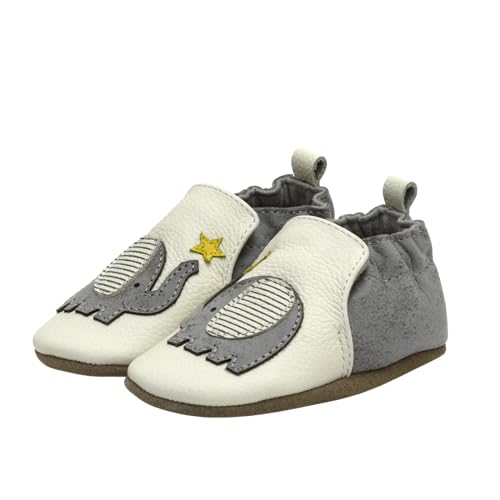
Robeez Soft Soles Elephant Stars — Best for crawlers
The ivory leather and the little elephant-and-stars print make this the pair relatives reach for first at a baby shower, but the reason it leads this list is underneath. A full leather soft sole moves the way a crawling foot moves: it folds at the toes when a baby pushes off, lies flat when weight comes through the whole foot, and gives a gentle drag on laminate that helps rather than hinders. In the 12-18 month band listed here, that matters most for babies who are crawling hard, kneeling up and beginning to cruise along furniture under a watchful eye.
Robeez builds the upper with an elasticated ankle, and that small detail decides whether the pair survives a trip round the supermarket. The shoe slips on without a fight, then the elastic gathers just enough to discourage the heel-flick removal technique every baby perfects. The leather itself is soft from new, so there is no breaking-in period to manage, and the ivory ground of the print is forgiving of the light scuffs that crawling across kitchen tiles inevitably leaves. Wipe-clean care suits leather better than machine washing, which is the honest cost of choosing a natural sole over fleece.
- Upper: printed leather with an elephant and stars design
- Sole: soft leather, slip-resistant intent for indoor floors
- Listed size: 12-18 months
- Fastening: slip-on with elasticated ankle
- Care: wipe clean rather than machine wash
Strengths
- Genuine leather sole flexes naturally through crawling and early standing.
- Elastic ankle keeps the shoe on better than a plain slip-on shape.
- Print and finish make it a presentable gift without a novelty costume feel.
Trade-offs
- Leather asks for wiping, not the washing machine, after a messy day.
- Ivory shows playground dust faster than the darker pairs below.
- Priced by tier as a premium soft sole rather than an everyday multipack buy.
Best for: crawling and furniture-cruising babies whose parents want a real leather sole. Not suited for: outdoor puddle play or anyone wanting machine-washable footwear.

Robeez Soft Soles Moccasins — Best classic gift
Where the Elephant Stars pair leads with its print, this Little Peanut moccasin leads with its silhouette. The fringed moccasin styling in pink reads instantly as a keepsake, the sort of first shoe that ends up kept in a drawer long after it stops fitting. Yet it is built on the same practical Robeez idea: a soft suede sole, an upper that gives around chubby feet, and an elasticated fit that treats staying on as a design problem rather than a parent’s problem.
The 6-12 month band is the busy one. Babies in it roll, crawl, sit up and begin bearing weight through their feet while holding hands or furniture. A moccasin this soft lets the foot work against the floor instead of against the shoe, and the suede underfoot offers mild purchase on boards without the grab of a rubber tread. Pink will not suit every family’s taste or every hand-me-down plan, and the fringe is decorative rather than functional, but as a single well-made pair for the half-year when soft soles genuinely earn their keep, it is difficult to argue with the formula that made this style a nursery standard.
- Style: moccasin with fringe detail, pink
- Sole: soft suede, indoor use
- Listed size: 6-12 months
- Fit: slip-on, elasticated around the ankle
- Role in this list: the traditional leather option for girls and gift buyers
Strengths
- Keepsake styling backed by a properly soft, flexible sole.
- Suede underfoot gives gentle grip on smooth indoor floors.
- Roomy shape accommodates the roundness of a young baby’s foot.
Trade-offs
- Pink and fringe narrow its appeal for passing down to a sibling.
- Suede marks with water, so damp grass ends the outing for this pair.
- No strap to adjust if a particular baby has especially slim ankles.
Best for: a 6-12 month old at the crawling and first-standing stage, and for gift buyers who want the classic look. Not suited for: families planning strictly neutral hand-me-downs.

SOFMUO Baby Plush Booties — Softest first pair
The SOFMUO booties abandon leather entirely and go for plush, which changes their job. These are warmth booties for the 6-12 month stage: the pair you pull on over socks for a frosty pushchair walk, a cold car seat, or a house with stone floors and a baby who is mostly carried, seated and supervised on a mat. The light purple plush, with its cartoon styling, is unapologetically cute, and the soft sole underneath is designed to be non-slip in intent while remaining bendy enough to fold into a changing bag as a spare.
Because plush traps air, it warms efficiently without weight, and a baby who kicks against a pram blanket all afternoon will not find these heavy. The bootie height helps too, covering the ankle gap that opens between trousers and socks whenever little legs bicycle. What plush cannot do is match leather for crawling durability: drag a plush sole across rough flooring for weeks and it will look tired sooner. Treat this pair as the cosy specialist in the list — the cold-day, carried-baby option — and its compromises make complete sense.
- Upper: plush fabric with cartoon detailing, light purple
- Sole: soft with non-slip intent
- Listed size: 6-12 months
- Shape: ankle bootie for coverage above the sock line
- Care: gentler handling than fleece; check the listing before washing
Strengths
- Plush warmth without weight on small legs.
- Bootie height closes the cold gap between sock and trouser cuff.
- Soft construction packs flat as a changing-bag spare pair.
Trade-offs
- Plush sole wears faster under heavy crawling than leather.
- Cartoon styling is a taste some parents will love and others will skip.
- Warm enough to be too much on a heated floor in a mild house.
Best for: cold-weather outings, carriers and pushchairs where warmth is the whole job. Not suited for: a determined crawler doing daily laps of rough floors.

Babelvit Fleece Baby Booties — Best gripper ankle
Babelvit sells these fleece booties on a phrase every parent recognises: stay on. The design wraps the ankle, adds a non-skid gripper sole, and uses fleece that warms without the loft of plush, so the bootie sits closer to the foot and works for first walkers under supervision as well as for younger babies in arms. It is the most functional-looking pair in this guide, closer in spirit to a grip sock with ambitions than to a keepsake shoe, and many households will find that exactly right for daily use.
Fleece brings a practical dividend the leather pairs cannot match: easy washing and quick drying. Booties live a grubby life — dragged through puree, soaked by a leaking cup, dampened on a wet bathroom floor — and a pair that can be cleaned and returned to service by morning earns a permanent place by the front door. The gripper pattern underfoot deserves honest framing: it helps on smooth floors during supervised standing and toddling, but it does not turn a bootie into a walking shoe, and bare feet remain the better teacher whenever conditions allow. Within those limits, this is the workhorse pick.
- Upper: fleece, ankle bootie shape
- Sole: non-skid gripper pattern
- Positioning: newborn through first-walker stage; confirm the size band on the listing
- Fastening: stay-on ankle design
- Care: fleece, generally machine washable; confirm on the listing
Strengths
- Ankle design directly answers the lost-bootie problem.
- Gripper sole adds purchase during supervised standing on smooth floors.
- Fleece washes and dries faster than leather or plush alternatives.
Trade-offs
- Plainer appearance than the gift-oriented pairs above.
- Grippers wear smooth eventually, and then the pair is near retirement.
- Fleece warmth is moderate, so deep-winter outings may want a blanket as well.
Best for: everyday home use and first standers who need a bootie that stays put. Not suited for: buyers wanting a keepsake or photograph-led gift.

Pro Goleem Fleece Baby Booties — Best adjustable fit
Pro Goleem’s answer to the same problem is adjustability. These black fleece booties, listed for 6-12 months, fasten with an adjustable closure, so a parent can set the ankle snugness for a slim ankle on Monday and loosen it over thicker socks on Friday. That adjustability is genuinely useful in the 6-12 month window, when feet change shape almost monthly and a fixed elastic that fitted at seven months can leave marks at nine.
Black is also a quiet strategic choice. It hides the scuffs of crawling, goes with everything in the drawer, photographs neutrally, and passes between siblings and friends without a pattern dating it. The fleece upper keeps the bootie soft against skin, the sole is non-slip in intent for supervised indoor standing, and the whole thing presents as a sock-shoe: familiar to put on, easy to keep in the rotation. If the Robeez pairs are the occasion choices, this is the Tuesday-morning choice, and most babies spend far more time in Tuesdays.
- Upper: fleece, black
- Closure: adjustable fastening at the ankle
- Listed size: 6-12 months
- Sole: soft, non-slip intent
- Role in this list: the neutral, pass-it-on everyday bootie
Strengths
- Adjustable ankle suits slim and chunky feet within the same size band.
- Black fleece conceals crawling scuffs and suits any outfit.
- Sock-shoe shape is quick to put on a wriggling baby.
Trade-offs
- A fastening is one more thing to check is neither too tight nor loose.
- Black shows pale lint and pet hair more than mid-tone colours.
- Less gift presence than the leather pairs in this guide.
Best for: daily wear across the 6-12 month stage, especially over socks in cooler rooms. Not suited for: parents who prefer a strap-free design on principle.

Hudson Baby Fleece Booties Gray — Best newborn staple
Every list like this needs the pair you buy without overthinking, and Hudson Baby’s heather gray fleece booties fill that slot for the 0-6 month stage. At that age a bootie has one job — keep small feet warm while a baby is held, fed, carried and wheeled — and complexity is a drawback. There is no print to clash, no fringe to inspect, no colour decision beyond a gray that works with every blanket and sleepsuit already in the house.
Hudson Baby is a nursery-staples brand, and these booties behave like a staple: soft fleece, a stay-on shape for the age group, and a price tier, in qualitative terms, that makes buying a spare pair for the changing bag a sensible rather than extravagant move. Newborn feet are also the fastest-changing feet of all, so a simple, affordable bootie that fits the first months well is a smarter purchase than an elaborate one sized hopefully for a season the baby will outgrow by spring. When the next stage arrives, the Robeez and gripper pairs above are waiting.
- Upper: cozy fleece, heather gray
- Listed size: 0-6 months
- Shape: bootie for carried and seated babies
- Colour: neutral gray for mixing and hand-me-downs
- Role in this list: the newborn first pair
Strengths
- Simple fleece warmth matched to what a newborn actually needs.
- Heather gray goes with everything and hides light marks.
- Staple pricing tier makes a second spare pair painless.
Trade-offs
- Outgrown quickly, because 0-6 months is the fastest growth window.
- No gripper emphasis, so it hands over to other picks at standing stage.
- Plain styling will not satisfy anyone shopping for a statement gift.
Best for: newborns and young babies who are mostly carried, in the first half-year. Not suited for: crawlers and standers who need grip and durability.
How Do the Six Compare Side by Side?
| Pick | Material | Stage it serves | Standout trait |
|---|---|---|---|
| Robeez Soft Soles Elephant Stars | Leather | 12-18 months, crawling and cruising | Flexible leather sole with a giftable print |
| Robeez Soft Soles Moccasins | Leather and suede | 6-12 months | Classic moccasin looks on a soft sole |
| SOFMUO Baby Plush Booties | Plush | 6-12 months, carried and seated | Maximum warmth for cold outings |
| Babelvit Fleece Baby Booties | Fleece | Standing and first steps, supervised | Gripper sole and stay-on ankle |
| Pro Goleem Fleece Baby Booties | Fleece | 6-12 months, everyday | Adjustable ankle fastening |
| Hudson Baby Fleece Booties Gray | Fleece | 0-6 months, newborn | Neutral staple at an easy tier |
The pattern in the table is a handover: fleece for the carried months, grippers and adjustability for the wobbly middle, leather for confident crawling and cruising. Most families will use two of these stages, not all three.
Why Do Soft Soles Matter for Babies Who Are Not Walking Yet?
A pre-walking foot is mostly cartilage and padding, and it works by spreading, scrunching and pushing against whatever lies beneath it. A soft sole interferes least with that work. It shields skin from cold and roughness while still letting the foot flex through its full range, which is why this entire guide contains no rigid footwear. When a baby crawls, the top of the foot drags; when she pulls upright, the sole needs to fold rather than lever her toes. Leather and fleece both pass that test, each in its own way.
When Should a Baby Wear Slippers, and When Bare Feet?
Reach for booties when warmth or a cold, rough surface is the issue: winter floors, draughty halls, pushchair rides, a play date on someone else’s chilly tiles. Choose bare feet for ordinary indoor play on a clean, comfortable floor, especially once standing and early steps begin, because skin-to-floor contact gives the clearest feedback and the surest grip. Grip socks sit between the two, useful on polished boards. Slippers in this guide are a supervised layer for particular moments, not an all-day uniform.
How Do You Measure a Baby’s Foot for the Right Size?
Measure at the end of the day, when feet are at their largest. With the baby standing if she can, or with the foot gently pressed flat if she cannot, trace or measure from the back of the heel to the tip of the longest toe — which is not always the big toe. Compare that length with the listing’s own chart rather than trusting the month band, then allow modest growing room: enough that toes are not pressed, not so much that the heel swims and the bootie twists. Recheck every few weeks in the first year; growth spurts outrun calendars.
What Makes a Bootie Actually Stay On?
Three designs work. An elasticated ankle, as on both Robeez pairs, gathers below the ankle bone and resists the downward flick. A wrap or adjustable fastening, as on the Pro Goleem, lets a parent set the tension directly. Height helps too: a bootie that rises above the ankle gives a kicking leg less leverage than a low shoe shape. What does not work is a loose slip-on with a smooth lining — charming in the box, single by lunchtime. Whatever the design, check the fit after a few minutes of wear; a closure should hold without leaving deep marks.
Leather, Fleece or Plush: Which Material Suits Your Baby?
Leather is the crawler’s material: durable, breathable, wipeable, and grippy in a quiet way, at a premium tier and with wipe-only care. Fleece is the household material: warm enough for most homes, washable, quick to dry, and cheap enough in tier to own in pairs. Plush is the outing material: the warmest and softest against skin, best for carried babies in cold weather, and the first to look tired under daily crawling. Choosing by how the baby spends most of the day — carried, playing, or crawling laps — settles the question faster than choosing by colour.
How Should Baby Slippers Be Washed and Cared For?
Follow the listing for the pair in hand, because leather and fleece part company here. Fleece and plush booties generally tolerate gentle machine washing; wash them in a mesh bag so a single bootie cannot hide in the machine, and dry them flat or on low heat so the ankle elastic is not cooked. Leather soft soles prefer a damp cloth, mild soap for marks, and air drying away from radiators, which stiffen leather. Grippers deserve an occasional inspection: once the pattern underfoot has worn smooth or begun to peel, the bootie’s working life is over.
What Mistakes Do Parents Make When Buying Baby Slippers?
The classic error is buying ahead — a beautiful pair two sizes up, saved for later, that fits for about a fortnight when later finally arrives. Close behind comes choosing by month label without measuring, choosing hard soles because they look like proper shoes, and choosing purely decorative pairs with ties or attachments a baby can worry loose. A subtler mistake is keeping slippers on all day out of habit; warmth gear worn constantly indoors can leave feet sweaty, and bare-foot time is part of the point. Buy the stage the baby is in, measure, and let the next stage be a fresh decision.
Are Gripper Soles Worth It for First Standers?
For supervised standing on smooth floors, yes, with modest expectations. A gripper pattern interrupts the slide that a plain fleece sole allows on laminate, and that can steady a baby who is pulling up and lowering down a hundred times a day. It is assistance, not protection: grippers do not prevent falls, and a determined toddler can slide in anything. Keep the furniture arrangement forgiving, stay within reach during those early standing weeks, and retire gripper booties once their pattern smooths out.
How Many Pairs Does a Baby Actually Need?
One working pair and one spare cover most households. The spare earns its place the first time the working pair is soaked, lost or discovered in the dog’s bed the morning of a cold outing. Families using childcare may add a third pair that lives in the nursery bag. More than that usually means several half-fitting pairs instead of one right one, because babies outgrow footwear faster than they wear it out. Spend the budget on correct sizing at each stage rather than on a wardrobe of colours.
What Should You Look for in a Gift Pair?
Gift buying reverses the usual priorities: presentation matters, but size risk matters more. Choose the stage the baby will reach soon rather than the newborn band they may have already passed, keep the receipt logic simple by picking a listing with clear size options, and favour designs — the Robeez moccasin is the template — that look keepsake-worthy while still being genuinely wearable. Neutral colours widen the odds of the pair suiting the family’s taste, and a soft sole keeps the gift appropriate for any stage of the first year.
When Is It Time to Move Up a Stage?
Watch behaviour rather than birthdays. A carried baby who begins crawling in earnest needs a sole that survives dragging — that is the leather moment. A crawler who pulls to standing on smooth floors benefits from grippers. Toes pressing the end of the bootie, red marks after short wear, or a heel that suddenly escapes easily all say the current pair is finished regardless of the calendar. Each handover is also the moment to re-measure, because the next size up is a guess until a foot confirms it.
How Do Cold Floors Change What a Baby Needs?
A house with stone, tile or uncarpeted boards in winter is a different environment from a carpeted flat, and booties earn their keep most clearly in the first kind. Babies lose the benefit of movement-generated warmth quickly when they sit still on a mat, and feet are the part furthest from the blanket that keeps slipping off. In a cold-floored home, fleece or plush booties over socks are a sensible daily layer for floor play, and the leather pairs add a windproof quality that fleece lacks when a baby is carried between rooms or out to the car. In a warm, carpeted home the same pairs may be needed only for outings, which is why judging your own floors honestly saves buying warmth that will mostly live in a drawer.
What Works Best for Pushchair and Carrier Outings?
Outings expose the weakness of ordinary socks: they rotate, slide and vanish. A bootie that fastens or gathers at the ankle survives the pushchair foot-muff shuffle and the carrier, where dangling legs kick against a parent’s coat for the whole walk. Warmth per gram matters here too, because a seated baby is not generating much heat of her own. Plush and fleece both perform well; the deciding detail is usually the ankle. Before a long outing, do a two-minute test at home — if a bootie can be kicked free on the sofa, it will certainly be lost somewhere along the pavement, and the spare pair in the bag will be promoted sooner than planned.
How Do You Handle the One-Lost-Bootie Problem?
Every household with a baby owns at least one single bootie, kept in sentimental hope. Reduce the supply by treating pairs as units: store them clipped or paired sole-to-sole, keep the spare pair in the changing bag rather than in a different room, and choose designs with enough ankle hold that removal is a project rather than an accident. When a single does escape, check the usual traps before mourning it — under the car seat, inside the pushchair fold, within the washing machine’s door seal and, reliably, inside a sibling’s toy box. A mid-tone colour helps here as well; a gray bootie in a gray car footwell is functionally invisible.
What Should Grandparents and Childcare Settings Look For?
Footwear that other caregivers must manage should be the simplest footwear you own. A pair that goes on one way, fastens obviously and fits forgivingly will actually be used; a fiddly pair will be quietly left off, and the baby will arrive home in socks. For childcare settings, label the pair inside, choose a washable fleece design that staff can clean after a spilled lunch, and send the spare pair in the bag with the same label. Grandparents often appreciate the classic leather styles because they resemble the first shoes they remember buying, which makes the Robeez pairs a diplomatic as well as practical choice for family gifting.
Does Crawling Style Change Which Sole Suits?
Yes, more than most parents expect. A commando crawler, who drags along on forearms, wears the tops of the feet and the front of the ankle hardest, so a bootie with coverage and a durable upper matters more than sole grip. A classic hands-and-knees crawler pushes through the toes, folding the sole repeatedly at the same crease — leather handles that crease gracefully, while thin fleece can thin at the fold. A bottom-shuffler barely uses the feet at all, and for that baby warmth and staying on are the whole brief. Watching a week of crawling before buying the next stage tells you which wear pattern you are actually shopping for.
How Do You Check Fit Without a Fight?
Fit checks go better during a feed or immediately after one, when the baby is settled and the foot is relaxed. Slide a fingertip between the heel and the back of the bootie: a small gap is right, a finger swallowed whole means too big, and no entry at all means too small. Press gently at the toe end and feel for the toes — they should lie flat, not curled against the end. After ten minutes of wear, look at the ankle: a faint sock-style impression is normal, a deep ring is a message. Doing this check weekly in the fast-growth months catches the moment a favourite pair quietly becomes the wrong pair.
What About Babies Who Hate Anything on Their Feet?
Some babies object to footwear on principle, and the answer is rarely a tighter bootie. Start with the lightest option — a fleece pair worn for a few minutes during a happy, distracted play session — and build duration gradually rather than winning a daily wrestling match. Check for internal seams, labels or a particular fastening that might genuinely irritate; a baby who accepts one design and rejects another is often reporting a real discomfort in the only language available. And remember the default: a warm room and bare feet are a perfectly good outcome. Slippers serve the baby, not the other way round.
How Should You Think About Buying for Twins or Close Siblings?
Multiples multiply the lost-bootie problem and the laundry problem at once. The practical system is boring and effective: buy the same design in the same colour in the correct size for each child where possible, so any two booties in the house form a working pair, and keep a small basket by the door where pairs are reunited nightly. Deliberately different colours per child look organised on day one and chaotic by day ten, when one child’s left bootie is at nursery and the other’s is under the pram. Hand-me-downs between close siblings follow the same rule — a neutral, durable pair such as the black Pro Goleem or the gray Hudson Baby passes down without negotiation.
When Do Grip Socks Beat Slippers Altogether?
Often, and admitting it makes the rest of this guide more trustworthy. Grip socks win for early walking practice on smooth floors, for warm houses where insulation is unnecessary, for babies between sizes whose booties twist, and for quick floor play where dressing feet feels like overkill. Slippers win when it is cold, when feet need protection from a rough or chilly surface, when outings demand something that stays on better than a sock, and when crawling durability matters. Most families end up owning both and reaching for each in its moment; the mistake is expecting either to do the other’s job all winter.
How Do You Keep Leather Soft Soles in Good Condition?
Leather rewards small habits. Wipe mud off before it dries into the grain, let a damp pair dry at room temperature stuffed loosely with tissue to hold its shape, and keep it away from direct heat, which makes leather stiff and crackly. A pair that has gone slightly firm from floor washing usually softens again with wear, because body warmth and flexing recondition it. Store leather pairs out of the toy box crush, ideally in the drawer with the good clothes they match. Looked after this way, a Robeez pair commonly survives to be the hand-me-down that starts arguments about whose baby wore it first.
What Seasonal Changes Should You Plan Around?
The pair that is perfect in January can be a small sauna in May. As rooms warm up, step down through the materials: plush gives way to fleece, fleece to leather or to grip socks, and eventually to bare feet for most of the day. Cold snaps reverse the order. Because sizes turn over so quickly in the first year, seasonal planning mostly means not buying a heavy winter bootie in a size the baby will reach in spring. Check the calendar against the size chart before ordering, and let the season the pair will actually be worn in — not today’s weather — choose the material.
How Do Tummy Time and Floor Play Affect the Choice?
Floor play is where baby footwear is tested hardest and noticed least. During tummy time, feet kick against the mat in short bursts, and any bootie with a loose heel will migrate south within minutes. During rolling practice, a foot catches, twists and pulls — a soft sole twists harmlessly with it, which is one more reason rigid footwear has no place in this age group. On a padded mat, warmth matters less and staying on matters more; on a bare floor in winter, the reverse holds. If floor play is the main event in your house, rank the ankle design first, the material second and the appearance a distant third, and the Babelvit and Pro Goleem pairs will rise naturally to the top of your shortlist.
What Should You Pack for Travel With a Baby?
Travel footwear should be light, squashable and replaceable. A fleece pair travels best: it flattens into a corner of the bag, warms feet in an air-conditioned cabin or a chilly holiday cottage, and will not cause grief if it is left behind in a hotel room. Save the leather keepsake pair for home, where its loss would actually be felt. Pack the spare in a different bag from the main pair, because the single most reliable law of family travel is that the bag you need is the one that is delayed, buried or sitting in another car. A small zip pouch for worn booties also keeps damp soles away from clean clothes on the journey home.
How Can You Tell a Quality Pair From a Costume Pair?
Turn the bootie inside out, metaphorically and then literally. A working pair has smooth internal seams, a sole attached all the way round rather than at a few points, an ankle that recovers its shape after stretching, and no decorative element a baby could work loose with gums and determination. A costume pair reverses those priorities: charming on the outside, scratchy within, with appliqué doing the selling. Costume pairs have their place in a photograph, but they should be bought as photographs, priced accordingly and worn briefly under supervision — not mistaken for the everyday footwear this guide is about.
Why Do Month-Age Labels Differ So Much Between Brands?
Because babies do. A month band is a population average dressed up as a size, and brands draw their averages from different lasts, different markets and different assumptions about socks. One maker’s 6-12 months can overlap another’s 12-18 almost exactly, which is why the same baby can be two sizes in two brands on the same afternoon. The defence is always the foot itself: a centimetre measurement travels between brands in a way that a month label never will. Keep a note of your baby’s foot length in the phone, update it monthly, and every listing in this guide becomes quick to judge.
Slippers for the Childminder’s and the Nursery Run
Babies who spend days elsewhere carry a second footwear brief: the pair must survive a setting where adults are outnumbered and anything complicated will simply not be used. For childcare, the winning features are brutally practical — a bootie that goes on in seconds with one hand, stays on without adjustment, is labelled or distinctive enough to come home in the right bag, and washes without ceremony after the incidents that group care guarantees. The Pro Goleem and Babelvit fleece booties, with their stay-on closures, were plainly designed by people who had watched a carer manage six babies at once.
Send the good pair, not the precious pair. Childcare floors are clean but busy, outdoor dashes happen in whatever is on the feet, and a bootie that returns grubby has done its job. The Robeez leather, beautiful as it is, belongs to home and outings where its owner controls the terrain; the fleece workhorses belong to the weekday front line. Households that split the roles that way stop mourning scuffed leather and start appreciating the system.
Pack the spare in the bag permanently rather than remembering it daily — the one-lost-bootie problem doubles its strike rate in group settings, and a spare that lives in the bag is a crisis already solved.
The Second Baby: Handing Booties Down
Baby slippers are among the few baby goods that hand down almost perfectly: they are worn briefly, indoors, by a person who weighs almost nothing, so a good pair finishes its first tour with its soles, seams, and softness essentially intact. The Robeez leather pairs hand down best of all — leather that has moulded to one baby’s foot will mould again — and a quick wash and air returns the fleece pairs to service without complaint.
The honest checks before handing down are three: the grip, which must still grip after its first tour of the floors; the closures, whose Velcro and elastic tire before anything else; and the size labels, which were optimistic fiction in several brands even when new, so the second baby should be measured rather than assumed into the inherited size.
There is also a pleasure in it that this guide will not pretend is practical: a pair of booties on a second child carries the first child’s winter inside it. Buy the first pair well enough to deserve that second tour, and the category’s arithmetic — already kind, since babies outgrow rather than wear out — becomes kinder still.
Final Recommendation
Start from the stage, not the shelf. For a newborn, take the Hudson Baby fleece booties and spend nothing on complexity. For the crawling and cruising months, the two Robeez leather pairs are the strongest buys in this guide, with the Elephant Stars the more practical print and the Moccasins the better gift. Between those poles, the Babelvit grippers and the adjustable Pro Goleem booties handle daily life, and the SOFMUO plush pair warms the coldest outings. Parents comparing footwear for an older child taking first classes will find a different kind of soft shoe entirely in our guide to Best Ballet Slippers, where soles are built for studio floors rather than nursery ones. Buy the pair that matches this month, measure before you order, and let bare feet do their quiet work whenever the floor is warm and clean — a first pair of booties is a small, brief pleasure, so choose the one that will actually be worn while it fits.
Frequently Asked Questions
Can babies wear slippers while they sleep?
This guide covers footwear for awake, supervised time: warmth while carried, seated or playing with an adult nearby. Slippers and booties are daytime layers to be taken off when they are not needed, and any questions about a baby’s sleep setup belong with your usual trusted sources on infant care rather than with a footwear round-up.
Are soft soles better than hard soles for a baby?
For the pre-walking and early-standing stages covered here, soft soles are the appropriate style: they flex with the foot, drag kindly while crawling and add warmth without rigidity. Hard-soled shoes serve older, confident walkers outdoors. Nothing in that preference is a medical claim; it is simply matching the footwear to the stage.
How long will a pair of baby slippers last?
Usually one growth stage rather than one season. In the first year, feet can move through a size in a matter of weeks, so fit ends most pairs’ service before wear does. Leather pairs such as the Robeez often survive well enough to be handed down; fleece pairs are more likely to be outgrown looking nearly new.
Why does my baby kick one bootie off constantly?
Because kicking works. A loose slip-on gives a baby leverage, and removing it is an entertaining cause-and-effect game. Switch to a design that gathers or fastens above the ankle, check that the size is not simply too big, and accept that one Houdini foot is a normal feature of the first year.
Can baby slippers be worn outdoors?
Soft soles are indoor footwear. A dry garden path while carried is one thing, but damp grass soaks suede, rough pavement abrades fleece, and neither offers a walking child outdoor protection. Once outdoor walking is the activity, a proper first walking shoe takes over from everything in this guide.
Should slippers be worn with socks?
Either way works, and the choice is about temperature and fit. Socks under booties add warmth on cold days and can improve the grip of a slightly roomy ankle; bare feet inside fleece are fine in a warm house. If you add socks, recheck the fit, because the extra layer can turn a right size into a tight one.
How do I stop gripper soles picking up fluff?
They will gather some — that is the texture doing its job. Shake and brush the soles after outings, wash fleece pairs in a mesh bag, and store booties sole-to-sole in the drawer. A gripper sole that stays clogged with fluff grips less, so a quick brush before standing practice is worth the ten seconds.
What is the safest default for a baby learning to walk indoors?
Bare feet on a clean, comfortable floor, with grip socks as the usual alternative on smooth boards. Slippers from this guide are for warmth and supervised moments around that default, chosen soft and flat, and they should never be treated as equipment that prevents falls.
Related Guides
For warmth that reaches further up the leg, our round-up of Best Boot Slippers for Women covers the grown-up equivalent for cold evenings at home. Bedding for the wider nursery and family bedrooms is compared in Best Cotton Sheet Sets (Full Size), a useful companion when a room is being put together from scratch. And for the layer that goes over the baby rather than on the feet, see Best Baby Quilts for weights and fabrics suited to the nursery.


