What's inside
- Key Takeaways
- Quick Picks
- How Did We Choose These Birkenstock Slippers?
- The Six Birkenstock Slippers in Detail
- How Do the Six Compare Side by Side?
- What Actually Happens During the Break-In?
- Standard or Soft Footbed — Which Should You Choose?
- How Should Birkenstock Slippers Fit at the Heel and Toe?
- Can You Wear Birkenstock Slippers Outside?
- How Do You Care for Felt, Shearling and Oiled Leather?
- What Are the Most Common Mistakes When Buying Birkenstock Slippers?
- Zermatt or Boston: Which Shape Suits Your Evenings?
- What Does the Cork Footbed Do Across a Year?
- Buying Birkenstock Slippers as a Gift
- Shearling, Wool Felt, or Oiled Leather: Reading the Uppers
- What If You Already Own the Sandals?
- What the Footbed Cannot Do: Honest Limits of the Brand
- Reading the Widths and Sizes Without a Shop
- The Pair by the Door: How Owners Actually Use Them
- One Last Fitting Note: The Sock Drawer Decides
- Final Recommendation
- Frequently Asked Questions
- Related Guides
As an Amazon Associate I earn from qualifying purchases. This post may contain affiliate links at no extra cost to you.
cottageverdict.com is reader-supported. When you buy through links on our site, we may earn an affiliate commission.
Where to buy: every pair in this guide is sold through Amazon, where you can check price on Amazon, confirm whether the listing is narrow or regular width, and double-check the European size conversion before you order. Birkenstock sizing runs in EU numbers with US equivalents printed beside them, and the width choice matters as much as the length, so treat that listing page as part of the fitting process rather than a formality.
The best Birkenstock slippers start from a premise most house shoes ignore: your feet spend more waking hours in slippers than in almost any other footwear you own. Morning coffee, the school-run scramble back inside, an evening of cooking, the last trip downstairs to lock up — all of it happens on the same pair of soles. Birkenstock builds its indoor range around the same contoured cork footbed that made its sandals famous, which means these slippers ask something of you at first. The footbed feels firm, almost stubborn, for the first week or two. Then the cork and latex blend begins to take the impression of your heel and arch, and the pair stops feeling like a product and starts feeling like a footprint you can step into.
That break-in bargain shapes everything in this guide. If you want instant plush, the kind of sink-in softness a memory foam slipper gives on day one, Birkenstock will feel like a negotiation. If you want a slipper that still supports a long Sunday of standing in the kitchen three winters from now, the negotiation is worth it. The six picks below are all genuine Birkenstock lines, but they are not six versions of the same shoe. Three are Zermatt clogs with different uppers and linings, one is an open Arizona sandal lined in shearling, one is the leather Boston clog on the softer footbed, and one is a two-strap Arizona in the brand’s synthetic Birko-Flor. The differences between them — warmth, openness, leather care, width, how each handles a cold stone floor — are the real subject here.
One honest note before the reviews: Birkenstock sells most of these styles in both narrow and regular widths, and the narrow fitting is common in slipper listings. A narrow pair on a wide foot will never break in kindly, because cork moulds to pressure, and pressure at the side walls of the footbed is exactly what a too-narrow fit produces. Read the width on the listing as carefully as the size number, and if your feet run wide, hold out for the regular fitting rather than hoping the felt or leather will stretch sideways. Uppers give a little; footbed width does not.
Key Takeaways
- All six picks are genuine Birkenstock lines built on the brand’s contoured cork-latex footbed, which moulds to your foot over the first couple of weeks.
- The three Zermatt clogs differ mainly in lining and upper: two carry shearling for cold houses, one is plain wool felt for milder rooms.
- Shearling lining adds real warmth but also bulk, so shearling pairs feel snugger in the same marked size than unlined ones.
- The Boston in oiled leather is the pair most likely to double as a quick outdoor shoe for porches, bins and school gates.
- Birko-Flor is the low-maintenance upper in this line-up, wiping clean where leather and felt ask for more care.
- Width is the fitting decision that matters most; narrow listings are common and wide feet should wait for regular fittings.
Quick Picks
| Pick | Badge | Why it earned its place |
|---|---|---|
| Birkenstock Zermatt Shearling Anthracite | Warmest Zermatt | Shearling lining over a wool felt clog body, in a dark shade that hides the dust of real household life. |
| Birkenstock Zermatt Shearling Light Gray | Soft Neutral Pick | The same shearling warmth in a pale grey that suits light, calm interiors and shows lint less than you would fear. |
| Birkenstock Zermatt Wool Felt Slippers | Classic Felt Clog | Unlined wool felt on the standard footbed; the purest version of the Zermatt idea for houses that never get truly cold. |
| Birkenstock Arizona Shearling Sandals | Open-Toe Shearling | Two adjustable straps and a shearling-lined footbed for people who want warmth underfoot without a closed toe. |
| Birkenstock Boston Clog Soft Footbed | Leather All-Rounder | Oiled leather, a closed toe and the cushioned soft footbed; the most shoe-like and longest-lived pair here. |
| Birkenstock Arizona Soft Footbed Birko-Flor | Easiest Care | Synthetic straps that wipe clean, on the soft footbed, for kitchens, workshops and households with muddy dogs. |
How Did We Choose These Birkenstock Slippers?
We limited the field to lines Birkenstock itself sells as slippers or as indoor-outdoor staples, then verified every pick against the brand’s current listings so that each name, material and footbed type in this guide matches what you will actually receive. That verification step matters with this brand more than most, because the second-hand and lookalike market around Birkenstock is enormous, and a cork-look footbed made of moulded foam is not the same product at all. Every pick below is the genuine article, with the genuine footbed.
Within the genuine range, we chose for contrast rather than redundancy. A guide with six near-identical clogs helps nobody, so the six span the real decisions a buyer faces: lined or unlined, clog or open sandal, leather or felt or synthetic, standard footbed or soft footbed. Where two picks look similar — the two shearling Zermatts — the difference is colour and household practicality, and we say so plainly rather than inventing a performance gap that does not exist.
Finally, we weighted the judgements toward how these pairs behave across a whole winter of daily wear: how the footbed feels at week one versus week six, how each upper handles a splash by the sink, whether the sole stays quiet on wooden stairs at night, and how the pair ages when it is the only house shoe someone owns. Birkenstock buyers tend to keep one pair for years, so durability and repairability of routine care counted for more than first-impression softness.
The Six Birkenstock Slippers in Detail

Birkenstock Zermatt Shearling Anthracite — Warmest Zermatt
The anthracite Zermatt is the pair we would hand to someone whose house runs cold from October to March. Its upper is wool felt in a deep charcoal grey, and inside that felt shell sits a genuine shearling lining that covers the footbed and wraps the top of the foot. The effect on a January morning is immediate: where an unlined clog feels like stepping onto a cool board, this one feels like stepping into something that has been waiting for you. The shearling is not a decorative trim at the collar; it lines the whole interior, which is why this variant, more than any other Zermatt, changes the character of the shoe.
Underneath, the footbed is the classic contoured cork and latex build with its deep heel cup and raised toe bar, and the shearling layer sits on top of it. Expect the moulding process to take a little longer here than in an unlined pair, because the shearling compresses first and the cork shapes itself second. Give it two to three weeks of daily wear before judging the fit. The anthracite colour earns its keep in real houses: it shrugs off the grey dust of wood stoves, the scuffs of hallway traffic and the general evidence of a dog who believes the slipper basket is a toy box.
Warmth this complete has one predictable consequence. In a well-heated modern flat, the shearling Zermatt can feel like too much by mid-evening, and feet that run hot will prefer the plain felt version below. It is a cold-house specialist, and it is at its best exactly where it is needed most: stone floors, draughty cottages, bedrooms above unheated garages, and anywhere else the floor steals heat faster than radiators replace it.
- Upper: wool felt in anthracite grey
- Lining: genuine shearling throughout the interior
- Footbed: classic contoured cork-latex, shearling topped
- Shape: closed-toe clog with a low back
- Fit note: listed in narrow width; shearling makes the fit feel snug
Strengths
- Warmest option in this guide for genuinely cold floors
- Dark felt hides household dust and scuffs gracefully
- Shearling lining covers the whole foot, not just a collar trim
Trade-offs
- Can feel too warm in a well-heated home
- Break-in takes longer because the lining compresses first
- Narrow listing will not suit wide feet
Best for: cold houses, stone or tile floors, and anyone whose feet stay chilly all winter. Not suited for: warm flats, hot sleepers, or wide feet in the narrow fitting.

Birkenstock Zermatt Shearling Light Gray — Soft Neutral Pick
Mechanically, this is the same slipper as the anthracite Zermatt above: wool felt clog, full shearling lining, classic cork footbed underneath. What changes is the colour — a pale, natural light grey — and with it, the way the pair lives in a room. Light grey felt belongs to the Scandinavian end of interior taste, all pale wood and linen, and plenty of buyers choose this variant simply because it looks calm on the feet in a bright house. That is a legitimate reason. Slippers are the footwear you see most often, and liking how they look is part of wearing them for years.
The practical question with any pale felt is upkeep, and here the answer is better than expected. Wool felt is naturally resistant to surface dirt, and a stiff brush lifts most household dust and pet hair from the fibres before it works in. The light grey will show a dark scuff that anthracite would hide, but it also shows less of the pale lint and flour-dust that kitchens produce, which on balance makes it the easier colour in a cooking household. The shearling inside is a natural tone on this variant, and it darkens gently with wear in a way that reads as patina rather than grime.
Fit and feel mirror the anthracite pair exactly, including the snugness the lining adds and the narrow width of this listing. If you are choosing between the two shearling Zermatts, choose on your floors and your décor, not on imagined performance differences. Dark, busy, pet-heavy household: anthracite. Light, bright, flour-dusted kitchen life: this one. Either way you are buying the warmest expression of the Zermatt design, and the footbed underneath will shape itself to you in the same unhurried way.
- Upper: wool felt in light grey with natural tones
- Lining: genuine shearling throughout the interior
- Footbed: classic contoured cork-latex, shearling topped
- Shape: closed-toe clog with a low back
- Fit note: listed in narrow width; lining adds snugness
Strengths
- Same full shearling warmth in a bright, calm colour
- Pale felt shows kitchen lint and flour dust less than dark felt
- Brushes clean easily thanks to wool’s natural surface resistance
Trade-offs
- Dark scuffs and muddy paw marks show more readily
- Equally warm, so equally excessive in a hot flat
- Narrow fitting limits who should order it
Best for: bright interiors, keen cooks, and cold floors in light-filled homes. Not suited for: mud-prone entrances, wide feet, or anyone who dislikes visible wear.

Birkenstock Zermatt Wool Felt Slippers — Classic Felt Clog
Strip the shearling out of the Zermatt and you get this: the design in its original, unlined form, and for many households the most sensible Birkenstock slipper of all. The wool felt upper sits directly over the cork footbed, your sock or bare foot meets the shaped cork sooner, and the moulding process that defines the brand happens faster and more precisely because nothing soft is standing between your foot and the footbed. If the idea of a slipper that gradually becomes a cast of your own stride appeals to you, this is the purest route to it.
Wool felt deserves more credit than it usually gets as an upper material. It breathes, so feet stay dry-feeling through a long evening; it regulates temperature in both directions, taking the chill off a cold floor without cooking your feet beside a fire; and it is quiet. A felt clog makes almost no sound on wooden floors, which matters at 6 a.m. in a house with thin walls and sleeping children. The felt will soften and relax slightly across the top of the foot over the first weeks, though the footbed beneath it keeps the pair’s structure honest.
What this version gives up is obvious: there is no plush layer, and on a truly cold floor the first step of the morning has a briskness the shearling pairs spare you. It is the Zermatt for temperate houses, for spring and autumn as much as winter, and for people who wear socks indoors year-round and want structure under them rather than padding. In a household that keeps one pair of slippers by the door for everything, this unlined clog is also the easiest to slip on and off a dozen times a day without the lining dragging at your heel.
- Upper: unlined wool felt
- Lining: none; foot meets the footbed directly or through socks
- Footbed: classic contoured cork-latex
- Shape: closed-toe clog with a low back
- Fit note: roomier feel than the shearling versions in the same size
Strengths
- Fastest, most precise footbed moulding of the three Zermatts
- Breathable felt suits three seasons, not just deep winter
- Nearly silent on wooden floors and stairs
Trade-offs
- First steps feel brisk on very cold floors
- No plush comfort layer for those who want softness
- Felt needs brushing to stay looking fresh
Best for: temperate homes, sock wearers, and anyone who values the moulded fit above warmth. Not suited for: freezing stone floors or buyers expecting a cushioned first feel.

Birkenstock Arizona Shearling Sandals — Open-Toe Shearling
Calling a two-strap sandal a slipper sounds like a category error until you have lived with one through a winter. The Arizona Shearling lines the familiar Arizona footbed with genuine shearling, so the part of the shoe your foot actually stands on is warm and soft, while the open toe and twin buckle straps keep the top of the foot free. For people who find closed slippers stifling — who kick off duvets, sleep with a foot out, and overheat in lined clogs by nine in the evening — this is the Birkenstock that resolves the contradiction: warmth where the cold floor attacks, ventilation where your own heat builds.
The straps deserve attention because they change the fit conversation. Every other pick in this guide asks you to choose the right size and width and then live with it; the Arizona lets you tune the fit daily with two buckles. Thick socks in January, bare feet in April, a slightly swollen foot at the end of a long day — the straps absorb all of it. That adjustability also makes this the most forgiving pick for feet between sizes, and for households where one pair of house sandals gets borrowed by a partner whose feet are close to, but not exactly, your size.
The mink-toned suede straps on this listing pair handsomely with the natural shearling, and the whole shoe reads more like a sandal you would wear to a cabin weekend than a slipper you would hide from guests. Its limits are the open design’s own: toes are exposed to cold draughts at floor level and to the occasional dropped pan lid, and it offers no protection on a wet doorstep. Treat it as an indoor shoe for people who run warm, and it has no real rival in this line-up.
- Upper: suede straps in a mink tone, twin adjustable buckles
- Lining: genuine shearling across the footbed surface
- Footbed: contoured cork-latex beneath the shearling layer
- Shape: open-toe, open-back two-strap sandal
- Fit note: buckle adjustment forgives in-between sizes
Strengths
- Warm underfoot without enclosing the top of the foot
- Buckles tune the fit for socks, bare feet and borrowed wear
- Works across more of the year than any closed pick here
Trade-offs
- Toes stay exposed to draughts and kitchen accidents
- Shearling footbed surface flattens where heels strike
- Not a doorstep shoe in wet weather
Best for: warm-running feet, in-between sizes, and anyone who hates the enclosed feel of clogs. Not suited for: draughty floors at ankle height or cooks who drop things.
Birkenstock Boston Clog Soft Footbed — Leather All-Rounder
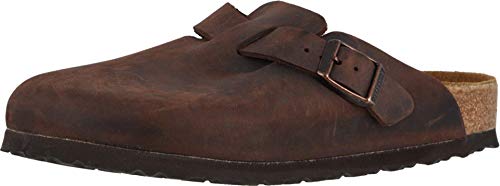
The Boston is the Birkenstock that refuses to stay indoors, and that is precisely its value as a slipper. The closed toe is oiled leather in a rich Habana brown, the strap across the vamp adjusts with a single buckle, and underneath sits the soft footbed — the classic cork construction with an additional foam layer worked in, which takes the edge off the first week’s firmness without surrendering the moulded support that arrives later. If the standard footbed’s break-in has put you off the brand before, this softer variant is the answer the company itself offers.
Oiled leather changes the ageing story completely. Felt absorbs the evidence of household life; leather records it as character. The Habana finish is designed to be scuffed, knocked and rubbed, and to look better for it, developing the kind of patina that makes a five-year-old pair look owned rather than worn out. It also shrugs off the two accidents that age felt fastest: a splash of dishwater at the sink and a wet step onto the porch. Wipe it, let it dry away from radiators, and the clog carries on. Owners who treat the leather to an occasional balm will get the longest service, but even neglected Bostons tend to outlast the felt pairs in this guide.
Because the Boston reads as a shoe, it handles the border crossings of domestic life — bins, post, the school gate, a neighbour’s doorstep — without the self-consciousness of a slipper. That versatility is why it is the most expensive-feeling purchase here and also, for many households, the only one they need. Buy it as a slipper and you will find yourself wearing it as a shoe; buy it in the narrow fitting of this listing only if your feet genuinely run slim, because the leather upper will not stretch a narrow footbed wider.
- Upper: oiled leather in Habana brown, single buckle strap
- Lining: suede footbed lining over the soft footbed build
- Footbed: soft footbed — cork-latex with an added cushioning layer
- Shape: closed-toe clog, the most shoe-like here
- Fit note: listed in narrow width; leather does not widen the footbed
Strengths
- Soft footbed shortens the famous break-in considerably
- Oiled leather ages into patina instead of looking tired
- Handles porches and pavements without embarrassment
Trade-offs
- Heavier and more structured than the felt Zermatts
- Leather appreciates occasional conditioning
- Premium positioning within this line-up
Best for: one-pair households, doorstep errands, and anyone who wants a slipper that behaves like a shoe. Not suited for: buyers wanting featherweight felt or a wide fit from this narrow listing.

Birkenstock Arizona Soft Footbed Birko-Flor — Easiest Care
Birko-Flor is Birkenstock’s own synthetic upper material, a smooth, leather-look surface with a soft backing, and on this Arizona it solves the problem the leather and felt pairs cannot: mess. Kitchen splashes, workshop dust, garden soil tracked to the back door, the muddy enthusiasm of a dog at your ankles — all of it wipes off Birko-Flor with a damp cloth, where the same afternoon would mark suede, stain felt or demand a drying day from shearling. In a working household, that wipe-clean indifference is not a compromise; it is the feature.
The footbed is the soft version, as on the Boston, so the first fortnight is kinder than the classic build, and the twin straps give the same day-by-day adjustability as the shearling Arizona. This listing is the regular width, which makes it the most straightforward recommendation in the guide for average-to-wide feet: no narrow-fitting caveat, no lining squeezing the volume, just the standard Birkenstock shape with room in it. The black colourway keeps the whole shoe visually simple and hides the scuffs of utility wear.
Honesty requires naming what Birko-Flor is not. It does not develop patina, it does not breathe quite like a natural upper, and purists who buy Birkenstock for the all-natural materials story will feel the absence of leather every time they look down. But as a household workhorse — the pair that lives by the back door, takes the recycling out, and stands through a morning of cooking without complaint — it earns its place as the practical conscience of this guide, and its regular width makes it the pair we would suggest first to anyone unsure about Birkenstock sizing.
- Upper: Birko-Flor synthetic in black, twin adjustable buckles
- Lining: soft felted backing against the skin
- Footbed: soft footbed — cork-latex with an added cushioning layer
- Shape: open-toe, open-back two-strap sandal
- Fit note: regular width — the most accommodating listing here
Strengths
- Wipes clean after kitchen, garden and workshop mess
- Regular width suits average and wider feet without caveats
- Soft footbed plus buckle adjustment makes fitting easy
Trade-offs
- Synthetic upper develops no patina and breathes less
- Open design leaves toes unprotected and chilly in draughts
- Looks utilitarian beside the leather Boston
Best for: busy kitchens, back-door duty, and wider feet wanting a fuss-free first Birkenstock. Not suited for: natural-material purists or anyone needing a closed, warm toe.
How Do the Six Compare Side by Side?
| Pick | Upper | Footbed | Best territory |
|---|---|---|---|
| Birkenstock Zermatt Shearling Anthracite | Wool felt, shearling lined | Classic cork-latex | Coldest rooms, dark décor |
| Birkenstock Zermatt Shearling Light Gray | Wool felt, shearling lined | Classic cork-latex | Cold floors, bright kitchens |
| Birkenstock Zermatt Wool Felt Slippers | Unlined wool felt | Classic cork-latex | Temperate houses, sock wearers |
| Birkenstock Arizona Shearling Sandals | Suede straps, shearling footbed | Classic cork-latex | Warm feet wanting an open shoe |
| Birkenstock Boston Clog Soft Footbed | Oiled leather | Soft footbed | Indoor-outdoor all-round use |
| Birkenstock Arizona Soft Footbed Birko-Flor | Birko-Flor synthetic | Soft footbed | Messy, practical everyday wear |
What Actually Happens During the Break-In?
New Birkenstock footbeds feel board-like because the cork-latex blend has not yet been compressed by your particular pattern of weight. Every step presses the material a fraction further into the shape of your heel strike, your arch height and the roll of your stride, and body heat softens the blend just enough to let that shaping happen. The visible result after a few weeks is a footbed with your footprint pressed into it — darker where your heel lands, shaped where your toes grip the raised bar. That is not wear; it is the product working as designed.
The sensible way through the process is gradual wear: an hour or two the first day, building up across the first week, rather than a defiant full day that leaves your arches aching and your opinion of the brand unfairly soured. Socks during the first days reduce friction while the surface is still smooth. If a pair still feels wrong after three weeks of honest wear, the problem is almost always sizing or width rather than the footbed itself, and it is worth re-measuring your feet against the brand’s EU conversion before assuming the design is not for you.
Standard or Soft Footbed — Which Should You Choose?
The classic footbed is cork and latex with a suede lining, firm from day one and increasingly personal as it moulds. The soft footbed adds a foam layer into that construction, which does not change where the support sits but softens the first impression and keeps a whisper of cushion under the moulded shape permanently. People who have worn standard Birkenstocks happily for years usually stay with the classic build out of loyalty to its firmer feedback. Newcomers, people whose feet dislike hard surfaces, and anyone buying a first pair to wear all day immediately tend to be happier starting soft — which is why both leather and synthetic picks in this guide use it.
How Should Birkenstock Slippers Fit at the Heel and Toe?
A correctly fitted pair leaves a small margin — roughly a finger’s width in total — split between the front of your toes and the back of your heel, because the footbed’s raised edges are boundaries your foot should sit inside, not rest upon. Your heel should settle into the cup rather than perch on its rim, and the toe bar should sit under the joints of your toes where they naturally grip. In the clog styles, a little heel lift as you walk is normal and expected; a clog that clamps the heel like a shoe is too small. In the Arizona styles, straps should hold the foot without your toes clawing to keep the sandal on — if they claw, tighten the front strap a hole before blaming the size.
Can You Wear Birkenstock Slippers Outside?
Briefly and dryly, yes — with judgement divided by upper material. The Boston in oiled leather treats a dry pavement, a porch and a garden path as natural territory. The Birko-Flor Arizona shrugs off a damp doorstep. The felt Zermatts are the cautious ones: felt drinks water, and a soaked felt clog worn repeatedly outdoors will age in a single season what indoor use would take years to do. All six share soles that handle dry outdoor surfaces comfortably, but none of them is a rain shoe, and the cork footbed itself should never be soaked, hosed down or left drying on a radiator after a drenching.
How Do You Care for Felt, Shearling and Oiled Leather?
Felt wants a stiff brush and patience: brush dust and hair out of the fibres weekly, treat spots with a barely damp cloth, and let the pair air away from direct heat. Shearling wants less intervention than owners expect — a shake and an airing handle most freshness questions, and the lining should never be saturated with water. Oiled leather is the most forgiving: wipe it down, let scuffs blend into the finish, and rub in a leather balm when the surface starts to look thirsty. Across all three materials, the shared rule is heat discipline. Cork footbeds crack when baked dry, so the radiator, the airing cupboard boiler wall and the tumble dryer are all enemies of every pair in this guide.
What Are the Most Common Mistakes When Buying Birkenstock Slippers?
The first mistake is buying the narrow fitting by accident, because slipper listings default to it often and the word sits quietly in the size line. The second is judging the footbed in the first ten minutes and returning a pair that would have become the most comfortable thing you own by week three. The third is wearing felt outdoors in wet weather and blaming the material. The fourth is ordering your usual trainer size without checking the EU conversion, which does not map onto US sizes as neatly as people assume. And the fifth is buying shearling for a warm house because it looks cosy in photographs, then spending the winter with overheated feet. Each mistake is a mismatch between the pair and the household, not a flaw in the shoe — which is why this guide keeps returning to your floors, your heating and your habits as the real specification sheet.
Zermatt or Boston: Which Shape Suits Your Evenings?
Three of this guide’s six picks are Zermatts and one is a Boston, and the choice between the two clog cousins is the brand’s central indoor decision. The Zermatt is the true slipper of the pair: a soft upper — wool felt or shearling-lined — over the famous footbed, shaped for houses, evenings, and bare or socked feet. The Boston is the shoe that happens to live indoors: oiled leather, a closed toe with street manners, and a silhouette that can answer the door, cross the yard, and sit in a café without changing its story.
Choose by the furthest your slippers travel. If the answer is the garden door, the Zermatt’s softness wins and its felt never meets weather it cannot handle. If the answer involves pavements, school runs, or a dog with opinions, the Boston’s leather earns its keep daily. Households that buy the Zermatt for a Boston’s life wear through felt in a season of doorsteps and blame the brand for a routing error.
The Arizona pair, for completeness, serves the third life: the warm house, the summer evening, the wearer who wants the footbed’s architecture with the least material around it. Between the three shapes, the brand has quietly covered the whole indoor map, which is why a single-brand guide can be written about it without strain.
What Does the Cork Footbed Do Across a Year?
The footbed is the reason this brand exists, and its year runs in three acts. The first fortnight is the argument: the cork-latex bed feels firm, even severe, and the toe bar and arch meet a foot that has lived in foam with a certain scepticism. The second act, across the first months, is the moulding — body heat and pressure press the bed into a negative of the individual foot, the darkening footprint appears, and the firmness resolves into support that feels personal rather than generic. The third act is the long plateau: a footbed that now fits its owner better than any new shoe can, maintained by nothing more than air and the occasional cork sealant on the exposed edges.
That timeline is the honest answer to the price question this brand always provokes. You are not buying the first fortnight; you are buying the plateau, and the plateau lasts for years because cork compresses into shape rather than collapsing into nothing the way foam does. A foam slipper’s best day is its first; a cork footbed’s best year may be its third.
The care corollary follows: keep the footbed dry, let it rest a day between long wears where you can, and protect the cork’s exposed rim from crumbling with sealant when it begins to look pale. Treated so, the bed outlasts the upper above it — which is why this brand sells replacement insoles’ worth of loyalty without ever needing to.
Buying Birkenstock Slippers as a Gift
A Birkenstock slipper is a confident gift: the brand carries its own explanation, the footbed carries its own argument, and the recipient who has never owned a pair is receiving a small education along with the footwear. The Zermatt in its felt version is the safest form of the gift — sized by the familiar shoe size, soft enough to please immediately, and unmistakably a considered purchase rather than a seasonal novelty.
The risks are the brand’s own: the narrow-versus-regular width decision, which the giver must get right or exchange gracefully, and the break-in, which the giver should warn about in the card rather than let it arrive as a surprise. A line in the card — “they feel firm for two weeks, then they become yours” — converts the brand’s one liability into part of the present’s story.
For the recipient who already lives in the brand’s sandals, the slippers are the easiest gift in this entire batch: same last logic, same sizing, new season. For the recipient who has mocked the brand’s looks for years, the shearling Zermatt has converted more sceptics than any argument, because warmth plus that footbed is a difficult position to hold a grudge against.
Shearling, Wool Felt, or Oiled Leather: Reading the Uppers
The brand’s indoor range divides by upper before it divides by shape, and each material writes a different contract. Wool felt is the temperate diplomat: it breathes in both directions, insulates honestly without roasting, and asks for nothing but a brush and dry storage — which is why the plain Zermatt felt is the pair this guide would hand to a stranger. Shearling is the winter specialist, a natural lining that manages moisture as it warms, at the price of being too much slipper for a heated modern flat in any month but January.
Oiled leather, on the Boston, is the traveller: it scuffs and then un-scuffs with a thumb’s rub, shrugs off the doorstep’s weather, and ages into a personal patina that felt cannot imitate. Its cost is care of a different kind — leather wants conditioning across the years and dislikes being dried on radiators — and a first fortnight of stiffness that makes the footbed’s own break-in feel like a group project.
The Birko-Flor on the second Arizona is the pragmatic fourth material: synthetic, wipeable, and honest about it, for the household that wants the footbed’s architecture without any material’s demands. None of the four is the correct choice in the abstract; each is correct for a house, a climate, and a temperament, and the guide’s six picks exist so that the matching can be done by description rather than by disappointment.
What If You Already Own the Sandals?
A large share of this brand’s slipper buyers arrive from its sandals, and they bring two assets: a foot already educated by the footbed, which shortens the slipper break-in to almost nothing, and a size that transfers — with the width caveat — directly from the sandal last to the slipper. For them the purchase is a season extension rather than a new experiment, and the Zermatt in particular reads as the sandal’s winter coat.
The one adjustment the sandal owner must make is sock thickness: a footbed moulded to a bare summer foot meets a winter sock as a small sizing event, and wearers who plan to live in thick socks should try the pair wearing them. The brand’s regular width swallows most sock decisions; the narrow width does not forgive them.
There is also a rotation argument the sandal owner already understands in their bones, because the footbed rests and recovers between wears exactly as the sandals taught them. Slipper and sandal alternating across the year give the cork two seasons of varied work, and owners who run the system report both pairs ageing slower — the brand’s ecosystem quietly rewarding the household that buys into it twice.
What the Footbed Cannot Do: Honest Limits of the Brand
A single-brand guide owes its reader the brand’s limits as plainly as its virtues, and Birkenstock’s are real. The footbed’s support is architectural, not cushioned: a wearer whose feet want softness above all will find the cork severe no matter how well it moulds, and the break-in weeks are a genuine cost that no amount of brand loyalty should be allowed to minimise. The uppers, felt especially, are indoor materials with an indoor lifespan when they are treated as outdoor ones, and the prices sit where they sit — this is a purchase to be made once and kept, not sampled.
The brand also does not chase the heated, the waterproof, or the novelty end of the slipper market, and a buyer whose brief is any of those should leave this guide for the general ones. What the brand does — one footbed philosophy, executed in a handful of honest materials — it does with a consistency that the wider market, for all its variety, rarely matches. The six picks here are variations on a single idea, and the idea is either for your feet or it is not; the break-in fortnight will tell you, and it is worth hearing it out before deciding.
Reading the Widths and Sizes Without a Shop
Buying this brand online turns on two decisions the listing cannot make for you. The first is width: the regular width suits most feet and all sock plans, the narrow suits genuinely slim feet and bare-foot wearers, and the difference is not a comfort preference but the footbed’s geography — a narrow bed under a wide foot puts the arch’s architecture in the wrong place, which no break-in can correct. The second is the size itself, which in this brand rewards measuring the foot in millimetres and trusting the chart over your usual number, because the footbed’s toe bar and heel cup are placed for a specific length.
Get those two decisions right and the famous break-in is the only remaining toll. Get either wrong and the same break-in becomes evidence in a returns process, which is why this brand’s online reviews divide so sharply between the converted and the baffled: the baffled are very often wearing the right slipper in the wrong width.
The Pair by the Door: How Owners Actually Use Them
Ask owners where their Birkenstock slippers live and the answer is rarely a wardrobe: they live by the door, in the kitchen’s warm corner, at the foot of the stairs — the threshold spots of a house, because the brand’s indoor-outdoor ambiguity makes them the footwear of transitions. Shoes come off, the Zermatt goes on; the bin needs the garden, the Boston handles it; the evening settles, and the pair is still on, having never once been the wrong footwear for a domestic moment. That threshold life is the strongest argument for the cork bed’s durability: a slipper worn for every transition of every day accumulates more hours in a month than a fashion pair sees in a year, and the footbed’s slow, plateau-style ageing is precisely the ageing such a life requires.
One Last Fitting Note: The Sock Drawer Decides
The final variable in any Birkenstock fitting is hanging in a drawer: the household’s actual socks, whose thickness the footbed will meet every day of winter. Bring the thickest pair you honestly wear to the fitting — or order with them in mind — because a bed moulded around a bare foot and then asked to host a winter sock is a bed being re-fitted by force, and the regular width forgives that experiment far better than the narrow. Owners who plan the sock into the purchase skip the January renegotiation entirely, and their break-in stories, tellingly, are the boring ones.
Final Recommendation
Start with your floors. Cold stone, tile or draughty boards point straight at the shearling Zermatts, with anthracite for busy dark households and light grey for bright ones. A temperate house and a love of the classic moulded feel make the unlined felt Zermatt the connoisseur’s choice. Warm feet and a hatred of enclosed toes belong in the Arizona Shearling, while anyone who wants one pair to cover slippers, doorstep and school gate should buy the leather Boston on the soft footbed. The Birko-Flor Arizona in regular width is the easiest first Birkenstock of all — wipe-clean, adjustable and forgiving on width. Whichever you choose, if your household is also hunting for tall, ankle-warming house boots, our guide to Best Boot Slippers for Women covers that warmer, higher-cut territory in the same detail. After a winter in a properly fitted pair, most people stop describing these as slippers at all and start describing them simply as the shoes their feet live in.
Frequently Asked Questions
How long does the Birkenstock break-in really take?
For most wearers the footbed feels noticeably personal after one to two weeks of daily use, and fully settled by the end of the first month. Shearling-lined pairs sit at the slower end of that range because the lining compresses before the cork begins shaping. Wearing the pair for short periods at first, rather than whole days, gets you through the process without sore arches.
Should I size up in the shearling Zermatt?
Only if you are already at the very top of your usual size. The lining makes the same marked size feel snugger, and feet that sit mid-range usually settle perfectly as the shearling compresses. Feet at the upper edge of a size, or anyone planning thick winter socks, will be more comfortable one EU size up.
What is the difference between narrow and regular width?
The footbed itself is narrower, with less room across the toes and a closer fit at the side walls. Birkenstock marks width on the footbed with a footprint symbol — filled for narrow, outline for regular. If your feet are average to wide, a narrow listing will feel pinched no matter how long you break it in, so check the listing’s width before ordering.
Can I replace the footbed when it wears out?
The footbed is built into these slipper styles rather than sold as a drop-in replacement, but cork life is measured in years, and the footbed protector products the brand sells can reseal the cork edges when they begin to look dry. Cobblers familiar with the brand can also resole many styles, which is one reason owners keep pairs for so long.
Are Birkenstock slippers warm enough without socks?
The shearling-lined Zermatts and the shearling Arizona footbed are designed to be worn barefoot and stay warm that way. The unlined felt Zermatt is comfortable barefoot in a temperate house but brisk on a cold floor first thing. The leather Boston sits between the two, its closed toe keeping more warmth than the open Arizona styles.
How do I clean the cork footbed if it gets grubby?
Wipe the suede footbed lining with a barely damp cloth and a drop of mild soap, then let the pair dry slowly at room temperature. Never soak the footbed or use heat to speed drying, because saturated cork that dries too fast can crack. A footbed refresher spray made for cork sandals handles odour between deeper cleans.
Do Birkenstock slippers stretch over time?
Uppers relax modestly — felt gives a little across the top of the foot, leather softens and shapes, and straps can be re-buckled — but the footbed’s length and width are fixed by the cork. Buy the size and width your foot needs on day one, expecting the feel to improve through moulding rather than through the shoe getting bigger.
Which pair suits a household with dogs?
The Birko-Flor Arizona, because muddy paw contact and wet noses wipe straight off the synthetic upper, and its regular width and straps tolerate the constant on-off of door duty. The anthracite Zermatt is the runner-up: its dark felt hides the evidence of dog-adjacent living better than any other warm option here.
Related Guides
Round out the cosy end of the house with our bedding and soft-furnishing guides: Best Cotton Sheet Sets (Full Size) for the bed itself, Best Alternatives to UGG Slippers if you want the shearling look from other makers, and Best Bamboo and Seagrass Rugs for a natural layer over the cold floors that made you shop for slippers in the first place.



[…] guide to Best Birkenstock Slippers covers the other great leather-footbed tradition, while the natural-fibre luxury end of the […]