What's inside
- Key Takeaways
- Quick Picks
- How Did We Judge Vacuums for a Job Done One Step at a Time?
- How Do the Six Vacuums Compare on Weight, Hose and Stair Manners?
- Why Weight and Hose Length Outrank Everything Else on Stairs
- How Do You Clean a Flight of Stairs Safely, Step by Step?
- Bagged or Bagless on a Staircase?
- What About the Landing, the Hall and the Turn?
- How Does a Runner Change the Cleaning Brief?
- When Is a Handheld the Better Stair Answer?
- How Do You Keep Stair Carpet Looking Evenly Clean?
- What Should You Do About the Dust That Lives Above the Stairs?
- How Do Stairs with a Turn or a Winder Change the Technique?
- How Often Should Stairs Actually Be Vacuumed?
- What Is the Right Way to Empty a Bagless Cup After Stair Work?
- How Do You Choose Between the Three Eureka Bagless Models Here?
- What Safety Checks Belong in a Monthly Stair Routine?
- How Should Guests and Children Change Your Stair Routine?
- What Does a Stair Vacuum Owe a House With Bare Wooden Steps?
- How Do You Store a Stair Vacuum Without Losing the Hall?
- How Do You Decide Between the Canister Route and the Handheld Route, Finally?
- What Mistakes Do Stair Vacuum Buyers Make Most Often?
- Final Recommendation
- Frequently Asked Questions
- Related Guides
As an Amazon Associate I earn from qualifying purchases. This post may contain affiliate links at no extra cost to you.
cottageverdict.com is reader-supported. When you buy through links on our site, we may earn an affiliate commission.
Where to buy: every vacuum below is sold through Amazon, and the names in the Quick Picks table, the detailed sections and the comparison table link to the listings, so you can check price on Amazon and confirm weight, hose length and included tools before ordering. The best canister vacuums for stairs are judged on a staircase’s own terms, which are not the terms of any showroom floor: the machine must be light enough to sit on a step, and its hose must reach the steps it is not sitting on.
Those two criteria — weight and hose reach — run through this whole guide, because they decide whether stair cleaning is a ten-minute routine or a wrestling match conducted at height. A canister that parks securely on a tread while its hose and wand work three steps up and three steps down is the correct tool; a heavier machine with a short hose must be carried step by step, and a vacuum that has to be carried is a vacuum that gets used less, on the dirtiest vertical surface in the house.
Four of the six picks are Eureka canisters, including — stated plainly, because it matters — two colour versions of the same NEN110 model, in blue and in red, which this guide treats as one design with two finishes rather than two discoveries. A bagged Eureka, a powerful unbranded canister and a corded handheld with a dedicated stair tool complete a field that spans every honest approach to the staircase.
One last thought before the picks, from the top of a thousand cleaned flights: the staircase is the only surface in the house that every resident uses every day and no resident sits in. It is cleaned, therefore, purely as an act of care for the journeys it carries — school runs, night feeds, grandparents arriving with cake. A machine that makes that care easy will be used like it matters, and the stairs will show it.
Key Takeaways
- Stair cleaning is decided by machine weight and hose length before suction ever enters the conversation.
- The Eureka NEN110A in blue and the NEN110D in red are the same model in two colours; this guide says so wherever they appear.
- Bagless Eurekas carry 2.5L cups and HEPA filtration as listed; the 3670M is the bagged alternative with five bags included.
- The Dirt Devil Scorpion Plus is a corded handheld with a pivoting stair tool — the specialist instrument for single flights.
- A canister parked on a step, working through its hose, is safer and faster than any vacuum carried step by step.
Quick Picks
| Pick | Badge | Why it earns its place |
|---|---|---|
| Eureka NEN110A Bagless Canister | Best All-Round Stair Canister | A lightweight bagless canister with a 2.5L cup and HEPA filtration, in blue — the NEN110 design in its original finish. |
| Eureka 3670M Canister | Best Bagged Option | A lightweight bagged canister for carpets and hard floors, supplied with five bags, in yellow. |
| Eureka NEN110D Bagless Canister Red | Best in Red — Same NEN110 Design | The NEN110 WhirlWind in red: same 2.5L cup, HEPA filtration and lightweight design as the blue A version. |
| 40Kpa Canister Vacuum 1600W | Best Tool Set and Cord Control | A bagless canister with a 4-quart washable cup, double HEPA filtration, retractable cord and five tools. |
| Dirt Devil Scorpion Plus Handheld Vacuum, Po | Best Dedicated Stair Tool | A corded handheld with a pivoting stair and upholstery tool, plus hose and dusting brush included. |
| Eureka Bagless Canister Vacuum Cleaner, Vacu | Best With Auto Cord Rewind | The NEN180 WhirlWind in silver, with auto cord rewind, HEPA filtration and a pet-hair brief. |
How Did We Judge Vacuums for a Job Done One Step at a Time?
Listings were read from the staircase’s point of view. Weight came first wherever a listing states it, and where it does not, this guide says so and directs the buyer to check, because a stair vacuum’s weight is not a detail. Hose and cord reach came second: the working radius from a parked machine decides how many times it must be moved per flight, and retractable cords and auto rewind, named on two picks here, were credited as genuine stair virtues because loose cord on steps is a trip hazard with a plug.
Filtration and format were read plainly. The bagless Eurekas state HEPA filtration and 2.5L cups in their listings, with noise capped at 82 dBA in their listings; the bagged 3670M trades the cup for bags and includes five of them; the unbranded canister’s 40Kpa figure is reported as maker-claimed, in line with this site’s standing rule that unverifiable suction numbers are decoration. The Dirt Devil was judged as what it is — a corded handheld, not a canister — included because its pivoting stair tool answers the brief by a different route.

Eureka NEN110A Bagless Canister — Best All-Round Stair Canister
The NEN110A is the reference design of this guide: a lightweight bagless canister from Eureka’s WhirlWind line, with a 2.5L dust container that swallows a whole flight’s worth of grit without a mid-stair emptying expedition, and HEPA filtration named in the listing for the dust the stairs have been storing. Its 2-in-1 brief covers hard floors and carpets, which is precisely the mixed surface a staircase presents — carpeted treads, a hard landing, perhaps a runner that changes the rules halfway up.
On the stairs themselves, its virtues are the guide’s two criteria in person. Lightweight is the listing’s own word, and a canister that can be parked on a tread without dominating it leaves the cleaner’s hands for the hose and the banister. The hose works the steps around the parked machine, which is the entire technique of stair cleaning done properly: the vacuum sits, the wand travels, and nobody carries a motor up a flight one step at a time.
Blue is this version’s finish, and the honest note belongs here: the red NEN110D further down this guide is this same model in another colour, a fact this guide states rather than disguises. Buyers choosing between them are choosing a colour and nothing else — which is a perfectly good basis for a decision, once it is made knowingly. Its listing puts noise at 82 dBA or under, respectable for a machine that will work in the stairwell’s echo chamber.
- Format: bagless canister, WhirlWind NEN110A in blue
- Dust container: 2.5L as stated in the listing
- Filtration and noise: HEPA filtration, listed at 82 dBA or under
- Surfaces: hard floors and carpets, 2-in-1 design
Strengths
- Lightweight body parks securely on a tread
- 2.5L cup covers a full flight without emptying
- HEPA filtration for dust-heavy stairwells
Trade-offs
- Bagless cup needs regular filter attention
- Same model as the red NEN110D — colour is the only difference
- Cord management on stairs needs the usual care
Best for: carpeted staircases in family homes cleaned weekly.
Not suited for: anyone wanting a bagged machine that seals dust away.
Confirm the hose length on the listing against your flight — count the steps it must span from one parked position: Check price on Amazon

Eureka 3670M Canister — Best Bagged Option
The 3670M is the bagged traditionalist in a bagless field, and its case deserves a hearing. A bag seals the dust at disposal — no cup to shake over a bin, no cloud at the moment of emptying — which households with dust sensitivities have valued for decades and continue to value for sound mechanical reasons. Five bags are included in the box by the listing, so the machine arrives with its consumables for a good stretch of cleaning already provided.
Eureka describes it as lightweight and powerful, for carpets and hard floors, and that pairing is the stair brief once again: a machine that can sit on a step and a motor that can pull grit out of tread carpet, where feet grind dirt deeper than anywhere else in the house. The yellow finish is cheerfully visible, which on a staircase is a safety feature in disguise — a machine you can see is a machine you do not trip over.
The bagged bargain has its known cost: bags are a consumable to keep in stock, and a household that runs out mid-month will resent the design until the post arrives. Against that, bags protect the motor and filters from the dust load that bagless owners must wash away themselves, so the maintenance moves from the sink to the shopping list. Households that prefer their upkeep in that form will find this the most congenial machine in the guide.
- Format: bagged canister cleaner, yellow
- Included: five bags as stated in the listing
- Design: lightweight, for carpets and hard floors
- Maker: Eureka, an established vacuum name
Strengths
- Bags seal dust away at emptying time
- Five bags included to start the routine
- Lightweight body suits step-by-step work
Trade-offs
- Bags are an ongoing consumable to stock
- Bagless rivals offer larger, washable cups
- Fewer filtration specifics are headlined in the listing
Best for: dust-sensitive households that prefer bagged disposal.
Not suited for: anyone unwilling to keep spare bags in the cupboard.
Check the bag type on the listing and order the machine with its refills in mind, so the routine never stalls: Check price on Amazon
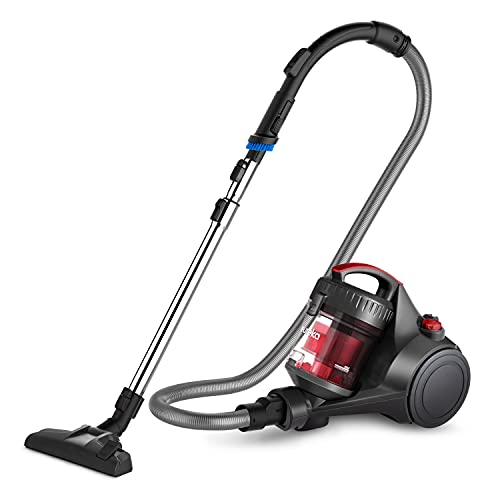
Eureka NEN110D Bagless Canister Red — Best in Red — Same NEN110 Design
Honesty first, because this guide promised it: the NEN110D is the NEN110A in red. Same WhirlWind design, same 2.5L dust container, same HEPA filtration and the same noise ceiling of 82 dBA in its listing. Eureka sells the model in two colours, and this guide lists both because both were in the verified pool — but no reader should finish this section believing they have discovered a second, different vacuum. They have discovered a colour choice, and colour choices are legitimate when they are made with open eyes.
Everything said for the blue version holds here, and it bears repeating in this model’s own words because stair buyers may land on either listing first. The lightweight canister parks on a tread; the hose works the steps around it; the bagless cup holds a flight’s worth of debris; the 2-in-1 design moves from carpeted treads to hard landings without a change of machine. On a staircase, that combination is the job, and the NEN110 design does the job in whichever colour the household prefers.
Why might a household choose red knowingly? Visibility, honestly assessed: a red machine announces itself on a step, in a dim hall, at the edge of a landing, and stair safety is partly the art of seeing what is underfoot. Households with children or grandparents on the stairs may find that argument worth more than any specification in this guide. The rest is taste, and taste needs no defence.
- Format: bagless canister, WhirlWind NEN110D in red
- Dust container: 2.5L as stated in the listing
- Filtration and noise: HEPA, with noise rated 82 dBA or less
- Note: same model as the blue NEN110A, different colour
Strengths
- All the NEN110 virtues in a high-visibility finish
- Lightweight body parks on a tread securely
- Bagless cup and HEPA filtration as listed
Trade-offs
- Identical design to the blue version — no functional gain
- Bagless upkeep falls on the owner
- Cord needs managing on the steps, as with all canisters
Best for: households that want the NEN110 design in its most visible colour.
Not suited for: buyers looking for a functionally different second machine.
You are choosing a colour here, so let the listing photographs settle it — the specifications will not separate the twins: Check price on Amazon

40Kpa Canister Vacuum 1600W — Best Tool Set and Cord Control
This unbranded canister competes on equipment. Its 4-quart washable dust cup is the largest container in this guide, its filtration is described as double HEPA, five tools are included for hard floors and beyond, and its cord retracts — a feature whose value only a stair cleaner fully appreciates, because a retractable cord gathers itself instead of pooling on the treads where feet need to be. The 1600W motor figure is the maker’s own, stated in the listing.
The 40Kpa in its name receives this guide’s standard treatment: a maker-claimed suction figure, unverifiable against any shared standard, and no part of the case made here. The case rests instead on the cup, the tools and the cord — verifiable, usable things. Five tools matter on stairs more than anywhere, because a staircase is not one surface but several in sequence: treads, risers, skirting edges, the banister’s dusty top rail, and the cobwebbed corner above the turn.
Lightweight is claimed in the listing, and the buyer should verify the figure there, since this guide’s first criterion for stair work is a body that parks happily on a step. If the weight checks out, this is the capacity pick of the six: the machine for large homes whose stairs carry a week’s traffic from many feet, and whose cleaner wants the cup and the cord to stop interrupting the work.
- Dust cup: 4-quart washable cup as listed
- Filtration: double HEPA as described in the listing
- Cord and tools: retractable cord, five tools included
- Suction figure: 40Kpa maker-claimed — see guide note
Strengths
- Largest cup in this guide, washable
- Retractable cord keeps treads clear
- Five tools cover the staircase’s many surfaces
Trade-offs
- Suction figure is maker-claimed and unverified
- Unbranded support path runs through the listing
- Weight must be confirmed on the listing before ordering
Best for: large homes with heavy stair traffic and many surfaces.
Not suited for: buyers who prefer an established maker’s network.
Weight decides this machine’s stair manners, so find the figure on the listing and picture it parked on your narrowest tread: Check price on Amazon

Dirt Devil Scorpion Plus Handheld Vacuum, Po — Best Dedicated Stair Tool
The Scorpion Plus is not a canister, and it earns its place in a canister guide by being the specialist the canisters imitate. It is a corded handheld — no battery to fade halfway up the flight, no runtime arithmetic — supplied with a pivoting stair and upholstery tool that is designed for exactly the geometry that defeats ordinary nozzles: the right angle where tread meets riser, worked from the step below, at the angle a standing cleaner actually holds.
Lightweight is the listing’s word and the format’s nature. A handheld goes where the hand goes, one step at a time, with the other hand free for the banister — which, on a steep or narrow flight, is not a convenience but the whole safety argument. The included hose extends its reach into the corners a rigid handheld cannot bend to, and the dusting brush covers the banister rails and skirting that stair cleaning should include while it is there.
Its limits are the format’s limits. A handheld’s cup is small, its reach is the cord’s, and it will not do the landing, the hall and the bedrooms after the stairs with a canister’s stamina. Households with one flight and a cupboard elsewhere full of vacuum will find it the perfect specialist; households buying their only machine should look at the canisters above and let the Scorpion be the second instrument it was designed to be.
- Format: corded handheld vacuum, portable
- Signature tool: pivoting stair and upholstery tool
- Also included: hose and dusting brush as listed
- Maker: Dirt Devil, an established floor-care name
Strengths
- Pivoting tool is purpose-built for stair geometry
- Corded power never fades mid-flight
- One hand stays free for the banister
Trade-offs
- Small cup needs frequent emptying on long flights
- Not a whole-house machine by design
- Cord length bounds each session’s reach
Best for: single flights and spot-cleaning between deep cleans.
Not suited for: households buying their one and only vacuum.
Measure your flight against the cord’s reach from the nearest socket, the one measurement this format lives by: Check price on Amazon

Eureka Bagless Canister Vacuum Cleaner, Vacu — Best With Auto Cord Rewind
The NEN180 closes the Eureka family in this guide with the feature stair cleaners dream about: auto cord rewind. When the flight is finished, the cord gathers itself at a touch instead of being coiled by hand on a staircase — a small luxury everywhere, and on stairs a genuine tidiness and safety habit, since the rewind also means the cord’s length is managed by the machine while you work rather than pooling wherever gravity takes it.
The rest of the specification is the family’s familiar honesty: lightweight WhirlWind design, 1000W as listed, a noise figure no higher than 82 dBA, HEPA filtration, and a 2-in-1 brief that this version extends to pet hair explicitly — hard floors, carpets and the hair that migrates up a staircase on socks and settles into every tread’s edge. Silver is the finish, the most neutral of the Eureka colours here, for households whose hall cupboard has a dress code.
Against its NEN110 siblings, the choice is features against simplicity: the rewind and the pet-hair tuning here, the larger stated cup emphasis there. All three Eurekas share the virtues this guide scores — light bodies, honest listings, a maker’s network behind them — and a household choosing among them is choosing well in three directions at once. On stairs, the rewind may be the difference that decides it.
- Format: bagless canister, WhirlWind NEN180 in silver
- Cord: auto rewind as stated in the listing
- Power and noise: 1000W motor, 82 dBA or quieter, as listed
- Brief: hard floors, carpets and pet hair, 2-in-1 design
Strengths
- Auto cord rewind keeps stairs tidy and safer
- Pet hair named in its brief for tread edges
- Lightweight with HEPA filtration as listed
Trade-offs
- Silver finish shows dust between wipes
- Bagless filter care falls to the owner
- Shares its platform’s limits on very deep pile
Best for: pet households wanting the tidiest stair routine.
Not suited for: buyers who prefer a bagged machine’s sealed disposal.
Auto rewind is this model’s signature, so confirm the cord length on the listing spans your flight from one socket: Check price on Amazon
How Do the Six Vacuums Compare on Weight, Hose and Stair Manners?
| Pick | Badge | Key detail | Best for |
|---|---|---|---|
| Eureka NEN110A Bagless Canister | Best All-Round Stair Canister | Format: bagless canister, WhirlWind NEN110A in blue | carpeted staircases in family homes cleaned weekly. |
| Eureka 3670M Canister | Best Bagged Option | Format: bagged canister cleaner, yellow | dust-sensitive households that prefer bagged disposal. |
| Eureka NEN110D Bagless Canister Red | Best in Red — Same NEN110 Design | Format: bagless canister, WhirlWind NEN110D in red | households that want the NEN110 design in its most visible colour. |
| 40Kpa Canister Vacuum 1600W | Best Tool Set and Cord Control | Dust cup: 4-quart washable cup as listed | large homes with heavy stair traffic and many surfaces. |
| Dirt Devil Scorpion Plus Handheld Vacuum, Po | Best Dedicated Stair Tool | Format: corded handheld vacuum, portable | single flights and spot-cleaning between deep cleans. |
| Eureka Bagless Canister Vacuum Cleaner, Vacu | Best With Auto Cord Rewind | Format: bagless canister, WhirlWind NEN180 in silver | pet households wanting the tidiest stair routine. |
Why Weight and Hose Length Outrank Everything Else on Stairs
A staircase converts a vacuum’s specifications into physics. Every pound of machine must be carried up, parked on a tread perhaps ten inches deep, and trusted not to slide while its owner works two steps away with a hose. A lightweight canister that sits securely turns the flight into a workstation; a heavy one turns it into a portage, and portage is where machines get dropped, banisters get abandoned, and the whole job gets postponed until the stairs are genuinely filthy. Weight is not one criterion among many here. It is the gate through which every other virtue must pass.
Hose length is the second gate, because it sets the working radius. A generous hose lets one parked position serve half a flight — three or four steps up, the landing turn, three steps down — so the machine moves twice per flight instead of twelve times. Each move is a lift, a placement and a small risk; halving the moves halves the risk and most of the effort. When you read the listings in this guide, read those two numbers first and let suction, that most advertised of qualities, wait its turn like everyone else.
How Do You Clean a Flight of Stairs Safely, Step by Step?
Start at the top and work down, so the dirt travels ahead of you and the cleaned steps stay cleaned. Park the canister two or three steps below your working position — never above it, where a tug on the hose could bring it visiting — and keep one hand’s worth of attention on the banister whenever you move. The hose and wand do the travelling; the machine moves only when its radius is spent, and each move is deliberate, with the vacuum set squarely on a tread before the hose is picked up again.
Work each step as a small room: the tread’s centre, its edges where grit collects against the risers, and the riser itself if it is carpeted, because risers gather more dust than visitors ever notice. The crevice where tread meets skirting is the staircase’s archive, and a crevice tool or the Scorpion’s pivoting head earns its existence there. Finish at the bottom, gather the cord — or let the rewind gather it — and the flight is done in one calm pass.
Bagged or Bagless on a Staircase?
The bagless Eurekas offer the modern bargain: a cup that empties into the bin, filters that wash, and no consumables to stock. On stairs their 2.5L cups are well judged — large enough for a flight and its landings, small enough to keep the body light. The cost is the emptying moment, when a cup of stair dust, the finest and oldest in the house, must be persuaded into a bin without touring the hall. Do it outside or into a bag, slowly, and the bargain holds.
The bagged 3670M answers with the older bargain: dust sealed in paper, disposed of whole, with the motor breathing through a fresh surface each time. For dust-sensitive households the sealed disposal is not nostalgia but engineering. Its cost is the standing order for bags. Neither answer wins; the staircase is indifferent, and the household’s lungs and habits should decide, in that order.
What About the Landing, the Hall and the Turn?
A staircase is never only stairs. It arrives with a hall below that tracks in the grit, a landing above that collects the household’s passing dust, and — in most houses — a turn where the flight changes direction and the dirt, carried on socks, settles in the corner nobody’s upright vacuum ever reaches. A canister’s hose is the natural instrument for all of it, working from the parked machine into corners, along skirting and under the hall bench without dragging a full vacuum across every surface.
This is where the tool count in a listing stops being garnish. The five tools of the unbranded canister, the Eureka family’s attachments, the Scorpion’s brush — each is a claim on one of these secondary territories. When comparing machines, walk your own stairs mentally with each tool in hand and ask which set covers your hall’s bench, your landing’s rug and your turn’s awkward angle. The staircase will grade the answer weekly.
How Does a Runner Change the Cleaning Brief?
A stair runner concentrates the staircase’s traffic onto its centre strip, and the grit with it. The runner’s edges, where carpet meets bare tread, are ground zero: dirt migrates off the pile and collects along the boundary, and a vacuum pass that only blesses the middle leaves the edges to darken by the month. Work the edges deliberately with the hose’s crevice tool, then the centre with the floor head, and the runner keeps its contrast instead of developing a grey frame.
Runners also forgive and conceal in equal measure. They hide a multitude of tread sins from visitors while quietly storing the evidence, so a household with a runner should clean on the calendar rather than on appearances — weekly for the traffic lanes, with the edges monthly at minimum. The canisters here, light enough to park beside the runner and patient enough for edge work, are the right shape of tool; a heavy upright balanced on the stairs is not, whatever its power.
When Is a Handheld the Better Stair Answer?
When the flight is short, the messes are frequent and small, and a full canister session would be ceremony out of proportion to the crime. The Scorpion Plus exists for the household whose stairs collect a daily tribute of crumbs, pet hair and tracked grit in quantities a handheld swallows in ninety seconds. Corded, it is always ready; light, it keeps a hand free; and its pivoting tool was drawn for the tread-and-riser angle by someone who had clearly cleaned stairs with the wrong nozzle and taken notes.
The handheld’s honesty is its boundary: it will not deep-clean a house, and its cup will fill on a long-neglected flight. The mature arrangement in many homes is both instruments — the handheld for the week’s skirmishes, the canister for the monthly campaign — and this guide’s field, unusually, lets a buyer assemble exactly that pairing from a single page. Choose the canister as the foundation and the handheld as the convenience, in that order.
How Do You Keep Stair Carpet Looking Evenly Clean?
Stair carpet wears in lanes. The centre of each tread takes every foot the house owns, while the edges live a quieter life, and a vacuum routine that always follows the same path will eventually engrave that difference — a bright, tired lane up the middle of the flight. Vary the work deliberately: some weeks favour the edges with the crevice tool, some weeks give the centres a slow, overlapping double pass, and the pile ages as one surface instead of a road with verges.
Direction matters too. A pass that always travels downward grooms the pile into a single lie, which catches light unevenly and makes a clean staircase look striped. Alternate the wand’s direction on the treads when time allows, and finish with a pass in the pile’s natural direction so the flight presents itself properly to the hall below. These are small arts, but a staircase is the most-seen carpet in the house, and it repays them in the currency of first impressions.
What Should You Do About the Dust That Lives Above the Stairs?
A stairwell is a chimney for household air, and its upper reaches collect what the air carries: cobwebs in the high corners, dust along the picture rail and the top of the banister, a film on the pendant light. The canister’s hose, worked from a parked position on the landing, is the civilised instrument for all of it — no ladder acrobatics with an upright, no handheld stretched beyond its cord. The dusting brush in the Scorpion’s kit and the tool sets of the canisters exist for exactly this altitude.
Schedule the heights less often than the treads — monthly is plenty for most homes — but schedule them, because stairwell dust descends. Every web above the flight is a slow rain of particles onto the steps below, and a staircase cleaned only from the knees down is fighting a battle its ceiling keeps rejoining. Ten minutes aloft, a few times a year, is the whole secret, and it is why hose length earned its place as this guide’s second criterion.
How Do Stairs with a Turn or a Winder Change the Technique?
A turn in the flight is where parked-machine technique earns its keep. The corner tread or small landing at the turn is the natural harbour: set the canister there, squarely, and its hose commands both the flight below and the flight above, halving the moves the clean requires. Winder steps, narrow at their inner edge, ask for the crevice tool and patience rather than the floor head, which bridges their wedge shape and cleans the wide end twice and the narrow end never.
Turns also collect the house’s debris with unfair diligence — the corner is where carried items are set down, where coats brush the wall, where the dog pauses to consider its options. Give the turn a double share of attention and the whole staircase looks cleaner than its average, because the eye reads a staircase from its corners. The lightweight machines in this guide, parked and re-parked without ceremony, suit turned flights far better than any vacuum that must be carried as a single piece.
How Often Should Stairs Actually Be Vacuumed?
More often than the rooms they connect, because stairs receive every journey the house makes, compressed onto a tenth of its floor area. A busy family flight earns a weekly pass as a minimum, with the hall-side bottom steps — the grit frontier — taken twice in muddy seasons. The good news hidden in that frequency is that a weekly stair clean is a short one: ten minutes with a parked canister, against the hour-long excavation a neglected flight demands.
Frequency also protects the carpet’s life. Grit on treads is ground by every passing foot, and stair carpet fails at the tread edges first, exactly where the grinding is fiercest. Removing the grit weekly is not housekeeping vanity but fibre preservation, and it is the practical reason this guide cares so much about machines light enough to be used without negotiation. The best stair vacuum is the one that gets carried to the stairs; everything else is specification.
What Is the Right Way to Empty a Bagless Cup After Stair Work?
Slowly, and preferably outdoors. Stair dust is the house’s oldest and finest — a grey flour of skin, fibre and tracked grit that puffs at the slightest encouragement. Carry the sealed cup to an outside bin where possible, open it low inside the bin rather than above it, and let gravity do the work without shaking. A cup emptied in haste over a kitchen bin returns a visible tithe of its contents to the hall floor, which is a poor reward for a well-cleaned flight.
The filter deserves its moment in the same routine. A bagless machine’s filtration is its owner’s homework, and stair dust loads it faster than any other room’s — tap or wash it on the maker’s rhythm, let it dry fully, and the machine’s suction stays the machine you bought. Households that build the emptying and the filter into one outdoor ritual, after each deep stair clean, rarely meet the slow fade that makes owners blame a healthy vacuum.
How Do You Choose Between the Three Eureka Bagless Models Here?
By the feature your household will actually touch. The NEN110 twins — blue A, red D, one design — are the straightforward choice: the cup, the filtration and the light body without embellishment, in whichever colour your stairs prefer. The NEN180 adds auto cord rewind and an explicit pet-hair brief, and on a staircase the rewind is not garnish but a daily kindness, gathering the cord that otherwise pools on the treads. Choose the twins for simplicity, the 180 for the routine, and know that the underlying virtues — weight, honesty, the maker’s network — are shared by all three.
The bagged 3670M stands apart from the family argument entirely, answering a different question about disposal rather than features. A household can therefore decide in two steps: bags or no bags, on the dust question; then, if no bags, twins or rewind, on the routine question. Two small decisions, honestly framed, instead of a four-way spec-sheet fog — which is how most durable purchases are actually made.
What Safety Checks Belong in a Monthly Stair Routine?
Once a month, give the staircase and its machine a joint inspection. The vacuum’s cord, flexed daily on steps, should be checked along its length for nicks, especially near the plug and the body; the hose for splits at its cuffs, where stair work bends it hardest; the wheels and underside for the grit that would scratch a wooden tread. A canister is a machine that works at height among feet, and its maintenance is partly a safety discipline.
Then look at the stairs themselves with the cleaner’s eye the machine has taught you: the runner’s edges for fraying, the tread edges for the pale line where grit is winning, the banister’s fixings for the wobble that a hand discovers before a guest does. Ten minutes, monthly, and the staircase — the hardest-working structure in the house — stays ahead of its wear instead of announcing it. The vacuum that made the inspection easy has earned its place twice over.
How Should Guests and Children Change Your Stair Routine?
A staircase cleaned for its own household is one thing; a staircase expecting guests is a stage. Visitors read a home from its hall and stairs before they read any room, and the flight’s edges and banister — the parts a resident’s eye has stopped seeing — are exactly where a guest’s hand and eye travel. Before guests, give the banister a pass with the dusting brush and the tread edges their crevice-tool moment; five minutes of edge work outperforms twenty of general effort in the impression it leaves.
Children change the routine in the opposite direction: they lower it. A toddler’s staircase is explored at hand height and sometimes at mouth height, and the grit that an adult household tolerates on the bottom steps becomes a small person’s environment. Households in that season clean the lower flight more often and forgive themselves the upper, and a light canister or the handheld — quick to deploy, quick to put away — fits that rhythm better than any scheduled campaign.
What Does a Stair Vacuum Owe a House With Bare Wooden Steps?
Gentleness and containment. Bare treads show every scratch and hold their dust visibly, so the machine must glide rather than grind: park it on a mat or a tread’s carpeted neighbour where the flight allows, keep its wheels clean of the grit that turns them into casters of sandpaper, and let the hose tools — not the body — travel the wood. The 2-in-1 Eurekas are built for hard floors as part of their stated brief, which is the listing-level assurance a wooden staircase should ask for.
Bare wood also rewards the little-and-often doctrine even more than carpet does, because dust on a polished tread is both visible and slippery. A two-minute handheld pass over the traffic lane, twice a week, keeps wooden stairs safer as well as cleaner — housekeeping as a safety measure, in the one place in the home where a slip has a staircase’s consequences. The Scorpion’s existence in this guide is partly an argument for exactly that habit.
How Do You Store a Stair Vacuum Without Losing the Hall?
Near the stairs, or the routine dies. A canister exiled to a distant cupboard will be fetched for the monthly campaign and never for the weekly pass, and the weekly pass is where stair cleanliness actually lives. The hall cupboard, the under-stairs triangle, the landing’s dead corner — one of these is the machine’s home, and the lightweight canisters here were chosen partly because they fit such honest, small addresses without evicting the coats.
Cord discipline completes the storage story. A machine with auto rewind or a retractable cord stores as a tidy object; a machine whose cord must be coiled stores as an argument. Keep the hose looped as the maker intends rather than kinked over a hook, and the tools in one bag or bin beside the body, so the whole kit can be carried to the flight in one journey. Storage is not the epilogue to a vacuum’s purchase; it is the first chapter of its working life.
How Do You Decide Between the Canister Route and the Handheld Route, Finally?
Count your flights and your patience. One flight, cleaned often in small moments, belongs to the handheld: it is out, working and stored again before a canister has been fetched. Two flights, a landing with a rug, a hall that joins the job — that is canister territory, where the parked machine and its hose turn a campaign into a routine. Households with both shapes of work, which is most households with stairs at all, will recognise the pairing this guide quietly recommends: a canister as the foundation, the handheld as the skirmish weapon, each covering the other’s honest limits.
Budget enters last, as it should. Either route, chosen deliberately, costs less than the wrong machine bought twice — and stair vacuums are bought twice with unusual frequency, because buyers discover the weight and hose truths only on their own steps. Read those two numbers before any other, picture the machine parked on your narrowest tread, and the route usually chooses itself while the comparison table is still loading.
What Mistakes Do Stair Vacuum Buyers Make Most Often?
Buying a stair vacuum by its floor performance is the founding mistake. A canister that triumphs in a carpeted lounge may be a miserable stair tool — too heavy to park, too short in the hose — and the staircase, not the lounge, is where it will be cursed weekly. Read weight and hose length first, as this guide does, and let the floor virtues queue behind them.
A second mistake is parking the machine above your working position, or on a tread too narrow to hold it squarely. A canister pulled off its step by its own hose arrives at the cleaner’s feet with opinions. Park below, park square, and let the hose do the climbing; the technique costs nothing and prevents the one accident this category is known for.
Finally, buyers ignore the cord until it is underfoot. Loose cord on stairs is a hazard with a plug, and it is why retractable cords and auto rewind appear in this guide as headline virtues rather than footnotes. Manage the cord as part of the technique — gathered, routed, never pooled on the treads — and stair cleaning becomes the calm routine it should be.
A fourth mistake is treating the stairs as an afterthought of the floor clean, tacked on when the machine is already out and the cleaner already tired. The flight deserves its own short session, with the machine parked and the technique deliberate — ten fresh minutes beat twenty exhausted ones, on stairs more than anywhere else in the house.
Final Recommendation
For most staircases, the Eureka NEN110A Bagless Canister is the answer this guide reaches first: light enough to park on a tread, a 2.5L cup, HEPA filtration and a maker’s name behind it. The Eureka 3670M Canister serves dust-sensitive households with its sealed bags and five included to start, and the Eureka NEN110D Bagless Canister Red offers the identical NEN110 design in red for households that value a machine they can always see on the step.
The unbranded canister counters with the biggest cup, five tools and a retractable cord for large, busy homes; the Scorpion Plus is the specialist for quick, frequent passes over a single flight; and the silver NEN180 adds auto cord rewind and a pet-hair brief to the Eureka virtues. Every one of them was judged by the staircase’s own criteria, and every one can do the job its description claims.
Measure your flight, count the steps a hose must span, and choose the machine light enough to live on them comfortably — because the right stair vacuum turns the house’s hardest cleaning job into its quickest, and that transformation is worth more than any figure printed on a box.
Frequently Asked Questions
Are the blue and red Eureka vacuums in this guide the same machine?
Yes. The NEN110A in blue and the NEN110D in red are colour versions of the same Eureka WhirlWind model, with the same 2.5L cup, HEPA filtration and noise figure in their listings. This guide lists both because both are sold, and says plainly that the choice between them is a choice of colour — with red offering extra visibility on a step.
How long a hose do I need for my stairs?
Long enough to work three or four steps in each direction from one parked position, so the machine moves only a few times per flight. Count your steps, picture the canister parked mid-flight, and compare that span against the hose length stated on the listing of any model you are considering.
Is a bagged vacuum better for dust allergies?
Bagged machines seal dust inside the bag at disposal, which many dust-sensitive households prefer over shaking out a bagless cup. This guide makes no medical claims for any model; the mechanical difference is real, though — sealed disposal versus cup emptying — and the 3670M includes five bags to start that routine.
Can I use a canister vacuum on bare wooden stairs?
Yes — the Eurekas here are 2-in-1 designs for hard floors and carpets, so bare treads and landings are within their brief. Work gently on polished wood, keep grit from gathering under the machine’s wheels by parking it cleanly, and use the hose tools for edges rather than dragging the body across each tread.
Why does this guide include a handheld in a canister roundup?
Because the Scorpion Plus answers the stair brief directly: it is corded, lightweight and supplied with a pivoting stair tool made for the tread-and-riser angle. It is not a canister and is not presented as one — it is the specialist alternative for single flights and quick cleans, included so buyers can compare the two honest approaches side by side.
How do I stop the canister rolling or sliding on a step?
Park it squarely on the tread’s centre, with its wheels or base fully on the step rather than overhanging, and keep the hose’s pull gentle and downward where possible. If your treads are unusually narrow, park the machine on the landing or the hall floor and let a longer hose span do the reaching — the technique adapts, and no clean is worth a falling vacuum.
How do I keep the hose from marking the banister and walls?
Let the hose travel in your hand rather than dragging across corners: lift it around the newel post and the turn instead of pulling it through, and keep its cuffs — the stiff ends that do the scuffing — under your control on painted woodwork. A hose treated as something you carry, not something you tow, leaves the stairwell’s paint exactly as it found it.
Related Guides
Stairs lead somewhere, and the guides below cover the rooms, rugs and routines waiting at the top and bottom of them. Best Machine Washable Area Rugs Best Cordless Hand Blenders Best White Double Sink Bathroom Vanities


