What's inside
- Key Takeaways
- Quick Picks
- How We Chose These Picks
- How Do the Six Sheet Sets Compare at a Glance?
- Why Does the Standard Crib Size Matter So Much?
- Cotton, Jersey or Chenille: Which Fabric Should You Choose?
- How Many Crib Sheets Does a Household Actually Need?
- How Should You Fit and Change a Crib Sheet Properly?
- How Do You Wash Crib Sheets So They Keep Fitting?
- What Should You Check When a Sheet Starts Popping Off?
- How Do Crib Sheets Carry Into the Toddler Bed Years?
- What About Mattress Protectors Under the Sheet?
- How Can You Tell a Good Fitted Sheet in the Hand?
- Prints, Colours and the Nursery You Actually Live In
- When Should You Replace a Crib Sheet?
- How Do You Buy Crib Sheets as a Gift Without Guessing Wrong?
- What Happens to Fit When the Mattress Is Not Standard?
- How Should You Store the Spare Sheets?
- How Do Sheets Behave Differently Across the Seasons?
- What Should Grandparents’ Houses and Travel Cribs Have?
- How Do You Handle the Stain Years Without Ruining Sheets?
- What Role Does the Sheet Play in the Bedtime Routine?
- How Should You Read a Crib Sheet Listing Before Buying?
- How Do You Keep White and Pale Sheets Looking Fresh?
- What Is the Sensible Order to Buy Nursery Bedding In?
- What Mistakes Do Crib Sheet Buyers Make Most Often?
- Final Recommendation
- Frequently Asked Questions
- Related Guides
As an Amazon Associate I earn from qualifying purchases. This post may contain affiliate links at no extra cost to you.
cottageverdict.com is reader-supported. When you buy through links on our site, we may earn an affiliate commission.
Where to buy: the six best crib sheet sets in this guide are sold through Amazon, and each name in the Quick Picks table, the detailed reviews and the comparison table links to its own listing, where you can check price on Amazon and confirm the pack count, the exact dimensions and the fabric before it goes anywhere near your nursery.
A crib sheet is a small rectangle of fabric that carries an outsized workload. It is washed more often than almost anything else in the house, changed at hours when nobody is at their best, and expected to fit a standard crib mattress — 52 by 28 inches, the size every pick in this guide is built around — snugly enough to stay smooth and flat through a night of determined wriggling. When a sheet fails, it rarely fails dramatically. It shrinks a whisper in the wash, its corners start their slow climb, and one tired evening the fitted edge pops free at the exact moment nobody needed another job.
So this guide judges crib sheets the way the laundry basket judges them: by fit that survives washing, fabric that stays pleasant against skin, elastic that keeps its grip, and pack counts that match the arithmetic of real life — one on the mattress, one in the wash, one folded and ready. Cotton in its several forms dominates the list, from organic percale-style weaves to soft jersey and one plush chenille outlier, and the differences between them are worth understanding before the baby registry closes.
Key Takeaways
- Every pick here fits the standard crib mattress size of 52 by 28 inches — measure your mattress anyway, because toddler beds and older cribs vary.
- Fabric is the real choice: smooth cotton for a crisp feel, jersey for T-shirt softness and stretch, chenille for plush warmth.
- Two-packs suit most households; the rotation of one on, one washing, one spare is the arithmetic that prevents 2 a.m. improvisation.
- Judge a fitted sheet by its corners and elastic after washing, not by how it feels in the packet on day one.
- Organic cotton options from HonestBaby and KeaBabies lead this list for parents who want certification-minded fabric choices.
- Prints are not decoration trivia — a pattern a toddler loves can turn sheet-changing from a wrestle into a ritual.
Quick Picks
| Pick | Badge | Why it earns its place |
|---|---|---|
| HonestBaby Crib Sheets | Best Organic Cotton | One hundred percent organic cotton in a clean, neutral black — the quality-first single sheet for parents who buy fewer, better. |
| Yoofoss Crib Sheets | Best Stretchy Two-Pack | A stretchy two-pack in green and leaf prints, sized 52 by 28, that forgives mattresses and toppers that sit slightly proud. |
| American Baby Company Crib Sheets | Best Natural Cotton Staple | Two natural cotton sheets, 52 by 28, in grey stars and plain grey — the dependable staple every rotation needs. |
| Dreamology Jersey Crib Sheets | Best Jersey Softness | Cotton jersey — the T-shirt fabric — in a two-pack for standard 52 by 28 mattresses, soft from the first night. |
| American Baby Chenille Crib Sheet | Best Plush for Cold Rooms | A single chenille sheet, 28 by 52, in steel grey — plush and warm where every other pick is smooth. |
| KeaBabies Crib Sheets | Best Organic Two-Pack | Organic cotton in a two-pack, 52 by 28, with a butterflies print — the organic choice that also solves the rotation. |
How We Chose These Picks
We began with the tape measure. Any sheet not built for the standard 52 by 28 inch crib mattress was set aside, however pretty, because a sheet that almost fits is worse than an ugly one that does. Within that size, we looked for fitted construction that wraps the mattress properly — deep enough pockets and elastic with real tension — since the whole point of a fitted sheet is that it stays where it was put.
Then we sorted by fabric philosophy. Nursery bedding divides into smooth woven cotton, knitted jersey, and plush outliers, and each has devoted families behind it. The final six include both organic cotton choices, a stretchy printed two-pack, a natural cotton staple, a jersey pair and a chenille sheet for cold rooms, so that whichever fabric religion your household follows, there is a considered option waiting. Pack counts were weighed honestly: a one-pack must justify itself on quality, and a two-pack must not hide thin fabric behind arithmetic.
- Confirmed fit for the standard 52 x 28 inch crib and toddler mattress size stated in each listing.
- Fabric honesty: cotton content and construction as the listing describes, with no invented performance claims.
- Fitted security: pocket depth and elastic behaviour that keep corners seated through washing and wear.
- Rotation value: pack counts judged against the one-on, one-washing, one-spare rhythm of nursery life.
- Wash tolerance, because a crib sheet’s real life is measured in laundry cycles, not in first impressions.

HonestBaby Crib Sheets — Best Organic Cotton
The HonestBaby Crib Sheets entry makes its argument in the first line of its listing: 100% organic cotton, fitted for a standard mattress, in a plain neutral black that refuses to shout. This is the sheet for parents who have decided that the fabric touching their child for twelve hours a day should be the fabric they would choose for themselves, grown and made with the organic standard as the starting point rather than the marketing garnish.
Black is a bolder nursery choice than the pastel default, and a smarter one than it first appears. It hides the evidence of small disasters, pairs with any blanket or nursery palette, and photographs as modern rather than saccharine. The fitted cut is made for the standard crib mattress, and the cotton’s smooth woven hand gives the crisp, cool surface that parents who dislike jersey’s cling tend to prefer on warm nights.
The honest cost of this pick is arithmetic: it is a one pack. One superb sheet still leaves the rotation problem unsolved, so most households will pair it with a second sheet — possibly a second of these, possibly a workhorse from further down this list — and treat this one as the sheet that goes on after bath night, when everything is clean and the week resets.
For gift-givers, this is the sheet that reads as considered rather than bulk-bought, the one that goes into the nursery hamper with the good intentions visible. The HonestBaby Crib Sheets set the standard the rest of this guide is measured against for fabric quality, and they earn the lead position by being the pick parents describe, months later, as the one they reach for first when all three are clean.
- Fabric: 100% organic cotton
- Pack: 1 fitted sheet
- Size: standard crib mattress, 52 x 28 class
- Colour: black, neutral styling
- Role: the quality-first sheet in the rotation
Strengths
- Organic cotton with a smooth, crisp hand
- Black hides wear and suits any nursery palette
- Fitted cut made for the standard mattress
Trade-offs
- Single sheet leaves the laundry rotation short
- Dark colour shows light lint and dust
- Crisp weave is less stretchy over thick mattress toppers
Best for: parents prioritising organic fabric and a modern, neutral nursery. Not suited for: anyone who needs a full rotation from a single purchase.

Yoofoss Crib Sheets — Best Stretchy Two-Pack
The Yoofoss Crib Sheets solve a specific and common irritation: the mattress that is almost standard. A protector adds height, a topper adds more, and suddenly the crisp fitted sheet that behaved on the bare mattress starts its corner-climbing act. Yoofoss answers with stretch — the listing describes the fabric as stretchy, soft and breathable — and a two-pack in green and leaf prints that keeps the nursery looking intentional while the fit problem quietly disappears.
Stretch changes the changing routine, too. A sheet with give goes on faster at midnight, corners seating without the two-handed wrestle that wakes the household, and it settles smoothly over protectors that make woven sheets drum-tight. The prints earn their keep with toddlers, for whom a leaf pattern is not décor but a thing to point at, name and discuss at length during the bedtime negotiations.
The trade-off of stretch is feel. A fabric with give will never have the cool, ironed crispness of a smooth woven cotton, and parents who love that hotel-sheet sensation should look at the HonestBaby or American Baby picks instead. But for the far larger group whose priority is a sheet that goes on easily, stays put and washes without drama, the Yoofoss Crib Sheets are the pragmatic heart of this guide.
Buy them as the rotation’s engine room: two in the pack means the wash cycle stops being an emergency, and the forgiving fit means they will serve from the first crib months through the toddler bed conversion, where mattress toppers and protectors multiply. Few nursery purchases stay useful that long; these intend to.
- Pack: 2 fitted sheets
- Size: 52 x 28 inches per the listing
- Fabric: soft, stretchy, breathable per listing
- Prints: green and leaf designs
- Fit note: stretch accommodates protectors and toppers
Strengths
- Stretchy fit forgives protectors and thicker mattresses
- Two-pack solves the basic rotation in one buy
- Prints toddlers genuinely enjoy at bedtime
Trade-offs
- No crisp woven-cotton feel for traditionalists
- Prints will not suit every nursery’s palette
- Stretch fabrics prefer gentler wash heat
Best for: households using mattress protectors, and anyone who changes sheets at midnight. Not suited for: parents who want a smooth, crisp cotton hand above all.

American Baby Company Crib Sheets — Best Natural Cotton Staple
Every category has a pick that simply does the job the category exists for, without argument or theatre, and here it is the American Baby Company Crib Sheets. One hundred percent natural cotton, fitted for the 52 by 28 mattress, in a two-pack that pairs a grey stars print with a plain grey — one sheet with personality, one that goes with everything, which is exactly the combination a working rotation wants.
Natural woven cotton brings the qualities generations of nurseries have relied on: it breathes, it washes hot when the situation demands it, it softens gradually rather than degrading, and it feels reassuringly like bedding rather than like a garment. The neutral grey palette suits boys’ and girls’ rooms equally, as the listing notes, and it coordinates with the blankets and bumpers-free minimalism of most modern nurseries without a colour argument.
There is no stretch here, so measure with a protector on if you use one, and expect the honest fit of a woven sheet: snug, smooth and dependent on the mattress being the standard size it claims to be. In return you get fabric that tolerates the full laundry repertoire, from stain treatments to warm washes, with the resilience cotton is famous for.
This is the set grandparents buy, the set that appears on registries from families who have done this before, and the set whose absence of surprises is its entire recommendation. The American Baby Company Crib Sheets will not be the most talked-about object in the nursery. They will simply be on the mattress, fitting, wash after wash — which is the highest praise a crib sheet can earn.
- Fabric: 100% natural cotton
- Pack: 2 fitted sheets
- Size: 52 x 28 inches per the listing
- Designs: grey stars and plain grey
- Role: the rotation’s dependable staple
Strengths
- Natural cotton tolerates thorough, warm washing
- One print plus one plain covers every bedding mood
- Neutral grey suits any nursery and either sex
Trade-offs
- Woven fit has no stretch for oversized toppers
- Plain styling will not thrill print-loving toddlers
- Cotton wrinkles more than knitted fabrics
Best for: families wanting a proven natural-cotton staple for crib and toddler bed. Not suited for: mattresses stacked with thick protectors and toppers.

Dreamology Jersey Crib Sheets — Best Jersey Softness
Jersey is the fabric of the favourite T-shirt: knitted rather than woven, soft without being broken in, and possessed of a natural give that woven cotton cannot imitate. The Dreamology Jersey Crib Sheets bring that hand-feel to the crib in a two-pack of 100% cotton jersey, fitted for the standard 52 by 28 mattress, and the result is the sheet that feels kindest against skin from the very first use — no wash-in period, no crispness to soften.
The knit construction changes small practical things. Jersey drapes rather than tents, so it settles over the mattress without the drum-tight corners that can make woven sheets ping free; it resists wrinkling, which matters to anyone whose nursery standards include a bed that looks calm in photographs; and it feels warm to the first touch in a cool room, where a smooth woven sheet can feel briefly chilly.
Jersey’s cautions are the knitter’s cautions. It prefers a gentler wash than battle-grade cotton, it can pill if abused with high heat and rough company in the drum, and its softness invites comparison with garments — which is to say, it will not satisfy the parent who wants the bed made with hotel corners and a sheet that crackles faintly when shaken.
For most nurseries, though, this is the fabric children themselves would vote for, and the two-pack keeps the rotation honest. The Dreamology Jersey Crib Sheets are the comfort pick: the ones that go on for the unsettled nights, the teething weeks and every other stretch where softness is not a luxury but a strategy.
- Fabric: 100% cotton jersey knit
- Pack: 2 fitted sheets
- Size: 52 x 28 standard crib mattress
- Feel: T-shirt soft, warm to first touch
- Role: the comfort-first sheet in the rotation
Strengths
- Soft from day one with no breaking-in
- Knit give settles easily over the mattress
- Barely wrinkles, so the crib always looks calm
Trade-offs
- Prefers gentler washing than woven cotton
- Can pill under high heat and rough loads
- No crisp, tailored sheet feel
Best for: parents who want garment-level softness against their child’s skin. Not suited for: hot-wash traditionalists and crisp-sheet households.

American Baby Chenille Crib Sheet — Best Plush for Cold Rooms
The American Baby Chenille Crib Sheet is the outlier of this guide, and it knows it. Chenille is a plush, tufted fabric — soft in the way a favourite jumper is soft — and in a crib it turns the sheet from a surface into an experience: warm to the touch, cosy in a way smooth cotton never attempts, and particularly welcome in cold houses, winter nurseries and rooms where the heating minds its own business at night.
The listing describes it as heavenly soft, warm and cozy, in a neutral steel grey that suits boys and girls and every blanket you own. Sized 28 by 52 inches, it fits the same standard crib and toddler mattresses as the rest of this guide, but the feel could not be more different: where the woven picks are crisp and the jersey is T-shirt soft, the chenille is a shallow plush that small hands will stroke as a self-soothing habit.
Use it with seasonal intelligence. Chenille’s warmth is a genuine asset in January and a genuine liability in a heatwave, so this sheet earns its place as the winter specialist in a rotation rather than the year-round default. It is also a single sheet, so it joins a rotation rather than constituting one, and plush fabrics generally ask for a little more care in the wash to keep their pile cheerful.
Households in old houses, cold climates and draughty farmhouses will understand this pick instantly, because they know the specific misery of laying a child onto a cold sheet. The American Baby Chenille Crib Sheet exists for that moment, and for the toddler who reaches down, pats the surface, and approves.
- Fabric: chenille plush
- Pack: 1 fitted sheet
- Size: 28 x 52 inches per the listing
- Colour: steel gray, neutral
- Role: the winter and cold-room specialist
Strengths
- Warm to the first touch in cold rooms
- Plush texture toddlers love to stroke
- Neutral grey pairs with every blanket
Trade-offs
- Too warm for summer nights and hot houses
- Single sheet only — a rotation partner is needed
- Pile prefers a gentler wash routine
Best for: cold houses, winter babies and draughty nurseries. Not suited for: warm climates or year-round single-sheet plans.
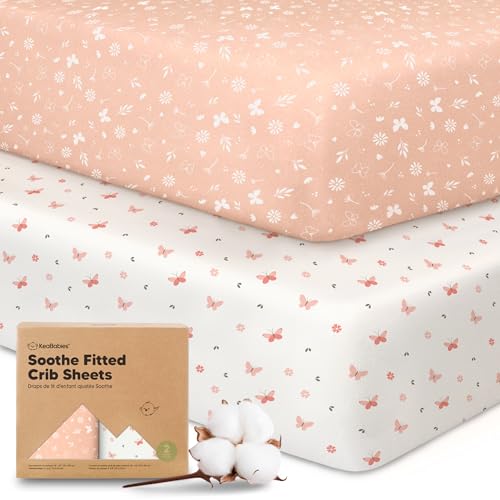
KeaBabies Crib Sheets — Best Organic Two-Pack
The KeaBabies Crib Sheets answer the question the HonestBaby pick leaves open: what if you want organic cotton and a working rotation in the same purchase? The answer is a two-pack of organic cotton fitted sheets at the standard 52 by 28 size, finished with a butterflies print that manages to be sweet without surrendering the nursery’s dignity — no small design achievement.
Organic cotton in a two-pack changes the buying maths. Instead of one premium sheet plus a compromise partner, the rotation itself is organic, and the sheet that goes on at midnight is the same quality as the one that went on at bedtime. The fabric is described as soft and breathable, the fit is for standard crib and toddler mattresses, and the print gives toddlers something gentle to look at while the bedtime story gathers itself.
Prints ask one honest question: will butterflies still please in eighteen months? For most toddlers the answer is cheerfully yes, and the neutral ground of the design keeps it from fighting the rest of the room. Parents building a strictly minimalist nursery may prefer the HonestBaby’s plain black, but they will pay for that purity with a second purchase to complete the set.
As a registry item this is the easiest recommendation in the guide: organic fabric, correct size, rotation solved, print included. The KeaBabies Crib Sheets are what happens when a brand understands that parents do not want to choose between their principles and their laundry logistics — they want both, in one packet, by Friday.
- Fabric: organic cotton
- Pack: 2 fitted sheets
- Size: 52 x 28 per the listing
- Print: butterflies on a neutral ground
- Role: the organic rotation in a single purchase
Strengths
- Organic cotton across the whole rotation
- Two-pack ends the spare-sheet problem immediately
- Print is gentle enough for design-conscious nurseries
Trade-offs
- Print may date faster than a plain sheet
- Organic cotton asks for kind washing to stay soft
- Butterflies will not suit every nursery’s theme
Best for: organic-minded parents who still need laundry practicality. Not suited for: strict minimalists who want plain bedding only.
How Do the Six Sheet Sets Compare at a Glance?
All six fit the same standard mattress, so the table is really a fabric map: two organic cottons, one natural woven cotton, one stretchy printed pair, one jersey knit and one plush chenille. Choose the fabric your household’s skin, climate and laundry habits prefer, and the pack count follows from how many sheets your rotation honestly needs.
A second pattern hides in the pack counts: the two single sheets are the fabric extremists — the crispest organic and the plushest chenille — while every two-pack is a diplomat. That is not a coincidence. Singles are bought for a quality; pairs are bought for a system, and a wise nursery usually ends up owning one of each kind.
| Pick | Badge | Distinguishing detail |
|---|---|---|
| HonestBaby Crib Sheets | Best Organic Cotton | 100% organic cotton, 1 pack, black, standard mattress fit |
| Yoofoss Crib Sheets | Best Stretchy Two-Pack | 2 pack, 52 x 28, stretchy fabric, green and leaf prints |
| American Baby Company Crib Sheets | Best Natural Cotton Staple | 2 pack, 100% natural cotton, 52 x 28, grey stars and grey |
| Dreamology Jersey Crib Sheets | Best Jersey Softness | 100% cotton jersey, 2 pack, 52 x 28, unisex |
| American Baby Chenille Crib Sheet | Best Plush for Cold Rooms | Chenille, single sheet, 28 x 52, steel gray |
| KeaBabies Crib Sheets | Best Organic Two-Pack | Organic cotton, 2 pack, 52 x 28, butterflies print |
Why Does the Standard Crib Size Matter So Much?
Standardisation is the nursery’s quiet blessing. Crib mattresses in the standard class measure 52 by 28 inches, and every sheet in this guide is cut for that footprint, which means sheets, protectors and mattresses from different brands mostly agree with each other. Mostly is doing work in that sentence: mattress thickness varies, protectors add height, and a sheet cut exactly to size can struggle over a padded stack even when its length and width are perfect.
Measure before you buy, with the protector fitted if you use one, and compare against the listing’s stated size rather than the word ‘standard’ alone. The few minutes with a tape measure are the cheapest insurance in the nursery, because a sheet returned is a nuisance but a sheet that pops its corners at night is a recurring one.
Cotton, Jersey or Chenille: Which Fabric Should You Choose?
Woven cotton — the HonestBaby, American Baby and KeaBabies route — is the traditionalist’s fabric: smooth, breathable, tolerant of thorough washing, and possessed of a crispness many parents associate with a properly made bed. It softens over time rather than arriving soft, and it asks for a mattress that truly matches its stated size because it has little stretch to offer in negotiation.
Jersey knits trade crispness for immediate softness and give, draping where woven cotton tents. Chenille leaves the comparison altogether and becomes a texture, plush and warm, chosen for cold rooms and tactile toddlers rather than for any notion of classic bedding. There is no fabric winner here, only fabric fit: your climate, your child’s skin preferences as they emerge, and your washing machine’s temperament should cast the deciding votes.
How Many Crib Sheets Does a Household Actually Need?
Three is the number experienced parents land on, and the reasoning is pure logistics. One sheet is on the mattress. One is in the wash or drying. One is folded, clean, and ready for the incident that has not happened yet — and in a crib, incidents are not a possibility but a schedule. Two sheets can work in a house with a fast laundry turnaround; one sheet is a gamble that the night will be kind.
That arithmetic is why two-packs dominate this guide and why the single-sheet picks — the HonestBaby and the chenille — are best understood as the quality or specialist layer within a three-sheet system rather than as a system themselves. Buy the rotation first and the luxury second, and no 2 a.m. sheet change will ever involve a hairdryer and a prayer.
How Should You Fit and Change a Crib Sheet Properly?
Start with the mattress out or tilted if the crib design allows it — fighting a fitted sheet through crib rails at arm’s length is how corners get half-seated. Hook the two far corners first, deep over the mattress edges, then walk the near corners on, and run a hand around the full perimeter to confirm every corner is genuinely home rather than resting on the edge. The surface should be smooth and flat, without bunched fabric or loose folds anywhere a child will lie.
Change with the spare already in hand. Strip, wipe the protector if the incident demands it, fit the clean sheet fully before the child is anywhere near the crib, and put the used sheet straight into the laundry flow rather than onto a chair to be forgotten. The whole operation, practised, takes three minutes; unpractised, at 3 a.m., it can take a household’s entire remaining goodwill.
How Do You Wash Crib Sheets So They Keep Fitting?
Shrinkage is the fitted sheet’s natural enemy, and it is mostly a heat story. Wash warm rather than hot unless the situation genuinely requires heat, tumble on a moderate setting or line dry when you can, and never bake a sheet dry and then wrestle it onto the mattress while it is still deciding its final dimensions. Cotton relaxes and gives a little with wear; what it will not do is grow back length that aggressive drying took away.
Keep nursery laundry as its own load where you can. Sheets washed with towels and heavy items get abraded and tangled; washed with other light bedding, they emerge smoother and last longer. Treat stains promptly — the overnight soak in cold water has saved more crib sheets than any detergent claim — and rotate evenly, so the favourite sheet does not do double duty while its partners stay folded and new.
What Should You Check When a Sheet Starts Popping Off?
A corner that escapes is diagnostic information. If the sheet fitted for months and has begun to climb, suspect shrinkage from hot drying, elastic that has tired, or a new protector that has quietly added height to the mattress stack. Check the elastic’s tension by hand, measure the mattress stack again, and compare the sheet against its partner: if one fits and one climbs, the sheet has changed, not the crib.
Do not solve a popping corner by tucking harder or adding loose fabric to compensate — a fitted sheet that cannot seat properly should be retired to the travel bag or the rag drawer, and replaced. Sheets are consumables with a long cycle, not heirlooms, and the rotation only works when every member of it genuinely fits.
How Do Crib Sheets Carry Into the Toddler Bed Years?
The standard crib mattress very often becomes the toddler bed mattress, which is why every pick here is described for both. That continuity is a gift: the rotation you built for the crib serves the toddler bed unchanged, and the prints a baby ignored become, in the toddler years, a genuine feature — a child who loves the leaf or butterfly sheet participates in bed-making with an enthusiasm no plain sheet has ever inspired.
Expect the workload to change shape rather than shrink. Night-time drinks, the occasional accident during toilet training, and a toddler’s conviction that the bed is also a trampoline, a boat and a veterinary surgery all test elastic and seams. Sheets bought well at the crib stage, in a rotation of three, will see the whole era through; sheets bought thin will be replaced mid-era at the least convenient moment, because that is when everything is replaced.
What About Mattress Protectors Under the Sheet?
A protector is the sheet’s silent partner: it guards the mattress, and the sheet guards the child from the protector’s less lovely texture. Fit is a team event — a protector that adds height or shifts under the sheet will make a good sheet behave like a bad one, so choose a protector that itself fits snugly and lies flat, and fit the pair together when you test a new sheet’s corners.
Layering order matters for comfort. Protector first, fully seated; sheet over it, fully seated; nothing else loose in the sleep space. If the protector crinkles, the sheet will not fix it; if the sheet is jersey or stretch, it will forgive a slightly proud protector that defeats a woven sheet. The Yoofoss and Dreamology picks exist in this guide partly because protector stacks are now the nursery norm rather than the exception.
How Can You Tell a Good Fitted Sheet in the Hand?
Turn a corner inside out. On a good sheet the pocket is deep, the elastic runs with real tension — ideally around the whole perimeter rather than only at the corners — and the stitching at the corner seams is dense and even. The fabric should feel substantial without stiffness: hold it to the light and a nursery sheet should not read as tissue, because it will be washed like equipment, not like lingerie.
Then do the stretch test your hands already know from clothing: pull the elastic and release it, and watch whether it snaps home or sighs home. Elastic that sighs on day one will give up entirely by month six. None of the picks in this guide is the cheapest sheet available in its class, and the corner construction is precisely where that money went.
Prints, Colours and the Nursery You Actually Live In
Bedding is the largest soft surface in a nursery, so its colour quietly sets the room’s mood in every photograph and every night feed. Neutrals — the HonestBaby black, the American Baby greys, the chenille’s steel grey — forgive changing décor and second children of either sex. Prints — Yoofoss leaves, KeaBabies butterflies — give toddlers a world to point at and give plain rooms their one cheerful note.
Choose for the years, not the reveal photograph. The nursery reveal lasts an afternoon; the sheet rotation lasts until the toddler bed is outgrown. A print that pleases a two-year-old at bedtime is worth more than a palette that pleased a design board before the baby arrived, and a neutral that survives three children is worth more than either. Most households land, sensibly, on a mixture — which is, not coincidentally, what a three-sheet rotation makes easy.
When Should You Replace a Crib Sheet?
Replace on fit first: a sheet whose corners will not stay seated after honest washing has finished its service, whatever its surface looks like. Replace on fabric second: thinning you can see light through, elastic that has gone slack, pilling that changes the surface’s feel, or a stain history that no longer washes to a standard you are happy to lay a child on. Sheets rarely fail all at once; they retire by degrees, and the rotation hides the decline until the worst sheet is suddenly the only clean one.
Keep the retired sheet. It becomes the travel sheet, the car sheet, the sheet that goes to grandparents and under the painting project. A nursery produces uses for honest old fabric for years, and the sheet that no longer earns the crib can still earn its keep everywhere else in a small child’s extremely material life.
How Do You Buy Crib Sheets as a Gift Without Guessing Wrong?
Buy the size, not the theme. Standard 52 by 28 is the nursery’s lingua franca, and a quality two-pack in a neutral or gentle print — the American Baby or KeaBabies pattern — will fit the crib the parents actually bought, in the room they actually painted. Include the receipt, because duplicates in a rotation are a blessing but the wrong size is a errand, and new parents have enough errands.
If you know the household, buy to its gaps: the organic-minded pair will use the KeaBabies or HonestBaby; the cold old house will bless you for the chenille; the family on its second child needs arithmetic, not novelty, and a plain hardworking two-pack is the most loving object in this entire guide. Gifts of bedding are unfashionable and unforgettable in equal measure, because they are used on the hardest nights.
What Happens to Fit When the Mattress Is Not Standard?
Not every crib is standard. Mini cribs take a smaller sheet entirely — a different guide’s subject — and some older or imported cribs sit between sizes, where a standard sheet will either drum or sag. A sagging, loose sheet is not a cosmetic issue to tolerate; bedding should lie smooth and fitted, and a sheet that pools fabric does not belong on that mattress at all.
The stretch picks forgive millimetres, not centimetres. If your mattress measures outside the 52 by 28 class by more than a whisker, buy for its true size rather than hoping elastic will negotiate the difference. Measure length, width and depth, keep the numbers in your phone, and let every future bedding purchase be a thirty-second confirmation instead of a fresh act of faith.
How Should You Store the Spare Sheets?
Folded flat, in the room, within arm’s reach of the crib: that is the whole doctrine. A spare sheet stored in a linen cupboard down the hall is a spare sheet that arrives ninety seconds later than the incident required, and at night those seconds are denominated in crying. One shelf, one drawer, one basket in the nursery itself, holding the clean rotation and nothing else, is the system that survives contact with reality.
Store sheets fully dry, because a sheet folded damp will smell of its storage when it is needed most, and rotate the stack — clean sheets to the bottom, next use from the top — so wear spreads evenly across the set. When the toddler bed era ends, the same drawer logic transfers to single-bed spares, and the household keeps the habit the crib taught it: the next sheet is always already there.
How Do Sheets Behave Differently Across the Seasons?
A nursery’s temperature swings more than parents expect: heating dries and warms winter air, summer turns small rooms stuffy by midnight, and the sheet sits at the centre of the child’s microclimate. Smooth woven cotton is the all-season diplomat, cool enough in July and perfectly adequate under a blanket in January. Jersey runs a touch warmer to the touch, which is comfort in autumn and a consideration in a heatwave.
Chenille is the honest seasonal specialist, and the mistake is not owning it but owning only it. Build the rotation so the seasons can be dressed: woven or jersey as the year-round base, the plush sheet entering service when the house turns cold, and the whole set rebalanced in spring. Children cannot adjust their own bedding layers for much of this era, so the sheet choice is one of the few climate decisions entirely in the parents’ hands.
What Should Grandparents’ Houses and Travel Cribs Have?
The second crib — at grandparents’, in the holiday cottage, in the travel setup — deserves the same fitted standard as the home crib and rarely gets it. A dedicated two-pack that lives at the second house ends the era of improvised bedding and borrowed towels, and it should be fitted and tested on that mattress before the first visit, not discovered wanting during it.
Travel argues for the forgiving fabrics. A stretchy or jersey sheet tolerates the slightly different mattress dimensions that travel cribs and second-hand cribs present, washes in a strange machine without ceremony, and packs flat. Send the sheet with the child as part of the kit, the way the favourite blanket travels, and sleep away from home stops being a bedding negotiation.
How Do You Handle the Stain Years Without Ruining Sheets?
Crib sheets meet everything: milk, medicine, mystery fluids at 4 a.m., and later, felt-tip pens wielded with intent. The defence is speed and cold water. Rinse or soak a stained sheet cold as soon as it comes off the bed, because heat sets most nursery stains permanently, and keep a simple stain routine in the laundry area so the night-shift parent does not have to invent chemistry while exhausted.
Accept, too, that sheets have a cosmetic lifespan shorter than their structural one. A sheet can be perfectly fitted, clean and serviceable while carrying the faint archive of its service. That sheet is not a failure; it is the rotation’s veteran, and it is exactly the one to send on travel duty, keep for illness weeks, and lay under art projects when its crib career finally closes.
What Role Does the Sheet Play in the Bedtime Routine?
Toddlers run on ritual, and the sheet is part of the stage set. A print to say goodnight to, a familiar texture under the hand, the same smooth surface in the same order every night — these small constants tell a small person that the world is arranged and sleep is safe to approach. Parents underestimate how much of bedtime resistance is really stage fright at a changed set.
Use that. Let the toddler choose between the two clean sheets on change day, a tiny sovereignty that costs nothing and buys cooperation. Keep the favourite sheet for the hardest nights rather than spending it on ordinary ones. The sheet will never be thanked in words, but in the currency of a household — a bedtime that works — it is quietly one of the highest-yield objects you own.
How Should You Read a Crib Sheet Listing Before Buying?
Read a listing the way you would read a rental contract: for the numbers first. Dimensions in inches, pack count, fabric content in percent, and fitted depth if it is stated. Then read what the listing does not say. A sheet that never mentions its pocket depth may be shallow; a fabric described only with adjectives may be a blend wearing cotton’s clothes. The picks in this guide were chosen partly because their listings answer the measurable questions plainly.
Photographs deserve the same scepticism. A sheet photographed on a thick display mattress with studio lighting tells you about the photograph. Look instead for the corner construction, the elastic’s path, and any image of the sheet’s underside. Thirty seconds of this reading, per purchase, is the entire difference between the households in this guide’s success stories and the ones re-tucking corners at midnight.
How Do You Keep White and Pale Sheets Looking Fresh?
Pale nursery bedding lives a hard life under a gentle colour, and keeping it fresh is a routine rather than a product. Wash pale sheets together, treat marks before they dry, and give them air and daylight when the weather allows — sunlight remains the laundry’s oldest brightener. Avoid the temptation to scorch them clean with the hottest cycle as a habit; heat is what ages both cotton and elastic, and a pale sheet’s freshness comes from promptness, not punishment.
Rotate ruthlessly. The sheet that rests between uses keeps its surface and its fit longer than the favourite washed and refitted in a loop. If one pale sheet is darkening with service while its partner stays bright, retire the veteran to travel duty and promote a fresh sheet into the home rotation. Small disciplines like these are why some nurseries’ bedding looks new at the toddler bed stage and others’ looks archaeological.
What Is the Sensible Order to Buy Nursery Bedding In?
Mattress first, protector second, sheets third, blankets and decoration last of all — because each layer’s fit depends on the one beneath it, and the nursery’s money should flow downhill in that order. Parents who reverse the sequence end up with beautiful blankets and a sheet that will not seat over the protector nobody measured. The unglamorous layers are the load-bearing ones, and they deserve first claim on the budget.
Within sheets, buy the staple before the specialist: the natural cotton or organic two-pack that will run the rotation, then the jersey for comfort weeks, then the chenille when winter actually arrives and proves the need. Bought in that order, every purchase is used the week it arrives. Bought in the decorative order, half the nursery waits in packaging while the one sheet you own goes around again, still damp at the corners.
What Mistakes Do Crib Sheet Buyers Make Most Often?
Crib sheet mistakes are rarely about taste. They are about arithmetic, heat and assumptions — the three forces that govern all nursery logistics. These are the ones that recur in household after household.
- Buying a single beautiful sheet and discovering the rotation problem during the first stomach bug.
- Assuming ‘standard’ without measuring, then blaming the sheet for a non-standard mattress.
- Drying cotton sheets on maximum heat until they shrink just enough to start climbing corners.
- Choosing a plush winter sheet as the only sheet and sweltering through July with it.
- Fitting a sheet over a protector without checking that the pair seats together at the corners.
- Keeping a sheet in service after its elastic has tired, and re-tucking the same corner every night.
Every one of these is cheap to avoid at purchase and expensive to endure nightly, which is the defining economics of nursery equipment. The sheet is a small purchase that behaves like infrastructure; treat it that way and it disappears into the background of family life, which is exactly where good infrastructure belongs.
Final Recommendation
If the whole guide must narrow to one recommendation for the most households, it is the KeaBabies two-pack: organic cotton, the correct standard size, a print with genuine charm, and the rotation solved in a single purchase. Traditionalists should take the American Baby natural cotton pair, comfort-first families the Dreamology jersey, protector-stack households the stretchy Yoofoss, and cold houses the chenille as their winter layer, with the HonestBaby as the premium single to build around.
Whichever fabric wins your household, buy the rotation before the baby needs it, fit the first sheet on a calm afternoon rather than a hard night, and the best crib sheet sets will do what the best nursery purchases always do — vanish into the routine, leaving only the small, clean, ordinary miracle of a bed that is always ready.
Frequently Asked Questions
What size are standard crib sheets?
Standard crib sheets are made for mattresses measuring 52 by 28 inches, the size every pick in this guide is built around. Measure your mattress — including its depth and any protector — before ordering, because older, imported and mini cribs follow different sizes.
How many crib sheets should I buy?
Three is the working number: one on the mattress, one in the wash, one clean and folded in the nursery. Two-packs plus one quality single, or a two-pack and a specialist sheet like the chenille, are the combinations most households settle on.
Is jersey or woven cotton better for a crib?
Neither is better outright. Woven cotton is crisper, tolerates thorough washing and suits traditional bedding tastes; jersey is softer from the first night, drapes easily and barely wrinkles. Many rotations sensibly contain both, using jersey for hard weeks and woven cotton as the staple.
Can crib sheets be used on a toddler bed?
Yes — toddler beds generally use the same standard crib mattress, and every pick here is listed for crib and toddler mattresses alike. The same rotation carries through, which is part of the value of buying decent sheets at the crib stage.
Why does my fitted sheet keep coming off at the corners?
Usually shrinkage from hot drying, tired elastic, or a protector that has added height to the mattress stack. Re-measure the stack, check the elastic’s tension, and retire any sheet that will no longer seat fully — a sheet that cannot fit properly should not stay in the rotation.
Are printed sheets a mistake for a nursery?
Not at all. A gentle print gives toddlers something to enjoy at bedtime and hides small marks between washes. The only caution is longevity of taste: pair one printed set with plain neutrals, as several picks here do, and the rotation stays flexible for years.
Related Guides
The nursery’s bedding system has a smaller sibling and several neighbours worth your attention: the compact version of this very problem is solved in Best Mini Crib Sheet Sets, the grown-up bed gets its texture from Best Waffle Blankets for Beds, and the kitchen that feeds the night shift starts with Best Motion Sensor Kitchen Faucets.



[…] a kitchen with good problems, and the rest of the house has its own lists: the nursery is sorted in Best Crib Sheet Sets, the bathroom shelf improves with Best Waffle Bath Towels, and the soak that follows a long juicing […]