What's inside
- Key Takeaways
- Quick Picks
- How Did We Choose These White Faucets?
- How Do the Six White Faucets Compare Side by Side?
- Why Does the Shade of White Matter More Than the Word White?
- Pull-Out, Pull-Down or Spring: Which Spray Format Fits Your Sink?
- How Do You Keep a White Faucet Looking White?
- What Should You Measure Before Ordering Any White Faucet?
- How Do You Install a Single-Hole Faucet on a Three-Hole Sink?
- How Does Water Pressure Change the Way These Faucets Behave?
- White in a Farmhouse Kitchen Versus a Modern One: Does the Same Faucet Work Twice?
- How Long Do Pull-Out and Pull-Down Hoses Really Last?
- What Should Renters and Landlords Look for in a White Faucet?
- How Do You Choose a Handle Style Your Whole Household Can Use?
- Can a White Faucet Work With Dark or Coloured Cabinets?
- How Should You Plan the Faucet Around the Sink You Already Own?
- What Does Living With a White Faucet Teach You After Six Months?
- How Do You Swap a Faucet Without Losing the Kitchen for a Weekend?
- Why Do Some White Faucets Cost So Much More Than Others?
- How Do You Read a Faucet Listing Without Being Fooled by It?
- Which of These Six Should a Small Kitchen Choose?
- How Does a White Faucet Age Across Five Years of Family Life?
- Should the Faucet Match the Appliances, the Sink or the Cabinet Handles?
- What Mistakes Spoil a White Faucet Purchase?
- Final Recommendation
- Frequently Asked Questions
- Related Guides
As an Amazon Associate I earn from qualifying purchases. This post may contain affiliate links at no extra cost to you.
cottageverdict.com is reader-supported. When you buy through links on our site, we may earn an affiliate commission.
Where to buy: Every faucet in this guide links to its Amazon listing, where you can check price on Amazon and confirm the exact shade of white, the hole count it covers and whether a deck plate is in the box. White is the least forgiving finish to buy from a photograph, so read the listing’s finish name carefully before you commit.
Choosing the best white kitchen faucets sounds like a colour decision, yet it quickly becomes a materials decision. A white faucet can be glossy enamel over metal, a matte coating on a tall modern body, or a two-tone design where chrome shares the frame. Each version sits differently against a farmhouse sink, a white worktop or pale cabinetry, and each one ages differently around the handle, where hands, rings and cleaning cloths do their slow work. This guide gathers six white faucets that approach the colour from genuinely different directions, then explains how to judge shade, spray type and mounting before you order.
White also changes how a kitchen feels at different hours. In morning light a glossy white spout nearly disappears against a white splashback, which suits cooks who want the sink area calm. By evening, under warm bulbs, a matte white body reads softer and slightly creamier, while a white-and-chrome model keeps a bright outline. None of these effects show up in a specification table, so the reviews below talk about presence and upkeep as much as valves and hoses.
Key Takeaways
- White faucets divide into glossy, matte and two-tone families, and the family matters more than the word white on the box.
- Pull-out sprayers suit shallower sinks, while pull-down heads and spring coils give taller arcs for stockpots and trays.
- Only one pick here states a flow figure in its listing, so treat unstated numbers as unknown rather than guessing them.
- A deck plate decides whether a single-hole faucet can cover a three-hole sink, so check inclusion before ordering.
- White shows limescale as pale crust and hides hard-water spots better than black, but it reveals turmeric and tomato stains quickly.
Quick Picks
| Pick | Badge | Why it earns a place |
|---|---|---|
| Moen Brecklyn White Pull-Out Faucet | Big-Name Pull-Out | Moen pairs a tidy pull-out sprayer with its Power Clean spray technology in a clean, uncomplicated white body. |
| Pfister Pfirst White Kitchen Faucet | Documented All-Rounder | The listing states its flow, swivel and valve type outright, which makes this older design unusually easy to judge. |
| Kraus Nolen Matte White Kitchen Faucet | Two-Tone Statement | A tall matte white body edged with chrome gives modern kitchens a faucet that reads as furniture, not plumbing. |
| AguaStella AS60W White Kitchen Faucet | Glossy Minimalist | A shiny white finish and pull-down sprayer keep the silhouette simple for small, bright kitchens. |
| KMEINO White Kitchen Faucet | Deck Plate Included | Stainless construction, a full swivel and an included deck plate make this a flexible swap for older sinks. |
| GULICA White Spring Kitchen Faucet | Commercial Spring Style | An exposed spring coil and pre-rinse sprayer bring a professional look to a white scheme without going chrome. |
How Did We Choose These White Faucets?
We started from listings whose titles confirm a genuinely white finish, then filtered for variety of spray format, because a household rinsing salad leaves in a shallow sink needs different hardware from one filling preserving pans. Brand support mattered too: Moen, Pfister and Kraus publish deep parts catalogues, while the smaller names here earned their slots through included hardware, stated construction or a distinctive spring design that the big brands do not offer in white.
Numbers were only credited when the listing itself states them. Where a title gives a flow rate, a height or a swivel angle, the review repeats it and says where it came from. Where a listing stays silent, the review says the figure is not stated in the listing instead of filling the gap with a plausible guess. That discipline keeps the comparison honest, even when it leaves a few boxes marked unknown.
Finally, we weighed how each white surface will look after a year of real cooking. Gloss shows fingerprints less than people fear but telegraphs chips; matte hides smears yet can hold onto oily splashes near the handle; two-tone designs push the high-touch areas onto chrome, which wipes clean fastest. Those judgements run through every review below.

Moen Brecklyn White Pull-Out Faucet — Big-Name Pull-Out
The Brecklyn takes the conservative route to white: a mid-arc body, a single handle and a sprayer that pulls out toward you rather than dropping down from a tall neck. Pull-out designs keep the working end low, so the stream lands inside the bowl instead of bouncing off a saucepan rim and misting the worktop. Moen’s listing highlights its Power Clean spray technology, the brand’s name for a spray pattern intended to rinse with more force than its standard mode, which is the mode you will reach for when porridge has welded itself to a pan.
In a white finish this faucet suits kitchens where the sink sits under a window and a tall gooseneck would block the view or fight the sill. The handle action is the familiar single-lever lift-and-turn, easy with the back of a wrist when your hands are floury. Because the sprayer docks into the spout end rather than hanging from a hose below, the counter keeps a tidy profile, and the white surface has fewer seams where grime can settle.
- Spray format: pull-out sprayer with Power Clean spray technology named in the listing
- Handle layout: single handle
- Finish: white, as titled
- Flow rate: not stated in the listing
- Mounting details: not stated in the listing, so confirm hole count on the product page
Strengths
- Low working height keeps spray inside the sink and off the surrounding worktop.
- Moen’s parts and cartridge support network is among the easiest to use years later.
- Power Clean gives the rinse mode a clear purpose beyond a gentle stream.
Trade-offs
- A pull-out hose reaches less far than a tall pull-down when rinsing a wide roasting tray.
- The listing leaves flow and mounting figures unstated, so pre-order checking is essential.
- White around the docking collar needs regular wiping to stop a grey tide line forming.
Best for: compact kitchens and under-window sinks where a low, tidy faucet beats a tall one.
Not suited for: cooks who regularly fill very deep stockpots under the spout.

Pfister Pfirst White Kitchen Faucet — Documented All-Rounder
Pfister’s Pfirst has been sold for years, and its listing reads like a spec sheet from a more forthcoming era: a pull-out sprayer, a mid-arc spout that swivels a full 360 degrees, ceramic disc valve technology and a stated flow of 1.75 GPM. That combination makes it the easiest pick in this guide to evaluate on paper. The 360-degree swivel matters in double-bowl sinks, where the spout must park over either side without the handle fouling the splashback.
The styling is unapologetically traditional, with a curved spout and a lever that would look at home in a cottage kitchen with a ceramic sink. Ceramic disc valves are the detail to appreciate quietly: they resist the drip that washer-based valves develop, and they keep the handle feel consistent. In white, the Pfirst reads as part of the sink furniture rather than a feature, which is exactly what many period kitchens want from a modern-mechanism faucet.
- Flow rate: 1.75 GPM, stated in the listing
- Spout movement: 360-degree swivel, stated in the listing
- Valve: ceramic disc valve technology, stated in the listing
- Spray format: pull-out sprayer
- Arc: mid arc, per the listing title
Strengths
- Full swivel suits double-bowl and corner sinks better than limited-arc rivals.
- Published flow and valve details remove guesswork from the buying decision.
- Traditional curves blend with ceramic sinks and older kitchen styles.
Trade-offs
- Mid-arc height limits clearance for the tallest preserving pans.
- The design has been around a long time, so it will not satisfy a strictly modern scheme.
- Pull-out hose length is not given in the listing and varies in usefulness by sink depth.
Best for: traditional kitchens wanting documented mechanics in a discreet white body.
Not suited for: minimal modern kitchens chasing a sculptural faucet.

Kraus Nolen Matte White Kitchen Faucet — Two-Tone Statement
The Nolen is the extrovert of this group. Kraus lists it at 16 3/8 inches tall, finished in matte white with chrome accents, and fitted with a dual-function pull-down sprayer. That height puts the spout well above stockpots and watering cans, while the chrome detailing draws a bright line along the handle and spray head so the white body does not vanish against a pale splashback. It is the pick for kitchens where the faucet is meant to be looked at.
Dual function means the head switches between a steady stream for filling and a spray for rinsing, the standard modern pairing. The matte surface behaves differently from the glossy picks here: it shrugs off fingerprints and water spots, yet cooking oil mist can dull it near the handle if you let weeks pass between wipes. A soft cloth and mild soap restore it; abrasive pads are the enemy of any matte coating and this one is no exception.
- Overall height: 16 3/8 inches, stated in the listing
- Finish: matte white with chrome, a two-tone design
- Spray format: dual-function pull-down sprayer
- Handle layout: single handle
- Flow rate: not stated in the listing
Strengths
- Generous height clears tall pots that defeat mid-arc faucets.
- Chrome accents keep definition against white tiles and pale stone.
- Matte surface hides the water spotting that plagues dark finishes.
Trade-offs
- Tall body can clash with low window sills and wall cabinets over the sink.
- Matte white needs prompt attention after oily frying sessions nearby.
- The two-tone look commits you to mixing chrome elsewhere in the room.
Best for: modern white kitchens that want the faucet to act as a deliberate design accent.
Not suited for: sinks under low windows or anyone wanting white to be invisible.
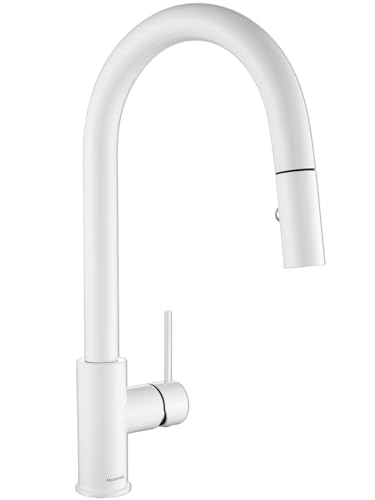
AguaStella AS60W White Kitchen Faucet — Glossy Minimalist
AguaStella describes the AS60W plainly: a shiny white kitchen sink faucet with a pull-down sprayer and a single handle. That gloss is the point. Where the Kraus goes matte and architectural, this one is bright and simple, the sort of faucet that disappears happily into a small white kitchen, a rental refresh or a utility room that deserves better than a chrome builder fitting. The pull-down head gives more working reach than the pull-out designs here when you are rinsing the far corners of a big single bowl.
The listing is brief, and this review will not pretend otherwise: it does not state a flow figure, a height or a valve type, so those boxes below are honestly marked. What can be judged is the format. A single-lever pull-down in gloss white is the most familiar modern arrangement, parts and hoses follow common patterns, and the smooth glossy coat is the easiest of all these finishes to wipe back to bright with a damp cloth after a curry night.
- Finish: shiny white, per the listing title
- Spray format: pull-down sprayer
- Handle layout: single handle
- Flow rate: not given in the listing
- Height and valve type: not given in the listing
Strengths
- Gloss coat wipes clean faster than any matte surface in this guide.
- Pull-down reach suits large single-bowl sinks and tray rinsing.
- Understated shape avoids dating a kitchen the way novelty designs can.
Trade-offs
- Sparse listing means several specifications must be confirmed with the seller.
- Gloss white shows chips more starkly if metal utensils strike the spout.
- Brand support network is smaller than the Moen, Pfister and Kraus operations.
Best for: small bright kitchens and refresh projects wanting simple gloss white.
Not suited for: buyers who need every specification published before they order.

KMEINO White Kitchen Faucet — Deck Plate Included
The KMEINO listing packs several practical confirmations into its title: stainless steel construction, a high arc, a pull-out sprayer on a 360-degree swivel spout, and a deck plate in the box. That last item decides real-world fit more often than any styling point, because a plate lets a single-hole faucet cover the spare holes of an older three-hole sink without leaving open holes to collect water and grime. For a replacement project, this is the pick that asks the fewest extra purchases.
High arc plus pull-out is an interesting pairing: the arc gives pot clearance while the sprayer stays at spout level, so rinsing happens close to the bowl. Stainless construction under the white finish is a reassuring base material for a value-brand faucet. The full swivel lets the spout swing to a draining board or a bucket beside the sink, a small freedom that single-bowl households use daily.
- Construction: stainless steel, stated in the listing
- Spout movement: 360-degree swivel, stated in the listing
- Arc: high arc with pull-out sprayer
- Deck plate: included, per the listing title
- Flow rate: the listing does not state one
Strengths
- Included deck plate makes it a straightforward swap onto multi-hole sinks.
- Stainless base material is a solid foundation beneath the white finish.
- Full swivel and high arc together cover filling, rinsing and bucket duty.
Trade-offs
- Pull-out sprayers offer a shorter working hose than pull-down heads.
- Value-brand listings can change included parts, so verify the box contents at order time.
- White finish over the plate and body must be shade-matched to your sink by eye.
Best for: replacement projects on older sinks where hole coverage is the headache.
Not suited for: new-build kitchens designed around a single drilled hole and a tall neck.

GULICA White Spring Kitchen Faucet — Commercial Spring Style
Spring faucets borrow their silhouette from restaurant kitchens: an exposed coil holds a flexible sprayer that you pull down and aim like a hose. GULICA renders that working look in white, with a high arc, a 360-degree swivel and a pre-rinse sprayer, plus a deck plate for mounting flexibility. In a white scheme the coil reads as texture rather than machinery, which softens the industrial idea for a home kitchen.
Pre-rinse sprayers are built to blast: the narrow, forceful pattern strips porridge, mash and baked-on sauces before the pan goes into wash water. That enthusiasm needs a deep bowl, because the same jet in a shallow sink will bounce water across the worktop. The listing calls the style commercial, and the honest reading is that it rewards cooks who wash up like professionals, in a sink deep enough to contain the spray.
- Style: high-arc spring design, commercial pre-rinse format
- Sprayer: pull-out pre-rinse sprayer, per the listing
- Spout movement: 360-degree swivel, stated in the listing
- Deck plate: included with the faucet
- Flow rate: not stated in the listing
Strengths
- Pre-rinse jet clears stubborn food faster than standard spray patterns.
- Flexible coil aims water anywhere in a large or double bowl.
- White finish makes the professional silhouette feel domestic rather than stark.
Trade-offs
- Forceful spray splashes in shallow sinks, so bowl depth is a real condition.
- Spring coils collect dust and grease in the windings and need deliberate cleaning.
- The look is a commitment; it dominates a small sink run.
Best for: keen cooks with deep sinks who wash up in volume and like the restaurant look.
Not suited for: shallow sinks or kitchens aiming for a quiet, invisible faucet.
How Do the Six White Faucets Compare Side by Side?
| Pick | Spray format | Stated figures | Character |
|---|---|---|---|
| Moen Brecklyn White Pull-Out Faucet | Pull-out | Power Clean spray named; flow not stated | Low, tidy, big-brand support |
| Pfister Pfirst White Kitchen Faucet | Pull-out | 1.75 GPM, 360-degree swivel, ceramic disc | Traditional and fully documented |
| Kraus Nolen Matte White Kitchen Faucet | Pull-down, dual function | 16 3/8 inch height | Tall two-tone statement |
| AguaStella AS60W White Kitchen Faucet | Pull-down | Figures not given in the listing | Glossy and minimal |
| KMEINO White Kitchen Faucet | Pull-out | 360-degree swivel, deck plate included | Practical replacement choice |
| GULICA White Spring Kitchen Faucet | Pre-rinse spring | 360-degree swivel, deck plate included | Commercial energy in white |
Read the table by format first and finish second. Format decides how washing up feels every day; finish decides how the room looks in photographs. A household that mostly rinses glasses and salad will be happiest with a pull-out or pull-down, while a household scrubbing roasting tins will forgive the GULICA its drama. The Pfister remains the only model whose maker publishes a flow figure in the listing, which says more about listing habits than about the faucets themselves.
Why Does the Shade of White Matter More Than the Word White?
Whites are not interchangeable. A glossy enamel white leans blue-bright beside the warm white of many ceramic sinks, and a matte white can look grey next to brilliant-white quartz. The mismatch shows most at the sink rim, where faucet base and basin sit centimetres apart and the eye compares them constantly. If your sink is an aged ceramic with a creamy cast, a blue-bright faucet will make the basin look tired; a warmer white or a two-tone model with chrome breaks the comparison and hides the difference.
Practical buyers order with an exit plan: check the listing photographs against your sink in daylight, hold a white appliance or a sheet of printer paper beside the basin to learn its undertone, and prefer sellers whose returns process you have read. Undertone clashes are the single most common reason white faucets get sent back, ahead of any mechanical complaint.
Pull-Out, Pull-Down or Spring: Which Spray Format Fits Your Sink?
Pull-out sprayers, like the Moen and the Pfister here, keep the nozzle low and close to the bowl. They suit shallow sinks, under-window installations and anyone who dislikes water falling from height onto crockery. Pull-down heads, on the Kraus and the AguaStella, hang from a taller neck and give a longer hose arc, better for rinsing the corners of a wide single bowl or filling a pot sitting on the worktop beside the sink.
The spring format is a specialist tool. Its jet is designed for pre-rinsing in deep commercial bowls, and in a domestic setting it rewards a deep sink and a cook who washes roasting tins daily. Choose it for the way it works, not only for the way it looks, because a coil that impresses guests still has to earn its keep on an ordinary Tuesday.
How Do You Keep a White Faucet Looking White?
White’s enemies are pigment and scale. Turmeric, tomato sauce, beetroot juice and red wine all stain pale finishes if they sit, so the rule is a quick wipe after colourful cooking rather than a weekly rescue mission. Limescale builds as a chalky ring at the spout tip and around the base; a cloth soaked in a mild descaling solution, left in contact for a few minutes, lifts it without scratching. Never use abrasive pads or gritty creams on coated finishes, since the micro-scratches they leave hold dirt faster than the original surface did.
Handles deserve the same attention as spouts. The lever is where cooking oil, soap and hand cream concentrate, and on white that mixture dries to a visible grey film. A weekly pass with warm soapy water keeps all six of these faucets honest, and matte finishes benefit from being dried after cleaning so water spots do not dry into the texture.
What Should You Measure Before Ordering Any White Faucet?
Start with the sink itself: count the holes, measure their spread, and note whether a soap dispenser or filter tap already occupies one of them. Then measure from the worktop to anything overhead, since a tall model like the Kraus needs clear air beneath windowsills and wall units. Check the distance from the mounting hole to the splashback as well; a handle that rotates backward can strike tiles if the sink sits close to the wall.
Under the sink, look at your supply lines and shut-off valves. Most modern faucets use standard flexible connectors, but older plumbing may need adapters, and a crowded cabinet with a waste disposal unit changes how much hose slack you can store. Ten minutes with a tape measure and a phone torch prevents the most common installation-day surprises.
How Do You Install a Single-Hole Faucet on a Three-Hole Sink?
The bridge between the two worlds is the deck plate. A plate mounts under the faucet body and stretches to cover the unused outer holes, sealing them against splashes. Two picks here, the KMEINO and the GULICA, include a plate according to their listings; with the others, confirm plate availability on the product page before assuming. Fit the plate with its gasket seated flat, tighten the faucet’s mounting nut evenly, and check that the plate does not rock when the handle is worked.
If your sink’s holes are widely spaced in a widespread pattern rather than a standard centreset spacing, a short plate will not reach, and a different faucet format is the honest answer. Measure the outer-hole distance rather than guessing from the sink’s age. Once fitted, run the sprayer through its full travel and confirm the hose does not snag on the disposal unit or the underside of the bowl.
How Does Water Pressure Change the Way These Faucets Behave?
A faucet is only the visible end of your home’s water pressure, and white models are no exception. In a house with strong pressure, a pull-down spray can feel fierce in a shallow bowl, drumming on the sink base and throwing mist over the rim. In a low-pressure flat, the same sprayer may feel gentle to the point of frustration when you are trying to shift rice grains toward the waste. The Pfister’s stated 1.75 GPM tells you its ceiling at standard test pressure, but your own supply decides what actually arrives, and the listings for the other five picks leave flow unstated, so expectations should be set by your plumbing rather than by hope.
If pressure is marginal, clean the aerator before blaming any new faucet. The aerator is the small mesh screen where water exits, and in hard-water districts it slowly clogs with grit and scale until even a good faucet dribbles. Unscrew it by hand or with a cloth-wrapped wrench, rinse the mesh, soak it briefly in a descaling solution and refit it. That five-minute job transforms more kitchen taps than any upgrade, and it is worth doing the week a new white faucet arrives so you judge the faucet, not the clog.
White in a Farmhouse Kitchen Versus a Modern One: Does the Same Faucet Work Twice?
Farmhouse kitchens ask white to be warm and unpretentious. Beside an apron-front ceramic sink, tongue-and-groove cabinetry and a wooden worktop, the Pfister’s curved mid-arc body looks like it grew there, and the Moen’s low profile respects a window full of herbs. In that setting a glossy finish reads as enamel, a material with a century of kitchen history behind it, and small signs of wear blend into the room’s general patina rather than shouting for attention.
Modern kitchens ask white to be precise. Flat-front cabinets, stone worktops and integrated appliances leave nowhere for a clumsy silhouette to hide, which is why the Kraus Nolen’s height and chrome edging earn their keep there, and why the AguaStella’s plain gloss cylinder suits a small contemporary galley. The GULICA’s coil can work in both worlds, but it changes meaning: in a farmhouse it reads as a nod to the old scullery, while in a modern room it becomes deliberate industrial texture against smooth surfaces.
The lesson is that white is not one style but a material that takes the style of its shape. Choose the silhouette for your room first, then let the colour unify it with the sink, and you will avoid the common disappointment of a faucet that is the right colour and the wrong personality entirely.
How Long Do Pull-Out and Pull-Down Hoses Really Last?
The hose is the hardest-working hidden part of four picks in this guide, flexing every time the sprayer moves and rubbing gently against the cabinet interior. Braided hoses with a smooth outer sleeve glide best over shelf edges and waste pipes, and they resist the kinking that makes a sprayer retract reluctantly. The docking feel tells you about hose health months in advance: a head that used to click home firmly and now hangs slightly loose is usually reporting a tired hose weight or a hose that has started to twist.
You can extend hose life with dull habits. Keep the under-sink cabinet from becoming a bottle warehouse that pins the hose loop, because a trapped loop wears at one fixed bend point. Every few months, pull the sprayer to full extension, let it retract slowly, and check the visible hose section for fraying or damp. A weeping hose announces itself on the cabinet floor first, and catching it there is far cheaper than catching it in a swollen cabinet base.
What Should Renters and Landlords Look for in a White Faucet?
Rental kitchens live hard lives, and a white faucet in one must survive tenants who will never read a care guide. Gloss finishes forgive that neglect best, since a quick wipe restores them and they do not hold oily films in a matte texture. The KMEINO’s included deck plate matters in rentals because older rental sinks often carry three holes and a history, and covering them neatly stops water pooling where tenants will not dry it. Landlords should also value the Pfister and Moen for a blunt reason: when a cartridge eventually needs changing, a local merchant will know the brand and likely stock the part.
Tenants choosing a faucet for a home they own emotionally but not legally should think about reversibility. A single-hole faucet fitted with a plate can be removed at the end of a tenancy and the original reinstated, leaving the sink unmarked. Keep the old faucet, its fixings and a photograph of the original plumbing arrangement, and the swap becomes an afternoon’s courtesy rather than a deposit dispute.
How Do You Choose a Handle Style Your Whole Household Can Use?
Every pick in this guide uses a single lever, and that is a quiet accessibility win. A lever can be nudged with a wrist, an elbow or the back of a hand, which matters when hands are raw-chicken slippery, arthritic, or simply full of mixing bowl. Lever length changes effort: a longer lever needs less force at the tip, something grandparents and children both appreciate, though the listings here do not publish lever dimensions, so judge from the product photographs at full size.
Think about where the lever parks. On many single-hole designs the handle sits to the right of the body or on top of it, and in a tight sink run a right-side lever can collide with a splashback or a tall soap dispenser when pushed fully back for hot water. Measure the swing space behind your chosen mounting point. It is a thirty-second check that decides whether full-hot is reachable without a knuckle grazing the tiles every single day.
Can a White Faucet Work With Dark or Coloured Cabinets?
Yes, and the contrast is often the making of the room. Against deep green or navy cabinets, a white faucet echoes the sink and stops the run of cabinetry from feeling heavy at its wet centre. The Kraus’s chrome accents help here, giving the eye a second bright note that ties to handles and appliances. Against black cabinets, gloss white reads almost sculptural, though it will demand the most wiping because every splash shows on both surfaces at once.
With wooden cabinets the question is warmth. Pale oak and white can feel Scandinavian and calm with the AguaStella or the Moen, while dark walnut suits the Pfister’s traditional curves. What rarely works is a white faucet as the only white object in a room of warm wood and cream walls; repeat the white in the sink, a shelf or lighting so the faucet belongs to a family rather than standing as an apology.
How Should You Plan the Faucet Around the Sink You Already Own?
The sink sets the faucet’s working limits. A deep single bowl forgives almost any spray format and rewards the GULICA’s pre-rinse enthusiasm, while a shallow double bowl punishes tall arcs, because water falling further gathers speed and splashes off the divider. Measure bowl depth honestly: place your largest roasting tin in the sink and note how much room remains above it. If the tin’s rim sits near the worktop, choose a pull-out design whose nozzle works low, like the Moen or the Pfister, rather than a statuesque pull-down.
Spout reach deserves the same realism. The stream should land near the centre of your main bowl, not at its back edge, or every filling task becomes a juggling act and the splashback takes a daily soaking. Sinks fitted far forward on the worktop, common in older kitchens, pair badly with short-reach faucets mounted behind them. Since several listings here do not publish reach figures, compare the product photographs against your sink’s dimensions and favour designs whose spout visibly projects well beyond the body.
Finally, consider the draining board and the second bowl if you have them. A 360-degree swivel, offered by the Pfister, the KMEINO and the GULICA, lets the spout serve a bucket standing on the drainer or rinse the smaller bowl without moving the sprayer at all. Households that wash up by hand in one bowl and rinse in the other use that swivel hundreds of times a week, and it quietly becomes the feature they would refuse to give up.
What Does Living With a White Faucet Teach You After Six Months?
The first lesson is that white moves cleaning earlier. A chrome faucet can hide a week of splashes behind its reflections; a white one shows Tuesday’s tomato sauce until you wipe it, so owners fall into a ten-second habit at the end of washing up. Most find the habit painless, even satisfying, because the faucet visibly rewards it. The second lesson is about light: in a north-facing kitchen a white faucet brightens the sink corner on grey mornings, while in a sun-blasted south-facing room gloss white can glare at midday, which is when the matte Kraus earns its softer surface.
The third lesson concerns guests and children, who treat a white faucet as a clean thing and handle it more carefully than chrome, an accidental social benefit no listing mentions. Against that, households with well water rich in iron sometimes see faint orange staining near the aerator over time, which lifts with a descaling soak but returns, so iron-heavy homes should expect a monthly ritual rather than a yearly one.
None of this makes white high-maintenance in any dramatic sense. It makes it legible. You can read the faucet’s week at a glance, and for many cooks that legibility is precisely the appeal: a sink area that shows it has been cared for, in a colour that suits the pale, calm kitchens they set out to build.
How Do You Swap a Faucet Without Losing the Kitchen for a Weekend?
Plan the job in the order professionals do. Photograph the plumbing under the sink before touching anything, so hose routing and valve positions can be restored exactly. Turn off both supplies and open the old faucet to drain the lines, then loosen the mounting nuts while the faucet is still plumbed, because a half-freed faucet that spins makes every later step miserable. Keep a shallow tray and old towels in the cabinet; a surprising amount of water hides in supply lines and sprayer hoses.
Fit the new faucet dry first, plate and gasket included, and check handle clearance against the splashback before any sealant or final tightening. Connect supplies, then flush the lines into a bucket for half a minute before attaching the sprayer head, so grit loosened by the disturbance does not lodge in the new aerator. Run every mode, pull the hose through its full travel twice, and leave a sheet of dry paper under the cabinet overnight; a dry sheet at breakfast is the cheapest leak certificate in plumbing.
Households with a waste disposal unit should route the sprayer hose so its counterweight clears the unit’s casing through the whole arc, repositioning the weight if the head retracts reluctantly. If the new faucet’s supplies are shorter than the old ones, braided extensions solve it, but each added joint is a future inspection point, so keep their number low and their positions reachable.
Why Do Some White Faucets Cost So Much More Than Others?
The gap between the value names and the big brands is rarely about the water path alone. It buys cartridge quality and availability, tighter machining that keeps handles free of wobble, finish processes that survive years of wiping, and a support operation that answers the phone. Moen, Pfister and Kraus charge partly for the decade after the purchase, when a drip begins at midnight and a replacement cartridge needs to exist. Smaller brands compete by including hardware, like the KMEINO’s deck plate, and by offering looks the big catalogues ignore, like the GULICA’s white spring coil.
Neither strategy is dishonest, and this guide includes both deliberately. The sensible question is how long you expect to keep the kitchen. A faucet bought for a five-year refresh can reasonably trade long-term parts depth for style or included extras, while a faucet bought for the kitchen you intend to grow old in should be chosen the way you would choose a boiler: boring reliability first, beauty a close second, and a maker who will still publish its parts list in fifteen years.
How Do You Read a Faucet Listing Without Being Fooled by It?
Listings are written to sell, so read them for what they commit to. A title that states a flow figure, a swivel angle or a valve type, as the Pfister’s does, is making a checkable promise; a title that offers only adjectives is asking you to trust photographs. Photographs deserve suspicion of a particular kind: most are taken at flattering angles with the sprayer docked, so look for an image showing the faucet beside a standard sink or a hand, which gives the scale your imagination keeps getting wrong.
Accessories are the other place listings hide their real value. A deck plate included in the box, as with the KMEINO and the GULICA, is worth real money and a saved second order. Supply lines included and pre-attached shorten the install; their absence means a trip to a merchant with the old lines in hand. Read the listing’s own words for those commitments, and where it stays silent, assume the item is not included rather than hoping it might be.
Which of These Six Should a Small Kitchen Choose?
Small kitchens punish visual bulk and reward anything that keeps the sink run calm. The Moen Brecklyn is the natural first look: its low arc leaves the window and the wall units alone, and its pull-out sprayer does the rinsing work without demanding vertical drama. The AguaStella runs it close for gloss lovers, with a similarly modest footprint and an even simpler outline. What a small kitchen should avoid is the GULICA, whose coil needs air around it to look intentional rather than crowded, and the Kraus, whose height can make a compact room feel like the faucet arrived a size too large.
Storage thinking matters too. In a small kitchen the under-sink cabinet is prime territory, and every pull-out or pull-down here stores a hose loop and counterweight inside it. Keep that loop’s swing zone clear of the cleaning bottles it wants to share with, using a narrow caddy on the cabinet door instead, and the sprayer will retract cleanly for years instead of snagging on a bleach bottle at the worst moment of washing up.
How Does a White Faucet Age Across Five Years of Family Life?
Year one is the honeymoon, when the finish is unmarked and the sprayer docks with a satisfying click. Year two usually brings the first small chip or scuff, most often at the spout tip where pans kiss the metal, and owners discover whether they are people who touch up paint or people who let a working kitchen show its work. By year three the handle area tells the truth about cleaning habits: faucets wiped weekly still look deliberate, while neglected ones carry a grey crescent where hands land, which a single patient clean with warm soapy water mostly reverses.
Years four and five test the mechanics rather than the colour. Hoses begin to retract a touch more slowly, aerators need their soak, and a cartridge may develop the faintest drip, which is where brand depth pays its dividend in a part that can actually be found. The white finish itself, on all six picks here, should still be fundamentally sound if abrasives were kept away from it. Plan on the finish outlasting the moving parts, keep the paperwork that identifies those parts, and a white faucet becomes a ten-year object rather than a seasonal refresh.
Should the Faucet Match the Appliances, the Sink or the Cabinet Handles?
Designers argue about this because each anchor produces a different room. Matching the sink is the quiet option: faucet and basin become one pale working sculpture, and the eye travels past the sink run to the parts of the kitchen with more to say. Matching white appliances suits kitchens where the cooker and fridge are also white enamel, a combination that reads as intentionally retro when the faucet has traditional curves like the Pfister’s. Matching neither, and letting the faucet be the single bright accent among wood and stone, works best with the Kraus, whose chrome edging stops the white from feeling accidental.
Cabinet handles are the weakest anchor of the three. Handles are small, numerous and often changed on a whim, so building the faucet choice around them inverts the room’s priorities. If anything, let the faucet lead and the handles follow at their next replacement. The practical rule that survives every trend cycle is simpler: repeat the faucet’s finish at least once more somewhere in the room, at any scale, and it will look chosen rather than leftover.
What Mistakes Spoil a White Faucet Purchase?
The classic error is matching the word rather than the shade, then living with a faucet that looks blue beside a warm sink. The second is choosing a tall or forceful design for a shallow bowl and spending years wiping the worktop after every rinse. A third is ignoring the hole pattern until the old faucet is already off and the kitchen has no water.
Buyers also underestimate cleaning reality. White is honest: it shows every splash of sauce and every ring of scale, and a household that cooks with turmeric three nights a week should choose gloss for wipe speed rather than matte for looks. Finally, do not bin the old faucet’s parts box or the new one’s spare cartridge information; the cheapest future repair is the one whose part number you kept.
Final Recommendation
For most white kitchens, the Pfister Pfirst White Kitchen Faucet is the safest pair of hands: published flow, a full swivel, ceramic disc valve and a shape that sits quietly in traditional rooms. Kitchens with a design agenda should step up to the Kraus Nolen Matte White Kitchen Faucet, whose height and chrome edging make the sink a feature, while replacement projects on older sinks will find the KMEINO White Kitchen Faucet and its included deck plate the path of least resistance. The Moen serves low sinks, the AguaStella serves gloss lovers, and the GULICA serves cooks who wash up like professionals.
Pick the shade in daylight, pick the format by your deepest pan, and a white faucet will stay the calmest object in the kitchen. If you are torn between two of these six, choose the one whose listing answers more of your questions in writing, because a maker who documents a faucet clearly tends to support it clearly too, and that support is what you will actually remember in year five.
Frequently Asked Questions
Does a white faucet finish chip easily?
Coated finishes can chip if struck by heavy pans or metal utensils, and chips show clearly on white. Gloss coatings tend to reveal damage at the spout tip first. Treat the faucet like painted furniture rather than bare steel, and it will hold up well.
Will a white faucet match my white ceramic sink?
Only if the undertones agree. Ceramic sinks often lean warm, while many faucet whites lean bright. Compare in daylight, and consider a two-tone model with chrome if your sink sits between shades, because the metal breaks the direct comparison.
Is matte or glossy white easier to live with?
Gloss wipes clean fastest and shrugs off sauce splashes, while matte hides fingerprints and water spots between cleans. Kitchens with heavy frying usually prefer gloss near the handle; calmer kitchens can enjoy matte.
Can I fit one of these faucets to a three-hole sink?
Yes, when a deck plate covers the spare holes. The KMEINO and GULICA listings include a plate; for the other picks, confirm plate options on the product page and measure your hole spacing first.
How do I remove limescale from a white spout?
Soak a cloth in a mild descaling solution, wrap it around the spout tip for a few minutes, then wipe and rinse. Avoid abrasive pads, which scratch coatings and make future scale grip harder.
Do pull-out sprayers reach as far as pull-down models?
Generally not. Pull-out hoses work close to the bowl, which suits shallow sinks, while pull-down heads travel further across wide bowls. Choose by sink size rather than by fashion.
Are white faucets a passing fashion?
White enamel has served in kitchens for over a century, long before it became a social-media finish, so the colour itself is not the risk. The risk is a novelty silhouette. Choose a shape with a long history, like a mid-arc pull-out or a bridge-like curve, and the faucet will outlast the trend cycle that delivered it.
Do white faucets show hard-water spots?
Less than dark finishes do. Dried droplets leave pale mineral traces that nearly match a white surface, so spotting stays subtle between cleans. Scale still builds at the aerator and base, and the descaling routine described earlier keeps it in check.
Related Guides
White faucets often arrive during a wider kitchen or bathroom refresh, so these companion guides may help you plan the neighbouring decisions: Best Solid Brass Kitchen Faucets for a warmer metal direction, Best Machine Washable Bath Mats for the room beyond the kitchen door, and Best Air Purifiers for Homes With Pets for keeping cooking and pet odours under control.



[…] the rest of the water story around the house: Best White Kitchen Faucets covers the tap the one-glass experiment starts at, Best Bath Mats That Will Not Get Mold handles […]