What's inside
- Key Takeaways
- Quick Picks
- How Did We Divide Sink Faucets From Pot Fillers?
- How Do the Six Wall-Mount Picks Compare Side by Side?
- Why Does Centre Spacing Decide Everything on a Wall?
- How Do You Plumb a Pot Filler Stub-Out Behind a Stove?
- How Do Wall Faucets Suit Old Houses With No Deck Holes?
- What Is the Daily Discipline of a Pot Filler?
- How Do You Choose Between Chrome Utility and Matte Black Over the Stove?
- What Happens to Wall Plumbing in a Freeze?
- How Do You Test a Wall Faucet’s Joints Before the Wall Closes?
- Why Do Laundries and Sculleries Keep the Wall Faucet Alive?
- How Much Weight Can a Wall Faucet Put on Old Pipework?
- What Is It Like to Clean a Sink With Nothing on Its Deck?
- How Do You Decide Whether the Wall or the Deck Should Host Your Next Faucet?
- How Does a Wall Faucet Change the Way You Use the Sink at Night?
- What Questions Should You Ask Before a Plumber Quotes the Wall Work?
- How Do You Keep a Pre-Rinse Sprayer Civilised at Home?
- How Do Hotels and Rental Owners Use the Wall Format Differently?
- How Do You Read a Wall Faucet Listing Like a Plumber?
- What Is the Case for Keeping a Deck Faucet and Adding Only a Pot Filler?
- How Do You Live With the Decision While the Wall Is Open?
- What Should You Know About Splashback and Reach Before Drilling?
- How Do You Maintain Plumbing You Cannot See?
- What Mistakes Do Wall-Mount Buyers Keep Making?
- Final Recommendation
- Frequently Asked Questions
- Related Guides
As an Amazon Associate I earn from qualifying purchases. This post may contain affiliate links at no extra cost to you.
cottageverdict.com is reader-supported. When you buy through links on our site, we may earn an affiliate commission.
Where to buy: Each pick below links to its Amazon listing, where you can check price on Amazon and confirm centre spacing, thread standards and what hardware is included. Wall-mounted plumbing forgives nothing: the supplies are inside the wall, so the measurements on the listing page are the contract everything else must obey.
The best wall mount kitchen faucets solve a problem deck-mounted faucets cannot: they free the entire sink deck, suit sinks with no faucet holes at all, and carry a working, scullery character that suits old houses and serious utility rooms. This guide covers two distinct families that share a wall and nothing else. Four picks are true sink faucets, designed to mix hot and cold over a basin. Two picks are pot fillers, cold-water arms that live above the stove and fill pans where they cook. Confusing the families is the classic wall-mount mistake, so they are reviewed as the separate tools they are.
Wall mounting also changes the risk profile of a faucet purchase. A deck faucet can be swapped in a morning; a wall faucet’s rough plumbing sits behind tile or plaster, and its centres were fixed by whoever plumbed the room, possibly a century ago. Every review below therefore leads with fit — spacing, threads, spout reach — before it discusses finish or feel.
Key Takeaways
- Four picks are wall-mount sink faucets that mix hot and cold; two are pot fillers that deliver cold water only, above a stove.
- A pot filler does not replace a sink faucet, because it has no drain beneath it and usually no hot supply.
- Centre spacing is destiny: most sink picks here follow the 8-inch wall-mount standard, and your wall’s plumbing must match it.
- The iVIGA adds a pre-rinse sprayer and a swing spout at a stated 25-inch height, the commercial end of this guide.
- Thread standards matter on the pot fillers: both name NPT fittings, and the KES specifies a half-inch connection in its listing.
Quick Picks
| Pick | Badge | Why it earns a place |
|---|---|---|
| BWE Wall Mount Kitchen Faucet | Commercial Utility Classic | An 8-inch dual-handle wall faucet with swivel spout, pitched at kitchens, restaurants and laundry rooms alike. |
| Peerless 2-Handle Wall Mount Kitchen Faucet | Big-Brand Wall Standard | Peerless brings mainstream parts support to the wall-mount format in straightforward chrome. |
| Pfister Pfirst Wallmount Kitchen Faucet | Stated Flow, Polished Chrome | The listing publishes its 1.5 gallon-per-minute figure, rare candour in this category. |
| iVIGA Commercial Wall Mount Faucet with Pre-Rinse | Pre-Rinse Powerhouse | A 25-inch commercial frame with a pull-down pre-rinse sprayer and a separate swing spout. |
| GIMILI Pot Filler Matte Black | Pot Filler, Longest Reach | A 26.6-inch double-jointed arm in matte black that folds flat when the stove is busy. |
| KES Pot Filler Faucet | Pot Filler, Documented Detail | Lead-free 304 stainless construction, a heat-resistant cartridge and a full 360-degree swing in the listing. |
How Did We Divide Sink Faucets From Pot Fillers?
By the question each tool answers. A sink faucet answers: how do I wash, rinse and fill at this basin, with hot water when I need it? A pot filler answers a narrower question: how do I get cold water into a pan already sitting on the stove, without carrying litres across the kitchen? Any guide that ranks the two families as rivals misleads its readers, so this one reviews them in sequence and compares them only on the wall they share.
Within the sink family, we weighed published fit data — centres, spout behaviour, stated flow — above styling, because a wall faucet that misses your plumbing centres is wall art. Within the pot fillers, reach, joint design and thread standard led, since an arm that cannot reach the back burners or cannot connect to the stub-out is equally decorative. Finish came last in both families, as it should in a category defined by hidden pipework.

BWE Wall Mount Kitchen Faucet — Commercial Utility Classic
BWE’s wall faucet is the pattern generations of utility sinks have worn: two handles on an 8-inch centre, a swivel spout between them, chrome over everything, and a listing that names kitchens, restaurants and laundry rooms in one breath. That breadth is honest. This is a working mixer tap built for rooms where the sink earns its keep, from a bakery’s wash corner to a farmhouse scullery that still scrubs garden produce by the basinful.
The swivel spout is the feature daily life will notice. Over a wide utility basin it parks to either side, fills a bucket standing in the bowl, and swings clear when something bulky needs the space. Dual handles give the separate hot and cold control that utility work prefers, since a laundry sink’s jobs swing between cold rinses and the hottest fill the house can offer. Chrome keeps the surface wipeable in rooms where splashes are a climate rather than an event.
The listing does not state a flow figure or a valve type, and both are marked unstated below. What it promises is the standard geometry — 8-inch centres, wall mounting, swivel spout — and for the vast installed base of sinks plumbed to that standard, geometry is the promise that matters most. Confirm your wall’s centres against it before anything else.
- Format: wall-mount mixer, two dual handles, 8-inch centres
- Spout: swivel spout, per the listing
- Intended settings: kitchen, utility, laundry and restaurant use, per the listing
- Finish: chrome
- Flow rate: not stated in the listing
Strengths
- Standard 8-inch wall geometry fits the largest installed base of utility sinks.
- Swivel spout serves wide basins and bucket-filling without a sprayer.
- Commercial plainness means few cosmetic surfaces to baby.
Trade-offs
- No sprayer, so rinsing relies on the spout and the bowl.
- Flow and valve details are not published in the listing.
- Industrial looks will not flatter a styled kitchen’s sink wall.
Best for: utility rooms, sculleries and working kitchens plumbed at 8-inch centres.
Not suited for: design-led kitchens or walls plumbed to a different spacing.
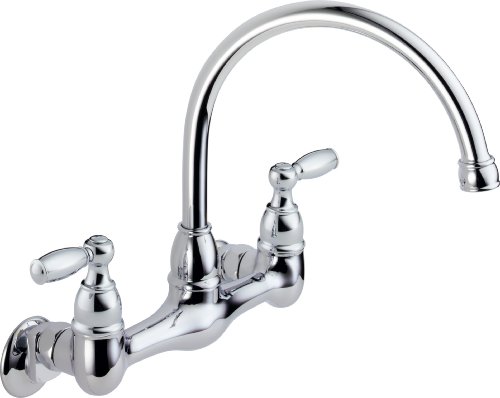
Peerless 2-Handle Wall Mount Kitchen Faucet — Big-Brand Wall Standard
Peerless, Delta’s sibling brand, sells this wall-mount model with the least ornament in the guide: a two-handle chrome faucet, model P299305LF, described in a single line. That brevity cuts both ways. The listing states almost nothing beyond format and finish, so flow and valve boxes below are honestly empty. What the name buys is the ecosystem behind it — cartridges, handles and documentation from a major plumbing group, stocked and searchable in a way no anonymous import can promise.
For an old house, that ecosystem is often the whole argument. Wall-mount faucets live long lives in laundries and farmhouse kitchens, and the day a washer or cartridge tires, the difference between a Peerless and an orphan import is the difference between a part number and a full replacement behind finished tile. Owners planning to keep a period sink in service for decades should weigh that heavily, because wall work punishes orphaned hardware more than any other faucet format.
Functionally this is the classic pattern: two handles metering separate supplies, a spout over the bowl, chrome asking only for a wipe. It will not rinse like a sprayer or swing like the commercial picks, and it does not pretend to. It is the conservative wall choice, bought for the name’s longevity and the format’s proven geometry.
- Format: two-handle wall-mount kitchen sink faucet
- Finish: chrome, per the listing
- Model: P299305LF, as titled
- Flow rate: not stated in the listing
- Valve type: not stated in the listing
Strengths
- Major-brand parts and documentation support for a long-lived format.
- Unadorned chrome design suits period sinks without visual argument.
- Simple two-handle mechanics are serviceable by any plumber.
Trade-offs
- The listing publishes almost no specifications to compare.
- No sprayer or extended spout features are claimed.
- Conservative styling offers nothing to a modernising kitchen.
Best for: period homes that value repairability above features.
Not suited for: buyers who shop by published specification.

Pfister Pfirst Wallmount Kitchen Faucet — Stated Flow, Polished Chrome
Pfister’s Pfirst wallmount does something its two sink rivals here decline to do: it prints a number. The listing states 1.5 gallons per minute in plain capitals, alongside its two-handle format and polished chrome finish. That single figure lets a buyer on a low-pressure supply, or in a water-conscious district, judge the faucet against their circumstances instead of against their hopes, and it earns the Pfirst this guide’s documentation badge among the wall-mount sink faucets.
The Pfirst name will be familiar from our white and two-handle guides, where the same family trades on straightforward mechanics at honest prices. Here the format is the wall version of that philosophy: two handles, a spout over the bowl, polished chrome bright enough to lift a dim scullery. Polished is the dressiest of the chrome family, and in a utility setting it will show its splashes; the counterweight is that it also shows its cleanliness, which some households count as a feature in a room devoted to washing.
Beyond the flow figure the listing stays quiet, leaving valve and spout details unstated below. The purchase logic is therefore simple: if your wall is plumbed for this pattern and you want the one sink faucet in the family whose maker commits to a flow number, the Pfirst is the shortlist of one.
- Flow rate: 1.5 gallons per minute, stated in the listing
- Format: two-handle wallmount
- Finish: polished chrome, per the listing
- Valve type: not stated in the listing
- Spout details: not stated in the listing
Strengths
- Published flow figure supports low-pressure and water-saving decisions.
- Pfirst family reputation for plain, serviceable mechanics.
- Bright polished chrome lifts dark utility spaces.
Trade-offs
- Polished chrome shows splashes and prints in a working room.
- Remaining specifications are left to the product page.
- No sprayer is mentioned for rinsing wide basins.
Best for: buyers who want a documented flow from a mainstream maker.
Not suited for: anyone expecting sprayer convenience at a utility sink.

iVIGA Commercial Wall Mount Faucet with Pre-Rinse — Pre-Rinse Powerhouse
The iVIGA is the guide’s heavy artillery, a commercial wall-mount frame standing a stated 25 inches tall on 8-inch centres, carrying two ways to deliver water: a pull-down pre-rinse sprayer for blasting, and a separate 9.6-inch swing spout for filling. Restaurants separate those jobs because a sprayer that rinses brilliantly fills a stockpot slowly and splashily, while a spout that fills calmly cannot strip a sheet pan. This faucet refuses the compromise by including both.
Pre-rinse sprayers earn their drama honestly. The concentrated jet is built to shear food from trays before washing, and in a home that roasts, bakes and preserves at volume it changes washing-up from soaking to doing. The swing spout then handles the quiet work, arcing over the bowl for pots and kettles. At 25 inches of height the whole assembly needs a wall and a splashback that can take it, and a basin deep enough to contain the sprayer’s enthusiasm.
Fit is the gate this pick must pass. The centres must match your wall’s 8-inch plumbing, the height must clear any shelf or window above the sink, and the household must genuinely wash at commercial tempo to justify the hardware. Where those conditions hold, nothing else in this guide does what the iVIGA does; where they do not, it is a great deal of gleaming machinery aimed at a problem you do not have.
- Height: 25 inches, stated in the listing
- Centres: 8-inch wall-mount pattern
- Sprayer: pull-down pre-rinse sprayer, per the listing
- Second spout: 9.6-inch add-on swing spout, stated in the listing
- Flow rate: not stated in the listing
Strengths
- Separate sprayer and spout end the rinse-versus-fill compromise.
- Pre-rinse jet handles commercial volumes of baked-on washing up.
- Tall frame suits deep utility and catering-style sinks.
Trade-offs
- Twenty-five inches of height overwhelms small or low-ceilinged sink walls.
- Forceful spray demands a deep basin to avoid soaking the room.
- More joints and a hose mean more components to inspect over time.
Best for: serious home preserving, catering corners and deep commercial-style sinks.
Not suited for: compact kitchens or shallow basins.

GIMILI Pot Filler Matte Black — Pot Filler, Longest Reach
Crossing into the pot filler family, the rules change: this arm delivers cold water above your stove and nothing else. GIMILI’s version reaches a stated 26.6 inches on a double-jointed swing arm, wears matte black, carries two handles — one at the wall, one at the outlet, the pot filler’s classic safety pairing — and connects by an NPT thread, all per its listing. Folded, it sits flat against the splashback; extended, it reaches the back burners of a serious range.
The two-handle arrangement deserves explanation, because it is a safety system rather than a mixing control. The wall handle is the master shut-off, kept closed when the filler is idle; the outlet handle meters the fill. If the outlet valve ever weeps, the closed wall valve means the drip lands in a pan or stops entirely rather than running unnoticed onto a hob. Owners who adopt that discipline get the pot filler’s full benefit — no more hauling eight litres of water from sink to stove — with its risk properly managed.
Matte black above a stove lives a greasy life, and this finish will need a regular degreasing wipe to stay handsome. Reach figures also deserve a tape measure’s scepticism: 26.6 inches is the arm’s full extension, so confirm your stove’s depth and the stub-out’s position let that reach land over your largest pan’s centre, not its rim.
- Type: pot filler, cold water only — a separate class from sink faucets
- Reach: 26.6 inches at full extension, stated in the listing
- Arm: double-jointed swing arm with two handles
- Connection: NPT thread, per the listing
- Finish: matte black
Strengths
- Longest stated reach in this guide, serving deep ranges and back burners.
- Double-jointed arm folds flat against the splashback when idle.
- Two-valve layout gives a true master shut-off at the wall.
Trade-offs
- Cold water only, and no drain beneath: it fills pans, it washes nothing.
- Matte black above a hob needs frequent degreasing to look its best.
- Requires a correctly placed cold stub-out behind the stove.
Best for: keen cooks with big ranges who fill heavy pans daily.
Not suited for: anyone expecting it to serve as a sink faucet.

KES Pot Filler Faucet — Pot Filler, Documented Detail
KES publishes the kind of pot filler listing an engineer would approve: a 25.6-inch arm swinging a full 360 degrees, lead-free 304 stainless steel construction, a heat-resistant cartridge, a drip-free promise and a half-inch NPT thread on a single-hole wall mount, finished in matte black. The heat-resistant cartridge is the detail that shows the maker understands the address — a pot filler lives above burners, in rising steam and radiant heat that ordinary cartridges were never asked to endure.
Lead-free 304 stainless is equally well aimed. A pot filler’s water goes directly into cooking, often into the pan a family eats from that night, so the wetted material’s credentials matter here more than at a hand-washing sink. Stainless under the matte black coat also means the arm’s joints and threads are working in a corrosion-resistant metal in the steamiest corner of the kitchen.
At 25.6 inches the reach runs slightly shorter than the GIMILI’s, which will matter only on the deepest ranges; for standard cookers either arm lands comfortably over the back burners. The single-hole mount simplifies the wall work to one stub-out. As with its sibling, remember the family rule: this is a cold-water filling arm for the stove, a companion to a sink faucet and never a substitute for one.
- Type: pot filler, cold water only — a separate class from sink faucets
- Reach: 25.6 inches, stated in the listing, with 360-degree swing
- Construction: lead-free 304 stainless steel, stated in the listing
- Cartridge: heat-resistant, per the listing
- Connection: 1/2 NPT thread, single-hole mount
Strengths
- Heat-resistant cartridge suits the steam and heat above a stove.
- Lead-free stainless construction suits water destined for cooking.
- Single-hole mount keeps the wall work to one connection.
Trade-offs
- Slightly shorter reach than the GIMILI on very deep ranges.
- Cold-only service means pans still travel to the sink for washing.
- Matte black finish needs degreasing in its position over the hob.
Best for: cooks who want documented materials and heat-aware engineering over the stove.
Not suited for: kitchens without a stub-out position behind the range.
How Do the Six Wall-Mount Picks Compare Side by Side?
| Pick | Family | Key stated figure | Water service |
|---|---|---|---|
| BWE Wall Mount Kitchen Faucet | Sink faucet | 8-inch centres, swivel spout | Hot and cold mixing |
| Peerless 2-Handle Wall Mount Kitchen Faucet | Sink faucet | Model P299305LF | Hot and cold mixing |
| Pfister Pfirst Wallmount Kitchen Faucet | Sink faucet | 1.5 GPM flow | Hot and cold mixing |
| iVIGA Commercial Wall Mount Faucet with Pre-Rinse | Sink faucet | 25-inch height, 9.6-inch spout | Hot and cold, sprayer and spout |
| GIMILI Pot Filler Matte Black | Pot filler | 26.6-inch reach, NPT | Cold only, over the stove |
| KES Pot Filler Faucet | Pot filler | 25.6-inch reach, 1/2 NPT | Cold only, over the stove |
Read the family column first, because it decides what job the purchase does. Within the sink family, the Pfister owns documentation, the iVIGA owns capability and the BWE and Peerless own the classic pattern, one on geometry and one on brand support. Within the pot fillers, the GIMILI reaches further while the KES documents deeper, and both demand the same cold stub-out behind the stove.
Why Does Centre Spacing Decide Everything on a Wall?
A deck faucet’s holes live in a sink you can replace; a wall faucet’s supplies live in a wall you cannot, at least not cheaply. The distance between the hot and cold stub-outs — the centres — was set when the room was plumbed, and the faucet’s body must match it within a hair. Most wall sink faucets, including the BWE and the iVIGA here, follow the 8-inch standard, but older houses hide 4-inch, 6-inch and entirely personal spacings behind their tiles.
Measure before you shop, from the wall itself: expose the supplies if covers allow, measure centre to centre twice, and photograph the tape against the pipes. If your centres are non-standard, the honest options are an adjustable-centre model, replumbing while the wall is open for other work, or a deck faucet on a sink that accepts one. Forcing a body onto mismatched centres strains every joint it touches, and strained joints behind tile announce themselves as damp plaster months later.
How Do You Plumb a Pot Filler Stub-Out Behind a Stove?
A pot filler needs one thing from the wall: a cold-water stub-out at the right height, capped until the filler is fitted. The right height places the arm above your tallest pan’s rim with the arm level, which most installers judge by standing the pan on the back burner and measuring to its rim, then adding clearance for the outlet to swing over it. Too low and the arm fouls the pan; too high and the fill splashes from a height onto hot surfaces.
The stub-out’s thread must match the filler’s — both pot fillers here speak NPT, with the KES specifying a half-inch connection — and the pipe must be anchored solidly, because a swing arm is a lever that will work a loose stub-out back and forth thousands of times. This is work most households give to a plumber during a kitchen renovation, when the wall is already open. Retrofitting a stub-out into a finished tiled splashback is possible but should be priced honestly before the filler is ordered, since the wall work can cost more than the arm it feeds.
How Do Wall Faucets Suit Old Houses With No Deck Holes?
Generations of sinks were cast with no faucet holes at all, because the faucet was never meant to live on the sink. Belfast and butler’s sinks, stone troughs, galvanised laundry tubs and early farmhouse basins all expect their water to arrive from the wall, and fitting a deck faucet to them means drilling a material that was never meant to be drilled, or perching a modern body on a rim it does not fit. A wall faucet respects the object’s original logic, which is why restorers reach for this family before any other.
The practical dividend is a completely clear deck. On a stone or ceramic sink with a narrow back ledge, there is no room for a faucet base, a soap dish and a washing-up brush to coexist, and moving the faucet to the wall returns that ledge to the brushes and bottles that need it. Gardeners and flower arrangers discover a second dividend: a wall spout over a deep trough fills watering cans and stands buckets under it without the wrestling match a low deck faucet imposes.
What Is the Daily Discipline of a Pot Filler?
Pot fillers ask for one habit and repay it forever: close the wall valve when the filling is done. The outlet handle over the pan is the working control, but the wall handle is the guardian, and a filler left with only its outlet valve holding back the mains is a drip waiting for an empty house to notice it. Households that build the two-step ritual — wall on, outlet to fill, outlet off, wall off — treat the filler as the safest convenience in the kitchen, and the ritual takes four seconds once it is learned.
The second discipline is a monthly swing. An arm that sits folded for weeks can stiffen at its joints and weep at seals that never move, so swing it through its full travel and run a litre of water through it even in weeks when no big pan is filled. That same run refreshes the water standing in the arm, which matters for a cold line whose contents go into cooking. Small rituals, faithfully kept, are the entire operating manual of a pot filler, and both of this guide’s models reward them equally.
How Do You Choose Between Chrome Utility and Matte Black Over the Stove?
The sink family here wears chrome almost unanimously, and chrome earns the job: it wipes clean, tolerates the utility room’s chemical cupboard, and shows its dirt honestly so it gets cleaned. Over the stove, both pot fillers wear matte black, and the choice deserves a moment’s thought, because the air above a hob carries grease that settles on every surface within reach. Matte black hides water spotting beautifully and shows grease as a dulling film that a degreasing wipe removes; it is handsome in a modern kitchen and slightly theatrical in a period one.
Match the filler to the range rather than to the sink. A black filler over a black range reads as one appliance; the same filler over a cream enamel cooker becomes a deliberate modern accent that needs an ally — black handles, a black kettle — to look chosen. The KES and GIMILI share the finish, so this decision sits upstream of the brand decision, and it is best made standing at your own stove in evening light, which is when the kitchen’s metals tell their truths.
What Happens to Wall Plumbing in a Freeze?
Pipes inside an exterior wall live closer to winter than pipes under a sink, and a wall faucet on an outside wall deserves a freezing plan. The supplies should run through the wall’s warm side wherever the house allows, lagged where they cannot, and the household should know which interior valve isolates the wall faucet before the coldest month, not during it. A faucet that can be isolated and drained in five minutes is a faucet that survives a hard frost as an anecdote rather than a claim.
Pot fillers on exterior walls deserve the same respect, with the bonus that their discipline helps: a filler whose wall valve is closed and whose arm is drained holds very little water in harm’s way. In genuinely cold climates, ask the plumber who sets the stub-out about a frost-proof arrangement or an accessible isolation valve inside the warm envelope of the house. The conversation costs nothing in summer and everything in January.
How Do You Test a Wall Faucet’s Joints Before the Wall Closes?
Renovation offers one golden hour: the plumbing is roughed in, the faucet can be fitted, and the wall is still open. Use it ruthlessly. Run both handles at full pressure, swing every spout and arm through its travel, and inspect every joint with a dry hand and a torch while a helper watches the pressure side. A joint that weeps a teaspoon an hour under test would have become a stained ceiling by spring if the tiles had gone up that afternoon.
Leave the system pressurised while other work proceeds around it, and check again before the board or tile closes the wall. Photograph every run and joint with a tape measure in frame, because that photograph becomes the map for every future intervention, telling a plumber in ten years exactly where the supplies travel. Walls forget nothing, but they tell nothing either; your photographs are the only testimony the hidden work will ever give.
Why Do Laundries and Sculleries Keep the Wall Faucet Alive?
Because the work there is wet in a way kitchens only imitate. Laundry sinks swallow soaking buckets, dye baths, muddy boots and the overflow of a household’s dirtiest jobs, and a wall faucet keeps every one of those encounters away from the faucet’s own base and fixings. There is no deck for filthy water to pool on, no base gasket marinating in bleach, and the spout swings out of the way when a tub needs the whole basin. The format persists because the room’s demands never changed, even while kitchens chased fashion through five faucet styles.
Homeowners rediscovering the scullery — as utility rooms are renamed and revalued — inherit that logic intact. A BWE or a Peerless over a deep second sink handles the garden, the dog and the decorating weekends, while the kitchen’s prettier faucet keeps its dignity. Two sinks with two faucet philosophies is not extravagance; it is the old house pattern reasserting itself, and this guide’s sink family exists to serve the working half of that pattern.
How Much Weight Can a Wall Faucet Put on Old Pipework?
A wall faucet hangs its whole self, plus the leverage of every spout swing, on two supply stubs. In a modern wall those stubs are anchored to framing and shrug the load off. In an old house the stubs may be elderly copper or even threaded iron, supported by habit and plaster, and a heavy commercial body like the iVIGA asks questions of them that a light Peerless does not. Before choosing the heavyweight pick for an old wall, have the visible pipework assessed; reinforcing a stub while the wall is open is trivial, and discovering its weakness after tiling is not.
The daily version of the same physics is gentler: never use a wall spout as a handle to steady yourself, and teach the household that the arm of a pot filler is a pipe, not a rail. These are strong fittings doing a static job, and they fail, when they fail, from being borrowed for dynamic ones. Respect the difference and a wall faucet’s mounting will outlast the kitchen around it, possibly by generations.
What Is It Like to Clean a Sink With Nothing on Its Deck?
Blissfully simple, and owners mention it more than any specification. A cloth travels the deck’s whole length in one stroke, with no base to detour around and no gasket line harbouring the grey crescent that deck faucets grow. The wall behind takes the splashes instead, which is why the splashback’s material matters, but a vertical wipeable surface is faster to clean than a horizontal cluttered one, and it dries by gravity rather than by attention.
The handles still ask for their weekly wipe, and the spout’s underside — invisible, rarely cleaned, directly over the washing up — deserves a monthly pass with a cloth that you then look at, as a reminder of why the habit exists. Beyond that, the wall format’s cleaning ledger is the shortest in this batch of guides, one more working virtue for rooms that were built to be hosed down in spirit if not in fact.
How Do You Decide Whether the Wall or the Deck Should Host Your Next Faucet?
Let the sink vote first. A sink with sound, well-placed deck holes and a household happy with its layout has no problem a wall faucet needs to solve. A sink with no holes, damaged holes, a cramped ledge or a stone body you refuse to drill casts the deciding ballot for the wall, provided the wall’s plumbing can be made to agree. Let the room vote second: utility spaces gain from the wall’s clearance, while a kitchen mid-renovation with closed walls and finished tile pays a heavy toll to open them for a fashion.
Finally, let the future vote. Wall plumbing commits a room’s geometry for decades, which suits houses being restored for the long term and suits short-tenancy refreshes poorly. The six picks in this guide split that commitment honestly — four that serve the sink from the wall, two that serve the stove — and the right choice is the one whose commitment your household actually intends to keep.
How Does a Wall Faucet Change the Way You Use the Sink at Night?
Small mercies accumulate in the dark. With no faucet body rising from the deck, a sleepy cook can set a pan down anywhere along the sink’s back edge without a collision, and the spout parked flat against the wall leaves the whole basin open for the soaking roasting tin that appears after every good dinner party. The handles, sitting proud of the wall at a familiar height, are findable by touch in a way deck handles behind a deep sink are not.
There is also the matter of noise. Wall bodies transmit a whisper of their water’s travel into the wall itself, and in a house with stud partitions that whisper can be heard in the next room when the house is silent. It is rarely a problem and never a defect, but light sleepers in adjoining rooms sometimes prefer the wall faucet’s supplies fitted with quieter, modern pipework during a renovation, when the choice is still cheap to make.
What Questions Should You Ask Before a Plumber Quotes the Wall Work?
Ask what the wall is made of, because the answer prices the job: stud and board open and close cheaply, while solid masonry and finished tile charge for every centimetre. Ask where the supplies will be anchored and whether an access panel can be left, and ask which valve will isolate the new faucet from inside the warm part of the house. Ask, finally, what happens if the opened wall reveals centres or pipework different from the assumption, and get that contingency in the quote rather than in an apologetic phone call.
Bring the chosen faucet’s listing to that conversation, printed, with its centres, threads and dimensions visible. Plumbers quote accurately against documents and vaguely against descriptions, and the difference between those two quotes, multiplied by one surprise inside a wall, is where renovation budgets go to be renegotiated. The document habit that this guide applies to listings applies with interest to the trades who must honour them.
How Do You Keep a Pre-Rinse Sprayer Civilised at Home?
The iVIGA’s sprayer was born in rooms with floor drains, and a home basin is neither floored nor drained for its enthusiasm. Civilise it with aim and distance: keep the head low inside the bowl, angled at the work rather than across it, and let the bowl’s depth absorb the rebound. Short bursts clear more food than a sustained blast and throw a fraction of the water, a technique dish-pit professionals learn in their first week and home cooks can learn in their first wash.
Park the head properly when the work is done. A pre-rinse sprayer left dangling by its hose wears its hose at the crimp and drips its last mouthful onto whatever sits beneath, so the dock or hook is part of the tool, not an accessory. Households that build the docking habit keep both the hose and the worktop dry, and they get the sprayer’s full working life instead of half of it.
How Do Hotels and Rental Owners Use the Wall Format Differently?
Owners of rentals and small hotels read this category with a manager’s eye. A wall faucet’s clear deck speeds the cleaner’s turn between guests, its commercial patterns survive being used by strangers who owe it nothing, and a Peerless or BWE pattern can be serviced by any local plumber with parts that exist in the town, not just on a website. In a property where a broken faucet is a refunded night, that serviceability is the specification that outranks all others.
Pot fillers, by contrast, rarely survive a manager’s audit. They delight the right guest and baffle the rest, they depend on a discipline — closing the wall valve — that strangers cannot be asked to learn, and a stove-top arm in a rental is a leak with a booking calendar. This guide loves them for owner-occupied kitchens where the same hands cook every day, and the distinction is worth stating plainly so the right households buy them for the right reasons.
How Do You Read a Wall Faucet Listing Like a Plumber?
Plumbers read listings backwards, starting with the connection and ending with the colour. Centres first, because they cannot be negotiated. Thread standard second, because adapters exist but each one is a joint that can weep. Spout projection third, because a stream that misses the bowl is a defect no finish can excuse. Only then do they look at handles, finish and brand, in the comfortable knowledge that everything above those lines has already decided whether the faucet belongs in the room at all.
Adopt that order for the six listings in this guide and their differences reorganise themselves. The Pfister’s flow figure and the KES’s thread and cartridge details rise in value, because they answer a plumber’s questions in a plumber’s order. The Peerless’s silence stops looking like modesty and starts looking like a request to do your homework on the product page, which, for a faucet that may serve for thirty years, is homework worth doing properly.
What Is the Case for Keeping a Deck Faucet and Adding Only a Pot Filler?
Many readers arrive here wanting the wall look without the wall commitment, and the pot filler family offers exactly that compromise. A deck faucet continues to serve the sink with all its plumbing accessible from the cabinet, while a single cold stub-out behind the stove adds the one wall feature whose benefit — filling pans in place — cannot be replicated at the deck. The renovation stays surgical: one small penetration, one new run of pipe, and a kitchen transformed at the two points where water is actually used.
That hybrid is how most real kitchens adopt this guide, and it reframes the pot filler picks as the lowest-risk entry into wall plumbing. Choose between the GIMILI’s reach and the KES’s documented internals, keep the wall-valve discipline, and the stove gains a tool your back will thank every time a full stockpot stays exactly where it was filled.
How Do You Live With the Decision While the Wall Is Open?
There is a particular anxiety in the hour before a wall closes over new plumbing, and experienced renovators treat it as a checklist rather than a feeling. Everything pressurised, everything photographed, every joint touched dry, the isolation valve located and labelled, the access panel framed if one was planned. Run the list out loud with whoever is closing the wall, because a spoken check catches the item that silent confidence skips, and the cost of reopening is measured in tiles rather than minutes.
Then let it close, with the photographs filed and the isolation valve labelled. A wall faucet installation that has passed its tests has earned your trust, and the format’s whole appeal is that it then disappears into the architecture, asking for nothing but the ordinary courtesies of aerators and cartridges for years at a time.
What Should You Know About Splashback and Reach Before Drilling?
A wall faucet’s spout must land its stream inside the bowl, and that geometry is fixed by two distances: how far the spout projects from the wall, and how far the sink’s centre sits from it. Utility sinks mounted tight to the wall forgive almost anything, while a deep farmhouse sink pulled forward on its cabinet can leave a short spout dribbling onto its back rim. Lay the distances out with a tape and a jug of water before ordering: mark where the stream would fall and check it against the bowl you actually own.
Splashback material matters as well. A wall faucet throws its occasional drips and its handle splashes at the wall rather than the deck, so the surface behind the sink needs to be waterproof and wipeable for its whole height — tile, stone, glass or sealed metal. Painted plaster behind a wall-mount utility faucet lives a short, stained life, and planning the splashback is part of planning the faucet, not an afterthought for the decorator.
How Do You Maintain Plumbing You Cannot See?
Wall faucets hide their connections, so maintenance becomes a discipline of watching for evidence. A faint tide mark on the wall below a handle, paint that bubbles near the splashback’s edge, a musty note when the under-sink cabinet opens — these are the early dispatches from a weeping joint, and they reward a household that looks monthly and acts early. The faucet side of the system stays conventional: aerators unscrew for descaling, cartridges and washers tire on the usual schedule, and handles loosen at their screws like any other.
Access panels are the grown-up solution where a renovation allows one. A discreet panel on the wall’s other side, or within a neighbouring cabinet, turns a future leak from a tile-breaking excavation into a ten-minute inspection. If your kitchen is being rebuilt around a wall faucet, ask the builder for that panel while the framing is open; it is the cheapest insurance in the entire project and the one nobody regrets buying.
What Mistakes Do Wall-Mount Buyers Keep Making?
The family’s founding mistake is buying a pot filler to do a sink faucet’s job, then discovering at installation that it delivers only cold water over a stove with no drain beneath. This guide separates the families precisely so that mistake happens on the page rather than in the kitchen. The second mistake is assuming the wall’s centres from the sink’s age; walls keep secrets, and only a tape measure tells the truth.
Buyers also underestimate height and splash. A 25-inch commercial frame under a wall cabinet is a collision drawn in advance, and a pre-rinse jet over a shallow basin redecorates the room at every wash. Finally, there is the quiet mistake of sealing a wall faucet’s escutcheons so enthusiastically that future servicing requires destroying the finish around them — snug and sealed is right, entombed is not.
Final Recommendation
For a working utility or farmhouse sink, the BWE Wall Mount Kitchen Faucet covers the standard pattern with commercial plainness, while buyers who read numbers should take the Pfister Pfirst Wallmount Kitchen Faucet and its published flow, and households washing at volume should step up to the iVIGA Commercial Wall Mount Faucet with Pre-Rinse. Over the stove, the KES documents its materials best and the GIMILI reaches furthest; choose between them by your range’s depth. The Peerless remains the repairability pick for period homes.
Measure the wall twice, name the family you are buying from once, and a wall-mounted faucet will serve for decades in the place where plumbing and architecture meet. Keep the photographs of the hidden work with the house’s papers, and the next owner will inherit not just a faucet but the knowledge of how it lives inside the wall, which is the rarest thing any renovation can leave behind.
Frequently Asked Questions
Can a pot filler replace my kitchen sink faucet?
No. A pot filler delivers cold water only, above a stove with no drain beneath it. It is a companion that fills pans where they cook. Washing, rinsing and hot water still belong to a sink faucet, which is why this guide treats the families separately.
What if my wall’s centres are not 8 inches?
Then a fixed 8-inch body will not fit without strain. Options are an adjustable-centre model, replumbing while the wall is open, or moving the faucet to the deck if the sink allows. Measure the actual stub-outs before ordering anything.
Do wall-mount faucets drip onto the wall?
A sound installation does not. Drips at the escutcheons usually mean a joint behind the cover needs attention, and a tide mark on the wall is the signal to investigate early, before moisture reaches plaster or timber.
Is a pre-rinse sprayer too powerful for a home sink?
It is powerful by design, and it needs a deep basin to contain it. In a deep utility or catering-style sink it transforms washing up; over a shallow domestic bowl it will splash. Match the iVIGA’s enthusiasm to a sink built for it.
How high should a pot filler be mounted?
High enough for the arm to swing level over your tallest pan standing on the back burner, with clearance to spare. Measure with the pan in place before the stub-out is set, because an inch too low cannot be argued with afterwards.
Can I install a wall-mount faucet myself?
Swapping a like-for-like body onto sound existing stub-outs is within a confident homeowner’s ability. Creating new in-wall plumbing, especially a pot filler stub-out behind a stove, is plumber’s work in most homes and often regulated work as well.
Are wall-mount faucets harder to clean than deck models?
The faucet itself is no harder, and the sink becomes easier, because the deck is empty and wipes in a single pass. The wall behind takes the splashes a deck would have caught, so the splashback needs to be a properly waterproof, wipeable surface for the arrangement to feel effortless every single day of the year.
Related Guides
Wall mounting is one branch of the traditional faucet family tree, and these guides cover its relatives: Best Traditional Kitchen Faucets for period styling on the deck, Best Wooden Bath Mats for the washroom end of a utility-minded house, and Best Air Purifiers for Construction Dust for clearing the air after the renovation that wall plumbing usually involves.


