What's inside
- Key Takeaways
- Quick Picks
- How Did We Separate a True Outdoor Faucet From Outdoor-Suitable Ones?
- How Do the Six Outdoor Picks Compare Side by Side?
- How Do You Winterise an Outdoor Faucet So It Survives the Freeze?
- What Plumbing Does an Outdoor Sink Actually Need?
- Why Does Salt Air Change the Alloy Conversation?
- How Do You Clean an Outdoor Faucet That Lives in the Weather?
- What Jobs Does an Outdoor Sink Actually Do All Summer?
- How Do You Site an Outdoor Sink So It Earns Its Keep?
- What Should Boaters and Camper Owners Take From This Guide?
- How Do You Keep an Outdoor Sprayer Hose From Ruining Its Winter?
- What Is the Case for a Trough and a Wall Tap Over a Styled Outdoor Kitchen?
- How Does Sunlight Age an Outdoor Faucet Differently From Rain?
- How Do You Test an Outdoor Installation Before the First Party?
- What Should a Coastal Buyer Check That an Inland Buyer Can Skip?
- How Do You Share an Outdoor Sink With Wildlife Gracefully?
- How Does an Outdoor Faucet Change Winter Gardening and Spring Cleanup?
- What Is the Environmental Etiquette of an Outdoor Sink?
- How Do You Decide Between Wall and Deck at an Outdoor Sink?
- What Should You Photograph Before You Bury an Outdoor Line?
- How Do You Hand an Outdoor Sink Over to a Housesitter or a Buyer?
- What Mistakes Do Outdoor Faucet Buyers Keep Making?
- Final Recommendation
- Frequently Asked Questions
- Related Guides
As an Amazon Associate I earn from qualifying purchases. This post may contain affiliate links at no extra cost to you.
cottageverdict.com is reader-supported. When you buy through links on our site, we may earn an affiliate commission.
Where to buy: Each pick below links to its Amazon listing, where you can check price on Amazon and confirm whether the faucet offers hot and cold or cold only. That single fact divides this entire guide, and the listings state it plainly if you read them before the photographs persuade you.
The best outdoor kitchen faucets begin with an honest admission that this guide will repeat until it sticks: only one pick here, the Kraus Oletto in marine-grade T-316 stainless steel, is designed from the alloy up as an outdoor kitchen faucet. The other five are stainless utility faucets that serve cold water only, and they earn their places because a great many outdoor sinks — at a barbecue station, a potting bench, a poolside bar — genuinely need nothing more than a well-made cold tap. Calling them outdoor faucets without that qualification would be a lie of omission, so this guide makes the qualification its headline instead.
Outdoor plumbing also plays by colder rules than indoor plumbing. Water left standing in an exposed line can freeze, finishes face ultraviolet and rain rather than steam and soap, and a faucet that cannot be drained or isolated lives one hard winter from a burst. The reviews and the how-to sections below keep returning to those realities, because outdoors, installation decisions matter as much as the metal you buy.
Key Takeaways
- Only the Kraus Oletto, in marine-grade T-316 stainless steel, is a true outdoor kitchen faucet with a pull-down sprayer and full hot-and-cold duty.
- The other five picks are cold-water-only stainless utility faucets, well suited to outdoor sinks that never had a hot supply.
- Cold-only service is a feature when the sink’s jobs are rinsing, filling and washing down, and a fatal flaw when you expect to wash greasy pans in hot water.
- Freeze protection is part of the purchase: plan isolation and drainage for any line that runs outside the house’s warm envelope.
- One pick is a two-handle wall-mount in no-lead SUS304 stainless, the closest rival to the Kraus for a plumbed outdoor kitchen.
Quick Picks
| Pick | Badge | Why it earns a place |
|---|---|---|
| KRAUS Oletto Outdoor Kitchen Faucet T-316 | The True Outdoor Faucet | Marine-grade T-316 solid stainless steel, a pull-down sprayer and pre-attached lines: the genuine article. |
| Cold Water Wall Mount Stainless Steel Faucet | Wall-Mount Cold Utility | A high-arc wall-mounted cold tap in stainless with a chrome finish, aimed at garden, boat and camper sinks. |
| iVIGA Cold Water Outdoor Sink Faucet | Deck-Mount Cold Utility | A single-hole deck-mount cold faucet in brass, listed for outdoor sinks from bars to farmhouses. |
| Brushed Nickel Cold Water Only Faucet SUS304 | SUS304 Simplicity | A single-hole cold faucet in named SUS304 stainless with a brushed nickel surface for kitchen or outdoors. |
| Cold Water Faucet Only High Arc | High Arc, Hose Included | A high-arc cold faucet sold with its water supply hose, aimed at kitchen, bar and outdoor use. |
| FORIOUS Chrome Wall Mount Kitchen Faucet | Two-Handle Wall Utility | An adjustable 8-inch-centre wall faucet in no-lead SUS304 with a 12-inch swivel spout for utility and outdoor sinks. |
How Did We Separate a True Outdoor Faucet From Outdoor-Suitable Ones?
By the alloy and the intent. A faucet designed for outdoors starts with a metal chosen for weather and salt air, and T-316 marine-grade stainless is the benchmark alloy for exactly that exposure, which is why the Kraus stands alone at the top of this guide. The other five picks make no marine claim in their listings; they are stainless utility faucets whose cold-only service and simple mechanics happen to suit the many outdoor sinks that were never plumbed for hot water. Both groups are reviewed on their own stated terms, and neither is allowed to borrow the other’s credentials.
We also graded honesty about water service. Every listing here that is cold-only says so in its title, which is to the makers’ credit, and this guide preserves that clarity in every spec box. A buyer who finishes this page knowing precisely which faucets will run a hot wash outdoors — one — has been served better than a buyer misled into thinking all six would.

KRAUS Oletto Outdoor Kitchen Faucet T-316 — The True Outdoor Faucet
The Oletto is what an outdoor kitchen faucet looks like when a major maker designs one deliberately. The listing states marine-grade T-316 solid stainless steel — the alloy boats specify because its molybdenum content resists the pitting that salt air and coastal weather inflict on lesser stainless — shaped into a modern faucet with a pull-down sprayer, and sold with pre-attached water lines and hardware in the box. Hot and cold service, a working sprayer, weather-grade metal: this is the complete specification the rest of the guide is measured against.
Pre-attached lines deserve their sentence, because outdoor installations often happen at the end of a garden, far from the house’s tool cupboard, and every fitting included is a trip not taken. The pull-down sprayer transforms the outdoor sink’s usefulness, rinsing grills, trays and muddy produce with the same ease as the indoor sink, and in T-316 the sprayer’s body shares the faucet’s weather resistance rather than being its weakest point.
The honest costs are commitment and plumbing. This faucet deserves, and requires, a proper outdoor kitchen: hot and cold supplies run to the sink, drainage that goes somewhere legal, and a winterisation plan for the lines. Households with that infrastructure should buy the Oletto and stop reading. Households without it should keep reading, because the cold-only picks below solve the simpler outdoor sink at a simpler level, and pretending otherwise wastes money in both directions.
- Construction: marine-grade T-316 solid stainless steel, stated in the listing
- Spray: pull-down sprayer, per the listing
- Included: pre-attached water lines and hardware, per the listing
- Water service: full kitchen faucet service, hot and cold
- Flow rate: not stated in the listing
Strengths
- The only pick engineered from the alloy up for outdoor exposure.
- Pull-down sprayer gives the outdoor sink indoor-grade usefulness.
- Pre-attached lines and hardware simplify a remote installation.
Trade-offs
- Requires hot and cold supplies and drainage to justify its capability.
- Exposed lines still need a freeze plan in cold climates.
- Over-specified for a sink that only ever rinses and fills.
Best for: plumbed outdoor kitchens, especially in coastal or high-weather districts.
Not suited for: a lone cold line at a potting bench.

Cold Water Wall Mount Stainless Steel Faucet — Wall-Mount Cold Utility
This wall-mount pick states its terms in its title: cold water, single handle, one hole, wall mounted, stainless steel, high arc, with a chrome finish, and a list of homes that runs from kitchen and garden to outdoor, boat and camper. Read that list as a clue to the design’s virtues — compact, simple, corrosion-resistant enough for damp places, and indifferent to being splashed — rather than as a promise that one faucet is ideal for all of them.
Wall mounting suits outdoor sinks particularly well, because it keeps the faucet off a wet deck and lets a simple outdoor basin, even a trough, serve without drillings. The high arc fills buckets and watering cans, the single handle meters cold with one hand, and the stainless construction under the chrome finish shrugs at the damp that destroys lesser metals in a garden setting. For a sink plumbed with a single cold line — the commonest outdoor arrangement there is — this is the natural shape of the answer.
What it will not do is wash a greasy grill pan in hot water, because no hot water exists at its wall. It also carries a chrome finish into the weather, which will need the occasional wipe to keep its brightness in rain and sun. Judge it as a cold utility tap of good materials and honest scope, and it is a strong one; judge it as an outdoor kitchen faucet and the Kraus has already won that argument.
- Water service: cold water only, stated in the listing
- Mounting: wall mount, one hole, single handle
- Construction: stainless steel with chrome finish, per the listing
- Arc: high arc bar-faucet form
- Flow rate: not stated in the listing
Strengths
- Wall mounting suits hole-less outdoor basins and troughs.
- Stainless build tolerates damp, splashy settings.
- High arc fills the buckets and cans outdoor sinks live on.
Trade-offs
- Cold only: no hot washing at this sink, ever.
- Chrome finish needs wiping to stay bright outdoors.
- Single-hole wall fitting must match the existing stub-out.
Best for: garden and utility sinks fed by a single cold line.
Not suited for: outdoor kitchens expecting hot water at the sink.

iVIGA Cold Water Outdoor Sink Faucet — Deck-Mount Cold Utility
iVIGA’s entry is the deck-mounted counterpart to the wall pick above: a single-hole, cold-only faucet whose listing names brass as its material and chrome as its finish, and lists its habitats as commercial, bar, RV, kitchen, farmhouse and laundry alongside the outdoor sink. A brass body under chrome is the classic utility recipe — brass machines well, resists corrosion and has carried cold water in outbuildings for a century — and the deck mount suits the outdoor sinks that arrive with a hole already drilled.
The single-hole format keeps the installation to one penetration and one supply, which is the correct scale of plumbing for a sink whose jobs are filling, rinsing and washing down. In an outdoor bar or a greenhouse sink, that simplicity is the feature: fewer joints to winterise, fewer parts to weather, and a lever any guest or gardener understands on first touch. The chrome surface will out-shine the setting and ask for the occasional wipe in return.
As with every cold-only pick here, the boundary must be respected: this faucet serves a cold line, and no adapter turns it into a hot-and-cold kitchen faucet. Its listing’s breadth of settings should be read as versatility of placement, not of function. Within its function — one cold supply, honestly served — it is a tidy, well-aimed piece of hardware.
- Water service: cold water only, stated in the listing
- Mounting: single-hole deck mount
- Construction: brass, per the listing, with chrome finish
- Settings named: outdoor sink, bar, RV, farmhouse, laundry and commercial use
- Flow rate: not stated in the listing
Strengths
- Single-hole deck fit suits pre-drilled outdoor sinks and bar sinks.
- Brass body is the proven material for cold utility service.
- Minimal joints make winterising and maintenance simple.
Trade-offs
- Cold only, with no path to hot service at this sink.
- Chrome finish is bright for rustic settings and needs wiping.
- Smaller brand support compared with the Kraus at the top.
Best for: outdoor bars, greenhouse and utility sinks with a deck hole.
Not suited for: any sink expected to deliver hot water.
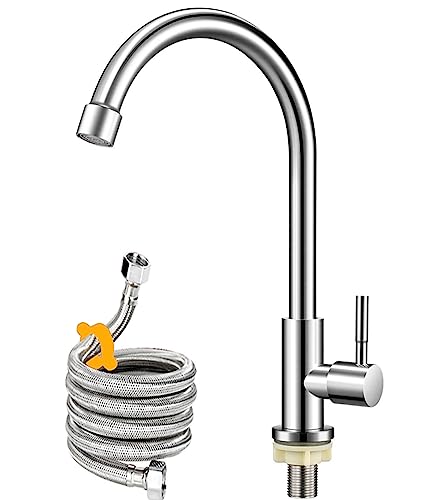
Brushed Nickel Cold Water Only Faucet SUS304 — SUS304 Simplicity
This pick’s listing is a model of economy: a brushed nickel, cold-water-only faucet in SUS304 stainless steel, single handle, single hole, for kitchen and outdoor use. The named steel grade is the substance to hold onto. SUS304 is the workhorse stainless of the food industry, and in a cold utility faucet it promises a body that will not rust in a damp outbuilding or under an open sky, with a brushed nickel surface that hides the water spots a garden tap collects daily.
Brushed finishes are the pragmatist’s choice outdoors. Rain spots, pollen dust and the faint film of a summer’s use all disappear into a brushed texture in a way they never do on chrome, so the faucet looks maintained even when it is merely used. The single-hole, single-handle format keeps the whole proposition at the scale an outdoor cold sink deserves: one hole, one line, one lever, no ceremony.
Nothing in the listing claims marine-grade alloy, freeze resistance or hot service, and this review claims none of them for it. What it offers is the right common stainless, honestly labelled, in the simplest useful format. For the thousands of outdoor sinks that rinse tools, fill dog bowls and wash garden produce, that is not a compromise; it is the correct specification, arrived at without pretending to be the Kraus.
- Water service: cold water only, stated in the listing
- Construction: SUS304 stainless steel, stated in the listing
- Finish: brushed nickel, per the listing
- Format: single handle, single hole
- Flow rate: not stated in the listing
Strengths
- Named SUS304 grade gives the corrosion claim a checkable basis.
- Brushed surface hides the spotting outdoor taps collect.
- Simplest possible format to install and winterise.
Trade-offs
- Cold only, like every utility pick in this guide.
- Not a marine-grade alloy, so coastal buyers should note the difference.
- Listing is brief, leaving dimensions to the product page.
Best for: everyday outdoor cold sinks that value low upkeep.
Not suited for: salt-air installations wanting T-316 protection.

Cold Water Faucet Only High Arc — High Arc, Hose Included
The plainest listing in the guide belongs to a faucet with one quietly excellent idea: it includes its water supply hose. The title promises a cold-water-only faucet with a high arc, a single handle and one hole, for kitchen, bar and outdoor use, and then adds the hose to the box. Anyone who has installed a remote sink knows the hose is the part that strands a Saturday project, and its inclusion marks a maker who has thought about the whole job rather than the photograph.
The high arc is the other working virtue. Outdoor sinks fill tall things — buckets, cans, sprayers, the occasional paddling-pool toy — and an arc that clears them turns the sink from a rinsing station into a filling station. Single-handle cold control keeps the operation one-handed, useful when the other hand is holding whatever is being filled steady against the stream.
Materials and flow go unstated in the listing, and they are marked that way below; the buyer is trusting the format and the included hardware rather than a published alloy. That trust should be priced accordingly and checked against the product page. As a complete-in-one-box answer for a cold line at a simple outdoor sink, though, the proposition is coherent and unusually considerate.
- Water service: cold water only, stated in the listing
- Arc: high arc, per the listing
- Included: water supply hose, per the listing
- Format: single handle, one hole
- Construction material: not given in the listing
Strengths
- Included supply hose prevents the classic mid-installation parts run.
- High arc suits the tall vessels outdoor sinks constantly fill.
- One-handed cold control suits working, muddy-handed use.
Trade-offs
- Construction material is not published in the listing.
- Cold only, with the same boundary as its utility siblings.
- Unbranded support means parts questions end at the seller.
Best for: simple outdoor sinks where one box should finish the job.
Not suited for: buyers who need a named alloy before they buy.

FORIOUS Chrome Wall Mount Kitchen Faucet — Two-Handle Wall Utility
FORIOUS closes the guide with the most substantial of the utility picks: a chrome wall-mount faucet on an adjustable 8-inch centre with two handles, built from no-lead SUS304 stainless steel, carrying a 12-inch spout that swivels a full 360 degrees, and listed for utility, laundry, restaurant and outdoor service. Adjustable centres are the headline for real walls, whose stub-outs rarely sit at the textbook spacing, and a body that can adapt to them saves the replumbing that fixed-centre faucets demand.
Two handles on a wall utility faucet give separate hot and cold control where both supplies exist — which makes this pick the one utility model here that can serve a mixed supply, a meaningful step toward the Kraus’s territory for outdoor kitchens plumbed with both lines but built to a utility budget. The 12-inch swivel spout serves wide basins and troughs, parking against the wall when the whole sink is needed for something bulky and muddy.
No-lead SUS304 is a strong material claim for the class, stated plainly in the listing. What the FORIOUS does not claim is marine-grade alloy or outdoor-specific engineering, so coastal and freeze-prone buyers should apply the same winterising discipline as with any pick here. As a wall-mounted, two-handle utility faucet with published materials and adaptable geometry, it is the cold family’s most complete member — while remaining, honestly, a utility faucet rather than a designed outdoor kitchen piece.
- Construction: no-lead SUS304 stainless steel, stated in the listing
- Mounting: wall mount, adjustable 8-inch centre, two handles
- Spout: 12-inch spout with 360-degree swivel, stated in the listing
- Settings named: utility, laundry, restaurant and outdoor sinks
- Flow rate: not stated in the listing
Strengths
- Adjustable centres forgive real-world wall plumbing spacing.
- Two handles can meter hot and cold where both supplies exist.
- Long swivel spout serves troughs and wide utility basins.
Trade-offs
- Not marine-grade, so salt-air buyers should choose the Kraus.
- Chrome finish needs wiping to stay bright in the weather.
- Two-handle wall fitting needs both stub-outs sound and accessible.
Best for: plumbed outdoor and utility sinks needing adaptable wall geometry.
Not suited for: single cold stub-outs or coastal installations wanting T-316.
How Do the Six Outdoor Picks Compare Side by Side?
| Pick | Water service | Material claim | Mount |
|---|---|---|---|
| KRAUS Oletto Outdoor Kitchen Faucet T-316 | Hot and cold, with sprayer | Marine-grade T-316 stainless | Deck, lines pre-attached |
| Cold Water Wall Mount Stainless Steel Faucet | Cold only | Stainless steel, chrome finish | Wall, one hole |
| iVIGA Cold Water Outdoor Sink Faucet | Cold only | Brass, chrome finish | Deck, single hole |
| Brushed Nickel Cold Water Only Faucet SUS304 | Cold only | SUS304 stainless | Deck, single hole |
| Cold Water Faucet Only High Arc | Cold only | Not given in the listing | Deck, one hole, hose included |
| FORIOUS Chrome Wall Mount Kitchen Faucet | Two-handle mixing where plumbed | No-lead SUS304 stainless | Wall, adjustable 8-inch centre |
The water-service column is the whole guide in miniature. One faucet does everything an indoor faucet does, in an alloy chosen for weather. Four serve a single cold line with varying degrees of documentation, and one wall-mount stands between the camps, able to mix where the plumbing offers both supplies. Buy the column your plumbing and your cooking actually need, and every pick here is defensible; buy a colder column than your expectations and no finish will save the purchase.
How Do You Winterise an Outdoor Faucet So It Survives the Freeze?
Water expands as it freezes, and it does so inside the least forgiving spaces: the faucet body, the sprayer hose and any low point in the supply line. Winterising is therefore a drainage ritual, performed before the first hard frost rather than after the first burst. Shut the interior valve that isolates the outdoor line, open the outdoor faucet to let the line empty, and leave it open so any remaining water has somewhere to expand into. A pull-down sprayer like the Kraus’s should be drained with its head lowered, because its hose holds a cup of water in its loop all winter if you let it.
Where the design allows, an interior drain cap on the line lets you empty the run completely, and a frost-proof sillcock arrangement — where the actual valve seat sits inside the house’s warm envelope — removes most of the risk at the design stage. Cold-only utility faucets have one winter virtue: a single line is a single thing to drain, and their simple bodies tolerate the ritual without complaint. Whatever you install from this guide, write the winterising steps on a card and tape it inside the cabinet nearest the isolation valve; the person who needs it in November may not be the person who installed the faucet in June.
What Plumbing Does an Outdoor Sink Actually Need?
Supply is the easy half to imagine and drainage is the half that decides legality and smell. A cold line teed from the house supply, with an interior isolation valve, serves every pick in this guide. Hot service for the Kraus or the FORIOUS needs a hot line run the same way, which is why true outdoor kitchens are usually planned with the house’s renovation rather than added on a whim. Drainage must go to the household system or another approved route in most districts; a bucket under an open waste is a temporary courtesy, not a plumbing plan, and a soakaway for sink water is regulated in many places.
Plan the route before the faucet, because the route prices the project. A sink against the house wall borrows short runs and easy drainage; a sink at the garden’s far end is a small civil-engineering work of trenches, lagging and falls. Both are legitimate ambitions, but they belong to different budgets, and the faucet — even the magnificent Kraus — is the cheapest line item in either of them.
Why Does Salt Air Change the Alloy Conversation?
Stainless steel resists corrosion with a chromium oxide skin, and chloride — salt — is that skin’s natural enemy, worrying at it until pits form. The 304 grade in two picks here handles ordinary weather and freshwater splash honourably, but in salt air its pits arrive years sooner. T-316 answers with molybdenum in the alloy, which stabilises the skin against chloride attack, and that is why boats, piers and coastal architecture specify it. The Kraus’s premium is, in large part, that single element’s rent.
Distance matters more than drama. A house a street from the sea, with salt on every window, lives in the T-316 world. A house ten miles inland, whose outdoor sink meets rain and hose water, lives comfortably in the 304 world, and the utility picks will serve it for years without a pit worth naming. Judge your own air honestly — if the car and the garden gate show salt, believe them — and let geography, not anxiety, choose the alloy.
How Do You Clean an Outdoor Faucet That Lives in the Weather?
Outdoor faucets collect a different dirt: pollen films in spring, dust and insect evidence in summer, leaf tannins in autumn. The cleaning stays gentle — warm soapy water, a soft cloth, a rinse from the faucet itself — because the finishes here are the same families as indoors and resent the same abrasives. Brushed nickel hides the most between cleans; chrome asks for the most frequent wipe to keep its dignity; the T-316 Kraus can be washed down as casually as the sink it serves.
Two outdoor specifics deserve habits. Keep the aerator’s soak in the calendar, because outdoor lines stir sediment after every winterising and refill, and that sediment lands in the mesh. And check the base and wall seals each spring, since a winter of freeze and thaw worries at sealant, and a failed seal outdoors admits water to wall timbers rather than to a wipeable cabinet floor. Ten minutes each spring is the whole maintenance budget of a well-chosen outdoor faucet.
What Jobs Does an Outdoor Sink Actually Do All Summer?
Watch a real outdoor sink for a season and its job description writes itself. It rinses garden produce before it crosses the threshold, fills watering cans and paddling pools, washes hands that are muddy, fishy or covered in barbecue marinade, hoses down grill grates and cool boxes, and gives dogs, boots and bicycles their first rinse before the house allows them further. Almost every one of those jobs is cold work, which is why the cold-only family in this guide is not a consolation prize but an accurate map of outdoor demand.
The hot jobs cluster at the serious end: degreasing grill parts, washing up after cooking for a crowd outdoors, and the outdoor kitchen that functions as a second full kitchen all summer. Those households know who they are, and for them the Kraus exists. The honest self-assessment is simply a count — how many times last summer did you carry a greasy pan indoors to hot water? If the answer is twice, cold-only serves you. If it is twenty times, plumb hot and buy accordingly.
How Do You Site an Outdoor Sink So It Earns Its Keep?
Convenience is measured in steps. An outdoor sink placed between the garden and the back door intercepts mud before it enters the house; one placed beside the grill serves the cook; one at the far fence serves nobody after the first month, because every use costs a walk. Water and drainage conspire in the same direction, since both run cheapest near the house, so the glamorous far-garden sink is usually the wrong sink twice over — dearest to plumb and least used once plumbed.
Shade deserves a vote too. A sink in full afternoon sun heats its standing water, fades its surroundings and makes midday washing up a squinting chore, while a sink under a pergola or an eave stays pleasant and kinder to its own finishes. If the only available wall bakes all day, the brushed and stainless picks here will tolerate it best, and a simple shade sail will repay itself in comfort within a single season.
What Should Boaters and Camper Owners Take From This Guide?
Two listings here name boats and campers among their habitats, and the marine logic transfers with one correction. A boat is a salt environment by definition, so the alloy conversation stops being optional: ordinary stainless pits in a marina, and the T-316 argument that the Kraus makes for coastal houses applies with interest to anything that floats. Space argues the other way, toward the compact wall-mount and single-hole formats, whose small footprints suit galleys where every centimetre is already employed.
Campers and RVs add vibration to the specification, working joints loose over road miles in a way no house ever will. Simple mechanics, few joints and a faucet whose parts can be checked by hand earn their place there, and the cold-only utility family — built for exactly that simplicity — travels better than any flagship. Whichever setting, the rule from the top of this guide survives the journey: buy the water service the plumbing actually offers, and let the alloy match the air it will breathe.
How Do You Keep an Outdoor Sprayer Hose From Ruining Its Winter?
The Kraus’s pull-down hose is its hardest-working luxury and its most freeze-vulnerable part, because a hose loop holds water in a curve that gravity alone will not empty. The winter ritual for it is specific: with the supply isolated, draw the sprayer out, lower the head below the faucet’s level, and let the loop drain through the open head, then leave the head somewhere it can drip dry rather than sealing the last water inside. A hose that enters winter dry enters spring flexible; one that freezes full can split its braid invisibly and announce the damage as a fine mist the first time June pressurises it.
During the season, the hose asks for the same courtesy as indoors — a clear space to loop in and no sharp masonry edge to saw against as it travels. Outdoor cabinets and sink pedestals are rougher environments than kitchen cupboards, so route the loop deliberately at installation, with its swing kept off stone edges and the fixings of the sink itself. Five minutes of routing buys the hose its full life.
What Is the Case for a Trough and a Wall Tap Over a Styled Outdoor Kitchen?
Not every garden needs a second kitchen, and the trough pattern — a deep utility basin, a wall-mounted cold tap, a drain that behaves — serves the majority of outdoor lives at a fraction of the commitment. It asks for one cold line and one waste, it can be winterised in minutes, and it never pretends the garden is a restaurant. The wall-mount picks in this guide exist for that pattern, and their plainness is the point: they are infrastructure, not furniture, and infrastructure that works disappears into the season.
The styled outdoor kitchen is a different promise, and it should be made with open eyes: hot and cold supplies, real drainage, weather-grade everything, and a winter ritual performed faithfully every year. Households that make that promise get the Kraus and a genuine second kitchen. Households that only need the trough get their summers back without the plumbing bill. Both are right answers; the only wrong one is paying for the kitchen and using the trough.
How Does Sunlight Age an Outdoor Faucet Differently From Rain?
Rain is the honest adversary — it wets, it dries, it tests seals — but ultraviolet is the patient one. Sunlight degrades the polymer parts every faucet hides: hose braids’ outer sleeves, handle inserts, sprayer gaskets and any plastic beneath the metal skin. A faucet in full southern sun can have a sound stainless body over tired internals in five years, while its shaded twin stays supple. Siting and shade therefore belong in the durability calculation alongside alloy, and where sun cannot be avoided, the simpler faucets in this guide carry fewer vulnerable parts to age.
Finishes read sunlight differently too. Chrome mirrors it back and can glare at a seated cook; brushed surfaces diffuse it; matte and dark finishes absorb it and run warm to the touch at midday, a small surprise for the first hand of the afternoon. None of these is a defect, but all of them are knowable in advance, and a buyer who pictures the faucet at two in the afternoon as well as in the listing’s soft light will not be surprised by any of them.
How Do You Test an Outdoor Installation Before the First Party?
Commission an outdoor sink the way you would a boat: under load, looking for trouble. Run the faucet at full flow while the drainage carries a bucket’s worth at speed, and watch whether the waste keeps up or begins to sulk. Work every joint with a dry hand after ten minutes of running, because outdoor joints hide behind pedestals and wall boxes where a slow weep can soak timber for a season before it shows. Fill the tallest vessel the sink will serve and confirm the arc clears it with the vessel sitting where it will actually sit.
Then rehearse the winter in miniature: find the isolation valve with your eyes closed, open the drain point, and time the whole ritual. If it takes more than a few minutes in July’s patience, it will not happen in November’s, and the design — not the household — should be adjusted while the installer still answers the phone. An outdoor water system that cannot be winterised by its actual owners is a burst waiting for its winter, whatever its alloy.
What Should a Coastal Buyer Check That an Inland Buyer Can Skip?
Salt reaches further than the view of the sea. It rides the wind streets inland, settles on every surface and concentrates wherever water evaporates, which is to say, precisely at a faucet’s joints and aerator. The coastal checklist therefore starts with alloy — T-316 for anything permanent — and continues to fixings: screws, brackets and hose fittings in lesser metals will stain and seize long before a good body shows wear, so the whole installation should be specified to the same standard as the faucet it serves.
Rinsing becomes a coastal habit rather than a cleaning preference. A freshwater rinse of the faucet after storm weather, and a wipe when salt crust shows at the base, keeps chlorides from sitting in the crevices where pitting begins. It is the same discipline boat owners apply to deck hardware, scaled down to a sink, and it is the difference between a coastal faucet that ages gracefully and one that freckles by its second summer.
How Do You Share an Outdoor Sink With Wildlife Gracefully?
An outdoor water source is a public announcement to the neighbourhood’s birds, bees and occasional larger visitors. Design with them rather than against them: a faucet that drips will be found and used as a drinking fountain, which argues for fixing drips promptly rather than tolerating them as garden charm. Keep the basin rinsed of soap and food residue at the day’s end, both for hygiene and because a clean sink attracts less determined attention overnight.
Bees at a summer faucet are usually collecting water, not trouble, and a shallow dish with stones set a few steps away gives them a safer station and returns the faucet to the humans. It is a small, kind piece of garden diplomacy, and it works because it offers the wildlife a better version of what it came for. The outdoor sink belongs to the household, but it stands in shared territory, and the graceful installations acknowledge that in their details.
How Does an Outdoor Faucet Change Winter Gardening and Spring Cleanup?
The households that winterise well are rewarded in the muddy seasons, because an outdoor cold line that survives to March becomes the tool of the spring offensive: washing pots from the greenhouse, rinsing tools before they return to the shed, filling the first watering cans without tracking the garden through the kitchen. Gardeners consistently rank the outdoor tap among the highest-value plumbing in the house, ahead of appliances that cost ten times more, precisely because its work is spread across every month the ground is open.
That value argues for treating the faucet as infrastructure in the budget as well as in the ground. A sound stainless utility pick, an isolation valve that works, a drain point that exists — these unglamorous line items are what convert a summer novelty into a four-season tool. The Kraus earns its place at the top of this guide for kitchens, but the gardener’s version of wisdom is simpler: any pick here, correctly plumbed and faithfully drained, will be thanked out loud every spring.
What Is the Environmental Etiquette of an Outdoor Sink?
Outdoor sinks tempt their owners to rinse things the drain should never meet: paint, solvents, garden chemicals, the washings of a dozen projects that belong at a hazardous-waste shelf rather than in a watercourse. The etiquette is simple and absolute — if you would not pour it down the kitchen sink, do not pour it down the garden one, and if the outdoor waste runs anywhere other than the household drainage, pour nothing down it but water and the mildest soap. The faucet’s convenience does not change the chemistry of what leaves through it.
Water use carries its own courtesy in dry seasons. A cold line at the garden’s heart makes long rinses feel free, and a sprayer left running while a grill is scraped can spend a bath’s worth of water on a single chore. The discipline is the indoor one, transplanted: water on for the work, off for the thinking. Outdoor abundance is a plumbing illusion, and the households that remember it keep both their bills and their consciences clear.
How Do You Decide Between Wall and Deck at an Outdoor Sink?
The wall keeps the deck clear and suits troughs and basins that were never drilled, while the deck keeps the plumbing accessible and suits sinks that arrive with a hole and a pedestal. Outdoors, accessibility argues louder than indoors, because every joint lives in the weather and will be inspected in the weather; a deck-mounted cold faucet can be unbolted, serviced on a bench and refitted in an hour, while its wall-mounted cousin asks the wall’s permission for every repair. Households planning to maintain the installation themselves should weigh that difference honestly.
The FORIOUS wall pick answers with adjustable centres and standard construction, narrowing the wall’s disadvantages, and the wall-mount cold pick answers with a single hole, narrowing them further. Still, the beginner’s outdoor sink — the first one a household installs — is usually happiest on the deck, where mistakes are visible and reversible, leaving the wall formats to renovations and confident second projects.
What Should You Photograph Before You Bury an Outdoor Line?
Outdoor plumbing disappears under soil, decking and gravel, and it takes its secrets with it. Before any trench closes, photograph the run with a tape in frame, note the depth, and mark the isolation valve’s location on the same record. In five years, when a spade or a fence post is planned for that ground, the photograph is the difference between a confident dig and a fountain. Keep the record with the house’s papers, where the winterising card from the how-to section also lives, and the outdoor water system becomes the best-documented plumbing on the property.
Add the faucet’s own paperwork to the same envelope: model, alloy, the listing’s exact words about its materials. Outdoor hardware outlasts its listings as reliably as indoor hardware does, and the gardener who can name the steel grade at a merchant’s counter in year nine gets the right washer the first time, every time.
How Do You Hand an Outdoor Sink Over to a Housesitter or a Buyer?
Outdoor water is the system guests and buyers understand least, so leave it documented rather than explained. The winterising card by the isolation valve, the photograph of the buried run, and one line in the house notes — which faucet, which alloy, cold only or hot and cold — convert a private arrangement into a transferable one. Housesitters in a frost week are the stress test: if the card lets a stranger protect the line in five minutes, the documentation has done the job the installation always needed.
Buyers, for their part, read a well-kept outdoor sink as evidence about the whole property, the same way they read a boiler’s service history. A T-316 faucet with its paperwork, or a humble cold tap with its drain point labelled, tells them the invisible systems of the house were run by someone careful, and that inference is worth more than the faucet ever cost.
What Mistakes Do Outdoor Faucet Buyers Keep Making?
The founding mistake is expectation: buying a cold-only utility faucet for an outdoor kitchen where greasy pans, hand-washing and winter salads will all demand hot water by October. This guide’s first three paragraphs exist to prevent it. The second mistake is forgetting the freeze, installing in the optimism of June a line that January will burst, because no isolation valve or drain point was planned while the trench was open.
Buyers also under-plan drainage, discovering that a sink without a legal waste route becomes a bucket with ambitions, and they over-trust the word outdoor in a title, which is why this guide grades alloy claims rather than adjectives. Finally, there is the coastal error: saving money on 304 a street from the sea, then watching pits bloom on a faucet that a T-316 would have kept clean for decades.
Final Recommendation
If your outdoor kitchen is plumbed like a kitchen, buy the KRAUS Oletto Outdoor Kitchen Faucet T-316 and be done: it is the only true outdoor faucet here, and its alloy, sprayer and included lines justify its place at the head of the guide. If your outdoor sink runs on a single cold line, as most do, the Brushed Nickel Cold Water Only Faucet SUS304 is the honest everyday answer, with the FORIOUS Chrome Wall Mount Kitchen Faucet as the step up for wall-mounted, two-supply installations. The remaining picks serve their niches — wall, deck and one-box simplicity — without pretending to be what they are not.
Outdoors, the weather always gets a vote, so choose the faucet whose promises were written for the sky it will actually live under. Write its winterising date in the diary before the first season turns, keep its paperwork with the house’s own records, and the sink at the garden door will repay that small ceremony with a full decade of unglamorous, indispensable, year-round service in all weathers and all seasons.
Frequently Asked Questions
Can I use a regular indoor faucet outdoors?
Physically it will fit, but its alloy and finish were chosen for steam and soap, not ultraviolet, rain and frost. In a sheltered porch it may serve for years; in open weather or salt air, a purpose-chosen stainless like the picks here will outlast it comfortably.
Why are most of these faucets cold only?
Because most outdoor sinks are plumbed with a single cold line, and their work — rinsing, filling, washing down — is cold work. The listings state the limitation plainly. Where hot water matters, the Kraus and, where both supplies exist, the two-handle FORIOUS are the guide’s answers.
What does marine-grade T-316 actually buy me?
Resistance to chloride pitting, the corrosion that salt air and coastal weather inflict on lesser stainless grades. Inland, the benefit is smaller and 304 serves well; near the sea, T-316 is the difference between a faucet that ages and one that pits.
How do I stop an outdoor faucet freezing?
Isolate the line at its interior valve before hard frost, open the outdoor faucet to drain the run, leave it open, and drain any sprayer hose loop. A frost-proof arrangement that seats the valve inside the warm wall is the design-stage solution.
Does an outdoor sink need drainage?
Yes, and in most districts it must reach the household drainage or another approved route. Plan the waste before the faucet, because drainage, not supply, is what usually prices and permits an outdoor sink project.
Will a brushed nickel faucet survive outside?
The SUS304 pick here is built for damp service and its brushed surface hides weather spotting well. It is not a marine alloy, so in direct salt air expect a shorter cosmetic life than the T-316 Kraus and plan accordingly.
Can I leave an outdoor faucet pressurised all winter in a mild climate?
Mild climates forgive, but a single exceptional frost is all a burst requires, and forecasts are promises made by strangers. If your district ever sees a hard freeze, the isolation-and-drain ritual is cheap insurance performed once a year. Where frost genuinely never reaches, keep the isolation valve exercised anyway, so the one winter it is needed does not find it seized.
Should an outdoor faucet have an aerator?
A simple aerator steadies the stream and saves water during long rinses, and it removes in seconds for the sediment flush that outdoor lines need after every refill. In filling stations where buckets are the whole job, some owners remove it permanently for maximum flow; either choice is respectable, provided it is a deliberate and considered choice rather than a lost part that nobody ever replaced or missed.
Whichever way you leave it, note the decision on the winterising card, so spring’s recommissioning starts from knowledge rather than from a puzzlingly weak or strong stream.
Related Guides
An outdoor sink usually belongs to a wider project, so these guides cover the neighbouring ground: Best Bath Mats That Will Not Get Mold for the indoor rooms that muddy boots reach next, Best Air Purifiers for Cat Litter Smell for keeping the house fresh when the garden party moves inside, and Best Air Purifiers for Dorm Rooms for the student annexe many outdoor projects quietly serve.



[…] faucets rarely arrive alone in a renovation, so continue with Best Outdoor Kitchen Faucets for the garden room’s tougher brief, Best Egyptian Cotton Bath Sheets for traditional luxury […]