What's inside
- Key Takeaways
- Quick Picks
- How Did We Choose These 120-Volt Dryers?
- Why Does 120 Volts Change a Dryer So Much?
- How Long Will Your Loads Actually Take?
- Vented, Ventless, and Where the Warm Air Goes
- How Do You Get the Best Results From a Low-Power Dryer?
- Who Should Not Buy a 120-Volt Dryer at All?
- What Does a Sensible Week of Compact Drying Look Like?
- How Do Compact Dryers Treat Delicate and Everyday Fabrics?
- How Should You Set Up a Laundry Corner Around a Compact Dryer?
- How Long Do Compact Dryers Last, and What Wears Out?
- How Do the Six 120-Volt Dryers Compare?
- What Mistakes Make 120-Volt Drying Miserable?
- Final Recommendation
- Frequently Asked Questions
- Related Guides
As an Amazon Associate I earn from qualifying purchases. This post may contain affiliate links at no extra cost to you.
cottageverdict.com is reader-supported. When you buy through links on our site, we may earn an affiliate commission.
Where to buy: the dryers below are sold on Amazon under their listing names, and in this category the specification to read twice is the electrical line — volts and watts together decide both where the machine can live and how patient you will need to be; check price on Amazon once the outlet question and the venting question both have answers.
The best compact 120-volt electric dryers exist because of a wall socket. A conventional electric dryer wants a dedicated high-voltage circuit that renters cannot install, dorm residents cannot touch and many small homes simply do not have. A 120-volt compact plugs into the ordinary outlet that is already there, which converts laundry from a facilities problem into a furniture decision: if you have a corner, a socket and a way to vent warm air, you have a dryer. That single fact explains the whole category, and everything else in this guide is about pricing its consequences honestly.
The consequence has a name, and we will not bury it: time. A standard outlet delivers a fraction of the power a full-size dryer circuit provides, and the machines below state their wattage in their listings — 1500W at the strong end, 850W at the gentle end — so drying takes longer, sometimes much longer, than the big machines manage. A load that a 240-volt dryer finishes briskly may occupy a 120-volt compact for the better part of an afternoon. Buyers who accept that exchange in advance tend to love these machines; buyers who discover it afterwards tend to return them, which is why this guide repeats it in nearly every review.
The six picks spread across the category’s real range: two BLACK+DECKER capacities that anchor the mainstream, a COSTWAY with the highest stated wattage of the group, Panda and Euhomy models at the generous 3.5 cu. ft. end, and a small Auertech for dorm-scale loads. Five state their 120-volt (or dual 110/120-volt) nature in their titles; the COSTWAY’s title does not print a voltage, and its review says so plainly and tells you where to confirm it. Venting, drum size and load discipline fill out the picture section by section.
Key Takeaways
- A 120-volt dryer plugs into an ordinary household outlet — no dedicated dryer circuit, no electrician, no landlord negotiation.
- The trade is time: at 850W to 1700W, these machines dry more slowly than full-size 240-volt dryers, and planning must absorb that.
- Five of the six listings state their voltage in the title; the COSTWAY title does not, so confirm its electrical line on the listing itself.
- Most picks here are vented designs, so a window, vent path or door for the exhaust is part of the installation, such as it is.
- The 3.5 cu. ft. models handle a small household’s loads whole; the 1.8 cu. ft. Auertech is a dorm-and-smalls instrument.
- Small, frequent loads suit 120-volt drying far better than one heroic weekly mountain.
Quick Picks
| Pick | Badge | Why it earns its place |
|---|---|---|
| BLACK+DECKER 3.5 Cu. Ft. Portable Dryer, 120V | The mainstream 120V benchmark | The category’s reference specification in one listing: 3.5 cu. ft., 13.2 lb. capacity, 1500W at 120V, vented, with a stainless steel drum. |
| BLACK+DECKER 2.65 Cu. Ft. Portable Dryer | One person’s right size | The same formula a step down: 2.65 cu. ft., 8.8 lb. capacity, 1400W at 120V, vented and stainless — sized for a solo laundry rhythm. |
| COSTWAY 1700W Electric Portable Clothes Dryer | Highest wattage, homework attached | A 13.2 lb. front-load compact with a stainless tub and the strongest stated wattage here — 1700W — but read its full listing for the voltage line before you buy. |
| Panda 3.5 Cu. Ft. Portable Clothes Dryer, 120V | Full-size compact from a compact specialist | Panda’s 3.5 cu. ft. entry states 13.2 lbs, 1500W and 120V with a stainless tub and vented front-load design, pitched squarely at apartments, dorms and small laundry spaces. |
| Euhomy 3.5 Cu. Ft. Clothes Dryer, 120V | LCD control and exhaust pipe included | The benchmark capacity with the most modern control story here — an LCD panel, four functions and an exhaust pipe in the listing — at 120V and 1500W. |
| Auertech 1.8 Cu. Ft. Portable Clothes Dryer, 110V/120V | Dorm-scale and dual-voltage | The smallest pick: 1.8 cu. ft. at 850W, 110V/120V compatible, with eight smart modes and LED control — a dryer for smalls, dorms and RV corners. |
How Did We Choose These 120-Volt Dryers?
The electrical line came first, as it must in this category. We favoured listings that state their voltage and wattage in the title itself, because a buyer should be able to verify the category’s defining fact without spelunking a specification table: the two BLACK+DECKERs, the Panda and the Euhomy all print 120V, and the Auertech prints its 110V/120V compatibility. The COSTWAY earns its place on capacity and wattage but with the disclosure its review carries — its title states 1700W without printing a voltage, so treat the listing’s full specification as required reading before ordering it for a 120-volt plan.
Capacity was audited against load honesty. Compact ratings flatter in two currencies, cubic feet and pounds, and the listings here use both, so the reviews translate each pick into the loads it genuinely serves: a couple’s weekly rotation, a dorm resident’s smalls, a small family’s overflow. Stainless steel drums recur across the field and were counted in each machine’s favour, since a smooth drum is kinder to the smaller, more delicate loads these dryers typically serve.
Noise and heat in the living space were weighed as small-space facts, not afterthoughts. A compact dryer shares its room with its owners in a way a laundry-room machine never does, so a pick that dries adequately but drones, vibrates or warms the flat oppressively fails its actual job. The models below were favoured for the ordinary virtues that matter at close quarters — stable drums, manageable sound, exhaust that can be routed away from the living area — because in a studio, the dryer’s manners are part of its specification.
Finally, we checked the category against its alternatives so the guide can be honest about its borders. Households with a proper dryer circuit and family volume belong in a different article entirely — Best Dryers for Large Families covers the large-capacity machines — while this guide serves the outlet-limited: renters, dorms, RVs, studios, and houses whose laundry corner never got its circuit. If that is your situation, the picks below are not compromises. They are the correct machines.
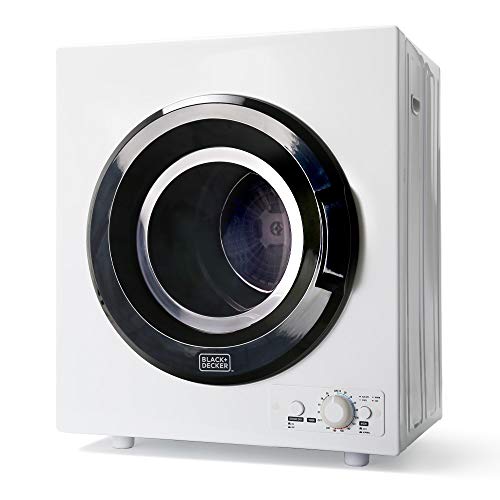
BLACK+DECKER 3.5 Cu. Ft. Portable Dryer, 120V — The mainstream 120V benchmark
If a friend asked what a 120-volt compact dryer is, this is the listing you would show them. BLACK+DECKER states the whole proposition in its title: 3.5 cubic feet, a 13.2-pound load capacity, 1500 watts on a standard 120-volt outlet, vented operation, and a stainless steel drum. That combination — the largest drum class in this guide at the strongest common wattage — makes it the benchmark against which the other five are variations, and for a small household it is the safest single answer: big enough for real loads, ordinary enough to plug in anywhere.
Real loads deserve defining. Thirteen pounds of dry laundry is a couple’s several days of clothing, a set of towels with the bath mat, or a small family’s midweek rotation — not a king duvet, and not a sports team’s kit. Dried in this machine, such a load takes its time, because 1500 watts is the ceiling a normal outlet offers and physics collects the difference in minutes. Owners who run the machine in rhythm with the day — a load in the morning, folded by evening — report the pace as a non-issue; owners who arrive home with a week’s laundry and an evening to do it in should read the trade-off box twice.
The vented design needs its sentence: warm, moist air must leave, through the exhaust toward a window, a vent or a door opened for the purpose, and a room dried into itself grows humid and slows every subsequent load. Plan the vent route when you plan the corner, and the machine settles into apartment life completely — no plumbing, no circuit, no permission slips. It is the least installation a tumble dryer has ever asked for, and this pick executes that idea at the category’s most useful size.
Against its smaller sibling below, the choice is pure load arithmetic: the 3.5 takes the loads a household actually generates, while the 2.65 serves one person’s rhythm better and stores smaller. Against the Panda and Euhomy at the same capacity, the BLACK+DECKER’s case is the clarity of its listing and the maturity of the design — the specification reads like a checklist because, in this category, it has become one.
- Electrical stated in the listing: 120V, 1500W, standard wall outlet
- Capacity from the listing: 3.5 cu. ft., 13.2 lb. load
- Drum: stainless steel
- Operation: vented electric dryer
- Format: portable compact for apartments and small laundry spaces
Strengths
- Largest mainstream drum at full 120V wattage
- Stainless drum is kind to smaller, delicate loads
- Listing states every key specification in its title
Trade-offs
- 120V pace: full loads take markedly longer than 240V drying
- Vented — needs an exhaust route out of the room
- Not sized for family bedding or bulk loads
Best for: couples and small households wanting a real dryer on an ordinary outlet.
Not suited for: families expecting full-size speed or duvet capacity.
BLACK+DECKER 2.65 Cu. Ft. Portable Dryer — One person’s right size
Not every household needs the biggest compact, and this smaller BLACK+DECKER makes the case for proportion. Its listing states 2.65 cubic feet, an 8.8-pound capacity, 1400 watts at 120 volts, vented operation and a stainless steel drum — the family formula, scaled to one person’s laundry. A solo resident’s loads are simply smaller: a few days of clothes, gym kit, the weekly towel pair. Run at that scale, the 2.65’s drum is not a limitation but a match, and loads that fit properly tumble properly, which in a compact dryer is half of drying well.
The hundred-watt difference from its sibling is worth an honest sentence: at these power levels, drying time is governed more by load size and fabric than by a 1400-versus-1500 distinction, and the smaller drum’s lighter loads roughly cancel the smaller wattage. What genuinely changes is storage and presence. The 2.65 fits corners, closets and RV bays that refuse its sibling, and for a dorm-adjacent or studio life, that fit is the specification that decides whether the machine gets used daily or resented weekly.
Ownership rhythm defines success here even more than with the larger machine. Small loads, run often, dried while you do something else in the same room — that is the 120-volt compact’s native cadence, and the 2.65 is built exactly to it. The owner who tries to save up a fortnight’s laundry for one heroic session will find the drum too small and the clock too slow; the owner who washes as they go will find the machine always ready and never in the way. Choose by which of those people you actually are.
As with its sibling, the vent needs a route and the room needs the machine’s exhaust respected. Within those terms, this is the pick we would hand a student leaving for a first flat or a professional in a studio who is done with laundromat evenings: modest, honest, stainless-drummed, and exactly as fast as its outlet allows — no faster, and, crucially, no slower than its listing leads you to expect.
- Electrical stated in the listing: 120V, 1400W
- Capacity from the listing: 2.65 cu. ft., 8.8 lb. load
- Drum: stainless steel
- Operation: vented electric dryer for a standard wall outlet
- Format: portable compact, smaller footprint than the 3.5 model
Strengths
- Right-sized drum for one person’s real loads
- Stores in corners and closets its sibling cannot use
- Same stainless, vented formula as the benchmark
Trade-offs
- Couples will outgrow the drum quickly
- 120V pace applies in full — small loads are the strategy
- Vented exhaust still needs a planned route
Best for: solo renters, students and studio dwellers drying little and often.
Not suited for: couples or anyone whose loads regularly exceed a few days’ clothing.
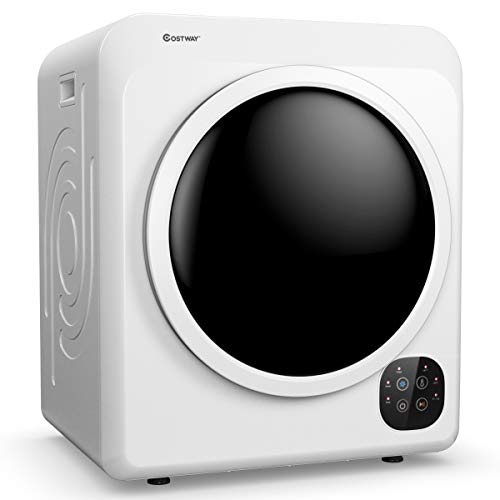
COSTWAY 1700W Electric Portable Clothes Dryer — Highest wattage, homework attached
The COSTWAY opens with the most eye-catching number in this guide: 1700 watts, stated at the head of its listing, attached to a 13.2-pound front-load compact with a stainless steel tub and a button control panel mounted low on the body. Wattage is drying speed’s raw material, so a machine offering more of it than the 1500W mainstream deserves attention from every buyer whose chief anxiety about this category is the clock. More power into a similar drum means hotter, faster cycles — the closest a machine in this guide comes to narrowing the time gap with full-size dryers.
Now the disclosure this guide owes you, in the review rather than the footnotes: the COSTWAY’s title does not print its voltage. Every other pick here states 120V (or 110/120V) in its title; this one states wattage and capacity and leaves the electrical line to the full listing. Before ordering it for a standard-outlet plan, open the listing and confirm the voltage in its specification — if it confirms the standard-outlet operation this category requires, the machine is a strong buy; if your reading leaves doubt, the BLACK+DECKER and Panda state their case in their titles and ask for no trust. We include the COSTWAY because its specification is genuinely interesting, and we flag it because our standard is that interesting never outranks verified.
The design details that are stated suit its role: a front-load layout with the control panel low — the listing’s own description — which suits machines placed on the floor or a low stand, and a stainless tub for the drum, the fabric-kind material this category favours. Capacity at 13.2 pounds matches the benchmark class, so the COSTWAY competes directly with the 3.5 cu. ft. models on loads while arguing its case on power. For a small household whose laundry corner has been measured and whose listing homework is done, it is the pace candidate of the guide.
Its ownership bargain is therefore slightly different: a little more speed, a little more diligence required before purchase. Some buyers will happily trade ten minutes of listing-reading for faster cycles across years of ownership, and they are rational to do so. Others want the specification settled in the title, and the guide serves them with four other picks. Either way, the COSTWAY is presented here exactly as its evidence allows — promising, powerful on paper, and one verification away from a full recommendation.
- Power stated in the listing: 1700W — the highest here
- Voltage in the title: not stated — confirm in the full listing
- Capacity from the listing: 13.2 lbs, front-load compact
- Tub: stainless steel
- Controls: button panel mounted low, per the listing
Strengths
- Strongest stated wattage in the guide
- Benchmark-class capacity with a stainless tub
- Front-load layout with low, reachable controls
Trade-offs
- Voltage not printed in the title — verification required
- Higher power still operates within compact drying times
- Front-load format needs door-swing room in tight corners
Best for: pace-conscious small households willing to verify the electrical line first.
Not suited for: buyers who want the 120V fact settled in the title itself.

Panda 3.5 Cu. Ft. Portable Clothes Dryer, 120V — Full-size compact from a compact specialist
Panda builds its reputation in exactly this corner of the appliance world — compact laundry for small homes — and its 3.5 cu. ft. dryer shows the specialisation. The listing states the category’s benchmark numbers (13.2 pounds, 1500W, 120V) with a stainless steel tub and a vented front-load design, and names its habitats without embarrassment: apartments, dorms and small laundry spaces. A maker that designs for those rooms understands their constraints — thin walls, shared circuits, corners that double as hallways — in a way a full-size brand downsizing a flagship rarely does.
In use, the Panda competes head-on with the benchmark BLACK+DECKER: same capacity class, same wattage, same vented stainless formula. The honest separators are the intangibles a listing can only suggest — control layout, cycle selection, the feel of the door and filter — and the household’s existing loyalties, since many Panda dryers are bought to stand beside a Panda portable washer as a matched small-space pair. Matched pairs matter more in compact laundry than in full-size, because the two machines often share one corner and one routine, and a pair designed together tends to stack, vent and schedule together more gracefully.
The 120-volt bargain applies to the Panda in full, and its review repeats it without varnish: loads dry at the pace 1500 watts permits, which is to say thoroughly and unhurriedly. The households that thrive with this machine build the rhythm described throughout this guide — smaller loads, run in the background of the day, vented properly through the route planned at installation. For a dorm or a small flat, that rhythm replaces a laundromat trip entirely, and the replacement, not the speed, is the product being bought.
Choose the Panda over the benchmark if the pair-matching matters, if its control style suits your hand, or if your corner’s dimensions favour its particular body — at this specification level, those are legitimate and sufficient reasons. Choose it with confidence either way: the numbers that govern a 120-volt dryer’s life are printed in its title, and they are the right numbers for the category’s mainstream job.
- Electrical stated in the listing: 120V, 1500W
- Capacity from the listing: 3.5 cu. ft., 13.2 lbs
- Tub: stainless steel
- Operation: vented, front load
- Intended spaces in the listing: apartments, dorms, small laundry spaces
Strengths
- Benchmark specification from a compact-laundry specialist
- Pairs naturally with compact washers in one corner
- Every key figure stated in the title
Trade-offs
- Same 120V pace as the class — no shortcut on time
- Vented design needs its exhaust route planned
- Capacity ceiling is a small household’s, not a family’s
Best for: apartment and dorm households, especially beside a compact washer.
Not suited for: anyone needing family volume or 240V speed.
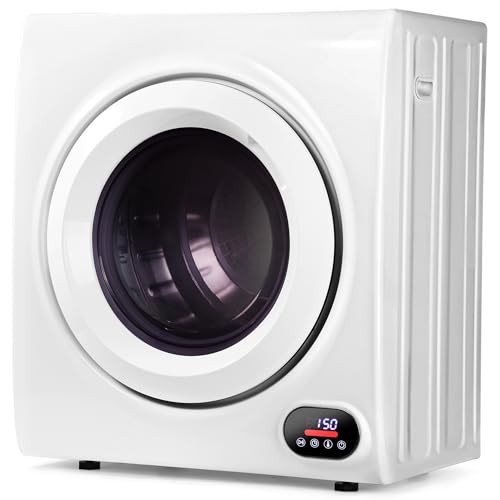
Euhomy 3.5 Cu. Ft. Clothes Dryer, 120V — LCD control and exhaust pipe included
The Euhomy matches the class’s capacity leaders — 3.5 cubic feet, 120 volts, 1500 watts, front load — and then differentiates on the two things compact owners touch daily: controls and venting. Its listing names an LCD control panel and four functions, a more informative interface than the dials most compacts offer, and it includes an exhaust pipe, which sounds like a footnote until you have priced and hunted a vent hose separately for a machine that arrived without one. Small completeness, daily felt: that is this pick’s character.
Four functions in a compact dryer is the right scale of choice — enough to separate the delicate load from the towel load without a programme menu that belongs on a flagship. Paired with the LCD’s plain feedback about where a cycle stands, the Euhomy suits owners who run their dryer as background infrastructure: load it, set it, and glance occasionally rather than supervise. In a small flat where the dryer shares the living space, that glanceability is a genuine quality-of-life feature, and the machine’s stated habitats — apartment, home and RV — are exactly the places it matters.
The physics, once more, is unmoved by the interface: 1500 watts dries at 1500 watts’ pace, and the Euhomy’s loads take the category’s usual unhurried time. What the modern controls buy is not speed but ease inside that pace — clearer choices, clearer progress, fewer guessed-at dial positions. Households upgrading from an elderly compact will feel the difference daily; households buying their first compact should know the difference is in the using, not in the drying, and judge the premium accordingly.
Venting, helped by the included pipe, still wants a destination: a window kit, an existing vent, or a door arrangement that lets moist air leave the room rather than condense on its walls. Plan it once and the Euhomy becomes the most appliance-like of the compacts here — the one that feels least like a workaround and most like a small dryer that happens to plug into a normal socket, which is, in the end, the category’s whole ambition.
- Electrical stated in the listing: 120V, 1500W
- Capacity from the listing: 3.5 cu. ft.
- Controls: LCD control panel, 4 functions
- Included per the listing: exhaust pipe
- Format: front load compact for apartment, home and RV
Strengths
- LCD panel gives clear cycle feedback rare in compacts
- Exhaust pipe included — venting solved out of the box
- Benchmark capacity and wattage underneath the polish
Trade-offs
- Drying pace is the class standard despite the modern controls
- Four functions is a compact range, not a flagship menu
- LCD electronics are one more system than a plain dial
Best for: small households wanting compact drying with full-size manners.
Not suited for: buyers who prefer the simplest possible dial-and-done machine.

Auertech 1.8 Cu. Ft. Portable Clothes Dryer, 110V/120V — Dorm-scale and dual-voltage
The Auertech is the category in miniature, and its listing is honest about the scale: 1.8 cubic feet, 850 watts, compatibility with both 110V and 120V supplies, eight smart modes and LED control, aimed at apartments, dorms and RVs. Everything about it is the small end of the trade this guide describes — the least power, the least capacity, the gentlest heat — assembled for the loads that dominate small-space life: underwear and socks, gym kit, a couple of shirts, the baby clothes that cannot wait for a laundry day.
Eight modes in a machine this size is a statement of intent: Auertech expects its owners to dry different small things differently, and gives them the settings to do it. The LED control keeps the small body uncluttered, and the dual-voltage compatibility quietly matters for RV travellers and anyone whose supply is nominally 110 rather than 120 — the machine simply accepts the outlet it finds, which is the founding promise of this category carried to its logical end.
Time, at 850 watts, is the honest price, and at this scale it prices fairly: a small load of light items dries in a span that a dorm evening absorbs without planning, while a load of wet towels would test anyone’s patience and should not be attempted as a habit. The Auertech is a smalls machine, and the households that love it are the ones whose laundry is mostly smalls. Ask it to be a family dryer and it will fail you daily; ask it to keep a student’s or a traveller’s basics in constant rotation and it becomes indispensable within a fortnight.
It also completes the guide’s range in a way worth noting: between this machine and the 3.5 cu. ft. models, the 120-volt category covers everything from a single person’s gym bag to a couple’s weekly wash, all from ordinary sockets. The Auertech is where that range begins — the dryer you buy when the alternative is a radiator and a prayer — and for that reader it is not the smallest pick in the guide but the most important one.
- Electrical stated in the listing: 110V/120V compatible, 850W
- Capacity from the listing: 1.8 cu. ft. compact
- Modes stated in the listing: 8 smart modes
- Controls: LED control
- Intended spaces in the listing: apartments, dorms, RVs
Strengths
- Dual-voltage compatibility suits RVs and varied supplies
- Eight modes give a small machine real range
- Smallest body — fits where no other pick can
Trade-offs
- 850W is the slowest drying in the guide
- Capacity is smalls-scale only
- Heavy items like towels are an endurance event
Best for: students, RV travellers and anyone drying small loads in tiny spaces.
Not suited for: couples or families as a main dryer.
Why Does 120 Volts Change a Dryer So Much?
A dryer’s speed is, to a first approximation, its wattage wearing a drum. A full-size electric dryer on its dedicated circuit draws several times the power of anything in this guide, and that power becomes heat, and heat becomes evaporation. A 120-volt machine is limited by what an ordinary outlet and its wiring can safely supply — the listings here cluster at 1400 to 1500 watts, with the COSTWAY stating 1700 and the little Auertech 850 — so the same water must be evaporated with a smaller fire, and smaller fires take longer. There is no design cleverness that repeals this; there is only honesty about it, which this category’s better listings provide in their titles.
There is also a sizing subtlety the wattage figures hide. Two dryers at the same 1500 watts can still dry at different paces if one moves air more effectively or seals its drum better, which is why this guide treats wattage as the category’s honest headline rather than its whole story, and why the reviews pay attention to drum material and venting design alongside the electrical line. Even so, no airflow cleverness moves a compact into full-size territory — it moves it within compact territory, from the slow end toward the brisk end, and buyers should calibrate their hopes to that map.
The compensations are real and worth listing beside the cost. Installation collapses to plugging in and venting. The machine can live in a rented flat, a dorm, an RV or a spare corner without an electrician’s visit or a landlord’s permission. Gentler heat is kinder to the smaller, more delicate loads these machines usually serve. And the household’s laundry becomes independent of laundromat hours and weather-window line drying. The category is a trade of time for freedom, and for its intended readers the freedom is the scarcer resource — which is why these machines sell in such numbers despite a limitation their listings state in plain figures.
How Long Will Your Loads Actually Take?
Set expectations by load, not by hope. Light synthetics and smalls — the native loads of compact life — dry in spans that fit inside an evening’s background. A full 13-pound load of mixed cotton in a 1500W machine is a longer commitment, and heavy, water-hoarding items like towels and denim are the slowest of all, because wattage must first repay the water those fibres hold. The practical responses are the ones this guide repeats: load smaller than the drum’s boast, dry more often, spin the wash hard before it reaches the dryer so the dryer starts with less water to remove, and schedule the heavy loads for when the machine can run unattended in the background.
There is a rhythm discovery every compact owner makes in the first month: the machine’s pace stops mattering once laundry stops being an event. A household that runs a modest load every day or two never waits for the dryer, because yesterday’s load is already folded and today’s is drying while dinner cooks. The household that saves a mountain for Sunday waits all Sunday. If your habits are the second kind and cannot change, this category will frustrate you regardless of which pick you choose — buy the largest drum and the strongest wattage, the benchmark or the COSTWAY, and even then, run the mountain in two shifts rather than one siege.
Vented, Ventless, and Where the Warm Air Goes
Every pick in this guide is a vented design in its listing, which simplifies the category and complicates the room. A vented dryer exports its moisture in a stream of warm air, and that air needs a destination: an exhaust pipe to a window, an existing vent, or at minimum a door arrangement that lets the room breathe. Drying into a sealed small room is the classic compact mistake — the air saturates, drying slows further, windows weep, and the flat gains a laundry smell that no candle defeats. The Euhomy’s included exhaust pipe exists because this step is so often fumbled; treat the pipe as the beginning of a plan, not the whole of it.
Placement follows from the vent. The machine wants to live near its exhaust route, on a surface that tolerates warmth and slight vibration, within reach of the socket without extension-lead improvisation — compact dryers draw meaningful current for long periods, and the socket should be a proper wall outlet in good condition, a point worth stating plainly in a category bought by people in older buildings. Give the machine its corner, its vent and its socket, and a 120-volt dryer asks for nothing else: no water, no drain, no gas, no permission. That minimalism is the product.
How Do You Get the Best Results From a Low-Power Dryer?
Technique repays more at 120 volts than at any other power, because the machine has no surplus to waste on your mistakes. First, extract before you dry: a thorough spin in the washer removes water mechanically at a fraction of the energy and time that evaporating it costs, so the dryer’s job should begin with clothes already spun as dry as your washer manages. Second, sort by weight — lights with lights, towels with towels — because a mixed load dries at the pace of its heaviest member while its lightest members over-cook waiting. Third, shake each item as it goes in; a compact drum has no spare room for untying the washer’s knots with heat.
Fourth, respect the drum’s honest capacity rather than its advertised one, filling to the point where items still tumble as individuals. Fifth, clean the lint filter every load — in a low-power machine, airflow is precious, and a filmed filter taxes the one resource you cannot spare. None of these habits is burdensome, and together they close much of the apparent gap between a compact and its full-size cousins for the loads compacts actually serve. The remaining gap is time, and time, in a well-run small home, is the one thing laundry can be arranged never to waste.
Who Should Not Buy a 120-Volt Dryer at All?
Honesty about borders sells fewer machines and better outcomes. If your home has a proper dryer circuit and your household produces family-scale laundry, the large family machines will serve you better in every way that matters — speed, capacity, bedding — and the 120-volt category’s freedom buys you nothing you lack. Likewise, if your laundry includes regular loads of heavy workwear, cloth nappies in quantity, or a sports club’s kit, the compact pace will become a weekly grievance rather than a background hum.
And if your real problem is not the circuit but the laundry room itself — a washer that needs replacing first, loads that need a proper soak cycle — sequence the purchases correctly, and give the washer side of that decision its own careful research before any money moves. The 120-volt dryer is a precise answer to a precise problem: no circuit, small loads, a socket and a corner. Households with that problem will find this category liberating. Households with a different problem should let this guide talk them out of it, which is also a service.
What Does a Sensible Week of Compact Drying Look Like?
Monday’s work clothes go in before breakfast and dry while the flat empties; nobody waits for them, which is the entire trick. Wednesday’s gym kit and smalls take the short end of the week in the Auertech-sized rhythm — small load, background hours, folded without ceremony. The towels, the week’s slowest citizens, are scheduled for the evening when the machine can run longest, spun hard in the washer first and batched by weight. Bedding, where the household has it in compact scale, gets its own unhurried session rather than a share of a mixed load.
Notice what is absent from that week: waiting. The compact dryer’s pace only becomes a grievance when a load is needed by a deadline the machine was never told about. Households that plan one load ahead — washing tonight what is worn the day after tomorrow — experience their 120-volt dryer as silent infrastructure. Households that wash against the clock experience it as a bottleneck. The machine is identical in both homes; the calendar is the difference, and calendars are free to change. New compact owners should give the rhythm a full month before judging the machine, because the first fortnight is usually spent unlearning the laundromat’s batch logic — and the verdict almost always softens once the household’s week has reshaped itself around a dryer that is simply always there, patiently turning in the corner like a small, warm appliance should. That patience, learned once, tends to spread to the rest of the household’s laundry thinking, and it is worth more than any single specification in this guide, however precisely that specification happens to be printed in a listing title or buried in a specification table somewhere below it online.
How Do Compact Dryers Treat Delicate and Everyday Fabrics?
Low power has a fabric dividend that this guide has mentioned in passing and should now state properly. The loads compact dryers serve — smalls, gym kit, shirts, light cottons, the delicate end of a small household’s wardrobe — are precisely the loads that suffer most in a full-size machine’s fierce, fast heat. A compact’s gentler temperatures and smaller drums treat those fabrics kindly almost by accident: less thermal shock, less violent tumbling, fewer garments baked past forgiveness. Owners who move a delicate wardrobe from a laundromat’s industrial dryers to a compact often report the change in their clothes first.
Everyday fabrics benefit in a quieter way. Because compact owners sort by weight and load modestly — the habits this category forces — their cotton spends less time over-drying, and their synthetics meet only the heat they need. A dryer with no surplus power teaches its household to dry properly, and proper drying is fabric care by another name.
How Should You Set Up a Laundry Corner Around a Compact Dryer?
The corner is the installation, so design it as one. The dryer sits within hose-reach of its vent destination and within its own cord’s reach of a sound wall socket — never draped across a room or doubled through adapters. Beneath it, a surface that tolerates warmth and a little vibration; beside it, the washer or the wash basket, arranged so the wet-load transfer is one step rather than a dripping journey. Above or beside, a small shelf for detergent and the filter brush, because maintenance that requires a treasure hunt stops happening.
Then give the corner its air. A compact dryer warms its immediate surroundings and exports moisture through its vent; a corner sealed inside a cupboard with the door shut recreates the sealed-room mistake at furniture scale. Louvred doors, an open top, or simply running the machine with the cupboard open — any of these keeps the corner breathing. Small homes are full of such negotiated spaces, and the laundry corner that is planned once, properly, disappears into the household’s background, which is the highest compliment small-space equipment can earn.
How Long Do Compact Dryers Last, and What Wears Out?
Compact dryers live simpler mechanical lives than full-size machines — smaller drums, lighter loads, fewer flagship electronics — and their longevity follows the pattern Best Long-Lasting Electric Dryers explores for electric dryers generally: the machines that last are the ones whose owners keep filters clean, vents clear and loads honest. The parts that wear are the predictable ones — belts, rollers, heating elements working long hours at full stretch — and the low-power duty cycle cuts both ways: gentler heat per minute, but more minutes per load, so total element hours accumulate faster than owners expect.
The practical conclusion is maintenance as a habit rather than an event. A filter cleaned every load, a vent checked each season, a drum never asked to dry a load it cannot tumble — a compact kept that way serves for years in exactly the small homes it was built for. Buyers choosing between the near-identical benchmark models can reasonably let this tip them: the machine whose filter and vent path look easiest to maintain in your corner is the machine that will still be drying well when its rivals are labouring. Longevity, in this category, is mostly housekeeping wearing a disguise. Readers speccing a matching washer in the same project will find the front-load side of that wider decision covered in Best Front-Load Washers With a Pre-Soak Option.
How Do the Six 120-Volt Dryers Compare?
| Pick | Key specification from the listing | Where it fits best |
|---|---|---|
| BLACK+DECKER 3.5 Cu. Ft. Portable Dryer, 120V | 3.5 cu. ft., 120V 1500W, vented, stainless drum | The benchmark compact for small households |
| BLACK+DECKER 2.65 Cu. Ft. Portable Dryer | 2.65 cu. ft., 120V 1400W, vented, stainless drum | Solo laundry in the smallest useful body |
| COSTWAY 1700W Electric Portable Clothes Dryer | 13.2 lbs, 1700W stated, voltage to confirm on listing | The pace candidate, with one check attached |
| Panda 3.5 Cu. Ft. Portable Clothes Dryer, 120V | 3.5 cu. ft., 120V 1500W, vented, stainless tub | The specialist’s version of the benchmark |
| Euhomy 3.5 Cu. Ft. Clothes Dryer, 120V | 3.5 cu. ft., 120V 1500W, LCD, exhaust pipe included | The polished compact for flats and RVs |
| Auertech 1.8 Cu. Ft. Portable Clothes Dryer, 110V/120V | 1.8 cu. ft., 110V/120V, 850W, 8 modes | Dorm and RV smalls at the gentlest pace |
What Mistakes Make 120-Volt Drying Miserable?
The first mistake is buying the category for the wrong house. A 120-volt compact installed in a home with a working dryer circuit and a family of five is a disappointment scheduled in advance. These machines answer the no-circuit problem; if that is not your problem, their slowness buys you nothing. Read the trade honestly before the socket seduces you.
Second, sealing the room. A vented compact drying into a closed flat fills the air with the load’s water, slows itself down, and mists the windows — then gets blamed for all three. Give the exhaust its route from the first load, and half the category’s bad reputation evaporates with the moisture.
Third, loading like a full-size owner: a drum stuffed to its advertised pounds, mixed towels with delicates, no shake-out. At 1500 watts there is no surplus power to forgive any of that. Load to looseness, sort by weight, and spin hard in the washer first — the three habits that make compact drying feel adequate instead of inadequate.
A fifth mistake is treating the dryer as the laundry system’s only worker. In compact homes the washer’s spin, the sort at the basket and the rack by the window are all part of drying, and a household that uses all four finishes loads faster than one that loads the dryer with dripping, unsorted laundry and complains about physics. The machine is the middle of the system, not the whole of it.
Fourth, ignoring the socket itself. These machines draw real current for long stretches; a tired outlet, a coiled extension lead or a multi-way adapter shared with a heater is poor practice with any dryer and worse with one that runs for hours. Plug directly into a sound wall outlet, as the listings’ standard-outlet language intends, and let the machine’s own simplicity do the rest.
Final Recommendation
Most readers should take the benchmark: the BLACK+DECKER 3.5, whose title states the category’s whole contract — 3.5 cubic feet, 1500 watts, standard outlet, stainless drum. Solo dwellers step down to its 2.65 sibling without losing anything they use. The Panda matches the benchmark for compact-pair households, the Euhomy adds the class’s best controls and a solved vent, the COSTWAY offers the most wattage to buyers willing to verify its voltage line, and the Auertech serves dorm and RV smalls at a scale nothing else here attempts. Every one of them trades time for freedom; choose the size of that trade your household’s loads actually require.
Our closing word is the one the category deserves: a 120-volt dryer is not a lesser dryer — it is a dryer for a different house, and in that house, the rented flat or the dorm room or the cottage with one good socket, it does not feel like a compromise at all. It feels like laundry, finally, at home. Measure your corner, plan your vent, pick the drum your loads honestly need, and the socket you already own will do the rest — quietly, slowly and entirely on your own schedule.
Frequently Asked Questions
Can a 120-volt dryer really dry a full load?
Yes — completely, and to the same dryness as any dryer, given time. The limit is pace, not capability: a full compact load of mixed cotton will take markedly longer than in a full-size machine, and heavy items longer still. Households that load modestly and dry in the background of the day rarely feel the limit; households drying against a deadline feel it every time.
Do these dryers need a special outlet or an electrician?
No — that is the category’s founding point. The listings describe standard wall outlet operation, and five of the six state their 120V (or 110/120V) nature in their titles. Use a sound wall socket directly, not an extension lead or adapter, and confirm the COSTWAY’s voltage in its full listing, since its title states wattage without printing the voltage.
Why does my compact dryer take so long with towels?
Towels are the hardest load in any dryer: they hold the most water per pound, and at 120-volt wattage that water must be evaporated with a modest heat supply. Spin them thoroughly in the washer first, dry them in smaller batches, and give them the machine’s longest, warmest setting. Or accept the hybrid: a compact cycle to take the worst out, then the airing rack for the finish.
Can I run a 120-volt dryer in a room without a window?
You can, but the moisture has to go somewhere, and a sealed room is the worst destination. Use the exhaust pipe toward a door left ajar, an existing vent, or a window in the next room if the pipe reaches. Watch the room’s windows and walls for condensation in the first weeks; if they mist heavily, the venting arrangement, not the dryer, needs the upgrade.
Which size should a couple choose?
The 3.5 cu. ft. class — the benchmark BLACK+DECKER, the Panda or the Euhomy — because a couple’s loads quickly outgrow the smaller drums, and an outgrown compact is replaced, not endured. Solo households can save the space with the 2.65, and anyone drying mostly smalls in a dorm or RV should look at the Auertech first.
Can I stack or shelf-mount a compact dryer?
Many compact owners place the dryer on a sturdy shelf or counter to bring the door to working height and free the floor, and the smaller picks here suit that life. Respect the basics: a surface rated for the machine’s weight plus a wet load, room for the vent pipe’s run, and nothing stored against the warm sides. If a placement needs improvisation to survive the spin’s vibration, choose a different placement — the floor has housed more successful compact dryers than any shelf arrangement.
Is a 120-volt dryer expensive to run?
Per load, modestly: it draws less power for longer, and the total energy for the same load is broadly comparable to a bigger machine’s shorter, stronger cycle, with the difference depending on the load and the machine. The honest cost of the category is time rather than electricity — and for the homes it serves, time at home still beats money and hours spent at a laundromat.
Related Guides
The towels these compact machines dry best are the generous kind that survive years of small-load laundry, and our guide to Best Bath Towel Sheets gathers the bath towel sheets worth that long service.


