What's inside
- Key Takeaways
- Quick Picks
- How Did We Choose Faucets for Hard Water?
- How Do the Six Hard Water Faucets Compare Side by Side?
- How Does Hard Water Actually Damage a Kitchen Faucet?
- What Is the Easiest Descaling Routine That Actually Works?
- Why Do Ceramic Cartridges Suit Hard Water Better?
- Should You Fit a Water Softener Instead of a Special Faucet?
- How Can You Tell How Hard Your Water Really Is?
- What Should You Do on Installation Day in a Hard Water Home?
- How Do You Care for the Aerator and Supply Lines?
- How Does Hard Water Affect Taste and Cooking?
- When Should You Replace Rather Than Descale a Faucet?
- How Should You Budget for Hard Water Ownership?
- What Does a Healthy Spray Pattern Tell You?
- What Mistakes Do Hard Water Households Make With Faucets?
- Final Recommendation
- Frequently Asked Questions
- Related Guides
As an Amazon Associate I earn from qualifying purchases. This post may contain affiliate links at no extra cost to you.
cottageverdict.com is reader-supported. When you buy through links on our site, we may earn an affiliate commission.
Where to buy: Every faucet below links to its Amazon listing, where you can check price on Amazon and confirm hole count, finish and included plates before ordering. Match the listing to your sink’s drilling, because hard water wisdom cannot rescue a faucet that does not fit.
Living with hard water changes what the best kitchen faucets for hard water need to do. It is not enough for a faucet to look good in the showroom; it must resist the white crust that creeps across spray faces, shrug off the spots that bloom on finishes after every splash, and keep its cartridge sealing cleanly while fine mineral grit flows through it daily. This guide judges six faucets by those specific enemies: scale on nozzles, spotting on finishes, and wear inside the valve.
Your own water sets the severity of the test. If your kettle furs up in a month and your shower head needs needle surgery twice a year, weight the anti-scale features heavily. If your water is merely firm and the marks wipe away easily, the simpler certified models here will serve you well. Read with your kettle in mind; it is the most honest water report in your house.
Bring your honesty about housekeeping to these reviews as well. A faucet that needs a monthly soak will only stay clean in a home that actually soaks things monthly; a faucet cleaned by a thumb-rub suits a home that prefers seconds to schedules. The best match is the one whose maintenance rhythm matches yours.
One last piece of framing before the reviews: hard water is not a defect in your home, it is a characteristic of your place, like the weather. The right faucet does not fight your place; it is designed for it, and living with it stops feeling like a battle you are slowly losing.
Read on, then, with your kettle’s fur and your current spray pattern as your two exhibits.
Both exhibits point the same way in most hard water homes: toward tolerance, cleanability and finishes that forgive.
Key Takeaways
- Silicone spray nozzles that rub clean beat metal faces that need soaking and needle work.
- Spot-resistant finishes hide the daily bloom that hard water leaves on ordinary steel.
- Ceramic cartridges tolerate mineral grit better and keep sealing after washer designs drip.
- A pull-down head or sprayer turns daily sink rinsing into the cheapest descaling habit.
- Stainless steel bodies resist the corrosion that mineral-heavy water encourages over years.
- Match the faucet to your water’s severity; mild districts do not need the heaviest armour.
Quick Picks
| Pick | Badge | Why it earns a place |
|---|---|---|
| Moen Adler Pulldown Faucet 87233SRS | Best Finish Against Spotting | Moen’s Spot Resist stainless is named for exactly the white marks hard water leaves on ordinary finishes. |
| WEWE High-Arc Pull-Down Kitchen Faucet | Easiest Nozzles to Descale | Soft silicone nozzles rub clean with a fingertip, dissolving the crust that hard water builds on spray faces. |
| FORIOUS Kitchen Faucet Brushed Nickel | Classic High-Arc Value | A classic high arc and pull-down sprayer in stainless steel cover hard water basics at a friendly price point. |
| OWOFAN Kitchen Faucet Brushed Nickel Spring | Spring Design, Easy Rinsing | An exposed spring spout gives the spray head free movement for blasting scale-prone corners of the sink. |
| FEELSO Kitchen Faucet Brushed Nickel | Certified Simplicity | Lead-free NSF certified stainless steel in a high arc single-handle design keeps hard water care uncomplicated. |
| Cinwiny 2-Handle Kitchen Faucet with Sprayer | Traditional Two-Handle Control | Separate hot and cold handles with a side sprayer suit older 4-hole sinks common in hard water regions. |
How Did We Choose Faucets for Hard Water?
We started from the failure points hard water creates. Spray faces clog, so we favoured nozzles designed to be cleaned by rubbing rather than soaking. Finishes spot, so a finish engineered to hide spotting earned its place, and honest brushed surfaces were judged on how forgivingly they wear marks. Cartridges wear, so ceramic valving and brands with realistic parts support counted heavily, because a faucet in a hard district is a machine on a maintenance clock.
Every model here appears in our verified pool, and each review uses only what its listing states: materials, certifications, flow, mounting and spray arrangements. Where a listing names no anti-scale feature, the review says so plainly and explains the manual routine that compensates. That discipline matters in this category, where marketing loves to imply protection that the specification never actually promises.
We also kept mounting variety in the list — one and three hole pull-downs, a spring design, and a two-handle centerset for four-hole sinks — because hard water households often cook in older kitchens whose sinks dictate the shortlist before style gets a vote.
We also read the listings the way a sceptical friend would, asking what each claim would look like after a year of your water. A certification can be checked, a material can be verified, a nozzle design can be pictured working. Claims that survived that reading earned their sentences in the reviews; anything vaguer was left out rather than repeated, because hard water exposes exaggeration faster than any reviewer can.
Price was deliberately treated as the last filter rather than the first. In this category the cheapest faucet that crusts within a season is dearer than the mid-priced one that rubs clean for a decade, and the reviews keep returning to that arithmetic whenever a simpler model asks its owner for more weekly effort.

Moen Adler Pulldown Faucet 87233SRS — Best Finish Against Spotting
Hard water wages its war on a faucet in two places: the finish you look at and the spray face you drink from. The Adler’s Spot Resist stainless addresses the visible half of that war directly. Mineral spots still land on it — no finish repeals chemistry — but they show far less against this surface, so the faucet keeps looking cared-for between proper cleans instead of wearing a permanent white freckling by the end of the week.
The pulldown format suits hard water in a subtler way. Because the spray head docks in the spout and pulls down into the sink, you can aim water precisely at the scale building around the base of a pot or the corners of the sink itself, rinsing deposits away before they set. Daily rinsing is the cheapest descaling programme ever devised, and a head that reaches everywhere makes it a ten-second habit.
Cartridge thinking matters with Moen because the brand’s support network is part of the purchase. In hard water districts every cartridge eventually stiffens or drips; the question is whether a replacement is findable in five years and fittable in an afternoon. Established makers answer yes on both counts, which is worth real money when the alternative is replacing the whole faucet because a small part went obsolete.
Choose the Adler when your water is hard, your sink is busy and you want the finish problem solved by design rather than by polishing. It will not descale your kettle or soften your shower, and it makes no such claim. What it does is keep the hardest-working fixture in the kitchen looking respectable in an area where most faucets surrender their shine within a year.
Installation day is when the Spot Resist advantage first shows itself. Plumbers’ fingerprints, flux smudges and the general handling of fitting usually leave a new faucet looking briefly grubby; this finish wipes back to calm with unusual ease. Owners in hard districts learn to value that forgiving nature every time a grandchild fills a glass and splashes the whole sink area without a thought for polishing.
Think also about resale and photographs. Kitchens sell houses, and a faucet that looks clean in estate agent pictures — in a town where every buyer knows the water — quietly signals a home that has been maintained. No single fixture closes a sale, but in hard water country a spot-free faucet is a detail local buyers genuinely register.
A word about the pulldown docking over years: keep the spray face rinsed and the docking area free of scale, and the head seats home with the same click as new. Neglect lets crust build exactly where the head meets the spout, which is why the daily rinse matters even on a premium faucet. Quality buys you tolerance, not exemption.
Photographs of real kitchens confirm the pattern: in hard water towns, the faucets that still look new at five years belong to owners who chose forgiving finishes and wiped them while making tea. The Adler is engineered to reward exactly that level of care — present, but never obsessive — which is why it suits busy households rather than showroom keepers.
- Finish named in pool title: Spot Resist stainless
- Model named in pool title: 87233SRS
- Format: pulldown spray head on a single-handle body
- Brand line: Moen Adler series
- Hard-water angle: finish chosen to hide mineral spotting
Strengths
- Spot Resist surface shrugs off the daily white bloom of hard water
- Pulldown head reaches every corner of a deep farmhouse sink
- Moen parts support makes cartridge replacement a realistic plan
Trade-offs
- Premium brand pricing compared with value rivals here
- Pulldown hose needs periodic checks in very gritty water areas
- Single finish choice may not suit oil-rubbed or black schemes
Best for: hard water homes wanting a big-brand faucet that hides spotting
Not suited for: buyers chasing the lowest possible price for a rental kitchen
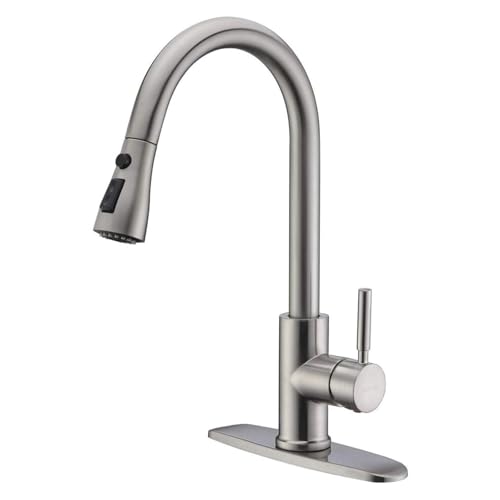
WEWE High-Arc Pull-Down Kitchen Faucet — Easiest Nozzles to Descale
If hard water has a headquarters in your kitchen, it is the spray face. Tiny holes plus evaporating mineral water equals crust, and crust equals a spray that squirts sideways into your sleeve. The WEWE’s soft silicone nozzles, named plainly in its listing, attack that problem with beautiful simplicity: rub the face with a thumb and the brittle scale flakes away, restoring the pattern in seconds without vinegar soaks or needle archaeology.
The supporting cast suits the mission. A ceramic cartridge handles the fine grit that travels with hard water far better than old rubber washer designs, sealing cleanly instead of grinding itself into a drip. The SUS 304 body resists the corrosion that mineral-heavy water encourages, and the 360 degree swivel plus twenty inches of pull-down reach mean the whole sink can be rinsed down after washing up, denying scale a quiet corner to establish itself.
Three spray modes earn their keep in a hard water kitchen for an unexpected reason: a forceful rinse mode helps blast loosened scale and food debris away, while the gentler stream fills pots without splashing mineral water across the worktop to dry into spots. Small behavioural helps like these compound across a year of daily use into a visibly cleaner sink area.
Pick this faucet when clogged, crusting spray heads are your chief grievance. Its brushed nickel will still show water marks more readily than a dedicated spot-resistant finish, so keep a cloth nearby. But for the mechanical war against scale — the nozzles, the cartridge, the rinse-down reach — this is the most thoughtfully armed option in the roundup.
Families with children find the rub-clean nozzles unexpectedly empowering: a child can be taught to wipe the spray face and restore the pattern, turning maintenance into a small, satisfying job rather than a parent-only chore. Equipment that invites participation gets maintained, and maintained equipment in a hard water home is the difference between a faucet that ages gracefully and one that crusts into embarrassment.
The twenty-inch reach deserves a second mention for bakers. Flour dust plus hard water makes a paste that sets like cement around a sink; a head that reaches the worktop edge and the mixing bowl where it stands lets you rinse flour away before it sets. Small ergonomic mercies like this are invisible in specifications and unforgettable in daily use.
Hard water and entertaining collide at the drinks station: ice buckets, jugs and a sink full of glasses at midnight. A sprayer that still sprays straight after months of neglect — because one rub restored it — keeps the end of a party civilised. Hosts in hard districts learn to love equipment that forgives a busy month.
Apartment dwellers with landlord-owned dishwashers and kettles often adopt this faucet as their one permitted upgrade, because it reverses the most visible symptom of hard water — the wandering, crusty spray — without touching the plumbing’s bones. Reversibility and impact rarely combine so neatly.
- Nozzles named in pool title: soft silicone, easy to rub clean
- Sprayer listed: 3 modes with 20-inch pull-down reach
- Body listed: SUS 304 stainless steel construction
- Swivel listed: 360 degree spout rotation
- Valve listed: ceramic cartridge; fit listed as 1 or 3 hole
Strengths
- Silicone nozzles shed scale with a rub instead of a soak
- Ceramic cartridge tolerates gritty water better than washer designs
- Long pull-down reach rinses big trays and the sink itself
Trade-offs
- Brushed nickel shows spots more than spot-resistant finishes
- Three spray modes include settings some households rarely use
- Hose retraction depends on clear space beneath the sink
Best for: very hard water homes tired of pin-cleaning clogged spray holes
Not suited for: anyone wanting a finish engineered specifically to hide spotting

FORIOUS Kitchen Faucet Brushed Nickel — Classic High-Arc Value
Not every hard water solution needs a special technology; some need sound basics maintained easily. This FORIOUS pairs a classic high arc — tall enough for the stockpots and buckets where scale does its worst damage — with a pull-down sprayer for rinsing the sink itself. In a hard water kitchen, the discipline of rinsing and wiping matters as much as any coating, and a faucet shaped for that discipline is halfway to staying clean.
The stainless steel construction named in the listing suits mineral-heavy water better than plated budget alternatives whose finishes can pit where scale is scrubbed away repeatedly. Brushed nickel hides minor marks more forgivingly than mirror chrome, though it will still bloom white in a hard water area if neglected for weeks. A weekly wipe with a vinegar-dampened cloth keeps it honest.
Because the listing does not claim silicone nozzles, plan on the traditional descaling ritual for the spray face: a vinegar soak in a bag tied over the head, a few times a year depending on your water’s hardness. That is a manageable chore, and many owners prefer a simpler faucet with a known chore to a complex one with hidden maintenance. The deck plate covering one or three hole sinks also makes it an easy retrofit into older kitchens.
Choose this model when the budget is real and the water is only moderately hard, or when the kitchen is a rental or utility space that needs competence rather than specialisation. Severe hard water households should climb to the WEWE or the Moen. For everyone else, this is the honest, classic answer.
Laundry and utility sinks, which the listing explicitly includes, are hard water’s second front. A classic high-arc faucet there takes buckets, pet bowls and soaking laundry without complaint, and its simple innards suit a room where the faucet is a tool rather than a showpiece. Buying the same forgiving design for both sinks also simplifies any future cartridge shopping.
Guests judge a kitchen by its faucet more than cooks realise. A classic shape in brushed nickel that has been kept bright reads as cared-for, while a crusting designer piece reads as neglected whatever it cost. This FORIOUS gives an ordinary household the means to pass that judgment comfortably, provided the weekly wipe becomes habit.
Camper and RV use, named in the listing, brings hard water from unfamiliar taps at every stop. A simple, sturdy faucet that tolerates varied water without delicate parts is exactly what a touring kitchen needs, and the same simplicity serves a hard-pressed family kitchen without distinction.
Think of this FORIOUS as the faucet equivalent of a good cast-iron pan: unglamorous, repairable, improved by regular small care and ruined only by neglect. Households that enjoy that relationship with their tools will understand it immediately and get a decade of service from the understanding.
- Build named in pool title: stainless steel, brushed nickel finish
- Shape named in pool title: classic high arc spout
- Sprayer: pull-down head for sink-wide rinsing
- Mounting listed: deck plate covers 1 or 3 hole sinks
- Settings listed: farmhouse, camper, laundry, RV and bar use
Strengths
- High arc clears tall pots that collect the most scale
- Pull-down sprayer helps rinse deposits from sink corners
- Straightforward design keeps replacement planning simple
Trade-offs
- Listing does not name silicone nozzles for easy descaling
- Finish will show hard water spots without regular wiping
- Fewer specialised hard-water features than the top picks
Best for: budget-conscious hard water homes wanting a proven classic shape
Not suited for: anyone whose main pain is constantly clogging spray holes

OWOFAN Kitchen Faucet Brushed Nickel Spring — Spring Design, Easy Rinsing
The spring faucet’s exposed coil looks like a chef’s tool because it solves a chef’s problem: total freedom of movement. In a hard water kitchen that freedom becomes a cleaning weapon. The head travels to every corner of the sink, under the draining board lip and around the base of the faucet itself, flushing away the standing mineral water that would otherwise dry into scale rings exactly where you least want to scrub.
The listing’s lead-free, NSF certified stainless construction matters when your water already carries a mineral load; you do not need a faucet adding doubts of its own. Single-handle control keeps adjustment quick when hands are wet, and the deck plate option covers the common one and three hole layouts found in older sinks that hard water areas often have, since those districts skew toward established housing.
Be honest about the spring’s own maintenance: the coil catches splashes and will gather its own light scale in the crevices if ignored. A weekly wipe along the spring while you clean the sink keeps it bright, and the open design at least makes every part visible and reachable, unlike enclosed spouts where grime hides until it announces itself.
Pick the OWOFAN if your cleaning style is active — rinse, wipe, done — and your kitchen suits the commercial spring look. Households wanting a faucet that hides its workings and its water marks should look at the Moen instead. But for sheer rinsing freedom in a scale-prone sink, the spring earns its place.
Renters who can change a faucet but not a water supply find the spring design liberating: it installs across common hole patterns, rinses like a professional fixture, and can travel to the next home if the tenancy allows. Hard water districts are full of renters enduring crusty landlord faucets; a portable upgrade that solves the spray and the rinsing in one move is worth considering.
The spring also changes how teenagers and reluctant washers behave. A head that moves anywhere makes rinsing the sink feel like play rather than chore, and sinks that get rinsed get less scale. Designers rarely discuss motivation as a specification, yet in real kitchens the fun tool is the used tool, and the used tool is the clean one.
Bar and utility settings, both named for this model, involve constant splashing and quick rinses — the exact environment where an agile spring head earns its keep and where scale would otherwise colonise a static spout. Movement, it turns out, is a cleaning strategy in itself.
Café owners running small premises choose spring faucets for the same reason home cooks should consider one: when the sink is the business’s engine room, a head that reaches everything and rinses fast keeps the whole operation moving, scale or no scale.
- Design named in pool title: spring-style spout with pull-down sprayer
- Certification listed: lead-free, NSF certified stainless steel
- Mounting listed: 1 or 3 hole with deck plate included
- Settings listed: farmhouse, RV, bar and laundry rooms
- Handle listed: single handle control
Strengths
- Spring spout lets the head sweep the whole sink for rinsing
- Certified lead-free build suits drinking water peace of mind
- Open design exposes parts for wiping and inspection
Trade-offs
- Exposed spring collects splashes and needs its own wiping
- Commercial look divides opinion in traditional kitchens
- Brushed nickel finish still shows mineral spotting over time
Best for: hard water cooks who rinse the sink down after every wash
Not suited for: anyone wanting a smooth, minimalist spout silhouette

FEELSO Kitchen Faucet Brushed Nickel — Certified Simplicity
FEELSO’s case rests on materials and simplicity. The listing leads with lead-free, NSF certified stainless steel, which is the right priority for a fixture your drinking water passes through daily, especially in hard water areas where homeowners already think carefully about what their water carries. A high arc and pull-down sprayer then cover the practical bases: tall pots fill without tilting, and the sink rinses down after use.
Simplicity is itself a hard water strategy. Every extra joint, mode and decorative crevice is a place where mineral water dries and scale begins. A clean single-handle design with smooth surfaces gives deposits fewer headquarters to occupy, and the weekly vinegar wipe that keeps it bright takes minutes because there is nowhere for grime to hide from the cloth.
The honest limitation is that no named anti-scale technology appears in the listing — no silicone nozzles, no spot-resistant finish — so this faucet asks its owner to supply the discipline. In return it offers certified materials, a proven shape and straightforward installation across one or three hole sinks, including the farmhouse and laundry settings the listing mentions.
Choose it if you prefer a simple, certified faucet and a light cleaning routine over specialised features. In moderately hard water that bargain works well. In severe districts where scale crusts a kettle in a month, the specialised picks above will save you more effort than this one asks of you.
Second kitchens, annexes and holiday homes suit this FEELSO well: certified materials, no delicate technologies to maintain during empty months, and a shape any guest understands instantly. Hard water sitting in an unused faucet is its own problem, and a simple design that a neighbour can run and wipe during a check-in visit survives those gaps gracefully.
Consider also the hand-feel of a single handle when the water runs hot and hands are soapy. A clear, simple lever that can be nudged with a wrist keeps control safe and quick, which matters in homes with older cooks. Specifications rarely capture dignity, but a faucet that everyone in the house can operate confidently provides it daily.
For households simplifying their chemical cupboard, a faucet that cleans with vinegar and a cloth — no proprietary polishes, no special treatments — fits the philosophy. Certified steel, honest water and household vinegar: the FEELSO’s whole maintenance regime can be written on a sticky note.
New-build kitchens with entry-level fittings are this model’s quiet market: a certified, high-arc replacement transforms the sink’s usefulness in an afternoon, and its plain good manners suit the clean lines those kitchens were designed with.
- Certification in pool title: lead-free and NSF certified
- Build named in pool title: stainless steel, brushed nickel
- Shape listed: high arc spout with pull-down sprayer
- Handle listed: single handle for flow and temperature
- Fit listed: 1 or 3 hole sinks, farmhouse to RV settings
Strengths
- Certified lead-free construction for drinking water confidence
- High arc and pull-down pairing covers pots and rinsing
- Simple single-handle design minimises seals and crevices
Trade-offs
- Listing names no special nozzle or spot-resistant technology
- Brushed nickel needs routine wiping in hard districts
- Details are fewer than premium listings, so expectations stay basic
Best for: households wanting certified materials and a simple care routine
Not suited for: buyers who want named anti-scale features doing the work for them

Cinwiny 2-Handle Kitchen Faucet with Sprayer — Traditional Two-Handle Control
Two-handle faucets survive because many cooks genuinely prefer them: hot and cold adjusted independently, by feel, with the setting staying put between uses. The Cinwiny serves that tradition in SUS304 stainless steel with a separate sprayer, fitting the four-hole sinks that fill older kitchens — and older housing stock overlaps heavily with the country’s hardest water districts, where pipes and habits both have history.
Hard water maintenance doubles in one respect: two cartridges instead of one will eventually need attention as mineral grit works on their seals. The counterweight is that each cartridge is a simpler, cheaper part, and the separate sprayer keeps its own hose path clear of the spout’s workings. The 360 degree swivel and high arc keep big pots accessible, and the sprayer handles the daily rinse-down that denies scale its foothold.
The listed flow of 1.8 GPM is generous for filling and rinsing, which in a hard water kitchen has a hidden benefit: thorough rinsing with the sprayer after washing up leaves less mineral water standing in the sink to dry into rings. Use that flow deliberately — a ten-second sweep of the sink each evening is the cheapest anti-scale programme in this entire guide.
Choose the Cinwiny when your sink has four holes, your household likes two handles, and your style runs traditional. Single-handle households will find it fussy, and pull-down devotees will miss the docked head. But as a corrosion-resistant, repairable answer for an older kitchen in a hard water town, it respects both the house and the water it was built for.
Heritage kitchens deserve a word. In a period home with a Belfast sink, a pull-down modern spout can look like a spacecraft part; the Cinwiny’s two-handle centerset belongs visually, while its stainless body quietly outperforms the chrome antiques it replaces. Hard water care and period sympathy rarely coincide, and this faucet is the meeting point.
The separate sprayer’s hose lives outside the spout, which has an underappreciated maintenance virtue: if the sprayer ever suffers from scale or wear, it can be serviced or replaced without disturbing the main faucet body. In a hard water district, designing for the part most likely to need attention is simply good engineering manners.
Grandparents’ kitchens are this faucet’s natural habitat: controls that behave as they did fifty years ago, a sprayer that lives beside the spout, and nothing to reprogram after a power cut. In hard water country, where those kitchens are numerous, familiarity is a feature with real daily value.
Farmhouse renovators pairing a new faucet with an old sink should measure the hole spread twice; period sinks vary. When the Cinwiny’s centerset matches, the result looks inherited rather than installed, which is the highest compliment a renovation can earn.
- Handles named in pool title: two-handle control, 4 hole fitting
- Flow listed in pool title: 1.8 GPM
- Build listed: SUS304 stainless steel, lead-free
- Spout listed: high arc with 360 degree swivel
- Sprayer: separate sprayer included in the listing
Strengths
- Two handles give precise, familiar temperature control
- Separate sprayer rinses the sink without moving the spout
- SUS304 steel body resists mineral-water corrosion well
Trade-offs
- Two handles mean two cartridges to maintain over time
- Centerset style lacks a pull-down head’s convenience
- More fittings give scale more edges to colonise
Best for: traditional kitchens with 4-hole sinks and two-handle habits
Not suited for: anyone wanting single-handle speed and a pull-down sprayer
How Do the Six Hard Water Faucets Compare Side by Side?
| Pick | At a glance |
|---|---|
| Moen Adler Pulldown Faucet 87233SRS | Pulldown design, Spot Resist stainless finish, model 87233SRS |
| WEWE High-Arc Pull-Down Kitchen Faucet | Brushed nickel, 3-mode sprayer, silicone nozzles, 20-inch pull-down reach |
| FORIOUS Kitchen Faucet Brushed Nickel | Brushed nickel stainless steel, classic high arc, deck plate for 1 or 3 hole |
| OWOFAN Kitchen Faucet Brushed Nickel Spring | Spring spout design, lead-free NSF certified stainless, 1 or 3 hole deck plate |
| FEELSO Kitchen Faucet Brushed Nickel | High arc, single handle, lead-free NSF certified stainless steel |
| Cinwiny 2-Handle Kitchen Faucet with Sprayer | 2-handle centerset, 8-inch, 360 swivel, 1.8 GPM, SUS304 steel |
How Does Hard Water Actually Damage a Kitchen Faucet?
Hard water carries dissolved calcium and magnesium that precipitate as scale wherever water evaporates or heats. On a spray face, evaporation after every use leaves a microscopic layer; thousands of layers later the holes narrow and the spray pattern disintegrates into stray jets. Inside the cartridge, fine grit and scale roughen sealing surfaces until the faucet drips, and a drip in a hard district lays down fresh scale around the base like a tiny stalagmite.
Finishes suffer cosmetically rather than mechanically. Each splash dries into a faint white bloom that dulls steel and chrome, and aggressive scrubbing to remove it eventually scratches the surface, giving future scale a rougher foothold. Understanding this cycle explains the whole guide: the winning faucets either shed scale easily, hide its marks, or rinse it away before it sets.
What Is the Easiest Descaling Routine That Actually Works?
For silicone nozzles, the routine is a rub with your thumb whenever the spray pattern wobbles — seconds, done. For metal spray faces, fill a small bag with vinegar, tie it over the head so the face soaks, and leave it for a few hours or overnight before brushing the loosened scale away. Repeat monthly in severe districts, quarterly where water is milder, and always rinse well afterwards.
Finishes respond to gentleness: wipe spots with a cloth dampened with diluted vinegar, rinse and dry. Never attack scale on a finish with abrasive pads, which trade today’s marks for tomorrow’s scratches. Around the base, an old toothbrush with vinegar paste reaches the ring where scale thickens, and ten patient minutes there restores the whole faucet’s appearance more than any polish.
Why Do Ceramic Cartridges Suit Hard Water Better?
Traditional compression valves seal with rubber washers that mineral grit scores and hardens, producing the classic slow drip. Ceramic disc cartridges seal with two polished discs whose hard, smooth faces resist that abrasion far longer, sliding across each other cleanly even when the water carries fine particles. The result is a longer drip-free life and a handle action that stays smooth instead of growing gritty.
No cartridge is immortal in hard water, so plan for eventual replacement as routine maintenance rather than failure. Choosing a faucet whose cartridge is a standard, findable part — and keeping the model details somewhere safe — turns that future job into an afternoon’s errand. The cheapest faucet becomes expensive the day its unique cartridge cannot be sourced.
Should You Fit a Water Softener Instead of a Special Faucet?
A softener treats the whole house and remains the complete answer where water is severe: scale stops forming in the kettle, the shower and the heating system alike. But softeners cost far more than a faucet, need space and salt, and are impractical for renters. Many households therefore combine strategies — a faucet chosen to tolerate hard water now, and a softener considered when other appliances begin to suffer.
If your only symptoms live at the kitchen sink, a tolerant faucet plus a light descaling routine solves the problem at a fraction of the cost. If scale is destroying a boiler or a washing machine, the conversation has outgrown faucets entirely. Let the pattern of damage around your home, not a single fixture, decide when softening becomes the sensible investment.
How Can You Tell How Hard Your Water Really Is?
Your kettle is the first witness: fur that returns within weeks of descaling means genuinely hard water, while a faint dusting after months suggests moderation. Glassware tells the second part of the story, with spots and clouding that dishwashing never quite removes. Many water suppliers publish hardness figures for your postcode, and inexpensive test strips confirm them at the tap in a minute.
Knowing your level changes buying decisions honestly. Mild hardness asks only for forgiving finishes and occasional soaking; severe hardness justifies silicone nozzles, ceramic cartridges and perhaps a softener conversation. Guessing leads to either overspending on armour you do not need or underspending and living with crust. Measure once, then choose with the number in hand.
What Should You Do on Installation Day in a Hard Water Home?
Flush the supply lines before connecting the new faucet, because disturbing old pipework releases exactly the grit and scale flakes that damage fresh cartridges. Run each line into a bucket until the water clears, then connect. That five-minute ritual, skipped by hurried installers everywhere, is the cheapest cartridge insurance available and the one most worth insisting on.
After fitting, note the cartridge type, keep the instructions, and photograph the connections under the sink for future reference. Run the spray through all its modes, check for drips after an hour, and wipe the finish dry. Your new faucet begins life in hard water at a disadvantage only if grit from the old system is invited in; keep the door closed to it.
How Do You Care for the Aerator and Supply Lines?
The aerator, where fitted, is scale’s favourite hiding place because it slows water and traps particles. Unscrew it by hand or with a padded tool every few months, rinse the mesh, soak it in vinegar if the flow has weakened, and refit it finger-tight. A faucet whose flow mysteriously fades is usually asking for this small kindness rather than announcing its death.
Supply hoses and connections deserve an annual glance with a torch. Hard water districts often pair with older plumbing, and a weeping connection under a sink can run unnoticed for months. Check while you are under there for cartridge work or cleaning supplies, and the whole system stays as honest as the faucet above it.
How Does Hard Water Affect Taste and Cooking?
Mineral water is safe and often pleasant to drink, but it changes cooking in small ways: tea brews with a surface film, pulses take longer to soften, and pasta water foams more readily. A kitchen faucet cannot change the water’s chemistry, yet a clean, well-maintained one delivers it without adding the stale flavours of a scaled aerator or a neglected spray head.
Keep the faucet’s water path clean and your cooking water tastes like the supply, not like the fixture. That is a modest but real standard, and it is why the descaling routine in this guide matters beyond appearances. The faucet is the last thing your drinking water touches; keeping that last touch clean is simply good kitchen hygiene.
When Should You Replace Rather Than Descale a Faucet?
Descaling fixes surfaces; it cannot heal a cartridge whose seals have worn, a hose whose braid is fraying, or a finish that has been scrubbed through to base metal. When drips return within weeks of a cartridge change, when the spray face’s holes have eroded unevenly, or when corrosion pits appear on the body, replacement becomes the economical answer rather than another round of rescue.
Judge by trajectory rather than by a single symptom. A faucet that needs slightly more care each year is aging normally; one whose problems multiply despite honest maintenance is asking to retire. Replacing it with a model designed for your water — the entire point of this guide — breaks the cycle instead of restarting it.
How Should You Budget for Hard Water Ownership?
Honest budgeting counts the routine, not just the purchase. Vinegar, a soft cloth and an eventual cartridge are the running costs of any faucet in a hard district, and they are small. What is expensive is neglect: a dripping faucet wastes water daily, a scaled sprayer wastes your time weekly, and a ruined finish cannot be restored at any price once it is scrubbed through.
Set against that, paying a little more at purchase for silicone nozzles, a ceramic cartridge or a spot-hiding finish is usually the cheapest money in the whole decision. Spread across the decade a good faucet serves, the difference between the tolerant design and the fragile one costs less per year than the vinegar you will use on either.
What Does a Healthy Spray Pattern Tell You?
A healthy spray leaves the head in even, parallel streams that meet the sink without strays. The moment one jet wanders, scale has begun its work in that hole, and the faucet is giving you early notice while the cure still takes seconds. Read that signal the way you read a kettle’s first fur: as a friendly warning, not a failure.
Make checking the pattern part of filling the kettle each morning for a week after any descale, and you will learn your water’s true pace. Some households will see a month of grace, others a season. Either way, you will thereafter maintain the faucet on evidence rather than on a calendar printed for somebody else’s water supply.
What Mistakes Do Hard Water Households Make With Faucets?
Scrubbing finishes with abrasive pads tops the list, because the scratches left behind give scale a permanent grip and turn a cosmetic problem into a lasting one. The second mistake is ignoring a small drip: in hard water a drip is never stable, it is a scale factory and a cartridge announcing its decline, and early cartridge replacement is far cheaper than the water damage a neglected drip eventually causes.
Buyers also choose by photograph alone, picking mirror chrome that shows every spot in a district where the kettle crusts monthly. Match the finish to your water’s honesty. Finally, many owners never learn their faucet’s cartridge type until it fails on a Sunday; note it at installation, and keep the details with your household papers.
Another quiet mistake is using neat vinegar or harsh descalers on finishes they were never meant to meet, then blaming the faucet when the surface dulls. Diluted solutions, short contact times and a thorough rinse protect finishes while still dissolving scale. Read the care guidance for your specific finish before the first deep clean, not after the first dull patch appears.
One more error deserves naming: replacing a crusting faucet with an identical model and expecting a different life. If the old faucet failed to scale, the water has delivered its verdict on that design. Use the replacement as the chance to change the terms — different nozzles, a kinder finish, a better cartridge — rather than renewing the same losing arrangement for another five years.
Final Recommendation
Let your spray face and your finish cast the votes. If clogged nozzles are your weekly irritation, the WEWE’s rub-clean silicone is the most direct cure here, while households tired of polishing spots should start with the Moen Adler and its Spot Resist finish. The OWOFAN suits active rinsers, the FORIOUS and FEELSO cover certified, classic needs at gentler prices, and the Cinwiny respects traditional four-hole kitchens.
Whichever you install, begin the small habits on day one: rinse the sink down, wipe the finish dry when you remember, and rub or soak the spray face before the pattern breaks. Hard water never stops arriving, but with the right faucet it stops winning — and your kitchen’s hardest-working fixture stays handsome, sealed and spraying straight for years.
Still deciding between the two philosophies in this list? If you would rather the faucet hid the evidence, the Moen Adler Pulldown Faucet 87233SRS and its spot-hiding finish is your answer. If you would rather remove the evidence in seconds, the WEWE High-Arc Pull-Down Kitchen Faucet with its rub-clean nozzles wins. And if your kitchen is a traditional four-hole room that needs respecting, the Cinwiny 2-Handle Kitchen Faucet with Sprayer keeps faith with it. Hard water is a permanent condition of your postcode, not a temporary misfortune, so choose the tool whose daily behaviour fits the way you actually clean, cook and live.
Frequently Asked Questions
How often should I descale a kitchen faucet in a hard water area?
Let the spray pattern be your calendar. When jets start wandering, rub silicone nozzles clean immediately and soak metal faces in vinegar overnight. In severe districts that may mean monthly attention; in milder areas, quarterly is plenty. Finishes need only a vinegar-dampened wipe when spots become visible, followed by rinsing and drying.
Will a spot-resistant finish stop scale forming?
No finish stops scale, because scale forms from the water itself as it evaporates. A spot-resistant finish hides the marks and releases them more easily when wiped, which is a cosmetic and effort advantage rather than a chemical one. The spray face and cartridge still need the descaling attention described in this guide.
Can hard water cause a faucet to drip?
Yes. Mineral grit and scale roughen the sealing surfaces inside a cartridge or washer, so the valve no longer closes perfectly. Ceramic disc cartridges resist this wear longest, which is why they feature in our choices. A new drip in a hard water home should be read as a maintenance signal, not ignored as a quirk.
Is brushed nickel a good finish for hard water?
Brushed nickel is a reasonable middle choice: its textured surface hides light spotting better than mirror chrome, though it will still bloom under hard water if never wiped. Pair it with silicone nozzles or a sprayer for rinsing, keep a cloth by the sink, and it stays presentable with modest effort.
Does a pull-down sprayer help with hard water care?
Genuinely, yes. The head lets you rinse the whole sink, the faucet base and large items directly, removing mineral water before it dries into scale. That daily ten-second rinse prevents more buildup than any monthly deep clean removes. Just check the hose and connections occasionally, as with any moving part in a mineral-heavy supply.
Should I choose a two-handle or single-handle faucet for hard water?
Single-handle designs have one cartridge to maintain, which simplifies life in a hard district. Two-handle designs suit traditional sinks and tastes, with two simpler cartridges instead. Either can serve well in stainless steel with a sprayer for rinsing; choose by your sink’s holes and your household’s habits, then keep up the descaling routine.
Do I need a plumber to replace a faucet in a hard water home?
Many confident homeowners replace a like-for-like faucet themselves, especially single-hole and deck-plate models with standard connections. Hard water adds one wrinkle: old connections may be scaled stiff, so allow time, penetrating patience and new supply lines if the old ones look tired. If shut-off valves under the sink are corroded or absent, that is the moment to call a plumber and have the whole arrangement renewed.
Will vinegar damage my faucet’s finish?
Diluted vinegar, brief contact and a thorough rinse are safe for the stainless and brushed finishes in this guide, and it is the standard household answer to scale. Avoid leaving strong vinegar soaking on a finish for hours, and never combine it with abrasive scrubbing. When in doubt, test a small hidden area near the base first and observe the result before treating the whole faucet.
Related Guides
Keep improving a hard-working kitchen with our guides to Best Contemporary Kitchen Faucets, Best Countertop Ice Makers, Best Pellet Grills.


