What's inside
- Where to Buy the Best Hand Clothes Washers, and What “Hand” Really Means Here
- Key Takeaways
- Quick Picks
- How Did We Choose These Hand Washers?
- Hand Washer Formats Side by Side
- What Actually Gets Clothes Clean Without a Motor?
- How Do You Build a Hand-Washing Routine That Sticks?
- Which Hand Washer Fits an RV, a Dorm, or a Cabin?
- A Load-by-Load Playbook: What Goes in First, and What Waits Its Turn
- How Should You Care for a Machine That Has No Motor to Service?
- What Does a Hand-Washing Setup Really Need Around the Machine?
- How Much Water and Effort Does a Small Load Honestly Take?
- Reading a Hand Washer Listing Like a Skeptic
- Teaching Someone Else the Ropes
- Mistakes That Make Hand Washing Harder Than It Needs to Be
- Final Recommendation
- Frequently Asked Questions
- Related Guides
As an Amazon Associate I earn from qualifying purchases. This post may contain affiliate links at no extra cost to you.
cottageverdict.com is reader-supported. When you buy through links on our site, we may earn an affiliate commission.
Where to Buy the Best Hand Clothes Washers, and What “Hand” Really Means Here
None of the best hand clothes washers in this guide plugs into a wall, and that single fact shapes everything else about them. There is no motor to hum, no control board to fail, and no installation crew to book. What you get instead is a tub, a crank or a plunger, and your own arms doing the work a motor would normally do. For a camper rinsing swimwear beside a lake, a student in a dorm room with no laundry hookup, or a cabin owner who would rather not run a generator just for socks, that trade is often exactly right. It is not right for everyone, and this guide will be plain about the labour involved: you fill, you agitate, you drain, you rinse, and in most cases you wring by hand.
Where should you shop? All six picks below are sold through Amazon, and each linked name takes you to its listing so you can check price on Amazon and read the current product details before deciding. Hand washers are a category where listings change quietly — a colour variant disappears, a bundle gains a lid — so the listing page, not this guide, is the final word on what ships. Buy from the listing itself rather than from a marketplace reseller using a similar name, because small manual washers are copied often and the copies rarely match the tub thickness or crank gearing of the original.
A quick vocabulary note before the picks. A hand-crank washer is a sealed or lidded tub you turn with a handle, letting the load tumble through soapy water. A plunger agitator is not a tub at all: it is a handled tool you push up and down inside your own bucket or sink, forcing water through fabric. A washer-spinner adds a separate spinning basket that flings water out of clothes after washing, which shortens drying time a great deal. All three approaches appear below, labelled honestly, because choosing between them matters more than choosing between brands.
Key Takeaways
- Every pick here works without electricity, so all of them suit camping, RV travel, dorm rooms, boats, and off-grid cabins where power is scarce or absent.
- Loads stay small by household standards — the one pick with a stated figure carries 5 lb, and another states 4.4 lb — so plan on washing little and often rather than saving up a week of laundry.
- One pick is a plunger tool, not a tub: it needs a bucket or deep sink you already own, and in return it packs down to almost nothing.
- Two picks add a spin stage, and that stage is the difference between clothes that drip for a day and clothes that dry overnight on a line.
- Your arms are the motor, so crank resistance, handle height, and where you will brace the tub deserve as much thought as capacity.
- Detergent discipline matters more by hand: a small measured dose rinses clean, while a generous pour means extra rinse rounds you have to power yourself.
Quick Picks
| Pick | Badge | Why it earns its place |
|---|---|---|
| WonderWash Manual Hand-Crank Washer | Best all-round hand washer | A lidded hand-crank tub with a stated 5 lb load and a retro footprint that sits happily on a counter or cabin floor. |
| Breathing Mobile Washer Plunger Agitator | Best pack-away agitator tool | A plunger you work in your own bucket or sink, pushing water through fabric with each stroke and storing in a drawer afterwards. |
| Dezitrek Large Manual Clothes Washer | Best for bigger hand loads | Built for real laundry loads rather than a single shirt, aimed squarely at camping, caravans, and RV life. |
| Denash Manual Rotary Clothes Washer | Best dorm-room rotary | A compact rotary design pitched at dormitories and small apartments where floor space and noise both matter. |
| Hand-Crank 2-in-1 Manual Washer and Spinner | Best wash-and-spin pairing | Washes by crank and then spins water out, so laundry reaches the line already wrung rather than dripping wet. |
| Hand-Crank 2-in-1 Non-Electric Washer, 4.4 lb | Best travel two-cycle option | A stated 4.4 lb capacity with dual wash cycles in a compact travel body made for outdoor washing stops. |
How Did We Choose These Hand Washers?
We started by drawing a hard line around the category: if a machine needed a mains supply to agitate, it did not belong in a guide to hand clothes washers, however small or portable it might be. That removed a crowd of mini electric twin-tubs that often get mixed into this search. What remained had to move water through fabric using muscle alone — a crank turning a drum, a handle driving a rotary mechanism, or a plunger forcing water back and forth through the load.
Next we looked for honesty in the listing itself. A stated capacity in pounds, stated dimensions, or a stated construction material counted in a pick’s favour, because hand washing lives or dies on whether the tub fits your sink, your counter, and your actual pile of clothes. Where a listing gave no figure, we said so in the spec list rather than filling the gap with a guess. We also separated true tubs from tools. The plunger pick is useful, well reviewed as a type, and wonderfully portable, but it has no drum and no capacity of its own, so it is presented as an agitator you pair with a vessel you already own.
Finally, we weighted the unglamorous stages: draining and water removal. A washer that cleans well but leaves clothes sodden pushes the hard work to a wringing session over the sink. The two picks with a spin stage earned their places largely on that point. Readers comparing these with powered portables may also enjoy our companion guide, Best Smart Washers and Dryers, which sits at the opposite end of the effort spectrum and shows what automation adds — and costs.

WonderWash Manual Hand-Crank Washer — Best all-round hand washer
The WonderWash is the pick most people picture when they first search this category: a compact lidded tub, a side crank, and a retro shape that looks at home on a cottage counter. Its listing states a 5 lb load, dimensions of 12 x 16 x 12 inches, ABS construction, and a 3-year warranty, which together make it the most fully described tub in this guide. That stated capacity is roughly a couple of shirts, underwear, and socks — a day or two of one person’s light laundry, not a family wash.
In use, the routine is simple and oddly satisfying. Warm water and a small measure of detergent go in first, then the clothes, then the lid seals and you turn the crank steadily for a few minutes, reversing direction now and then so the load tumbles rather than settling. The sealed tub is the quiet advantage here: you can work it on a counter without sloshing, and the pressure that builds slightly inside a sealed hand washer helps push soapy water through fabric. Draining is by spout or by tipping, and a second fill gives the rinse.
- Load stated in the listing: 5 lb
- Footprint stated in the listing: 12 x 16 x 12 inches
- Construction stated in the listing: ABS
- Power source: none — hand crank only
- Warranty stated in the listing: 3-year
- Colour named in the listing: blue
Strengths
- The sealed, lidded drum keeps wash water contained, so countertop use does not end with a soaked worktop.
- A stated capacity and stated dimensions make it easy to judge against your sink, shelf, and typical load before buying.
- The warranty named in the listing is unusually reassuring for a small manual appliance category where support can be vague.
Trade-offs
- There is no spin stage, so clothes come out wet and need wringing or a long line dry.
- Five pounds disappears fast if you add denim or a bath towel, so heavy items still belong to a powered machine.
- Cranking a full, water-heavy drum is real arm work by the third consecutive load.
Best for: solo campers, cabin owners, and dorm residents who want one tidy tub that handles daily smalls without electricity. Not suited for: anyone hoping to wash bedding, jeans in bulk, or a family’s weekly laundry by hand.

Breathing Mobile Washer Plunger Agitator — Best pack-away agitator tool
Let us be exact about what this is, because the listing name calls it a washing machine and it is not one in the tub sense. The Breathing Mobile Washer is a plunger-style agitator: a handled tool with a bell-shaped head that you push down and lift up inside a bucket, basin, or deep sink filled with water, detergent, and clothes. Each downward stroke forces water through the fabric, and each lift lets it flow back, and that push-pull movement is what loosens dirt. There is no drum, no crank, and no capacity printed for the tool itself — the vessel you choose sets the load size.
Judged as a tool rather than a machine, it is excellent at the two things travellers care about: it weighs very little in a kit bag and it stores in a drawer or hangs from a hook. The listing highlights improved heavy-duty riveted metal threads where the handle meets the head, a detail that matters because plunger washing puts repeated stress exactly on that joint. In a tall bucket it handles delicates and travel clothes gently, since you control the force of every stroke in a way no motorised agitator allows.
- Form: plunger agitator tool — bucket or sink supplied by you
- Power source: none — push-and-lift hand action
- Connection detail stated in the listing: heavy-duty riveted metal threads
- Drum capacity: none — the tool has no drum
- Storage: hangs or drawers away; no counter footprint
- Price check: open the Breathing Mobile Washer Plunger Agitator listing on Amazon
Strengths
- Packs smaller than any tub in this guide, which makes it the natural choice for backpacking-adjacent travel and tiny van storage.
- Stroke-by-stroke control suits delicate fabrics that you would never trust to a vigorous crank drum.
- Nothing to assemble beyond the handle joint, and nothing electrical or mechanical to maintain.
Trade-offs
- You must already own a suitable bucket or deep sink, and a shallow basin will splash and frustrate.
- It is the most physical technique here — shoulders and arms feel a long session.
- Clothes still need hand wringing afterwards, since a plunger removes no water at all.
Best for: travellers, boat owners, and anyone whose storage space is measured in drawers rather than cupboards. Not suited for: shoppers who want a self-contained tub, or anyone with shoulder trouble who needs a crank’s steadier motion instead.

Dezitrek Large Manual Clothes Washer — Best for bigger hand loads
Most hand washers are built around the assumption that you are washing a shirt and some socks. The Dezitrek starts from a different assumption: its listing speaks of washing real laundry loads without electricity and describes the machine as high-capacity, aimed at camping, caravans, RVs, and travel. No pound figure is given in the listing, so we will not invent one — but the positioning is clear. This is the pick for the family campsite where four people’s T-shirts, shorts, and swim gear pile up by day three and the nearest launderette is a drive away.
A larger manual tub changes the working rhythm. Instead of several tiny batches, you can run fewer, fuller washes, which saves water overall and makes the fill-agitate-drain-rinse cycle feel worthwhile. The cost is effort and stability: a big tub of water is heavy, it needs a level patch of ground or a sturdy stand, and turning or agitating a full load asks more of your arms than a countertop mini ever will. Set it up where the drain water can go — a campsite grey-water point or a garden, not beside a stream.
- Load description in the listing: high-capacity, real laundry loads (no pound figure stated)
- Power source: none — manual operation
- Settings named in the listing: camping, caravans, RVs, travel
- Drum style: full tub rather than a plunger tool
- Spin stage: none stated in the listing
- Price check: open the Dezitrek Large Manual Clothes Washer listing on Amazon
Strengths
- Fewer, fuller batches suit group camping where laundry volume, not delicacy, is the problem.
- A proper tub contains the whole process, so you are not tied to a sink or bucket of the right depth.
- The travel and caravan framing means portability was a design goal, not an afterthought.
Trade-offs
- A full large tub is heavy to move and needs level, stable ground before you start.
- Without a stated pound capacity, judging your biggest load takes a cautious first trial.
- Like the other tub-only picks, it leaves wringing and drying entirely to you.
Best for: families and groups camping or touring in an RV who generate real piles of light clothing. Not suited for: solo travellers counting every inch of storage, or anyone who cannot comfortably shift a tub full of water.

Denash Manual Rotary Clothes Washer — Best dorm-room rotary
The Denash listing names its audience without embarrassment: dormitory and small apartment. That focus shows in the format — a compact, non-electric rotary washer with a hand crank, sized for the corner of a student room rather than a utility space. Rotary washing, where the drum or agitator turns in a circular motion as you crank, gives a steady, rhythmic action that many people find easier to sustain than the stop-start plunging of a bucket tool.
For a student, the appeal is practical rather than romantic. Small loads of gym kit, underwear, and the shirt needed tomorrow can be washed in the room, in the evening, without queuing for a shared laundry room or feeding coins into a machine. The compact body also matters at term’s end, when everything you own has to fit into a car or a storage box. Keep expectations aligned with the format: this is a small-load machine for one person’s essentials, and the listing offers no capacity figure, so treat the first wash as a sizing experiment.
- Action stated in the listing: hand-crank rotary
- Power source: none — non-electric
- Settings named in the listing: dormitory, small apartment
- Capacity figure: not stated in the listing
- Spin stage: none stated in the listing
- Price check: open the Denash Manual Rotary Clothes Washer listing on Amazon
Strengths
- Compact rotary format fits the reality of a single room where the washer must live beside a desk or wardrobe.
- Steady cranking rhythm is easy to keep up while listening to a lecture recording or a podcast.
- Running smalls in-room removes the shared-laundry queue from weekly student life entirely.
Trade-offs
- Small-apartment sizing means small loads; bedding and bulky hoodies overwhelm it quickly.
- No spin help, so a drying rack and an open window become part of the system.
- Dorm rules on grey water vary, so draining into a bathroom sink needs a moment’s thought.
Best for: students and single-room renters washing one person’s light laundry little and often. Not suited for: shared houses hoping one manual washer will serve four adults, or anyone washing heavy fabrics regularly.
Hand-Crank 2-in-1 Manual Washer and Spinner — Best wash-and-spin pairing
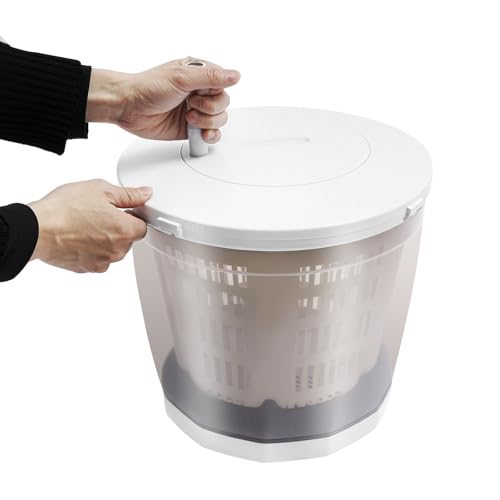
Ask anyone who has hand-washed for a season what the worst stage is and few will say the washing. It is the wringing: twisting wet fabric until your forearms ache, then hanging clothes that still drip for hours. This 2-in-1 pick attacks that stage directly. The listing describes a hand-crank manual washer with a spin dryer function — a portable, multifunctional, non-electric machine aimed at laundry at home, camping, travel, and RV use. Wash first, then spin, and the load reaches the line damp rather than sodden.
The spin stage changes planning as much as comfort. Spun clothes dry fast enough that an evening wash can be worn the next day in warm weather, which is the difference between packing three shirts for a trip and packing six. The machine is described as a mini wringer-style washer and spinner, so keep the load small and balanced: a spinner loaded lopsidedly will complain by wobbling, and the fix is always to redistribute the clothes evenly around the basket rather than to hold the machine down and hope.
- Functions stated in the listing: hand-crank wash plus spin dry
- Power source: none — non-electric
- Settings named in the listing: laundry, camping, travel, RV
- Capacity figure: not given in the listing
- Format: mini washer and spinner in one unit
- Price check: open the Hand-Crank 2-in-1 Manual Washer and Spinner listing on Amazon
Strengths
- Spinning removes far more water than hand wringing, cutting line-drying time dramatically.
- One unit covers the whole process, which suits RV and campsite routines where kit must earn its space.
- Faster drying means a smaller travel wardrobe can rotate through wash, spin, and wear.
Trade-offs
- The spin basket is small, so a wash load may need spinning in two balanced halves.
- Two mechanisms in one compact body means more moving parts to treat kindly than a plain tub.
- Spinning still will not match a powered machine’s extraction, so thick cotton stays heavier than you expect.
Best for: travellers and RV owners who wash in the evening and want clothes dry by morning. Not suited for: anyone whose main loads are jeans, hoodies, and towels, which swamp a mini spinner.

Hand-Crank 2-in-1 Non-Electric Washer, 4.4 lb — Best travel two-cycle option
This second 2-in-1 design states its capacity plainly — 4.4 lb — and adds a feature the other spinner does not claim: dual wash cycles. The listing describes a non-electric portable manual machine in a compact grey and blue colourway, built as a travelling outdoor washing machine. Dual cycles in a hand machine generally means two agitation patterns or intensities to choose between, letting you treat a muddy hiking shirt more vigorously than a delicate top, though the listing does not detail the mechanism, so judge it as a choice of settings rather than a promise of programmes.
The stated 4.4 lb figure is genuinely useful for trip planning. Weigh a typical day of travel clothes once at home — for most people a shirt, underwear, socks, and a light layer land close to that mark — and you will know exactly how many days of clothing one wash handles. Like its spinner sibling, this machine earns its keep at the drying stage: spin the load, hang it in a breeze, and the dual promise of wash and water removal in one compact body is fulfilled without a socket anywhere in sight.
- Load stated in the listing: 4.4 lb weight capacity
- Cycles stated in the listing: dual wash cycles
- Power source: none — hand crank, non-electric
- Format: 2-in-1 washer and spin stage, compact design
- Colours named in the listing: grey and blue sky blue
- Price check: open the Hand-Crank 2-in-1 Non-Electric Washer, 4.4 lb listing on Amazon
Strengths
- A stated capacity removes guesswork when matching the machine to a travel wardrobe.
- Two wash cycles give a gentler and a stronger option in a category that usually offers one speed: yours.
- Compact body and spin function together suit outdoor trips where drying space is a line between two trees.
Trade-offs
- At 4.4 lb it carries slightly less than the WonderWash tub, so couples will run it more often.
- The listing leaves the dual-cycle mechanism unexplained, so do not expect powered-machine programme variety.
- Colour availability on small travel listings shifts often; the current listing page is the authority.
Best for: solo travellers and outdoor users who want a stated capacity, a spin stage, and a choice of wash intensity. Not suited for: households wanting a single manual machine to cover family-sized loads.
Hand Washer Formats Side by Side
| Pick | How it moves water | Water removal afterwards | Stated load |
|---|---|---|---|
| WonderWash Manual Hand-Crank Washer | Sealed tub tumbled by side crank | Hand wringing only | 5 lb |
| Breathing Mobile Washer Plunger Agitator | Plunger strokes inside your own bucket | Hand wringing only | Set by your vessel |
| Dezitrek Large Manual Clothes Washer | Manual agitation in a large tub | Hand wringing only | Described as high-capacity |
| Denash Manual Rotary Clothes Washer | Rotary drum turned by hand crank | Hand wringing only | Not published in the listing |
| Hand-Crank 2-in-1 Manual Washer and Spinner | Crank wash, then separate spin stage | Spin basket extraction | Not published in the listing |
| Hand-Crank 2-in-1 Non-Electric Washer, 4.4 lb | Crank wash with dual cycles, then spin | Spin basket extraction | 4.4 lb |
What Actually Gets Clothes Clean Without a Motor?
Cleaning is a partnership between chemistry, water movement, time, and temperature, and a motor normally supplies the movement while you supply the rest. By hand, you are responsible for all four, which is why technique matters more than effort. Warm — not hot — water helps detergent work and is kinder to your hands during a long session. A soak of fifteen minutes before agitating does quiet, free work: water and detergent loosen everyday grime so your cranking or plunging only has to finish the job. Agitation itself works by pushing soapy water through the weave of the fabric, not by battering the clothes, so steady rhythm beats violent bursts that tire you and stress seams.
Detergent dose is the most common hand-washing mistake. A powered machine rinses with many litres of water; a hand tub rinses with what you carry. Use a small, measured amount — liquid detergent disperses fastest in a hand-filled tub — and resist the idea that more foam means more cleaning. Excess suds simply demand extra rinse fills, each of which you must agitate and drain yourself. When the rinse water runs mostly clear and no longer feels slippery, the clothes are rinsed, whatever the clock says.
Soil type should set your expectations. Sweat, dust, sunscreen, and everyday body oils respond beautifully to hand washing. Ground-in mud needs a pre-rinse outdoors so you are not washing in soup of your own making. Grease spots benefit from a dab of detergent worked in by fingertip before the tub. And some loads — a duvet, a week of work jeans — are simply beyond this category, which is a fact about physics rather than a flaw in any pick above.
How Do You Build a Hand-Washing Routine That Sticks?
The households and travellers who succeed with hand washing share one habit: they wash little and often. A small load every evening takes minutes, dries overnight, and never becomes the dreaded weekend mountain. Anchor the wash to an existing routine — after dinner, after a run, when you return to the campsite — and keep the kit assembled: tub or plunger, measured detergent, a short line and pegs. Friction kills habits, so store everything together rather than gathering pieces from three cupboards.
Water logistics deserve a plan before the first wash. Fill from the nearest tap with a jug rather than carrying a full tub. Drain into a sink, a campsite grey-water drain, or onto ground well away from streams and lakes, using biodegradable detergent if you are outdoors. Readers setting up a broader no-power laundry corner often pair a hand washer with the ideas in Best Simple Gas Dryers — not because a gas dryer is unpowered, but because simple, low-electronics appliances tend to suit the same cabins and rural homes where hand washing makes sense.
One more rhythm worth stealing from experienced hand washers: wash in the order you will hang. If the line fills left to right with the slowest-drying items first — the thicker cotton shirts and anything with a waistband — they get the longest airing, while quick-drying synthetics washed last can hang for the shortest time and still be ready by morning. It sounds like a small optimisation, and it is, but hand laundry is a game of small optimisations stacked patiently on top of one another until the whole routine feels effortless.
Drying is the final system piece. A spin-stage pick shortens it; a plain tub demands a thorough wring, rolling clothes in a dry towel and pressing to pull out more water. Hang items with air on both sides, turn them once, and bring them in before evening damp undoes your work. In humid climates, a small battery fan aimed at the line does more than an extra hour of hanging.
Which Hand Washer Fits an RV, a Dorm, or a Cabin?
Space decides first. An RV with a storage bay can carry the Dezitrek and wash for the whole travelling family at a site; a van conversion with one free drawer should choose the plunger and a collapsible bucket. Dorm rooms reward the Denash’s compact rotary footprint and quiet, contained process — neighbours hear a crank far less than they would a cheap electric mini machine vibrating against a shared wall. Cabins sit between the two: water may come from a pump or a well, power may be solar and precious, and a sealed tub like the WonderWash that can work on a porch without sloshing is a natural fit.
Trip length decides second. For a weekend, honestly, a sink and the plunger are enough. For a month of touring, the spin stage of either 2-in-1 pick pays for its space every single evening, because drying — not washing — is what limits a small wardrobe. And for a permanent off-grid home, think in systems: the washer, a wringer or spinner, a covered outdoor line, and a rain-day indoor rack together form the laundry room, and the washer is only one quarter of it.
A Load-by-Load Playbook: What Goes in First, and What Waits Its Turn
Sorting matters more by hand than it does with a big powered drum, because every load is small and the cost of a colour disaster is the same whether the machine held five pounds or fifteen. Start each session with the load that tolerates the warmest, soapiest water and work downward. Whites and sturdy cottons go first, while the water is fresh and your arms are fresh too. If a white shirt needs a fingertip of detergent worked into the collar, this is the moment, before the tub fills and the rhythm starts.
Second come the everyday colours: T-shirts, shorts, underwear, and socks in the mid-tone range that neither bleeds dye nor shows every mark. Test any new, deeply dyed garment separately the first time — a hand washer gives you the perfect chance, since you can plunge it alone in a basin and watch the water. If colour clouds out, that garment graduates to its own solo wash permanently, or travels with a colour-catcher sheet and like-coloured company only.
Delicates go last and get the gentlest treatment the pick allows. On a crank tub that means slower turns and shorter sessions; with the plunger it means shallow, unhurried strokes; on a dual-cycle machine it means choosing the milder setting and resisting the urge to add one more heavy item to fill space. Silk, lace, elastic straps, and anything with a wire should travel in a mesh bag even inside a hand tub, because the bag stops straps tangling around a crank agitator and saves you the untangling afterwards.
Some loads deserve their own strategy entirely. Swimwear wants a prompt rinse more than a wash: salt and chlorine damage elastic while they sit, so a quick plunge in clean water with the mildest touch of detergent, the same evening, keeps a costume alive for seasons. Gym kit wants the opposite emphasis — a full soak, because synthetic fibres hold odour in a way cotton does not, and ten still minutes in soapy water do what five frantic minutes of cranking cannot. Baby clothes want an extra rinse round, since small skin complains about detergent residue that adults never notice; the second rinse is cheap insurance when you are the one carrying the water anyway.
Finally, think about sequencing across the week rather than within the day. If you wash at a campsite on Monday, Wednesday, and Friday, no single session ever holds more than two days of light clothing, and each session stays inside the pleasant ten-minute window. Miss two sessions and the pile crosses the threshold where hand washing stops feeling clever and starts feeling like a punishment. The playbook, in other words, is mostly a calendar.
How Should You Care for a Machine That Has No Motor to Service?
The maintenance list for a hand washer is short, but it is not empty, and the items on it are the ones that decide whether the machine smells fresh in year two. Rinse the tub after every session, not just when it looks dirty, because detergent film builds invisibly and transfers a stale note to the next load. Dry the drum with the lid open or the tub inverted; a sealed tub stored wet is a small, dark greenhouse for mildew, and the retro charm of a lidded washer evaporates the first time you open it to a sour smell.
Crank mechanisms appreciate a glance now and then. Sand is the enemy at campsites: a few grains worked into a crank joint will grind quietly every time you turn it, so rinse the outside of the machine as faithfully as the inside, especially after beach use. If a handle joint is metal-threaded, as on the plunger pick, check occasionally that it still seats firmly; a joint that loosens mid-session is annoying, while one that fails mid-plunge can splash a bucket of soapy water across your shoes. Spinner baskets deserve the same respect — never force an unbalanced spin to continue, because the wobble that feels funny is the sound of bearings wearing unevenly.
Storage shapes lifespan too. These machines live in caravans that freeze, garages that bake, and dorm cupboards that get raided for floor space. Empty every drop of water before a frost, since ice expands in seams and spouts with no regard for warranties. Keep the machine out of prolonged direct sun where you can, because plastic that spends summers on a sunny porch ages faster than plastic stored in shade. And keep the small parts together — lids, drain plugs, handles — in or on the machine itself; the most common end for a hand washer is not breakage but a lost plug rendering a sound tub useless.
When something does go wrong, the news is usually good. A hand washer has no control board to diagnose and no pump to replace, so most failures are visible: a cracked handle, a perished seal, a spinner that no longer sits true. Seals and handles are the parts worth asking the seller about before you buy, and a listing that names its construction material and warranty, as the WonderWash does, gives you a head start on judging how repairable the machine will be in three years’ time.
What Does a Hand-Washing Setup Really Need Around the Machine?
New buyers budget for the washer and forget the supporting cast, then wonder why the routine feels improvised. The cast is small and cheap, but each member earns its place. First, a way to carry water: a jug or a short hose, because filling a tub by cup under a tap tries anyone’s patience by the third session. Second, a mesh laundry bag, which protects delicates, corrals socks so they stop vanishing in pairs of one, and doubles as the bag you carry wet washing to the line in.
Third, a drying arrangement you trust. A short line with real pegs beats draping clothes over a chair, because airflow on both sides halves drying time and prevents the shoulder-stretch marks that hangers leave on wet knits. Indoors, a folding rack near — not on — a heat source works; outdoors, a line strung in breeze outperforms one in still shade even on a cooler day. Fourth, a small measured scoop or cap dedicated to detergent, so dosing stays honest instead of drifting upward by mood. Fifth, for plunger users, the right bucket: tall enough that strokes do not splash, sturdy enough that it does not flex and spill, and reserved for laundry so yesterday’s mop water never meets tomorrow’s shirts.
Sixth, and most overlooked, a place for the machine to live that is on the way to where you wash. A tub stored in an attic will be used twice a year; a tub stored beside the sink will be used twice a week. Every successful hand-washing household we can picture has arranged this geography deliberately, even if they would describe it simply as keeping the thing handy.
How Much Water and Effort Does a Small Load Honestly Take?
Honesty about inputs is what separates a guide from a sales pitch, so here are the working numbers of the routine itself. A small tub load typically uses one fill for washing and one for rinsing — a few gallons in total, far less than an older powered top-loader drinks for the same shirts. Carrying that water is part of the effort budget: two or three jug trips per fill from a nearby tap is nothing, while a distant standpipe turns every wash into a portage exercise, and your setup should be judged by the distance to water as much as by the machine.
Effort follows a similar curve. The first load of the day feels easy; the fourth back-to-back load is a workout, because cranking and plunging use shoulders and forearms in a repetitive way that sneaks up on you. Alternate the cranking arm between loads, stand at a height where your elbow bends comfortably rather than working on the ground, and let the soak do the heavy lifting — patience is the one input that costs no muscle at all. Anyone with a wrist, elbow, or shoulder injury should test the motion gently with a borrowed bucket and plunger before buying any crank machine, since the category’s only fuel is a joint they may need to protect.
Temperature deserves one more honest word. Warm water cleans better and feels kinder, but heating water costs fuel or power that off-grid users count carefully. The good news is that modern detergents are formulated to perform in cool water, and for the lightly soiled loads this category exists for, cool water plus a proper soak loses very little. Save the warm fills for the greasy, ground-in exceptions, and the routine stays cheap as well as simple.
Reading a Hand Washer Listing Like a Skeptic
Listings in this category reward slow reading, because the vocabulary is slippery. The word portable can describe a sealed tub, a plunger, or a machine that still needs a socket, so confirm the power source in plain terms before anything else: if the listing does not say non-electric or manual clearly, assume it wants electricity until proven otherwise. The word large deserves the same suspicion — ask large compared with what, and look for a stated figure in pounds or inches rather than an adjective. Where a figure exists in this guide we printed it; where a listing offered only adjectives, we treated the claim as positioning and said so.
Photographs need translating too. A tub photographed alone against white space always looks bigger than the same tub beside a human hand, so hunt for the stated dimensions and measure your sink or shelf with a tape before ordering. Colour variants can quietly change what is included on small listings, so read the exact variant you are buying rather than the richest bundle shown in the gallery. And treat the phrase washing machine in a plunger listing as a category label rather than a description — the Breathing Mobile Washer earns its place here as a tool, and it will serve you well precisely if you buy it expecting a tool.
Finally, weigh what the listing does not say. No stated capacity, no stated dimensions, and no stated warranty is not automatically a bad product — the Denash and the first 2-in-1 spinner sit in that territory and still earned their places on format and audience fit — but silence should lower the price of your expectations and raise the value you place on the first careful trial wash at home, inside the returns window, with the packaging kept until the machine has proven itself on your floor, your water, and your clothes.
Teaching Someone Else the Ropes
Hand washers often get bought by one person and used by several — a partner at the cabin, a teenager at camp, a flatmate in the dorm — and the handover is where good machines get blamed for bad technique. Show, do not just tell: one supervised load teaches the fill level, the crank rhythm, and the rinse test better than any note left on the lid. The two rules worth writing down are the detergent measure and the load limit, because enthusiasm expresses itself as too much of both, and the machine pays for both in foam and strain.
Flatmates deserve a word of their own, because a shared manual washer fails socially before it fails mechanically. Agree whose detergent it uses, agree that it gets rinsed and left dry after every turn, and agree that the person who leaves a load soaking overnight owns the consequences at breakfast. Three sentences of house rules, settled once, prevent the slow resentment that kills shared kit far more reliably than any broken crank.
Children, supervised, are often surprisingly good at the cranking stage and genuinely enjoy it, which makes a hand washer a rare chore that recruits its own volunteers. Set them up at a stable height, keep the loads light, and let the spin stage — where fitted — be an adult job until balance and patience are proven. A routine shared is a routine that survives the buyer going away for a week, and survival, for a laundry habit, is the whole game.
Mistakes That Make Hand Washing Harder Than It Needs to Be
The classic error is saving laundry up. Five days of clothes in a 5 lb tub means five loads back to back, an hour of cranking, and a drying line that looks like a festival. Wash daily and the same work spreads into painless ten-minute sessions. A second error is overfilling the tub: clothes need room to move through water, and a jammed drum cleans unevenly no matter how hard you crank. If the load cannot shift when you tilt the tub, take two items out.
Detergent overdosing ranks third, for the rinse reasons already covered, and fourth comes skipping the soak to save time — a false economy, since fifteen still minutes replace five strenuous ones. Fifth, people wring delicate knits by twisting, which stretches them out of shape; press water out instead, or use a spin stage on its gentlest setting. Finally, do not drain soapy water where it harms the place you came to enjoy: keep wash water away from waterways, scatter it on ground where soil can filter it, and pack out anything that local rules require. If your travels lean toward beach campsites, our guide to Best Lightweight Backpack Beach Chairs covers the same pack-light philosophy for the sitting-down half of camp life.
Final Recommendation
Choose by the shape of your laundry life. If you want one sealed tub that simply works, the WonderWash is the centre of this guide for a reason: stated capacity, stated size, contained process. If storage is your scarcest resource, the plunger tool disappears into a drawer and turns any bucket into a wash station. Groups should look at the Dezitrek, students at the Denash, and anyone who dreads wringing should shortlist the two 2-in-1 spinner models, choosing between them on stated capacity and the dual-cycle option.
Whichever you pick, buy it for the loads you actually have — light, frequent, and mostly small — and the machine will feel like a liberation from launderettes and hookups rather than a chore. Hand washing rewards the household that treats it as a rhythm instead of an emergency measure, five quiet minutes at the end of the day, water moving through cloth because your own hands asked it to.
Frequently Asked Questions
Can hand clothes washers really clean as well as an electric machine?
For everyday soil on light clothing, yes — the chemistry and water movement do the cleaning, and your arms can supply enough movement for small loads. Where they fall behind is volume, consistency on very heavy grime, and water extraction. A powered machine wins on a mud-caked work uniform; a hand washer holds its own on shirts, underwear, and travel clothes washed promptly.
How long does one hand wash actually take?
Plan on roughly ten to fifteen minutes of hands-on time for a small load: a soak you can walk away from, a few minutes of cranking or plunging, a drain, a rinse round, and wringing or spinning. The clock time grows if clothes drip-dry slowly, which is why spin-stage picks feel faster in practice even when the wash itself takes the same minutes.
What detergent works best in a manual washer?
A liquid detergent, used sparingly, is the easiest choice because it disperses quickly in hand-filled water and rinses without leaving powder in seams. Outdoor users should choose a biodegradable formula and still dispose of wash water on ground away from streams. Avoid bleach except on sturdy whites, and never mix cleaning chemicals in a small tub you are leaning over.
Can I wash jeans or towels in these machines?
A single pair of jeans can go through the larger tubs, but it will dominate the load, drink a lot of water, and take a long time to dry without strong spin extraction. Towels are similar: possible one at a time, miserable as a batch. Most hand-washing households keep a powered option or a launderette visit in reserve for exactly these heavy, thirsty items.
How do I stop a crank washer walking across the counter?
Work on a non-slip mat, keep the tub low rather than on a high stool, and brace it with your non-cranking hand or against a wall. A steady, moderate rhythm moves a tub far less than short violent bursts. On the ground outdoors, level the surface first — a tub that rocks will tire you and spill water you carried.
Are hand washers allowed in dorm rooms?
Rules vary by residence, so check your housing agreement; the machines themselves are quiet, unpowered, and self-contained, which removes the usual objections about noise and plumbing. Drain into a bathroom sink rather than a bedroom basin where possible, and store the tub dry with the lid ajar so it never develops a musty smell between uses.
Related Guides
If your laundry setup is growing beyond a single tub, our guide to Best Portable Washing Machines and Compact Washers covers the powered compact machines that take over when hand power stops being fun, and it pairs naturally with everything in this guide.