What's inside
- Where to Buy Smart Washers and Dryers, and How to Tell a Smart Pair From a Pair With a Sticker
- Key Takeaways
- Quick Picks
- How Did We Separate Real Smart Laundry From Ordinary Laundry?
- Six Smart Laundry Systems at a Glance
- Which Smart Features Survive Contact With Real Life?
- How Do You Plan a Room Around a Pair, a Tower, or a Hub?
- What Should You Check in the First Fortnight of Ownership?
- What Does a Smart Pair Cost to Run Once the Novelty Wears Off?
- Decoding the Cycle Menu: Steam, Turbo, and Sensor in Plain Language
- Three Households, Three Different Right Answers
- Keeping a Connected Pair Happy for Ten Years
- What Happens When the Smart Side Fails?
- Delivery Day: Getting Two Large Machines Into a Small Room
- A Word About Noise, Vibration, and Where These Machines Live
- Matching a Pair to the People Who Will Actually Use It
- Smart-Laundry Buying Errors Worth Avoiding
- Final Recommendation
- Frequently Asked Questions
- Related Guides
As an Amazon Associate I earn from qualifying purchases. This post may contain affiliate links at no extra cost to you.
cottageverdict.com is reader-supported. When you buy through links on our site, we may earn an affiliate commission.
Where to Buy Smart Washers and Dryers, and How to Tell a Smart Pair From a Pair With a Sticker
The best smart washers and dryers earn the word smart by doing something useful with a connection: sending a phone alert when a cycle ends, letting you add a downloaded cycle, or diagnosing a fault before it becomes a flood. A machine that merely has a touch panel and a marketing badge is not the same thing, and the gap between the two is where buyers waste money. This guide only includes laundry pairs and laundry centres whose listings name a connected or intelligent feature in plain terms — Wi-Fi connectivity, an AI dial, steam intelligence in the controls, or a named smart platform — and it tells you exactly which feature each pick actually claims.
Every pick below is sold as a pair or a single stacked unit through Amazon, and the linked names lead to the listings, where you can check price on Amazon and confirm the bundle contents before committing. Bundles matter here more than in almost any other appliance category: several of these listings include power cords, hoses, a vent duct, pedestals, or a protection plan, and those inclusions change the real cost of getting the pair running. Read the bundle line as carefully as the capacity line.
One more framing note. A pair means two separate machines, usually sold and delivered together, that you place side by side or stack with a kit. A laundry centre or hub is a single tall unit with the washer below and the dryer above, controlled from one panel. Both forms appear below, labelled clearly, because the right choice depends on your floor plan and your ceiling height as much as on any app.
Key Takeaways
- Judge smart claims by the named feature in the listing — Wi-Fi connectivity, an AI dial, a smart platform — never by the word smart standing alone.
- Capacities here run from a 4.5 cu. ft. washer to a 5.0 cu. ft. washer, with dryers from 7.4 to 7.6 cu. ft., so family-sized loads are well covered.
- Two picks dry with gas and four with electricity; your home’s existing connections should settle that question before features do.
- Bundles in this guide variously include hoses, cords, a vent duct, pedestals, and protection plans — price the whole installation, not the headline.
- Sensor drying appears across the guide and quietly saves more money than most app features, by stopping cycles when clothes are actually dry.
- A stacked centre trades side-by-side flexibility for a single footprint and one central control panel.
Quick Picks
| Pick | Badge | Why it earns its place |
|---|---|---|
| Samsung Smart 4.7 Cu. Ft. Top-Load Washer and 7.4 Cu. Ft. Electric Dryer Pair | Best top-load smart bundle | A 4.7 cu. ft. smart top-loader with low-vibration washing and a sensor dryer, bundled with cords, hoses, and a vent duct. |
| LG Top-Load Washer and Dryer Pair with SmartThinQ Wi-Fi | Best named Wi-Fi platform | SmartThinQ Wi-Fi is stated outright, alongside TurboWash, steam drying, and sensor dry in a mega-capacity matte black pair. |
| LG WashTower Stacked Smart Laundry Center, Gas Dryer | Best stacked centre, gas | One tall unit pairing a 4.5 cu. ft. front-load washer with a 7.4 cu. ft. gas dryer and steam, in black steel. |
| LG 5.0 Cu. Ft. Front-Load Smart Washer and Electric Dryer Pair | Best capacity front-load pair | The largest washer here at 5.0 cu. ft., matched with a 7.4 cu. ft. electric dryer in a black steel finish. |
| Samsung Platinum Front-Load Smart Laundry Pair with Pedestals | Best AI dial with pedestals | An AI Smart Dial fronts a 4.5 cu. ft. washer and 7.5 cu. ft. dryer, and pedestals arrive in the bundle. |
| Samsung Bespoke AI Laundry Hub Single-Unit Washer with Gas Dryer | Best single-unit AI hub, gas | A single-unit hub with a 4.6 cu. ft. steam washer and a 7.6 cu. ft. gas dryer — the biggest dryer in this guide. |
How Did We Separate Real Smart Laundry From Ordinary Laundry?
Our first filter was linguistic discipline. Each pick had to name its intelligence in the listing itself: SmartThinQ Wi-Fi connectivity on the LG top-load pair, an AI Smart Dial on the Samsung platinum pair, the Bespoke AI branding and single-unit hub design on the Samsung gas model, or the word smart attached to a described system rather than floating free. Where a listing’s smart claim is thinner — a pair described as smart without a named app platform — we say so in that pick’s review instead of lending it borrowed credibility.
Our second filter was completeness. A smart washer paired with a dumb dryer is half a system, so we favoured listings where the drying side brings its own intelligence: sensor drying that stops at dryness rather than at a timer’s guess, or steam cycles that refresh and relax wrinkles. Third, we checked the unglamorous bundle contents, because a pair that arrives with hoses, cords, and ducting can be washing by the weekend, while a bare pair can wait a fortnight on parts. Efficiency-minded readers will find a useful contrast in Best Energy Star Top-Load Washers, which approaches the same machines from the energy label outward rather than from the app inward.
Finally, we kept fuel honest. Gas and electric dryers are not interchangeable purchases: a gas dryer needs a gas line and proper venting installed by a licensed professional, while an electric dryer needs the right high-voltage outlet. Two picks here dry with gas and four with electricity, and each review states which, early, so nobody falls in love with the wrong infrastructure.
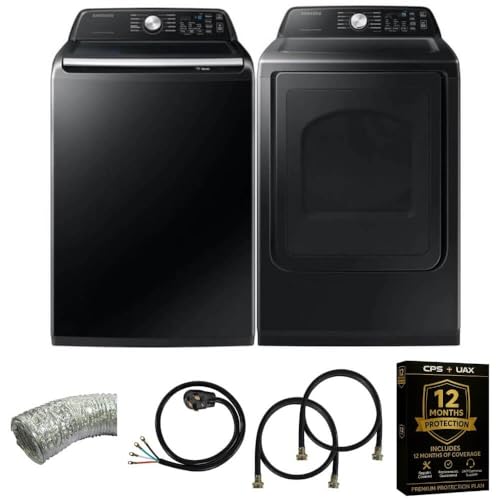
Samsung Smart 4.7 Cu. Ft. Top-Load Washer and 7.4 Cu. Ft. Electric Dryer Pair — Best top-load smart bundle
Top-load loyalists give up nothing here. The washer brings a 4.7 cu. ft. drum, a low-vibration quiet wash claim, and a WaterJet feature named in the listing, while the 7.4 cu. ft. electric dryer counters with a sensor that stops overdrying — the single most fabric-friendly behaviour a dryer can have, since most dryer damage is really over-drying damage. The pair arrives in black with power cords, hoses, and a vent duct in the bundle, plus a 1-year CPS protection plan, which makes this the most install-ready listing in the guide.
The smart side deserves a precise description. The listing calls the pair smart without naming a specific app platform in its title, so treat the connectivity as the headline claim to verify on the product page: confirm the app name, what it can start remotely, and what it only monitors. Many households find monitoring is the feature they actually use — a phone alert when the wash ends, before the load sits and wrinkles — while remote start matters mainly to people whose laundry room is far from their living space. Either way, the top-load format keeps the daily experience familiar: no bending to a low door, easy mid-cycle additions, and a drum that swallows a family load without choreography.
- Washer capacity stated in the listing: 4.7 cu. ft., top-load
- Dryer capacity as printed in the listing: 7.4 cu. ft., electric
- Dryer behaviour stated in the listing: sensor stops overdrying
- Wash features named: low vibration quiet wash, WaterJet
- Bundle contents named: power cords, hoses, vent duct, 1-year CPS protection
- Finish named in the listing: black
Strengths
- The bundle includes the connection hardware other listings leave you to source, shortening the road from delivery to first load.
- Sensor-controlled drying protects elastic, prints, and gym fabrics from the cooked finish timed cycles produce.
- Low-vibration washing suits laundry rooms over living space, where a thumping spin cycle announces itself through the floor.
Trade-offs
- The listing does not name its app platform, so the depth of the smart features needs confirming on the product page.
- Top-load washing uses more water than the front-load picks here, a running-cost point worth weighing.
- A matched black pair commits your laundry room’s look; replacing one unit later means matching a finish, not just a size.
Best for: top-load households wanting a complete, install-ready smart pair with fabric-kind drying. Not suited for: buyers who want a named, proven app ecosystem confirmed in the title itself — look at the LG ThinQ pair instead.
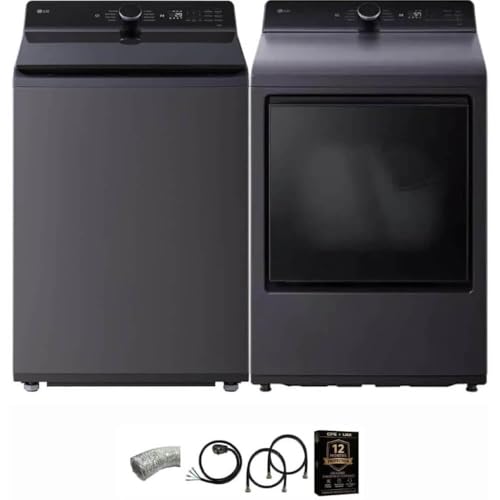
LG Top-Load Washer and Dryer Pair with SmartThinQ Wi-Fi — Best named Wi-Fi platform
This is the pick for buyers who want the smart claim spelled out. The listing names SmartThinQ Wi-Fi connectivity directly, which means the pair is built around LG’s connected platform rather than an undefined promise. Around that platform sit TurboWash technology on the washing side — aimed at cutting wash time on full loads — and steam dry plus sensor dry on the drying side. The pair is described as mega capacity and finished in matte black, and the bundle includes a dryer vent, a power cable, and a 12-month CPS protection plan.
Wi-Fi in a laundry pair earns its keep in three ordinary ways. Cycle-end alerts rescue loads from sitting damp. Downloaded cycles let the machine gain a programme it did not ship with — a specific fabric or a sanitising routine — instead of freezing its abilities at purchase. And remote diagnosis can identify a fault code’s meaning before a technician visit, which sometimes turns a repair call into a filter cleaning you do yourself. None of this requires you to run laundry from the sofa; it simply removes the small frictions that make laundry sprawl across a day.
- Connectivity stated in the listing: SmartThinQ Wi-Fi
- Wash technology named: TurboWash
- Dryer features named: steam dry, sensor dry
- Capacity description in the listing: mega capacity top-load pair (no cu. ft. figure stated)
- Bundle contents named: dryer vent, power cable, 12-month CPS protection plan
- Finish named in the listing: matte black
Strengths
- A named Wi-Fi platform means the smart features are a system with an app and support, not a badge.
- TurboWash and steam dry attack the two ends of laundry day: wash time and wrinkle removal.
- Mega-capacity top-load format suits big households that still prefer loading from above.
Trade-offs
- No cubic-foot figure appears in the listing title, so confirm exact capacities on the product page before ordering.
- Connected features depend on your home Wi-Fi reaching the laundry room with a stable signal.
- Matte black shows lint and detergent dust readily, asking for a quick wipe as part of the routine.
Best for: connected-home households that will genuinely use app alerts, downloads, and diagnostics. Not suited for: buyers in homes with poor laundry-room Wi-Fi, or anyone who wants capacities confirmed without leaving this guide.

LG WashTower Stacked Smart Laundry Center, Gas Dryer — Best stacked centre, gas
The WashTower answers a floor-plan question: what if the laundry room is really a laundry closet? It stacks a 4.5 cu. ft. front-load washer below a 7.4 cu. ft. gas dryer in one tall unit, finished in black steel, with steam on the drying side and the model named in the listing as WKGX201HBA. The defining ergonomic idea of a centre like this is control placement — the panel sits in the middle, between the two drums, so neither machine’s controls end up at ankle or tiptoe height.
Gas drying is the second headline. Gas dryers heat quickly and, in many regions, cost less per load to run than electric resistance models, but they demand a gas supply and safe venting, installed and checked by a licensed professional. If your home already dries with gas, this tower is a natural upgrade; if it does not, the cost of adding a line belongs in your comparison. The fully automatic washer and the shared centre controls make the unit feel like one appliance with two jobs, which is exactly the point for a household consolidating into a smaller footprint.
- Washer capacity stated in the listing: 4.5 cu. ft., front-load
- Dryer capacity per the listing title: 7.4 cu. ft., gas
- Format: single stacked laundry centre
- Dryer feature named: steam
- Model named in the listing: WKGX201HBA
- Finish named in the listing: black steel
Strengths
- One footprint does the work of two machines, freeing floor space for storage or a folding counter.
- Centre-height controls are kinder to backs than a stacked pair with the dryer panel at the top.
- Gas heat suits homes already plumbed for it and keeps heavy drying weeks economical in many regions.
Trade-offs
- A single unit means a failure on one side can idle both, and replacement happens as a pair.
- Gas installation requires a licensed professional and a suitable vent path — no exceptions.
- Tall stacked units need ceiling clearance and a door swing check before ordering.
Best for: space-tight homes with existing gas service that want a unified, steam-capable centre. Not suited for: all-electric homes, or buyers who like replacing washer and dryer on separate schedules.

LG 5.0 Cu. Ft. Front-Load Smart Washer and Electric Dryer Pair — Best capacity front-load pair
Capacity is the argument here, stated plainly: a 5.0 cu. ft. front-load smart washer — the largest washer in this guide — paired with a 7.4 cu. ft. electric dryer, in black steel, with the washer model family named in the listing. Five cubic feet is duvet territory, family-of-five territory, wash-the-whole-week-on-Sunday territory. Front-load mechanics support that ambition well, because the tumbling action cleans with less water than a top-loader of similar size and treats bulky items gently as they roll rather than twist.
The listing keeps its smart description brief — front-load smart is the claim, without a platform name in the title — so, as with the Samsung top-load pair, the product page is where you confirm the app and its abilities. What does not need confirming is the format logic: a big front-load pair can sit side by side under a counter that becomes a folding surface, or stack with the appropriate kit where width is scarce. Electric drying keeps installation simpler for homes without gas, needing the correct high-voltage receptacle and a vent path rather than a fuel line.
- Washer capacity stated in the listing: 5.0 cu. ft., front-load, smart
- Dryer capacity as listed: 7.4 cu. ft., electric
- Finish named in the listing: black steel
- Platform name in the listing title: none stated in the listing
- Configuration: separate pair, side-by-side or stackable with the right kit
- Price check: open the LG 5.0 Cu. Ft. Front-Load Smart Washer and Electric Dryer Pair listing on Amazon
Strengths
- The biggest washer here swallows bulky bedding that smaller drums force into launderette trips.
- Front-load tumbling is water-frugal and gentle on large, heavy items as they roll through the wash.
- A separate pair keeps replacement flexible — one machine can change without the other.
Trade-offs
- Big drums tempt overloading; a stuffed 5.0 cu. ft. load cleans worse than a loose one.
- Front-load doors need a wipe and an ajar rest to keep the seal fresh between washes.
- The smart platform is unnamed in the title, so connected features need verification before purchase.
Best for: large households and bedding-heavy laundry that want maximum drum size in a smart pair. Not suited for: small households whose loads would rattle around lost in a drum this size.

Samsung Platinum Front-Load Smart Laundry Pair with Pedestals — Best AI dial with pedestals
The control is the story. This pair — a 4.5 cu. ft. front-load washer and a 7.5 cu. ft. electric dryer in platinum — is fronted by Samsung’s AI Smart Dial, a control approach that learns which cycles you actually run and surfaces them, instead of presenting an identical wall of options to every household forever. The listing also names steam and an energy-efficient design, and the bundle is unusually complete: pedestals for both machines, a vent, a power cord, hoses, and a 1-year CPS warranty.
Pedestals deserve their sentence, because buyers often dismiss them as decoration. Raising a front-load door by a pedestal’s height is the difference between crouching and simply bending, multiplied by every load for a decade, and the drawers inside them swallow detergent and the odd single sock. An adaptive dial plus a raised door makes this the ergonomics pick of the guide: it is designed around the human doing the laundry, repeatedly, rather than around a specification sheet. Confirm the app’s exact abilities on the product page, as the listing leans on the dial’s intelligence rather than naming a platform.
- Washer capacity stated in the listing: 4.5 cu. ft., front-load
- Dryer capacity as printed in the listing: 7.5 cu. ft., electric
- Control named in the listing: AI Smart Dial
- Features named: steam, energy efficient
- Bundle contents named: pedestals, vent, power cord, hoses, 1-year CPS warranty
- Finish named in the listing: platinum
Strengths
- An adaptive dial shortens the daily interaction to the cycles your household genuinely uses.
- Pedestals included in the bundle lift both doors to a back-friendly height and add storage.
- The 7.5 cu. ft. dryer gives the pair extra breathing room for the fluffed-up output of a full wash.
Trade-offs
- Pedestals raise the top surface too, which can put a folding counter higher than some users like.
- An adaptive interface is a preference, not a universal good — button lovers may find it opinionated.
- Platinum finishes and matched pedestals make later single-unit replacement a matching exercise.
Best for: households that do laundry daily and feel every crouch and every menu scroll. Not suited for: buyers who want the simplest possible dial that never changes its mind about anything.
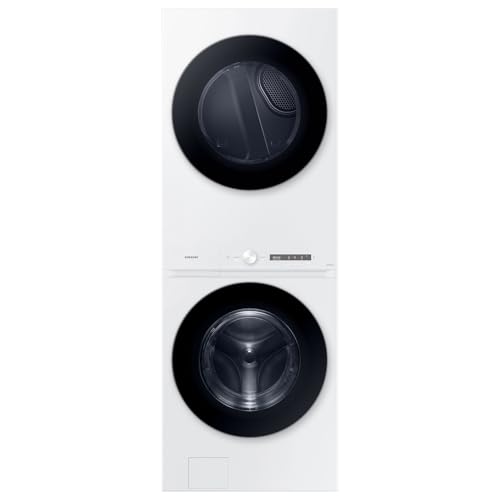
Samsung Bespoke AI Laundry Hub Single-Unit Washer with Gas Dryer — Best single-unit AI hub, gas
Samsung’s Bespoke hub takes the stacked idea and designs it as one object from the start: a single unit holding a 4.6 cu. ft. washer with steam wash below a 7.6 cu. ft. gas dryer — the largest dryer capacity in this guide — finished in white, with the model named as WH46DBH100GWA3. Where the WashTower reads as two appliances sharing a frame, the hub reads as a single appliance with a laundry workflow, controlled centrally and styled to be seen rather than hidden.
The Bespoke name signals Samsung’s design-forward line, and the AI branding signals its control philosophy, though the listing does not enumerate specific app functions, so the product page remains the place to confirm what the hub connects to and what it can do remotely. The gas dryer brings the same installation truth as the WashTower: licensed fitting, correct venting, no shortcuts. In return, a 7.6 cu. ft. drum dries a full family wash with room to tumble, which is what prevents the creased, half-damp centre of an overpacked load.
- Washer capacity stated in the listing: 4.6 cu. ft., steam wash
- Dryer capacity per the listing title: 7.6 cu. ft., gas
- Format: single-unit laundry hub
- Model named in the listing: WH46DBH100GWA3
- Finish named in the listing: white
- Price check: open the Samsung Bespoke AI Laundry Hub Single-Unit Washer with Gas Dryer listing on Amazon
Strengths
- The biggest dryer here gives bulky loads genuine tumbling room, the real secret to even drying.
- A single designed unit looks intentional in an open-plan utility space rather than apologetic.
- Steam wash below and gas heat above cover both the freshening and the heavy drying duties.
Trade-offs
- As with any single unit, one side’s failure can sideline the whole hub.
- Gas installation needs a licensed professional and may need a new line run.
- Specific connected functions are not enumerated in the listing, so verify them before relying on any.
Best for: design-conscious homes with gas service and family-sized loads. Not suited for: all-electric homes, or buyers who prefer to upgrade washer and dryer independently.
Six Smart Laundry Systems at a Glance
| Pick | layout | Washer size | Dryer fuel and size | Named intelligence |
|---|---|---|---|---|
| Samsung Smart 4.7 Cu. Ft. Top-Load Washer and 7.4 Cu. Ft. Electric Dryer Pair | Top-load pair | 4.7 cu. ft. | Electric, 7.4 cu. ft. | Smart pair; sensor stops overdrying |
| LG Top-Load Washer and Dryer Pair with SmartThinQ Wi-Fi | Top-load pair | Mega capacity | Electric format pair; size not published in the listing title | SmartThinQ Wi-Fi |
| LG WashTower Stacked Smart Laundry Center, Gas Dryer | Stacked centre | 4.5 cu. ft. | Gas, 7.4 cu. ft. | Smart centre with steam |
| LG 5.0 Cu. Ft. Front-Load Smart Washer and Electric Dryer Pair | Front-load pair | 5.0 cu. ft. | Electric, 7.4 cu. ft. | Smart front-load washer |
| Samsung Platinum Front-Load Smart Laundry Pair with Pedestals | Front-load pair on pedestals | 4.5 cu. ft. | Electric, 7.5 cu. ft. | AI Smart Dial |
| Samsung Bespoke AI Laundry Hub Single-Unit Washer with Gas Dryer | Single-unit hub | 4.6 cu. ft. | Gas, 7.6 cu. ft. | Bespoke AI hub |
Which Smart Features Survive Contact With Real Life?
After the first month, most owners use a small subset of their machines’ intelligence, and knowing which subset helps you buy correctly. Cycle-end alerts are the universal keeper: they compress laundry day by ending the forgotten-load problem, which is the main cause of musty rewashes. Remote monitoring — checking remaining time from another room — runs a close second. Downloaded cycles matter to households with specific fabrics: equestrian gear, technical outdoor wear, cloth nappies, anything the standard menu treats as an afterthought.
Diagnostics are the sleeper feature. A connected machine that can tell its owner, in plain language, that a drain filter is clogging or a vent is restricted prevents the two most common laundry-room disasters: the slow flood and the dryer that cooks for an hour and dries nothing. Treat any diagnostic claim as a reason to keep the app installed even if you never start a cycle from your phone. Energy dashboards, by contrast, are interesting for a week and then mostly ignored — useful if you are actively hunting a household’s power hogs, decorative otherwise.
Voice control is the feature buyers overestimate most. The listing titles in this guide do not promise specific voice assistants, and we have not invented any. If hands-free control matters to you — say, you routinely arrive at the machine carrying a basket — confirm the exact assistant and commands on the product page, and remember that a washer door still has to be loaded and closed by a human. Smart laundry removes errands and uncertainty; it does not remove the laundry.
How Do You Plan a Room Around a Pair, a Tower, or a Hub?
Start with the tape measure, not the brochure. A side-by-side pair wants roughly double a single machine’s width plus a finger’s gap, and front-load doors need swing room in front that a hallway laundry closet may not have. Towers and hubs trade width for height: confirm ceiling clearance, and remember that the dryer lint filter and controls must be reachable by the shortest adult in the house. Doors of the room itself matter too — measure the narrowest doorway on the delivery path, a classic place for a beautiful plan to die.
Then plan the services. Electric dryers need their high-voltage receptacle within cord reach; gas dryers need the gas line, a shut-off, and a vent route that a licensed installer approves. Venting deserves respect: every elbow in a vent run slows drying and gathers lint, so the shortest smooth path outside is a performance feature, not an aesthetic one. Households replacing a vented dryer in a flat that forbids new penetrations sometimes solve the problem differently, with the machines in Best Ventless Clothes Dryers — a reminder that the smartest purchase is the one your building actually permits.
Finally, plan the workflow on top of the machines. A counter over a side-by-side pair turns folding into a same-room task; a hub frees the wall beside it for shelving; every layout benefits from a sorting hamper’s width of floor that is not occupied by machine at all. The best laundry rooms are designed around the basket’s journey, and the smart features simply shorten the waiting inside it.
What Should You Check in the First Fortnight of Ownership?
Connect the app on day one, while the manuals are still out, and confirm that alerts actually arrive — a notification permission denied at setup is the most common reason a smart pair seems dumb. Run one load on every cycle your household expects to use, including the dryer sensor programme with a mixed load, and check that clothes emerge dry rather than nearly dry; sensor calibration complaints are easiest to resolve inside the returns and support window, not in month nine.
Register the protection plan if your bundle includes one — two picks here carry CPS plans of a year or twelve months — and photograph the model plates of both machines for your records. Check hoses and the vent connection after the first three hot cycles, when fittings settle. And level the machines again after a week: floors and feet settle, and a washer that was level on delivery day can develop a spin wobble by day ten that a quarter-turn of a foot fixes permanently.
What Does a Smart Pair Cost to Run Once the Novelty Wears Off?
The purchase is a single afternoon; the running costs are a decade. Three of them deserve attention before you choose. Water first: front-load machines tumble clothes through a shallow pool and typically use markedly less water per load than top-loaders, which fill a tub deep enough to float the wash. Households on metered water, septic systems, or well pumps feel that difference monthly, and it is the strongest running-cost argument for the front-load picks here. Top-load households answer, fairly, that their machines wash faster and let them add a forgotten sock mid-cycle — running cost is not only measured in gallons.
Energy second. On the washing side, most energy goes to heating water, so a household that washes warm and often spends more on the washer’s behalf than one that washes cool, whatever the badge. On the drying side, sensor control is the great saver, because a timed cycle that runs twenty minutes past dry is burning money to damage clothes. Gas drying shifts the energy bill rather than erasing it, and its advantage depends entirely on your local gas and electricity prices — a fact no guide can settle for your postcode, which is why we state fuels plainly and let your utility bills arbitrate.
Time third, and time is the currency smart features actually trade in. An alert that saves one forgotten load a month from a musty rewash has paid for the connectivity in water, energy, and temper. A downloaded cycle that handles the sports kit properly extends the life of expensive clothing. Judge each smart claim by asking what errand it deletes from your week; the features that survive that question are the ones still earning their keep in year five.
Decoding the Cycle Menu: Steam, Turbo, and Sensor in Plain Language
Steam appears on several picks here, in washers and dryers both, and it does two different jobs depending on where it lives. In a washer, steam is about soil and allergens in the load: hot vapour helps loosen ground-in grime and refreshes fabrics that cannot take a vigorous wash. In a dryer, steam is about the finish: a short steam phase relaxes wrinkles and refreshes a garment that is clean but creased, which can rescue a shirt from the ironing pile entirely. Neither job is magic, and both cost water and energy, so steam earns its place as an occasional cycle rather than a daily default.
Turbo washing, named on the LG ThinQ pair, is a time technology: stronger water movement aimed at completing a full load faster without leaving it half-rinsed. It suits the household whose laundry bottleneck is the clock — school uniforms discovered on Sunday night are its natural habitat. Sensor drying we have praised already, but its partner on the wash side deserves a mention too: load sensing, where the machine weighs or gauges the load and doses water accordingly, is the quiet reason a big drum does not waste a big tub of water on three shirts.
The practical advice is to map cycles to your real laundry before you buy. List the five loads your household actually runs — for most families: everyday colours, whites, towels and bedding, delicates, and the sports or work kit — and check the picks against that list. A machine whose menu matches your five loads is smarter for you than a machine with twenty programmes you will never touch, whatever its dial claims to know about you.
Three Households, Three Different Right Answers
Consider a family of five in a house with a proper laundry room and a gas line already capped behind the old dryer. Their loads are large, frequent, and heavy on towels and bedding. For them the Bespoke hub’s 7.6 cu. ft. gas dryer or the LG 5.0 cu. ft. pair are the honest finalists, and the decision turns on whether they prefer one designed unit or the flexibility of a separate pair when something eventually fails.
Consider, too, the rental household that expects to move within five years. For them, portability of value matters: a separate pair in a standard footprint resells or relocates more easily than a tall integrated hub, and a bundle that included its own hoses and cords travels complete. Renters should also confirm what their lease allows regarding gas work before even glancing at the gas picks — a landlord’s no is the end of that conversation.
Consider instead a couple in a city flat, converting a wide hallway cupboard into a laundry point with no gas and no appetite for building work. Width is their constraint and height is their freedom, which points at a stacked format; among these picks the WashTower is gas, so their real homework is confirming the electric alternatives and stacking kits for the front-load pairs, and checking that the cupboard’s depth swallows a full-size door swing or a sliding door solves it.
Finally, consider a multigenerational house where grandparents do weekday laundry and teenagers do weekend laundry. The AI Smart Dial pair was practically drawn for them: the machine learns the household’s handful of cycles and presents them simply, the pedestals spare older backs, and the alerts land on the teenager’s phone, where a forgotten load has at least a chance of being rescued by its owner. Technology that adapts to a household beats technology that demands the household adapt to it, every time.
Keeping a Connected Pair Happy for Ten Years
Smart machines add one maintenance item their ancestors never had: software. Accept firmware updates when the app offers them, because they carry fixes for cycle logic and connectivity bugs as well as new features, and an un-updated machine is the one that mysteriously drops off the network in year three. Keep the app account in the name of someone who will still live in the house; a pair registered to a departed flatmate’s email is a small domestic tragedy that plays out in password resets.
The mechanical liturgy is unchanged and still decides lifespan. Leave front-load doors ajar between washes and wipe the seal’s fold dry, because the gasket is where moisture lingers and odours are born. Clean the drain pump filter on the schedule the manual sets — diagnostics may warn you, but the filter does not care whether you were warned. Run the tub-clean cycle monthly if your household washes cool, since cool water and modern detergent leave a film that only a hot empty wash removes. On the drying side, the lint filter wants cleaning every single load, not most loads, and the vent run wants inspecting yearly: a vent slowly choking on lint is the leading cause of a dryer that seems to have lost its strength, and the fix is a brush, not a repair bill.
Water quality writes the last chapter. Hard water scales heating elements and dulls fabrics, and no app can soften it; if your kettle furs up, your washer is furring too, and a descaling routine or a softener belongs in the plan. Hoses are consumables with a quiet expiry — inspect them yearly for bulges, and replace them on suspicion rather than on evidence, because the evidence arrives as a flood. A smart pair that detects leaks only helps if someone receives the alert, which circles back to day one: notifications on, account right, app installed.
What Happens When the Smart Side Fails?
It is worth rehearsing the failure modes before you buy, because they are milder than sceptics claim and realer than brochures admit. If the Wi-Fi module fails, the machine becomes an ordinary excellent washer and dryer: every core cycle remains available at the panel. If the app is discontinued years from now — a genuine risk with any connected product — the same is true, which is why we weighted drum, sensor, and build qualities ahead of connectivity throughout this guide. A pair bought for its laundry fundamentals, with smart features as a bonus, cannot be stranded by a server decision.
The reverse failure is the one to guard against at purchase: a machine whose basic controls are so app-dependent that the panel feels like an afterthought. Judge the physical interface in its own right. Could a guest, a grandparent, or you-with-a-dead-phone run a normal wash confidently at the machine itself? For every pick here, the answer rests on a real dial or panel designed for hands, and that is not an accident of our selection — it was one of the filters. Buy the machine first and the app second, and the smart premium can only ever add to your laundry life, never hold it hostage.
Delivery Day: Getting Two Large Machines Into a Small Room
Pairs and hubs are among the largest objects that ever enter a home, and delivery deserves the same planning as purchase. Photograph the route — front door, hallway turns, the laundry room doorway — and measure its narrowest point with the door removed from its hinges in mind, since that trick gains the inches that save the day. Clear the route of everything movable, decide in advance where the old machines go, and confirm whether the delivery includes haul-away, because two old machines in a hallway have a way of becoming semi-permanent furniture.
When the new machines land, resist the urge to run a victory load immediately. Check both cabinets for transit damage before the crew leaves, confirm the shipping bolts have been removed from the washer — a first spin with bolts in place is a violent and unforgettable mistake — and run an empty rinse cycle to clear manufacturing residues. Only then connect the app, run the alert test described earlier, and wash something real. A calm first hour protects a decade of service, and it costs nothing but patience.
A Word About Noise, Vibration, and Where These Machines Live
Specifications rarely mention the lived experience of a spin cycle through a bedroom wall, yet for flats and small houses it can decide whether a purchase is loved. The Samsung top-load pair names low-vibration quiet washing in its listing, and that claim points at a real design axis: suspension quality and balance control during the spin. Any washer, smart or not, will punish an unlevel floor by walking and drumming, so the level check in the first fortnight is also a noise intervention. Anti-vibration pads under the feet help on wooden floors, and a ground-floor or concrete-slab location forgives what a suspended timber floor above a bedroom will not.
Dryers contribute their own soundtrack — the rhythmic thump of trainers or a zip-heavy load is normal, while new scraping or squealing is information worth acting on early, while support is attentive. Place the pair with a little air around them rather than wedged tight; machines that can dissipate heat and be pulled out for a hose inspection without a wrestling match are machines that get maintained. Smart alerts, in the end, are only the digital half of listening to your laundry room — the analogue half is simply paying attention, and the two together are how a pair reaches its tenth birthday still sounding like it did in its first month.
Matching a Pair to the People Who Will Actually Use It
Every household has a laundry cast of characters, and the right pair casts well. The early riser who washes before work needs a machine whose end-of-cycle alert can be a phone buzz rather than a melody through the house. The parent washing at midnight needs the quiet spin and a dryer that will not cook the school shirts left inside it. The teenager needs a dial that forgives random button pressing, and the grandparent needs a panel that behaves identically every single time it is touched.
Talk through these people before ordering, not after delivery. The conversation takes ten minutes and routinely changes the choice — toward the adaptive dial, toward the pedestals, toward the tower whose controls sit at a kind height. Appliances are bought by one person and lived with by everyone, and the smart premium is best spent on the friction your particular cast complains about, rather than on the feature a showroom demonstrated most loudly.
Smart-Laundry Buying Errors Worth Avoiding
The most expensive error is buying connectivity your home cannot support: a laundry room in a Wi-Fi dead zone reduces a smart pair to a pair, so test signal strength with your phone standing where the washer will live. The second error is falling for fuel mismatch — ordering a gas dryer for an all-electric home, or an electric dryer where only a low-capacity circuit exists. Third comes measuring the machines but not the path: doorways, stair turns, and the room’s own door swing have ended more installations than any specification.
Fourth, buyers often pay for a bundle twice — ordering hoses and cords that the listing already includes. Two picks here ship with connection hardware and one with pedestals; read the bundle line before adding accessories to the basket. Fifth, do not let an app substitute for the fundamentals: drum size matched to your loads, a dryer that senses dryness, and a vent run that breathes will still be deciding your laundry happiness long after the novelty of remote start fades. Readers furnishing the rest of a hard-working home in the same practical spirit may enjoy Best Metal Patio Swivel Chairs, where the same buy-it-once logic applies outdoors.
Final Recommendation
Let your house decide the shortlist and your habits decide the winner. Gas homes with a closet should choose between the WashTower’s centre controls and the Bespoke hub’s bigger dryer. Electric homes wanting maximum capacity should take the LG 5.0 cu. ft. pair; those wanting the smart claim made explicit should take the SmartThinQ pair; those wanting the gentlest daily interaction should take the AI Smart Dial pair on its pedestals; and top-load loyalists who want everything in the box should take the Samsung bundle that arrives with its hoses and duct included.
One last consideration belongs to timing. Laundry pairs are replaced in distress more often than in calm — the old washer fails on a Tuesday and a household shops in a panic by Friday. If your current machines are ageing noisily, measuring your space, checking your fuel, and reading a guide like this one before the failure is the cheapest upgrade of all, because it converts an emergency purchase into a chosen one. Keep the measurements with your appliance paperwork, and the eventual decision becomes an afternoon’s work rather than a week’s.
And if two finalists remain tied after all of this, break the tie with the dryer, not the washer: you will interact with dryness quality every single load, while most smart wash features are weekly pleasures at best.
Whichever system you choose, set it up completely on the first weekend — app connected, alerts tested, plans registered — because a smart pair only pays its premium when its intelligence is switched on, and the household that does the setup properly is the one still praising the purchase when the novelty has long since become routine.
Frequently Asked Questions
Do smart washers need the internet to wash clothes?
No. Every machine here washes and dries fully from its own controls with no connection at all. The connection adds alerts, remote monitoring, downloaded cycles, and diagnostics. If your Wi-Fi fails for a week, laundry continues; you simply lose the extras until it returns, which is exactly how a well-designed smart appliance should behave.
Is a stacked centre harder to repair than a separate pair?
It can be, because the two functions share one cabinet and one installation. A fault in one half of a centre or hub sometimes means servicing the whole unit, while a separate pair lets a technician remove only the broken machine. Weigh that against the space a centre saves, and factor in any protection plan the bundle includes.
Gas or electric dryer — which should I choose?
Choose the fuel your home already serves to the laundry room. Gas dryers heat fast and can cost less per load where gas is cheap, but they need a gas line and venting fitted by a licensed professional. Electric dryers install more simply where a suitable high-voltage receptacle exists. Converting a home’s fuel for a dryer alone rarely pays for itself.
What does sensor dry actually do?
Sensor drying measures moisture in the load as it tumbles and ends the cycle when the clothes reach the selected dryness, instead of running a fixed time. That prevents both the overdrying that fades prints and cooks elastic, and the underdrying that leaves waistbands damp. It is the feature in this guide most likely to save money and fabric over the machines’ lives.
Can I stack the separate pairs in this guide?
Front-load pairs are commonly stackable with the manufacturer’s matching stacking kit, sold for the specific models. Never improvise a stack with generic brackets, and confirm the kit and the combined height against your space before ordering. The top-load pairs, by design, cannot stack at all — the lid needs the room above it.
How long should a good pair last?
A well-kept washer and dryer should serve a household for roughly a decade, with the dryer’s heating and sensing parts and the washer’s hoses and seals being the items most likely to need attention along the way. The habits in this guide — filters cleaned, vents clear, loads balanced, hoses inspected — are the difference between a pair that reaches that decade gracefully and one that limps there. Smart diagnostics help by catching small faults while they are still small.
Will the app work for everyone in the household?
Connected platforms generally allow the machine to be linked to one account and shared or used by household members according to the app’s own rules, which you should confirm on the product page for the specific model. In practice, one person becomes the laundry account holder and everyone else simply enjoys the alerts being somebody’s job.
Related Guides
For the high-efficiency top-load machines that pair efficiency credentials with simpler controls, continue to Best HE Top-Load Washers, which covers the natural stablemates of the smart pairs reviewed above.



[…] on that point. Readers comparing these with powered portables may also enjoy our companion guide, Best Smart Washers and Dryers, which sits at the opposite end of the effort spectrum and shows what automation adds — and […]